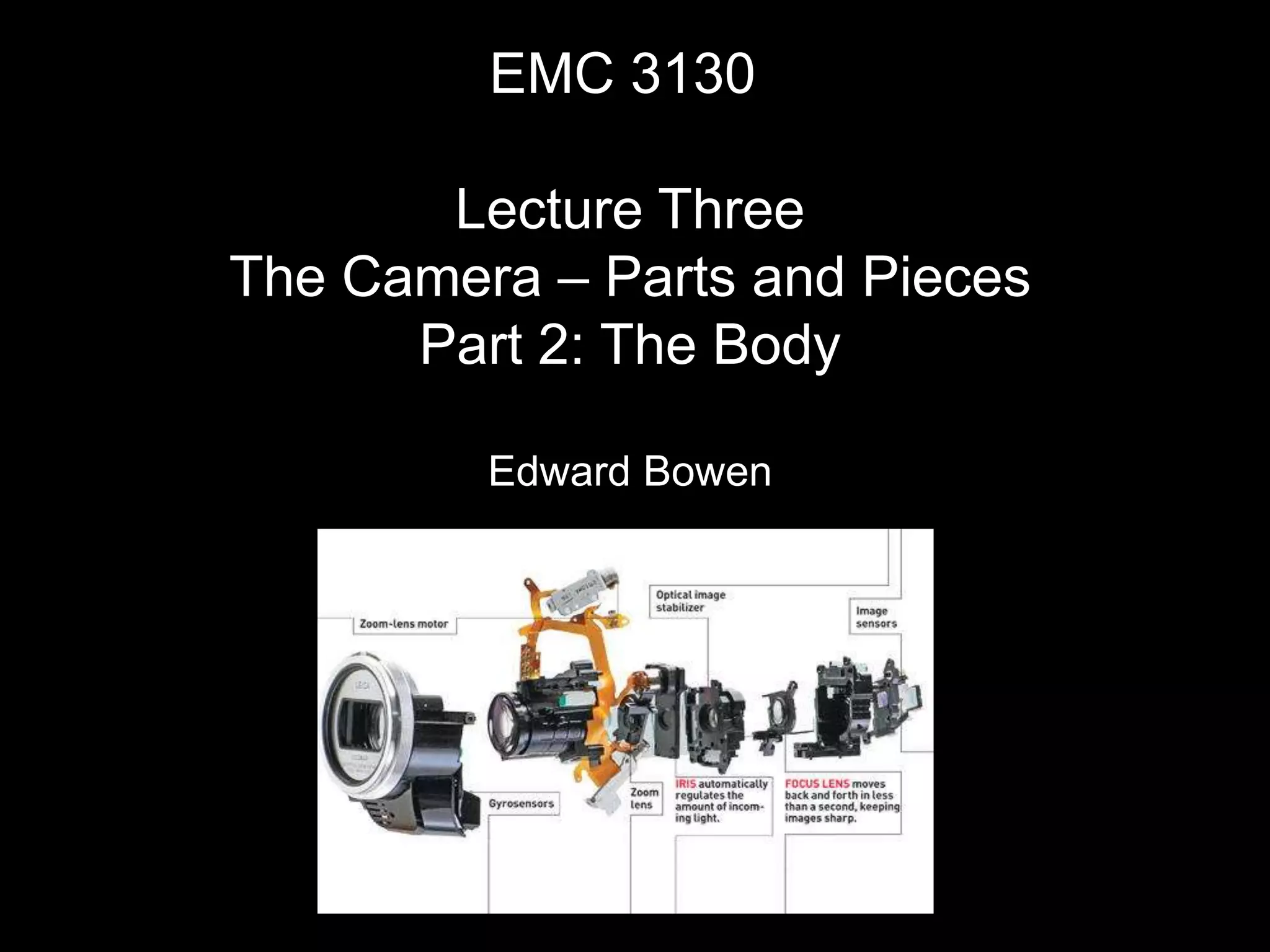

EMC 3130
Lecture Three
The Camera – Parts and Pieces
Part 2: The Body
Edward Bowen
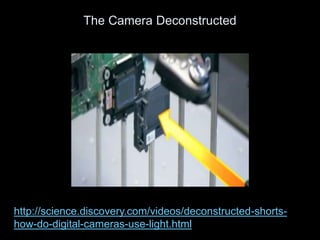
The Camera Deconstructed
http://science.discovery.com/videos/deconstructed-shorts-
how-do-digital-cameras-use-light.html
Part 2: The Body
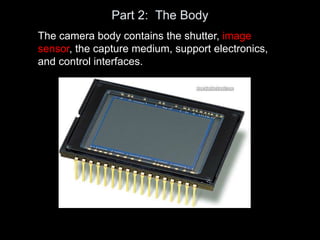
The camera body contains the shutter, image
sensor, the capture medium, support electronics,
and control interfaces.
Frame Rates
(frames per second)
Shutter Speed
(fraction of a second)
Part 2: The Body
The camera body contains the shutter, image
sensor, the capture medium, support electronics,
and control interfaces.
Frame Rates
The number of frames captured in a second
(frames per second)
Shutter Speed -
The time light is allowed to strike the image
sensor to create a single image.
(fraction of a second)
Part 2: The Body
The camera body contains the shutter, image
sensor, the capture medium, support electronics,
and control interfaces.
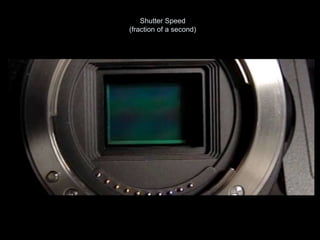
Shutter Speed
(fraction of a second)
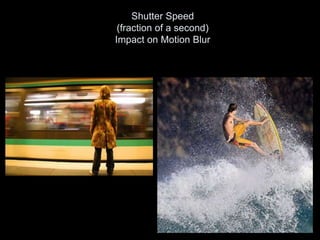
Generally, shutter speed must be at least half of the frame rate. At
30 frames per second, the shutter speed will be approximately
1/60th of a second.
It can be faster if the camera allows.
A higher frame rate requires a faster shutter speed.
Shutter speed can be increased independent of the frame rate.
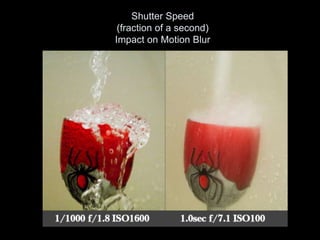
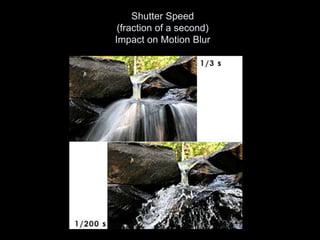
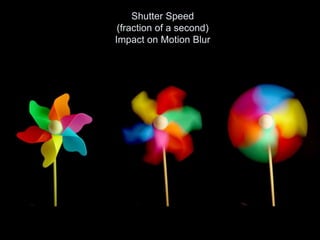
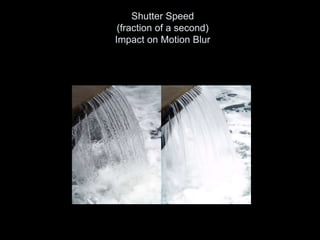
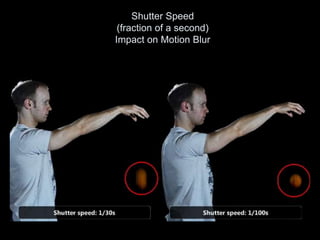
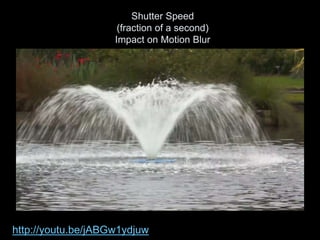
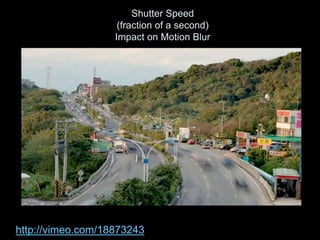
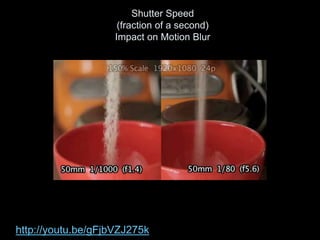
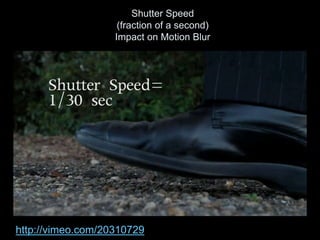
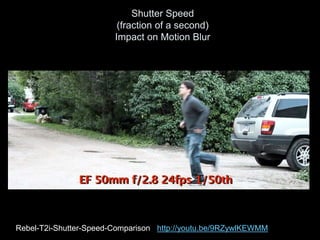
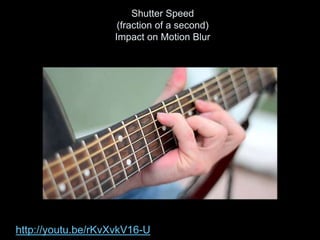
A faster the shutter speed results in diminished blur
A slower shutter speed results in added blur.
Shutter Speed
(fraction of a second)
Shutter Speed
(fraction of a second)
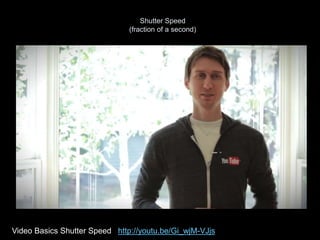
Video Basics Shutter Speed http://youtu.be/Gi_wjM-VJjs
Shutter Speed
(fraction of a second)
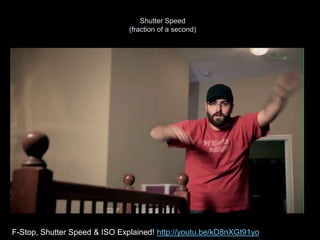
F-Stop, Shutter Speed & ISO Explained! http://youtu.be/kD8nXGt91yo
Shutter Speed
(fraction of a second)
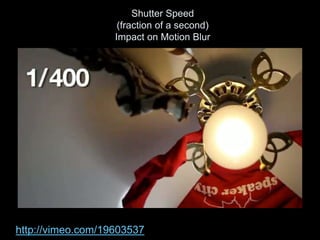
Impact on Motion Blur
Shutter Speed
(fraction of a second)
Impact on Motion Blur
Shutter Speed
(fraction of a second)
Impact on Motion Blur
Shutter Speed
(fraction of a second)
Impact on Motion Blur
Shutter Speed
(fraction of a second)
Impact on Motion Blur
Shutter Speed
(fraction of a second)
Impact on Motion Blur
Shutter Speed
(fraction of a second)
Impact on Motion Blur
http://youtu.be/jABGw1ydjuw
Shutter Speed
(fraction of a second)
Impact on Motion Blur
http://vimeo.com/18873243
Shutter Speed
(fraction of a second)
Impact on Motion Blur
http://youtu.be/gFjbVZJ275k
Shutter Speed
(fraction of a second)
Impact on Motion Blur
http://vimeo.com/20310729
Shutter Speed
(fraction of a second)
Impact on Motion Blur
Rebel-T2i-Shutter-Speed-Comparison http://youtu.be/9RZywlKEWMM
Shutter Speed
(fraction of a second)
Impact on Motion Blur
http://youtu.be/rKvXvkV16-U
Shutter Speed
(fraction of a second)
Impact on Motion Blur
http://vimeo.com/19603537
Part 2: The Body
The camera body contains the shutter, image
sensor, the capture medium, support electronics,
and control interfaces.
Part 2: The Body
The camera body contains the shutter, image
sensor, the capture medium, support electronics,
and control interfaces.
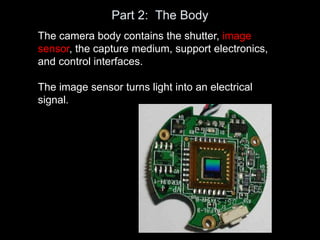
The image sensor turns light into an electrical
signal.
Part 2: The Body
The camera body contains the shutter, image
sensor, the capture medium, support electronics,
and control interfaces.
The image sensor turns light into an electrical
signal.
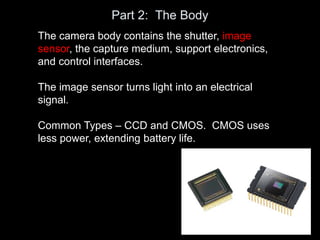
Common Types – CCD and CMOS. CMOS uses
less power, extending battery life.
Part 2: The Body
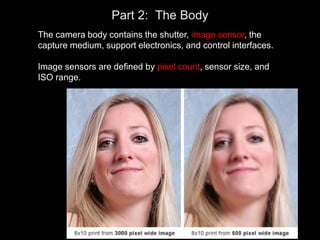
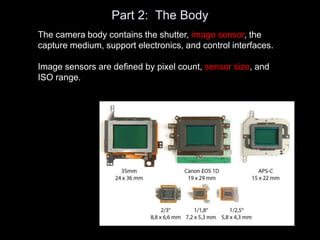
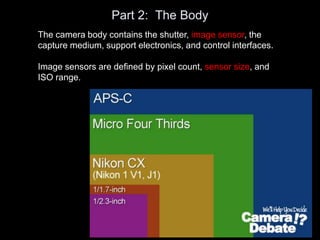
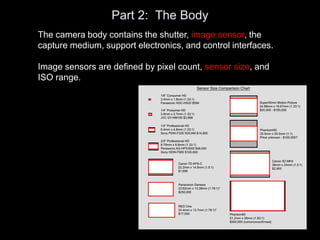
The camera body contains the shutter, image sensor, the
capture medium, support electronics, and control interfaces.
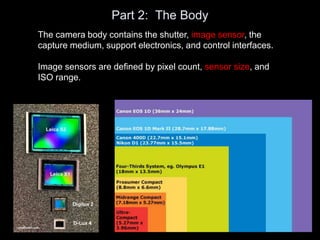
Image sensors are defined by pixel count, sensor size, and
ISO range.
Part 2: The Body
The camera body contains the shutter, image sensor, the
capture medium, support electronics, and control interfaces.
Image sensors are defined by pixel count, sensor size, and
ISO range.
Part 2: The Body
The camera body contains the shutter, image sensor, the
capture medium, support electronics, and control interfaces.
Image sensors are defined by pixel count, sensor size, and
ISO range.
Part 2: The Body
The camera body contains the shutter, image sensor, the
capture medium, support electronics, and control interfaces.
Image sensors are defined by pixel count, sensor size, and
ISO range.
Part 2: The Body
The camera body contains the shutter, image sensor, the
capture medium, support electronics, and control interfaces.
Image sensors are defined by pixel count, sensor size, and
ISO range.
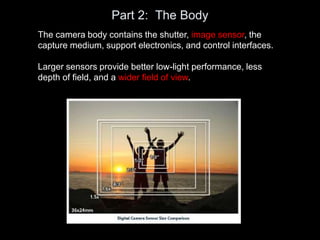
Part 2: The Body
The camera body contains the shutter, image sensor, the
capture medium, support electronics, and control interfaces.
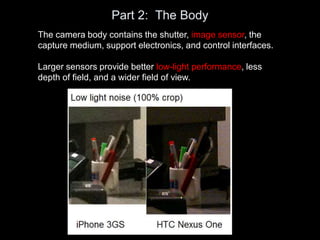
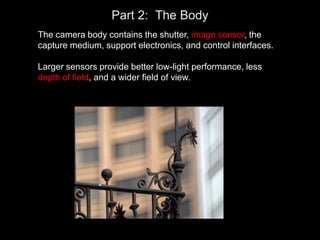
Larger sensors provide better low-light performance, less
depth of field, and a wider field of view.
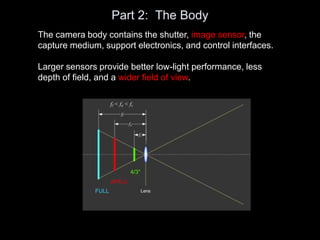
Part 2: The Body
The camera body contains the shutter, image sensor, the
capture medium, support electronics, and control interfaces.
Larger sensors provide better low-light performance, less
depth of field, and a wider field of view.
http://www.youtube.com/watch?v=_xjlpn-kxAM
Part 2: The Body
The camera body contains the shutter, image sensor, the
capture medium, support electronics, and control interfaces.
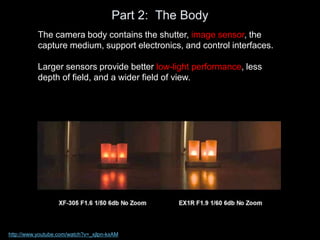
Larger sensors provide better low-light performance, less
depth of field, and a wider field of view.
Part 2: The Body
The camera body contains the shutter, image sensor, the
capture medium, support electronics, and control interfaces.
Larger sensors provide better low-light performance, less
depth of field, and a wider field of view.
Part 2: The Body
The camera body contains the shutter, image sensor, the
capture medium, support electronics, and control interfaces.
Larger sensors provide better low-light performance, less
depth of field, and a wider field of view.
Part 2: The Body
The camera body contains the shutter, image sensor, the
capture medium, support electronics, and control interfaces.
Larger sensors provide better low-light performance, less
depth of field, and a wider field of view.
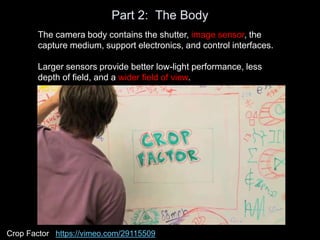
Crop Factor https://vimeo.com/29115509
Part 2: The Body
The camera body contains the shutter, image sensor, the
capture medium, support electronics, and control interfaces.
Larger sensors provide better low-light performance, less
depth of field, and a wider field of view.
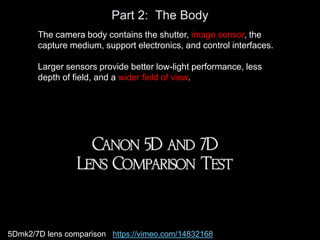
5Dmk2/7D lens comparison https://vimeo.com/14832168
Part 2: The Body
The camera body contains the shutter, image sensor, the
capture medium, support electronics, and control interfaces.
Image sensors are defined by pixel count, sensor size, and
ISO range.
Part 2: The Body
The camera body contains the shutter, image sensor, the
capture medium, support electronics, and control interfaces.
Image sensors are defined by pixel count, sensor size, and ISO
range.
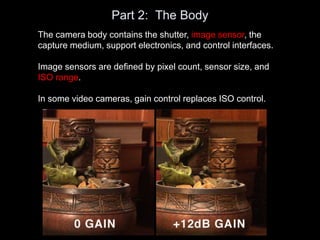
ISO is a measurement of the sensor’s sensitivity to light,
measured in numerals (100, 200, 400, 600, 800, 1600, 3200,
etc.)
Part 2: The Body
The camera body contains the shutter, image sensor, the
capture medium, support electronics, and control interfaces.
Image sensors are defined by pixel count, sensor size, and
ISO range.
ISO is a measurement of the sensor’s sensitivity to light,
measured in numerals (100, 200, 400, 600, 800, 1600, 3200,
etc.)
ISO can be adjusted, or set automatically by the camera.
Part 2: The Body
The camera body contains the shutter, image sensor, the
capture medium, support electronics, and control interfaces.
Image sensors are defined by pixel count, sensor size, and
ISO range.
ISO is a measurement of the sensor’s sensitivity to light,
measured in numerals (100, 200, 400, 600, 800, 1600, 3200,
etc.)
ISO can be adjusted, or set automatically by the camera.
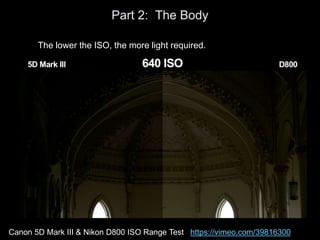
The lower the ISO, the more light required.
Part 2: The Body
The lower the ISO, the more light required.
Canon 5D Mark III & Nikon D800 ISO Range Test https://vimeo.com/39816300
Part 2: The Body
The camera body contains the shutter, image sensor, the
capture medium, support electronics, and control interfaces.
Image sensors are defined by pixel count, sensor size, and
ISO range.
ISO is a measurement of the sensor’s sensitivity to light,
measured in numerals (100, 200, 400, 600, 800, 1600, 3200,
etc.)
ISO can be adjusted, or set automatically by the camera.
The lower the ISO, the more light required.
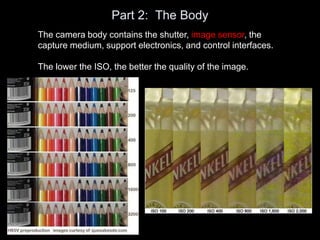
The lower the ISO, the better the quality of the image.
Part 2: The Body
The camera body contains the shutter, image sensor, the
capture medium, support electronics, and control interfaces.
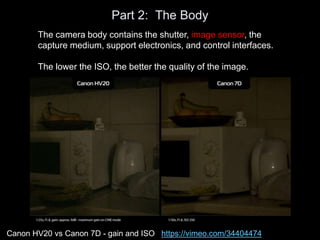
The lower the ISO, the better the quality of the image.
Part 2: The Body
The camera body contains the shutter, image sensor, the
capture medium, support electronics, and control interfaces.
The lower the ISO, the better the quality of the image.
Canon HV20 vs Canon 7D - gain and ISO https://vimeo.com/34404474
Part 2: The Body
The camera body contains the shutter, image sensor, the
capture medium, support electronics, and control interfaces.
Image sensors are defined by pixel count, sensor size, and
ISO range.
ISO is a measurement of the sensor’s sensitivity to light,
measured in numerals (100, 200, 400, 600, 800, 1600, 3200,
etc.)
ISO can be adjusted, or set automatically by the camera.
The lower the ISO, the more light required
The lower the ISO, the better the quality of the image.
The lower the ISO, the larger the aperture needed.
Part 2: The Body
The camera body contains the shutter, image sensor, the
capture medium, support electronics, and control interfaces.
Image sensors are defined by pixel count, sensor size, and
ISO range.
ISO is a measurement of the sensor’s sensitivity to light,
measured in numerals (100, 200, 400, 600, 800, 1600, 3200,
etc.)
ISO can be adjusted, or set automatically by the camera.
The higher the ISO, the less light required
The higher the ISO, the noisier the quality of the image.
The higher the ISO, the smaller the aperture needed.
Part 2: The Body
The camera body contains the shutter, image sensor, the
capture medium, support electronics, and control interfaces.
Image sensors are defined by pixel count, sensor size, and
ISO range.
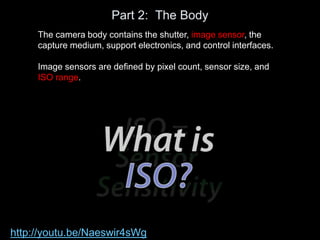
http://youtu.be/Naeswir4sWg
Part 2: The Body
The camera body contains the shutter, image sensor, the
capture medium, support electronics, and control interfaces.
Image sensors are defined by pixel count, sensor size, and
ISO range.
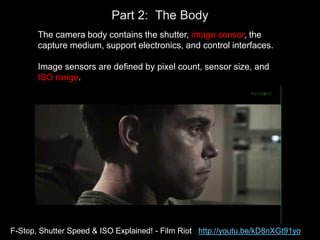
F-Stop, Shutter Speed & ISO Explained! - Film Riot http://youtu.be/kD8nXGt91yo
Part 2: The Body
The camera body contains the shutter, image sensor, the
capture medium, support electronics, and control interfaces.
Image sensors are defined by pixel count, sensor size, and
ISO range.
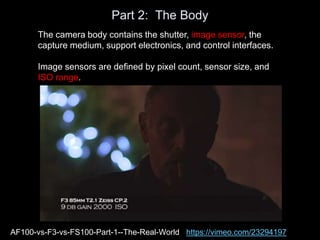
AF100-vs-F3-vs-FS100-Part-1--The-Real-World https://vimeo.com/23294197
Part 2: The Body
The camera body contains the shutter, image sensor, the
capture medium, support electronics, and control interfaces.
Image sensors are defined by pixel count, sensor size, and
ISO range.
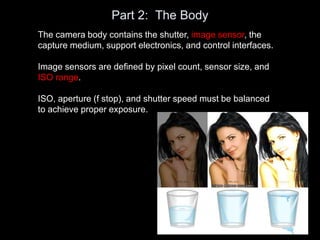
ISO, aperture (f stop), and shutter speed must be balanced
to achieve proper exposure.
Part 2: The Body
The camera body contains the shutter, image sensor, the
capture medium, support electronics, and control interfaces.
Image sensors are defined by pixel count, sensor size, and
ISO range.
ISO, aperture (f stop), and shutter speed must be balanced
to achieve proper exposure.
http://photo.tutsplus.com/articles/hardware/quick-tip-
a-look-at-5-iphone-lightmeter-apps/
http://www.calculator.org/calculate-
online/photography/exposure.aspx
Part 2: The Body
The camera body contains the shutter, image sensor, the
capture medium, support electronics, and control interfaces.
Image sensors are defined by pixel count, sensor size, and
ISO range.
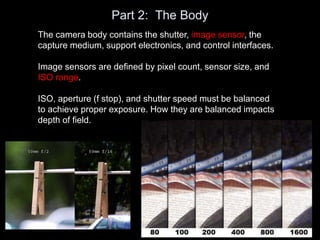
ISO, aperture (f stop), and shutter speed must be balanced
to achieve proper exposure. How they are balanced impacts
depth of field.
Part 2: The Body
The camera body contains the shutter, image sensor, the
capture medium, support electronics, and control interfaces.
Image sensors are defined by pixel count, sensor size, and
ISO range.
In some video cameras, gain control replaces ISO control.
Part 2: The Body
The camera body contains the shutter, image sensor, the
capture medium, support electronics, and control interfaces.
Image sensors are defined by pixel count, sensor size, and
ISO range.
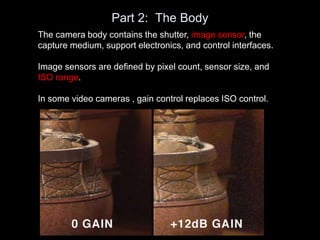
In some video cameras , gain control replaces ISO control.
Part 2: The Body
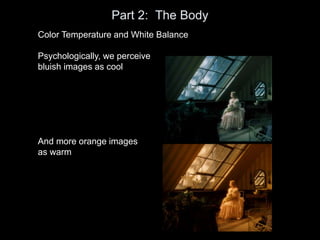
Color Temperature and White Balance
Psychologically, we perceive
bluish images as cool
And more orange images
as warm
Part 2: The Body
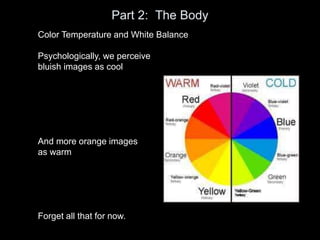
Color Temperature and White Balance
Psychologically, we perceive
bluish images as cool
And more orange images
as warm
Forget all that for now.
Part 2: The Body
Color Temperature and White Balance
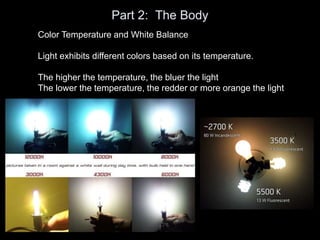
Light exhibits different colors based on its temperature.
The higher the temperature, the bluer the light
The lower the temperature, the redder or more orange the light
Part 2: The Body
Color Temperature and White Balance
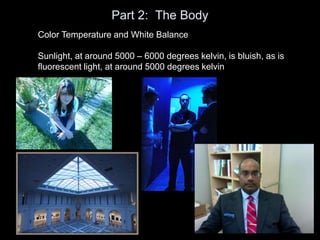
Sunlight, at around 5000 – 6000 degrees kelvin, is bluish, as is
fluorescent light, at around 5000 degrees kelvin
Part 2: The Body
Color Temperature and White Balance
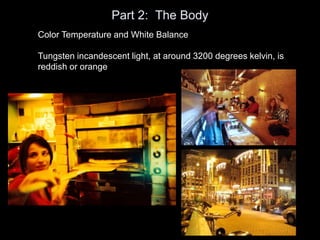
Tungsten incandescent light, at around 3200 degrees kelvin, is
reddish or orange
Part 2: The Body
Color Temperature and White Balance
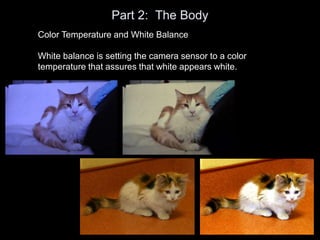
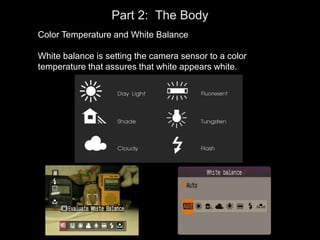
White balance is setting the camera sensor to a color
temperature that assures that white appears white.
Part 2: The Body
Color Temperature and White Balance
White balance is setting the camera sensor to a color
temperature that assures that white appears white.
Part 2: The Body
Color Temperature and White Balance
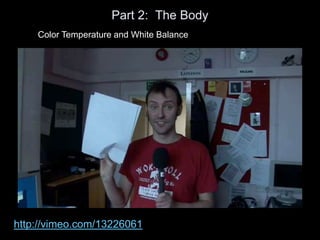
http://vimeo.com/13226061
Part 2: The Body
Color Temperature and White Balance
http://youtu.be/uGLIvAt1-7g
Part 2: The Body
Color Temperature and White Balance
http://youtu.be/B6RSE0LEQto
Part 2: The Body
Color Temperature and White Balance
http://youtu.be/B6RSE0LEQto
Part 2: The Body
Color Temperature and White Balance
http://youtu.be/fwxqE9PxgO4
Part 2: The Body
Color Temperature and White Balance
http://youtu.be/bXuaPsejEPs
Part 2: The Body
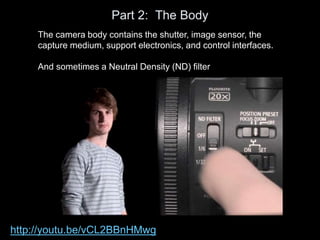
The camera body contains the shutter, image sensor, the
capture medium, support electronics, and control interfaces.
And sometimes a Neutral Density (ND) filter
http://youtu.be/vCL2BBnHMwg
Part 2: The Body
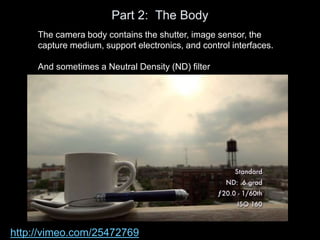
The camera body contains the shutter, image sensor, the
capture medium, support electronics, and control interfaces.
And sometimes a Neutral Density (ND) filter
http://vimeo.com/25472769
Part 2: The Body
The camera body contains the shutter, image sensor, the
capture medium, support electronics, and control interfaces.
Memory Cards
External Hard Drives
Internal Memory
DVD
HDV
Mini-DV
The Video Camera: Summary
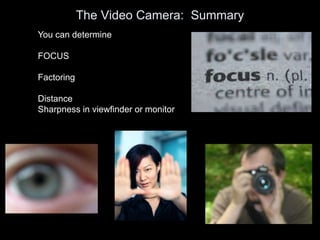
You can determine
FOCUS
Factoring
Distance
Sharpness in viewfinder or monitor
The Video Camera: Summary
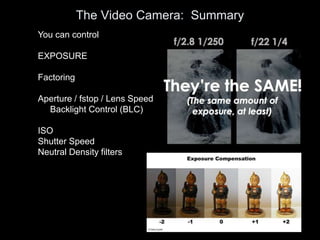
You can control
EXPOSURE
Factoring
Aperture / fstop / Lens Speed
Backlight Control (BLC)
ISO
Shutter Speed
Neutral Density filters
The Video Camera: Summary
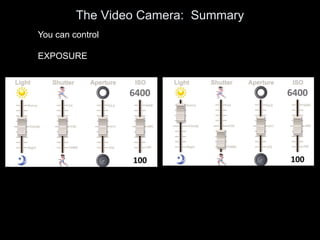
You can control
EXPOSURE
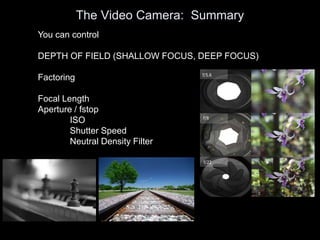
The Video Camera: Summary
You can control
DEPTH OF FIELD (SHALLOW FOCUS, DEEP FOCUS)
Factoring
Focal Length
Aperture / fstop
ISO
Shutter Speed
Neutral Density Filter
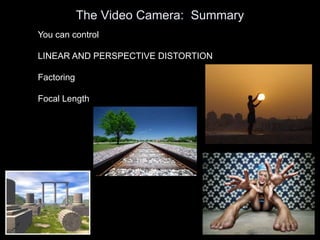
The Video Camera: Summary
You can control
LINEAR AND PERSPECTIVE DISTORTION
Factoring
Focal Length
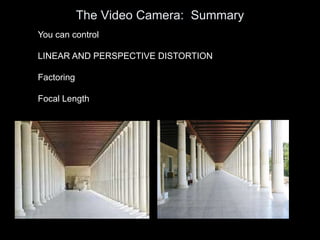
The Video Camera: Summary
You can control
LINEAR AND PERSPECTIVE DISTORTION
Factoring
Focal Length
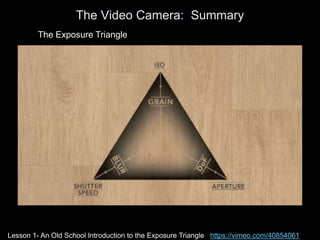
The Video Camera: Summary
The Exposure Triangle
Lesson 1- An Old School Introduction to the Exposure Triangle https://vimeo.com/40854061
The Video Camera: Summary
Summary
The ultimate Introduction to DSLR Filmmaking - Basic Tutorial http://youtu.be/w8BzeZEGEYY

EMC 3130/2130 Lecture Three - The Camera Body

  • 1.
    EMC 3130 Lecture Three TheCamera – Parts and Pieces Part 2: The Body Edward Bowen
  • 2.
  • 3.
    Part 2: TheBody The camera body contains the shutter, image sensor, the capture medium, support electronics, and control interfaces. Frame Rates (frames per second) Shutter Speed (fraction of a second)
  • 4.
    Part 2: TheBody The camera body contains the shutter, image sensor, the capture medium, support electronics, and control interfaces. Frame Rates The number of frames captured in a second (frames per second) Shutter Speed - The time light is allowed to strike the image sensor to create a single image. (fraction of a second)
  • 5.
    Part 2: TheBody The camera body contains the shutter, image sensor, the capture medium, support electronics, and control interfaces. Shutter Speed (fraction of a second) Generally, shutter speed must be at least half of the frame rate. At 30 frames per second, the shutter speed will be approximately 1/60th of a second. It can be faster if the camera allows. A higher frame rate requires a faster shutter speed. Shutter speed can be increased independent of the frame rate. A faster the shutter speed results in diminished blur A slower shutter speed results in added blur.
  • 6.
  • 7.
    Shutter Speed (fraction ofa second) Video Basics Shutter Speed http://youtu.be/Gi_wjM-VJjs
  • 8.
    Shutter Speed (fraction ofa second) F-Stop, Shutter Speed & ISO Explained! http://youtu.be/kD8nXGt91yo
  • 9.
    Shutter Speed (fraction ofa second) Impact on Motion Blur
  • 10.
    Shutter Speed (fraction ofa second) Impact on Motion Blur
  • 11.
    Shutter Speed (fraction ofa second) Impact on Motion Blur
  • 12.
    Shutter Speed (fraction ofa second) Impact on Motion Blur
  • 13.
    Shutter Speed (fraction ofa second) Impact on Motion Blur
  • 14.
    Shutter Speed (fraction ofa second) Impact on Motion Blur
  • 15.
    Shutter Speed (fraction ofa second) Impact on Motion Blur http://youtu.be/jABGw1ydjuw
  • 16.
    Shutter Speed (fraction ofa second) Impact on Motion Blur http://vimeo.com/18873243
  • 17.
    Shutter Speed (fraction ofa second) Impact on Motion Blur http://youtu.be/gFjbVZJ275k
  • 18.
    Shutter Speed (fraction ofa second) Impact on Motion Blur http://vimeo.com/20310729
  • 19.
    Shutter Speed (fraction ofa second) Impact on Motion Blur Rebel-T2i-Shutter-Speed-Comparison http://youtu.be/9RZywlKEWMM
  • 20.
    Shutter Speed (fraction ofa second) Impact on Motion Blur http://youtu.be/rKvXvkV16-U
  • 21.
    Shutter Speed (fraction ofa second) Impact on Motion Blur http://vimeo.com/19603537
  • 22.
    Part 2: TheBody The camera body contains the shutter, image sensor, the capture medium, support electronics, and control interfaces.
  • 23.
    Part 2: TheBody The camera body contains the shutter, image sensor, the capture medium, support electronics, and control interfaces. The image sensor turns light into an electrical signal.
  • 24.
    Part 2: TheBody The camera body contains the shutter, image sensor, the capture medium, support electronics, and control interfaces. The image sensor turns light into an electrical signal. Common Types – CCD and CMOS. CMOS uses less power, extending battery life.
  • 25.
    Part 2: TheBody The camera body contains the shutter, image sensor, the capture medium, support electronics, and control interfaces. Image sensors are defined by pixel count, sensor size, and ISO range.
  • 26.
    Part 2: TheBody The camera body contains the shutter, image sensor, the capture medium, support electronics, and control interfaces. Image sensors are defined by pixel count, sensor size, and ISO range.
  • 27.
    Part 2: TheBody The camera body contains the shutter, image sensor, the capture medium, support electronics, and control interfaces. Image sensors are defined by pixel count, sensor size, and ISO range.
  • 28.
    Part 2: TheBody The camera body contains the shutter, image sensor, the capture medium, support electronics, and control interfaces. Image sensors are defined by pixel count, sensor size, and ISO range.
  • 29.
    Part 2: TheBody The camera body contains the shutter, image sensor, the capture medium, support electronics, and control interfaces. Image sensors are defined by pixel count, sensor size, and ISO range.
  • 30.
    Part 2: TheBody The camera body contains the shutter, image sensor, the capture medium, support electronics, and control interfaces. Larger sensors provide better low-light performance, less depth of field, and a wider field of view.
  • 31.
    Part 2: TheBody The camera body contains the shutter, image sensor, the capture medium, support electronics, and control interfaces. Larger sensors provide better low-light performance, less depth of field, and a wider field of view. http://www.youtube.com/watch?v=_xjlpn-kxAM
  • 32.
    Part 2: TheBody The camera body contains the shutter, image sensor, the capture medium, support electronics, and control interfaces. Larger sensors provide better low-light performance, less depth of field, and a wider field of view.
  • 33.
    Part 2: TheBody The camera body contains the shutter, image sensor, the capture medium, support electronics, and control interfaces. Larger sensors provide better low-light performance, less depth of field, and a wider field of view.
  • 34.
    Part 2: TheBody The camera body contains the shutter, image sensor, the capture medium, support electronics, and control interfaces. Larger sensors provide better low-light performance, less depth of field, and a wider field of view.
  • 35.
    Part 2: TheBody The camera body contains the shutter, image sensor, the capture medium, support electronics, and control interfaces. Larger sensors provide better low-light performance, less depth of field, and a wider field of view. Crop Factor https://vimeo.com/29115509
  • 36.
    Part 2: TheBody The camera body contains the shutter, image sensor, the capture medium, support electronics, and control interfaces. Larger sensors provide better low-light performance, less depth of field, and a wider field of view. 5Dmk2/7D lens comparison https://vimeo.com/14832168
  • 37.
    Part 2: TheBody The camera body contains the shutter, image sensor, the capture medium, support electronics, and control interfaces. Image sensors are defined by pixel count, sensor size, and ISO range.
  • 38.
    Part 2: TheBody The camera body contains the shutter, image sensor, the capture medium, support electronics, and control interfaces. Image sensors are defined by pixel count, sensor size, and ISO range. ISO is a measurement of the sensor’s sensitivity to light, measured in numerals (100, 200, 400, 600, 800, 1600, 3200, etc.)
  • 39.
    Part 2: TheBody The camera body contains the shutter, image sensor, the capture medium, support electronics, and control interfaces. Image sensors are defined by pixel count, sensor size, and ISO range. ISO is a measurement of the sensor’s sensitivity to light, measured in numerals (100, 200, 400, 600, 800, 1600, 3200, etc.) ISO can be adjusted, or set automatically by the camera.
  • 40.
    Part 2: TheBody The camera body contains the shutter, image sensor, the capture medium, support electronics, and control interfaces. Image sensors are defined by pixel count, sensor size, and ISO range. ISO is a measurement of the sensor’s sensitivity to light, measured in numerals (100, 200, 400, 600, 800, 1600, 3200, etc.) ISO can be adjusted, or set automatically by the camera. The lower the ISO, the more light required.
  • 41.
    Part 2: TheBody The lower the ISO, the more light required. Canon 5D Mark III & Nikon D800 ISO Range Test https://vimeo.com/39816300
  • 42.
    Part 2: TheBody The camera body contains the shutter, image sensor, the capture medium, support electronics, and control interfaces. Image sensors are defined by pixel count, sensor size, and ISO range. ISO is a measurement of the sensor’s sensitivity to light, measured in numerals (100, 200, 400, 600, 800, 1600, 3200, etc.) ISO can be adjusted, or set automatically by the camera. The lower the ISO, the more light required. The lower the ISO, the better the quality of the image.
  • 43.
    Part 2: TheBody The camera body contains the shutter, image sensor, the capture medium, support electronics, and control interfaces. The lower the ISO, the better the quality of the image.
  • 44.
    Part 2: TheBody The camera body contains the shutter, image sensor, the capture medium, support electronics, and control interfaces. The lower the ISO, the better the quality of the image. Canon HV20 vs Canon 7D - gain and ISO https://vimeo.com/34404474
  • 45.
    Part 2: TheBody The camera body contains the shutter, image sensor, the capture medium, support electronics, and control interfaces. Image sensors are defined by pixel count, sensor size, and ISO range. ISO is a measurement of the sensor’s sensitivity to light, measured in numerals (100, 200, 400, 600, 800, 1600, 3200, etc.) ISO can be adjusted, or set automatically by the camera. The lower the ISO, the more light required The lower the ISO, the better the quality of the image. The lower the ISO, the larger the aperture needed.
  • 46.
    Part 2: TheBody The camera body contains the shutter, image sensor, the capture medium, support electronics, and control interfaces. Image sensors are defined by pixel count, sensor size, and ISO range. ISO is a measurement of the sensor’s sensitivity to light, measured in numerals (100, 200, 400, 600, 800, 1600, 3200, etc.) ISO can be adjusted, or set automatically by the camera. The higher the ISO, the less light required The higher the ISO, the noisier the quality of the image. The higher the ISO, the smaller the aperture needed.
  • 47.
    Part 2: TheBody The camera body contains the shutter, image sensor, the capture medium, support electronics, and control interfaces. Image sensors are defined by pixel count, sensor size, and ISO range. http://youtu.be/Naeswir4sWg
  • 48.
    Part 2: TheBody The camera body contains the shutter, image sensor, the capture medium, support electronics, and control interfaces. Image sensors are defined by pixel count, sensor size, and ISO range. F-Stop, Shutter Speed & ISO Explained! - Film Riot http://youtu.be/kD8nXGt91yo
  • 49.
    Part 2: TheBody The camera body contains the shutter, image sensor, the capture medium, support electronics, and control interfaces. Image sensors are defined by pixel count, sensor size, and ISO range. AF100-vs-F3-vs-FS100-Part-1--The-Real-World https://vimeo.com/23294197
  • 50.
    Part 2: TheBody The camera body contains the shutter, image sensor, the capture medium, support electronics, and control interfaces. Image sensors are defined by pixel count, sensor size, and ISO range. ISO, aperture (f stop), and shutter speed must be balanced to achieve proper exposure.
  • 51.
    Part 2: TheBody The camera body contains the shutter, image sensor, the capture medium, support electronics, and control interfaces. Image sensors are defined by pixel count, sensor size, and ISO range. ISO, aperture (f stop), and shutter speed must be balanced to achieve proper exposure. http://photo.tutsplus.com/articles/hardware/quick-tip- a-look-at-5-iphone-lightmeter-apps/ http://www.calculator.org/calculate- online/photography/exposure.aspx
  • 52.
    Part 2: TheBody The camera body contains the shutter, image sensor, the capture medium, support electronics, and control interfaces. Image sensors are defined by pixel count, sensor size, and ISO range. ISO, aperture (f stop), and shutter speed must be balanced to achieve proper exposure. How they are balanced impacts depth of field.
  • 53.
    Part 2: TheBody The camera body contains the shutter, image sensor, the capture medium, support electronics, and control interfaces. Image sensors are defined by pixel count, sensor size, and ISO range. In some video cameras, gain control replaces ISO control.
  • 54.
    Part 2: TheBody The camera body contains the shutter, image sensor, the capture medium, support electronics, and control interfaces. Image sensors are defined by pixel count, sensor size, and ISO range. In some video cameras , gain control replaces ISO control.
  • 55.
    Part 2: TheBody Color Temperature and White Balance Psychologically, we perceive bluish images as cool And more orange images as warm
  • 56.
    Part 2: TheBody Color Temperature and White Balance Psychologically, we perceive bluish images as cool And more orange images as warm Forget all that for now.
  • 57.
    Part 2: TheBody Color Temperature and White Balance Light exhibits different colors based on its temperature. The higher the temperature, the bluer the light The lower the temperature, the redder or more orange the light
  • 58.
    Part 2: TheBody Color Temperature and White Balance Sunlight, at around 5000 – 6000 degrees kelvin, is bluish, as is fluorescent light, at around 5000 degrees kelvin
  • 59.
    Part 2: TheBody Color Temperature and White Balance Tungsten incandescent light, at around 3200 degrees kelvin, is reddish or orange
  • 60.
    Part 2: TheBody Color Temperature and White Balance White balance is setting the camera sensor to a color temperature that assures that white appears white.
  • 61.
    Part 2: TheBody Color Temperature and White Balance White balance is setting the camera sensor to a color temperature that assures that white appears white.
  • 62.
    Part 2: TheBody Color Temperature and White Balance http://vimeo.com/13226061
  • 63.
    Part 2: TheBody Color Temperature and White Balance http://youtu.be/uGLIvAt1-7g
  • 64.
    Part 2: TheBody Color Temperature and White Balance http://youtu.be/B6RSE0LEQto
  • 65.
    Part 2: TheBody Color Temperature and White Balance http://youtu.be/B6RSE0LEQto
  • 66.
    Part 2: TheBody Color Temperature and White Balance http://youtu.be/fwxqE9PxgO4
  • 67.
    Part 2: TheBody Color Temperature and White Balance http://youtu.be/bXuaPsejEPs
  • 68.
    Part 2: TheBody The camera body contains the shutter, image sensor, the capture medium, support electronics, and control interfaces. And sometimes a Neutral Density (ND) filter http://youtu.be/vCL2BBnHMwg
  • 69.
    Part 2: TheBody The camera body contains the shutter, image sensor, the capture medium, support electronics, and control interfaces. And sometimes a Neutral Density (ND) filter http://vimeo.com/25472769
  • 70.
    Part 2: TheBody The camera body contains the shutter, image sensor, the capture medium, support electronics, and control interfaces. Memory Cards External Hard Drives Internal Memory DVD HDV Mini-DV
  • 71.
    The Video Camera:Summary You can determine FOCUS Factoring Distance Sharpness in viewfinder or monitor
  • 72.
    The Video Camera:Summary You can control EXPOSURE Factoring Aperture / fstop / Lens Speed Backlight Control (BLC) ISO Shutter Speed Neutral Density filters
  • 73.
    The Video Camera:Summary You can control EXPOSURE
  • 74.
    The Video Camera:Summary You can control DEPTH OF FIELD (SHALLOW FOCUS, DEEP FOCUS) Factoring Focal Length Aperture / fstop ISO Shutter Speed Neutral Density Filter
  • 75.
    The Video Camera:Summary You can control LINEAR AND PERSPECTIVE DISTORTION Factoring Focal Length
  • 76.
    The Video Camera:Summary You can control LINEAR AND PERSPECTIVE DISTORTION Factoring Focal Length
  • 77.
    The Video Camera:Summary The Exposure Triangle Lesson 1- An Old School Introduction to the Exposure Triangle https://vimeo.com/40854061
  • 78.
    The Video Camera:Summary Summary The ultimate Introduction to DSLR Filmmaking - Basic Tutorial http://youtu.be/w8BzeZEGEYY