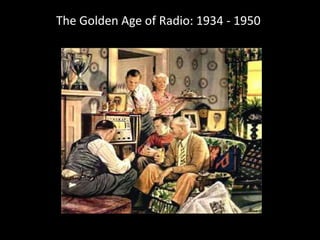
The Golden Age of Radio: 1934 - 1950
Intimacy
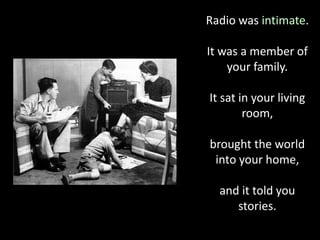
Radio was intimate.
It was a member of
your family.
It sat in your living
room,
brought the world
into your home,
and it told you
stories.
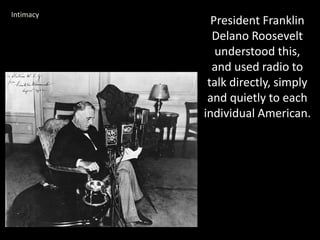
President Franklin
Delano Roosevelt
understood this,
and used radio to
talk directly, simply
and quietly to each
individual American.
Intimacy
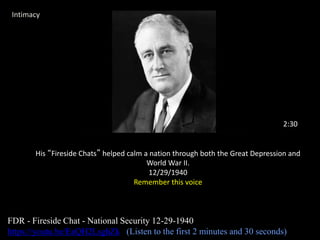
His “Fireside Chats” helped calm a nation through both the Great Depression and
World War II.
12/29/1940
Remember this voice
FDR - Fireside Chat - National Security 12-29-1940
https://youtu.be/EaQH2LsghZk (Listen to the first 2 minutes and 30 seconds)
2:30
Intimacy
Imagination
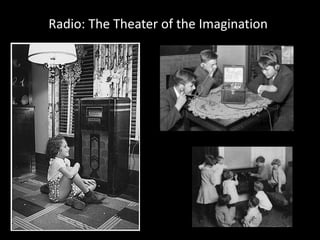
Radio: The Theater of the Imagination
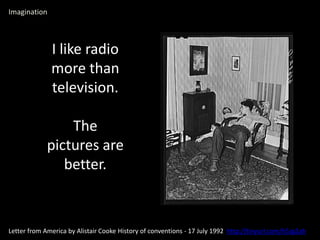
I like radio
more than
television.
The
pictures are
better.
Letter from America by Alistair Cooke History of conventions - 17 July 1992 http://tinyurl.com/h5zg2ah
Imagination
Imagination
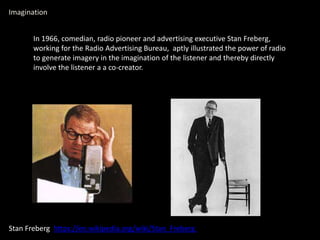
Stan Freberg https://en.wikipedia.org/wiki/Stan_Freberg
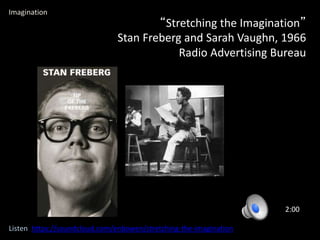
In 1966, comedian, radio pioneer and advertising executive Stan Freberg,
working for the Radio Advertising Bureau, aptly illustrated the power of radio
to generate imagery in the imagination of the listener and thereby directly
involve the listener a a co-creator.
“Stretching the Imagination”
Stan Freberg and Sarah Vaughn, 1966
Radio Advertising Bureau
2:00
Imagination
Listen https://soundcloud.com/enbowen/stretching-the-imagination
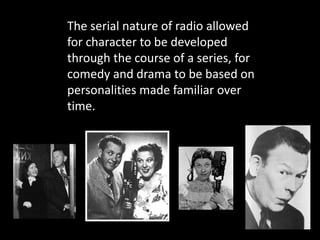
The serial nature of radio allowed
for character to be developed
through the course of a series, for
comedy and drama to be based on
personalities made familiar over
time.
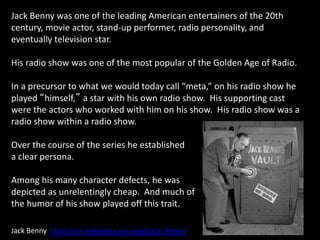
Jack Benny was one of the leading American entertainers of the 20th
century, movie actor, stand-up performer, radio personality, and
eventually television star.
His radio show was one of the most popular of the Golden Age of Radio.
In a precursor to what we would today call “meta,” on his radio show he
played “himself,” a star with his own radio show. His supporting cast
were the actors who worked with him on his show. His radio show was a
radio show within a radio show.
Over the course of the series he established
a clear persona.
Among his many character defects, he was
depicted as unrelentingly cheap. And much of
the humor of his show played off this trait.
Jack Benny https://en.wikipedia.org/wiki/Jack_Benny
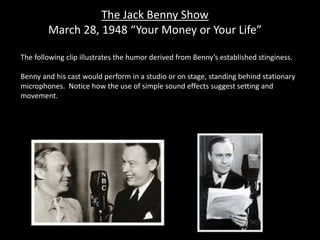
The Jack Benny Show
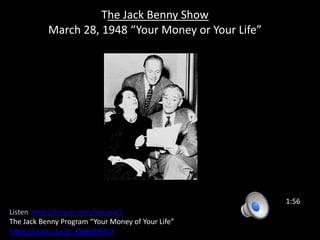
March 28, 1948 “Your Money or Your Life”
The following clip illustrates the humor derived from Benny’s established stinginess.
Benny and his cast would perform in a studio or on stage, standing behind stationary
microphones. Notice how the use of simple sound effects suggest setting and
movement.
The Jack Benny Show
March 28, 1948 “Your Money or Your Life”
1:56
Listen http://tinyurl.com/hkzxpw5
The Jack Benny Program “Your Money of Your Life”
https://youtu.be/p_XkdmRkOL0
The Jack Benny Show
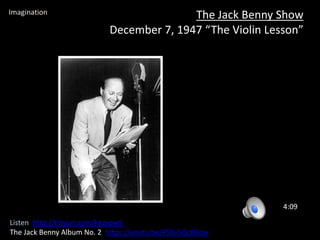
December 7, 1947 “The Violin Lesson”
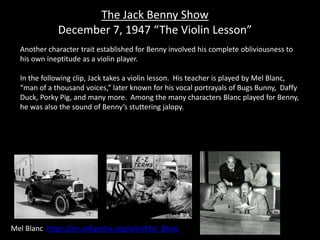
Mel Blanc https://en.wikipedia.org/wiki/Mel_Blanc
Another character trait established for Benny involved his complete obliviousness to
his own ineptitude as a violin player.
In the following clip, Jack takes a violin lesson. His teacher is played by Mel Blanc,
“man of a thousand voices,” later known for his vocal portrayals of Bugs Bunny, Daffy
Duck, Porky Pig, and many more. Among the many characters Blanc played for Benny,
he was also the sound of Benny’s stuttering jalopy.
The Jack Benny Show
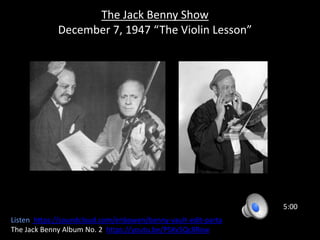
December 7, 1947 “The Violin Lesson”
5:00
Listen https://soundcloud.com/enbowen/benny-vault-edit-parta
The Jack Benny Album No. 2 https://youtu.be/PSXv5Qc8Row
The Jack Benny Show
December 7, 1947 “The Violin Lesson”
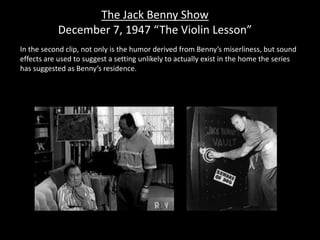
In the second clip, not only is the humor derived from Benny’s miserliness, but sound
effects are used to suggest a setting unlikely to actually exist in the home the series
has suggested as Benny’s residence.
The Jack Benny Show
December 7, 1947 “The Violin Lesson”
4:09
Imagination
Listen http://tinyurl.com/hkzxpw5
The Jack Benny Album No. 2 https://youtu.be/PSXv5Qc8Row
Lights Out
Lights Out https://en.wikipedia.org/wiki/Lights_Out_(radio_show)
Arch Oboler https://en.wikipedia.org/wiki/Arch_Oboler
Imagination
The radio series “Lights Out” was an anthology horror program that made
extensive use of description and suggestion to eerie effect. It was created by
Wyllis Cooper and later written and run by playwright Arch Oboler.
Oboler’s “The Chicken Heart” is one of the series’ most famous episodes, largely
due to a comedy routine about the broadcast recorded by Bill Cosby in 1966.
“The Dark” is another episode remembered for its horrific “imagery.” Both
episodes have been lost, but Oboler recreated them for a recording in 1962
titled “Drop Dead.”
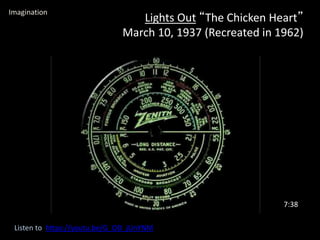
Lights Out “The Chicken Heart”
March 10, 1937 (Recreated in 1962)
Listen to https://youtu.be/G_OD_jUnYNM
7:38
Imagination
Lights Out “The Chicken Heart”
March 10, 1937 (Recreated in 1999)
Or listen to https://youtu.be/bwgmmMYshJQ
7:21
Imagination
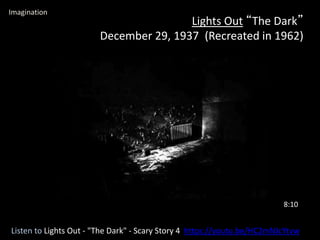
Lights Out “The Dark”
December 29, 1937 (Recreated in 1962)
Listen to Lights Out - "The Dark" - Scary Story 4 https://youtu.be/HC2mNJcYtvw
8:10
Imagination
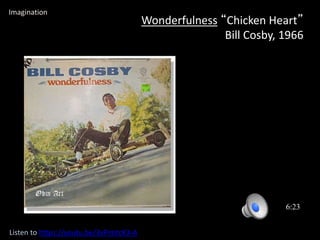
Wonderfulness “Chicken Heart”
Bill Cosby, 1966
6:23
Imagination
Listen to https://youtu.be/3vPimtcK3-A
Quiet Please
Imagination
Quiet Please https://en.wikipedia.org/wiki/Quiet,_Please
Wyllis Cooper https://en.wikipedia.org/wiki/Wyllis_Cooper
Quiet Please http://www.quietplease.org/
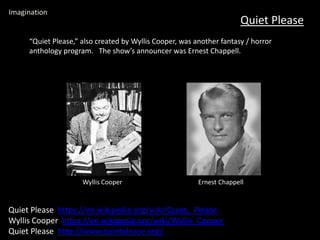
“Quiet Please,” also created by Wyllis Cooper, was another fantasy / horror
anthology program. The show’s announcer was Ernest Chappell.
Wyllis Cooper Ernest Chappell
Quiet Please
Imagination
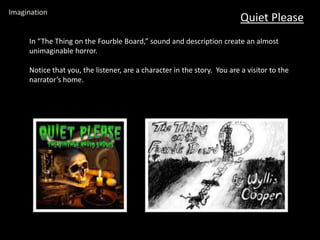
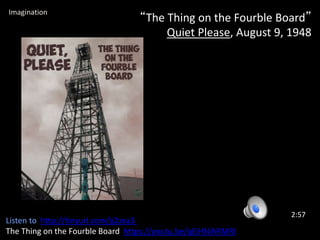
In “The Thing on the Fourble Board,” sound and description create an almost
unimaginable horror.
Notice that you, the listener, are a character in the story. You are a visitor to the
narrator’s home.
“The Thing on the Fourble Board”
Quiet Please, August 9, 1948
2:57
Imagination
Listen to http://tinyurl.com/jj2zea3
The Thing on the Fourble Board https://youtu.be/qEiHNihRMRI
“The Thing on the Fourble Board”
Quiet Please, August 9, 1948
Imagination
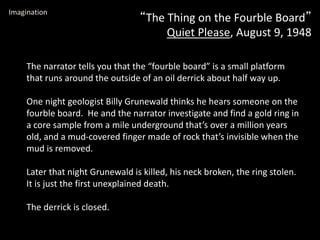
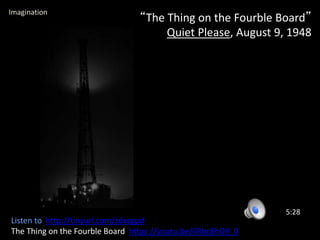
The narrator tells you that the “fourble board” is a small platform
that runs around the outside of an oil derrick about half way up.
One night geologist Billy Grunewald thinks he hears someone on the
fourble board. He and the narrator investigate and find a gold ring in
a core sample from a mile underground that’s over a million years
old, and a mud-covered finger made of rock that’s invisible when the
mud is removed.
Later that night Grunewald is killed, his neck broken, the ring stolen.
It is just the first unexplained death.
The derrick is closed.
“The Thing on the Fourble Board”
Quiet Please, August 9, 1948
5:28
Imagination
Listen to http://tinyurl.com/zdezgpd
The Thing on the Fourble Board https://youtu.be/ilRbcBhD9_0
Quiet Please
Imagination
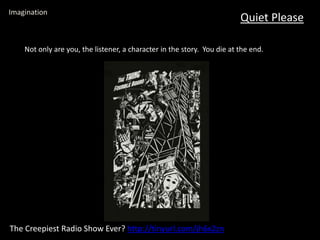
The Creepiest Radio Show Ever? http://tinyurl.com/jh6x2zn
Not only are you, the listener, a character in the story. You die at the end.
First Person
Narrative
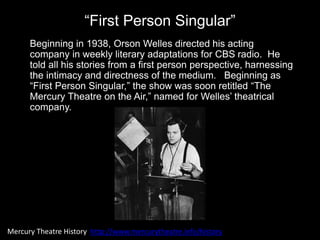
“First Person Singular”
Beginning in 1938, Orson Welles directed his acting
company in weekly literary adaptations for CBS radio. He
told all his stories from a first person perspective, harnessing
the intimacy and directness of the medium. Beginning as
“First Person Singular,” the show was soon retitled “The
Mercury Theatre on the Air,” named for Welles’ theatrical
company.
Mercury Theatre History http://www.mercurytheatre.info/history
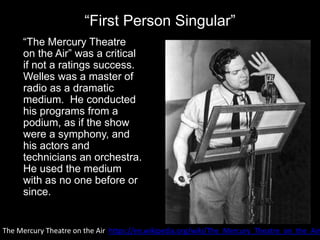
“First Person Singular”
“The Mercury Theatre
on the Air” was a critical
if not a ratings success.
Welles was a master of
radio as a dramatic
medium. He conducted
his programs from a
podium, as if the show
were a symphony, and
his actors and
technicians an orchestra.
He used the medium
with as no one before or
since.
The Mercury Theatre on the Air https://en.wikipedia.org/wiki/The_Mercury_Theatre_on_the_Air
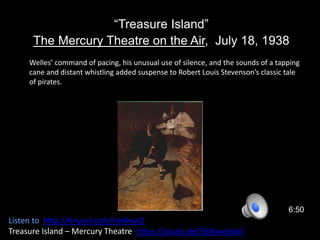
“Treasure Island”
The Mercury Theatre on the Air, July 18, 1938
6:50
Listen to http://tinyurl.com/he6hwt2
Treasure Island – Mercury Theatre https://youtu.be/56jKvwtJJq0
Welles’ command of pacing, his unusual use of silence, and the sounds of a tapping
cane and distant whistling added suspense to Robert Louis Stevenson’s classic tale
of pirates.
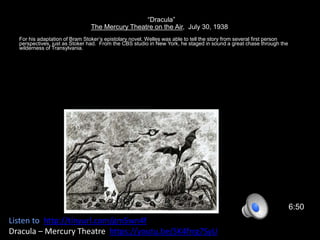
“Dracula”
The Mercury Theatre on the Air, July 30, 1938
For his adaptation of Bram Stoker’s epistolary novel, Welles was able to tell the story from several first person
perspectives, just as Stoker had. From the CBS studio in New York, he staged in sound a great chase through the
wilderness of Transylvania.
6:50
Listen to http://tinyurl.com/gm5wn4f
Dracula – Mercury Theatre https://youtu.be/SK4frrg7SyU

Audio Drama part 2

  • 1.
    The Golden Ageof Radio: 1934 - 1950
  • 2.
  • 3.
    Radio was intimate. Itwas a member of your family. It sat in your living room, brought the world into your home, and it told you stories.
  • 4.
    President Franklin Delano Roosevelt understoodthis, and used radio to talk directly, simply and quietly to each individual American. Intimacy
  • 5.
    His “Fireside Chats”helped calm a nation through both the Great Depression and World War II. 12/29/1940 Remember this voice FDR - Fireside Chat - National Security 12-29-1940 https://youtu.be/EaQH2LsghZk (Listen to the first 2 minutes and 30 seconds) 2:30 Intimacy
  • 6.
  • 7.
    Radio: The Theaterof the Imagination
  • 8.
    I like radio morethan television. The pictures are better. Letter from America by Alistair Cooke History of conventions - 17 July 1992 http://tinyurl.com/h5zg2ah Imagination
  • 9.
    Imagination Stan Freberg https://en.wikipedia.org/wiki/Stan_Freberg In1966, comedian, radio pioneer and advertising executive Stan Freberg, working for the Radio Advertising Bureau, aptly illustrated the power of radio to generate imagery in the imagination of the listener and thereby directly involve the listener a a co-creator.
  • 10.
    “Stretching the Imagination” StanFreberg and Sarah Vaughn, 1966 Radio Advertising Bureau 2:00 Imagination Listen https://soundcloud.com/enbowen/stretching-the-imagination
  • 11.
    The serial natureof radio allowed for character to be developed through the course of a series, for comedy and drama to be based on personalities made familiar over time.
  • 12.
    Jack Benny wasone of the leading American entertainers of the 20th century, movie actor, stand-up performer, radio personality, and eventually television star. His radio show was one of the most popular of the Golden Age of Radio. In a precursor to what we would today call “meta,” on his radio show he played “himself,” a star with his own radio show. His supporting cast were the actors who worked with him on his show. His radio show was a radio show within a radio show. Over the course of the series he established a clear persona. Among his many character defects, he was depicted as unrelentingly cheap. And much of the humor of his show played off this trait. Jack Benny https://en.wikipedia.org/wiki/Jack_Benny
  • 13.
    The Jack BennyShow March 28, 1948 “Your Money or Your Life” The following clip illustrates the humor derived from Benny’s established stinginess. Benny and his cast would perform in a studio or on stage, standing behind stationary microphones. Notice how the use of simple sound effects suggest setting and movement.
  • 14.
    The Jack BennyShow March 28, 1948 “Your Money or Your Life” 1:56 Listen http://tinyurl.com/hkzxpw5 The Jack Benny Program “Your Money of Your Life” https://youtu.be/p_XkdmRkOL0
  • 15.
    The Jack BennyShow December 7, 1947 “The Violin Lesson” Mel Blanc https://en.wikipedia.org/wiki/Mel_Blanc Another character trait established for Benny involved his complete obliviousness to his own ineptitude as a violin player. In the following clip, Jack takes a violin lesson. His teacher is played by Mel Blanc, “man of a thousand voices,” later known for his vocal portrayals of Bugs Bunny, Daffy Duck, Porky Pig, and many more. Among the many characters Blanc played for Benny, he was also the sound of Benny’s stuttering jalopy.
  • 16.
    The Jack BennyShow December 7, 1947 “The Violin Lesson” 5:00 Listen https://soundcloud.com/enbowen/benny-vault-edit-parta The Jack Benny Album No. 2 https://youtu.be/PSXv5Qc8Row
  • 17.
    The Jack BennyShow December 7, 1947 “The Violin Lesson” In the second clip, not only is the humor derived from Benny’s miserliness, but sound effects are used to suggest a setting unlikely to actually exist in the home the series has suggested as Benny’s residence.
  • 18.
    The Jack BennyShow December 7, 1947 “The Violin Lesson” 4:09 Imagination Listen http://tinyurl.com/hkzxpw5 The Jack Benny Album No. 2 https://youtu.be/PSXv5Qc8Row
  • 19.
    Lights Out Lights Outhttps://en.wikipedia.org/wiki/Lights_Out_(radio_show) Arch Oboler https://en.wikipedia.org/wiki/Arch_Oboler Imagination The radio series “Lights Out” was an anthology horror program that made extensive use of description and suggestion to eerie effect. It was created by Wyllis Cooper and later written and run by playwright Arch Oboler. Oboler’s “The Chicken Heart” is one of the series’ most famous episodes, largely due to a comedy routine about the broadcast recorded by Bill Cosby in 1966. “The Dark” is another episode remembered for its horrific “imagery.” Both episodes have been lost, but Oboler recreated them for a recording in 1962 titled “Drop Dead.”
  • 20.
    Lights Out “TheChicken Heart” March 10, 1937 (Recreated in 1962) Listen to https://youtu.be/G_OD_jUnYNM 7:38 Imagination
  • 21.
    Lights Out “TheChicken Heart” March 10, 1937 (Recreated in 1999) Or listen to https://youtu.be/bwgmmMYshJQ 7:21 Imagination
  • 22.
    Lights Out “TheDark” December 29, 1937 (Recreated in 1962) Listen to Lights Out - "The Dark" - Scary Story 4 https://youtu.be/HC2mNJcYtvw 8:10 Imagination
  • 23.
    Wonderfulness “Chicken Heart” BillCosby, 1966 6:23 Imagination Listen to https://youtu.be/3vPimtcK3-A
  • 24.
    Quiet Please Imagination Quiet Pleasehttps://en.wikipedia.org/wiki/Quiet,_Please Wyllis Cooper https://en.wikipedia.org/wiki/Wyllis_Cooper Quiet Please http://www.quietplease.org/ “Quiet Please,” also created by Wyllis Cooper, was another fantasy / horror anthology program. The show’s announcer was Ernest Chappell. Wyllis Cooper Ernest Chappell
  • 25.
    Quiet Please Imagination In “TheThing on the Fourble Board,” sound and description create an almost unimaginable horror. Notice that you, the listener, are a character in the story. You are a visitor to the narrator’s home.
  • 26.
    “The Thing onthe Fourble Board” Quiet Please, August 9, 1948 2:57 Imagination Listen to http://tinyurl.com/jj2zea3 The Thing on the Fourble Board https://youtu.be/qEiHNihRMRI
  • 27.
    “The Thing onthe Fourble Board” Quiet Please, August 9, 1948 Imagination The narrator tells you that the “fourble board” is a small platform that runs around the outside of an oil derrick about half way up. One night geologist Billy Grunewald thinks he hears someone on the fourble board. He and the narrator investigate and find a gold ring in a core sample from a mile underground that’s over a million years old, and a mud-covered finger made of rock that’s invisible when the mud is removed. Later that night Grunewald is killed, his neck broken, the ring stolen. It is just the first unexplained death. The derrick is closed.
  • 28.
    “The Thing onthe Fourble Board” Quiet Please, August 9, 1948 5:28 Imagination Listen to http://tinyurl.com/zdezgpd The Thing on the Fourble Board https://youtu.be/ilRbcBhD9_0
  • 29.
    Quiet Please Imagination The CreepiestRadio Show Ever? http://tinyurl.com/jh6x2zn Not only are you, the listener, a character in the story. You die at the end.
  • 30.
  • 31.
    “First Person Singular” Beginningin 1938, Orson Welles directed his acting company in weekly literary adaptations for CBS radio. He told all his stories from a first person perspective, harnessing the intimacy and directness of the medium. Beginning as “First Person Singular,” the show was soon retitled “The Mercury Theatre on the Air,” named for Welles’ theatrical company. Mercury Theatre History http://www.mercurytheatre.info/history
  • 32.
    “First Person Singular” “TheMercury Theatre on the Air” was a critical if not a ratings success. Welles was a master of radio as a dramatic medium. He conducted his programs from a podium, as if the show were a symphony, and his actors and technicians an orchestra. He used the medium with as no one before or since. The Mercury Theatre on the Air https://en.wikipedia.org/wiki/The_Mercury_Theatre_on_the_Air
  • 33.
    “Treasure Island” The MercuryTheatre on the Air, July 18, 1938 6:50 Listen to http://tinyurl.com/he6hwt2 Treasure Island – Mercury Theatre https://youtu.be/56jKvwtJJq0 Welles’ command of pacing, his unusual use of silence, and the sounds of a tapping cane and distant whistling added suspense to Robert Louis Stevenson’s classic tale of pirates.
  • 34.
    “Dracula” The Mercury Theatreon the Air, July 30, 1938 For his adaptation of Bram Stoker’s epistolary novel, Welles was able to tell the story from several first person perspectives, just as Stoker had. From the CBS studio in New York, he staged in sound a great chase through the wilderness of Transylvania. 6:50 Listen to http://tinyurl.com/gm5wn4f Dracula – Mercury Theatre https://youtu.be/SK4frrg7SyU