
BRYAN  ALEXANDER
STEVE BRAGAW
MARK RUSH
(ALPHABETICALLY, SPIRITUALLY, 
LENGTH OF BEARD)
AACU ANNUAL MEETING AND 
SNOWBALL FIGHT
22 JANUARY 2016
Liberal Education:
Embracing the Challenges
of Our Success
Why We Are Doing This Panel
 Different background experiences leading to
 Common shared
 celebration of liberal ed success
 concern about challenges to traditional model of higher
ed
 and defensive responses from contemporary stakeholders
The Challenges
 Challenges posed by successful responses to previous
“higher education crisis” phases
 Challenges posed by successful internationalization
 Challenges posed by successful incorporation of
technical competence
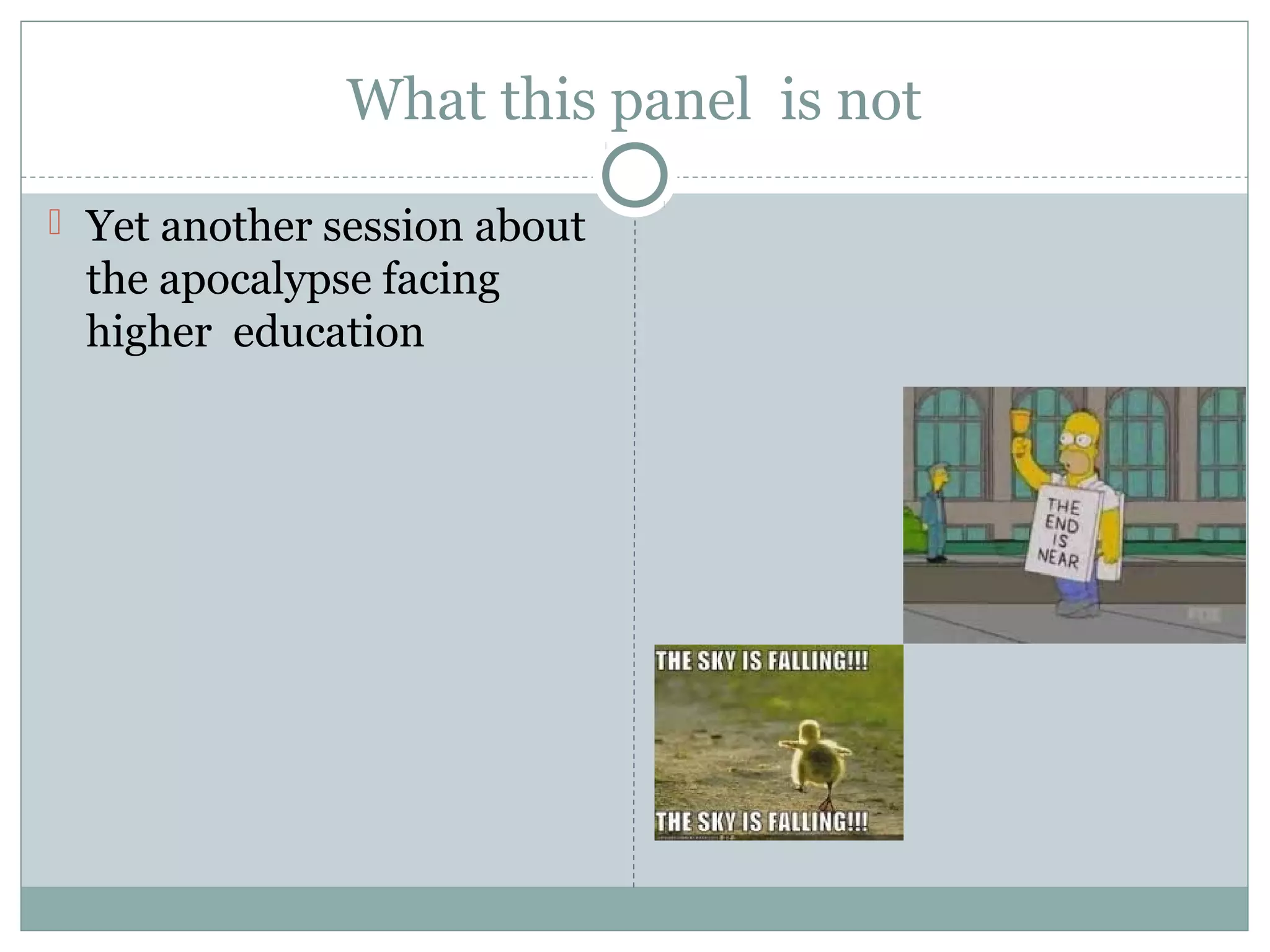
What this panel is not
 Yet another session about
the apocalypse facing
higher education
What this panel is
 A plea/invitation to
 a positive discussion of 
challenges to  the 
traditional model of 
higher education 
brought about by its
success
 with
 a spirit of
stewardship for
future generations of
students and faculty
STEVE BRAGAW
WASHINGTON & LEE UNIVERSITY
@STEVEBRAGAW
Strategy and Finance challenges
for liberal education
Higher ed crisis in America! (?)
 The Challenge:
• Experts predict that between ten percent and thirty percent of
America’s 3100 colleges and universities will close their doors
or merge with other institutions…On many campuses the fear of
imminent contraction or demise is almost palpable…The specter
lurks in colleges and universities of all sizes, public as well as
private, although smaller private colleges and the academically
weaker state colleges and community colleges are widely
expected to be the worst hit. Indeed, hundreds of college and a
few universities are already near an end.”
The problem: That was 1983
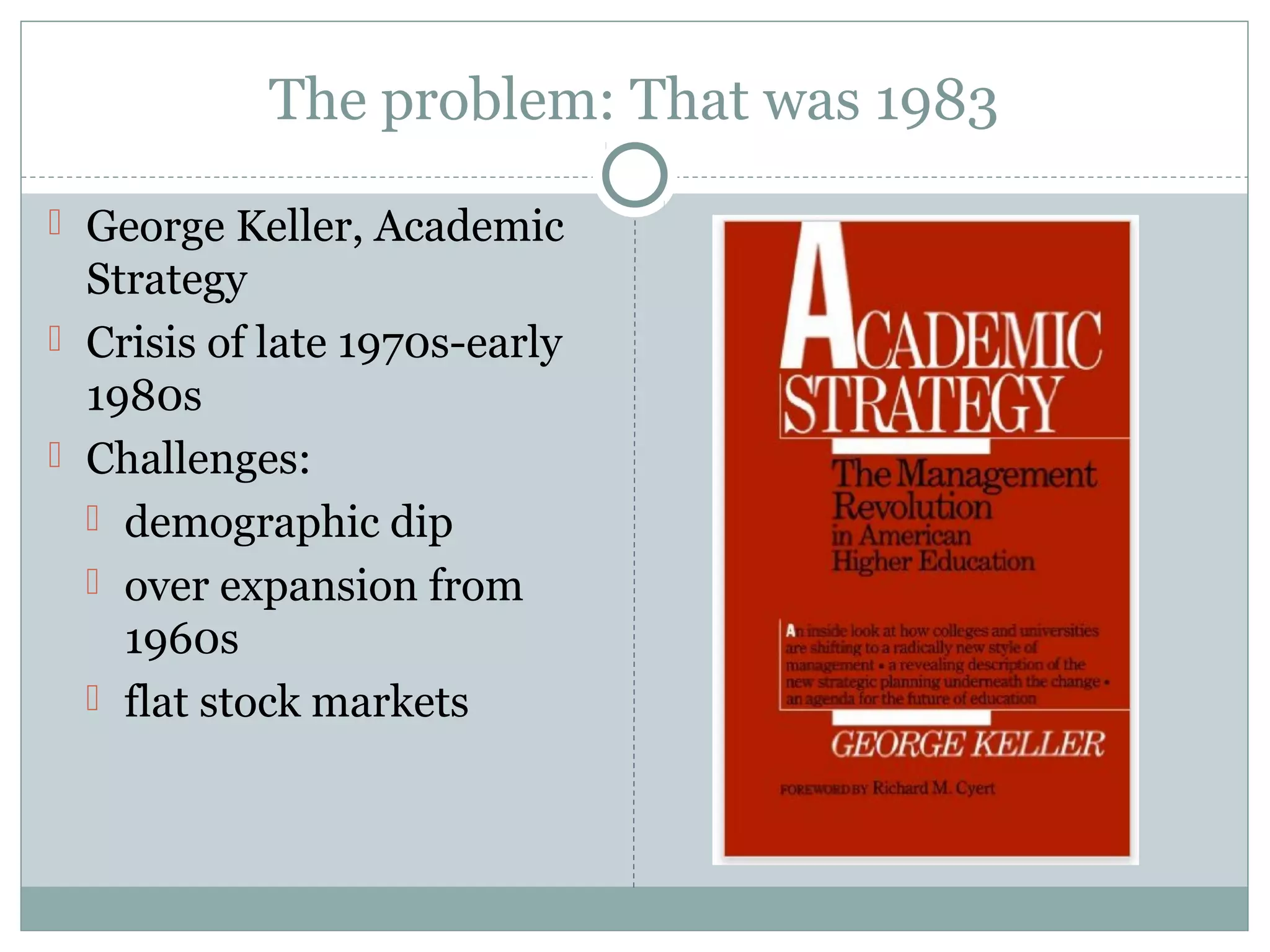
 George Keller, Academic
Strategy
 Crisis of late 1970s-early
1980s
 Challenges:
 demographic dip
 over expansion from
1960s
 flat stock markets
Response to the previous “Crisis”
 Demographic dip——changing enrollment strategies
 over expansion——changing infrastructure
 1970s economy——changing development and
endowment management
TODAY
 Challenges—-
 Debt—-Student and institutional
 Price/value proposition—-question of the cost
 Adjunctification
 Particular challenges to liberal arts colleges—
vulnerability as compared to comprehensive and
state institutions with their own particular challenges
The greatest threat
 My argument:
 The greatest threat to liberal arts colleges in the current
environment is failure to recognize that they are
businesses, whose business model is potentially
threatened by changes in current environment
 Emphasis on liberal arts colleges being “different”
because of
 mission
 tradition of shared governance
 This can lead to grave failure to recognize threats and
adapt
 How do we think our way out of this current
situation?
Disruption
 Liberal arts colleges are “content bundlers”—-their
business model hinges on “bundling” together a
number of fixed costs in one package
 “Content bundlers” are under incredible stress as
consumers try to pry the pieces they want loose and
only pay for the parts they want
Core questions:
• How should colleges and universities not just adjust, but
fundamentally rethink their strategies accordingly? How can they
find ways to take advantage of this new environment?
• How do these changes place stress on the core business model of
the college or university?
• My answer: don’t focus on how liberal arts colleges are different
from other for profit and not-for-profit businesses. Instead, ask
what can we learn when we focus on what they have in common?
• What’s the institution’s unique competitive advantage? What
forces are going to influence the institution’s strategic position?
Viewing the challenge in a different way
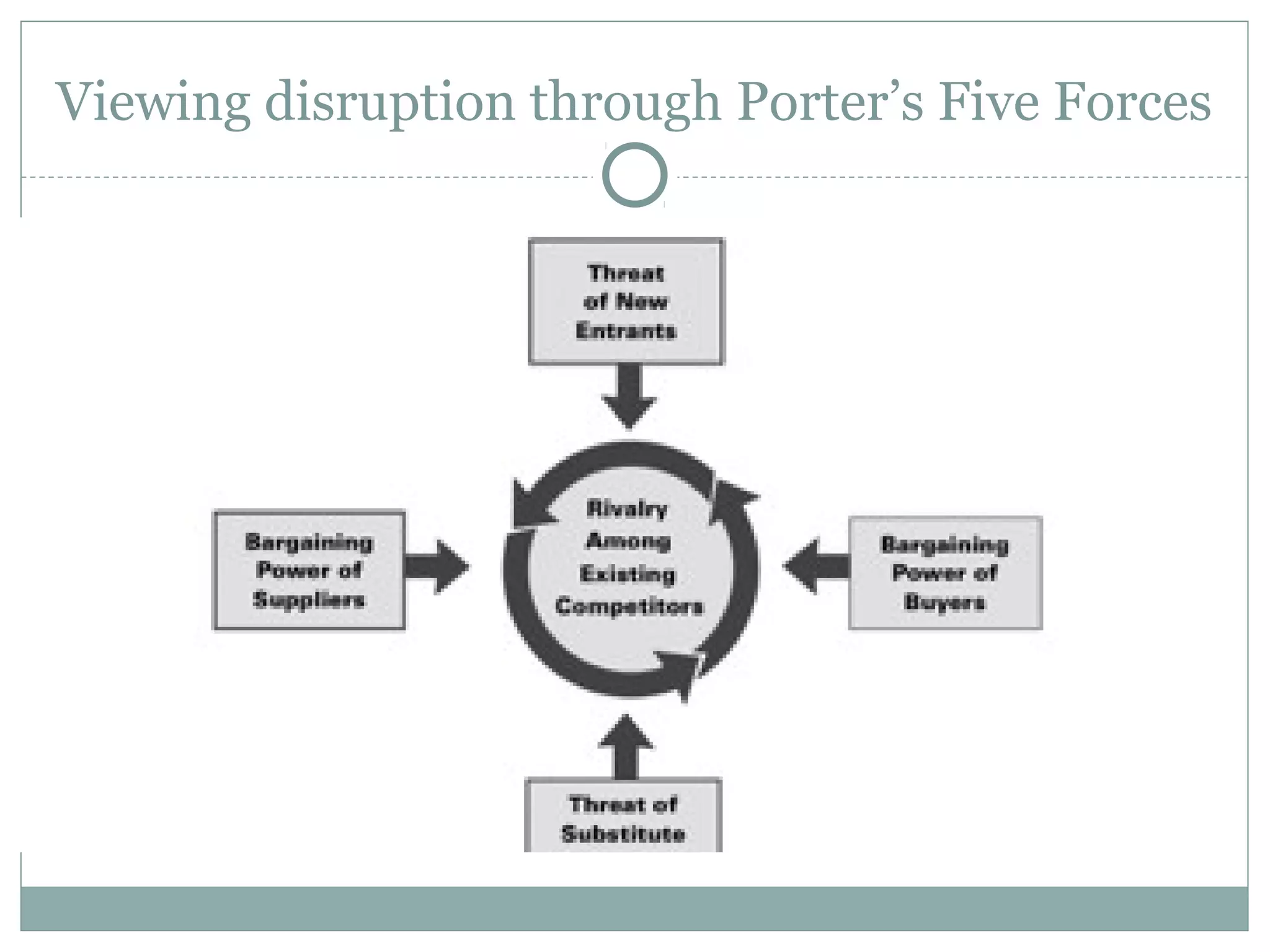
 Michael Porter “The Five Forces”—
 Competition with established rivals
 Threats from new entrants to the market
 Bargaining power of suppliers
 Bargaining power of buyers
 Threat of substitutes
Viewing disruption through Porter’s Five Forces
Challenge of “disruption”
 Challenge for business models of liberal arts colleges
come from:
 Threat of substitutes (online, mostly)
 Bargaining power of buyers—-price sensitivity, desire
to purchase the pieces of the degree credit hours
elsewhere
 Not a bricks versus clicks argument, but rather
threat of pieces of the degree being bought
elsewhere.
 Disruption and content unbundling in the
newspaper and publishing industries
Key takeaways
• Faculty, administrators, and trustees need to understand how
their institutions are not immune from strategic imperatives of
competitive forces that challenge key assumptions upon
which their business models are formed.
• Responsible stewardship requires adjusting and adapting by
challenging fundamental assumptions and values, regardless
of who is upset.
• Educating stakeholders to embrace rather than resist
• Difference between “failure is not an option” versus
“failure cannot happen”
 Embracing the potential of technology, collaboration,
and internationalization not as threats but as ways to
grow the business model of liberal arts colleges
 We’ve worked our way through many types of crisis
before. Secret now is to not shy away from core
threats or treat them with old strategies, but embrace
new thinking and approaches.
LIBERAL EDUCATION’S DEMOCRATIC DILEMMA?
MARK RUSH
Successful Internationalization
The Liberal Ed - Liberal Dem Connection
 "The approach to higher learning that best serves
individuals, our globally engaged democracy and an
innovating economy is liberal education." —AAC&U
Board of Directors, 2002
 AACU “What is a 21stCenturyLiberalEducation?”
The Challenge of Internationalization
 We have opened our doors…
 but to Which Democratic Values?
 What Happens when Liberal Education leaves the
symbiotic confines of Liberal Democracy?
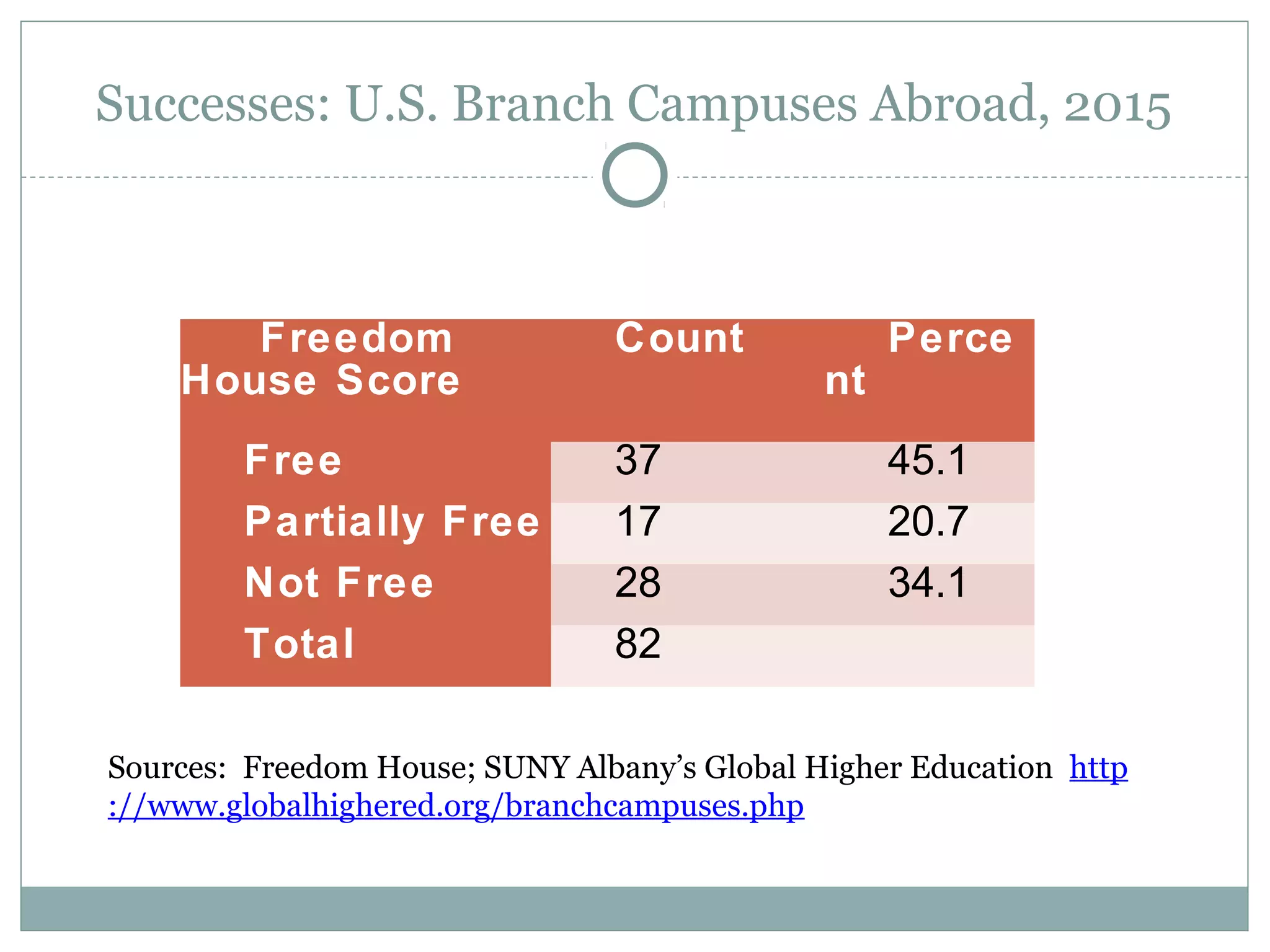
Successes: U.S. Branch Campuses Abroad, 2015
Freedom
House Score
Count Perce
nt
Free 37 45.1
Partially Free 17 20.7
Not Free 28 34.1
Total 82
Sources: Freedom House; SUNY Albany’s Global Higher Education http
://www.globalhighered.org/branchcampuses.php
Success: Internationalization Trends
 974,926 international
students attend US
universities 2014/15 (
www.iie.org, Open Doors)
 304, 467 US Students
abroad 2013/14
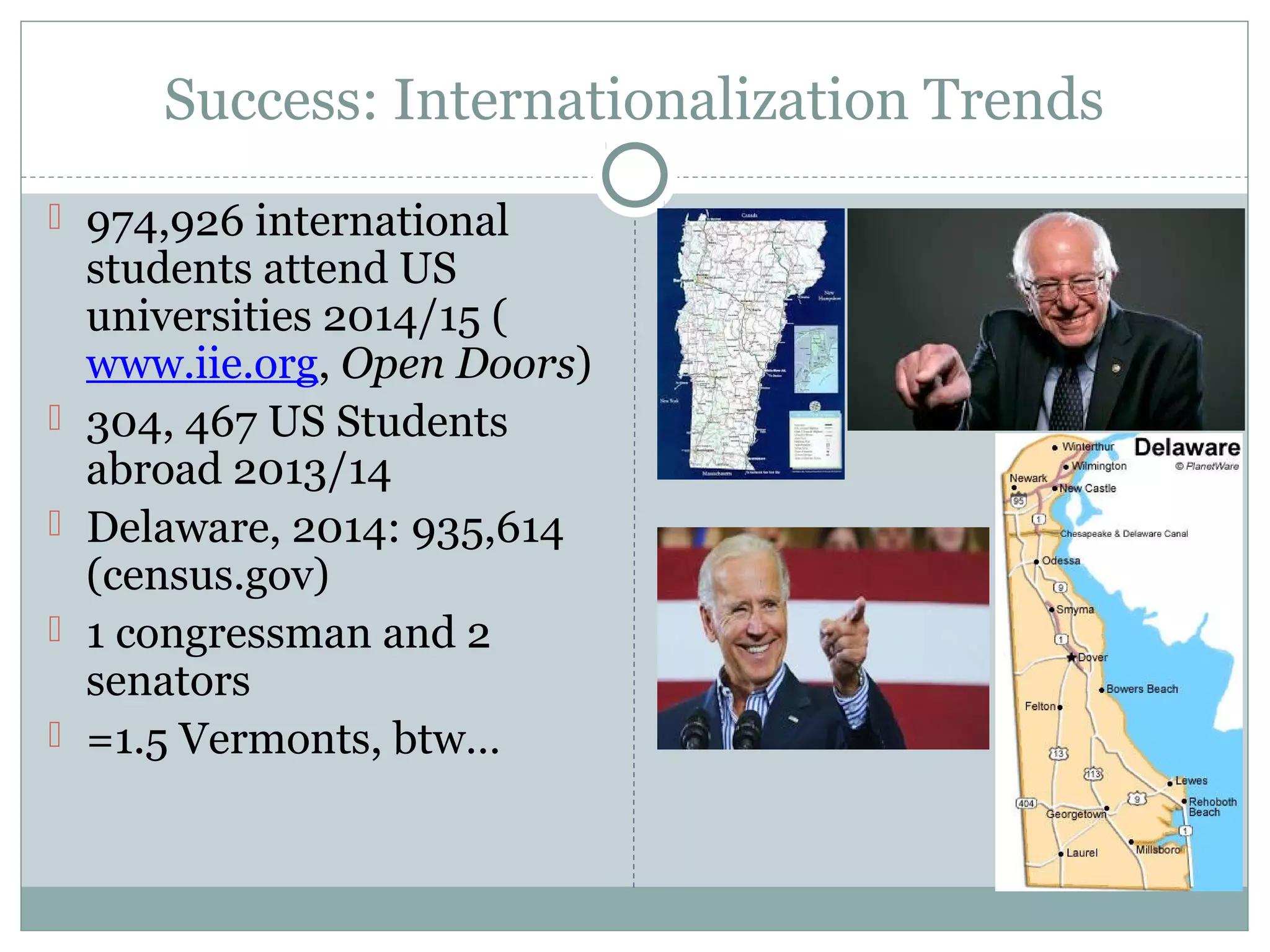
 Delaware, 2014: 935,614
(census.gov)
 1 congressman and 2
senators
 =1.5 Vermonts, btw…
An Increasingly Illiberal World
 Freedom House 2015: 54% of countries  are partially 
or not free.
 Law and Versteeg (2013): Steady, consistent decline of
U.S. Constitutional values around the world since
1946. (David S. Law and Mila Versteeg, “The Declining Influence of the United States
Constitution” New York University Law Review 87 (2012): 762)
 See also Fareed Zakaria, Illiberal Democracy (and
subsequent writings).
History Did Not End: Democracy Evolves
 Apologies to Francis Fukuyama (The End of History
and the Last Man)
 cf.
 Robert Kaplan: “Was Democracy Just a Moment?”
(1997)
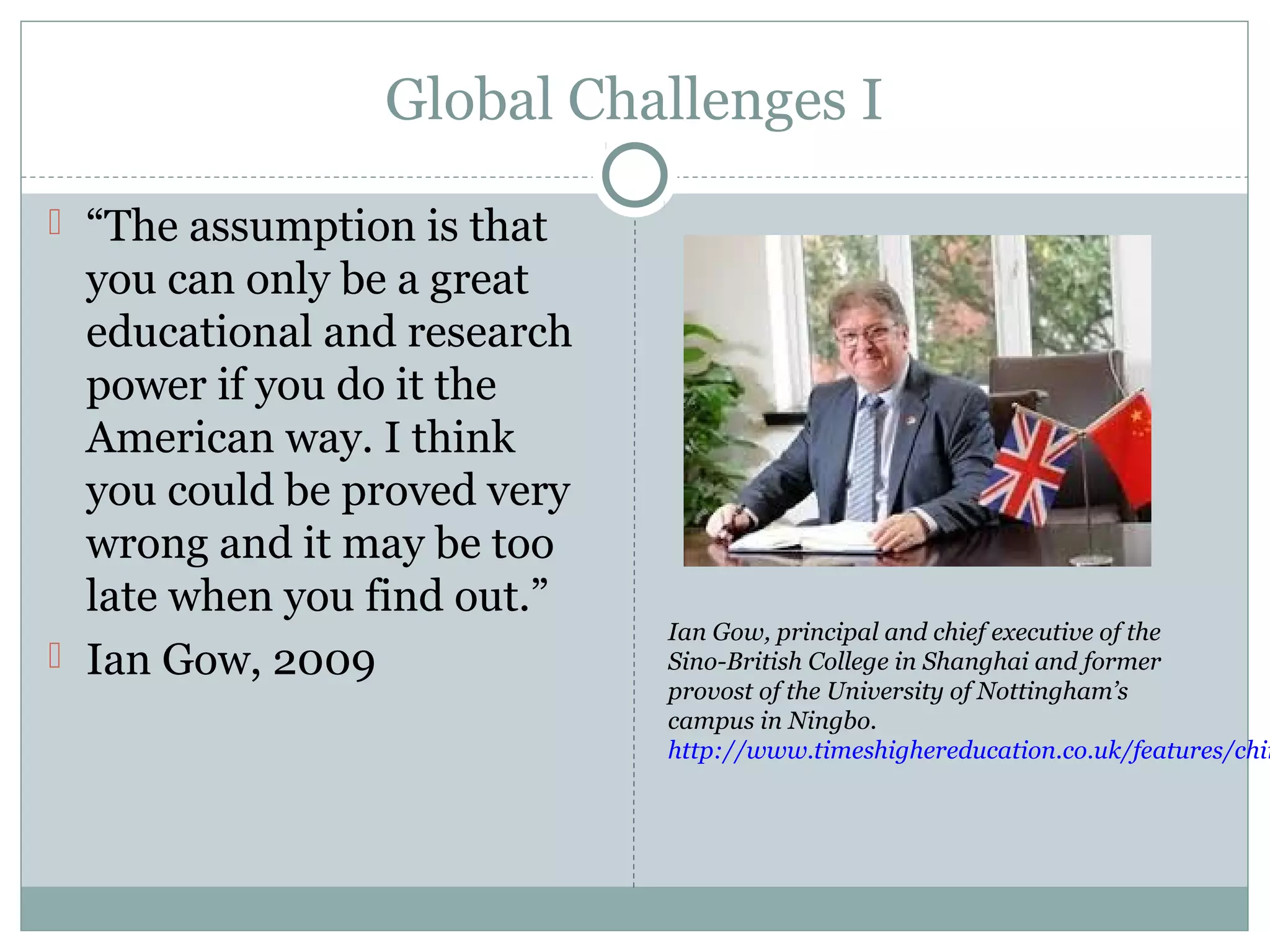
Global Challenges I
 “The assumption is that
you can only be a great
educational and research
power if you do it the
American way. I think
you could be proved very
wrong and it may be too
late when you find out.”
 Ian Gow, 2009
Ian Gow, principal and chief executive of the
Sino-British College in Shanghai and former
provost of the University of Nottingham’s
campus in Ningbo.
http://www.timeshighereducation.co.uk/features/chin
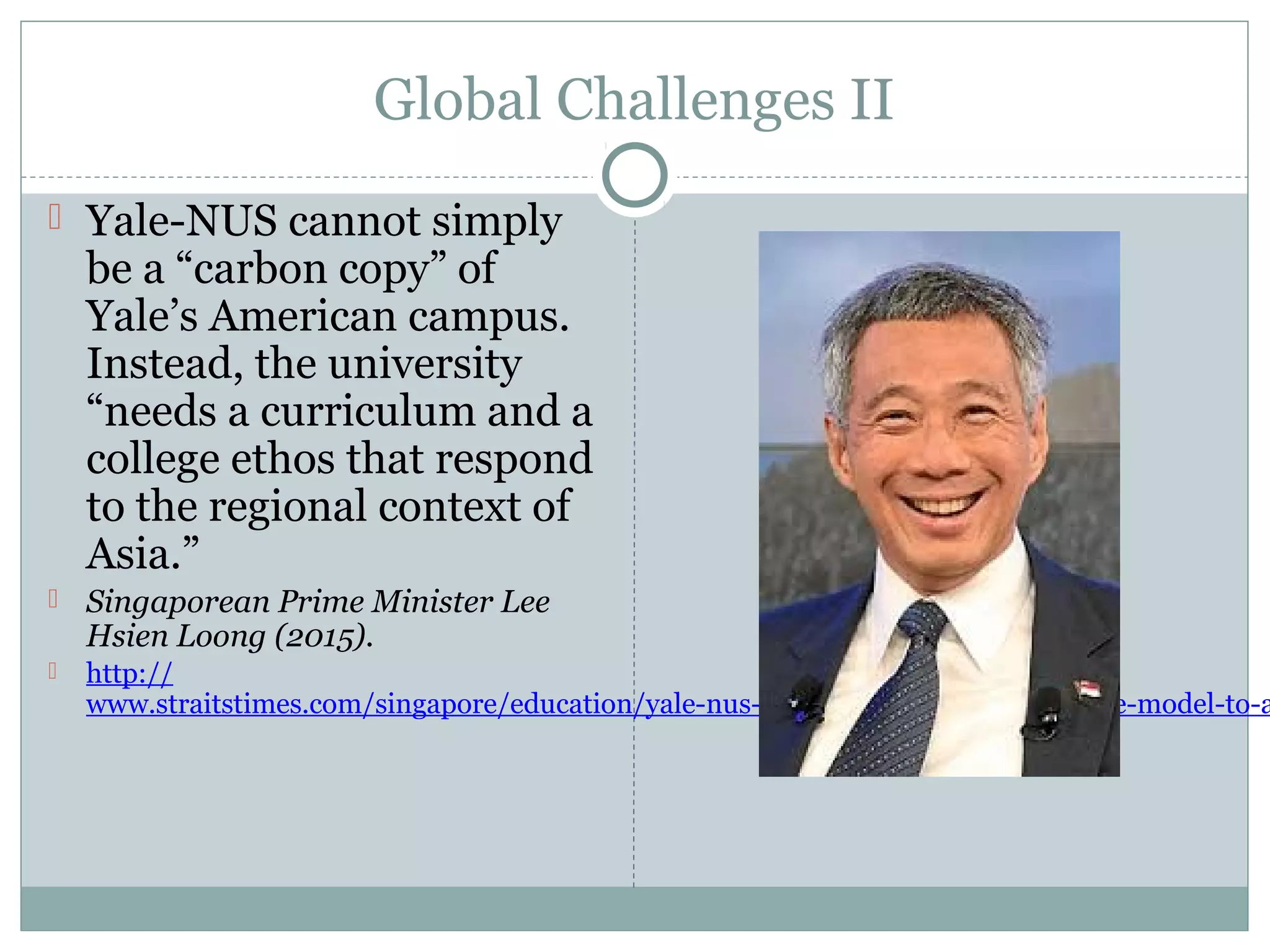
Global Challenges II
 Yale-NUS cannot simply
be a “carbon copy” of
Yale’s American campus.
Instead, the university
“needs a curriculum and a
college ethos that respond
to the regional context of
Asia.”
 Singaporean Prime Minister Lee
Hsien Loong (2015).
 http://
www.straitstimes.com/singapore/education/yale-nus-college-has-to-adapt-the-yale-model-to-a
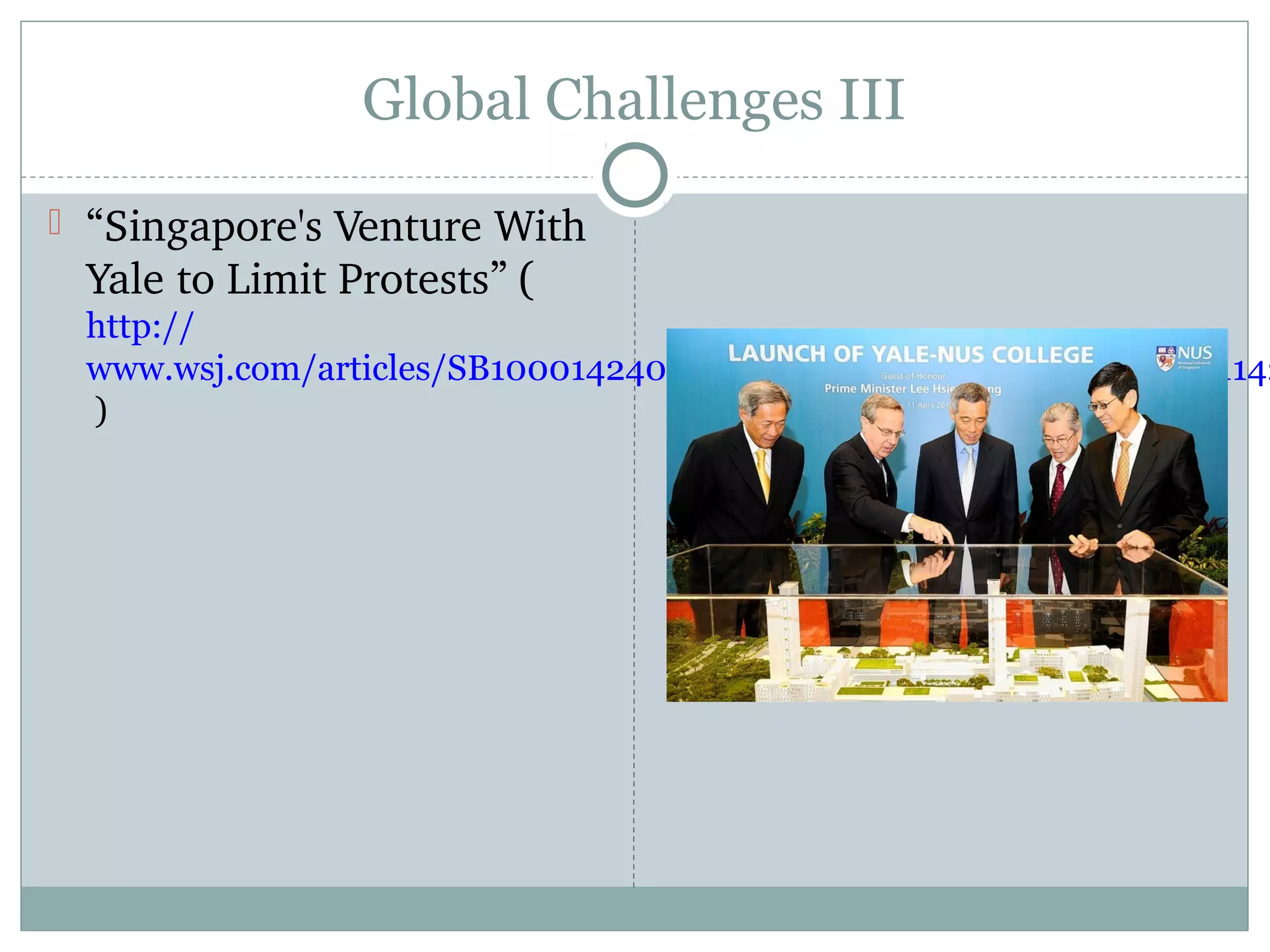
Global Challenges III
 “Singapore's Venture With 
Yale to Limit Protests” (
http://
www.wsj.com/articles/SB10001424052702303933704577530524046581142
)
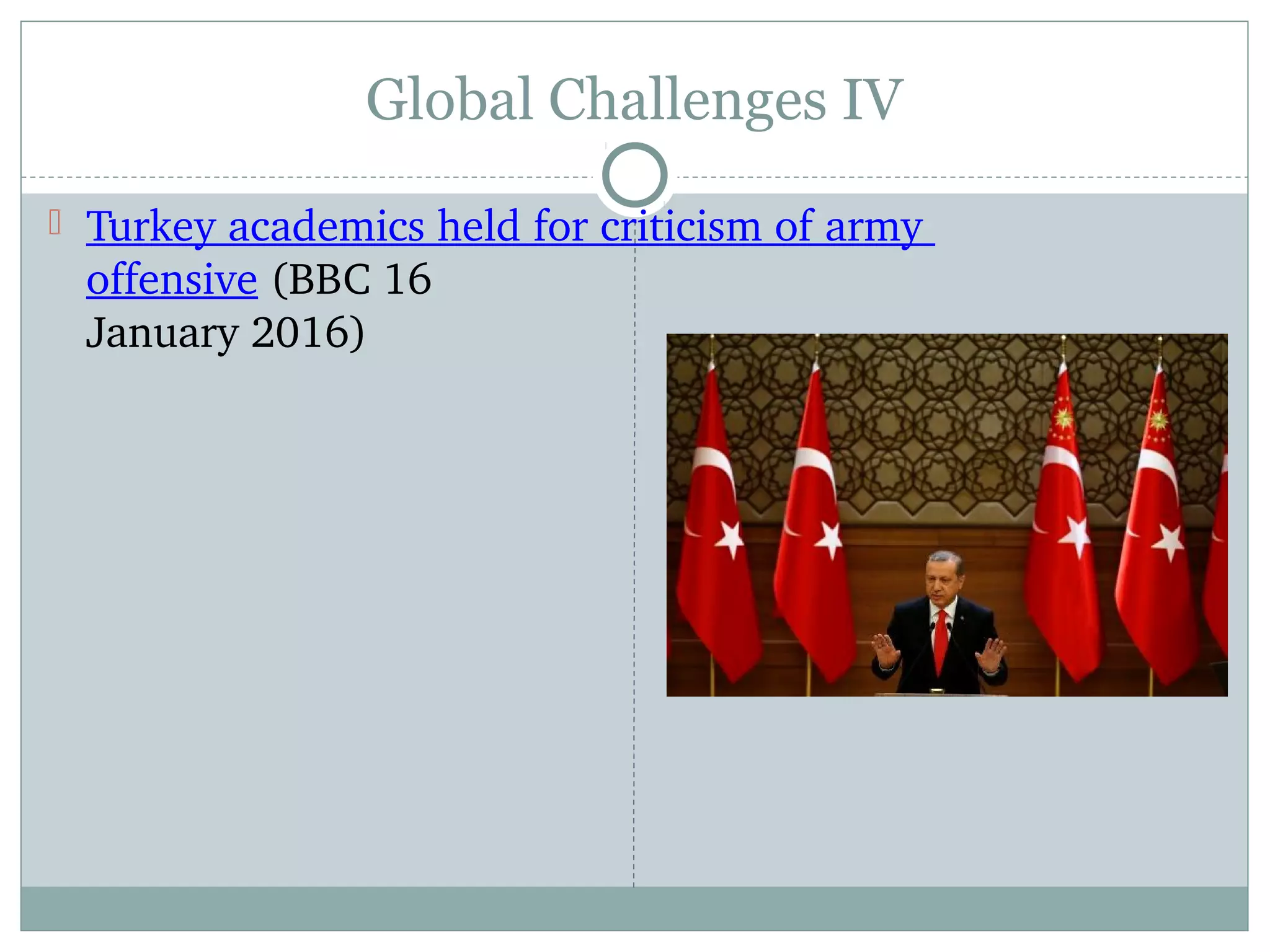
Global Challenges IV
 Turkey academics held for criticism of army 
offensive (BBC 16 
January 2016)
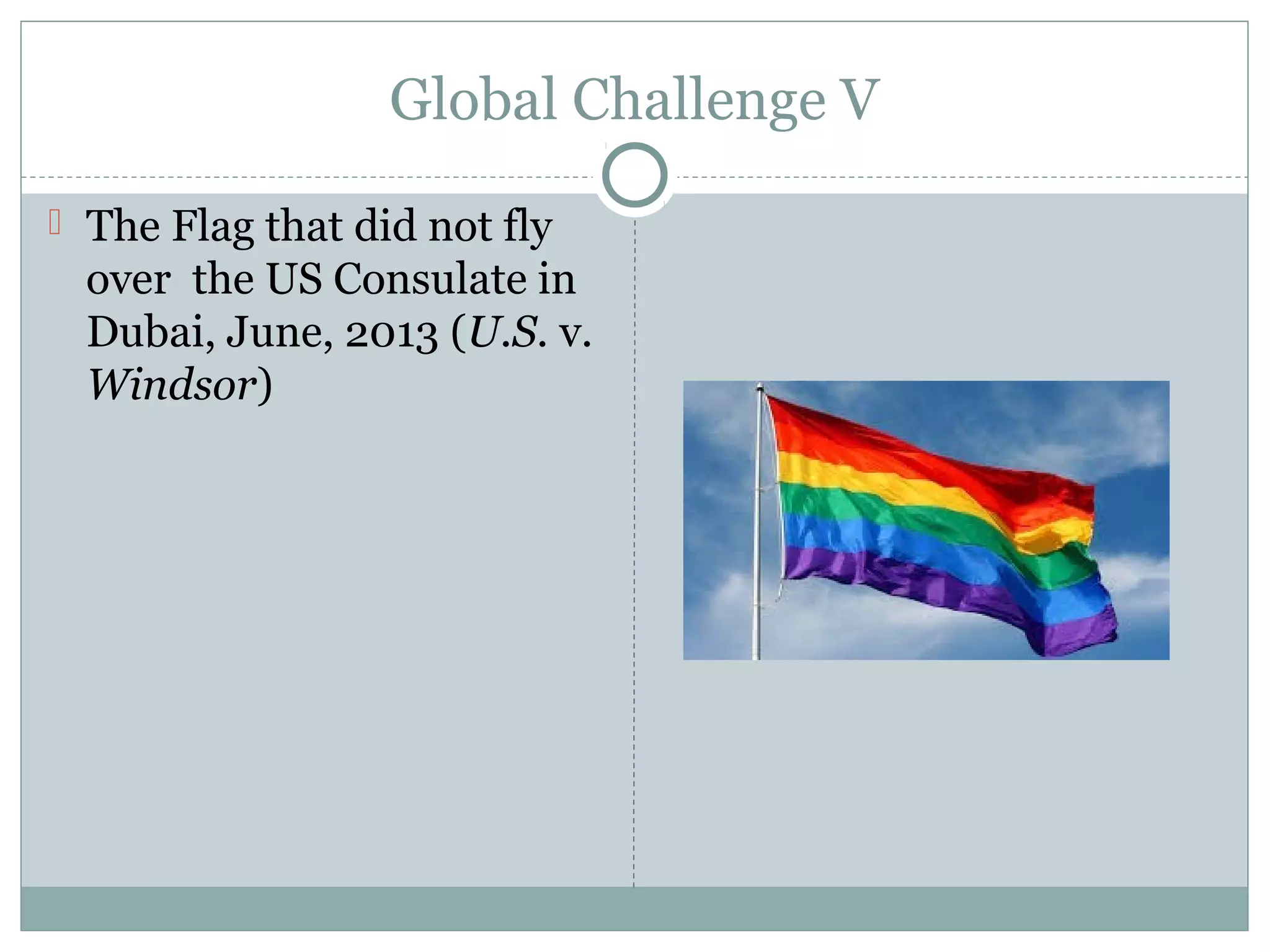
Global Challenge V
 The Flag that did not fly
over the US Consulate in
Dubai, June, 2013 (U.S. v.
Windsor)
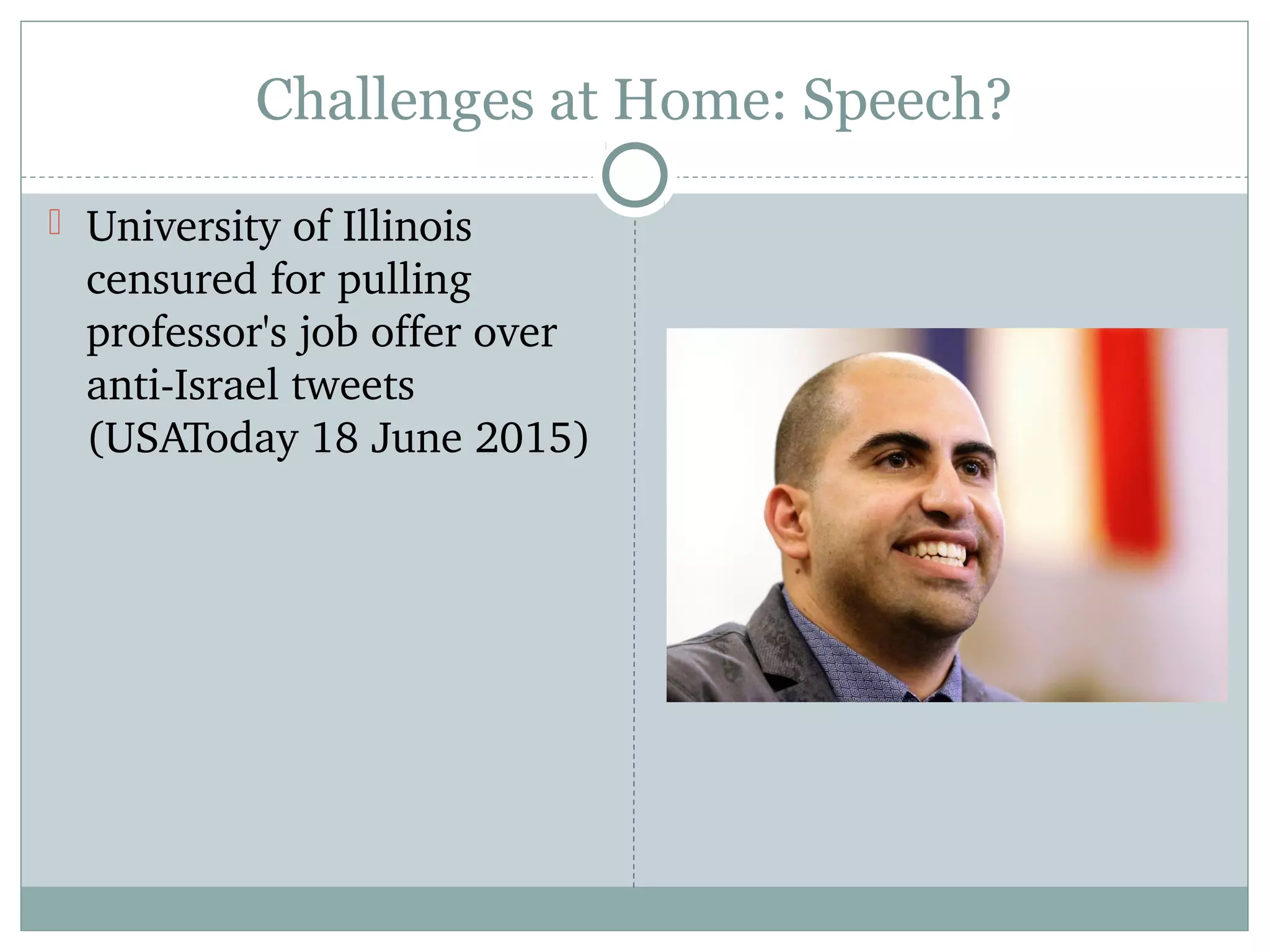
Challenges at Home: Speech?
 University of Illinois 
censured for pulling 
professor's job offer over 
anti­Israel tweets 
(USAToday 18 June 2015)
Challenges at Home: Integrity
 In one study, the University of Windsor in the
Canadian province of Ontario tracked how many
foreign students were being cited for academic 
dishonesty compared with their Canadian classmates.
It found that one in 53 international students
had been charged versus one in 1,122
Canadians. (timeshighereducation.com 6
Oct 2011)
Barbarianization of Liberal Ed?
 What will the American
Model look like in a
generation?
 Liberal values in an
increasingly illiberal
marketplace?
 Which version of Yale will
survive?
 Accreditation concerns?
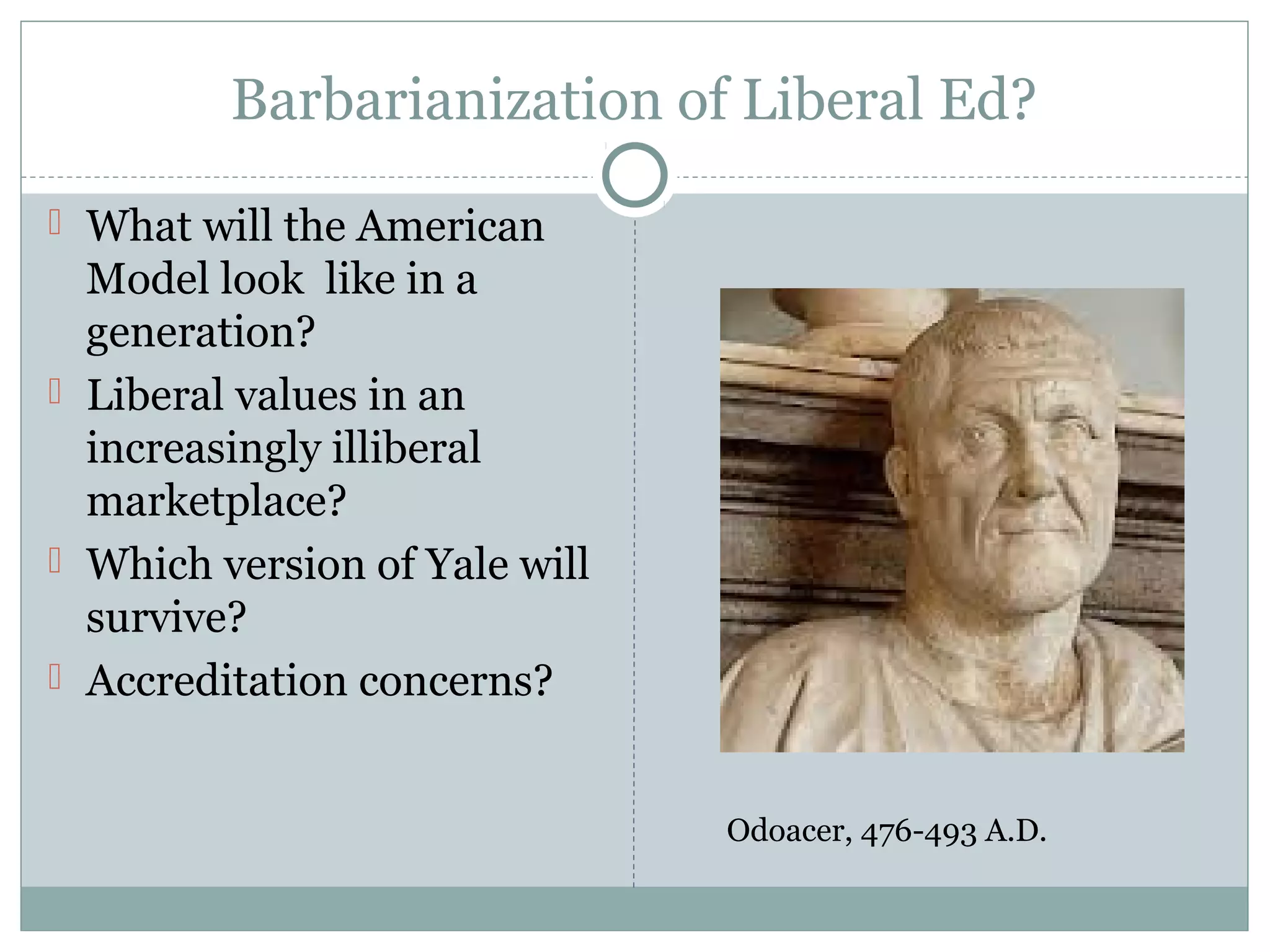
Odoacer, 476-493 A.D.
The Technology Challenge
 On to Bryan
The open movement
and liberal education
AAC&U annual conference
Snowpocalypse 2016
Liberal education and openLiberal education and open
My thesis: open education
has developed to a
sufficient level where
liberal arts institutions can -
and should - participate.
The open revolutionThe open revolution
 Open education
 Open access
scholarship
 Open source software
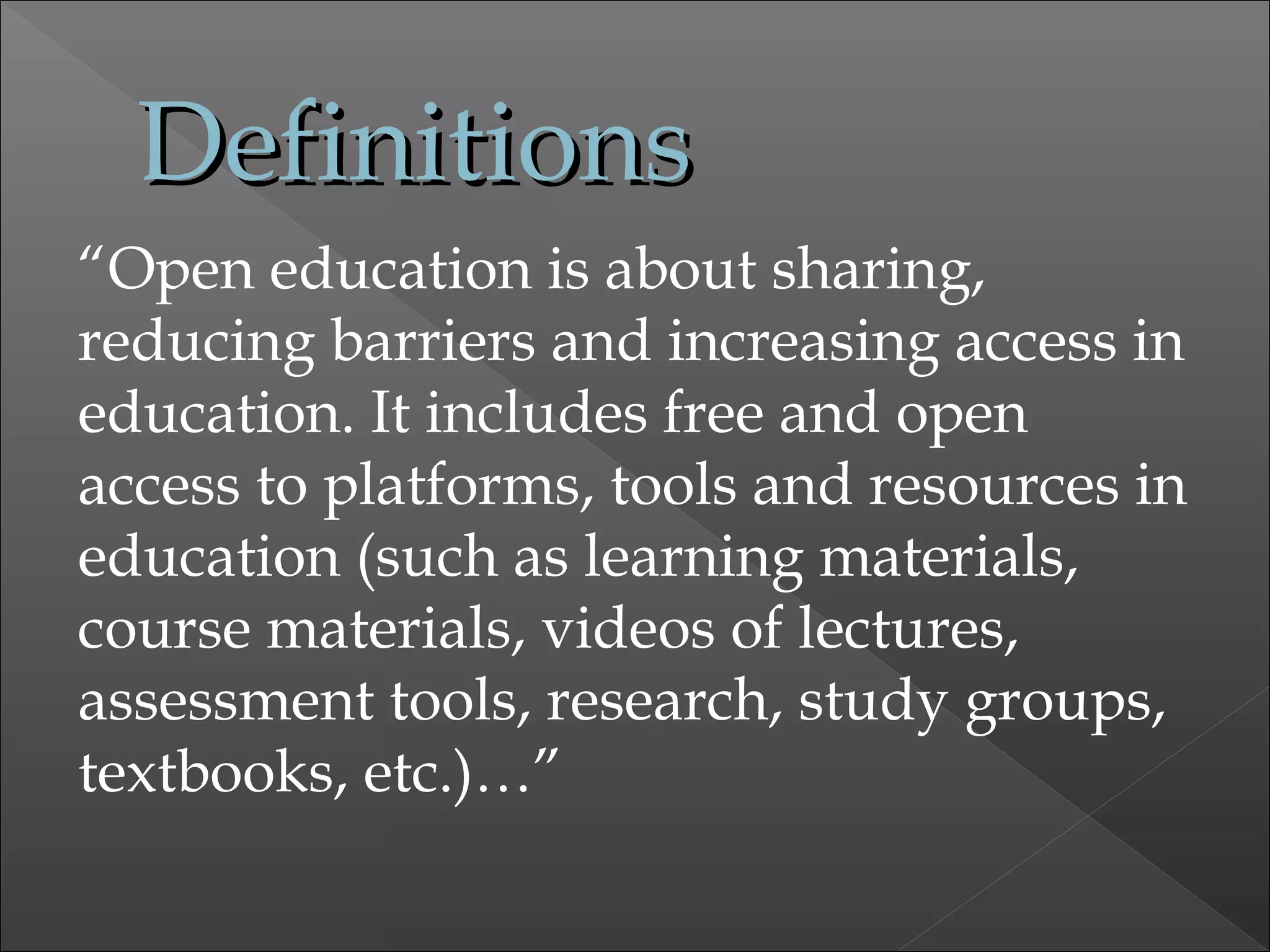
DefinitionsDefinitions
“Open education is about sharing,
reducing barriers and increasing access in
education. It includes free and open
access to platforms, tools and resources in
education (such as learning materials,
course materials, videos of lectures,
assessment tools, research, study groups,
textbooks, etc.)…”
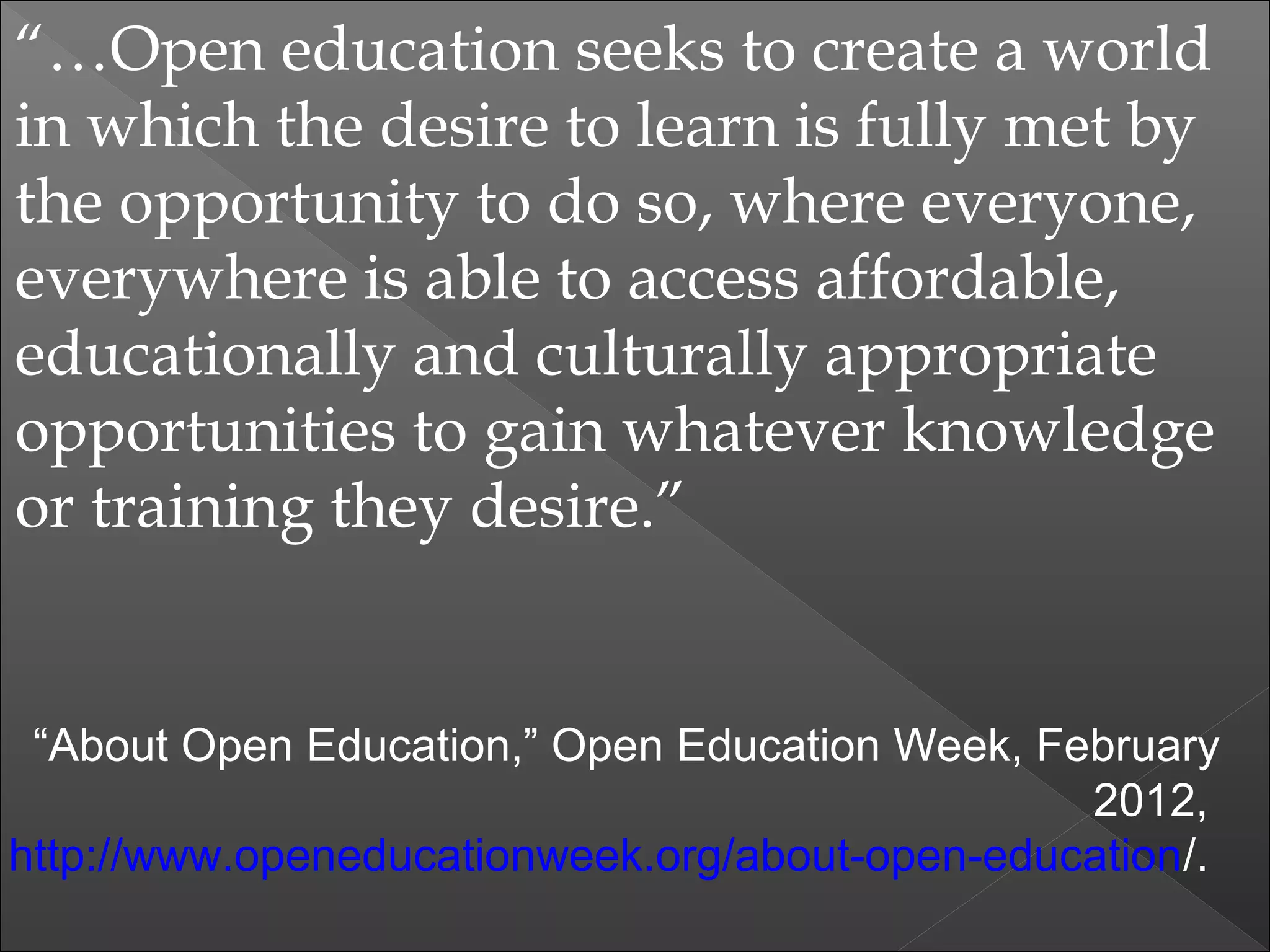
“…Open education seeks to create a world
in which the desire to learn is fully met by
the opportunity to do so, where everyone,
everywhere is able to access affordable,
educationally and culturally appropriate
opportunities to gain whatever knowledge
or training they desire.”
“About Open Education,” Open Education Week, February
2012,
http://www.openeducationweek.org/about-open-education/.
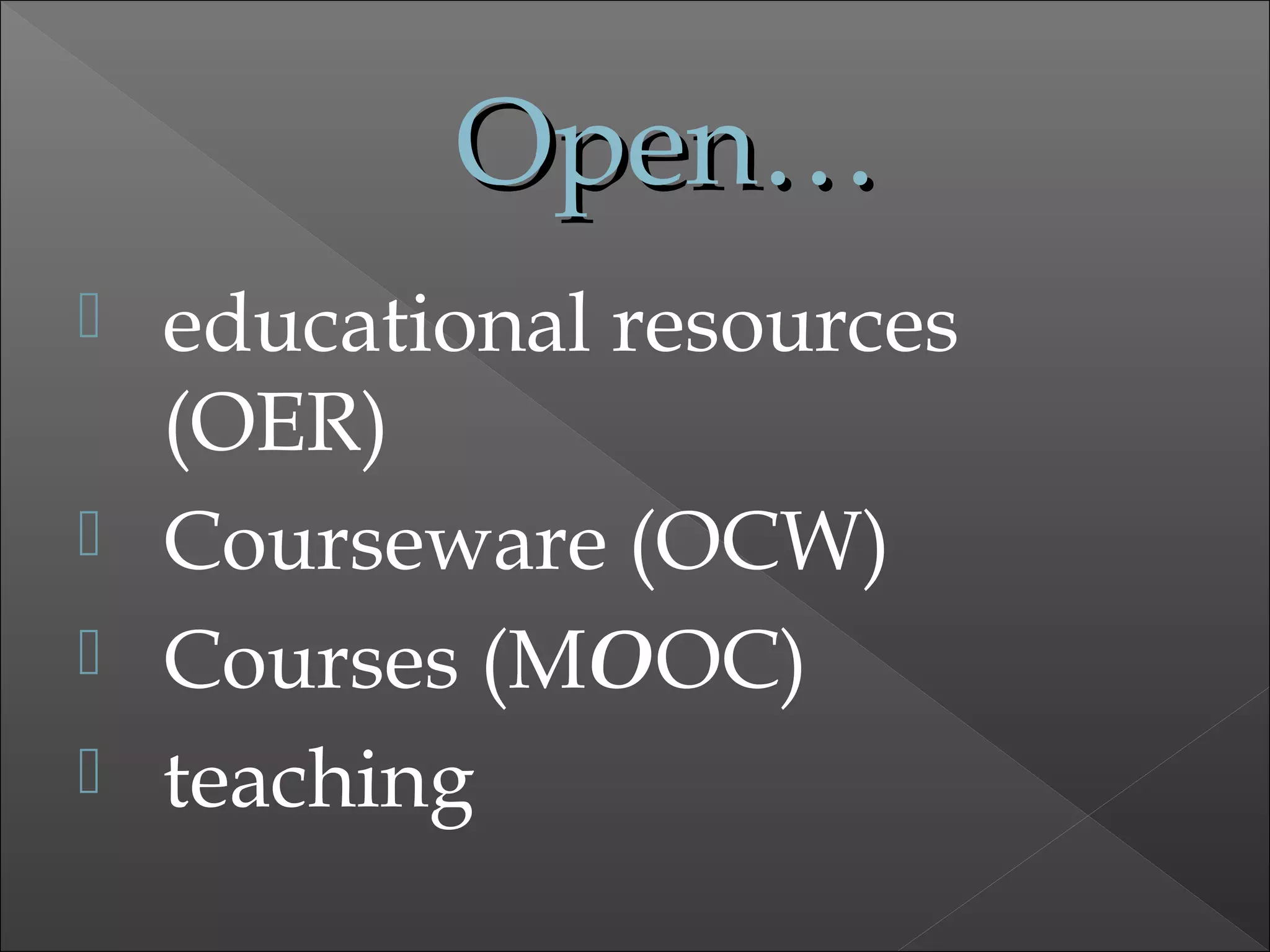
Open…Open…
 educational resources
(OER)
 Courseware (OCW)
 Courses (MOOC)
 teaching
Open…Open…
 learning tools (Moodle)
 Assessment (badges)
 access scholarly communication
 learners
 universities
Why open?Why open?
 Cost and flexibility
 Improving content, learning
 Outreach and visibility
 Participate in innovation
Open and liberal educationOpen and liberal education
 Early adopter phase
 Ex: OA - Trinity, Oberlin, Bucknell,
Hope
 Why not mainstream?
› Awareness
› Less cost pressure
› Wrong scale
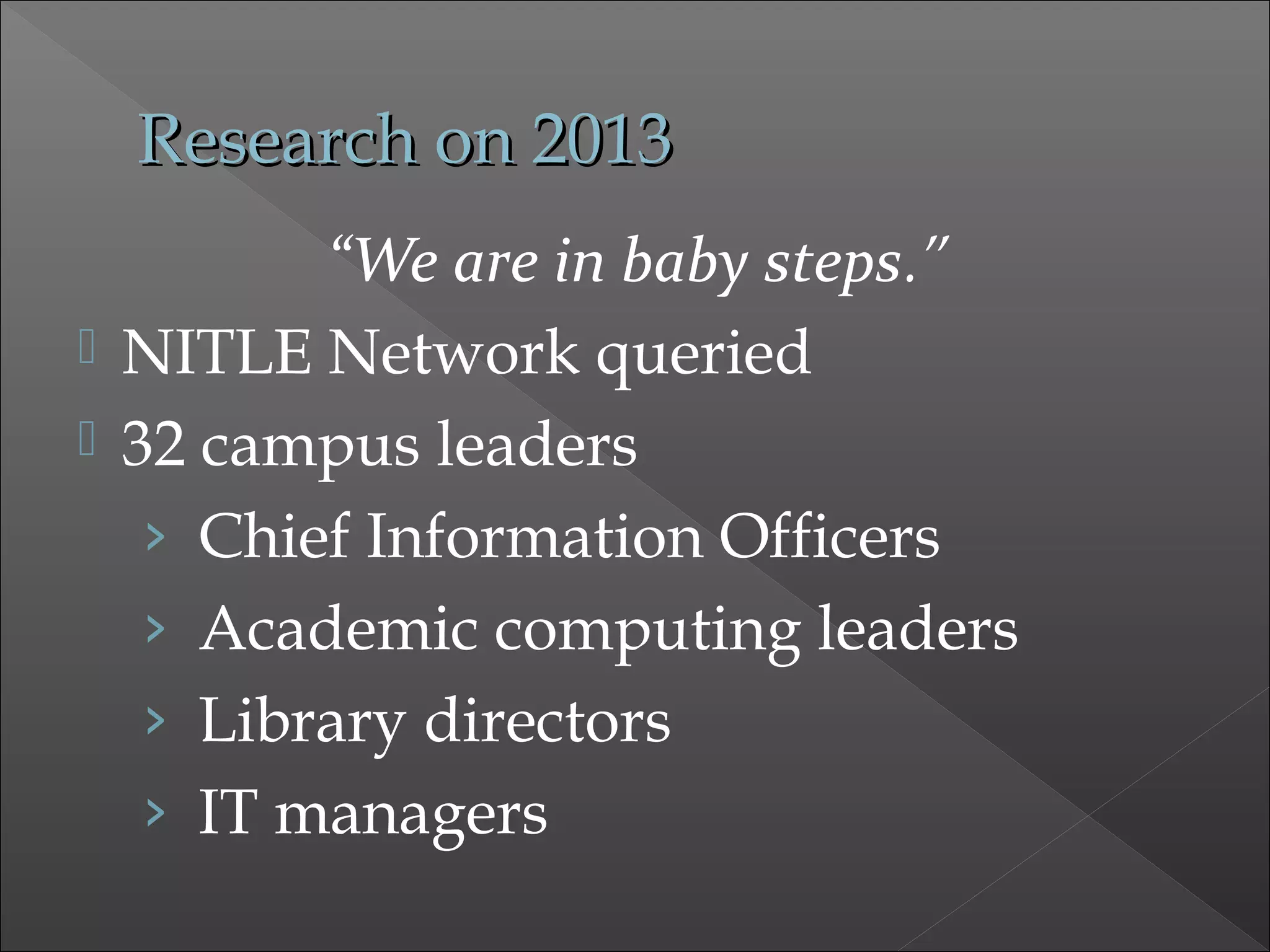
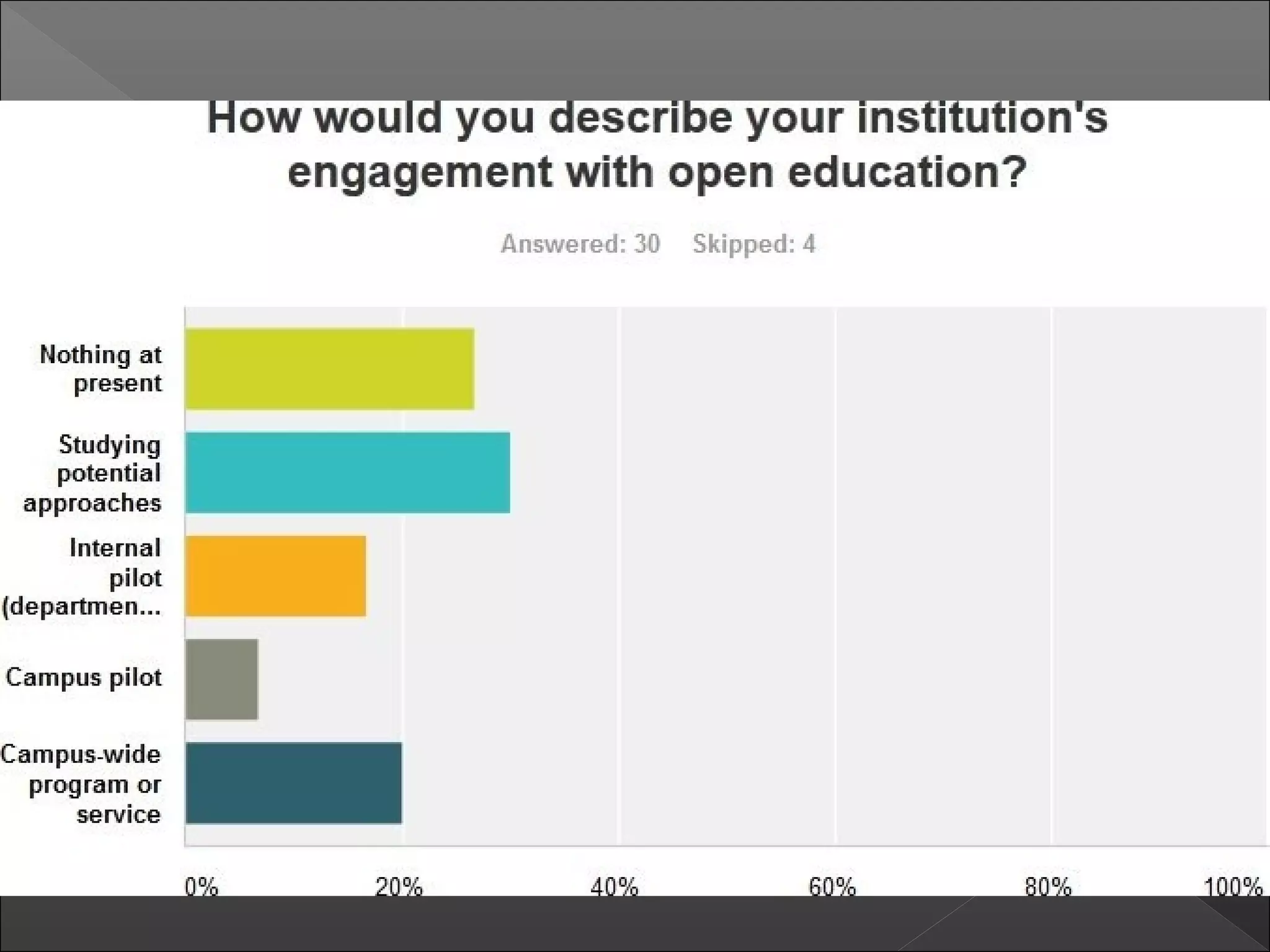
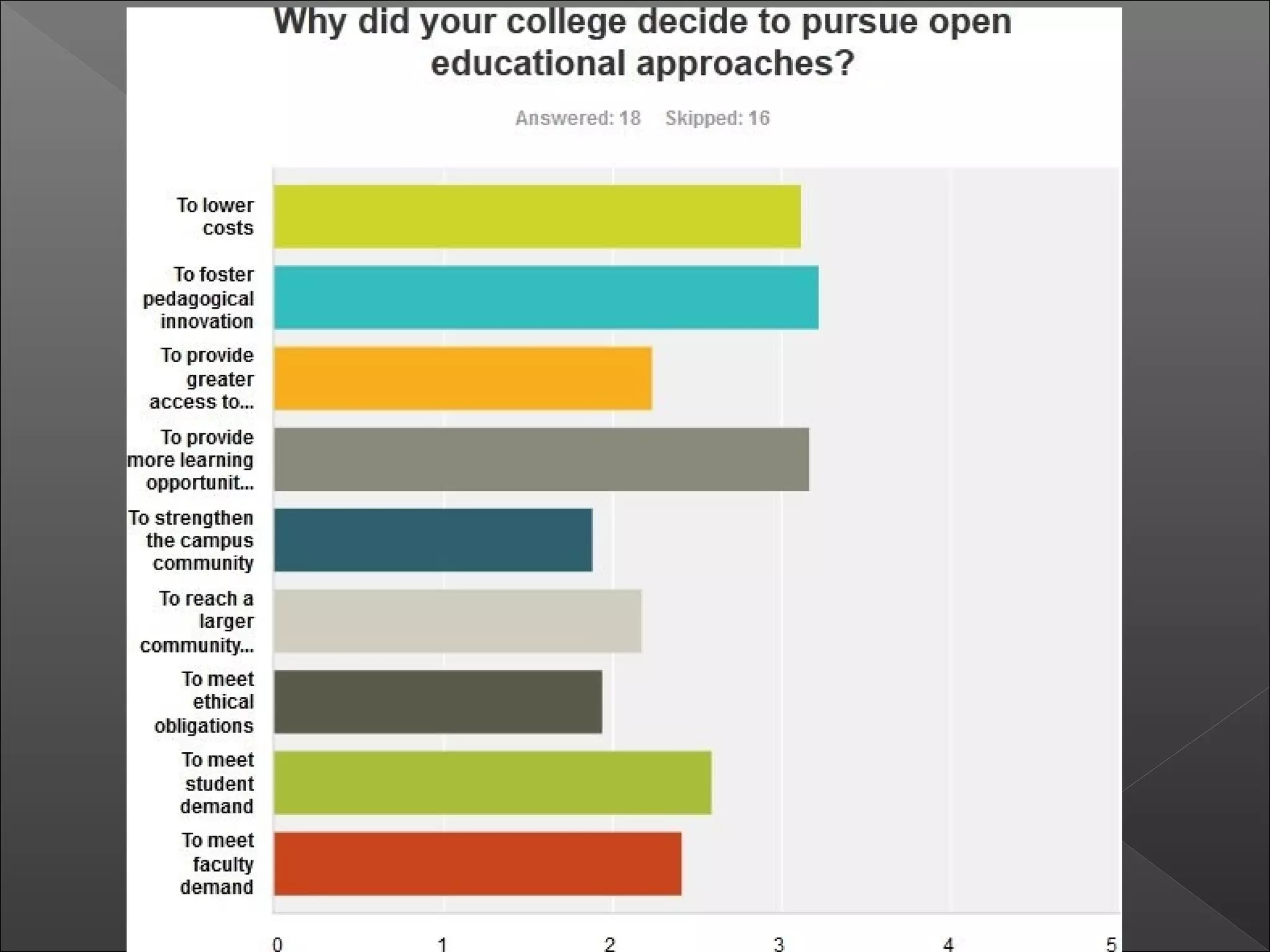
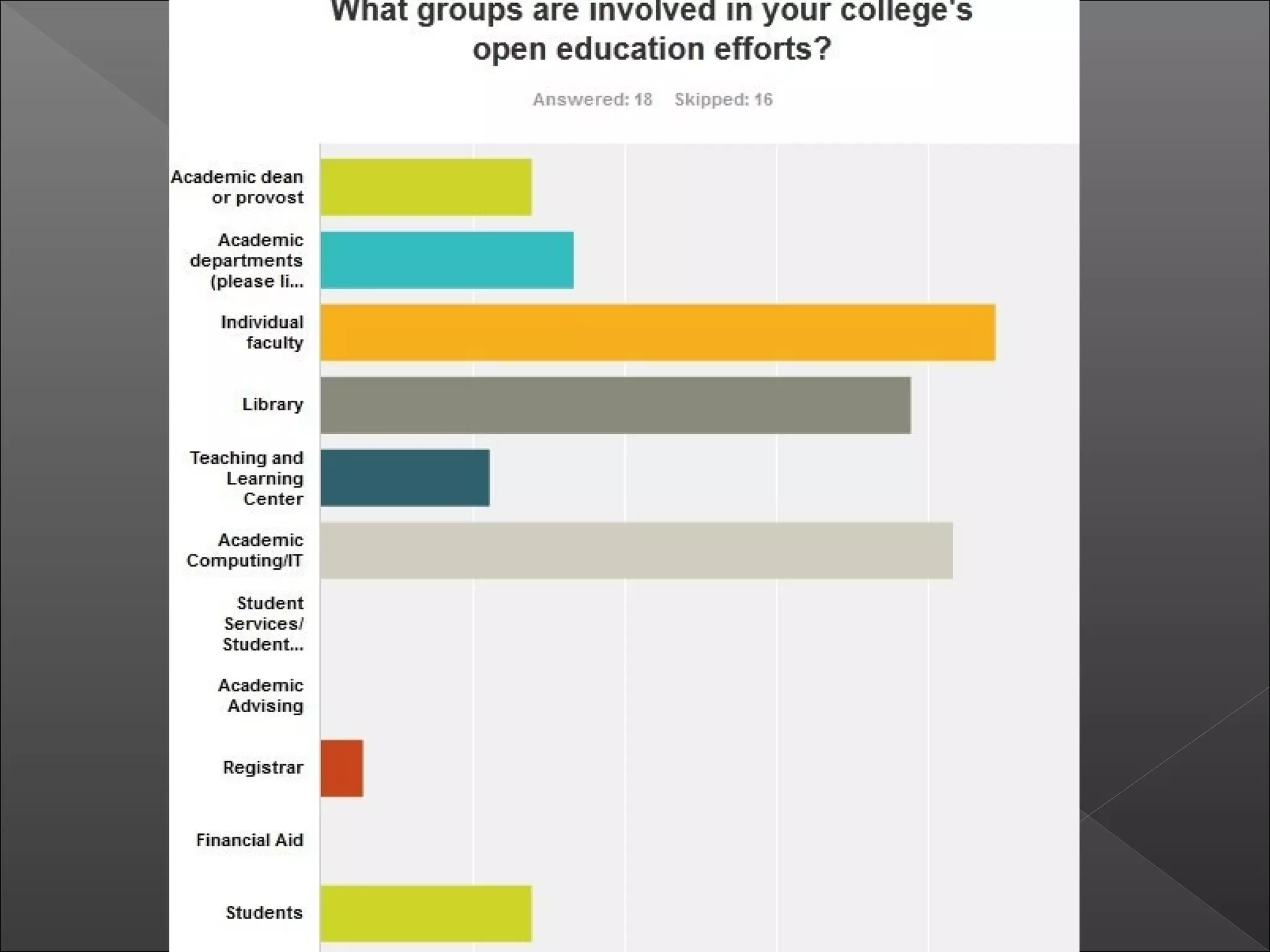
Research on 2013Research on 2013
“We are in baby steps.”
 NITLE Network queried
 32 campus leaders
› Chief Information Officers
› Academic computing leaders
› Library directors
› IT managers
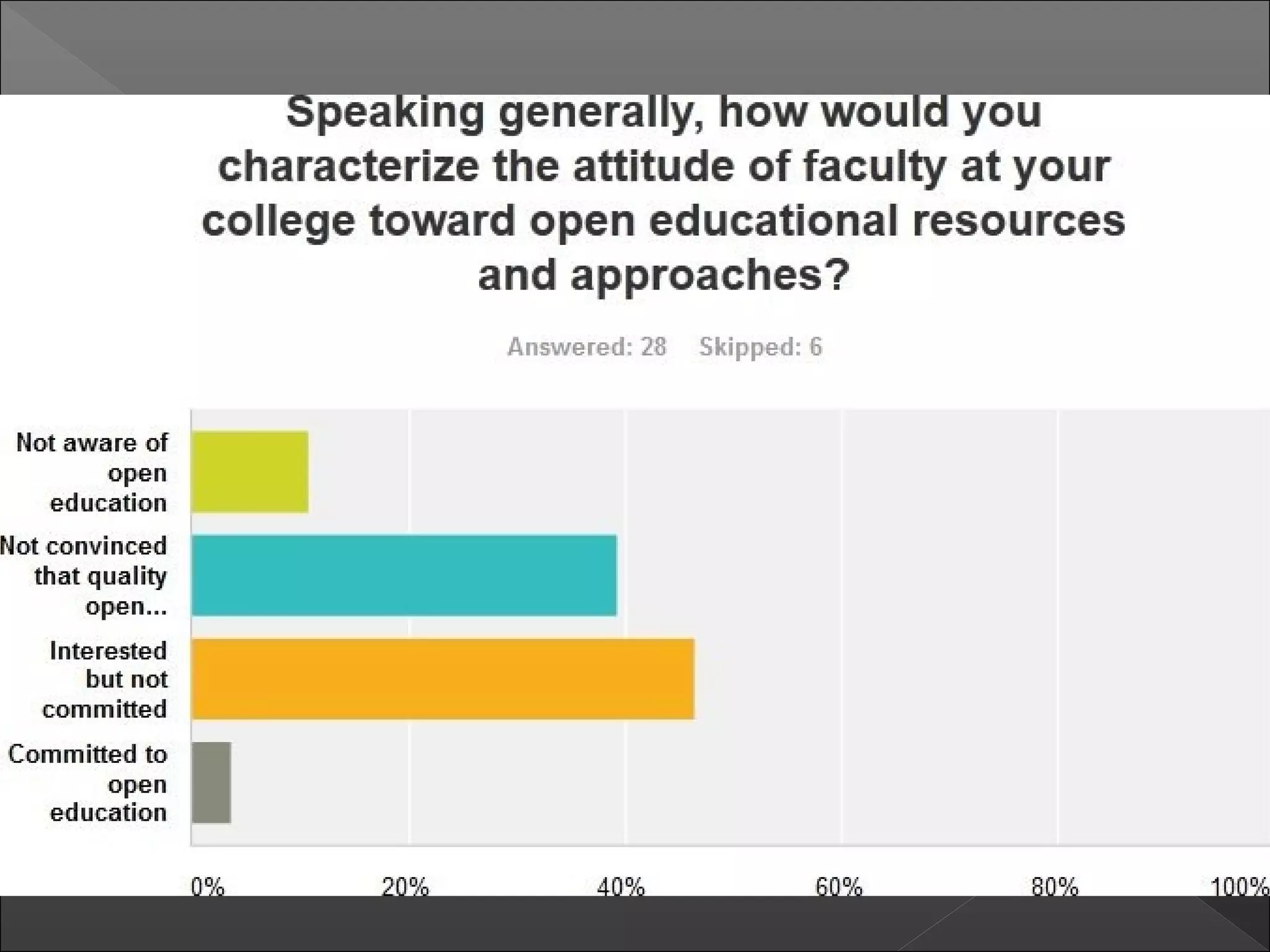
Why is your institution not pursuing
open education at this time?
 My institution lacks awareness of open
education
 My institution does not see open
education as being in its strategic
interest
 Open education is best pursued at the
faculty level, not the institution-level
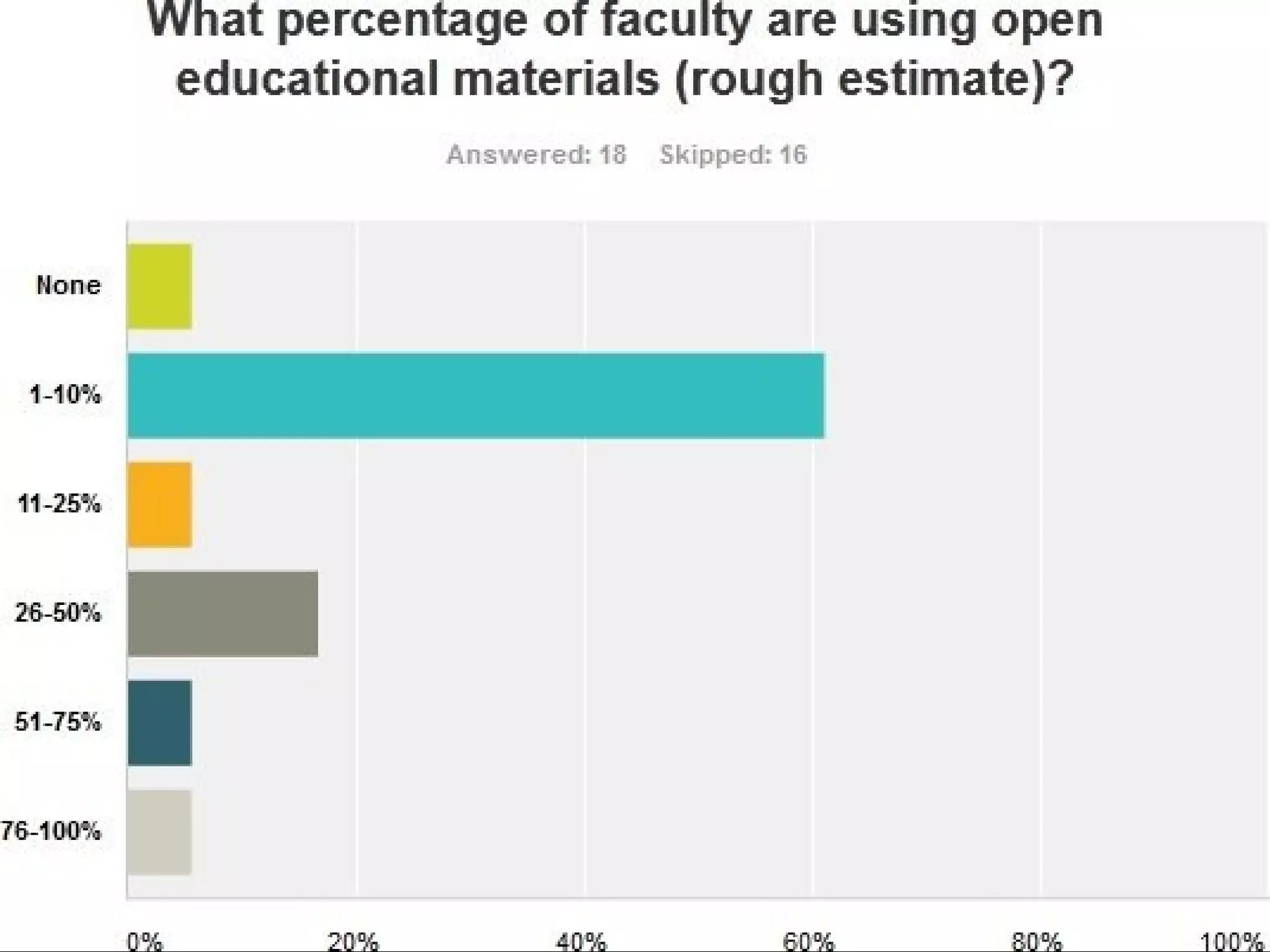
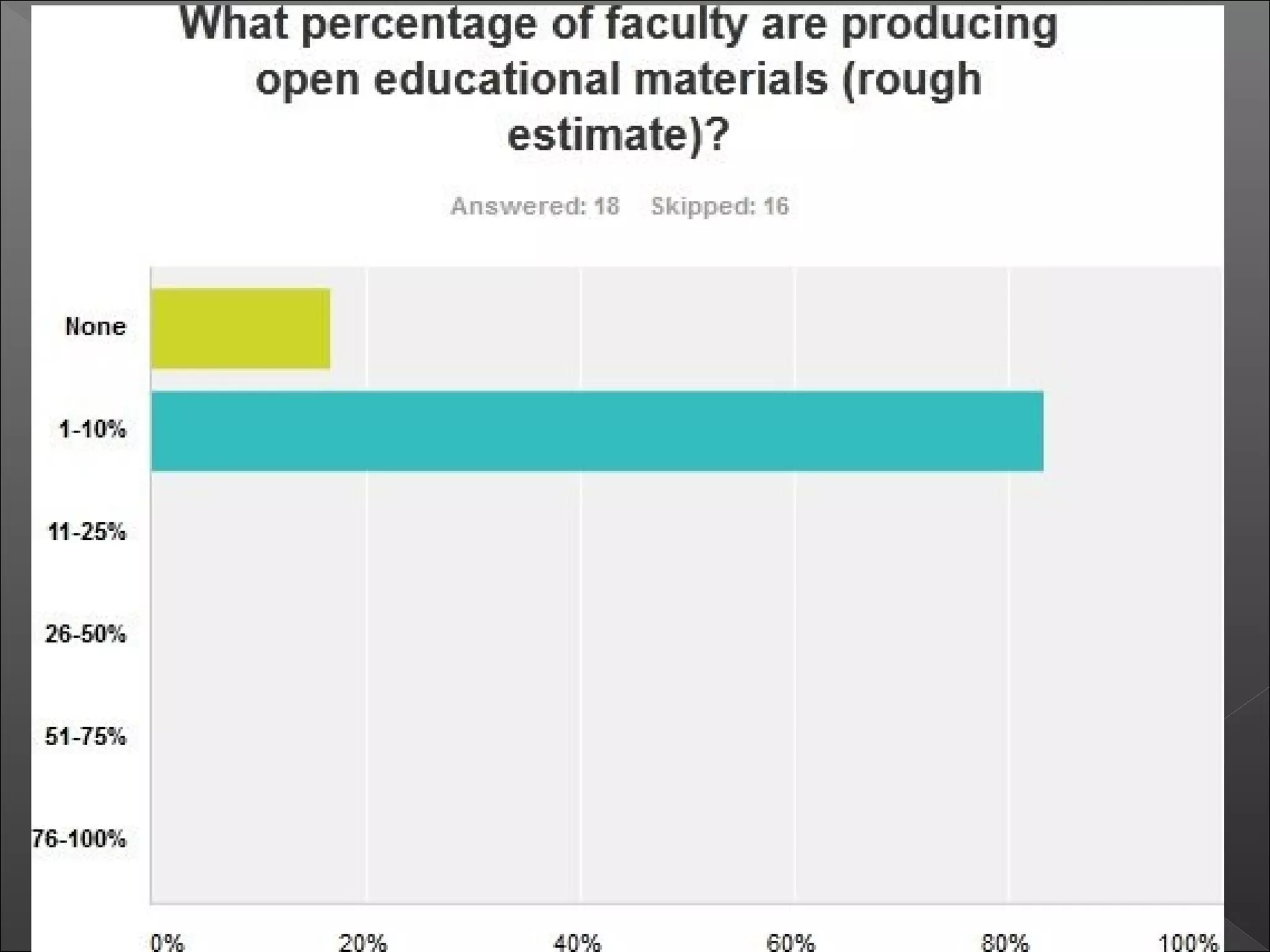
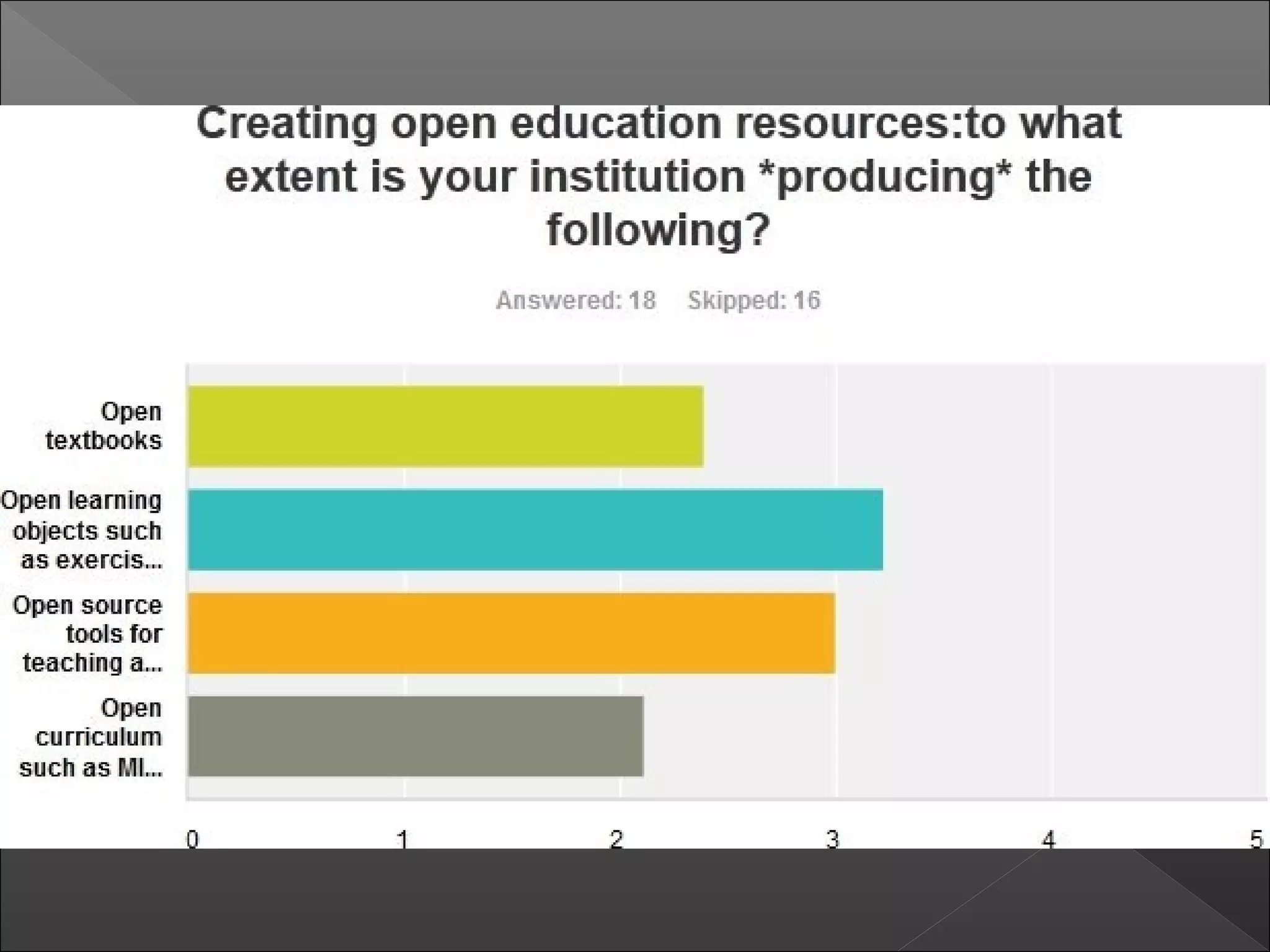
Why no LA engagement until now?Why no LA engagement until now?
Usage
 Awareness
 Quality concerns
 Inertia
 Specific OER
 Etextbooks
Production
 IP concerns
 Sustainability
 Faculty time
So why now?So why now?
• Technologies all mature
• Growing concerns about
equity
• “ “ “ globalization
Student cultureStudent culture
 Desire for open content
 Experience of open content
 Financial pressure of post-
2008 world
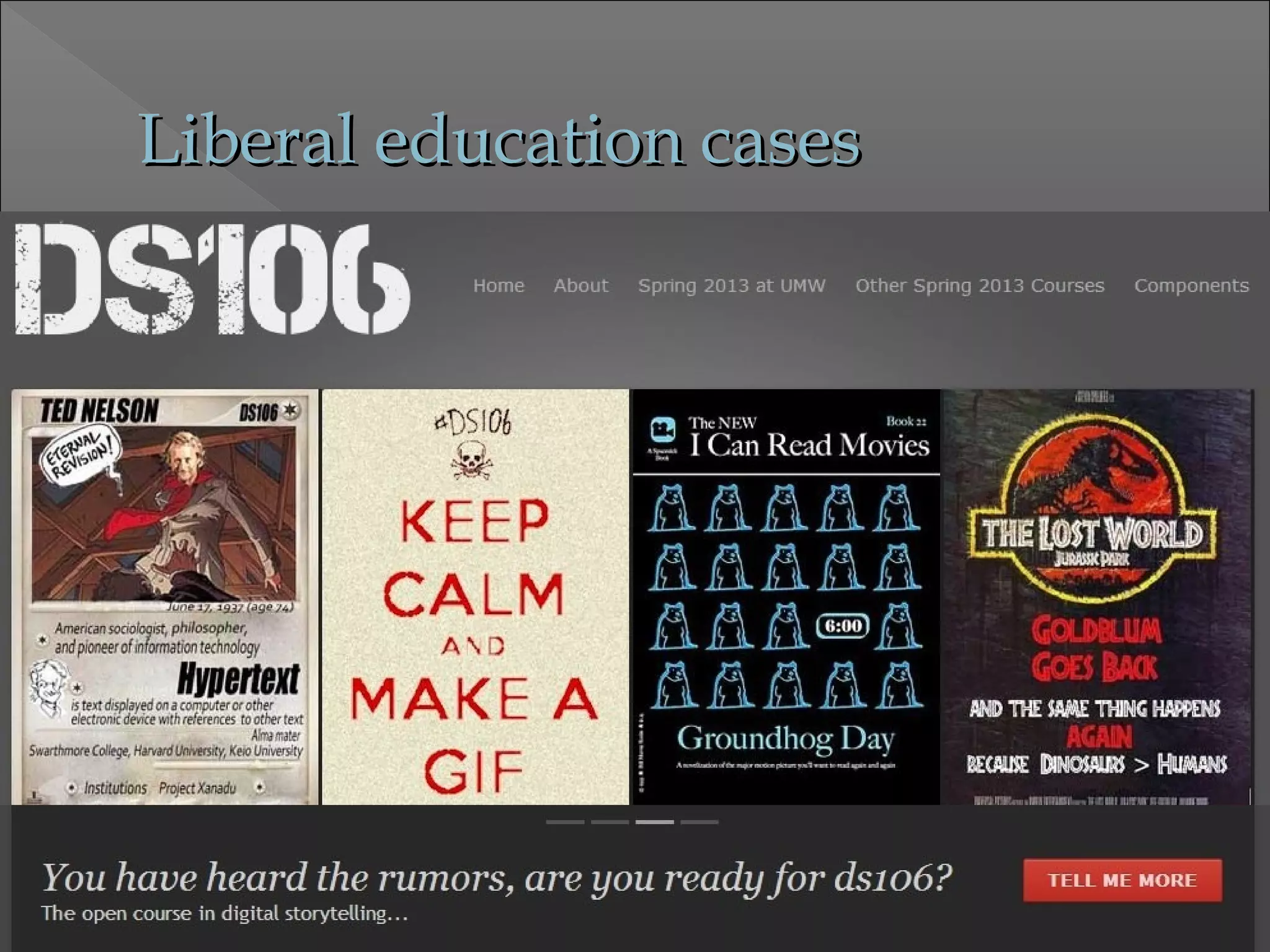
Liberal education casesLiberal education cases
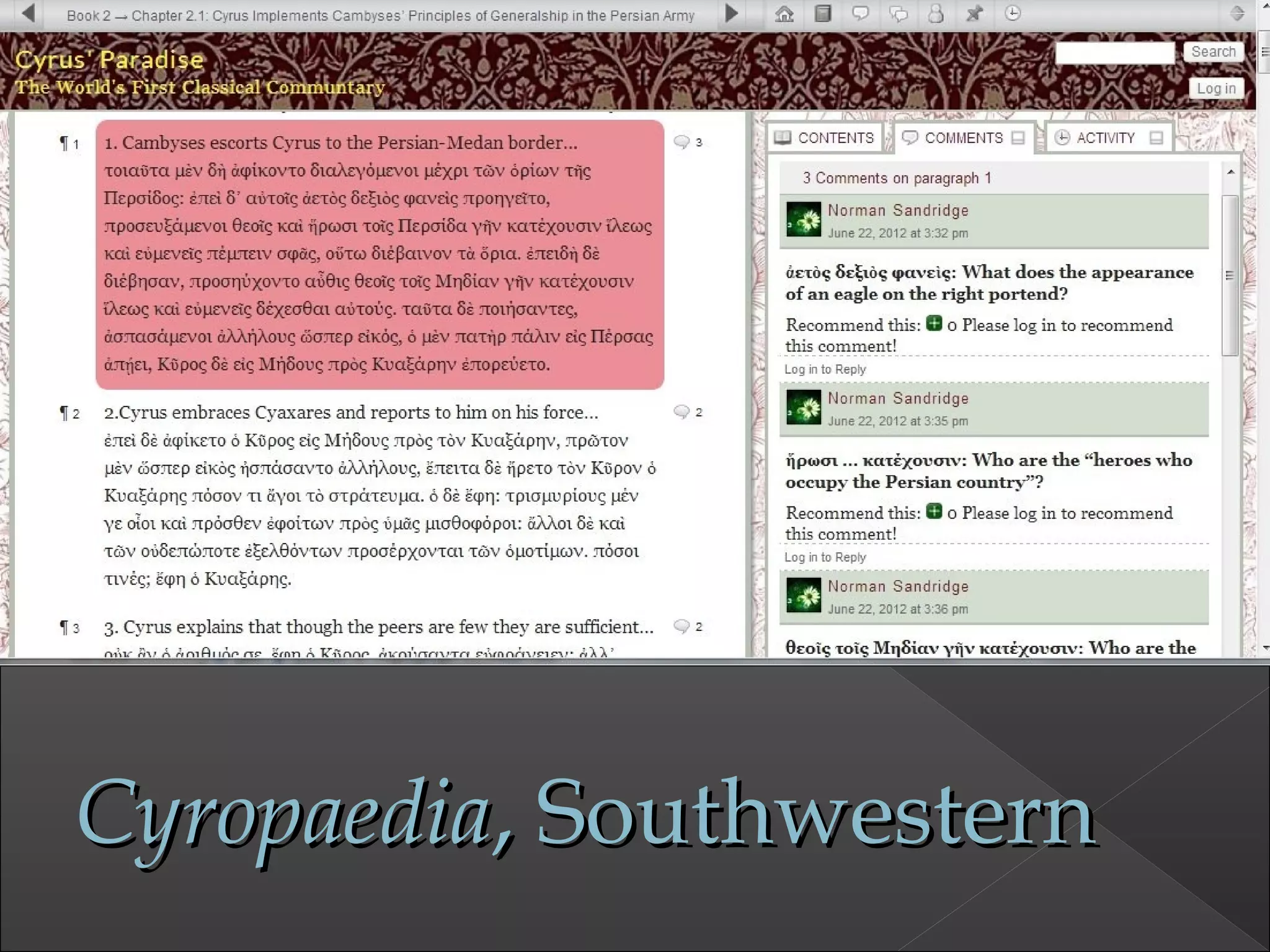
CyropaediaCyropaedia, Southwestern, Southwestern
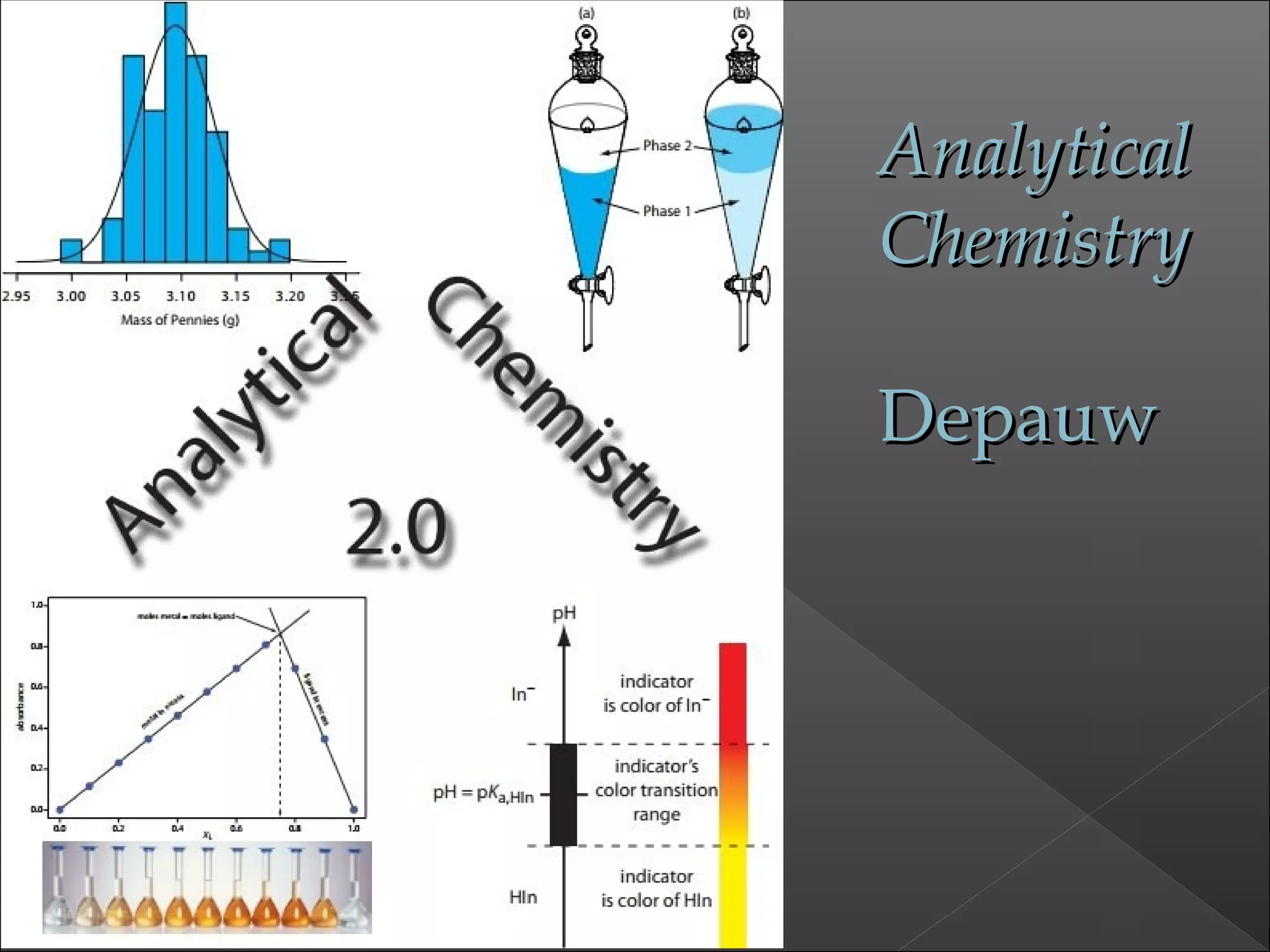
AnalyticalAnalytical
ChemistryChemistry
DepauwDepauw
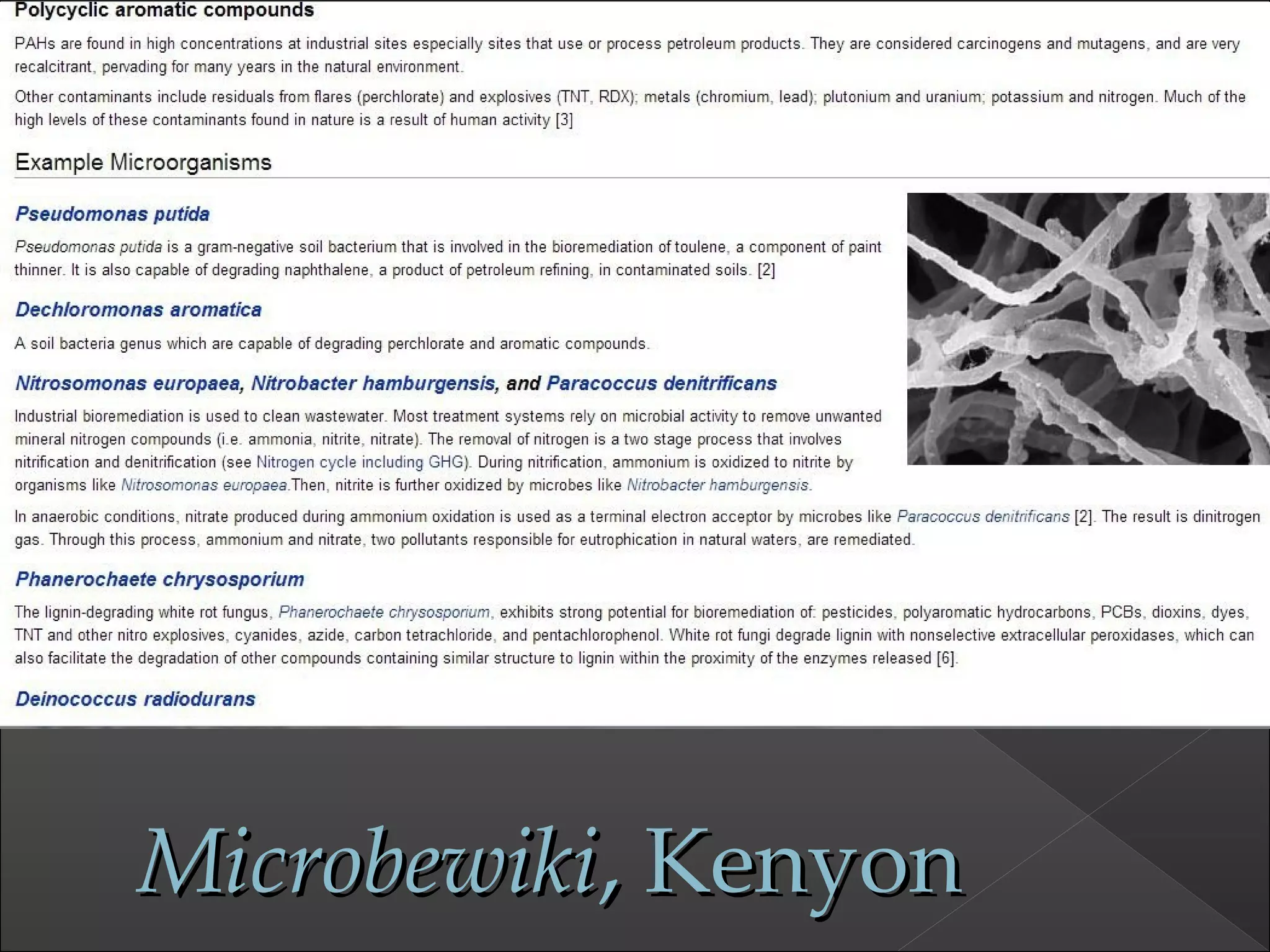
MicrobewikiMicrobewiki, Kenyon, Kenyon
OA mandatesOA mandates
 Trinity University led
the way - 40%+
adoption
The open revolutionThe open revolution
 Open source software
 Example: CLAMP (
https://cme.clamp-it.or
)
RecommendationsRecommendations
 Strategic rationale
 Multiple campus populations
 Upper-level institutional
support
 Awareness
RecommendationsRecommendations
 Rewards and incentives
 Pilots
 Experiment pedagogically
 Explore sustainability
models
The library role
• Informing the community
• Maintaining repository
• Helping faculty find
appropriate, high quality
materials
• Advocating for open access
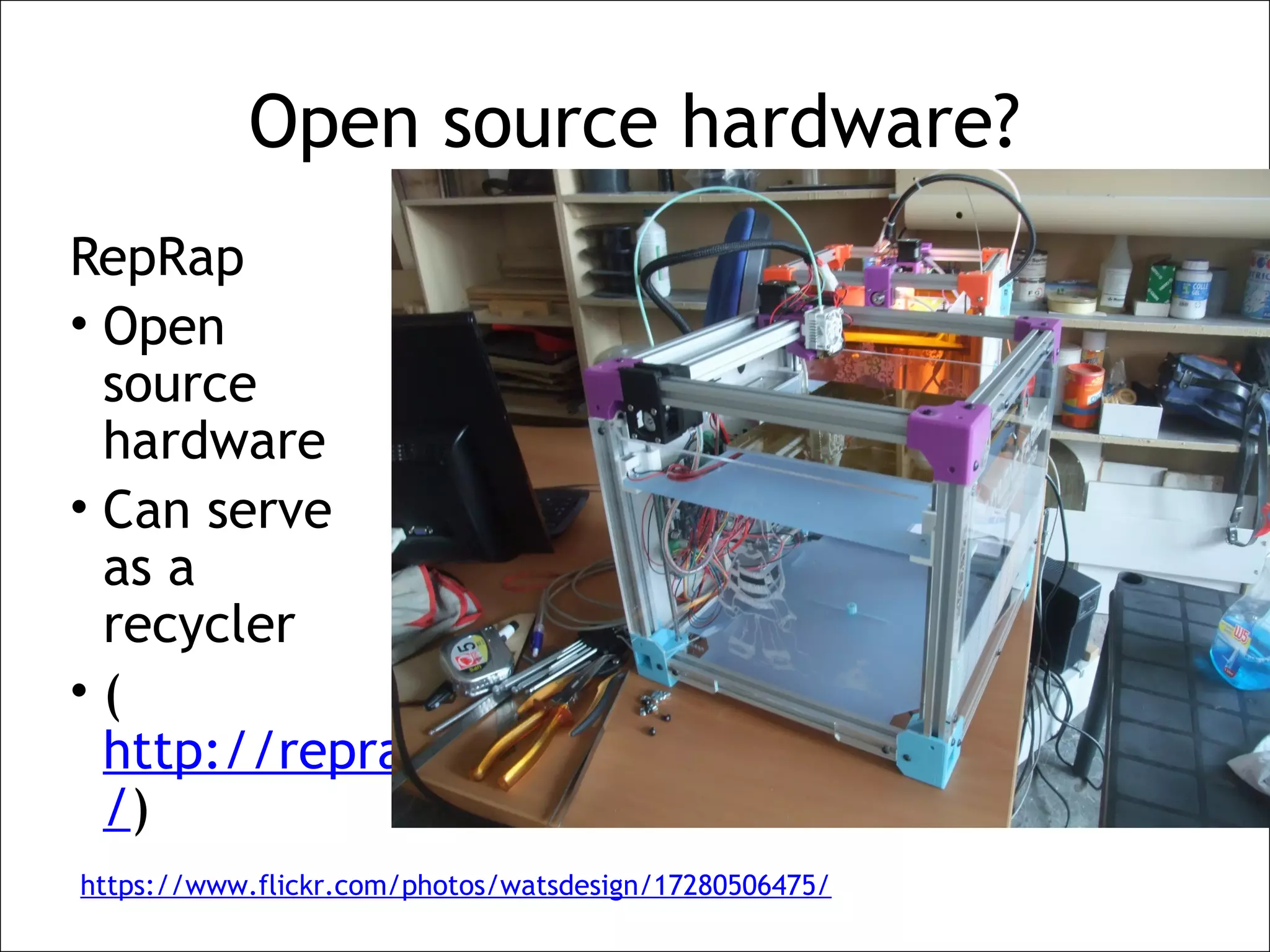
Open source hardware?
RepRap
• Open
source
hardware
• Can serve
as a
recycler
• (
http://reprap.org
/)
https://www.flickr.com/photos/watsdesign/17280506475/
One huge implication
Artificial intelligence has open
education to draw upon
http://bryanalexander.orghttp://bryanalexander.org
bryan.alexander@gmail.combryan.alexander@gmail.com
http://twitter.com/bryanalexanderhttp://twitter.com/bryanalexander

Embracing the Unexpected Challenges Posed by Liberal Education's Success

  • 1.
  • 2.
    Why We AreDoing This Panel  Different background experiences leading to  Common shared  celebration of liberal ed success  concern about challenges to traditional model of higher ed  and defensive responses from contemporary stakeholders
  • 3.
    The Challenges  Challengesposed by successful responses to previous “higher education crisis” phases  Challenges posed by successful internationalization  Challenges posed by successful incorporation of technical competence
  • 4.
    What this panelis not  Yet another session about the apocalypse facing higher education
  • 5.
    What this panelis  A plea/invitation to  a positive discussion of  challenges to  the  traditional model of  higher education  brought about by its success  with  a spirit of stewardship for future generations of students and faculty
  • 6.
  • 7.
    Higher ed crisisin America! (?)  The Challenge: • Experts predict that between ten percent and thirty percent of America’s 3100 colleges and universities will close their doors or merge with other institutions…On many campuses the fear of imminent contraction or demise is almost palpable…The specter lurks in colleges and universities of all sizes, public as well as private, although smaller private colleges and the academically weaker state colleges and community colleges are widely expected to be the worst hit. Indeed, hundreds of college and a few universities are already near an end.”
  • 8.
    The problem: Thatwas 1983  George Keller, Academic Strategy  Crisis of late 1970s-early 1980s  Challenges:  demographic dip  over expansion from 1960s  flat stock markets
  • 9.
    Response to theprevious “Crisis”  Demographic dip——changing enrollment strategies  over expansion——changing infrastructure  1970s economy——changing development and endowment management
  • 10.
    TODAY  Challenges—-  Debt—-Studentand institutional  Price/value proposition—-question of the cost  Adjunctification  Particular challenges to liberal arts colleges— vulnerability as compared to comprehensive and state institutions with their own particular challenges
  • 11.
    The greatest threat My argument:  The greatest threat to liberal arts colleges in the current environment is failure to recognize that they are businesses, whose business model is potentially threatened by changes in current environment  Emphasis on liberal arts colleges being “different” because of  mission  tradition of shared governance  This can lead to grave failure to recognize threats and adapt
  • 12.
     How dowe think our way out of this current situation?
  • 13.
    Disruption  Liberal artscolleges are “content bundlers”—-their business model hinges on “bundling” together a number of fixed costs in one package  “Content bundlers” are under incredible stress as consumers try to pry the pieces they want loose and only pay for the parts they want
  • 14.
    Core questions: • Howshould colleges and universities not just adjust, but fundamentally rethink their strategies accordingly? How can they find ways to take advantage of this new environment? • How do these changes place stress on the core business model of the college or university? • My answer: don’t focus on how liberal arts colleges are different from other for profit and not-for-profit businesses. Instead, ask what can we learn when we focus on what they have in common? • What’s the institution’s unique competitive advantage? What forces are going to influence the institution’s strategic position?
  • 15.
    Viewing the challengein a different way  Michael Porter “The Five Forces”—  Competition with established rivals  Threats from new entrants to the market  Bargaining power of suppliers  Bargaining power of buyers  Threat of substitutes
  • 16.
    Viewing disruption throughPorter’s Five Forces
  • 17.
    Challenge of “disruption” Challenge for business models of liberal arts colleges come from:  Threat of substitutes (online, mostly)  Bargaining power of buyers—-price sensitivity, desire to purchase the pieces of the degree credit hours elsewhere  Not a bricks versus clicks argument, but rather threat of pieces of the degree being bought elsewhere.  Disruption and content unbundling in the newspaper and publishing industries
  • 18.
    Key takeaways • Faculty,administrators, and trustees need to understand how their institutions are not immune from strategic imperatives of competitive forces that challenge key assumptions upon which their business models are formed. • Responsible stewardship requires adjusting and adapting by challenging fundamental assumptions and values, regardless of who is upset. • Educating stakeholders to embrace rather than resist • Difference between “failure is not an option” versus “failure cannot happen”
  • 19.
     Embracing thepotential of technology, collaboration, and internationalization not as threats but as ways to grow the business model of liberal arts colleges  We’ve worked our way through many types of crisis before. Secret now is to not shy away from core threats or treat them with old strategies, but embrace new thinking and approaches.
  • 20.
  • 21.
    The Liberal Ed- Liberal Dem Connection  "The approach to higher learning that best serves individuals, our globally engaged democracy and an innovating economy is liberal education." —AAC&U Board of Directors, 2002  AACU “What is a 21stCenturyLiberalEducation?”
  • 22.
    The Challenge ofInternationalization  We have opened our doors…  but to Which Democratic Values?  What Happens when Liberal Education leaves the symbiotic confines of Liberal Democracy?
  • 23.
    Successes: U.S. BranchCampuses Abroad, 2015 Freedom House Score Count Perce nt Free 37 45.1 Partially Free 17 20.7 Not Free 28 34.1 Total 82 Sources: Freedom House; SUNY Albany’s Global Higher Education http ://www.globalhighered.org/branchcampuses.php
  • 24.
    Success: Internationalization Trends 974,926 international students attend US universities 2014/15 ( www.iie.org, Open Doors)  304, 467 US Students abroad 2013/14  Delaware, 2014: 935,614 (census.gov)  1 congressman and 2 senators  =1.5 Vermonts, btw…
  • 25.
    An Increasingly IlliberalWorld  Freedom House 2015: 54% of countries  are partially  or not free.  Law and Versteeg (2013): Steady, consistent decline of U.S. Constitutional values around the world since 1946. (David S. Law and Mila Versteeg, “The Declining Influence of the United States Constitution” New York University Law Review 87 (2012): 762)  See also Fareed Zakaria, Illiberal Democracy (and subsequent writings).
  • 26.
    History Did NotEnd: Democracy Evolves  Apologies to Francis Fukuyama (The End of History and the Last Man)  cf.  Robert Kaplan: “Was Democracy Just a Moment?” (1997)
  • 27.
    Global Challenges I “The assumption is that you can only be a great educational and research power if you do it the American way. I think you could be proved very wrong and it may be too late when you find out.”  Ian Gow, 2009 Ian Gow, principal and chief executive of the Sino-British College in Shanghai and former provost of the University of Nottingham’s campus in Ningbo. http://www.timeshighereducation.co.uk/features/chin
  • 28.
    Global Challenges II Yale-NUS cannot simply be a “carbon copy” of Yale’s American campus. Instead, the university “needs a curriculum and a college ethos that respond to the regional context of Asia.”  Singaporean Prime Minister Lee Hsien Loong (2015).  http:// www.straitstimes.com/singapore/education/yale-nus-college-has-to-adapt-the-yale-model-to-a
  • 29.
    Global Challenges III “Singapore's Venture With  Yale to Limit Protests” ( http:// www.wsj.com/articles/SB10001424052702303933704577530524046581142 )
  • 30.
    Global Challenges IV Turkey academics held for criticism of army  offensive (BBC 16  January 2016)
  • 31.
    Global Challenge V The Flag that did not fly over the US Consulate in Dubai, June, 2013 (U.S. v. Windsor)
  • 32.
    Challenges at Home:Speech?  University of Illinois  censured for pulling  professor's job offer over  anti­Israel tweets  (USAToday 18 June 2015)
  • 33.
    Challenges at Home:Integrity  In one study, the University of Windsor in the Canadian province of Ontario tracked how many foreign students were being cited for academic  dishonesty compared with their Canadian classmates. It found that one in 53 international students had been charged versus one in 1,122 Canadians. (timeshighereducation.com 6 Oct 2011)
  • 34.
    Barbarianization of LiberalEd?  What will the American Model look like in a generation?  Liberal values in an increasingly illiberal marketplace?  Which version of Yale will survive?  Accreditation concerns? Odoacer, 476-493 A.D.
  • 35.
  • 36.
    The open movement andliberal education AAC&U annual conference Snowpocalypse 2016
  • 37.
    Liberal education andopenLiberal education and open My thesis: open education has developed to a sufficient level where liberal arts institutions can - and should - participate.
  • 38.
    The open revolutionTheopen revolution  Open education  Open access scholarship  Open source software
  • 39.
    DefinitionsDefinitions “Open education isabout sharing, reducing barriers and increasing access in education. It includes free and open access to platforms, tools and resources in education (such as learning materials, course materials, videos of lectures, assessment tools, research, study groups, textbooks, etc.)…”
  • 40.
    “…Open education seeksto create a world in which the desire to learn is fully met by the opportunity to do so, where everyone, everywhere is able to access affordable, educationally and culturally appropriate opportunities to gain whatever knowledge or training they desire.” “About Open Education,” Open Education Week, February 2012, http://www.openeducationweek.org/about-open-education/.
  • 41.
    Open…Open…  educational resources (OER) Courseware (OCW)  Courses (MOOC)  teaching
  • 42.
    Open…Open…  learning tools(Moodle)  Assessment (badges)  access scholarly communication  learners  universities
  • 43.
    Why open?Why open? Cost and flexibility  Improving content, learning  Outreach and visibility  Participate in innovation
  • 45.
    Open and liberaleducationOpen and liberal education  Early adopter phase  Ex: OA - Trinity, Oberlin, Bucknell, Hope  Why not mainstream? › Awareness › Less cost pressure › Wrong scale
  • 46.
    Research on 2013Researchon 2013 “We are in baby steps.”  NITLE Network queried  32 campus leaders › Chief Information Officers › Academic computing leaders › Library directors › IT managers
  • 54.
    Why is yourinstitution not pursuing open education at this time?  My institution lacks awareness of open education  My institution does not see open education as being in its strategic interest  Open education is best pursued at the faculty level, not the institution-level
  • 55.
    Why no LAengagement until now?Why no LA engagement until now? Usage  Awareness  Quality concerns  Inertia  Specific OER  Etextbooks Production  IP concerns  Sustainability  Faculty time
  • 56.
    So why now?Sowhy now? • Technologies all mature • Growing concerns about equity • “ “ “ globalization
  • 57.
    Student cultureStudent culture Desire for open content  Experience of open content  Financial pressure of post- 2008 world
  • 58.
  • 59.
  • 60.
  • 61.
  • 62.
    OA mandatesOA mandates Trinity University led the way - 40%+ adoption
  • 63.
    The open revolutionTheopen revolution  Open source software  Example: CLAMP ( https://cme.clamp-it.or )
  • 64.
    RecommendationsRecommendations  Strategic rationale Multiple campus populations  Upper-level institutional support  Awareness
  • 65.
    RecommendationsRecommendations  Rewards andincentives  Pilots  Experiment pedagogically  Explore sustainability models
  • 66.
    The library role •Informing the community • Maintaining repository • Helping faculty find appropriate, high quality materials • Advocating for open access
  • 67.
    Open source hardware? RepRap •Open source hardware • Can serve as a recycler • ( http://reprap.org /) https://www.flickr.com/photos/watsdesign/17280506475/
  • 68.
    One huge implication Artificialintelligence has open education to draw upon
  • 69.

Editor's Notes

  • #24 Sources: Freedom House; SUNY Albany’s Global Higher Education  (http://www.globalhighered.org/branchcampuses.php)