GRANT & COOPERATIVE AGREEMENTS
POSITIONING STRATEGY 2008-12
Carlos F. Camargo, PhD
Director of Foundations Relations & Development
August 2008
Shelter from the Gathering Storm:
Mapping Needs, Aligning Programs, Inspiring Youth
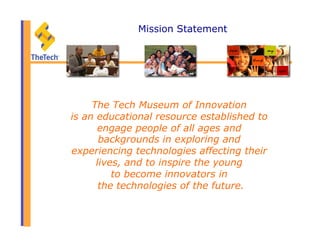
Mission Statement
The Tech Museum of Innovation
is an educational resource established to
engage people of all ages and
backgrounds in exploring and
experiencing technologies affecting their
lives, and to inspire the young
to become innovators in
the technologies of the future.
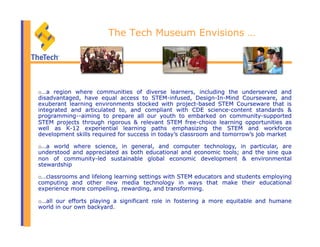
The Tech Museum Envisions …
•  Long term commitment
•  Maintaining focus
•  Capacity building
•  Sustainability
•  Leveraging resources
•  Credibility with stakeholders
•  Evaluation and benchmarking of results
Educational programming
@ The Tech
Strategies advancing the support of STEM education
and free-choice learning at all levels, K-16.
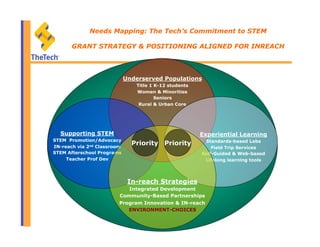
Underserved Populations
Title 1 K-12 students
Women & Minorities
Seniors
Rural & Urban Core
Supporting STEM
STEM Promotion/Advocacy
IN-reach via 2nd Classroom
STEM Afterschool Programs
Teacher Prof Dev
Experiential Learning
Standards-based Labs
Field Trip Services
Self-Guided & Web-based
Lifelong learning tools
In-reach Strategies
Integrated Development
Community-Based Partnerships
Program Innovation & IN-reach
ENVIRONMENT-CHOICES
PriorityPriority
Needs Mapping: The Tech’s Commitment to STEM
GRANT STRATEGY & POSITIONING ALIGNED FOR INREACH
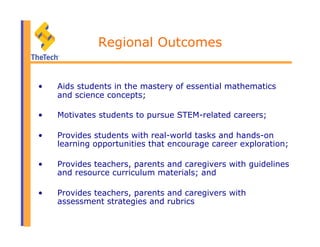
Regional Outcomes
•  Aids students in the mastery of essential mathematics
and science concepts;
•  Motivates students to pursue STEM-related careers;
•  Provides students with real-world tasks and hands-on
learning opportunities that encourage career exploration;
•  Provides teachers, parents and caregivers with guidelines
and resource curriculum materials; and
•  Provides teachers, parents and caregivers with
assessment strategies and rubrics
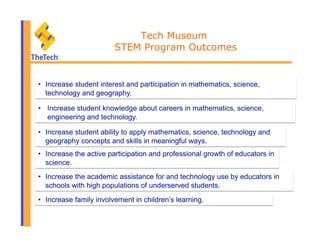
Tech Museum
STEM Program Outcomes
Overview of presentation
•  Origins of STEM Concerns
•  A Different Take on the Data
•  The Deeper Concerns About STEM
STEM Education
As we think about the big picture of STEM
education, we might ask ourselves…
1.  What are the drivers?
2.  What is the context?
3.  What are the issues?
The Drivers
1.  The global, knowledge based economy
2.  The recognition that STEM fields underpin
modern life and our standard of living
3.  The need for all students to be STEM literate
and the need for STEM experts
4.  The need to build a skilled workforce of problem
solvers, innovators and inventors
5.  The need for life long learning
The Context
1.  There are too few students who are choosing to
study math and science beyond the compulsory
school years
2.  This impacts the pool of generic and specialized
skills available
The Issues:
Industry and Academia sound alarms
•  “Regrettably, the American K-12 system is failing to provide
the math and science skills necessary for kids to compete in
the 21st century workforce, and the U.S. higher education
system cannot produce enough scientists and engineers to
support the growth of the high-tech industry that is so
crucial to economic prosperity.”
–  “Losing the Competitive Advantage?,” AeA
•  “Participants expressed concern that a weakening of science
and technology in the United States would inevitably degrade
its social and economic conditions and in particular erode the
ability of its citizens to compete for high-quality jobs.”
–  “Rising Above the Gathering Storm,” The National Academy of Sciences, the National Academy
of Engineering, and the Institute of Medicine of the National Academies
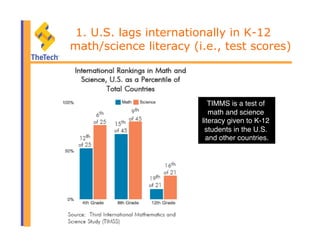
1. U.S. lags internationally in K-12
math/science literacy (i.e., test scores)
TIMMS is a test of
math and science
literacy given to K-12
students in the U.S.
and other countries."
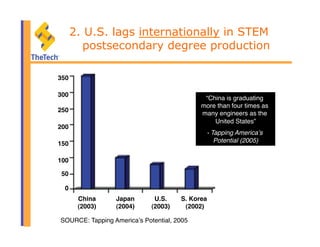
2. U.S. lags internationally in STEM
postsecondary degree production
SOURCE: Tapping Americaʼs Potential, 2005"
50!
100!
150!
200!
250!
300!
350!
0!
China

(2003)!
Japan

(2004)!
U.S.

(2003)!
S. Korea
(2002)!
“China is graduating
more than four times as
many engineers as the
United States”"
- Tapping Americaʼs
Potential (2005)"
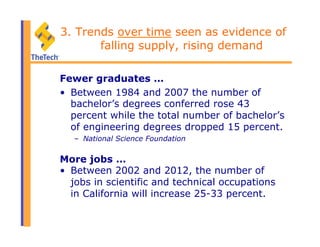
3. Trends over time seen as evidence of
falling supply, rising demand
Fewer graduates …
•  Between 1984 and 2007 the number of
bachelor’s degrees conferred rose 43
percent while the total number of bachelor’s
of engineering degrees dropped 15 percent.
–  National Science Foundation
More jobs …
•  Between 2002 and 2012, the number of
jobs in scientific and technical occupations
in California will increase 25-33 percent.
Scary Trends in
Supply & Demand …
“By 2015, if current trends continue,
more than 90 percent of all scientists
and engineers in the world will be living
in Asia.”
… Lead to Desperate Measures
The U.S. must “double the number
of STEM graduates with bachelor’s
degrees by 2015.”
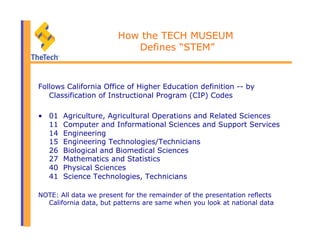
How the TECH MUSEUM
Defines “STEM”
Follows California Office of Higher Education definition -- by
Classification of Instructional Program (CIP) Codes
•  01 Agriculture, Agricultural Operations and Related Sciences
11 Computer and Informational Sciences and Support Services
14 Engineering
15 Engineering Technologies/Technicians
26 Biological and Biomedical Sciences
27 Mathematics and Statistics
40 Physical Sciences
41 Science Technologies, Technicians
NOTE: All data we present for the remainder of the presentation reflects
California data, but patterns are same when you look at national data
Overview of presentation
•  Origins of STEM Concerns
•  A Different View of the Data
•  The Deeper Concerns About STEM
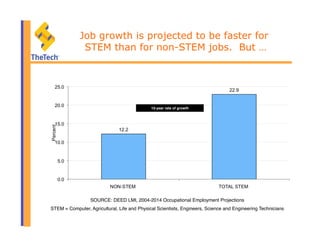
Job growth is projected to be faster for
STEM than for non-STEM jobs. But …
SOURCE: DEED LMI, 2004-2014 Occupational Employment Projections"
STEM = Computer, Agricultural, Life and Physical Scientists, Engineers, Science and Engineering Technicians"
Ten-year growth rate.
10-year rate of growth!
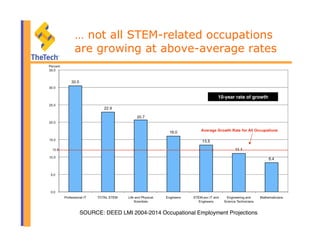
… not all STEM-related occupations
are growing at above-average rates
SOURCE: DEED LMI 2004-2014 Occupational Employment Projections"
10-year rate of growth!
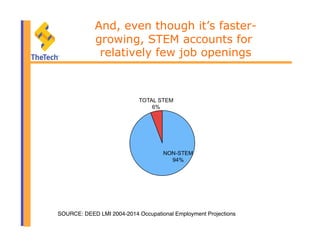
And, even though it’s faster-
growing, STEM accounts for
relatively few job openings
SOURCE: DEED LMI 2004-2014 Occupational Employment Projections"
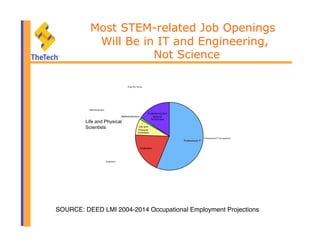
Most STEM-related Job Openings
Will Be in IT and Engineering,
Not Science
SOURCE: DEED LMI 2004-2014 Occupational Employment Projections"
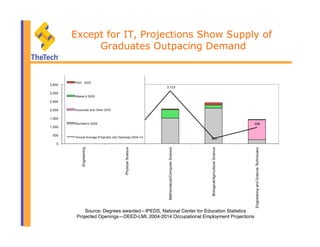
Except for IT, Projections Show Supply of
Graduates Outpacing Demand
Source: Degrees awarded—IPEDS, National Center for Education Statistics"
Projected Openings—DEED-LMI, 2004-2014 Occupational Employment Projections
National Data Shows Similar
Deterriorating Pattern
“Although I know you routinely are told by corporate lobbyists that
their R&D is being globalized in part due to shortages of scientists and
engineers in the U.S., no one who has studied this matter with an
open mind has been able to find any objective data of such general
shortages."
-- Michael S. Teitelbaum,VP of Alfred P. Sloan Foundation,
testifying before Congress on Nov. 7, 2007
Analysis of the flow of students up through the S&E pipeline, when it
reaches the labor market, suggests the education system produces
qualified graduates far in excess of demand: S&E occupations make
up only about one-twentieth of all workers, and each year there are
more than three times as many S&E four-year college graduates as
S&E job openings.
-- Urban Institute, October 2007
http://www.urban.org/publications/411562.html
So What Are the Deeper Issues?
•  Not all STEM is equal – current data do predict
significant workforce shortage in IT
•  It is believed that supply of STEM-prepared
students will drive job creation in U.S.
• a “supply side” strategy
Overview of presentation
•  Origins of STEM Concerns
•  A Different View of the Data
•  The Deeper Concerns About STEM
“Supply-side” strategy
Fields of math and science are “strategically critical”
“Losing America’s Competitive Advantage” (2007), AeA
•  “As countries catch up to the United States in science and
engineering and as they diffuse technology to promote
innovation and enhance competitiveness, the possibility
that the next breakthrough technologies will be born
abroad is ever more likely.”
•  “As more countries liberalize capital markets, lower tariffs
and other trade barriers, and pursue less interventionist
regulatory policies, the tipping point in choosing where
to locate the next cluster of innovation will be the
education and skill level of the workforce.”
So What Are the Deeper Issues?
•  Not all STEM is equal – current data do predict
significant workforce shortage in IT
•  It is believed that supply of STEM-prepared
students will drive job creation in U.S.
–  a “supply side” strategy
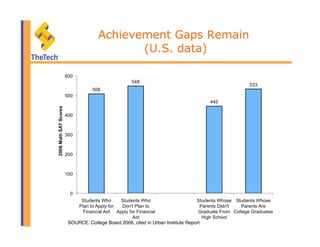
•  Achievement gaps remain
Achievement Gaps Remain
(U.S. data)
SOURCE: College Board 2006, cited in Urban Institute Report"
So What Are the Deeper Issues?
•  Not all STEM is equal – current data do predict
significant workforce shortage in IT
•  It is believed that supply of STEM-prepared
students will drive job creation in U.S.
–  a “supply side” strategy
•  Achievement gaps remain
•  STEM literacy is important for student success
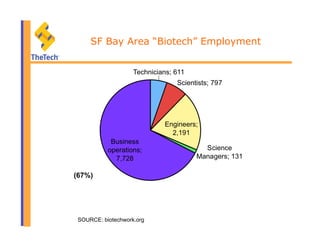
SOURCE: biotechwork.org
(67%)
SF Bay Area “Biotech” Employment
Analyze STEM-related Occupations
  Goal: Learn to what degree non-STEM
occupations require math and science
competency
  Used data from O*NET Resource Center
http://www.onetonline.org
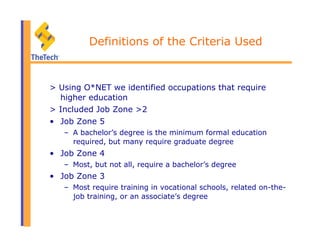
Definitions of the Criteria Used
> Using O*NET we identified occupations that require
higher education
> Included Job Zone >2
•  Job Zone 5
–  A bachelor’s degree is the minimum formal education
required, but many require graduate degree
•  Job Zone 4
–  Most, but not all, require a bachelor’s degree
•  Job Zone 3
–  Most require training in vocational schools, related on-the-
job training, or an associate’s degree
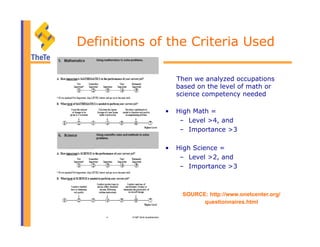
Definitions of the Criteria Used
Then we analyzed occupations
based on the level of math or
science competency needed
•  High Math =
–  Level >4, and
–  Importance >3
•  High Science =
–  Level >2, and
–  Importance >3
SOURCE: http://www.onetcenter.org/
questionnaires.html
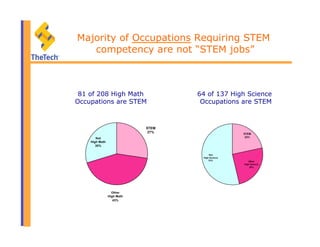
Majority of Occupations Requiring STEM
competency are not “STEM jobs”
81 of 208 High Math
Occupations are STEM
64 of 137 High Science
Occupations are STEM
Based on DEED-LMI
2004-2014 Employment
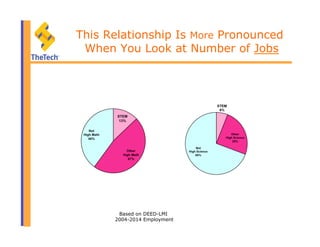
This Relationship Is More Pronounced
When You Look at Number of Jobs
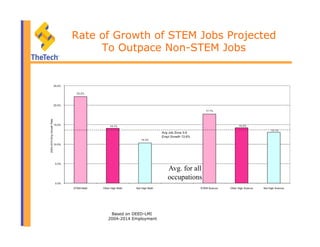
Rate of Growth of STEM Jobs Projected
To Outpace Non-STEM Jobs
Avg. for all
occupations
Based on DEED-LMI
2004-2014 Employment
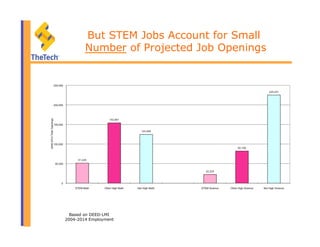
But STEM Jobs Account for Small
Number of Projected Job Openings
Based on DEED-LMI
2004-2014 Employment
STEM Literacy Is Important
•  Highest level of math taken in high school is better predictor
of bachelor’s degree attainment than socioeconomic status is.
–  Clifford Adelman, US Department of Education, February 2006
•  In 2003, about 5 million workers were in occupations formally
defined as science and engineering (S&E). However, today,
13 million said they needed at least a bachelor's degree level
of knowledge in S&E fields to do their jobs.
–  National Science Foundation, Science and Engineering Indicators, 2008
•  “We need to get our kids excited about STEM classes because
the economic currency of the 21st century is math and
science knowledge.”
–  Jack O’Connell, Superintendent of Public Instruction, CDE, November 2007

STEM@theTech-Preso

  • 1.
    GRANT & COOPERATIVEAGREEMENTS POSITIONING STRATEGY 2008-12 Carlos F. Camargo, PhD Director of Foundations Relations & Development August 2008 Shelter from the Gathering Storm: Mapping Needs, Aligning Programs, Inspiring Youth
  • 2.
    Mission Statement The TechMuseum of Innovation is an educational resource established to engage people of all ages and backgrounds in exploring and experiencing technologies affecting their lives, and to inspire the young to become innovators in the technologies of the future.
  • 3.
    The Tech MuseumEnvisions …
  • 4.
    •  Long termcommitment •  Maintaining focus •  Capacity building •  Sustainability •  Leveraging resources •  Credibility with stakeholders •  Evaluation and benchmarking of results Educational programming @ The Tech Strategies advancing the support of STEM education and free-choice learning at all levels, K-16.
  • 5.
    Underserved Populations Title 1K-12 students Women & Minorities Seniors Rural & Urban Core Supporting STEM STEM Promotion/Advocacy IN-reach via 2nd Classroom STEM Afterschool Programs Teacher Prof Dev Experiential Learning Standards-based Labs Field Trip Services Self-Guided & Web-based Lifelong learning tools In-reach Strategies Integrated Development Community-Based Partnerships Program Innovation & IN-reach ENVIRONMENT-CHOICES PriorityPriority Needs Mapping: The Tech’s Commitment to STEM GRANT STRATEGY & POSITIONING ALIGNED FOR INREACH
  • 6.
    Regional Outcomes •  Aidsstudents in the mastery of essential mathematics and science concepts; •  Motivates students to pursue STEM-related careers; •  Provides students with real-world tasks and hands-on learning opportunities that encourage career exploration; •  Provides teachers, parents and caregivers with guidelines and resource curriculum materials; and •  Provides teachers, parents and caregivers with assessment strategies and rubrics
  • 7.
  • 8.
    Overview of presentation • Origins of STEM Concerns •  A Different Take on the Data •  The Deeper Concerns About STEM
  • 9.
    STEM Education As wethink about the big picture of STEM education, we might ask ourselves… 1.  What are the drivers? 2.  What is the context? 3.  What are the issues?
  • 10.
    The Drivers 1.  Theglobal, knowledge based economy 2.  The recognition that STEM fields underpin modern life and our standard of living 3.  The need for all students to be STEM literate and the need for STEM experts 4.  The need to build a skilled workforce of problem solvers, innovators and inventors 5.  The need for life long learning
  • 11.
    The Context 1.  Thereare too few students who are choosing to study math and science beyond the compulsory school years 2.  This impacts the pool of generic and specialized skills available
  • 12.
    The Issues: Industry andAcademia sound alarms •  “Regrettably, the American K-12 system is failing to provide the math and science skills necessary for kids to compete in the 21st century workforce, and the U.S. higher education system cannot produce enough scientists and engineers to support the growth of the high-tech industry that is so crucial to economic prosperity.” –  “Losing the Competitive Advantage?,” AeA •  “Participants expressed concern that a weakening of science and technology in the United States would inevitably degrade its social and economic conditions and in particular erode the ability of its citizens to compete for high-quality jobs.” –  “Rising Above the Gathering Storm,” The National Academy of Sciences, the National Academy of Engineering, and the Institute of Medicine of the National Academies
  • 13.
    1. U.S. lagsinternationally in K-12 math/science literacy (i.e., test scores) TIMMS is a test of math and science literacy given to K-12 students in the U.S. and other countries."
  • 14.
    2. U.S. lagsinternationally in STEM postsecondary degree production SOURCE: Tapping Americaʼs Potential, 2005" 50! 100! 150! 200! 250! 300! 350! 0! China
 (2003)! Japan
 (2004)! U.S.
 (2003)! S. Korea (2002)! “China is graduating more than four times as many engineers as the United States”" - Tapping Americaʼs Potential (2005)"
  • 15.
    3. Trends overtime seen as evidence of falling supply, rising demand Fewer graduates … •  Between 1984 and 2007 the number of bachelor’s degrees conferred rose 43 percent while the total number of bachelor’s of engineering degrees dropped 15 percent. –  National Science Foundation More jobs … •  Between 2002 and 2012, the number of jobs in scientific and technical occupations in California will increase 25-33 percent.
  • 16.
    Scary Trends in Supply& Demand … “By 2015, if current trends continue, more than 90 percent of all scientists and engineers in the world will be living in Asia.”
  • 17.
    … Lead toDesperate Measures The U.S. must “double the number of STEM graduates with bachelor’s degrees by 2015.”
  • 18.
    How the TECHMUSEUM Defines “STEM” Follows California Office of Higher Education definition -- by Classification of Instructional Program (CIP) Codes •  01 Agriculture, Agricultural Operations and Related Sciences 11 Computer and Informational Sciences and Support Services 14 Engineering 15 Engineering Technologies/Technicians 26 Biological and Biomedical Sciences 27 Mathematics and Statistics 40 Physical Sciences 41 Science Technologies, Technicians NOTE: All data we present for the remainder of the presentation reflects California data, but patterns are same when you look at national data
  • 19.
    Overview of presentation • Origins of STEM Concerns •  A Different View of the Data •  The Deeper Concerns About STEM
  • 20.
    Job growth isprojected to be faster for STEM than for non-STEM jobs. But … SOURCE: DEED LMI, 2004-2014 Occupational Employment Projections" STEM = Computer, Agricultural, Life and Physical Scientists, Engineers, Science and Engineering Technicians" Ten-year growth rate. 10-year rate of growth!
  • 21.
    … not allSTEM-related occupations are growing at above-average rates SOURCE: DEED LMI 2004-2014 Occupational Employment Projections" 10-year rate of growth!
  • 22.
    And, even thoughit’s faster- growing, STEM accounts for relatively few job openings SOURCE: DEED LMI 2004-2014 Occupational Employment Projections"
  • 23.
    Most STEM-related JobOpenings Will Be in IT and Engineering, Not Science SOURCE: DEED LMI 2004-2014 Occupational Employment Projections"
  • 24.
    Except for IT,Projections Show Supply of Graduates Outpacing Demand Source: Degrees awarded—IPEDS, National Center for Education Statistics" Projected Openings—DEED-LMI, 2004-2014 Occupational Employment Projections
  • 25.
    National Data ShowsSimilar Deterriorating Pattern “Although I know you routinely are told by corporate lobbyists that their R&D is being globalized in part due to shortages of scientists and engineers in the U.S., no one who has studied this matter with an open mind has been able to find any objective data of such general shortages." -- Michael S. Teitelbaum,VP of Alfred P. Sloan Foundation, testifying before Congress on Nov. 7, 2007 Analysis of the flow of students up through the S&E pipeline, when it reaches the labor market, suggests the education system produces qualified graduates far in excess of demand: S&E occupations make up only about one-twentieth of all workers, and each year there are more than three times as many S&E four-year college graduates as S&E job openings. -- Urban Institute, October 2007 http://www.urban.org/publications/411562.html
  • 26.
    So What Arethe Deeper Issues? •  Not all STEM is equal – current data do predict significant workforce shortage in IT •  It is believed that supply of STEM-prepared students will drive job creation in U.S. • a “supply side” strategy
  • 27.
    Overview of presentation • Origins of STEM Concerns •  A Different View of the Data •  The Deeper Concerns About STEM
  • 28.
    “Supply-side” strategy Fields ofmath and science are “strategically critical” “Losing America’s Competitive Advantage” (2007), AeA •  “As countries catch up to the United States in science and engineering and as they diffuse technology to promote innovation and enhance competitiveness, the possibility that the next breakthrough technologies will be born abroad is ever more likely.” •  “As more countries liberalize capital markets, lower tariffs and other trade barriers, and pursue less interventionist regulatory policies, the tipping point in choosing where to locate the next cluster of innovation will be the education and skill level of the workforce.”
  • 29.
    So What Arethe Deeper Issues? •  Not all STEM is equal – current data do predict significant workforce shortage in IT •  It is believed that supply of STEM-prepared students will drive job creation in U.S. –  a “supply side” strategy •  Achievement gaps remain
  • 30.
    Achievement Gaps Remain (U.S.data) SOURCE: College Board 2006, cited in Urban Institute Report"
  • 31.
    So What Arethe Deeper Issues? •  Not all STEM is equal – current data do predict significant workforce shortage in IT •  It is believed that supply of STEM-prepared students will drive job creation in U.S. –  a “supply side” strategy •  Achievement gaps remain •  STEM literacy is important for student success
  • 32.
    SOURCE: biotechwork.org (67%) SF BayArea “Biotech” Employment
  • 33.
    Analyze STEM-related Occupations  Goal: Learn to what degree non-STEM occupations require math and science competency   Used data from O*NET Resource Center http://www.onetonline.org
  • 34.
    Definitions of theCriteria Used > Using O*NET we identified occupations that require higher education > Included Job Zone >2 •  Job Zone 5 –  A bachelor’s degree is the minimum formal education required, but many require graduate degree •  Job Zone 4 –  Most, but not all, require a bachelor’s degree •  Job Zone 3 –  Most require training in vocational schools, related on-the- job training, or an associate’s degree
  • 35.
    Definitions of theCriteria Used Then we analyzed occupations based on the level of math or science competency needed •  High Math = –  Level >4, and –  Importance >3 •  High Science = –  Level >2, and –  Importance >3 SOURCE: http://www.onetcenter.org/ questionnaires.html
  • 36.
    Majority of OccupationsRequiring STEM competency are not “STEM jobs” 81 of 208 High Math Occupations are STEM 64 of 137 High Science Occupations are STEM
  • 37.
    Based on DEED-LMI 2004-2014Employment This Relationship Is More Pronounced When You Look at Number of Jobs
  • 38.
    Rate of Growthof STEM Jobs Projected To Outpace Non-STEM Jobs Avg. for all occupations Based on DEED-LMI 2004-2014 Employment
  • 39.
    But STEM JobsAccount for Small Number of Projected Job Openings Based on DEED-LMI 2004-2014 Employment
  • 40.
    STEM Literacy IsImportant •  Highest level of math taken in high school is better predictor of bachelor’s degree attainment than socioeconomic status is. –  Clifford Adelman, US Department of Education, February 2006 •  In 2003, about 5 million workers were in occupations formally defined as science and engineering (S&E). However, today, 13 million said they needed at least a bachelor's degree level of knowledge in S&E fields to do their jobs. –  National Science Foundation, Science and Engineering Indicators, 2008 •  “We need to get our kids excited about STEM classes because the economic currency of the 21st century is math and science knowledge.” –  Jack O’Connell, Superintendent of Public Instruction, CDE, November 2007