





Renee Cassidy and Erinne Losinio20 April 2011CIE403 Module 13Internationalizing Higher Education
OverviewPart One: TerminologyKey conceptsPart Two: The DebateCritical issuesPart Three: The Way AheadConsiderations for the future
What is Internationalization?Part One: Terminology
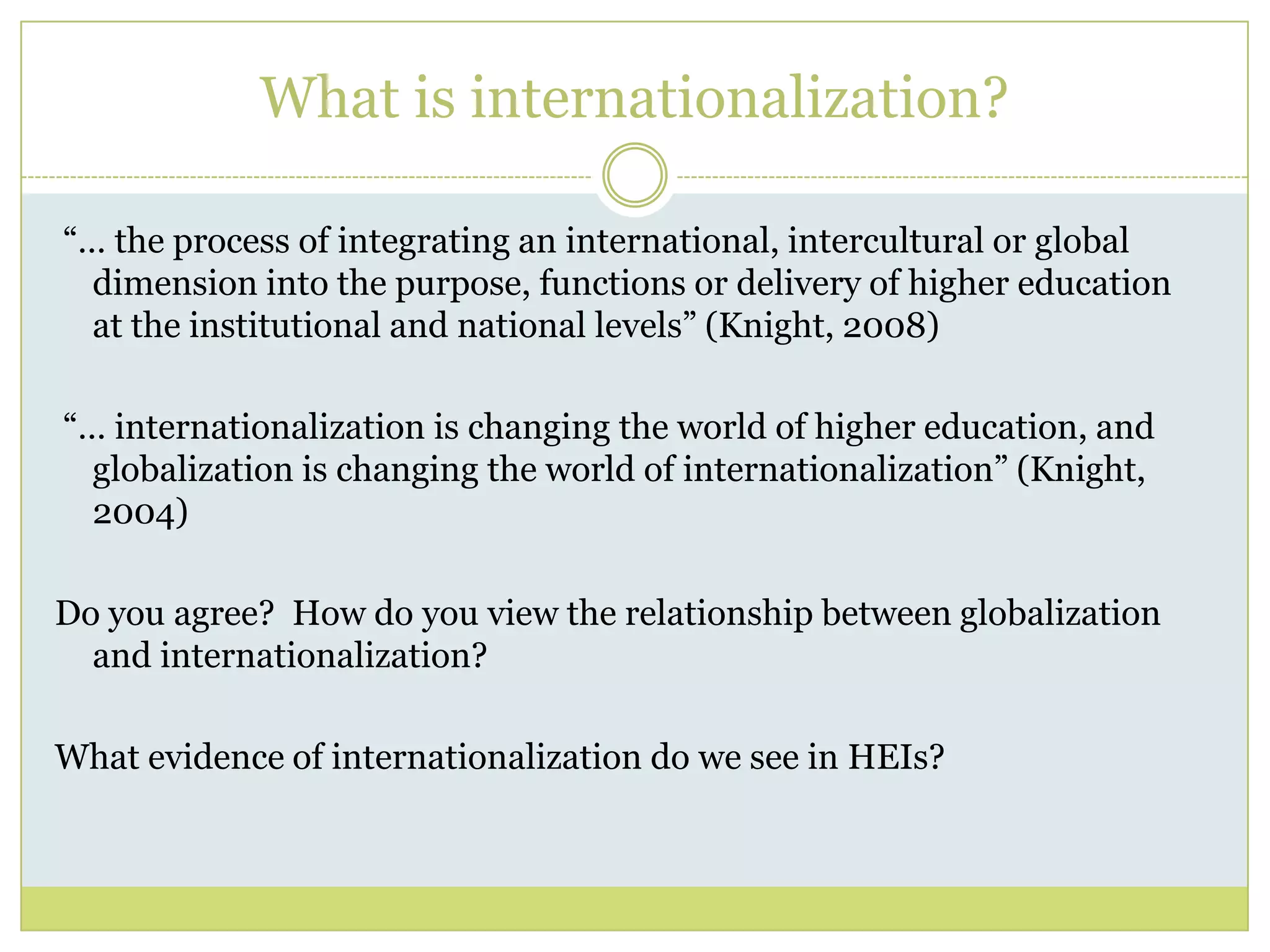
What is internationalization? “… the process of integrating an international, intercultural or global dimension into the purpose, functions or delivery of higher education at the institutional and national levels” (Knight, 2008) “… internationalization is changing the world of higher education, and globalization is changing the world of internationalization” (Knight, 2004)Do you agree?  How do you view the relationship between globalization and internationalization?  What evidence of internationalization do we see in HEIs?
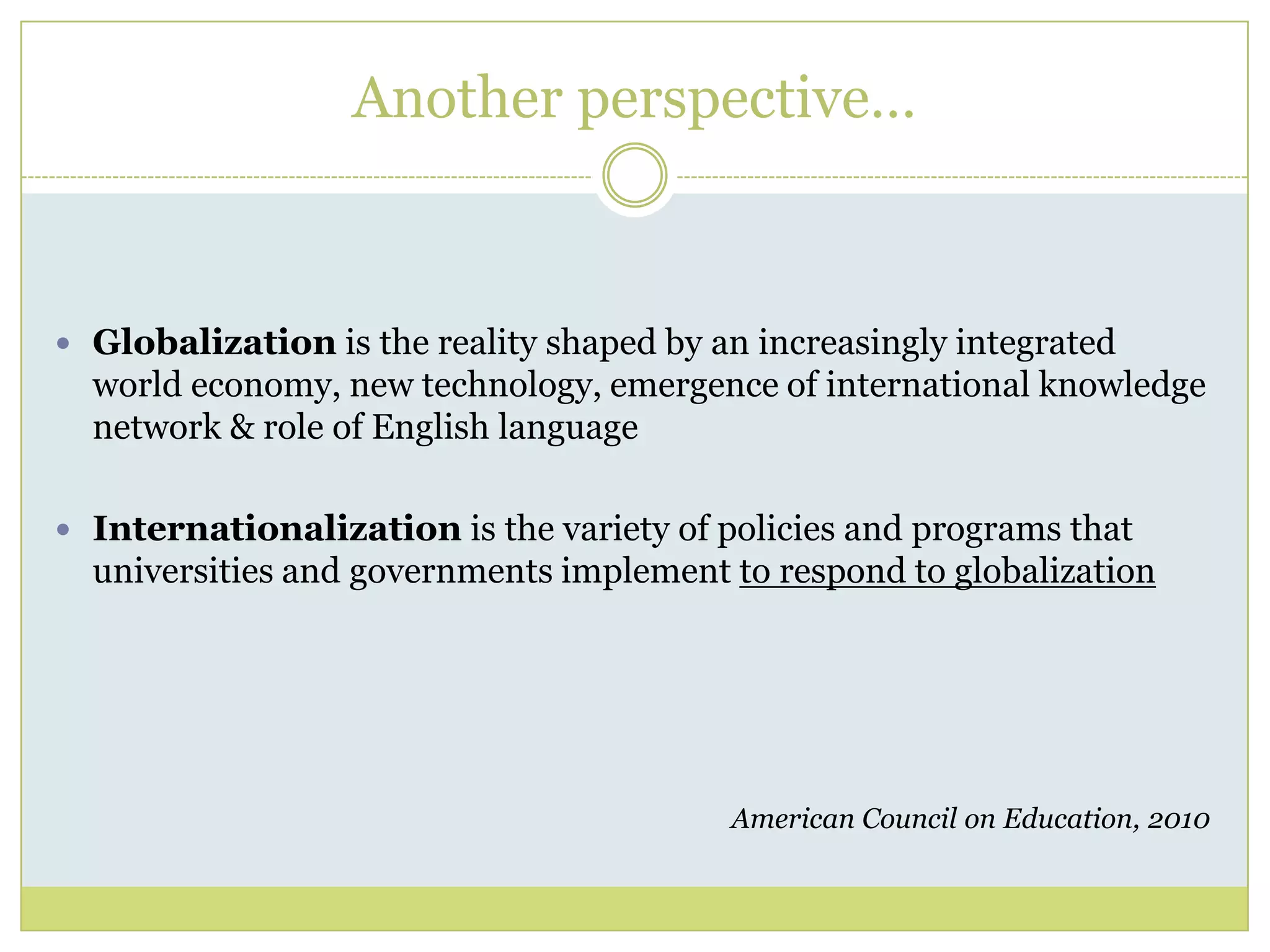
Another perspective…Globalization is the reality shaped by an increasingly integrated world economy, new technology, emergence of international knowledge network & role of English languageInternationalization is the variety of policies and programs that universities and governments implement to respond to globalizationAmerican Council on Education, 2010
What is the role of universities?“…curricula with an international orientation in content, aimed at preparing students for performing (professionally/socially) in an international and multicultural context, and designed for domestic students and/or foreign students” (OECD, 1994)Supporting international studentsFacilitating study abroad and educational exchange to broaden and enrich students’ cultural experiencesLearning about other languages and cultures as a way of developing their skills of intercultural communicationPreparing to work in the global knowledge economy
Key terms for considerationIntercultural/global competence
How does this relate to the ideas of global citizenship that we discussed in the past few weeks?
Neo-liberal imaginary
Is the link between intercultural competence and economic advancement overstated?
Epistemic virtues including relationalityand reflexivityHow do you envision an effective internationalized curriculum?
Group one: Defend the statementGroup two: Create a counter-argumentYou will have 20 minutes to prepare your case. Choose a spokesperson to present your group’s argument. The spokesperson must be different for each statement. Each side will have 3-5 minutes to present their case and 1 minute after the other side presents for any rebuttals. Online students will determine which side presented the best argument.Part Two: The Debate
StatementsInternationalization ultimately leads to the commodification and commercialization of education.Curricular reforms focused on internationalization are narrow in scope and do not adequately prepare students to engage critically with the cultural politics of globalization.
What does the future look like for universities?Part Three: The Way Ahead
Rising demand of HEDemand exceeds supply, especially in developing countriesGrowth in number of students, opportunities, and demand of globalized, knowledge-based economyCompetitive job marketConsequencesStudent mobilityCampuses abroad, onlineGrowth of private HEIsPrivatization of public HEDemand for accountability American Council on Education, 2010
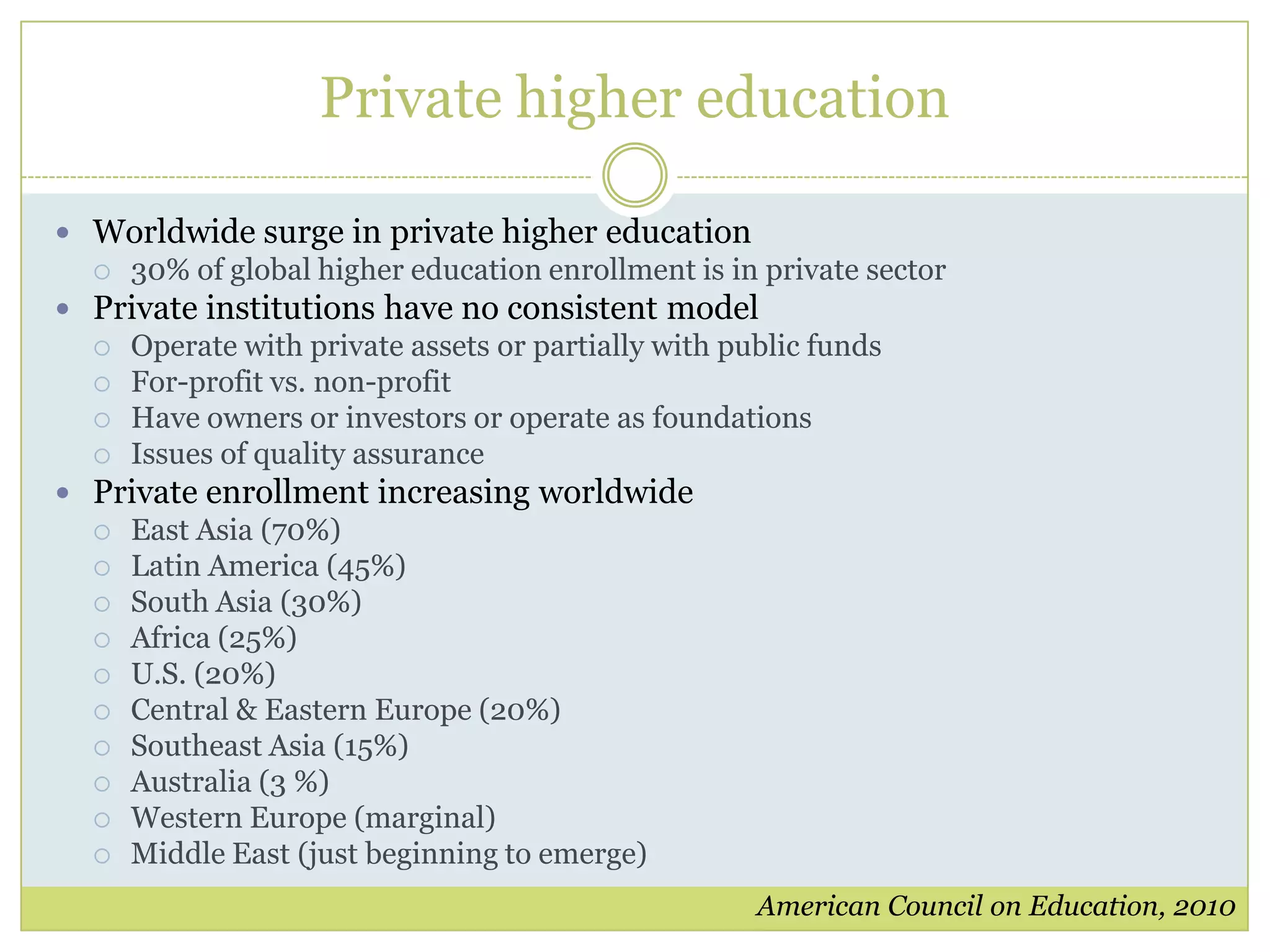
Private higher educationWorldwide surge in private higher education
30% of global higher education enrollment is in private sector
Private institutions have no consistent model
Operate with private assets or partially with public funds
For-profit vs. non-profit
Have owners or investors or operate as foundations

Internationalizing Curriculum in Universities (Module 13)

  • 1.
    Renee Cassidy andErinne Losinio20 April 2011CIE403 Module 13Internationalizing Higher Education
  • 2.
    OverviewPart One: TerminologyKeyconceptsPart Two: The DebateCritical issuesPart Three: The Way AheadConsiderations for the future
  • 3.
  • 4.
    What is internationalization?“… the process of integrating an international, intercultural or global dimension into the purpose, functions or delivery of higher education at the institutional and national levels” (Knight, 2008) “… internationalization is changing the world of higher education, and globalization is changing the world of internationalization” (Knight, 2004)Do you agree? How do you view the relationship between globalization and internationalization? What evidence of internationalization do we see in HEIs?
  • 5.
    Another perspective…Globalization isthe reality shaped by an increasingly integrated world economy, new technology, emergence of international knowledge network & role of English languageInternationalization is the variety of policies and programs that universities and governments implement to respond to globalizationAmerican Council on Education, 2010
  • 6.
    What is therole of universities?“…curricula with an international orientation in content, aimed at preparing students for performing (professionally/socially) in an international and multicultural context, and designed for domestic students and/or foreign students” (OECD, 1994)Supporting international studentsFacilitating study abroad and educational exchange to broaden and enrich students’ cultural experiencesLearning about other languages and cultures as a way of developing their skills of intercultural communicationPreparing to work in the global knowledge economy
  • 7.
    Key terms forconsiderationIntercultural/global competence
  • 8.
    How does thisrelate to the ideas of global citizenship that we discussed in the past few weeks?
  • 9.
  • 10.
    Is the linkbetween intercultural competence and economic advancement overstated?
  • 11.
    Epistemic virtues includingrelationalityand reflexivityHow do you envision an effective internationalized curriculum?
  • 12.
    Group one: Defendthe statementGroup two: Create a counter-argumentYou will have 20 minutes to prepare your case. Choose a spokesperson to present your group’s argument. The spokesperson must be different for each statement. Each side will have 3-5 minutes to present their case and 1 minute after the other side presents for any rebuttals. Online students will determine which side presented the best argument.Part Two: The Debate
  • 13.
    StatementsInternationalization ultimately leadsto the commodification and commercialization of education.Curricular reforms focused on internationalization are narrow in scope and do not adequately prepare students to engage critically with the cultural politics of globalization.
  • 14.
    What does thefuture look like for universities?Part Three: The Way Ahead
  • 15.
    Rising demand ofHEDemand exceeds supply, especially in developing countriesGrowth in number of students, opportunities, and demand of globalized, knowledge-based economyCompetitive job marketConsequencesStudent mobilityCampuses abroad, onlineGrowth of private HEIsPrivatization of public HEDemand for accountability American Council on Education, 2010
  • 16.
    Private higher educationWorldwidesurge in private higher education
  • 17.
    30% of globalhigher education enrollment is in private sector
  • 18.
    Private institutions haveno consistent model
  • 19.
    Operate with privateassets or partially with public funds
  • 20.
  • 21.
    Have owners orinvestors or operate as foundations
  • 22.
  • 23.
  • 24.
  • 25.
  • 26.
  • 27.
  • 28.
  • 29.
    Central & EasternEurope (20%)
  • 30.
  • 31.
  • 32.
  • 33.
    Middle East (justbeginning to emerge)American Council on Education, 2010
  • 34.
  • 35.
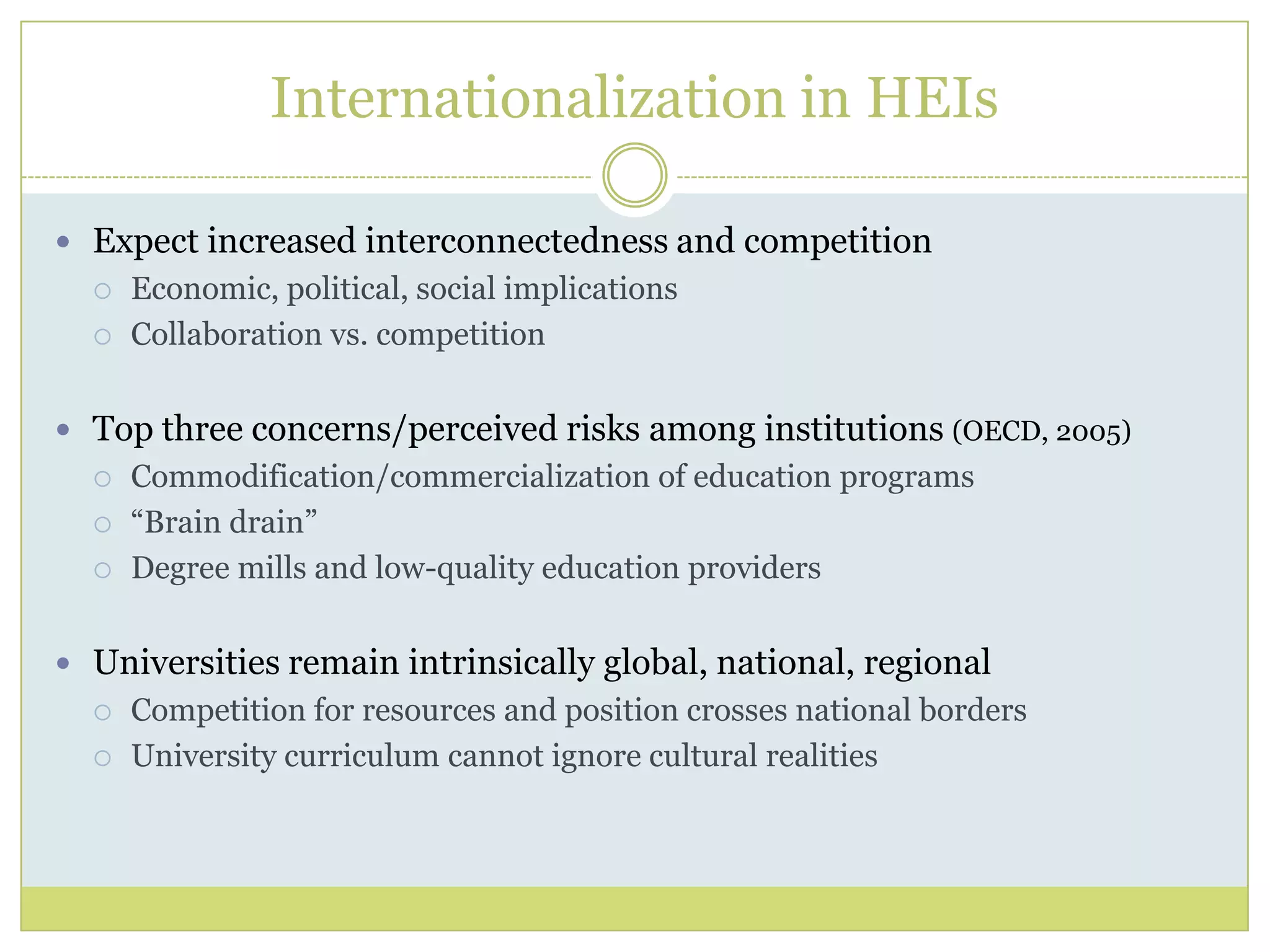
    Internationalization in HEIsExpectincreased interconnectedness and competition Economic, political, social implicationsCollaboration vs. competitionTop three concerns/perceived risks among institutions (OECD, 2005)Commodification/commercialization of education programs“Brain drain”Degree mills and low-quality education providersUniversities remain intrinsically global, national, regionalCompetition for resources and position crosses national bordersUniversity curriculum cannot ignore cultural realities
  • 36.
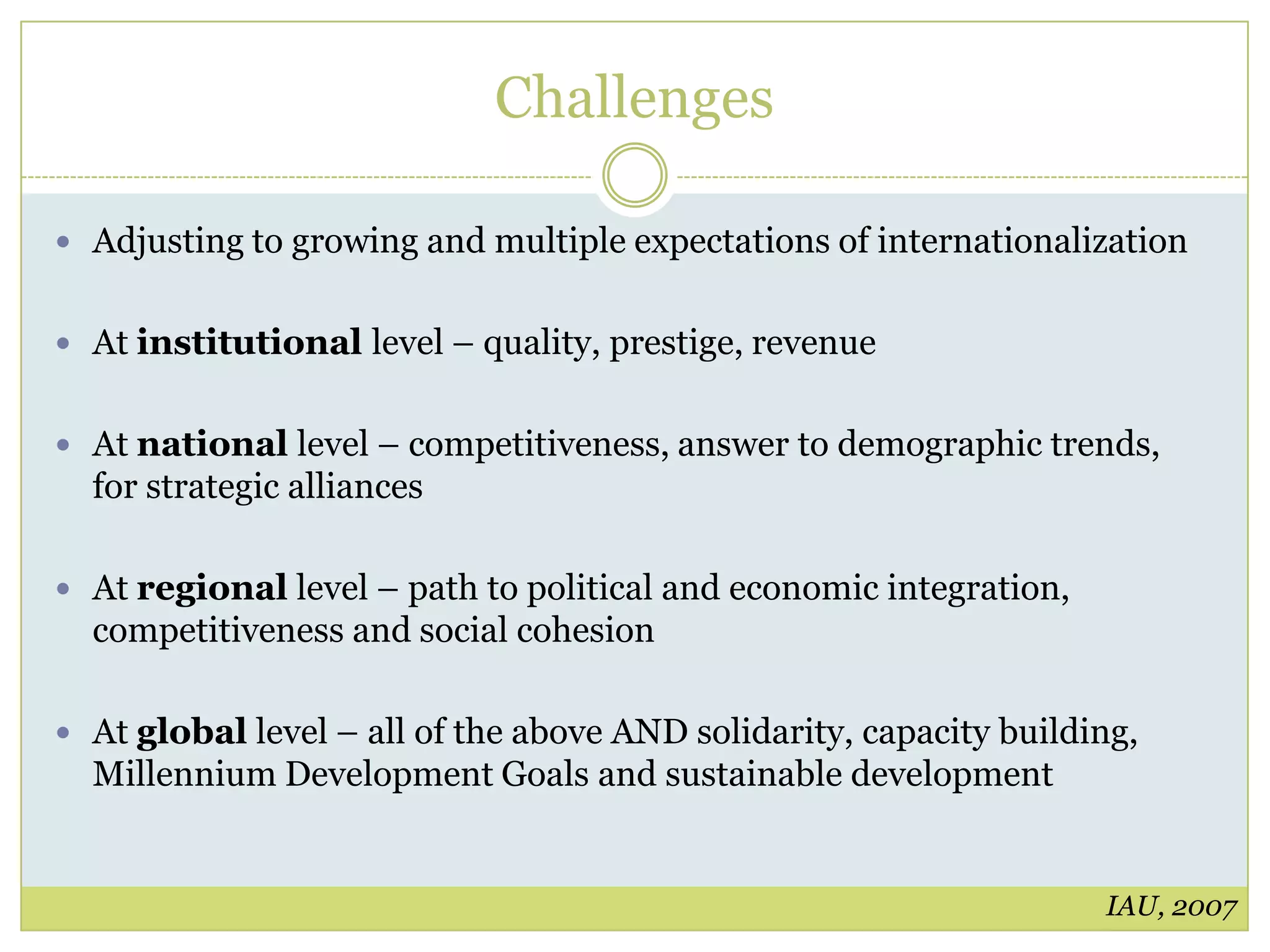
    ChallengesAdjusting to growingand multiple expectations of internationalizationAt institutional level – quality, prestige, revenueAt national level – competitiveness, answer to demographic trends, for strategic alliancesAt regional level – path to political and economic integration, competitiveness and social cohesionAt global level – all of the above AND solidarity, capacity building, Millennium Development Goals and sustainable developmentIAU, 2007
  • 37.
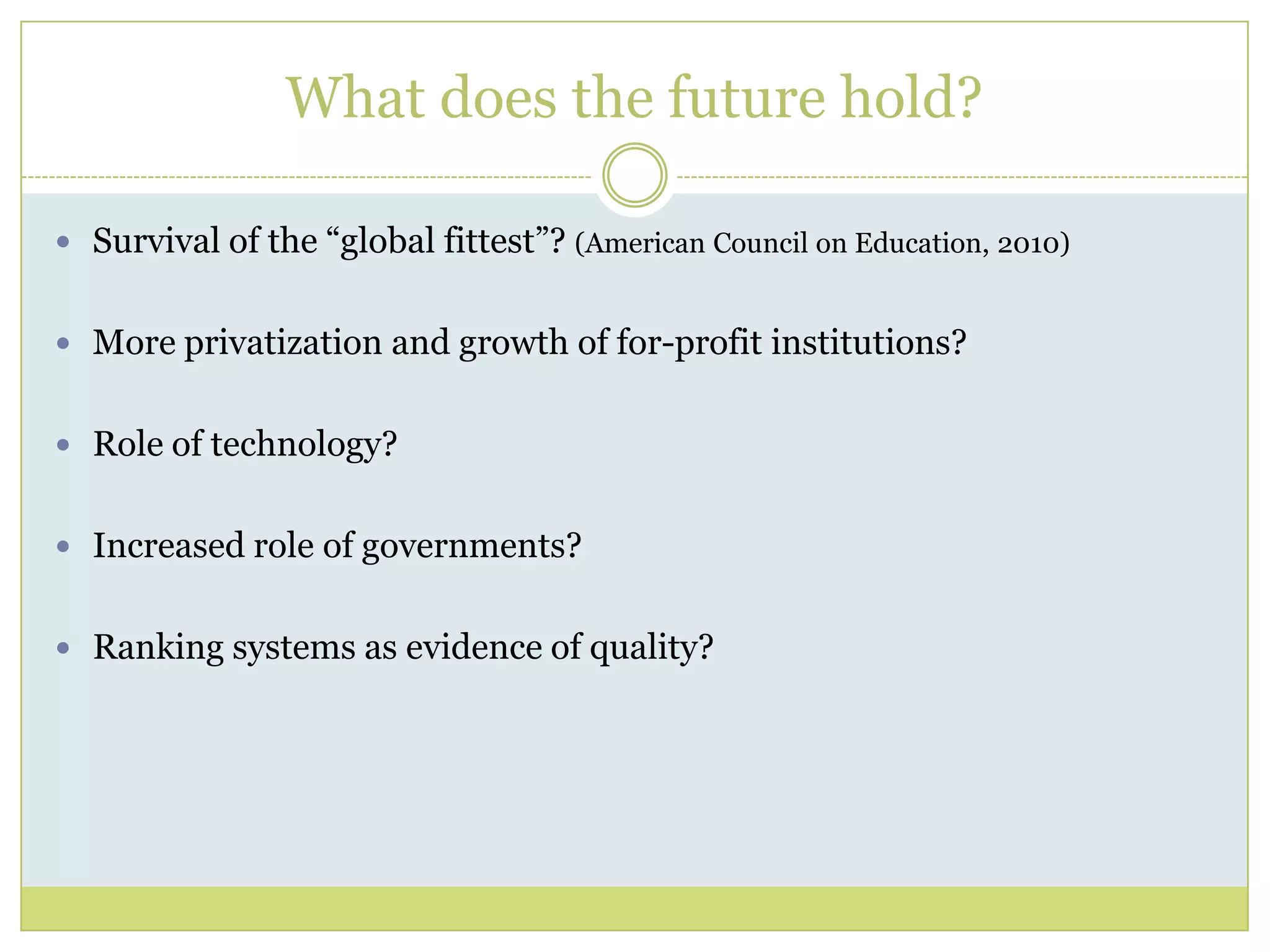
    What does thefuture hold?Survival of the “global fittest”? (American Council on Education, 2010)More privatization and growth of for-profit institutions?Role of technology?Increased role of governments?Ranking systems as evidence of quality?
  • 38.
    Final thoughtsDiversity ofgoals, rationales, geographic priorities, strategies, practices and modelsGrowing complexity with regionally differentiated interests and policy objectives (ex. immigration, competitiveness, trade, development)New risks, new actors and new challenges but also new possibilities and opportunities “We are at the beginning of the era of transnational higher education” (Altbach, 2004)
  • 39.
    To be continued(online)…Questions?
  • 40.
  • 41.
  • 42.

Editor's Notes

  • #14 Reference Bologna Process
  • #21 http://www.eua.be/typo3conf/ext/bzb_securelink/pushFile.php?cuid=399&file=fileadmin/user_upload/files/Publications/Trends_2010.pdf
  • #22 http://www.eua.be/typo3conf/ext/bzb_securelink/pushFile.php?cuid=399&file=fileadmin/user_upload/files/Publications/Trends_2010.pdf