Computer gaming
An introduction for 2020
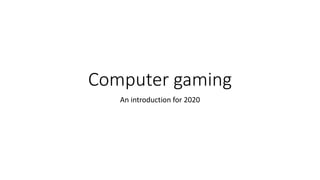
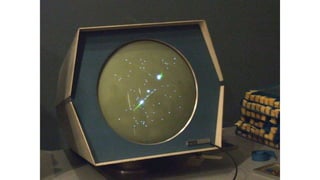
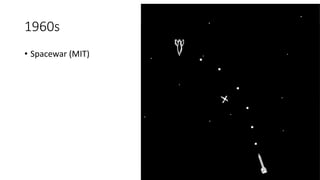
1960s
• Spacewar (MIT)
• http://iasl.uni-muenchen.de/links/GCA-VII.1e.html
• https://curlie.org/Games/Video_Games/History
Interactive fiction boom and bust
• Late 1970s-into 1983
• Parsers
• Props
• User-generated content
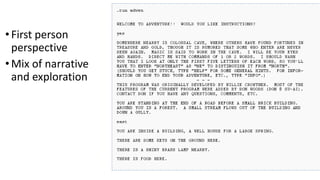
•First person
perspective
•Mix of narrative
and exploration
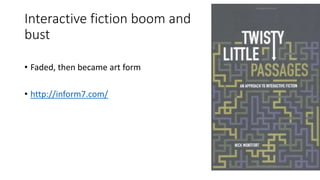
Interactive fiction boom and
bust
• Faded, then became art form
• http://inform7.com/
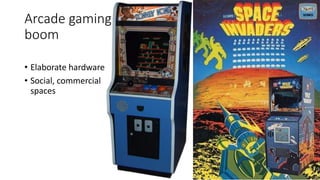
Arcade gaming
boom
• Elaborate hardware
• Social, commercial
spaces
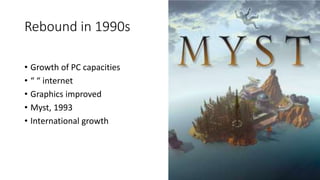
Rebound in 1990s
• Growth of PC capacities
• “ “ internet
• Graphics improved
• Myst, 1993
• International growth
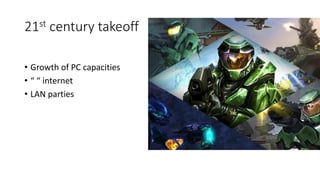
21st century takeoff
• Growth of PC capacities
• “ “ internet
• LAN parties
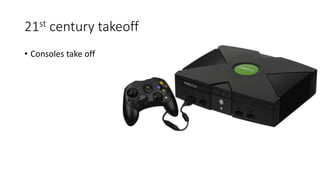
21st century takeoff
• Consoles take off
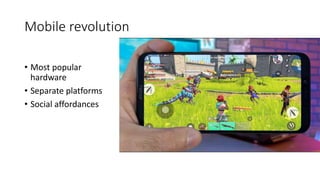
Mobile revolution
• Most popular
hardware
• Separate platforms
• Social affordances
And now?
From you all
• Pop culture (Ashly)
• Twitch (Andi, by accident)
• Violence; social interaction (Andi)
• Edu game (Amelia)
• bias a la textbook (Andrea)
• Worldness (Ryan)
• Violence; militarization (Andrea)
• Representaiton (Udit)
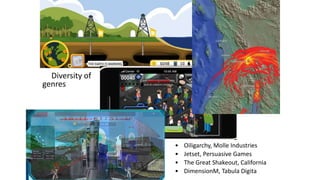
Diversity of
genres
• Oiligarchy, Molle Industries
• Jetset, Persuasive Games
• The Great Shakeout, California
• DimensionM, Tabula Digita
How big is the market?
• There are approximately 2.2 billion gamers in the world. Out of the
estimated 7.6 billion people living on earth, as of July 2018, that
means almost a third of people on this planet are gamers. Out of
those 2.2 billion gamers, 1.2 billion of those who play games are
playing games on a PC.
• About 67% of Americans, or roughly 211 million people, play video
games on at least one type of device, with more than half of those
who game, playing on multiple platforms
https://gaimin.io/how-many-gamers-are-there/
https://variety.com/2018/gaming/news/how-many-people-
play-games-in-the-u-s-1202936332/
How big is the market?
• 2018 was a record-breaking year for our industry, with total video
game sales exceeding $43.4 billion. Over 164 million adults in the
United States play video games and three-quarters of all Americans
have at least one gamer in their household.
https://www.theesa.com/esa-research/2019-essential-facts-about-the-computer-and-video-game-industry/
What’s involved: hardware
• Phones
• PC/Mac
• Consoles
• Tablets
• VR/XR headsets
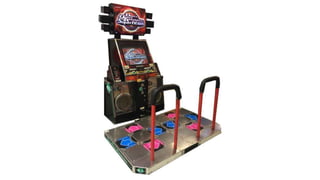
• Other equipment: toys, mats
What’s involved: software
• Individual programs
• Platforms
Genres
• Real-time strategy game (RTS)
• Open-world or sandbox
• Variant: crafting (Minecraft)
• First/third-person shooter
• Role-playing game (RPG)
• Massively multiplayer online game (MMORPG/MMO)
• Interactive fiction (IF)
• Sports games
• Puzzles
Computer game dynamics and themes
Which ones from non-digital games can we apply?
Themes
• Community, social sense
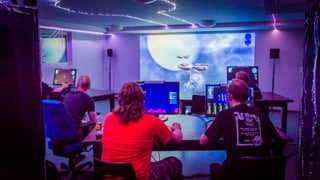
• Playing games in physical third places:
• LAN parties; cybercafes
• Less now
• Games AS third places
• Narrative vs mechanics balance
• Player desire
• Design
• “discover as you play”
• Intertwining histories of games
Themes
• Competition <-> cooperation
• Difficulty level
• Rules (and cheating)
• Immersion and empathy
Some dynamics to consider
•Linear vs open-ended play
•Simulation accuracy-playability
•Play for game – drama - simulation
(Mary Kuhner)
•One-shot - campaign
Big themes
•Storytelling vs mechanics
•Theme “ ”
•Cybertext
•Bad vs good behavior
•How a game teaches itself
•Industry
Chance?
•Role of randomness
•Generated: dice, cards
•Balance with skill
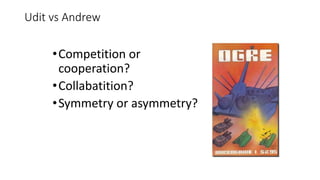
Udit vs Andrew
•Competition or
cooperation?
•Collabatition?
•Symmetry or asymmetry?
Information?
•Perfect information
•Players hide from others
•Fog of war

Computer games intro