Prepared for the Presidents’ Trust
by
Carol Geary Schneider, Association of American Colleges &
Universities
Liberal Education: Our Students' Best
Preparation for Work AND Citizenship
A Note to Presidents
This “case” combines and synthesizes
evidence from two previous PowerPoint
presentations* prepared for the Trust:
The Economic Value of Liberal Education
The Civic Case for Liberal Education
*Each of these PowerPoint presentations remains
available to Trust members at
http://www.aacu.org/leap/presidentstrust/resources.cfm
More College-Educated Workers are
Needed but Supply is Not Keeping up with
Demand
Economists predict that by 2018, America will be 3
million college-educated workers short to meet
demand, but college graduation rates are flat.
By 2018, 22 million new and replacement jobs will
require some college.
By 2018, 63 percent of all jobs will require at least
some postsecondary education.
Sources: Georgetown University Center on Education and the Workforce; AAC&U, College Learning
for the New Global Century (2007); Lumina Foundation for Education
.
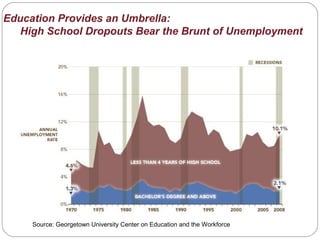
Education Provides an Umbrella:
High School Dropouts Bear the Brunt of Unemployment
Source: Georgetown University Center on Education and the Workforce
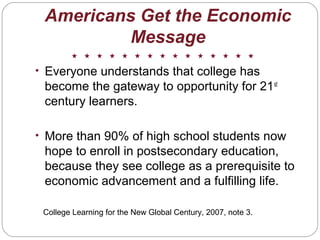
Americans Get the Economic
Message
• Everyone understands that college has
become the gateway to opportunity for 21st
century learners.
• More than 90% of high school students now
hope to enroll in postsecondary education,
because they see college as a prerequisite to
economic advancement and a fulfilling life.
College Learning for the New Global Century, 2007, note 3.
There has been almost no public or policy
discussion about what students really need from
a 21st
century college education.
Back stage, however, educators, employers and
civic leaders have been actively examining the
learning students need for a fast-changing
economy and an interconnected world.
A consensus on the 21st
century goals for
college learning has started to emerge.
But What Should Students
Learn in College?
In what follows, we explore the learning
students need…
• To contribute and thrive in a dynamic, innovation-
fueled economy
• To make wise choices as citizens, at home and
abroad
We explore the new consensus among educators,
employers and civic leaders on making the most of
college in this global century.
Overview
College Learning in the
21st
Century Economy
In a word, employers are demanding more –
much more
They want and seek many more college educated
works
They also seek much higher and broader levels of
learning in those they employ, retain and promote
Why Is There a Need for Higher
Levels of Learning?
• In a globalized knowledge economy, the capacity
to drive innovation is the key strategic economic
advantage
• Rapid scientific and technological innovations are
changing the workplace and demanding more of
all employees
• Global interdependence and complex cross-
cultural interactions increasingly define modern
society and the workplace and call for new levels
of knowledge and capability
Employers Continue to Raise the Bar and
Hire for Innovation
95% of employers “put a priority on hiring people with
the intellectual and interpersonal skills that will help
them contribute to innovation in the workplace”
93% of employers say that they are asking employees
to “take on more responsibilities and to use a broader
set of skills than in the past”
95% of employers say that “a candidate’s
demonstrated capacity to think critically, communicate
clearly, and solve complex problems is more
important than their undergraduate major”
91% of employers say that “the challenges their
employees face are more complex than they were in
the past.”
Source: “It Takes More Than a Major: Employer Priorities for College Learning and
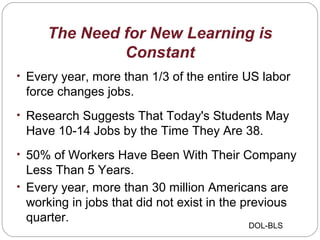
The Need for New Learning is
Constant
• Every year, more than 1/3 of the entire US labor
force changes jobs.
• Research Suggests That Today's Students May
Have 10-14 Jobs by the Time They Are 38.
• 50% of Workers Have Been With Their Company
Less Than 5 Years.
• Every year, more than 30 million Americans are
working in jobs that did not exist in the previous
quarter.
DOL-BLS
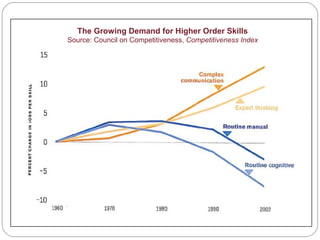
The Growing Demand for Higher Order Skills
Source: Council on Competitiveness, Competitiveness Index
What Employers Say
“[Employers] generally are...frustrated with their
inability to find ‘360 degree people’ who have
both the specific job/technical skills and the
broader skills (communication and problem-
solving skills, work ethic, and ability to work
with others) necessary to promise greater
success for both the individual and the
employer.”
From Peter D. Hart Research Associates, Report
of Findings Based on Focus Groups Among
Business Executives (AAC&U, 2006)
National Surveys of Employers on
College Learning and Graduates’
Work Readiness
AAC&U commissioned Hart Research Associates (in 2006, 2007, and in late 2009) to interview
employers (C-level suite executives and, in 2009 additional human resource professionals)
whose companies report that hiring relatively large numbers of college graduates
Findings are summarized in the following reports:
How Should Colleges Prepare Students to Succeed in Today’s Global Economy?
(AAC&U, 2007)
How Should Colleges Assess and Improve Student Learning? Employers’ Views on
the Accountability Challenge (AAC&U, 2008)
Raising the Bar: Employers’ Views on College Learning in the Wake of the Economic
Downturn (AAC&U, 2010)
It Takes More Than a Major: Employer Priorities for College Learning and Student
Success (AAC&U, 2013)
See: www.aacu.org/leap/public_opinion_research
In this Economy, Narrow
Learning is Not Enough!
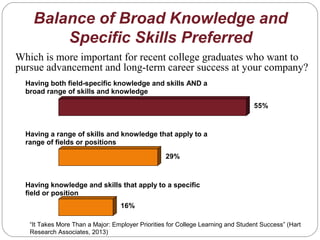
Balance of Broad Knowledge and
Specific Skills Preferred
Which is more important for recent college graduates who want to
pursue advancement and long-term career success at your company?
“It Takes More Than a Major: Employer Priorities for College Learning and Student Success” (Hart
Research Associates, 2013)
Having both field-specific knowledge and skills AND a
broad range of skills and knowledge
Having a range of skills and knowledge that apply to a
range of fields or positions
Having knowledge and skills that apply to a specific
field or position
16%
29%
55%
Key Capabilities Open the Door for
Career Success
“Irrespective of college major or
institutional selectivity, what matters
to career success is students’
development of a broad set of
cross-cutting capacities…”
Anthony Carnevale, Georgetown University
Center on Education and the Workforce
In the 21st
Century, Liberal
Education Outcomes Have
Become the Key to American
Capability and Student
Success
What is a Liberal
Education?
A Liberal Education Provides:
Rich Knowledge – of Human Cultures and the
Physical and Natural Worlds
Intellectual and Practical Skills
Personal and Social Responsibility
Integrative and Applied Learning
The LEAP Essential Learning
Outcomes
 Knowledge of Human Cultures and the Physical and Natural
World through study in the sciences and mathematics, social
sciences, humanities, histories, languages, and the arts
 Intellectual and Practical Skills, including inquiry and analysis,
critical and creative thinking, written and oral communication,
quantitative literacy, information literacy, and teamwork and
problem solving
 Personal and Social Responsibility, including civic knowledge
and engagement – local and global, intercultural knowledge and
competence, ethical reasoning and action, and foundations and
skills for lifelong learning
 Integrative and Applied Learning, including synthesis and
advanced accomplishment across general and specialized
studies
Employers Strongly Endorse the LEAP
“Essential Learning Outcomes” –
And They Urge New Effort to Help All
Students Achieve Them
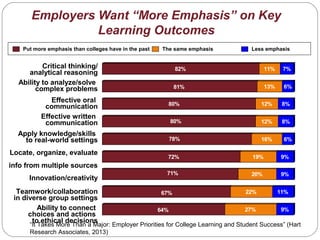
Employers Want “More Emphasis” on Key
Learning Outcomes
Put more emphasis than colleges have in the past Less emphasisThe same emphasis
Critical thinking/
analytical reasoning
Ability to analyze/solve
complex problems
Effective oral
communication
Effective written
communication
Apply knowledge/skills
to real-world settings
Locate, organize, evaluate
info from multiple sources
Innovation/creativity
Teamwork/collaboration
in diverse group settings
Ability to connect
choices and actions
to ethical decisions
64% 27% 9%
67% 22% 11%
71% 20% 9%
72% 19% 9%
78% 16% 6%
80% 12% 8%
80% 12% 8%
81% 13% 6%
82% 11% 7%
“It Takes More Than a Major: Employer Priorities for College Learning and Student Success” (Hart
Research Associates, 2013)
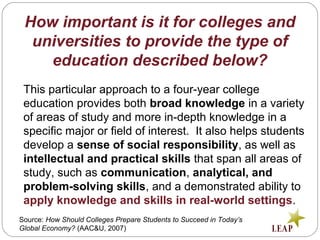
How important is it for colleges and
universities to provide the type of
education described below?
This particular approach to a four-year college
education provides both broad knowledge in a variety
of areas of study and more in-depth knowledge in a
specific major or field of interest. It also helps students
develop a sense of social responsibility, as well as
intellectual and practical skills that span all areas of
study, such as communication, analytical, and
problem-solving skills, and a demonstrated ability to
apply knowledge and skills in real-world settings.
Source: How Should Colleges Prepare Students to Succeed in Today’s
Global Economy? (AAC&U, 2007)
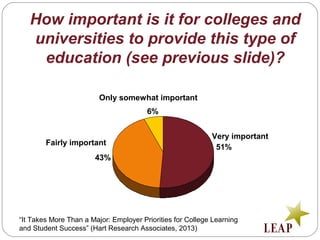
How important is it for colleges and
universities to provide this type of
education (see previous slide)?
“It Takes More Than a Major: Employer Priorities for College Learning
and Student Success” (Hart Research Associates, 2013)
6%
43%
51%
Only somewhat important
Fairly important
Very important
Higher Level Liberal
Education Skills and Abilities
=
Higher Wages
Data from Georgetown University
Center for Education and the Workforce
Center on Education and the Workforce
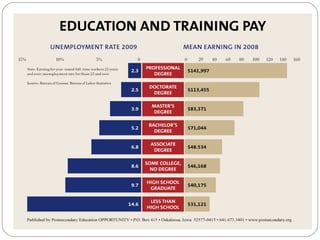
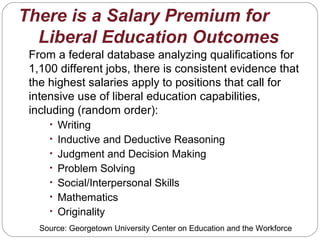
There is a Salary Premium for
Liberal Education Outcomes
From a federal database analyzing qualifications for
1,100 different jobs, there is consistent evidence that
the highest salaries apply to positions that call for
intensive use of liberal education capabilities,
including (random order):
• Writing
• Inductive and Deductive Reasoning
• Judgment and Decision Making
• Problem Solving
• Social/Interpersonal Skills
• Mathematics
• Originality
Source: Georgetown University Center on Education and the Workforce
• In sum, college alone is not enough to ensure
economic opportunity and success.
• The hallmark outcomes of liberal education
prepare students to adapt to change, succeed
in innovative environments and work
successfully with peers and clients from other
cultures and other parts of the world.
College Learning and Economic
Opportunity
“In an economy fueled by
innovation, the capabilities
developed through a liberal
education have become
America’s most valuable
economic asset.”
College Learning for the New Global Century
(AAC&U, 2007)
College and Civic
Capacity
While economic opportunity is a very
important college outcome, it is equally
important for colleges to build civic capacity-
the knowledge, judgment and commitment to
solve societal problems and ensure the integrity
and vitality of our democratic society.
As in the economy, the civic
challenges Americans face
are daunting
Within Our Borders,
And in the Global Community
Challenges Within Our Borders
• Cultures – Multiple and Multiplying
• Economy – In the Midst of Painful
Dislocations and Volatility
• Society – Riven Over Immigration
and Other “Social Questions”
• Politics – Contentious, Fractured,
Declining Confidence in Public
Sector
Global Challenges
• Poverty, War, Suffering...
Sustenance and Human Dignity
• Illiteracy and Its Effects...
Education and Opportunity
• Energy and the Environment...
Research and Innovation
• Terrorism and Fear...
Law, Justice, Democracy, Freedom
Global Challenges (Cont.)
• The United States’ Historic Role in
Global Leadership
• And as a Voice and Force for
Democratic Values and Democratic
Self-Determination
The Issues at Home and
Abroad Are Immense
Rising to These Challenges Will
Require Civic Will, Capacity, and
Commitment – the Determination to
Tackle Hard Questions – in All
Their Complexity
America’s Best Hope
• Civic Capacity is Developed Through
Education – and Liberal Education is the
Crucial Key Both to New Civic Capacity
And to Meeting the Challenges We Face
at Home and Abroad
Liberal Education and
Civic Capacity
Liberal Education – By Design –
Builds Both Capacity
(rich knowledge, high level skills;
social imagination)
AND the Commitment
(an examined sense of ethical and
civic responsibility)
To Create and Test Responsible
Solutions – and to Learn with and
for Others – Not Just Ourselves
The Civic Value of the
Essential Learning Outcomes
• Rich Knowledge – of Human Cultures
and the Physical and Natural Worlds
• Knowledge that can be applied to big societal,
scientific, and global challenges; knowledge of
the diverse peoples who must work together to
solve our problems of health, human dignity, and
sustainable communities
• Intellectual and Practical Skills
• Especially the capacity to deliberate and work
together, across differences of many kinds
• Testing solutions, and discovering “what works”
The Civic Value of Liberal
Education (cont.)
• Personal and Social Responsibility
• Ethical reasoning and action
• Intercultural knowledge and engagement
• Perspective taking and the capacity to work with
people and communities different from one’s own
• Democratic values – including a strong respect for
human dignity and active citizenship
• Integrative and Applied Learning
• The demonstrated ability to apply knowledge,
skills, AND a developed sense of responsibility to
complex problems and new challenges
• Liberal education prepares students
for career success and for mindful
citizenship
• It builds commitments and capacity
to work on emerging problems – in
the workplace and in communities
In Sum
“... [W]e are not forced to choose. ...
A flourishing economy requires the
same skills that support
citizenship.”
Martha Nussbaum
“The Liberal Arts Are Not Elitist”
Chronicle of Higher Education, June 10, 2010
Policy Influencers and
Business Leaders Agree
We must raise the level of civic
knowledge and engagement.
The learning outcomes important for
civic engagement are the same as
those essential for workplace success.
Republicans and Democrats
Agree
“Colleges and universities are uniquely
positioned to model and teach respectful
dialogue.” – Democratic policy influencer
“College is the last marker before…[one is]
released into the real world…colleges and
universities—if they have an opportunity to
play a key role in civic education…they
should.” – Republican policy influencer
Source: Key Findings from Focus Groups on Increasing Support for Civic
Learning in Higher Education (Hart Research Associates, 2011)
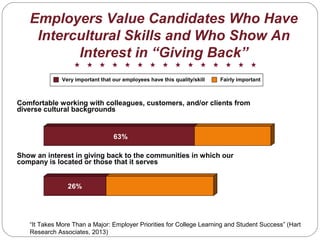
Employers Value Candidates Who Have
Intercultural Skills and Who Show An
Interest in “Giving Back”
Very important that our employees have this quality/skill Fairly important
26%
63%
Comfortable working with colleagues, customers, and/or clients from
diverse cultural backgrounds
Show an interest in giving back to the communities in which our
company is located or those that it serves
“It Takes More Than a Major: Employer Priorities for College Learning and Student Success” (Hart
Research Associates, 2013)
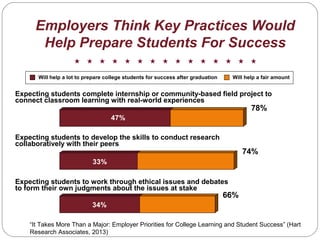
47
Expecting students complete internship or community-based field project to
connect classroom learning with real-world experiences
Expecting students to develop the skills to conduct research
collaboratively with their peers
Expecting students to work through ethical issues and debates
to form their own judgments about the issues at stake
34%
33%
47%
Will help a lot to prepare college students for success after graduation Will help a fair amount
78%
74%
66%
Employers Think Key Practices Would
Help Prepare Students For Success
“It Takes More Than a Major: Employer Priorities for College Learning and Student Success” (Hart
Research Associates, 2013)
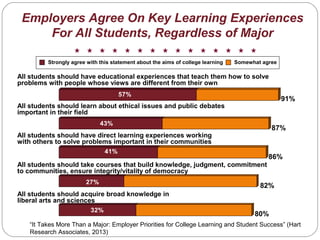
48
All students should have educational experiences that teach them how to solve
problems with people whose views are different from their own
All students should learn about ethical issues and public debates
important in their field
All students should have direct learning experiences working
with others to solve problems important in their communities
All students should take courses that build knowledge, judgment, commitment
to communities, ensure integrity/vitality of democracy
All students should acquire broad knowledge in
liberal arts and sciences
32%
27%
41%
43%
57%
Strongly agree with this statement about the aims of college learning Somewhat agree
86%
87%
82%
80%
91%
Employers Agree On Key Learning Experiences
For All Students, Regardless of Major
“It Takes More Than a Major: Employer Priorities for College Learning and Student Success” (Hart
Research Associates, 2013)
But in Higher Education Today,
Not Every Student Actually
Gets a Liberal Education
Many Are Steered to Narrow,
Technical Training, Largely Devoid
of the Studies—in the Sciences, the
Humanities, the Social Sciences
and the Arts—that Build Big Picture
Knowledge, Creativity, and
Leadership
First-Generation Students
Frequently Miss Out on the
Arts and Sciences
• First-generation students take fewer
courses than others in mathematics,
science, social studies, humanities,
history, foreign languages, or
computer science.
From National Center for Education Statistics, First-Generation Students in Postsecondary
Education: A Look at Their College Transcripts. (Washington, DC: U.S. Department of
Education, 2005).
First-Generation Students Are
Over-Represented in So-Called
“Career and Technical Programs”
and in For-Profit Institutions that
Never Were Designed to Foster
Either Broad Knowledge or Civic
Learning
Prominent Policy Leaders Are
Vigorously Promoting Short-Term
Technical Certificates for
First-Generation Students –
Faster, Less Costly, Directly Attuned
to Job Availability
Such programs typically include NO studies
in the humanities or social sciences
Is It Possible to Be Civically
and Globally Prepared Without
Any Study of:
• World histories?
• Global cultures?
• Political, economic, and social systems
and challenges?
• The ideas and institutions that support
constitutional democracy?
• The great religious and philosophical
traditions of peoples around the world?
Is It Possible to Be Economically
Prepared Without Any Study of:
• World histories?
• Global cultures?
• Political, economic, and social systems
and challenges?
• The ideas and institutions that support
constitutional democracy?
• The great religious and philosophical
traditions of peoples around the world?
What We Need – Today – from the
Higher Education Community, Is the
Commitment to Ensure that Every
Student Gets a Liberal Education
While in College
We Have Made that Commitment at X
Institution, and We Are Proud to Be a Leader
in Making Liberal Education a Top Priority for
Our Students, Our Faculty, Our Staff—and
through Their Achievements—an Important
Resource for Our Community and our
Economy
Here Is What
Our Campus Is Doing
• Mission
• Learning Outcomes
• Signature Programs
• Community Partnerships
Higher Education Is
Poised and Ready to
Provide New National
Leadership in Educating
Citizens for the
Challenges We Face,
at Home and Abroad
Today, Hundreds of Colleges
and Universities Are Placing
New Emphasis Both on the
Broad Aims of Liberal
Education AND on
Developing Students’
Civic Capacities and their
Economic Savvy
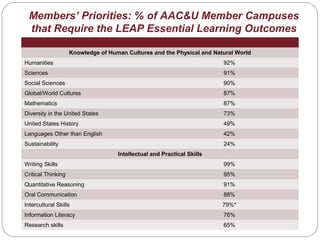
Members’ Priorities: % of AAC&U Member Campuses
that Require the LEAP Essential Learning Outcomes
Knowledge of Human Cultures and the Physical and Natural World
Humanities 92%
Sciences 91%
Social Sciences 90%
Global/World Cultures 87%
Mathematics 87%
Diversity in the United States 73%
United States History 49%
Languages Other than English 42%
Sustainability 24%
Intellectual and Practical Skills
Writing Skills 99%
Critical Thinking 95%
Quantitative Reasoning 91%
Oral Communication 88%
Intercultural Skills 79%*
Information Literacy 76%
Research skills 65%
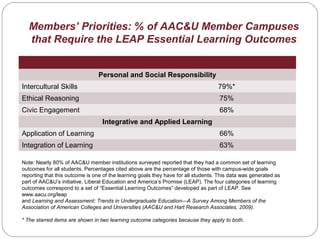
Members’ Priorities: % of AAC&U Member Campuses
that Require the LEAP Essential Learning Outcomes
Personal and Social Responsibility
Intercultural Skills 79%*
Ethical Reasoning 75%
Civic Engagement 68%
Integrative and Applied Learning
Application of Learning 66%
Integration of Learning 63%
Note: Nearly 80% of AAC&U member institutions surveyed reported that they had a common set of learning
outcomes for all students. Percentages cited above are the percentage of those with campus-wide goals
reporting that this outcome is one of the learning goals they have for all students. This data was generated as
part of AAC&U’s initiative, Liberal Education and America’s Promise (LEAP). The four categories of learning
outcomes correspond to a set of “Essential Learning Outcomes” developed as part of LEAP. See
www.aacu.org/leap
and Learning and Assessment: Trends in Undergraduate Education—A Survey Among Members of the
Association of American Colleges and Universities (AAC&U and Hart Research Associates, 2009).
* The starred items are shown in two learning outcome categories because they apply to both.
Collectively, Faculty Members
Have Created New Educational
Practices that Move Complex
Questions and Problem-
Solving to the Center
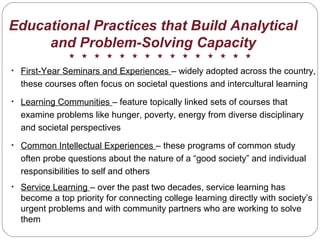
Educational Practices that Build Analytical
and Problem-Solving Capacity
• First-Year Seminars and Experiences – widely adopted across the country,
these courses often focus on societal questions and intercultural learning
• Learning Communities – feature topically linked sets of courses that
examine problems like hunger, poverty, energy from diverse disciplinary
and societal perspectives
• Common Intellectual Experiences – these programs of common study
often probe questions about the nature of a “good society” and individual
responsibilities to self and others
• Service Learning – over the past two decades, service learning has
become a top priority for connecting college learning directly with society’s
urgent problems and with community partners who are working to solve
them
Educational Practices (cont.)
• Collaborative Assignments and Projects – expected in many courses and
programs, these group assignments build capacities that are fundamental
for active citizenship, effective problem-solving and workplace success
• Undergraduate Research – opportunities to work with scholars on unsolved
problems help college students learn the arts of “evidence-based
reasoning” which is fundamental to innovation at work and problem-solving
in society
• Diversity/Global Learning – these programs build direct knowledge of
people, communities, and challenges different from one’s own; they build
civic vision and capacity and economic capacity
• Capstone Courses and Projects – often required in students’ majors, these
culminating experiences frequently provide opportunities for students to
apply their knowledge and skills to important problems in their chosen field
and in society.
As we tackle big challenges –
in the economy and civil
society – graduates need the
kind of education that fosters
BOTH economic innovation
and social responsibility.
“In a period of relentless
change, all students need the
kind of education that leads
them to ask not just ‘how do
we get this done’ but also
‘what is most worth doing?’”
College Learning for the New Global Century, 2007,
page 13.
Liberal Education – Our
Students’ Best Preparation for
a Complex and Fast-Changing
World

Liberal Education: Our Students' Best Preparation for Work and Citizenship – At Home and Abroad

  • 1.
    Prepared for thePresidents’ Trust by Carol Geary Schneider, Association of American Colleges & Universities Liberal Education: Our Students' Best Preparation for Work AND Citizenship
  • 2.
    A Note toPresidents This “case” combines and synthesizes evidence from two previous PowerPoint presentations* prepared for the Trust: The Economic Value of Liberal Education The Civic Case for Liberal Education *Each of these PowerPoint presentations remains available to Trust members at http://www.aacu.org/leap/presidentstrust/resources.cfm
  • 3.
    More College-Educated Workersare Needed but Supply is Not Keeping up with Demand Economists predict that by 2018, America will be 3 million college-educated workers short to meet demand, but college graduation rates are flat. By 2018, 22 million new and replacement jobs will require some college. By 2018, 63 percent of all jobs will require at least some postsecondary education. Sources: Georgetown University Center on Education and the Workforce; AAC&U, College Learning for the New Global Century (2007); Lumina Foundation for Education .
  • 4.
    Education Provides anUmbrella: High School Dropouts Bear the Brunt of Unemployment Source: Georgetown University Center on Education and the Workforce
  • 6.
    Americans Get theEconomic Message • Everyone understands that college has become the gateway to opportunity for 21st century learners. • More than 90% of high school students now hope to enroll in postsecondary education, because they see college as a prerequisite to economic advancement and a fulfilling life. College Learning for the New Global Century, 2007, note 3.
  • 7.
    There has beenalmost no public or policy discussion about what students really need from a 21st century college education. Back stage, however, educators, employers and civic leaders have been actively examining the learning students need for a fast-changing economy and an interconnected world. A consensus on the 21st century goals for college learning has started to emerge. But What Should Students Learn in College?
  • 8.
    In what follows,we explore the learning students need… • To contribute and thrive in a dynamic, innovation- fueled economy • To make wise choices as citizens, at home and abroad We explore the new consensus among educators, employers and civic leaders on making the most of college in this global century. Overview
  • 9.
    College Learning inthe 21st Century Economy In a word, employers are demanding more – much more They want and seek many more college educated works They also seek much higher and broader levels of learning in those they employ, retain and promote
  • 10.
    Why Is Therea Need for Higher Levels of Learning? • In a globalized knowledge economy, the capacity to drive innovation is the key strategic economic advantage • Rapid scientific and technological innovations are changing the workplace and demanding more of all employees • Global interdependence and complex cross- cultural interactions increasingly define modern society and the workplace and call for new levels of knowledge and capability
  • 11.
    Employers Continue toRaise the Bar and Hire for Innovation 95% of employers “put a priority on hiring people with the intellectual and interpersonal skills that will help them contribute to innovation in the workplace” 93% of employers say that they are asking employees to “take on more responsibilities and to use a broader set of skills than in the past” 95% of employers say that “a candidate’s demonstrated capacity to think critically, communicate clearly, and solve complex problems is more important than their undergraduate major” 91% of employers say that “the challenges their employees face are more complex than they were in the past.” Source: “It Takes More Than a Major: Employer Priorities for College Learning and
  • 12.
    The Need forNew Learning is Constant • Every year, more than 1/3 of the entire US labor force changes jobs. • Research Suggests That Today's Students May Have 10-14 Jobs by the Time They Are 38. • 50% of Workers Have Been With Their Company Less Than 5 Years. • Every year, more than 30 million Americans are working in jobs that did not exist in the previous quarter. DOL-BLS
  • 13.
    The Growing Demandfor Higher Order Skills Source: Council on Competitiveness, Competitiveness Index
  • 14.
    What Employers Say “[Employers]generally are...frustrated with their inability to find ‘360 degree people’ who have both the specific job/technical skills and the broader skills (communication and problem- solving skills, work ethic, and ability to work with others) necessary to promise greater success for both the individual and the employer.” From Peter D. Hart Research Associates, Report of Findings Based on Focus Groups Among Business Executives (AAC&U, 2006)
  • 15.
    National Surveys ofEmployers on College Learning and Graduates’ Work Readiness AAC&U commissioned Hart Research Associates (in 2006, 2007, and in late 2009) to interview employers (C-level suite executives and, in 2009 additional human resource professionals) whose companies report that hiring relatively large numbers of college graduates Findings are summarized in the following reports: How Should Colleges Prepare Students to Succeed in Today’s Global Economy? (AAC&U, 2007) How Should Colleges Assess and Improve Student Learning? Employers’ Views on the Accountability Challenge (AAC&U, 2008) Raising the Bar: Employers’ Views on College Learning in the Wake of the Economic Downturn (AAC&U, 2010) It Takes More Than a Major: Employer Priorities for College Learning and Student Success (AAC&U, 2013) See: www.aacu.org/leap/public_opinion_research
  • 16.
    In this Economy,Narrow Learning is Not Enough!
  • 17.
    Balance of BroadKnowledge and Specific Skills Preferred Which is more important for recent college graduates who want to pursue advancement and long-term career success at your company? “It Takes More Than a Major: Employer Priorities for College Learning and Student Success” (Hart Research Associates, 2013) Having both field-specific knowledge and skills AND a broad range of skills and knowledge Having a range of skills and knowledge that apply to a range of fields or positions Having knowledge and skills that apply to a specific field or position 16% 29% 55%
  • 18.
    Key Capabilities Openthe Door for Career Success “Irrespective of college major or institutional selectivity, what matters to career success is students’ development of a broad set of cross-cutting capacities…” Anthony Carnevale, Georgetown University Center on Education and the Workforce
  • 19.
    In the 21st Century,Liberal Education Outcomes Have Become the Key to American Capability and Student Success
  • 20.
    What is aLiberal Education?
  • 21.
    A Liberal EducationProvides: Rich Knowledge – of Human Cultures and the Physical and Natural Worlds Intellectual and Practical Skills Personal and Social Responsibility Integrative and Applied Learning
  • 22.
    The LEAP EssentialLearning Outcomes  Knowledge of Human Cultures and the Physical and Natural World through study in the sciences and mathematics, social sciences, humanities, histories, languages, and the arts  Intellectual and Practical Skills, including inquiry and analysis, critical and creative thinking, written and oral communication, quantitative literacy, information literacy, and teamwork and problem solving  Personal and Social Responsibility, including civic knowledge and engagement – local and global, intercultural knowledge and competence, ethical reasoning and action, and foundations and skills for lifelong learning  Integrative and Applied Learning, including synthesis and advanced accomplishment across general and specialized studies
  • 23.
    Employers Strongly Endorsethe LEAP “Essential Learning Outcomes” – And They Urge New Effort to Help All Students Achieve Them
  • 24.
    Employers Want “MoreEmphasis” on Key Learning Outcomes Put more emphasis than colleges have in the past Less emphasisThe same emphasis Critical thinking/ analytical reasoning Ability to analyze/solve complex problems Effective oral communication Effective written communication Apply knowledge/skills to real-world settings Locate, organize, evaluate info from multiple sources Innovation/creativity Teamwork/collaboration in diverse group settings Ability to connect choices and actions to ethical decisions 64% 27% 9% 67% 22% 11% 71% 20% 9% 72% 19% 9% 78% 16% 6% 80% 12% 8% 80% 12% 8% 81% 13% 6% 82% 11% 7% “It Takes More Than a Major: Employer Priorities for College Learning and Student Success” (Hart Research Associates, 2013)
  • 25.
    How important isit for colleges and universities to provide the type of education described below? This particular approach to a four-year college education provides both broad knowledge in a variety of areas of study and more in-depth knowledge in a specific major or field of interest. It also helps students develop a sense of social responsibility, as well as intellectual and practical skills that span all areas of study, such as communication, analytical, and problem-solving skills, and a demonstrated ability to apply knowledge and skills in real-world settings. Source: How Should Colleges Prepare Students to Succeed in Today’s Global Economy? (AAC&U, 2007)
  • 26.
    How important isit for colleges and universities to provide this type of education (see previous slide)? “It Takes More Than a Major: Employer Priorities for College Learning and Student Success” (Hart Research Associates, 2013) 6% 43% 51% Only somewhat important Fairly important Very important
  • 27.
    Higher Level Liberal EducationSkills and Abilities = Higher Wages Data from Georgetown University Center for Education and the Workforce Center on Education and the Workforce
  • 28.
    There is aSalary Premium for Liberal Education Outcomes From a federal database analyzing qualifications for 1,100 different jobs, there is consistent evidence that the highest salaries apply to positions that call for intensive use of liberal education capabilities, including (random order): • Writing • Inductive and Deductive Reasoning • Judgment and Decision Making • Problem Solving • Social/Interpersonal Skills • Mathematics • Originality Source: Georgetown University Center on Education and the Workforce
  • 29.
    • In sum,college alone is not enough to ensure economic opportunity and success. • The hallmark outcomes of liberal education prepare students to adapt to change, succeed in innovative environments and work successfully with peers and clients from other cultures and other parts of the world. College Learning and Economic Opportunity
  • 30.
    “In an economyfueled by innovation, the capabilities developed through a liberal education have become America’s most valuable economic asset.” College Learning for the New Global Century (AAC&U, 2007)
  • 31.
    College and Civic Capacity Whileeconomic opportunity is a very important college outcome, it is equally important for colleges to build civic capacity- the knowledge, judgment and commitment to solve societal problems and ensure the integrity and vitality of our democratic society.
  • 32.
    As in theeconomy, the civic challenges Americans face are daunting Within Our Borders, And in the Global Community
  • 33.
    Challenges Within OurBorders • Cultures – Multiple and Multiplying • Economy – In the Midst of Painful Dislocations and Volatility • Society – Riven Over Immigration and Other “Social Questions” • Politics – Contentious, Fractured, Declining Confidence in Public Sector
  • 34.
    Global Challenges • Poverty,War, Suffering... Sustenance and Human Dignity • Illiteracy and Its Effects... Education and Opportunity • Energy and the Environment... Research and Innovation • Terrorism and Fear... Law, Justice, Democracy, Freedom
  • 35.
    Global Challenges (Cont.) •The United States’ Historic Role in Global Leadership • And as a Voice and Force for Democratic Values and Democratic Self-Determination
  • 36.
    The Issues atHome and Abroad Are Immense Rising to These Challenges Will Require Civic Will, Capacity, and Commitment – the Determination to Tackle Hard Questions – in All Their Complexity
  • 37.
    America’s Best Hope •Civic Capacity is Developed Through Education – and Liberal Education is the Crucial Key Both to New Civic Capacity And to Meeting the Challenges We Face at Home and Abroad
  • 38.
  • 39.
    Liberal Education –By Design – Builds Both Capacity (rich knowledge, high level skills; social imagination) AND the Commitment (an examined sense of ethical and civic responsibility) To Create and Test Responsible Solutions – and to Learn with and for Others – Not Just Ourselves
  • 40.
    The Civic Valueof the Essential Learning Outcomes • Rich Knowledge – of Human Cultures and the Physical and Natural Worlds • Knowledge that can be applied to big societal, scientific, and global challenges; knowledge of the diverse peoples who must work together to solve our problems of health, human dignity, and sustainable communities • Intellectual and Practical Skills • Especially the capacity to deliberate and work together, across differences of many kinds • Testing solutions, and discovering “what works”
  • 41.
    The Civic Valueof Liberal Education (cont.) • Personal and Social Responsibility • Ethical reasoning and action • Intercultural knowledge and engagement • Perspective taking and the capacity to work with people and communities different from one’s own • Democratic values – including a strong respect for human dignity and active citizenship • Integrative and Applied Learning • The demonstrated ability to apply knowledge, skills, AND a developed sense of responsibility to complex problems and new challenges
  • 42.
    • Liberal educationprepares students for career success and for mindful citizenship • It builds commitments and capacity to work on emerging problems – in the workplace and in communities In Sum
  • 43.
    “... [W]e arenot forced to choose. ... A flourishing economy requires the same skills that support citizenship.” Martha Nussbaum “The Liberal Arts Are Not Elitist” Chronicle of Higher Education, June 10, 2010
  • 44.
    Policy Influencers and BusinessLeaders Agree We must raise the level of civic knowledge and engagement. The learning outcomes important for civic engagement are the same as those essential for workplace success.
  • 45.
    Republicans and Democrats Agree “Collegesand universities are uniquely positioned to model and teach respectful dialogue.” – Democratic policy influencer “College is the last marker before…[one is] released into the real world…colleges and universities—if they have an opportunity to play a key role in civic education…they should.” – Republican policy influencer Source: Key Findings from Focus Groups on Increasing Support for Civic Learning in Higher Education (Hart Research Associates, 2011)
  • 46.
    Employers Value CandidatesWho Have Intercultural Skills and Who Show An Interest in “Giving Back” Very important that our employees have this quality/skill Fairly important 26% 63% Comfortable working with colleagues, customers, and/or clients from diverse cultural backgrounds Show an interest in giving back to the communities in which our company is located or those that it serves “It Takes More Than a Major: Employer Priorities for College Learning and Student Success” (Hart Research Associates, 2013)
  • 47.
    47 Expecting students completeinternship or community-based field project to connect classroom learning with real-world experiences Expecting students to develop the skills to conduct research collaboratively with their peers Expecting students to work through ethical issues and debates to form their own judgments about the issues at stake 34% 33% 47% Will help a lot to prepare college students for success after graduation Will help a fair amount 78% 74% 66% Employers Think Key Practices Would Help Prepare Students For Success “It Takes More Than a Major: Employer Priorities for College Learning and Student Success” (Hart Research Associates, 2013)
  • 48.
    48 All students shouldhave educational experiences that teach them how to solve problems with people whose views are different from their own All students should learn about ethical issues and public debates important in their field All students should have direct learning experiences working with others to solve problems important in their communities All students should take courses that build knowledge, judgment, commitment to communities, ensure integrity/vitality of democracy All students should acquire broad knowledge in liberal arts and sciences 32% 27% 41% 43% 57% Strongly agree with this statement about the aims of college learning Somewhat agree 86% 87% 82% 80% 91% Employers Agree On Key Learning Experiences For All Students, Regardless of Major “It Takes More Than a Major: Employer Priorities for College Learning and Student Success” (Hart Research Associates, 2013)
  • 49.
    But in HigherEducation Today, Not Every Student Actually Gets a Liberal Education Many Are Steered to Narrow, Technical Training, Largely Devoid of the Studies—in the Sciences, the Humanities, the Social Sciences and the Arts—that Build Big Picture Knowledge, Creativity, and Leadership
  • 50.
    First-Generation Students Frequently MissOut on the Arts and Sciences • First-generation students take fewer courses than others in mathematics, science, social studies, humanities, history, foreign languages, or computer science. From National Center for Education Statistics, First-Generation Students in Postsecondary Education: A Look at Their College Transcripts. (Washington, DC: U.S. Department of Education, 2005).
  • 51.
    First-Generation Students Are Over-Representedin So-Called “Career and Technical Programs” and in For-Profit Institutions that Never Were Designed to Foster Either Broad Knowledge or Civic Learning
  • 52.
    Prominent Policy LeadersAre Vigorously Promoting Short-Term Technical Certificates for First-Generation Students – Faster, Less Costly, Directly Attuned to Job Availability Such programs typically include NO studies in the humanities or social sciences
  • 53.
    Is It Possibleto Be Civically and Globally Prepared Without Any Study of: • World histories? • Global cultures? • Political, economic, and social systems and challenges? • The ideas and institutions that support constitutional democracy? • The great religious and philosophical traditions of peoples around the world?
  • 54.
    Is It Possibleto Be Economically Prepared Without Any Study of: • World histories? • Global cultures? • Political, economic, and social systems and challenges? • The ideas and institutions that support constitutional democracy? • The great religious and philosophical traditions of peoples around the world?
  • 55.
    What We Need– Today – from the Higher Education Community, Is the Commitment to Ensure that Every Student Gets a Liberal Education While in College We Have Made that Commitment at X Institution, and We Are Proud to Be a Leader in Making Liberal Education a Top Priority for Our Students, Our Faculty, Our Staff—and through Their Achievements—an Important Resource for Our Community and our Economy
  • 56.
    Here Is What OurCampus Is Doing • Mission • Learning Outcomes • Signature Programs • Community Partnerships
  • 57.
    Higher Education Is Poisedand Ready to Provide New National Leadership in Educating Citizens for the Challenges We Face, at Home and Abroad
  • 58.
    Today, Hundreds ofColleges and Universities Are Placing New Emphasis Both on the Broad Aims of Liberal Education AND on Developing Students’ Civic Capacities and their Economic Savvy
  • 59.
    Members’ Priorities: %of AAC&U Member Campuses that Require the LEAP Essential Learning Outcomes Knowledge of Human Cultures and the Physical and Natural World Humanities 92% Sciences 91% Social Sciences 90% Global/World Cultures 87% Mathematics 87% Diversity in the United States 73% United States History 49% Languages Other than English 42% Sustainability 24% Intellectual and Practical Skills Writing Skills 99% Critical Thinking 95% Quantitative Reasoning 91% Oral Communication 88% Intercultural Skills 79%* Information Literacy 76% Research skills 65%
  • 60.
    Members’ Priorities: %of AAC&U Member Campuses that Require the LEAP Essential Learning Outcomes Personal and Social Responsibility Intercultural Skills 79%* Ethical Reasoning 75% Civic Engagement 68% Integrative and Applied Learning Application of Learning 66% Integration of Learning 63% Note: Nearly 80% of AAC&U member institutions surveyed reported that they had a common set of learning outcomes for all students. Percentages cited above are the percentage of those with campus-wide goals reporting that this outcome is one of the learning goals they have for all students. This data was generated as part of AAC&U’s initiative, Liberal Education and America’s Promise (LEAP). The four categories of learning outcomes correspond to a set of “Essential Learning Outcomes” developed as part of LEAP. See www.aacu.org/leap and Learning and Assessment: Trends in Undergraduate Education—A Survey Among Members of the Association of American Colleges and Universities (AAC&U and Hart Research Associates, 2009). * The starred items are shown in two learning outcome categories because they apply to both.
  • 61.
    Collectively, Faculty Members HaveCreated New Educational Practices that Move Complex Questions and Problem- Solving to the Center
  • 62.
    Educational Practices thatBuild Analytical and Problem-Solving Capacity • First-Year Seminars and Experiences – widely adopted across the country, these courses often focus on societal questions and intercultural learning • Learning Communities – feature topically linked sets of courses that examine problems like hunger, poverty, energy from diverse disciplinary and societal perspectives • Common Intellectual Experiences – these programs of common study often probe questions about the nature of a “good society” and individual responsibilities to self and others • Service Learning – over the past two decades, service learning has become a top priority for connecting college learning directly with society’s urgent problems and with community partners who are working to solve them
  • 63.
    Educational Practices (cont.) •Collaborative Assignments and Projects – expected in many courses and programs, these group assignments build capacities that are fundamental for active citizenship, effective problem-solving and workplace success • Undergraduate Research – opportunities to work with scholars on unsolved problems help college students learn the arts of “evidence-based reasoning” which is fundamental to innovation at work and problem-solving in society • Diversity/Global Learning – these programs build direct knowledge of people, communities, and challenges different from one’s own; they build civic vision and capacity and economic capacity • Capstone Courses and Projects – often required in students’ majors, these culminating experiences frequently provide opportunities for students to apply their knowledge and skills to important problems in their chosen field and in society.
  • 64.
    As we tacklebig challenges – in the economy and civil society – graduates need the kind of education that fosters BOTH economic innovation and social responsibility.
  • 65.
    “In a periodof relentless change, all students need the kind of education that leads them to ask not just ‘how do we get this done’ but also ‘what is most worth doing?’” College Learning for the New Global Century, 2007, page 13.
  • 66.
    Liberal Education –Our Students’ Best Preparation for a Complex and Fast-Changing World

Editor's Notes