SESSION ID:
#RSAC Copyright © 2016 Raytheon Company
Randall Brooks, CISSP,
CSSLP
Embedded Systems Security:
Building a More Secure Device
ASD-W05
Engineering Fellow
Raytheon
@randallsbrooks
#RSAC
Objectives
What are common embedded
systems?
What issues do they face?
Recommendations for securing
embedded systems
2
#RSAC
Poll
3
Which operating system is your software most commonly
developed for?
Which language is your software most commonly
developed for?
Which hardware does your system run on?
What are your thoughts on the following statement: My
system is standalone, therefore many Cybersecurity or
Software Assurance (SwA) requirements do not apply?
What do you perceive as the biggest threats to your
embedded system’s security?
Given the rise of IoT, do you feel IoT and its issues are
related to your embedded system’s security issues?
#RSAC
Results (Predicted)
OS: Green Hills and VxWorks
Language: C++
Hardware: PPC (SoC)
Standalone: Systems are not
actually standalone
Threats: Supply chain, physical
access
IoT Threats: IoT mirror without
legacy issues
4
#RSAC
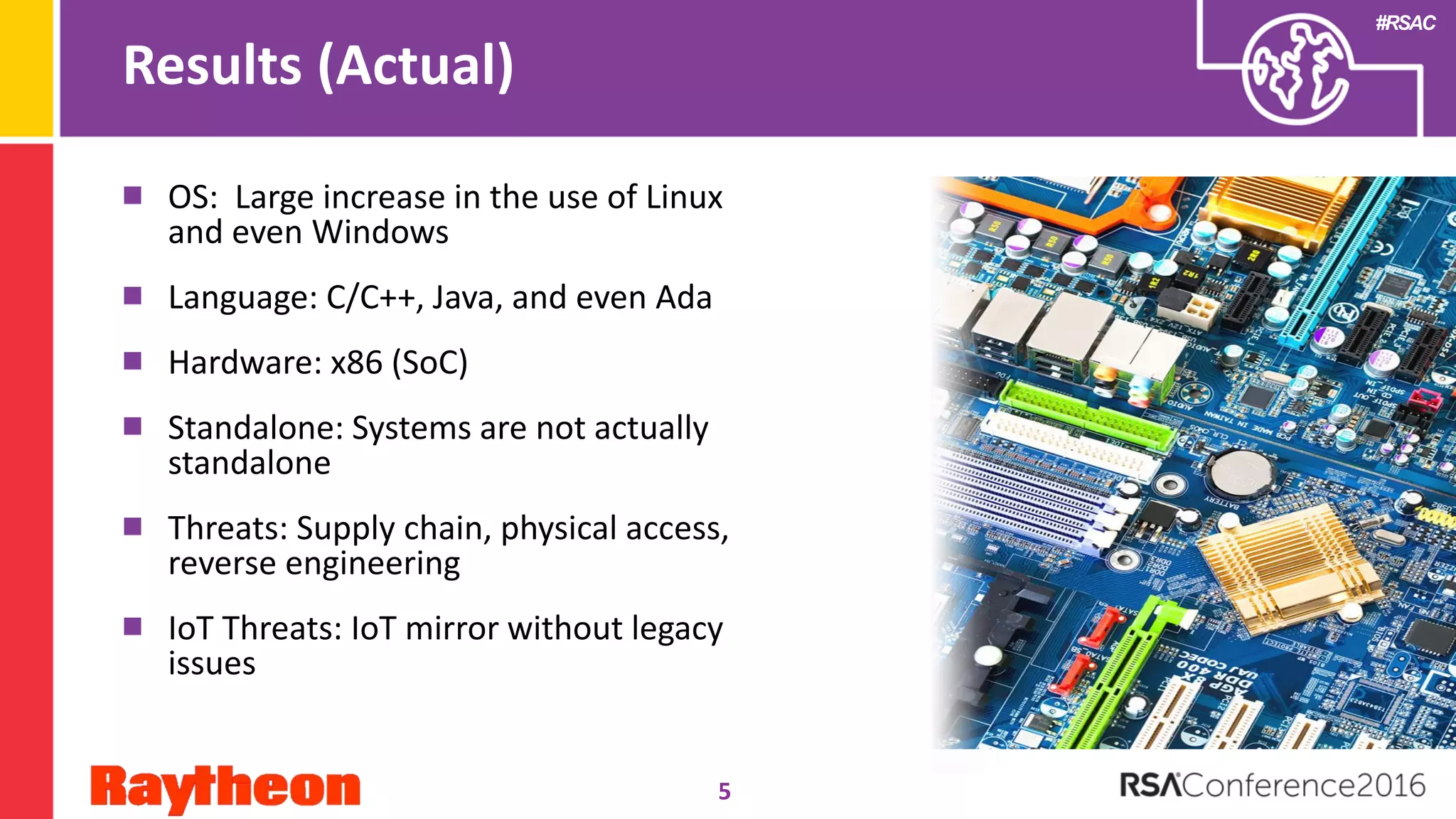
Results (Actual)
OS: Large increase in the use of Linux
and even Windows
Language: C/C++, Java, and even Ada
Hardware: x86 (SoC)
Standalone: Systems are not actually
standalone
Threats: Supply chain, physical access,
reverse engineering
IoT Threats: IoT mirror without legacy
issues
5
#RSAC
Audience Poll
6
Which operating systems do you see or
use?
Other languages?
Which about hardware?
MIPS?
ARM?
#RSAC
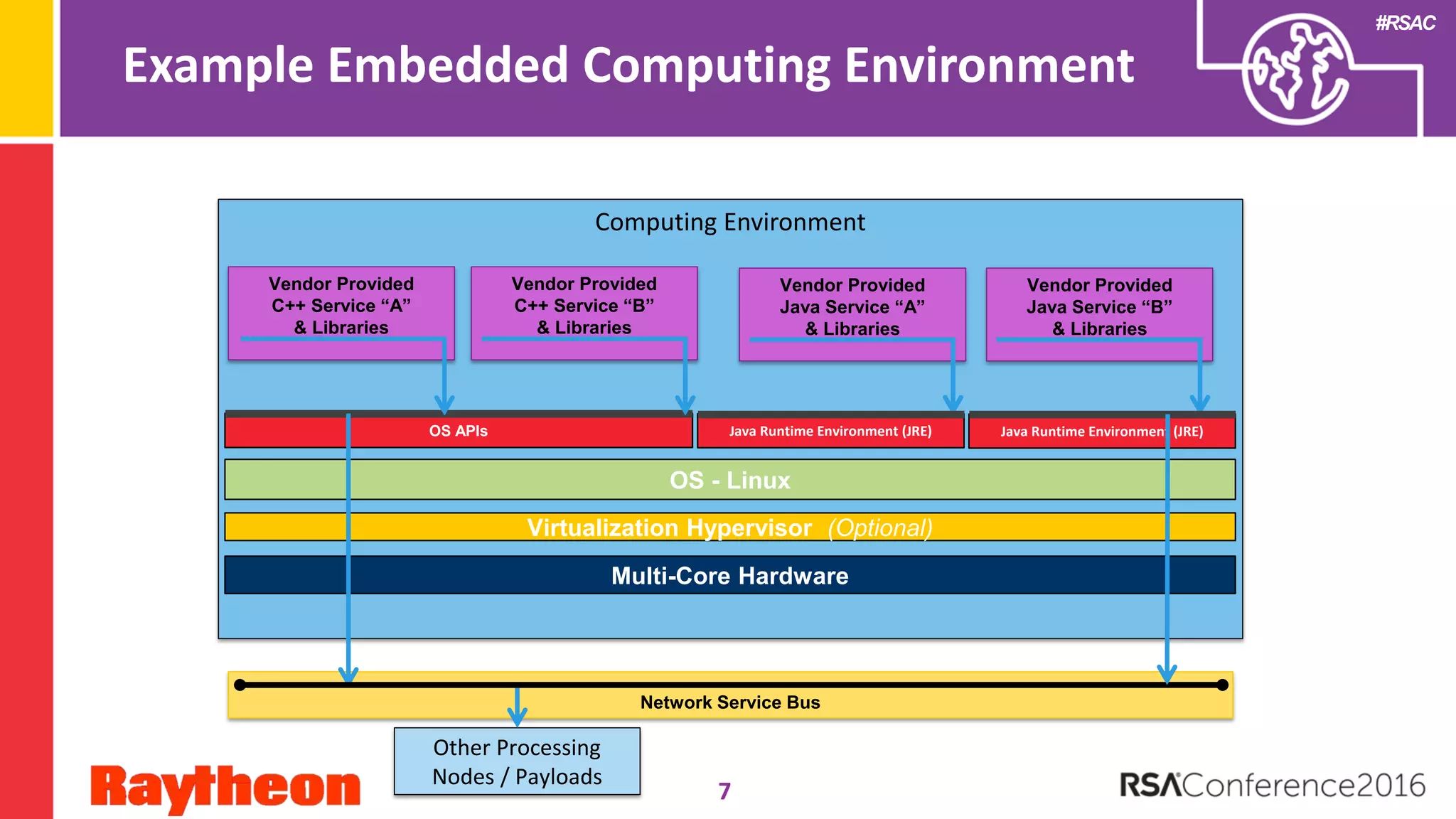
Example Embedded Computing Environment
7
Computing Environment
OS APIs
Multi-Core Hardware
Other Processing
Nodes / Payloads
Virtualization Hypervisor (Optional)
OS - Linux
Vendor Provided
C++ Service “B”
& Libraries
Vendor Provided
C++ Service “A”
& Libraries
Vendor Provided
Java Service “A”
& Libraries
Vendor Provided
Java Service “B”
& Libraries
Network Service Bus
Java Runtime Environment (JRE)Java Runtime Environment (JRE)
#RSAC
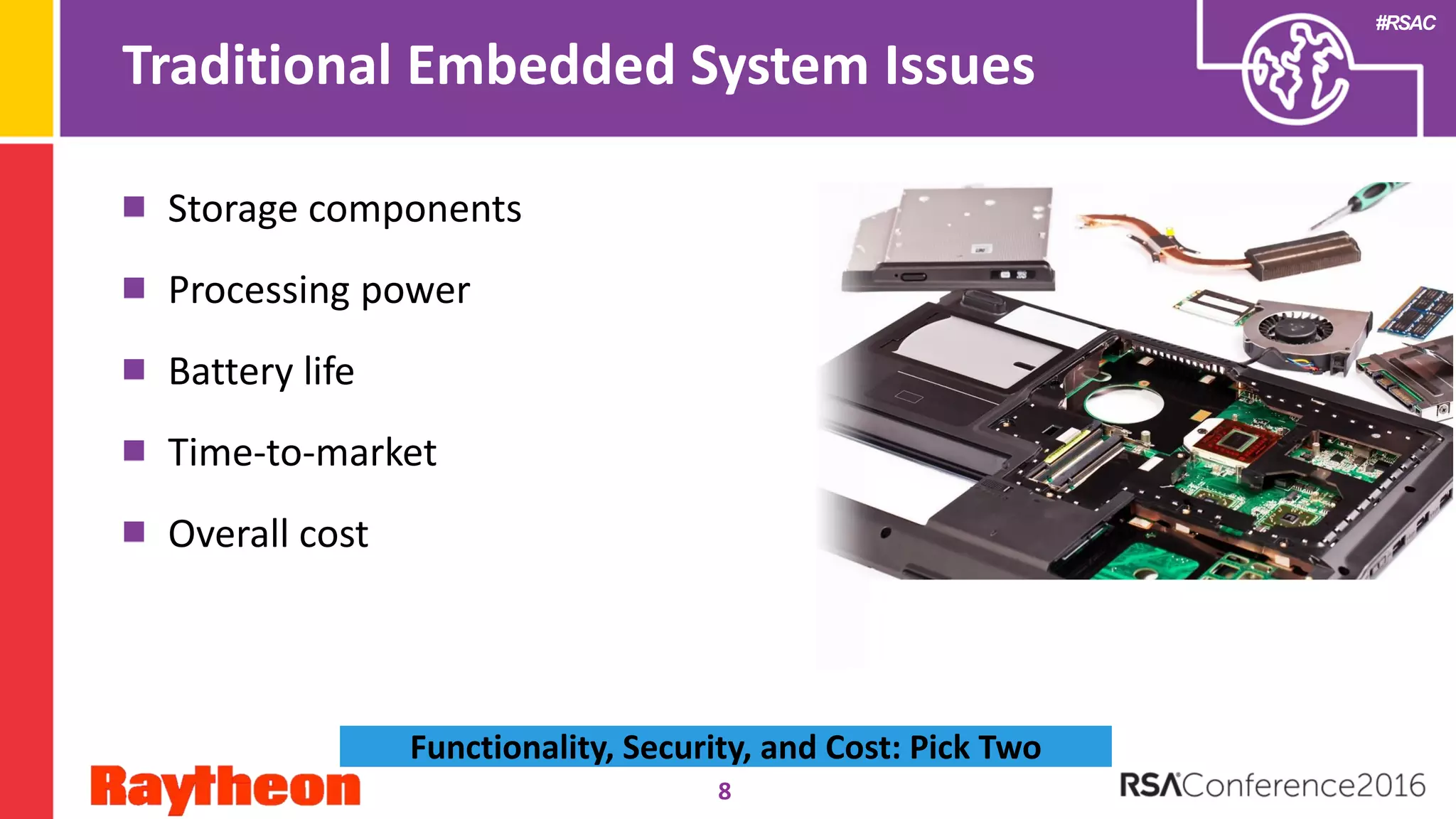
Traditional Embedded System Issues
Storage components
Processing power
Battery life
Time-to-market
Overall cost
8
Functionality, Security, and Cost: Pick Two
#RSAC
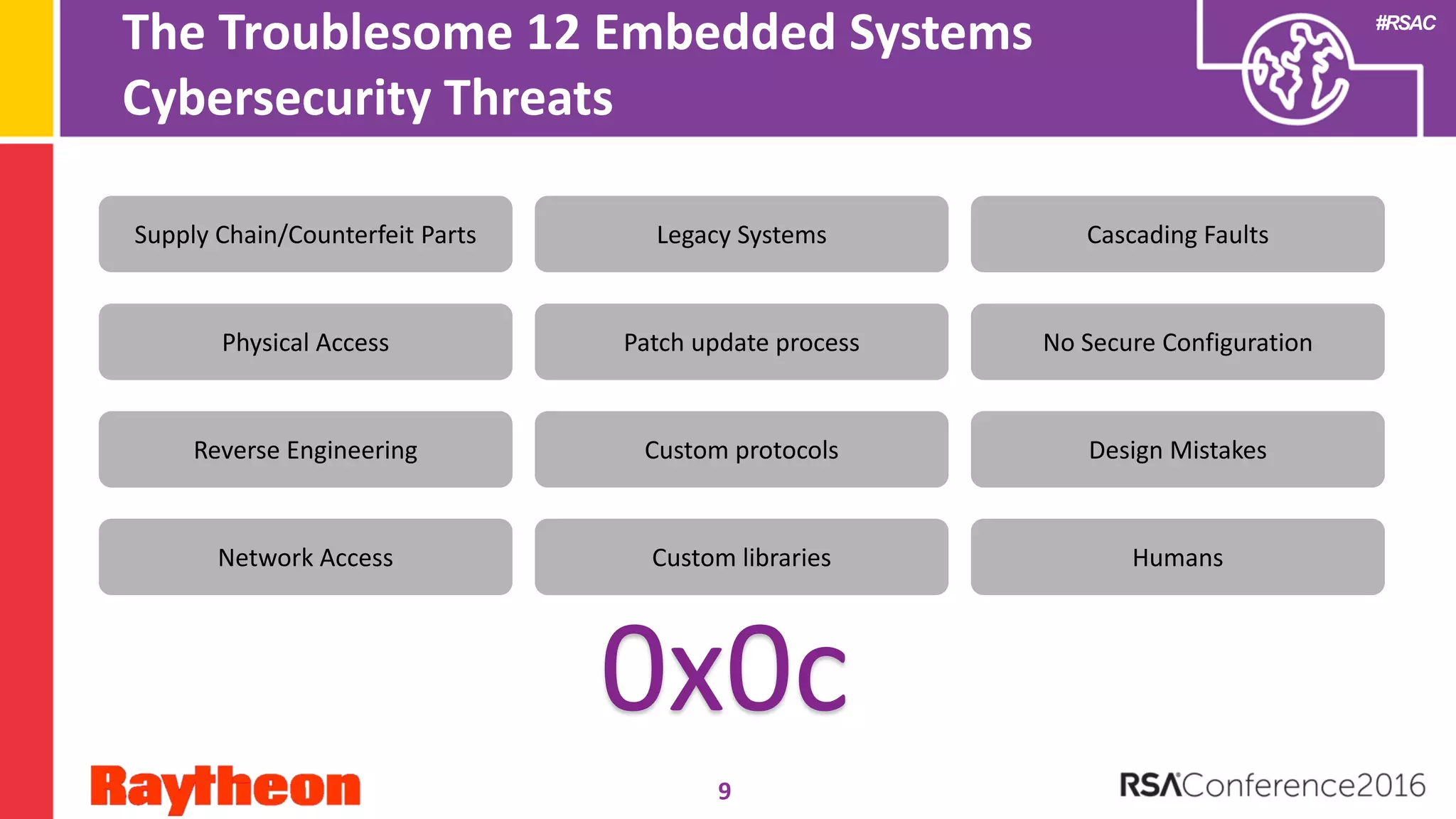
The Troublesome 12 Embedded Systems
Cybersecurity Threats
9
Supply Chain/Counterfeit Parts Legacy Systems Cascading Faults
Physical Access Patch update process No Secure Configuration
Reverse Engineering Custom protocols Design Mistakes
Network Access Custom libraries Humans
0x0c
#RSAC
Threat: Supply Chain/Counterfeit Parts
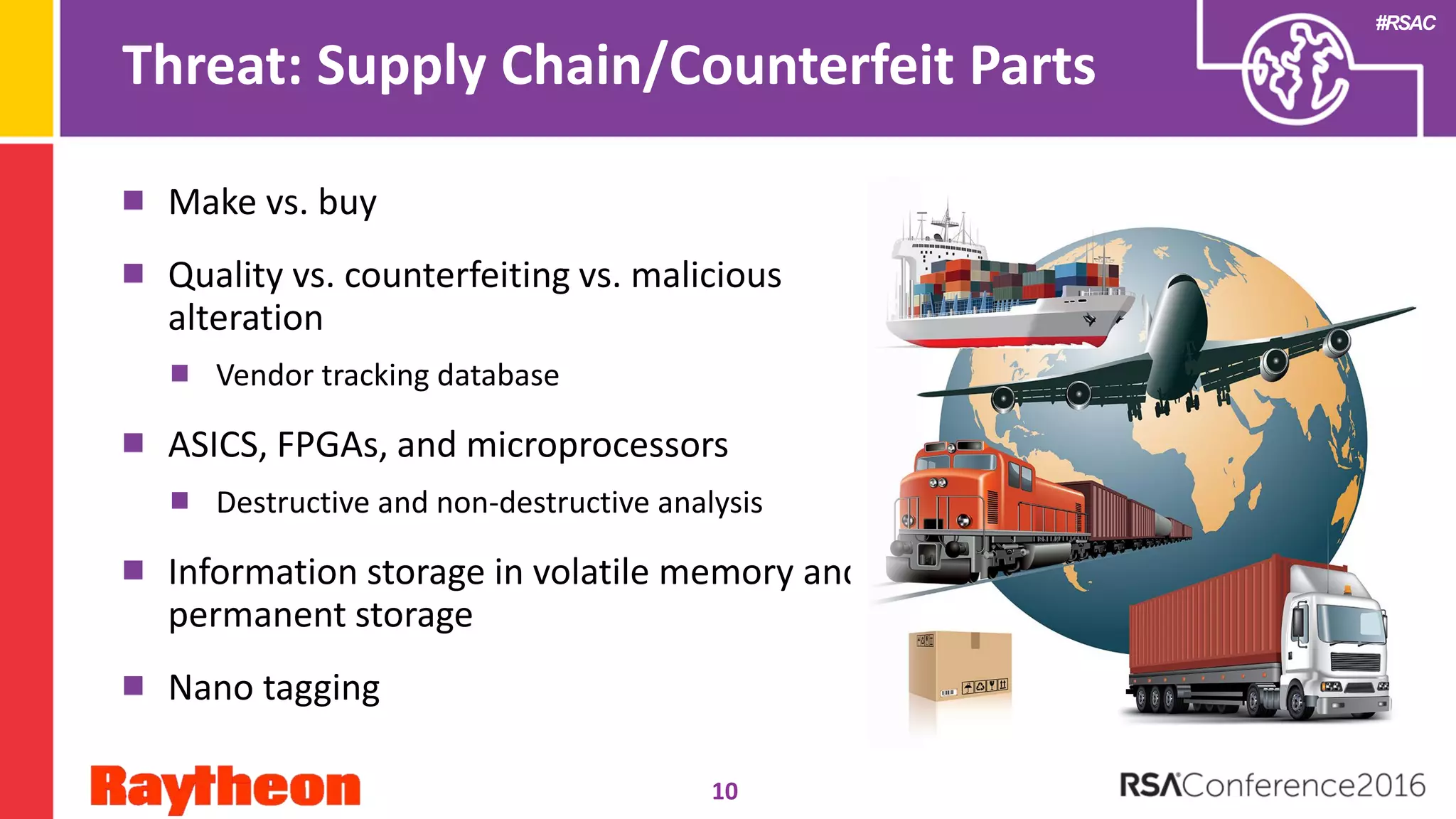
Make vs. buy
Quality vs. counterfeiting vs. malicious
alteration
Vendor tracking database
ASICS, FPGAs, and microprocessors
Destructive and non-destructive analysis
Information storage in volatile memory and
permanent storage
Nano tagging
10
#RSAC
Threat: Physical Access
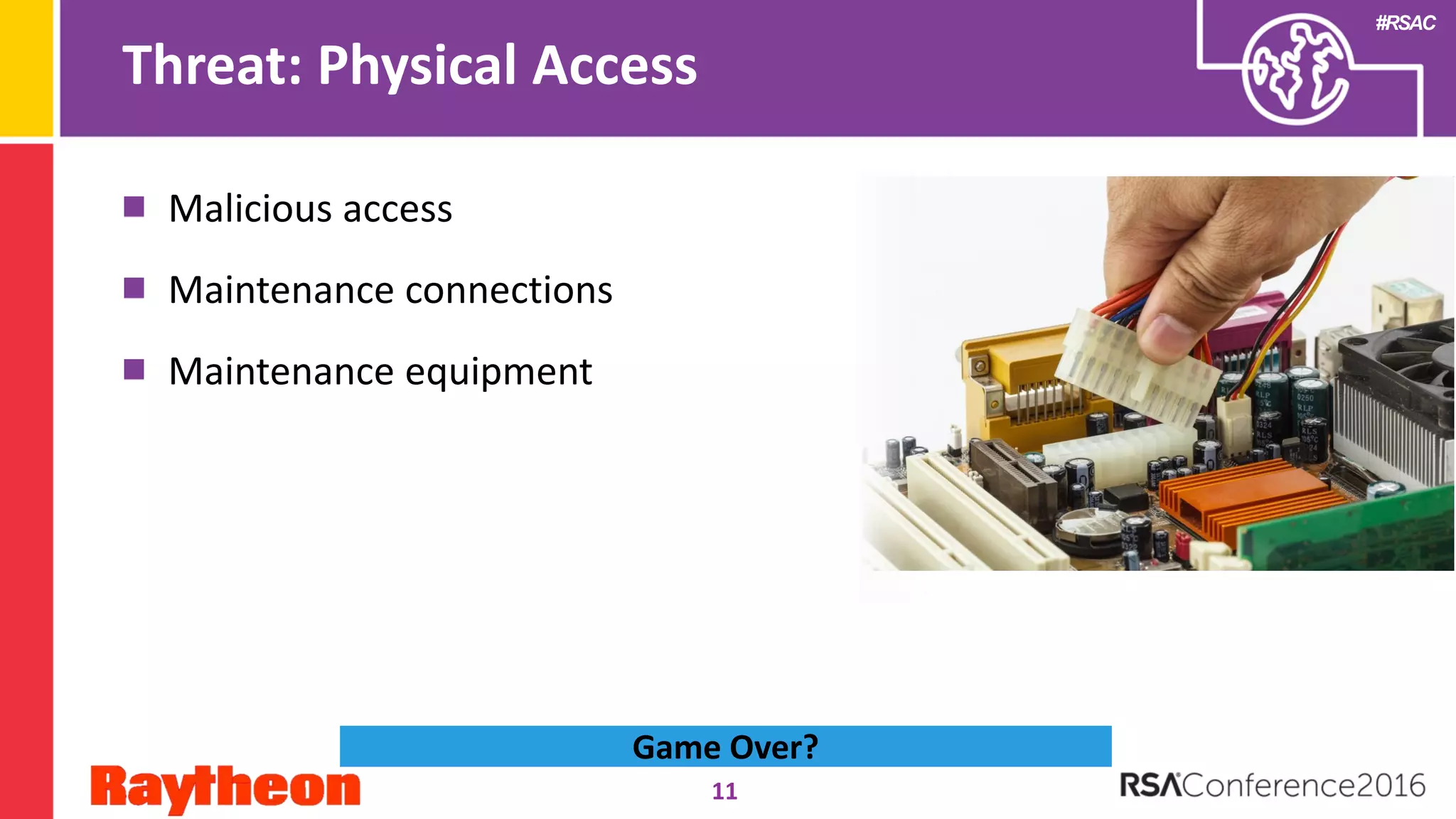
Malicious access
Maintenance connections
Maintenance equipment
11
Game Over?
#RSAC
Threat: Reverse Engineering
Intellectual Property (IP) access
System Integrity
Disassembly
Black box testing
Static Analysis Security Testing
(SAST) of binaries
Dynamic
System Probing
12
#RSAC
Threat: Network Access
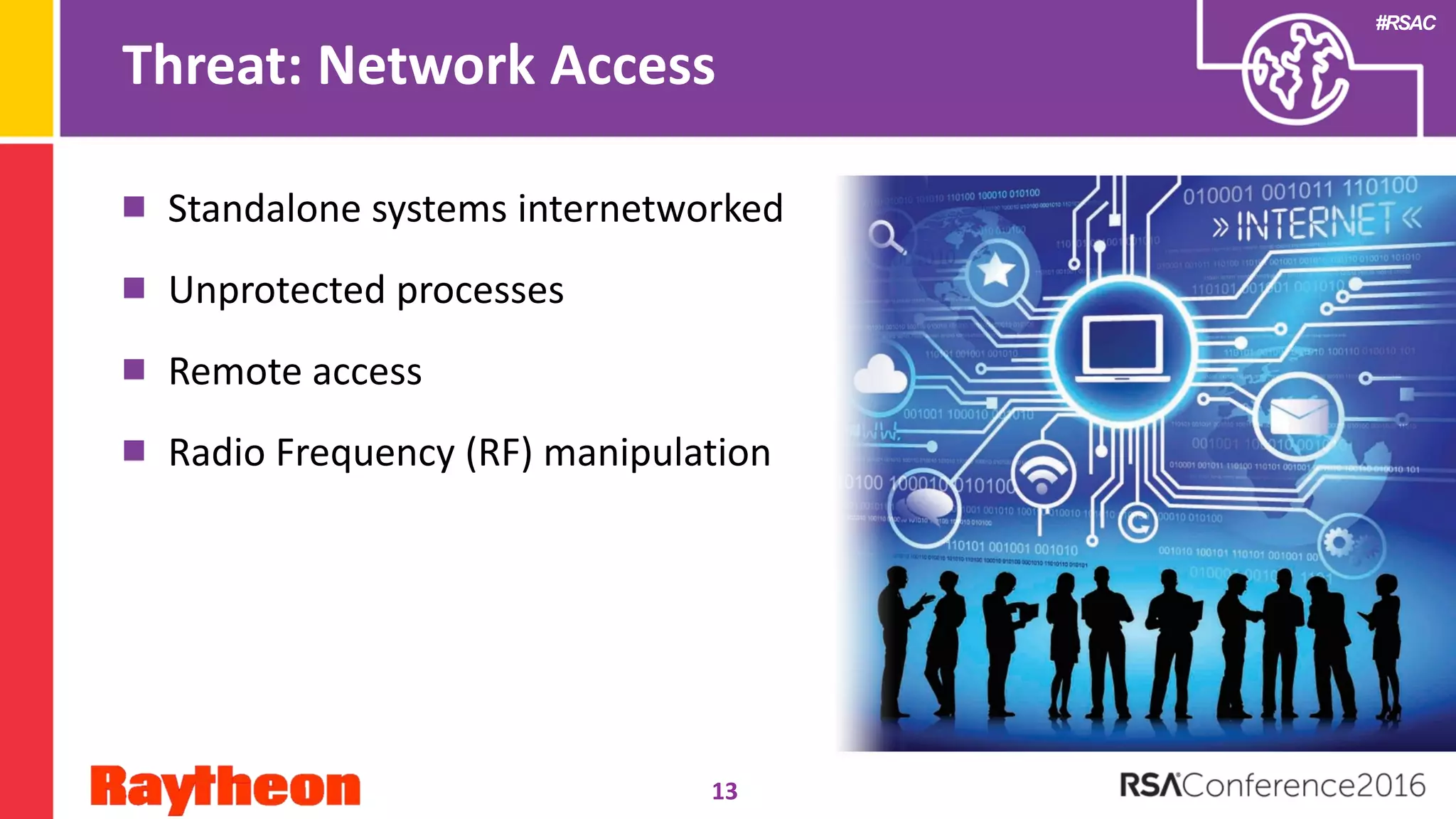
Standalone systems internetworked
Unprotected processes
Remote access
Radio Frequency (RF) manipulation
13
#RSAC
Threat: Legacy Systems
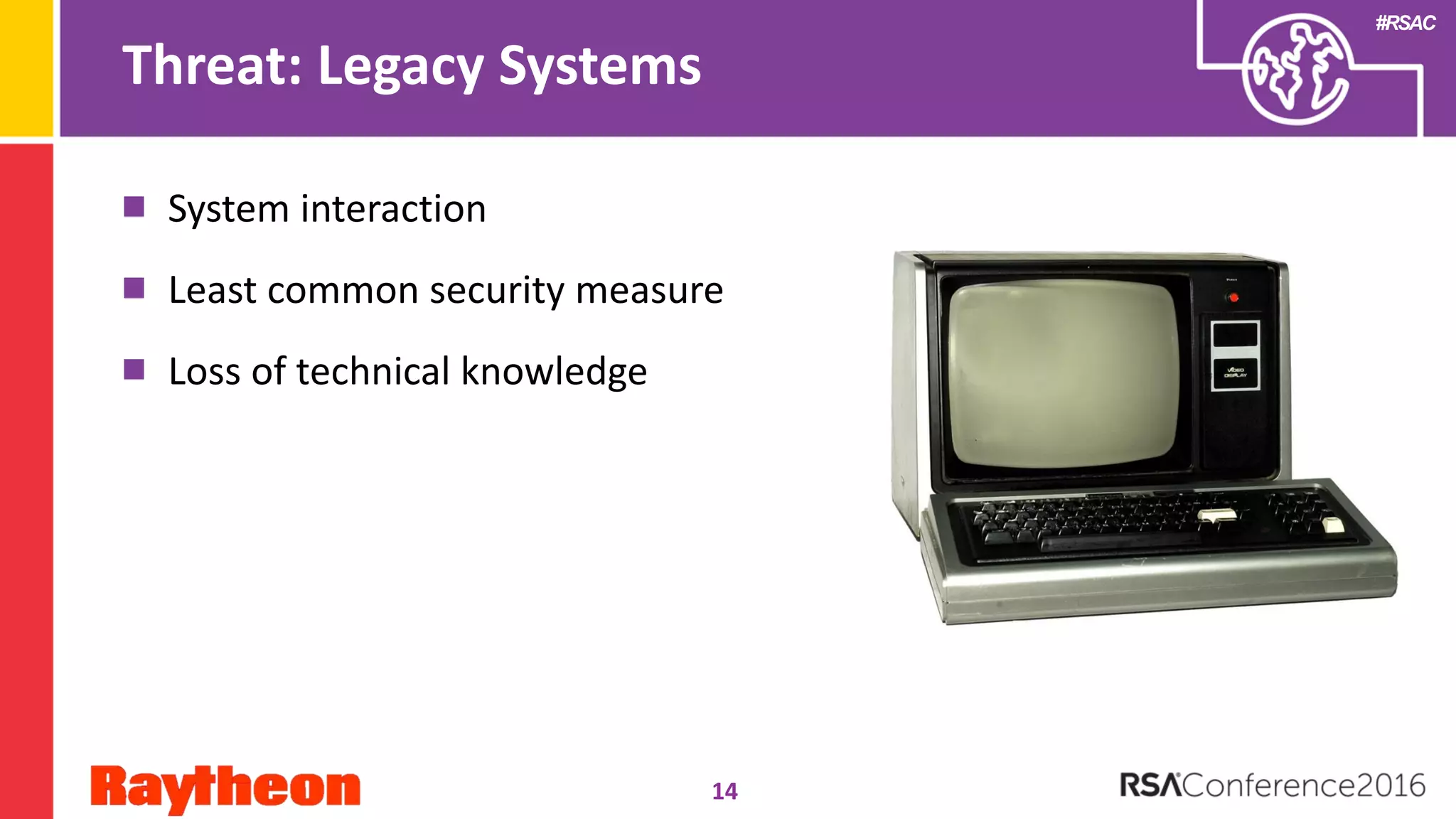
System interaction
Least common security measure
Loss of technical knowledge
14
#RSAC
Threat: Patch Update Process
None
Systems are permanent and not
updated
Unauthenticated
No digital signature on
software/firmware
Invalid
No integrity
No fail secure
15
#RSAC
Threat: Custom Protocols
Legacy
No authentication
Variable size
Non-standard or multiple version
support
16
#RSAC
Threat: Custom Libraries
Common functions
Extended
Malicious library
17
#RSAC
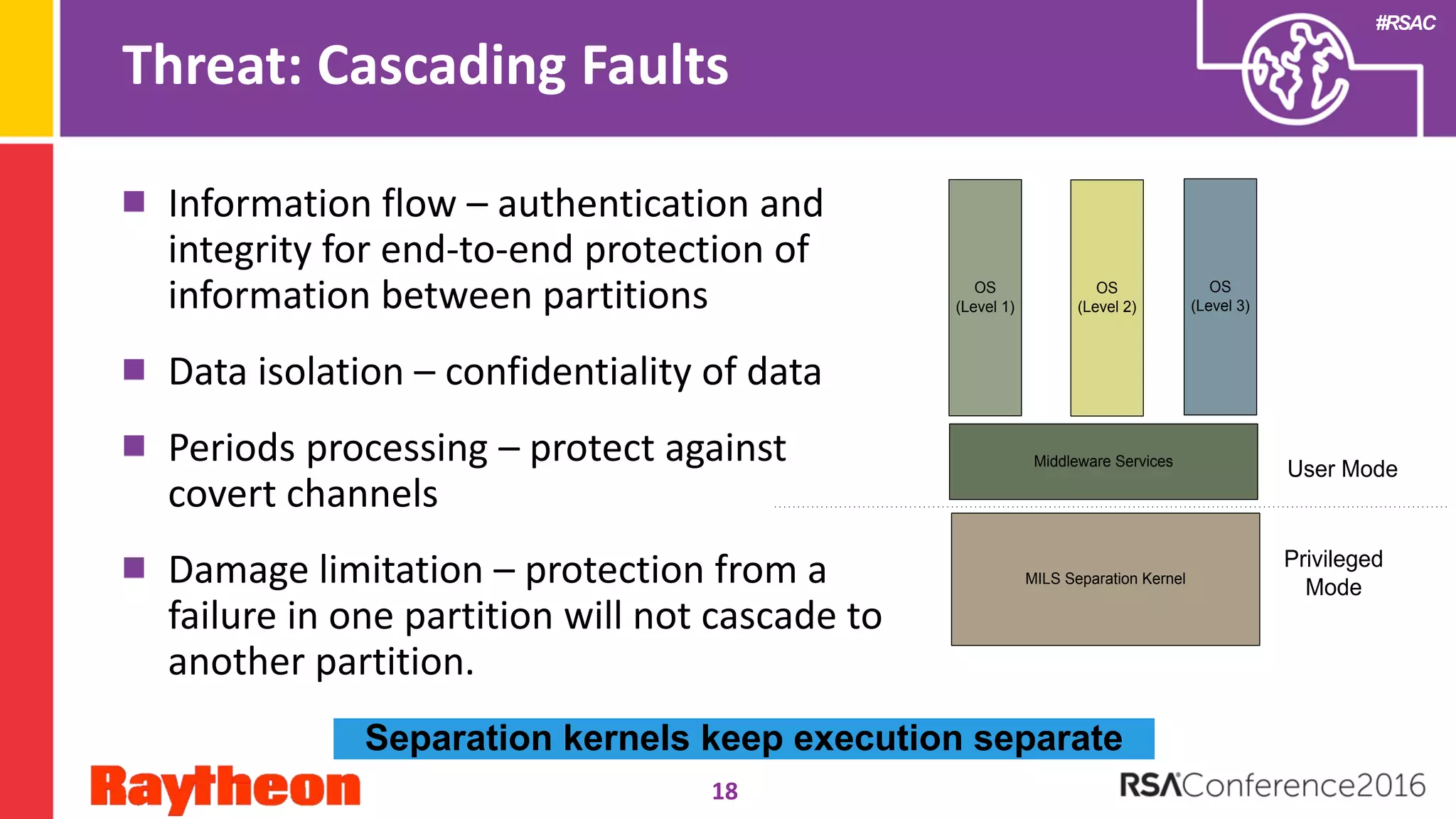
Threat: Cascading Faults
Information flow – authentication and
integrity for end-to-end protection of
information between partitions
Data isolation – confidentiality of data
Periods processing – protect against
covert channels
Damage limitation – protection from a
failure in one partition will not cascade to
another partition.
MILS Separation Kernel
OS
(Level 1)
OS
(Level 2)
OS
(Level 3)
Middleware Services
Privileged
Mode
User Mode
18
Separation kernels keep execution separate
#RSAC
Threat: No Secure Configuration
Tampered configuration
Not secure by default
Shared passwords across
collection’s embedded systems
19
#RSAC
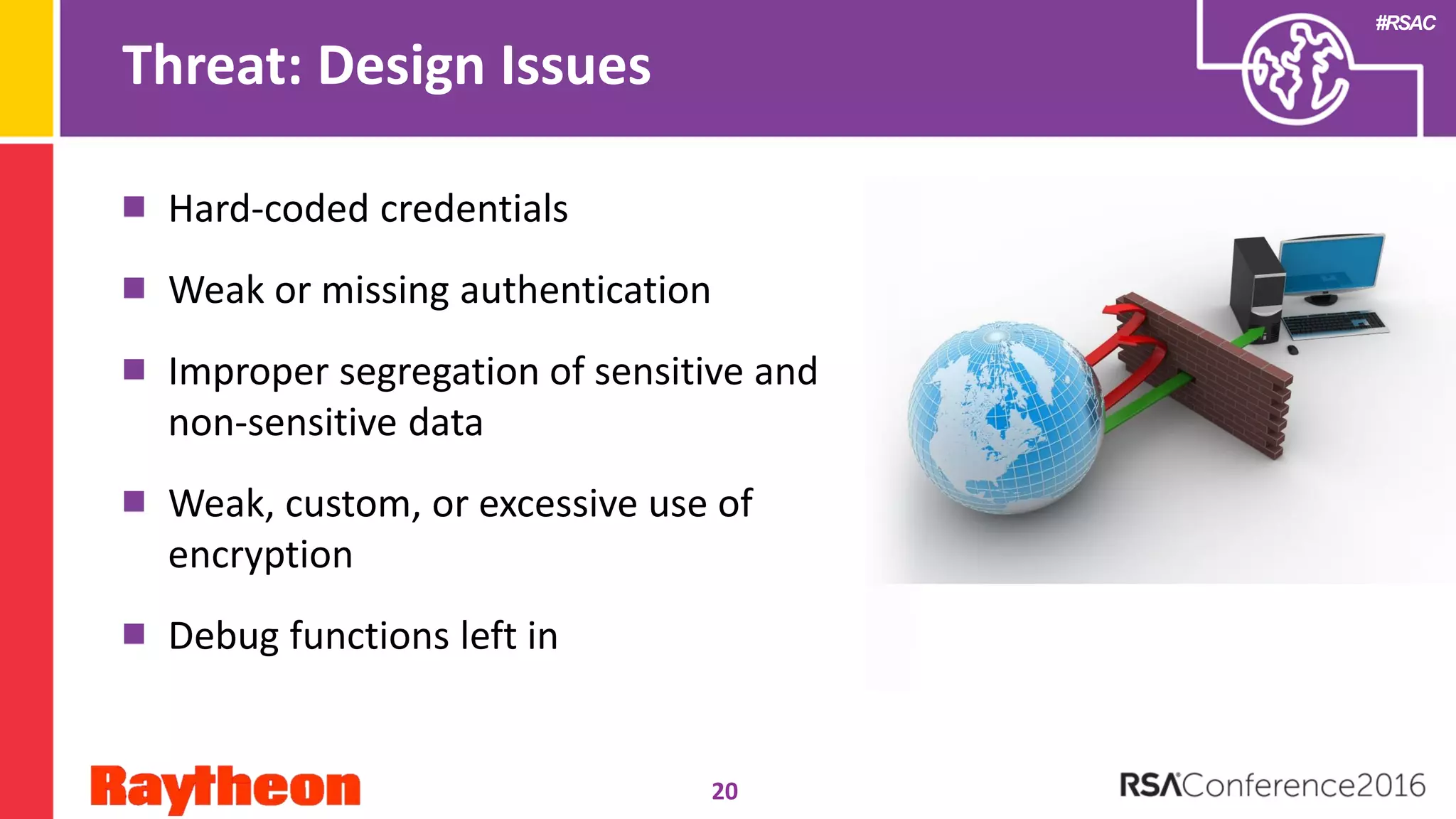
Threat: Design Issues
Hard-coded credentials
Weak or missing authentication
Improper segregation of sensitive and
non-sensitive data
Weak, custom, or excessive use of
encryption
Debug functions left in
20
#RSAC
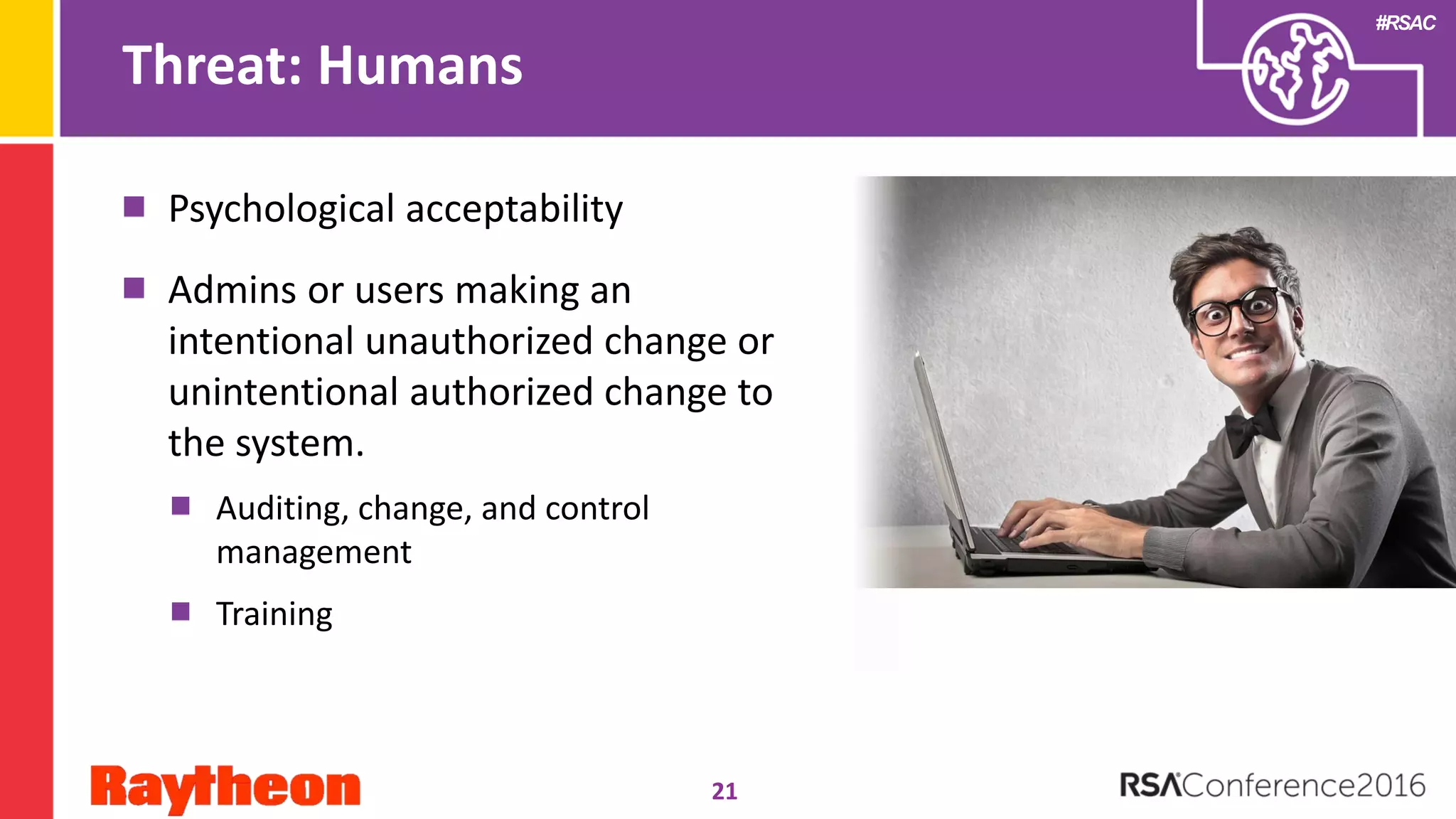
Threat: Humans
Psychological acceptability
Admins or users making an
intentional unauthorized change or
unintentional authorized change to
the system.
Auditing, change, and control
management
Training
21
#RSAC
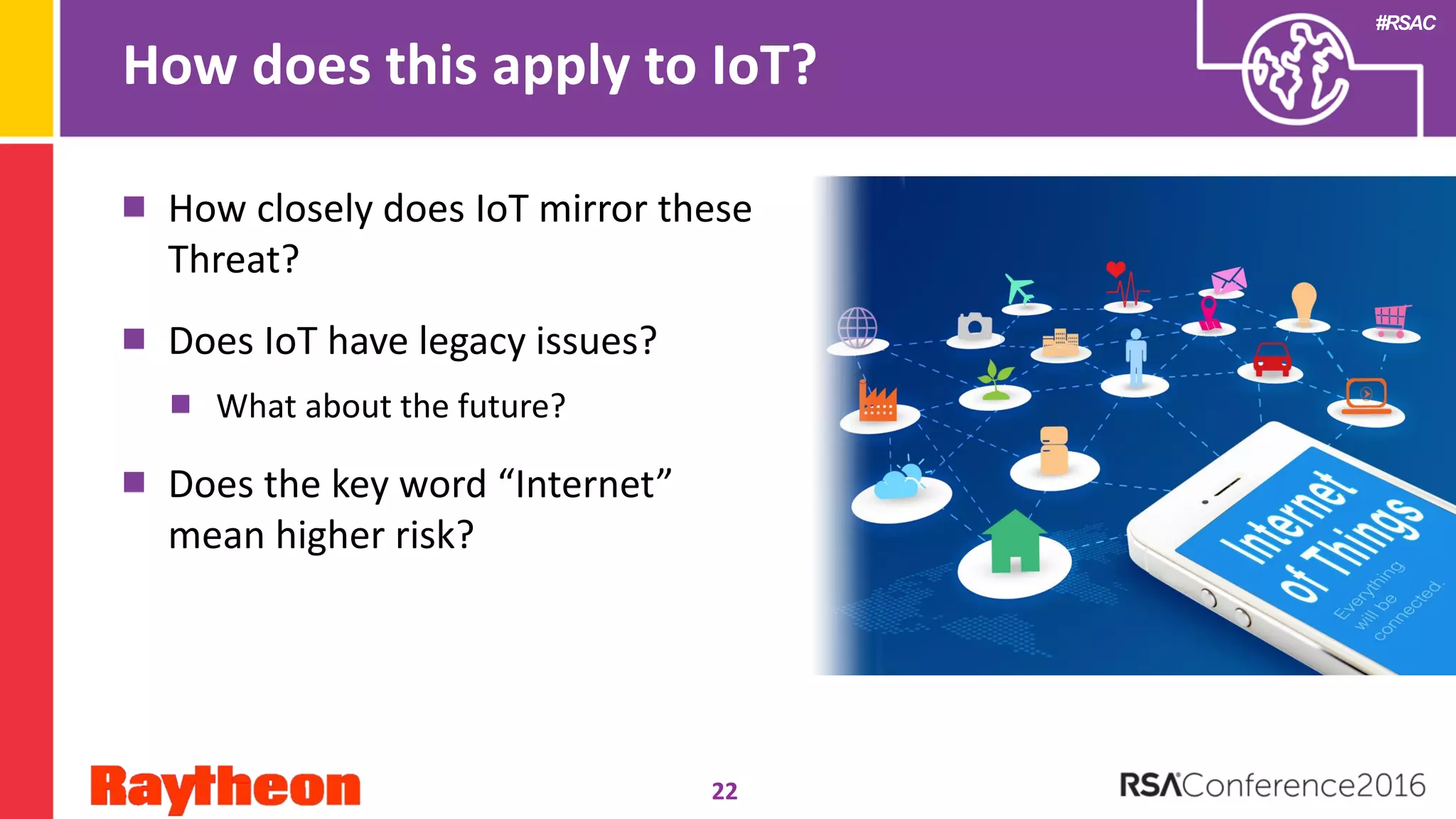
How does this apply to IoT?
How closely does IoT mirror these
Threat?
Does IoT have legacy issues?
What about the future?
Does the key word “Internet”
mean higher risk?
22
#RSAC
Conclusion
23
Protect Application, Execution, Data and IP
Security functions should be built in and
defend against threats within the
environment.
It is important to understand CPI and
what is done to protect it.
Host systems must maintain ultimate
control over security algorithms to
protect the data and prevent IP theft.
#RSAC
Applying What You Have Learned Part 1
24
Educate + Learn = Apply
Take any new knowledge
and apply to your
development system
As a student hopefully you
got 2-3 key items you
learned today
As an instructor, hopefully I
provided some good
lessons learned.
Let me know what you learned in the Question and Answers!
#RSAC
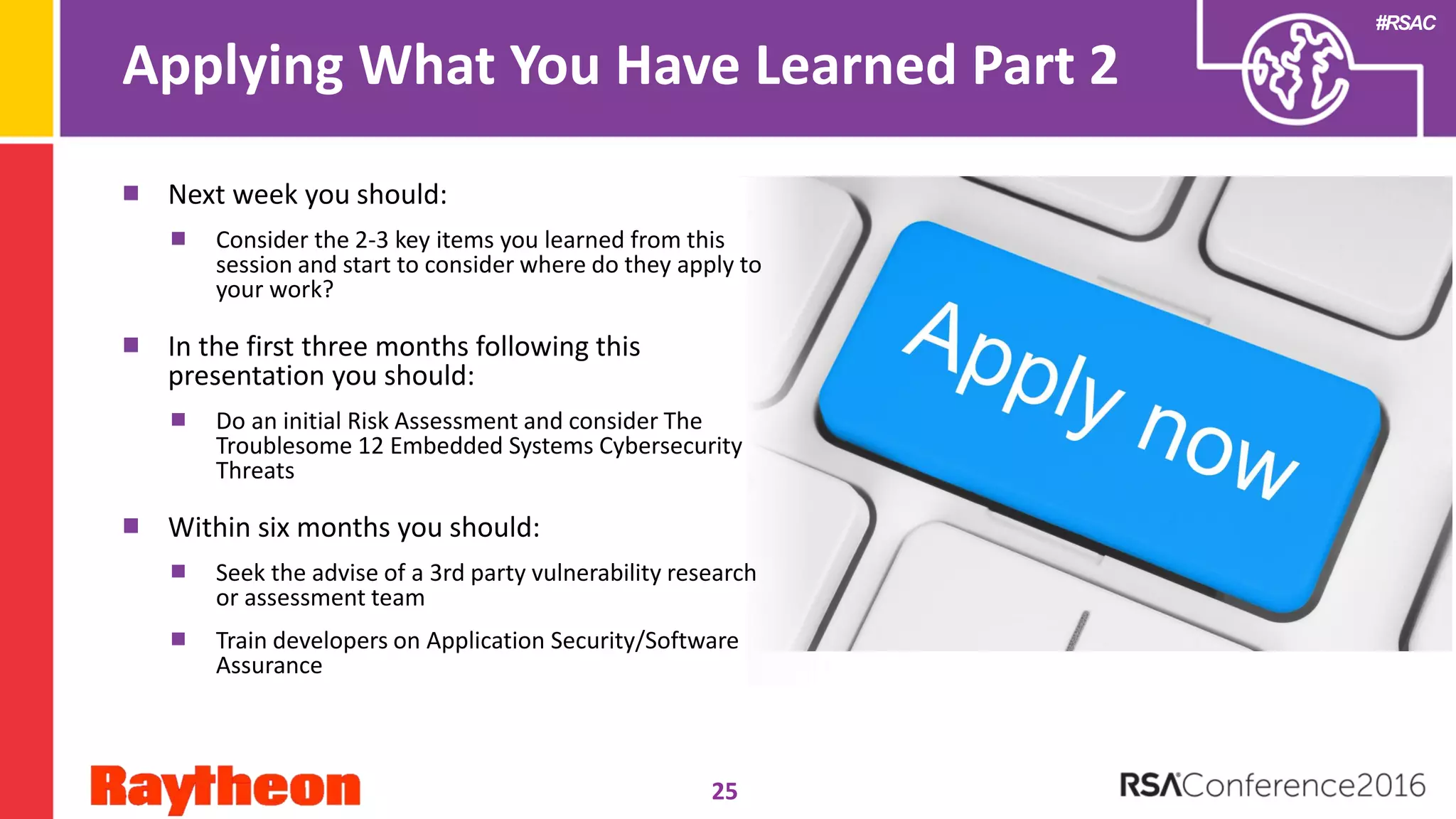
Applying What You Have Learned Part 2
25
Next week you should:
Consider the 2-3 key items you learned from this
session and start to consider where do they apply to
your work?
In the first three months following this
presentation you should:
Do an initial Risk Assessment and consider The
Troublesome 12 Embedded Systems Cybersecurity
Threats
Within six months you should:
Seek the advise of a 3rd party vulnerability research
or assessment team
Train developers on Application Security/Software
Assurance
#RSAC
Questions?
26
#RSAC
Biography
27
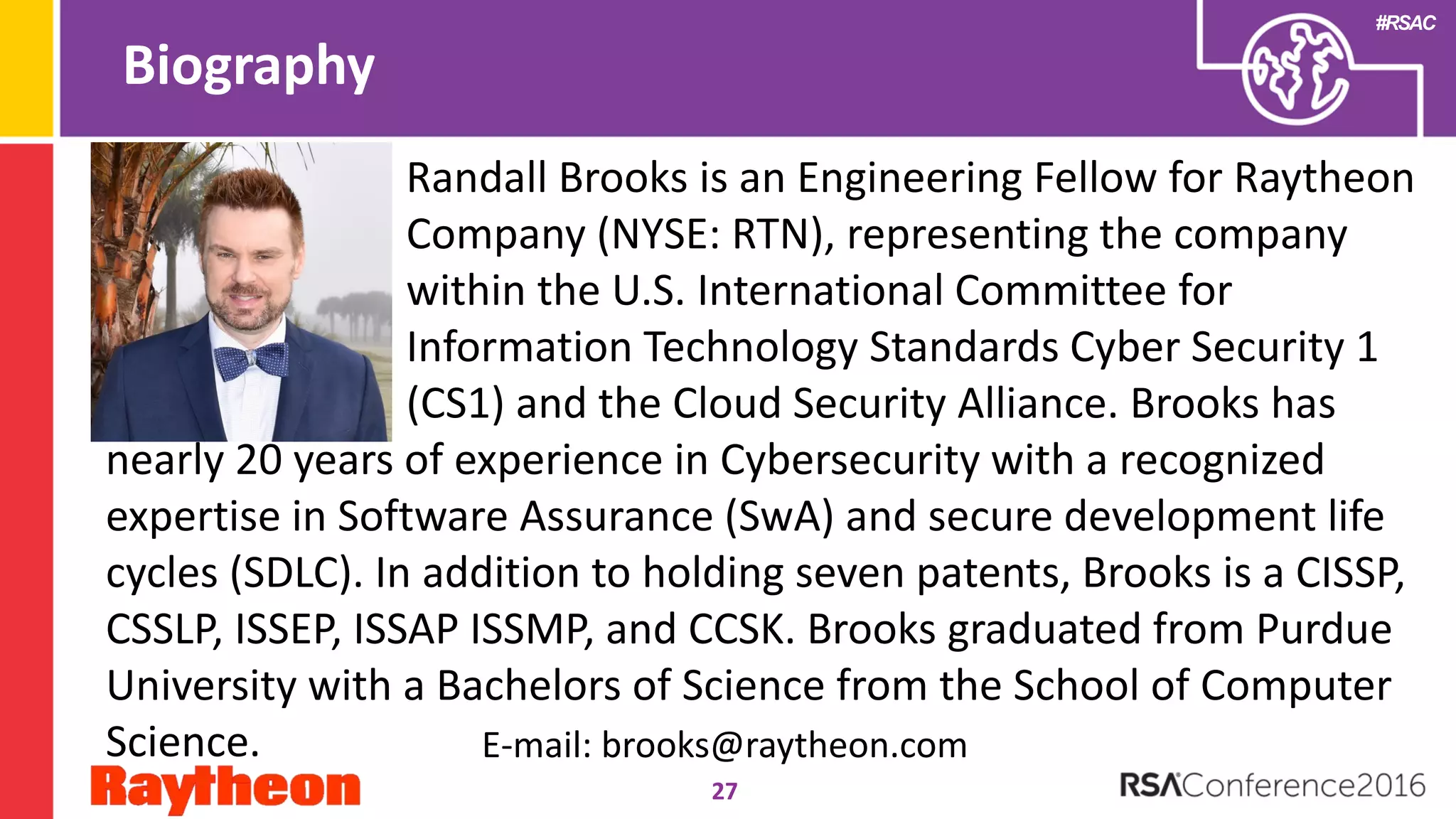
Randall Brooks is an Engineering Fellow for Raytheon
Company (NYSE: RTN), representing the company
within the U.S. International Committee for
Information Technology Standards Cyber Security 1
(CS1) and the Cloud Security Alliance. Brooks has
nearly 20 years of experience in Cybersecurity with a recognized
expertise in Software Assurance (SwA) and secure development life
cycles (SDLC). In addition to holding seven patents, Brooks is a CISSP,
CSSLP, ISSEP, ISSAP ISSMP, and CCSK. Brooks graduated from Purdue
University with a Bachelors of Science from the School of Computer
Science. E-mail: brooks@raytheon.com

Embedded Systems Security: Building a More Secure Device

  • 1.
    SESSION ID: #RSAC Copyright© 2016 Raytheon Company Randall Brooks, CISSP, CSSLP Embedded Systems Security: Building a More Secure Device ASD-W05 Engineering Fellow Raytheon @randallsbrooks
  • 2.
    #RSAC Objectives What are commonembedded systems? What issues do they face? Recommendations for securing embedded systems 2
  • 3.
    #RSAC Poll 3 Which operating systemis your software most commonly developed for? Which language is your software most commonly developed for? Which hardware does your system run on? What are your thoughts on the following statement: My system is standalone, therefore many Cybersecurity or Software Assurance (SwA) requirements do not apply? What do you perceive as the biggest threats to your embedded system’s security? Given the rise of IoT, do you feel IoT and its issues are related to your embedded system’s security issues?
  • 4.
    #RSAC Results (Predicted) OS: GreenHills and VxWorks Language: C++ Hardware: PPC (SoC) Standalone: Systems are not actually standalone Threats: Supply chain, physical access IoT Threats: IoT mirror without legacy issues 4
  • 5.
    #RSAC Results (Actual) OS: Largeincrease in the use of Linux and even Windows Language: C/C++, Java, and even Ada Hardware: x86 (SoC) Standalone: Systems are not actually standalone Threats: Supply chain, physical access, reverse engineering IoT Threats: IoT mirror without legacy issues 5
  • 6.
    #RSAC Audience Poll 6 Which operatingsystems do you see or use? Other languages? Which about hardware? MIPS? ARM?
  • 7.
    #RSAC Example Embedded ComputingEnvironment 7 Computing Environment OS APIs Multi-Core Hardware Other Processing Nodes / Payloads Virtualization Hypervisor (Optional) OS - Linux Vendor Provided C++ Service “B” & Libraries Vendor Provided C++ Service “A” & Libraries Vendor Provided Java Service “A” & Libraries Vendor Provided Java Service “B” & Libraries Network Service Bus Java Runtime Environment (JRE)Java Runtime Environment (JRE)
  • 8.
    #RSAC Traditional Embedded SystemIssues Storage components Processing power Battery life Time-to-market Overall cost 8 Functionality, Security, and Cost: Pick Two
  • 9.
    #RSAC The Troublesome 12Embedded Systems Cybersecurity Threats 9 Supply Chain/Counterfeit Parts Legacy Systems Cascading Faults Physical Access Patch update process No Secure Configuration Reverse Engineering Custom protocols Design Mistakes Network Access Custom libraries Humans 0x0c
  • 10.
    #RSAC Threat: Supply Chain/CounterfeitParts Make vs. buy Quality vs. counterfeiting vs. malicious alteration Vendor tracking database ASICS, FPGAs, and microprocessors Destructive and non-destructive analysis Information storage in volatile memory and permanent storage Nano tagging 10
  • 11.
    #RSAC Threat: Physical Access Maliciousaccess Maintenance connections Maintenance equipment 11 Game Over?
  • 12.
    #RSAC Threat: Reverse Engineering IntellectualProperty (IP) access System Integrity Disassembly Black box testing Static Analysis Security Testing (SAST) of binaries Dynamic System Probing 12
  • 13.
    #RSAC Threat: Network Access Standalonesystems internetworked Unprotected processes Remote access Radio Frequency (RF) manipulation 13
  • 14.
    #RSAC Threat: Legacy Systems Systeminteraction Least common security measure Loss of technical knowledge 14
  • 15.
    #RSAC Threat: Patch UpdateProcess None Systems are permanent and not updated Unauthenticated No digital signature on software/firmware Invalid No integrity No fail secure 15
  • 16.
    #RSAC Threat: Custom Protocols Legacy Noauthentication Variable size Non-standard or multiple version support 16
  • 17.
    #RSAC Threat: Custom Libraries Commonfunctions Extended Malicious library 17
  • 18.
    #RSAC Threat: Cascading Faults Informationflow – authentication and integrity for end-to-end protection of information between partitions Data isolation – confidentiality of data Periods processing – protect against covert channels Damage limitation – protection from a failure in one partition will not cascade to another partition. MILS Separation Kernel OS (Level 1) OS (Level 2) OS (Level 3) Middleware Services Privileged Mode User Mode 18 Separation kernels keep execution separate
  • 19.
    #RSAC Threat: No SecureConfiguration Tampered configuration Not secure by default Shared passwords across collection’s embedded systems 19
  • 20.
    #RSAC Threat: Design Issues Hard-codedcredentials Weak or missing authentication Improper segregation of sensitive and non-sensitive data Weak, custom, or excessive use of encryption Debug functions left in 20
  • 21.
    #RSAC Threat: Humans Psychological acceptability Adminsor users making an intentional unauthorized change or unintentional authorized change to the system. Auditing, change, and control management Training 21
  • 22.
    #RSAC How does thisapply to IoT? How closely does IoT mirror these Threat? Does IoT have legacy issues? What about the future? Does the key word “Internet” mean higher risk? 22
  • 23.
    #RSAC Conclusion 23 Protect Application, Execution,Data and IP Security functions should be built in and defend against threats within the environment. It is important to understand CPI and what is done to protect it. Host systems must maintain ultimate control over security algorithms to protect the data and prevent IP theft.
  • 24.
    #RSAC Applying What YouHave Learned Part 1 24 Educate + Learn = Apply Take any new knowledge and apply to your development system As a student hopefully you got 2-3 key items you learned today As an instructor, hopefully I provided some good lessons learned. Let me know what you learned in the Question and Answers!
  • 25.
    #RSAC Applying What YouHave Learned Part 2 25 Next week you should: Consider the 2-3 key items you learned from this session and start to consider where do they apply to your work? In the first three months following this presentation you should: Do an initial Risk Assessment and consider The Troublesome 12 Embedded Systems Cybersecurity Threats Within six months you should: Seek the advise of a 3rd party vulnerability research or assessment team Train developers on Application Security/Software Assurance
  • 26.
  • 27.
    #RSAC Biography 27 Randall Brooks isan Engineering Fellow for Raytheon Company (NYSE: RTN), representing the company within the U.S. International Committee for Information Technology Standards Cyber Security 1 (CS1) and the Cloud Security Alliance. Brooks has nearly 20 years of experience in Cybersecurity with a recognized expertise in Software Assurance (SwA) and secure development life cycles (SDLC). In addition to holding seven patents, Brooks is a CISSP, CSSLP, ISSEP, ISSAP ISSMP, and CCSK. Brooks graduated from Purdue University with a Bachelors of Science from the School of Computer Science. E-mail: brooks@raytheon.com