

1© 2017 Rogue Wave Software, Inc. All Rights Reserved. 1
Cyber Security: It Starts
With The Embedded
System
Walter Capitani
Product manager, Klocwork
2© 2017 Rogue Wave Software, Inc. All Rights Reserved. 2
Presenter
Walter Capitani
Product manager, Klocwork
Rogue Wave Software
walter.capitani@roguewave.com
Twitter: @walter_capitani
3© 2017 Rogue Wave Software, Inc. All Rights Reserved. 3
1. The problem
2. How can the security of
embedded systems be improved?
3. Zero-tolerance for security issues
4. Use safe coding standards
Agenda
4© 2017 Rogue Wave Software, Inc. All Rights Reserved. 4
Watch the webinar
5© 2017 Rogue Wave Software, Inc. All Rights Reserved. 5
The problem
• Embedded devices can be compromised to gain access to
enterprise data
– Networked embedded devices are perfect targets
– Devices are hard to secure, and incentives for manufacturers to do
so are low
– Hard to patch, and often left unpatched (20% patch rate)
– Breaches are hard to detect on these devices
– Access to many high value areas and targets
– Security through obscurity won’t work anymore
6© 2017 Rogue Wave Software, Inc. All Rights Reserved. 6
Some examples
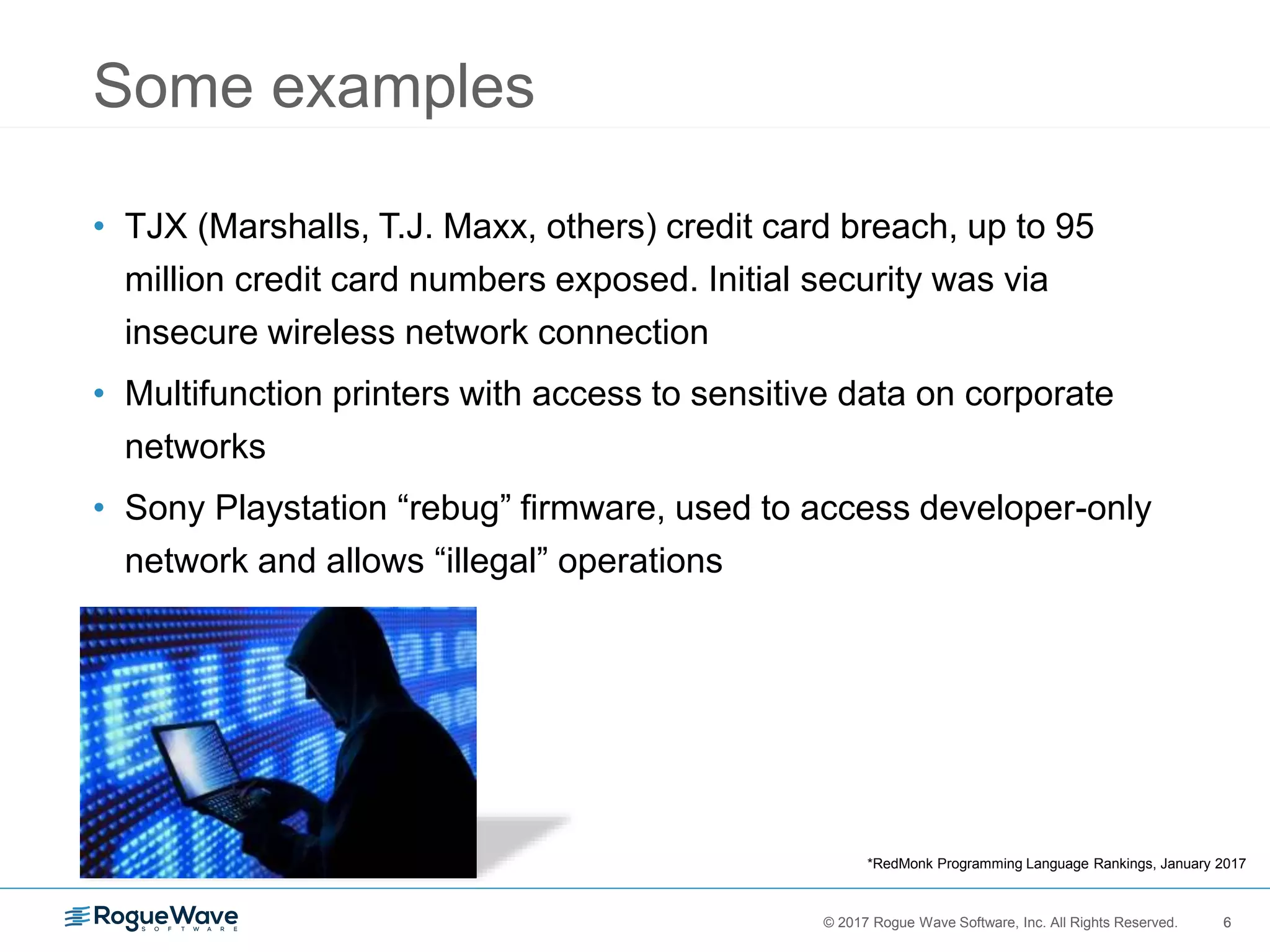
• TJX (Marshalls, T.J. Maxx, others) credit card breach, up to 95
million credit card numbers exposed. Initial security was via
insecure wireless network connection
• Multifunction printers with access to sensitive data on corporate
networks
• Sony Playstation “rebug” firmware, used to access developer-only
network and allows “illegal” operations
*RedMonk Programming Language Rankings, January 2017
7© 2017 Rogue Wave Software, Inc. All Rights Reserved. 7
Systems are not developed with security from
the ground up
• Computer science and software architects are not taught how to
design against security threats
• Typically reformed hackers are helpful to test for vulnerabilities, but
can only do so after the system is built and operational
• This means attack vectors must be present in the system elements
before they can be detected and fixed
• Security training is expensive and reduces developer productivity
• New attack vectors are being explored continuously, so systems
must be constantly probed for new vulnerabilities
8© 2017 Rogue Wave Software, Inc. All Rights Reserved. 8
Insight
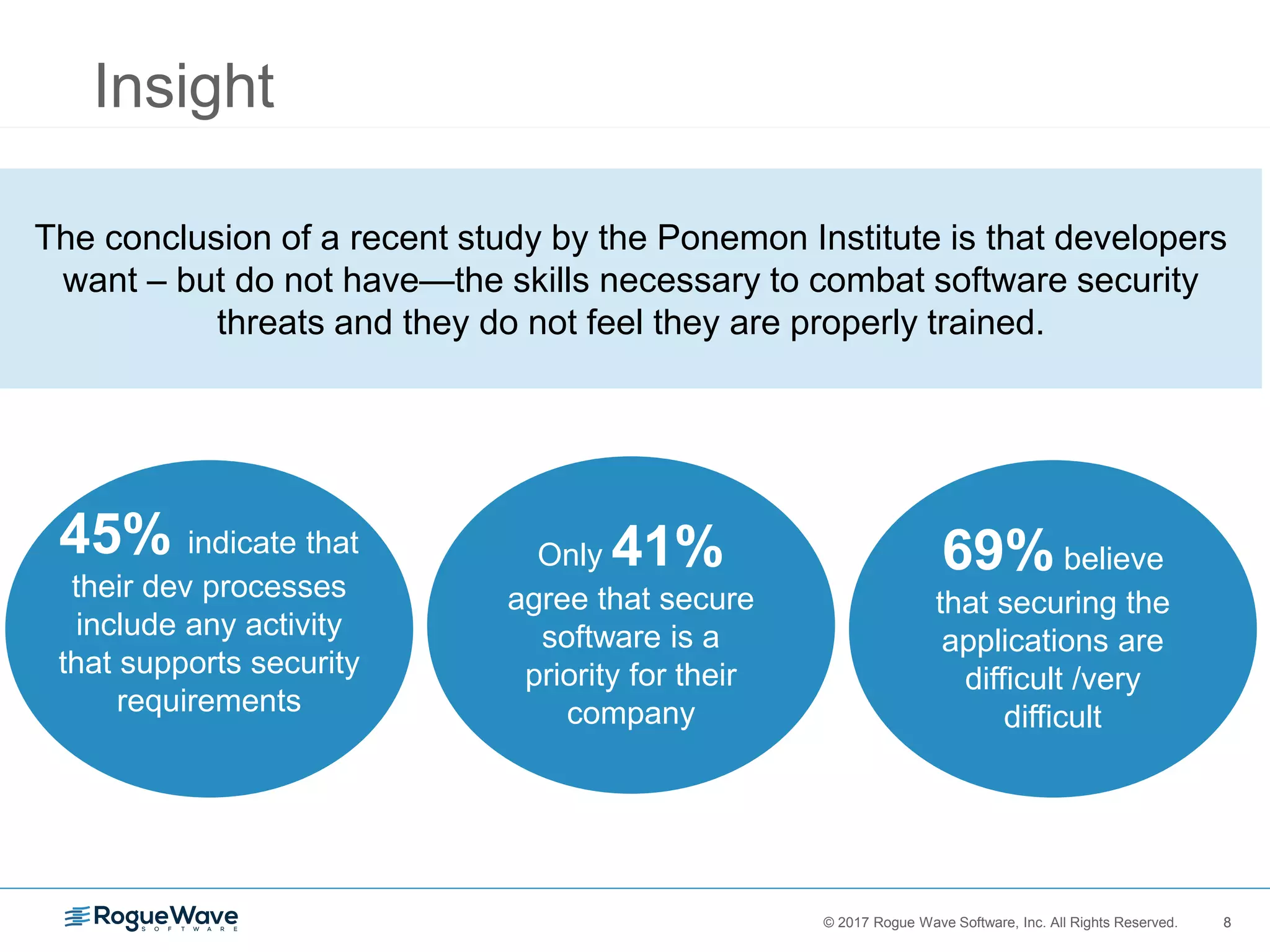
The conclusion of a recent study by the Ponemon Institute is that developers
want – but do not have—the skills necessary to combat software security
threats and they do not feel they are properly trained.
45% indicate that
their dev processes
include any activity
that supports security
requirements
Only 41%
agree that secure
software is a
priority for their
company
69% believe
that securing the
applications are
difficult /very
difficult
9© 2017 Rogue Wave Software, Inc. All Rights Reserved. 9
When are defects introduced?
80% of defects are introduced in development phase
• Most defects are introduced when the software is actually written
• However, most defects are only detected in QA or production
• This increases the costs associated with detection and correction of
defects
• Each defect reported by QA or Customer Support touches many people
across the organization, and derails developers
• The ”hidden costs” of these defects can be equal or greater to the effort
required to actually correct the defect
10© 2017 Rogue Wave Software, Inc. All Rights Reserved. 10
The solution
• Improve embedded device software testing by using static code
analysis (SCA)
• Implement a zero-tolerance policy on security issues
• Use safe coding standards such as MISRA and NASA to make
code more bulletproof
11© 2017 Rogue Wave Software, Inc. All Rights Reserved. 11
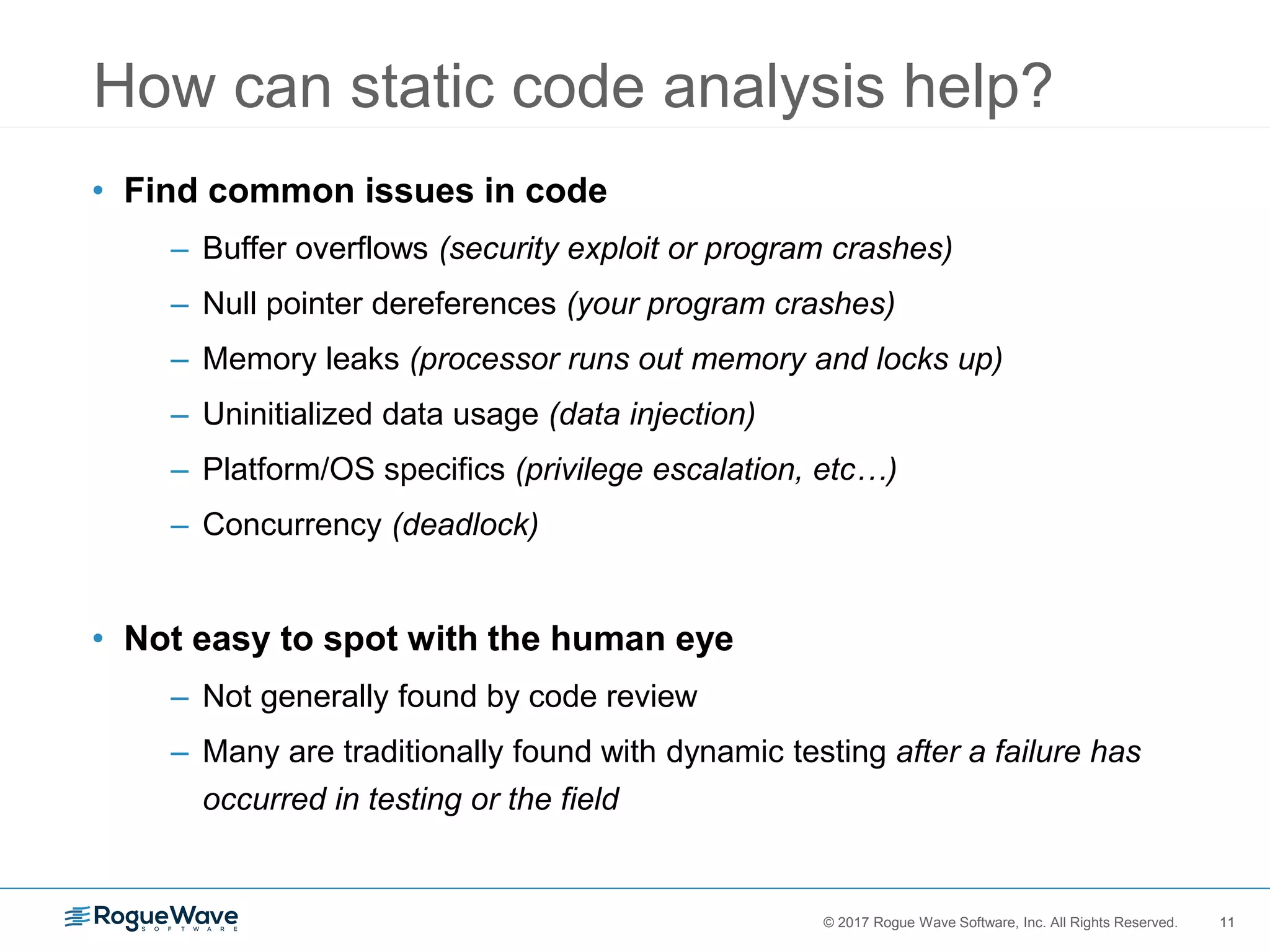
• Find common issues in code
– Buffer overflows (security exploit or program crashes)
– Null pointer dereferences (your program crashes)
– Memory leaks (processor runs out memory and locks up)
– Uninitialized data usage (data injection)
– Platform/OS specifics (privilege escalation, etc…)
– Concurrency (deadlock)
• Not easy to spot with the human eye
– Not generally found by code review
– Many are traditionally found with dynamic testing after a failure has
occurred in testing or the field
How can static code analysis help?
12© 2017 Rogue Wave Software, Inc. All Rights Reserved. 12
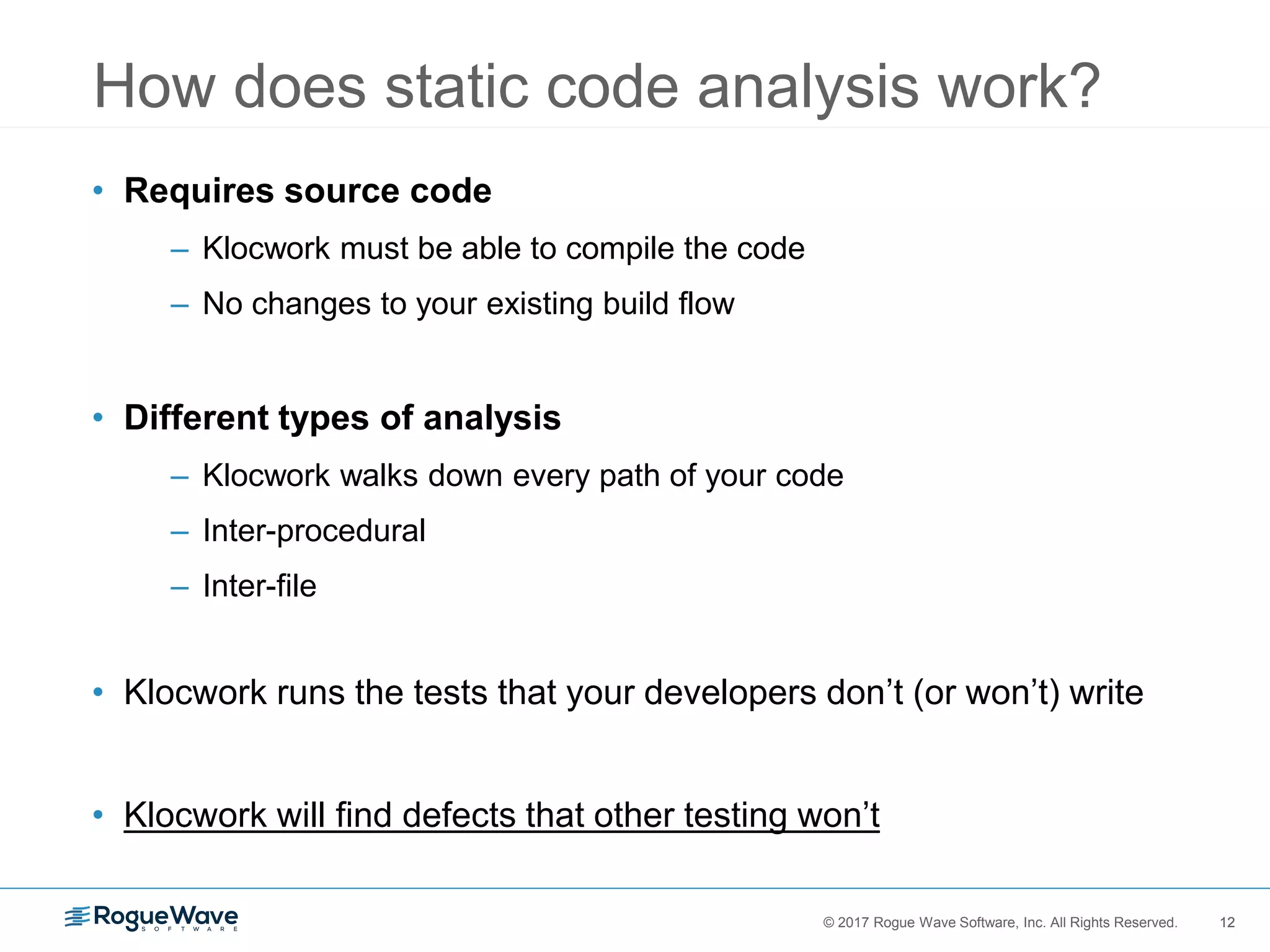
• Requires source code
– Klocwork must be able to compile the code
– No changes to your existing build flow
• Different types of analysis
– Klocwork walks down every path of your code
– Inter-procedural
– Inter-file
• Klocwork runs the tests that your developers don’t (or won’t) write
• Klocwork will find defects that other testing won’t
How does static code analysis work?
13© 2017 Rogue Wave Software, Inc. All Rights Reserved. 13
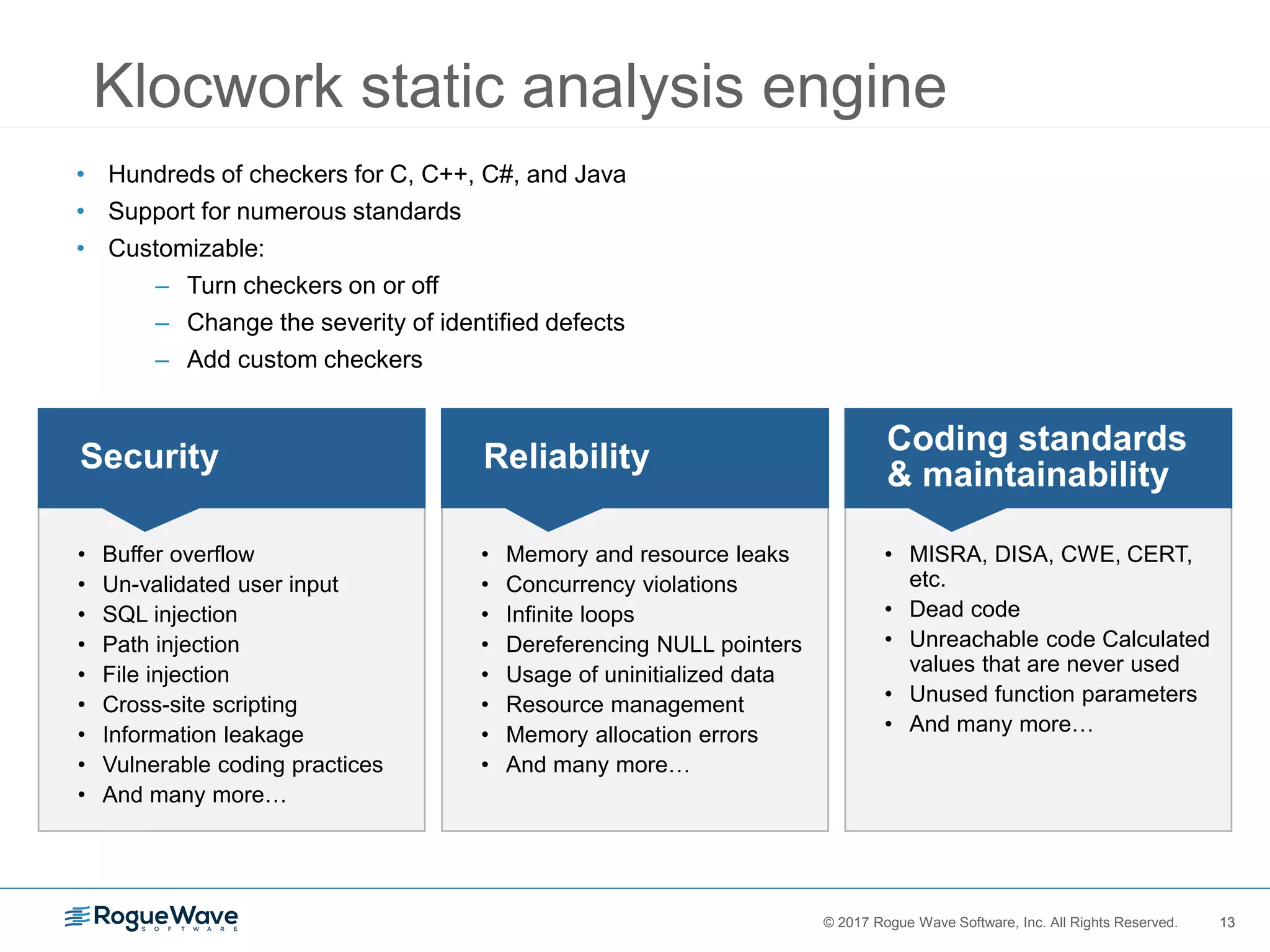
• Hundreds of checkers for C, C++, C#, and Java
• Support for numerous standards
• Customizable:
– Turn checkers on or off
– Change the severity of identified defects
– Add custom checkers
Klocwork static analysis engine
• MISRA, DISA, CWE, CERT,
etc.
• Dead code
• Unreachable code Calculated
values that are never used
• Unused function parameters
• And many more…
Coding standards
& maintainability
• Memory and resource leaks
• Concurrency violations
• Infinite loops
• Dereferencing NULL pointers
• Usage of uninitialized data
• Resource management
• Memory allocation errors
• And many more…
Reliability
• Buffer overflow
• Un-validated user input
• SQL injection
• Path injection
• File injection
• Cross-site scripting
• Information leakage
• Vulnerable coding practices
• And many more…
Security
14© 2017 Rogue Wave Software, Inc. All Rights Reserved. 14
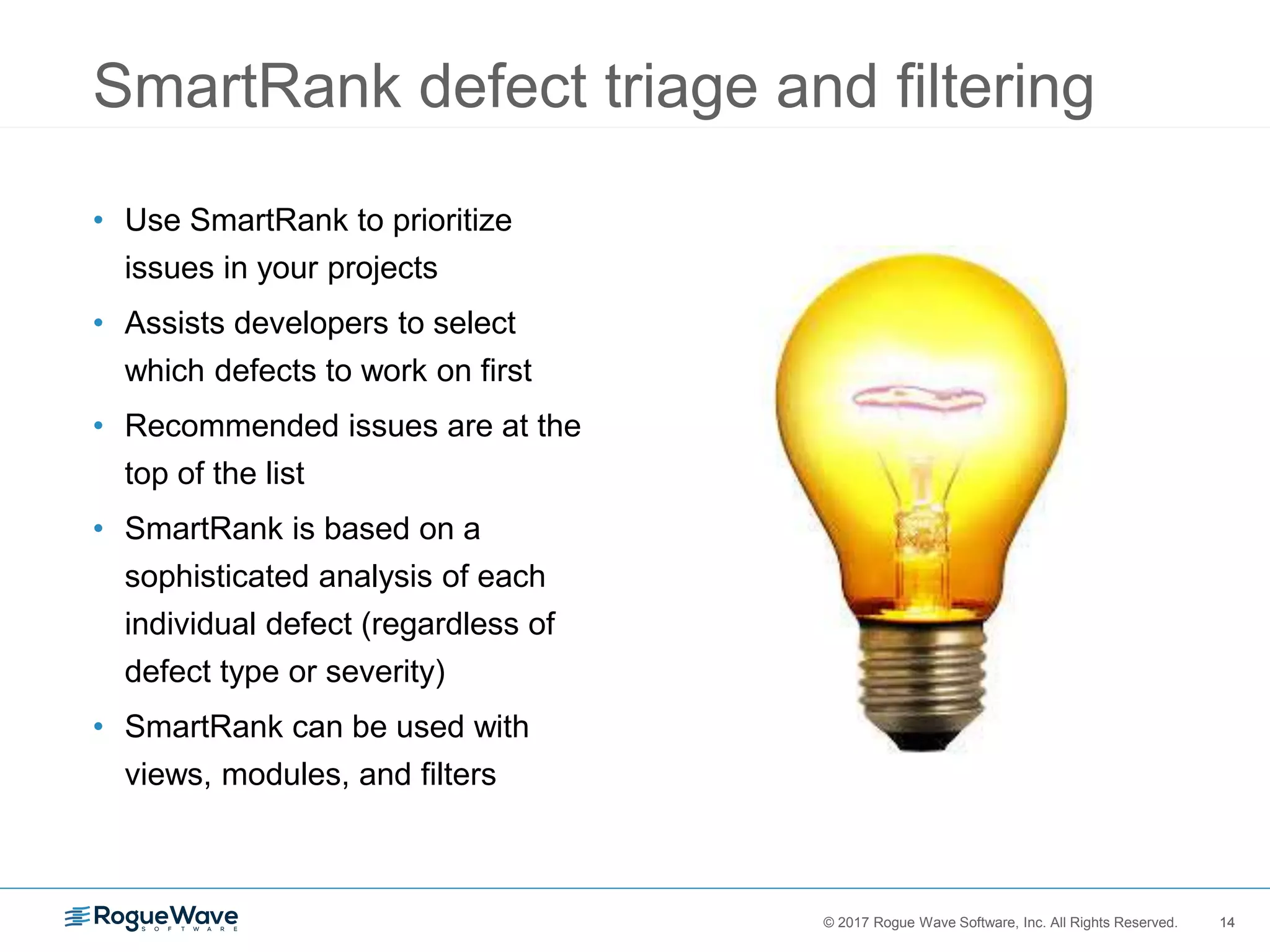
SmartRank defect triage and filtering
• Use SmartRank to prioritize
issues in your projects
• Assists developers to select
which defects to work on first
• Recommended issues are at the
top of the list
• SmartRank is based on a
sophisticated analysis of each
individual defect (regardless of
defect type or severity)
• SmartRank can be used with
views, modules, and filters
15© 2017 Rogue Wave Software, Inc. All Rights Reserved. 15
Flexible workflow
• Incremental CI analysis for the fastest defect detection
– Quickly and easily integrate Klocwork into an organization’s CI build process
• Desktop analysis for all users with integration analysis done
whenever you do your standard team-level build
– Developers see and fix defects prior to check in
– Team leads review status with just a simple browser, no software to install
• Complete stand-alone mode for very small projects
– Common for smaller microcontroller-based embedded projects where there isn't
a "team level" integration build
• Traditional post-development analysis
– Geared for audit type functions
16© 2017 Rogue Wave Software, Inc. All Rights Reserved. 16
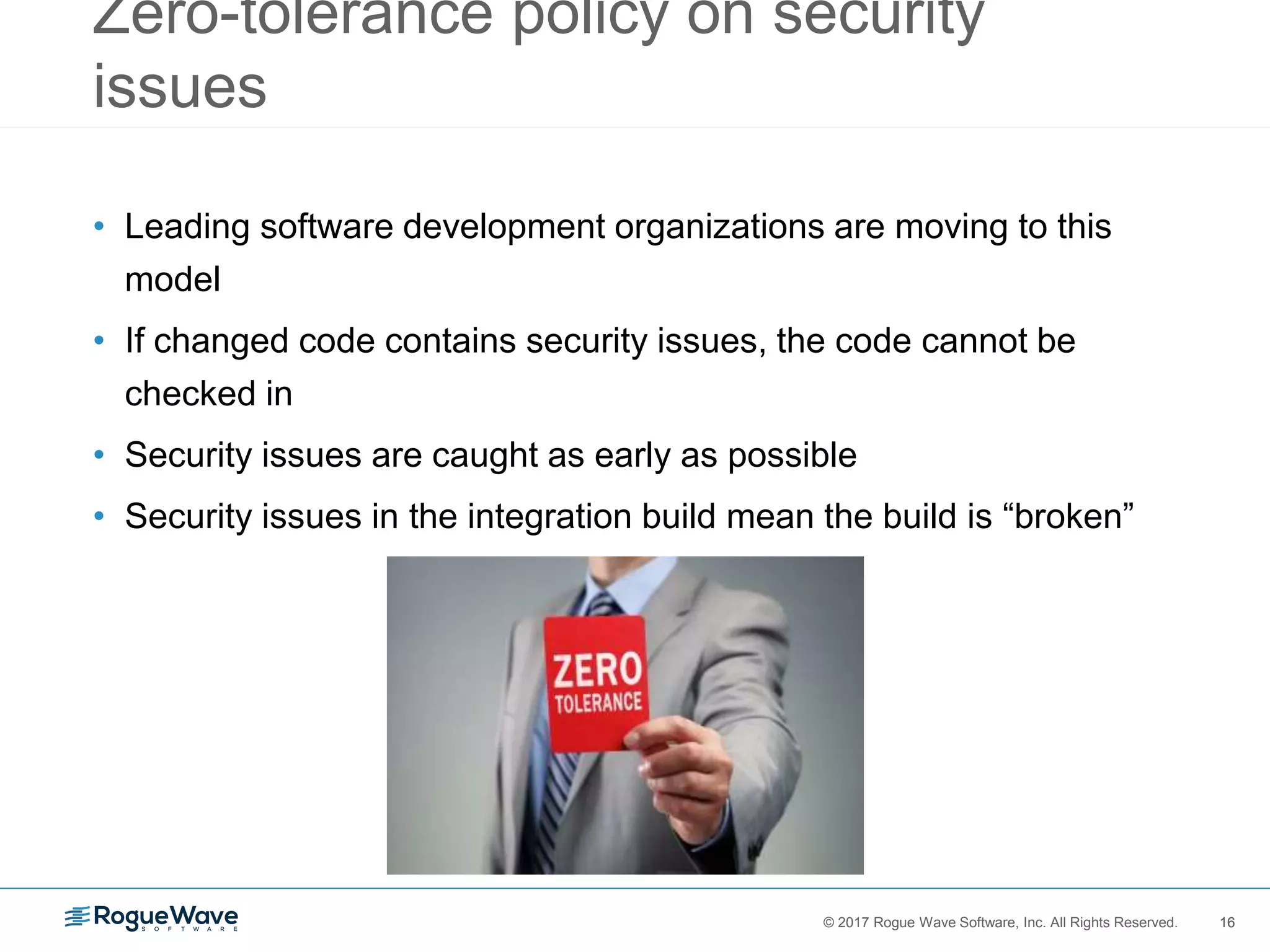
Zero-tolerance policy on security
issues
• Leading software development organizations are moving to this
model
• If changed code contains security issues, the code cannot be
checked in
• Security issues are caught as early as possible
• Security issues in the integration build mean the build is “broken”
17© 2017 Rogue Wave Software, Inc. All Rights Reserved. 17
• Significantly reduces the cost of reliable, secure software
– Complements existing testing approaches
– Automated and repeatable analysis
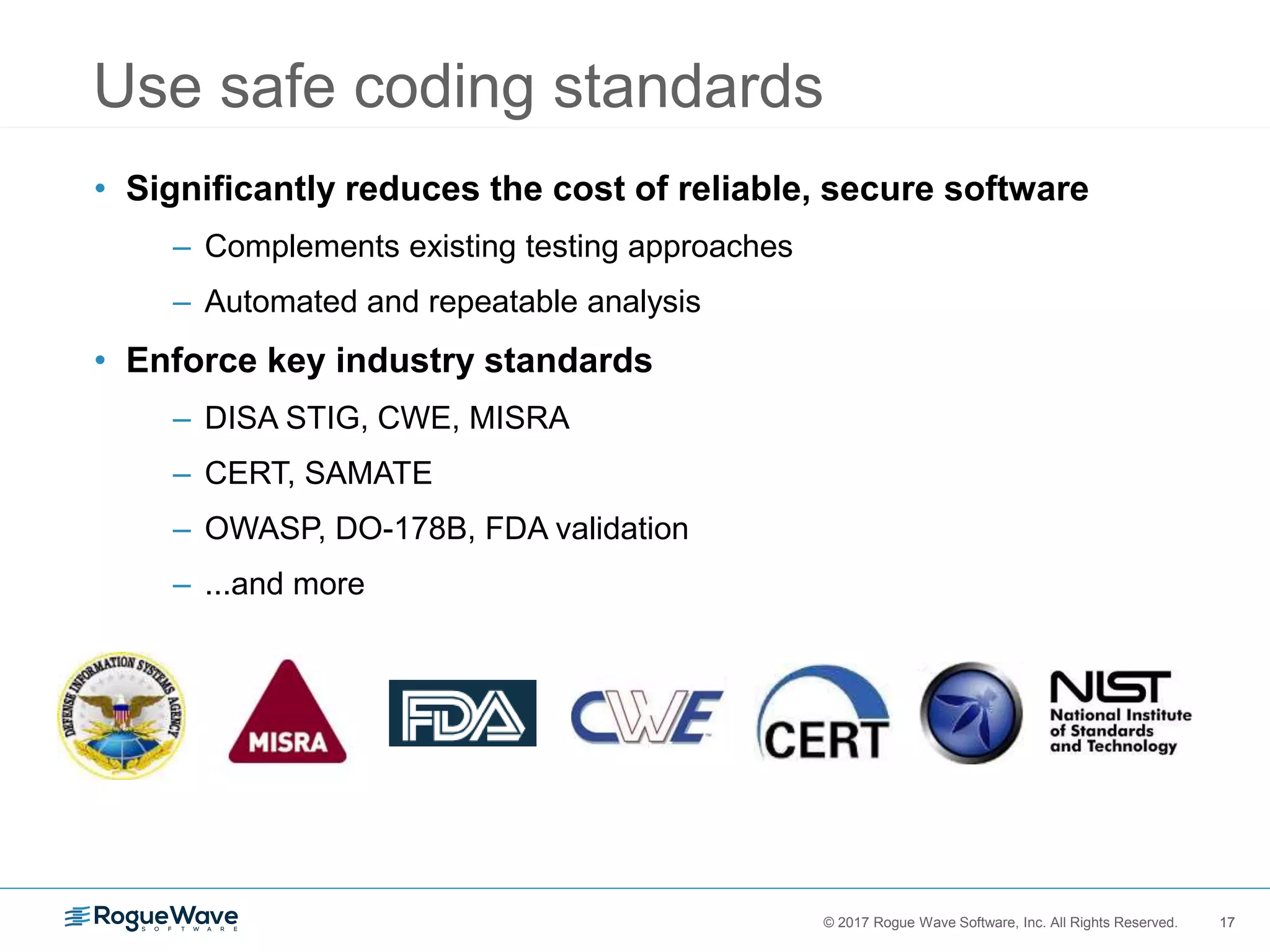
• Enforce key industry standards
– DISA STIG, CWE, MISRA
– CERT, SAMATE
– OWASP, DO-178B, FDA validation
– ...and more
Use safe coding standards
18© 2017 Rogue Wave Software, Inc. All Rights Reserved. 18
Watch the webinar
19© 2017 Rogue Wave Software, Inc. All Rights Reserved. 19

Cyber security - It starts with the embedded system

  • 1.
    1© 2017 RogueWave Software, Inc. All Rights Reserved. 1 Cyber Security: It Starts With The Embedded System Walter Capitani Product manager, Klocwork
  • 2.
    2© 2017 RogueWave Software, Inc. All Rights Reserved. 2 Presenter Walter Capitani Product manager, Klocwork Rogue Wave Software walter.capitani@roguewave.com Twitter: @walter_capitani
  • 3.
    3© 2017 RogueWave Software, Inc. All Rights Reserved. 3 1. The problem 2. How can the security of embedded systems be improved? 3. Zero-tolerance for security issues 4. Use safe coding standards Agenda
  • 4.
    4© 2017 RogueWave Software, Inc. All Rights Reserved. 4 Watch the webinar
  • 5.
    5© 2017 RogueWave Software, Inc. All Rights Reserved. 5 The problem • Embedded devices can be compromised to gain access to enterprise data – Networked embedded devices are perfect targets – Devices are hard to secure, and incentives for manufacturers to do so are low – Hard to patch, and often left unpatched (20% patch rate) – Breaches are hard to detect on these devices – Access to many high value areas and targets – Security through obscurity won’t work anymore
  • 6.
    6© 2017 RogueWave Software, Inc. All Rights Reserved. 6 Some examples • TJX (Marshalls, T.J. Maxx, others) credit card breach, up to 95 million credit card numbers exposed. Initial security was via insecure wireless network connection • Multifunction printers with access to sensitive data on corporate networks • Sony Playstation “rebug” firmware, used to access developer-only network and allows “illegal” operations *RedMonk Programming Language Rankings, January 2017
  • 7.
    7© 2017 RogueWave Software, Inc. All Rights Reserved. 7 Systems are not developed with security from the ground up • Computer science and software architects are not taught how to design against security threats • Typically reformed hackers are helpful to test for vulnerabilities, but can only do so after the system is built and operational • This means attack vectors must be present in the system elements before they can be detected and fixed • Security training is expensive and reduces developer productivity • New attack vectors are being explored continuously, so systems must be constantly probed for new vulnerabilities
  • 8.
    8© 2017 RogueWave Software, Inc. All Rights Reserved. 8 Insight The conclusion of a recent study by the Ponemon Institute is that developers want – but do not have—the skills necessary to combat software security threats and they do not feel they are properly trained. 45% indicate that their dev processes include any activity that supports security requirements Only 41% agree that secure software is a priority for their company 69% believe that securing the applications are difficult /very difficult
  • 9.
    9© 2017 RogueWave Software, Inc. All Rights Reserved. 9 When are defects introduced? 80% of defects are introduced in development phase • Most defects are introduced when the software is actually written • However, most defects are only detected in QA or production • This increases the costs associated with detection and correction of defects • Each defect reported by QA or Customer Support touches many people across the organization, and derails developers • The ”hidden costs” of these defects can be equal or greater to the effort required to actually correct the defect
  • 10.
    10© 2017 RogueWave Software, Inc. All Rights Reserved. 10 The solution • Improve embedded device software testing by using static code analysis (SCA) • Implement a zero-tolerance policy on security issues • Use safe coding standards such as MISRA and NASA to make code more bulletproof
  • 11.
    11© 2017 RogueWave Software, Inc. All Rights Reserved. 11 • Find common issues in code – Buffer overflows (security exploit or program crashes) – Null pointer dereferences (your program crashes) – Memory leaks (processor runs out memory and locks up) – Uninitialized data usage (data injection) – Platform/OS specifics (privilege escalation, etc…) – Concurrency (deadlock) • Not easy to spot with the human eye – Not generally found by code review – Many are traditionally found with dynamic testing after a failure has occurred in testing or the field How can static code analysis help?
  • 12.
    12© 2017 RogueWave Software, Inc. All Rights Reserved. 12 • Requires source code – Klocwork must be able to compile the code – No changes to your existing build flow • Different types of analysis – Klocwork walks down every path of your code – Inter-procedural – Inter-file • Klocwork runs the tests that your developers don’t (or won’t) write • Klocwork will find defects that other testing won’t How does static code analysis work?
  • 13.
    13© 2017 RogueWave Software, Inc. All Rights Reserved. 13 • Hundreds of checkers for C, C++, C#, and Java • Support for numerous standards • Customizable: – Turn checkers on or off – Change the severity of identified defects – Add custom checkers Klocwork static analysis engine • MISRA, DISA, CWE, CERT, etc. • Dead code • Unreachable code Calculated values that are never used • Unused function parameters • And many more… Coding standards & maintainability • Memory and resource leaks • Concurrency violations • Infinite loops • Dereferencing NULL pointers • Usage of uninitialized data • Resource management • Memory allocation errors • And many more… Reliability • Buffer overflow • Un-validated user input • SQL injection • Path injection • File injection • Cross-site scripting • Information leakage • Vulnerable coding practices • And many more… Security
  • 14.
    14© 2017 RogueWave Software, Inc. All Rights Reserved. 14 SmartRank defect triage and filtering • Use SmartRank to prioritize issues in your projects • Assists developers to select which defects to work on first • Recommended issues are at the top of the list • SmartRank is based on a sophisticated analysis of each individual defect (regardless of defect type or severity) • SmartRank can be used with views, modules, and filters
  • 15.
    15© 2017 RogueWave Software, Inc. All Rights Reserved. 15 Flexible workflow • Incremental CI analysis for the fastest defect detection – Quickly and easily integrate Klocwork into an organization’s CI build process • Desktop analysis for all users with integration analysis done whenever you do your standard team-level build – Developers see and fix defects prior to check in – Team leads review status with just a simple browser, no software to install • Complete stand-alone mode for very small projects – Common for smaller microcontroller-based embedded projects where there isn't a "team level" integration build • Traditional post-development analysis – Geared for audit type functions
  • 16.
    16© 2017 RogueWave Software, Inc. All Rights Reserved. 16 Zero-tolerance policy on security issues • Leading software development organizations are moving to this model • If changed code contains security issues, the code cannot be checked in • Security issues are caught as early as possible • Security issues in the integration build mean the build is “broken”
  • 17.
    17© 2017 RogueWave Software, Inc. All Rights Reserved. 17 • Significantly reduces the cost of reliable, secure software – Complements existing testing approaches – Automated and repeatable analysis • Enforce key industry standards – DISA STIG, CWE, MISRA – CERT, SAMATE – OWASP, DO-178B, FDA validation – ...and more Use safe coding standards
  • 18.
    18© 2017 RogueWave Software, Inc. All Rights Reserved. 18 Watch the webinar
  • 19.
    19© 2017 RogueWave Software, Inc. All Rights Reserved. 19

Editor's Notes

  • #6 http://blog.senr.io/blog/the-insecurity-of-things
  • #7 http://sydney.edu.au/engineering/it/courses/info5990/Supplements/Week07_Malware&Security/Supp07-4TJXCaseDetails.pdf https://www.forbes.com/sites/ciocentral/2013/02/07/the-hidden-it-security-threat-multifunction-printers/#78bdc709b615
  • #8 Hard coded passwords: http://news.softpedia.com/news/company-takes-two-years-to-remove-hard-coded-root-passwords-from-iot-thermostat-500101.shtml