
SESSION ID:
#RSAC
Chad Childers
Rapid Threat Modeling
Techniques
ASD-R01
IT Security
Ford Motor Company
#RSAC
Agenda
2
 Threat Modeling background
 Lessons Learned to make threat modeling faster
 Techniques specifically for DFD and STRIDE effectiveness
 Issues
 Customizations & other security analysis tools
 Success!
#RSAC
What is Threat Modeling?
3
 Design practice from the Software Assurance Forum (SAFECode)
 Attack trees
 Threat library (CAPEC, OWASP Top Ten)
 Use Cases
 STRIDE Spoofing
Tampering
Repudiation
Information Disclosure
Denial of Service
Elevation of Privilege
#RSAC
What is Threat Modeling?
4
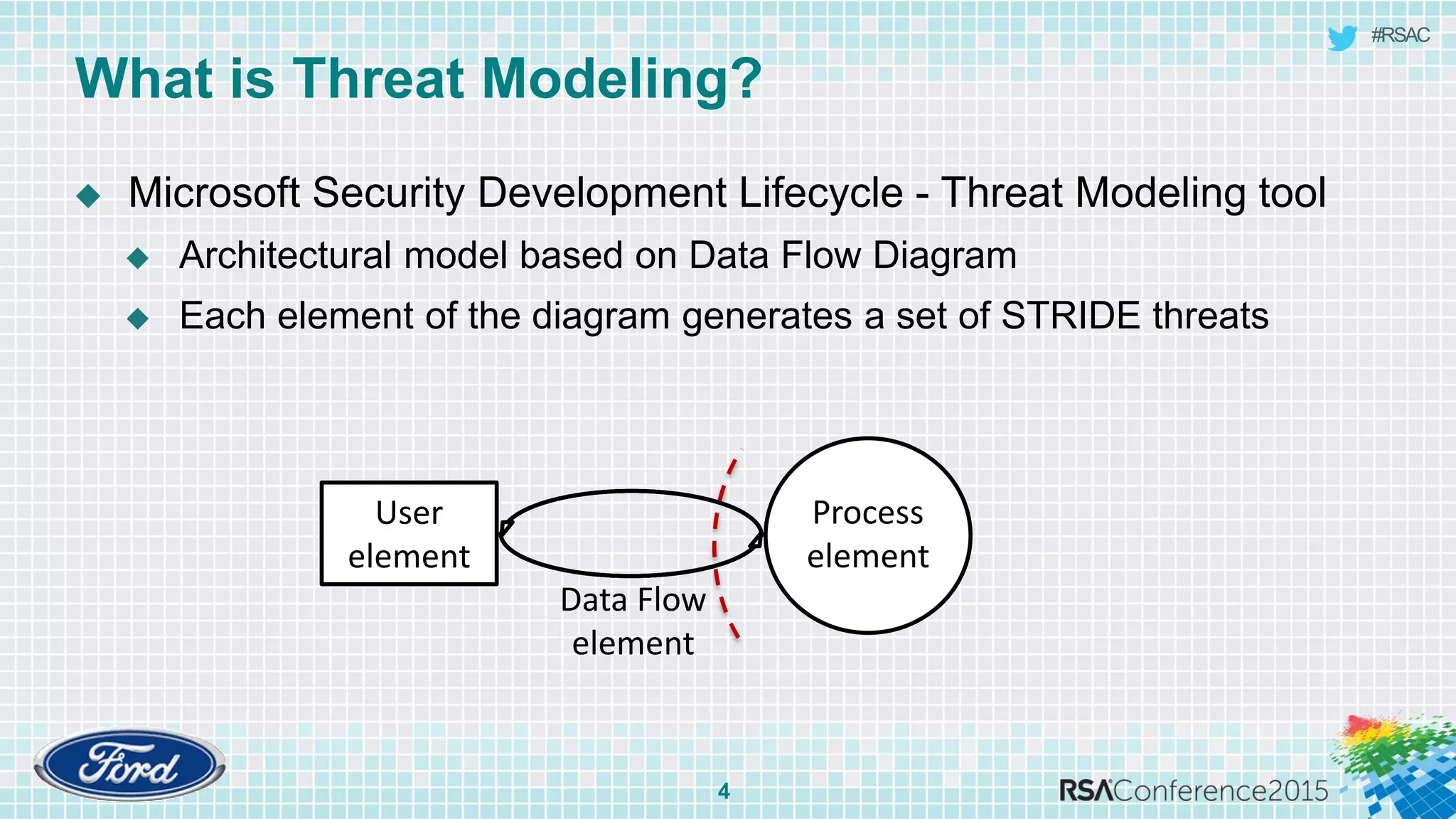
 Microsoft Security Development Lifecycle - Threat Modeling tool
 Architectural model based on Data Flow Diagram
 Each element of the diagram generates a set of STRIDE threats
Process
element
User
element
Data Flow
element
#RSAC
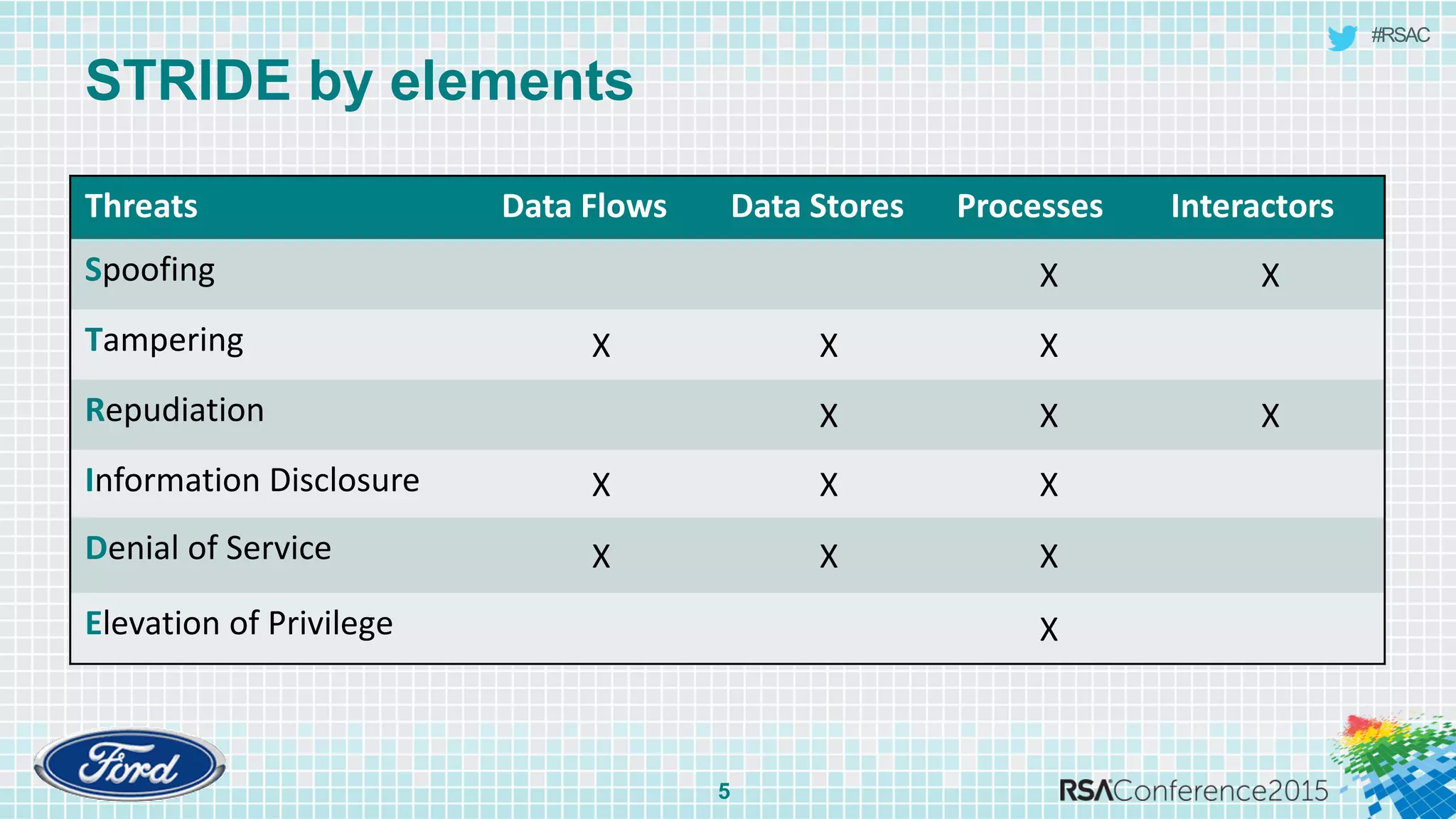
STRIDE by elements
5
Threats Data Flows Data Stores Processes Interactors
Spoofing X X
Tampering X X X
Repudiation X X X
Information Disclosure X X X
Denial of Service X X X
Elevation of Privilege X
#RSAC
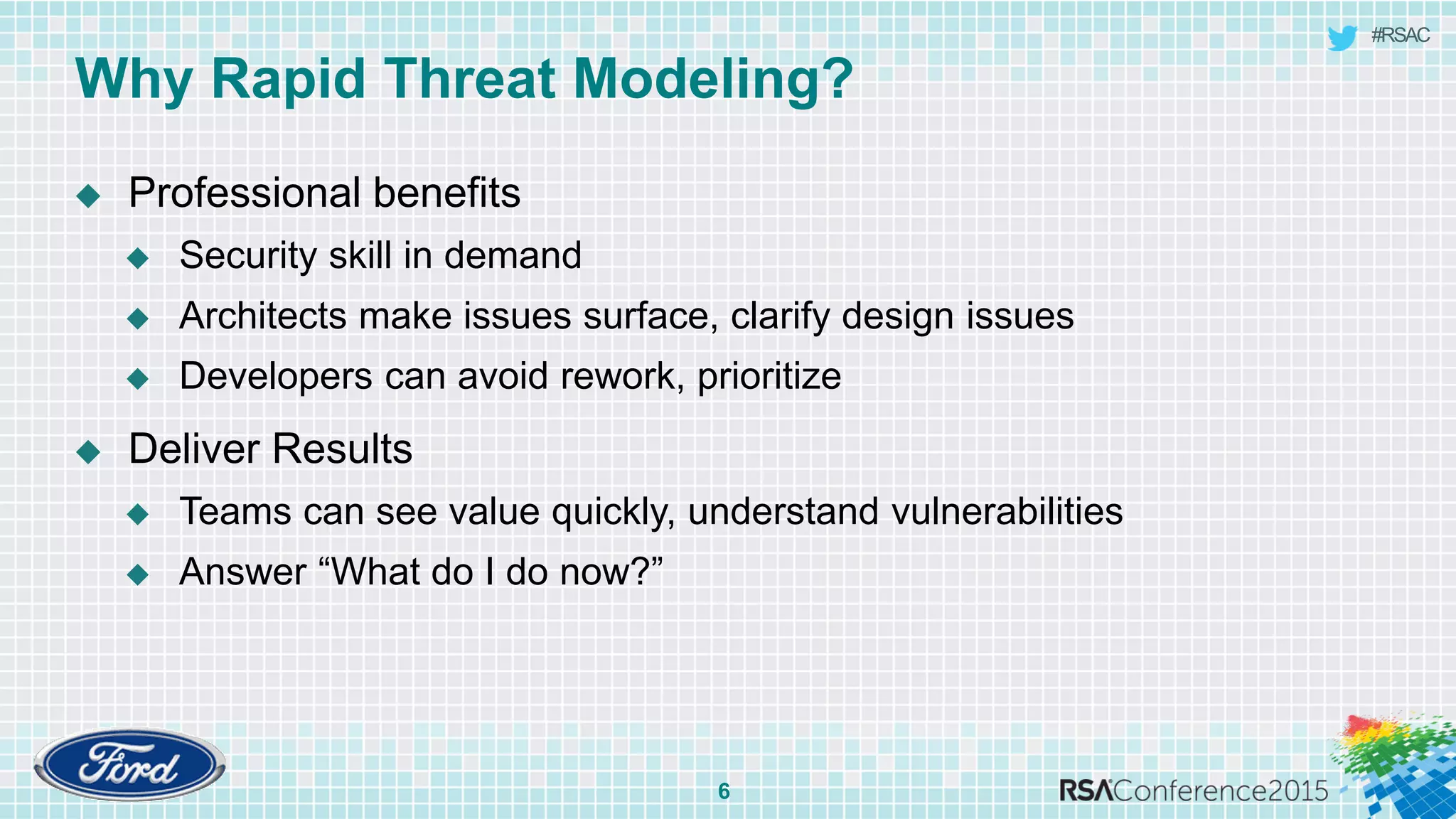
Why Rapid Threat Modeling?
6
 Professional benefits
 Security skill in demand
 Architects make issues surface, clarify design issues
 Developers can avoid rework, prioritize
 Deliver Results
 Teams can see value quickly, understand vulnerabilities
 Answer “What do I do now?”
#RSAC
Security
hurdles
• Controls documentation
• Paperwork exercise
• Last minute gate review
• Athletes have the right training
• They prepare and practice
• They are not surprised
#RSAC
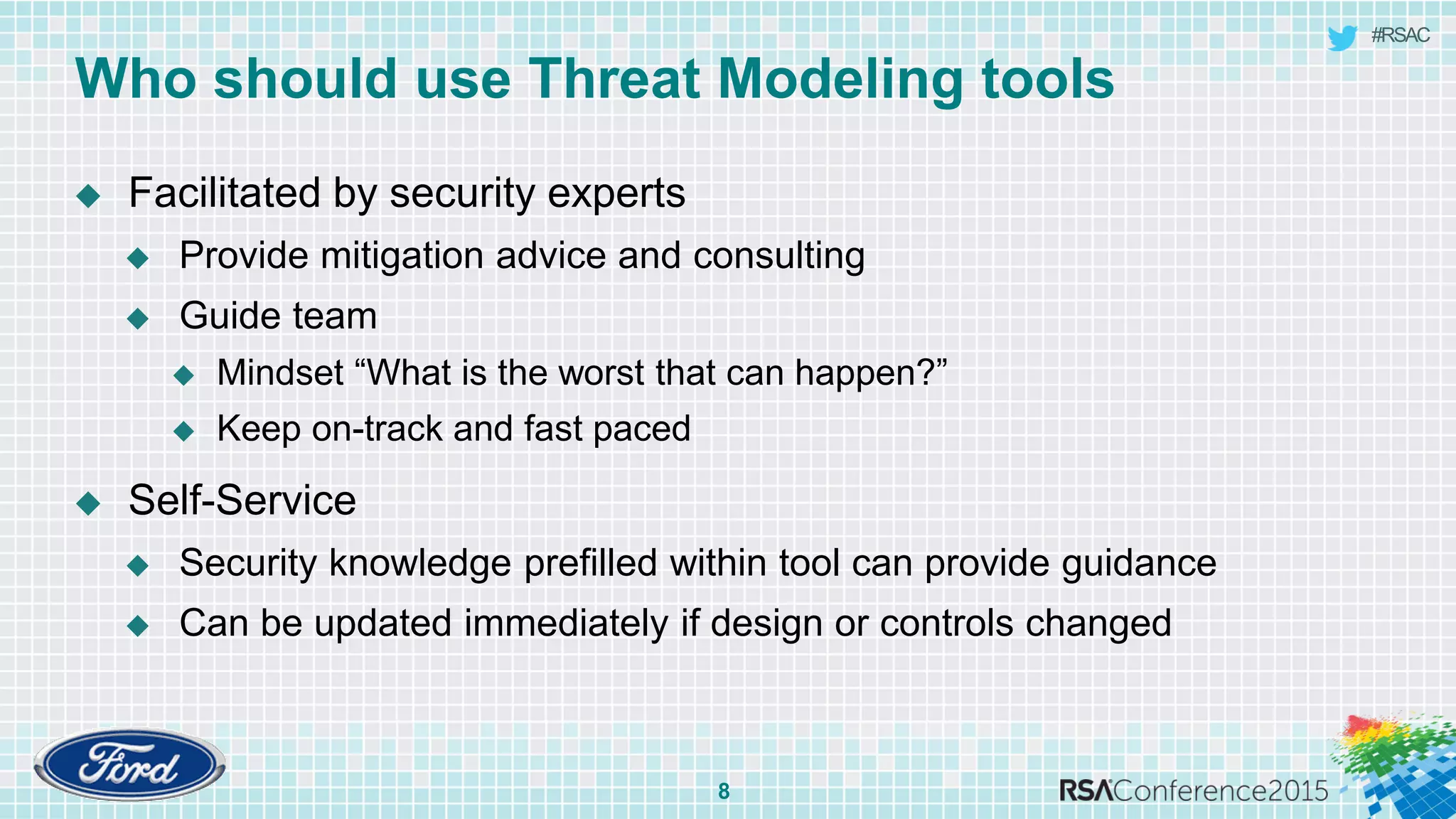
Who should use Threat Modeling tools
8
 Facilitated by security experts
 Provide mitigation advice and consulting
 Guide team
 Mindset “What is the worst that can happen?”
 Keep on-track and fast paced
 Self-Service
 Security knowledge prefilled within tool can provide guidance
 Can be updated immediately if design or controls changed
#RSAC
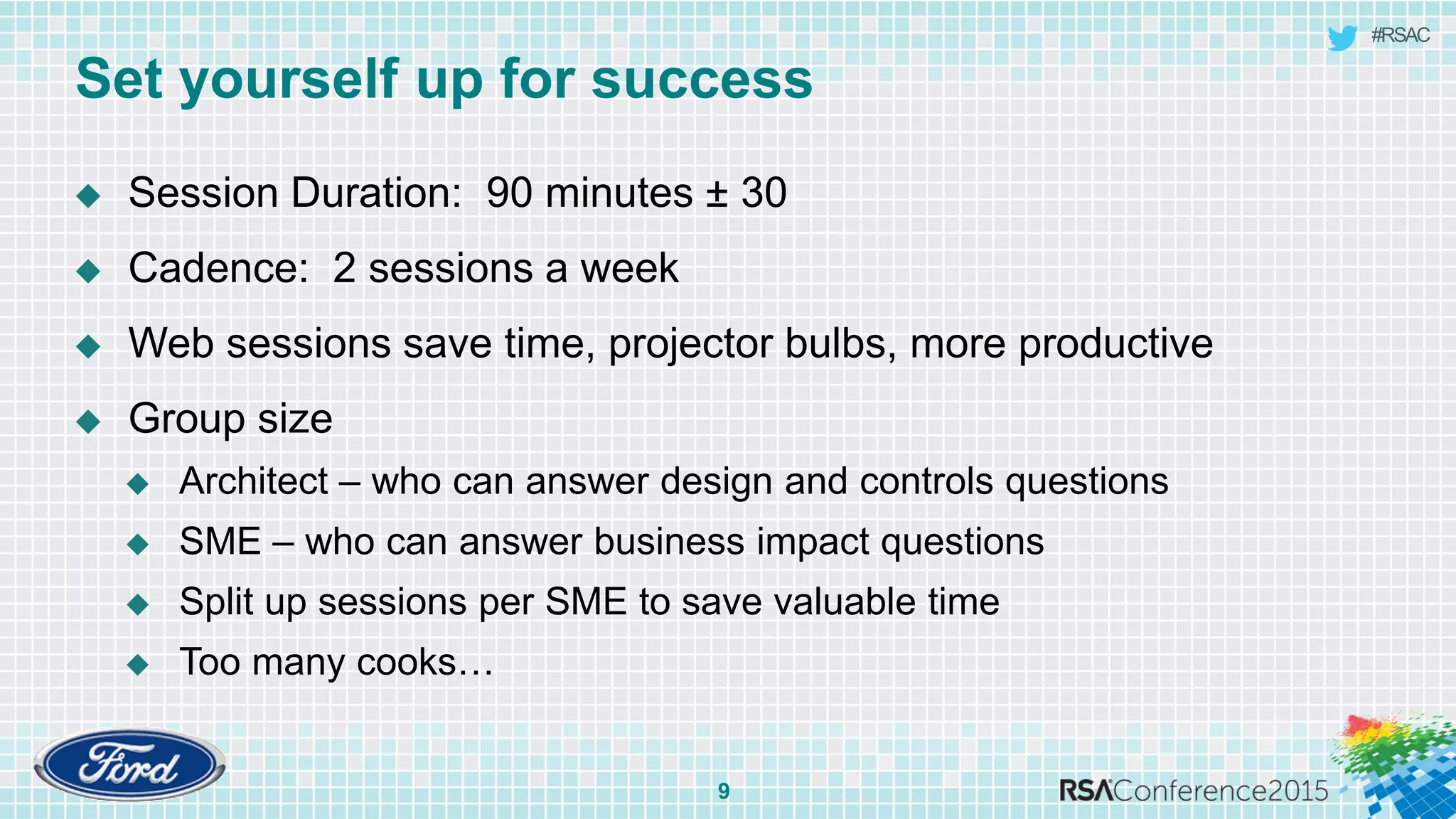
Set yourself up for success
9
 Session Duration: 90 minutes ± 30
 Cadence: 2 sessions a week
 Web sessions save time, projector bulbs, more productive
 Group size
 Architect – who can answer design and controls questions
 SME – who can answer business impact questions
 Split up sessions per SME to save valuable time
 Too many cooks…
#RSAC
What to Threat Model?
10
 High risk (Confidentiality/Integrity, external facing, reputational,
compliance…)
 Complex interactions between systems, emergent properties
 Data or control transfer across a boundary
 New technology/architecture to your company
 Architect has trouble thinking through potential issues
#RSAC
What not to Threat Model?
11
 A repeat implementation using all standard controls
 No significant revisions to application or data
 You already have a fully documented Control Review and all the
questions fit well
#RSAC
Art of the Data Flow Diagram
12
…make the irreducible basic elements as simple and as few
as possible without having to surrender the adequate
representation…
- Einstein
Threat Modeling Is Like Playing A Violin
- Shostack
#RSAC
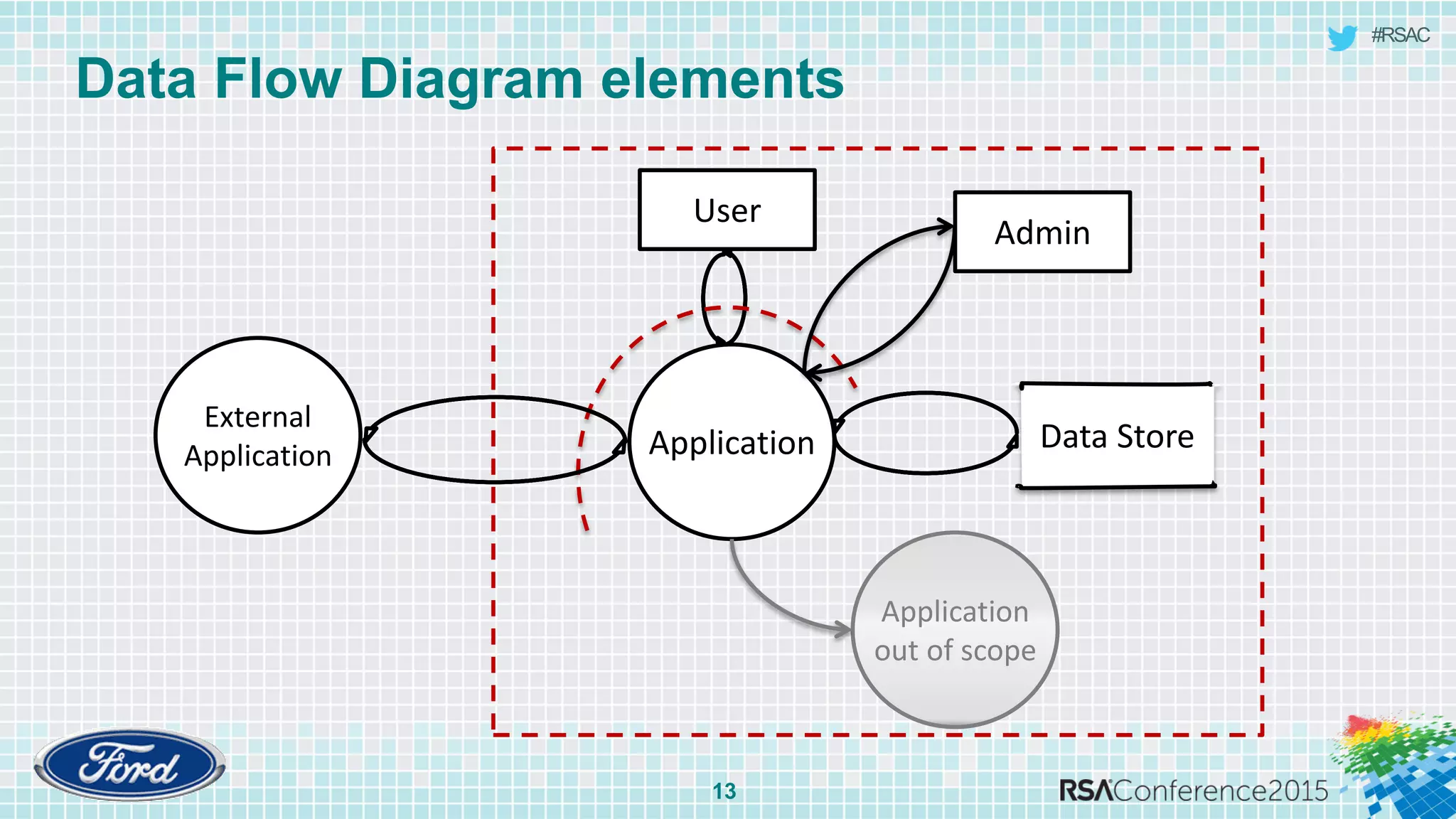
Data Flow Diagram elements
13
Application
User
Data Store
External
Application
Application
out of scope
Admin
#RSAC
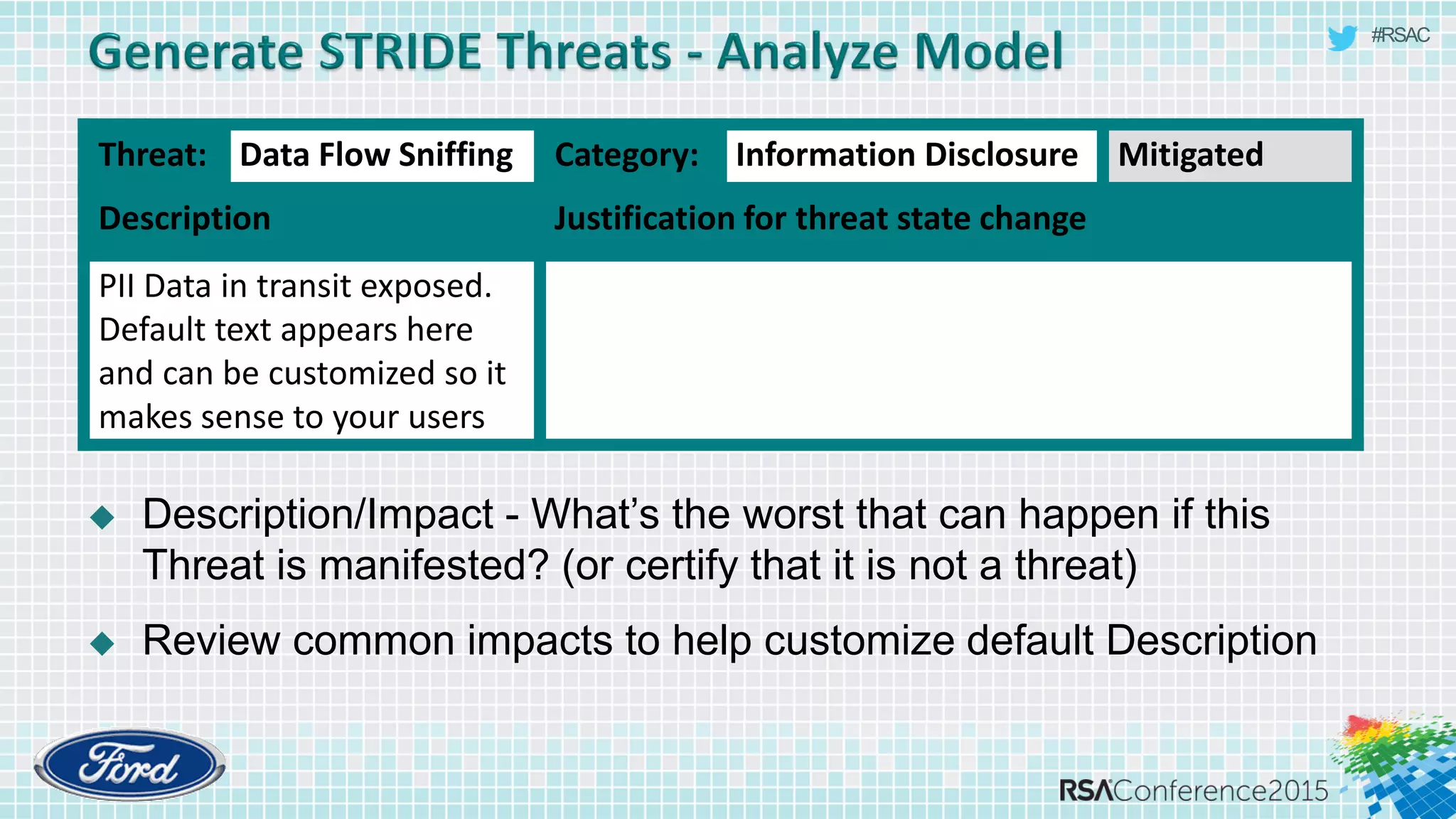
 Description/Impact - What’s the worst that can happen if this
Threat is manifested? (or certify that it is not a threat)
 Review common impacts to help customize default Description
Threat: Data Flow Sniffing Category: Information Disclosure Mitigated
Description Justification for threat state change
PII Data in transit exposed.
Default text appears here
and can be customized so it
makes sense to your users
#RSAC
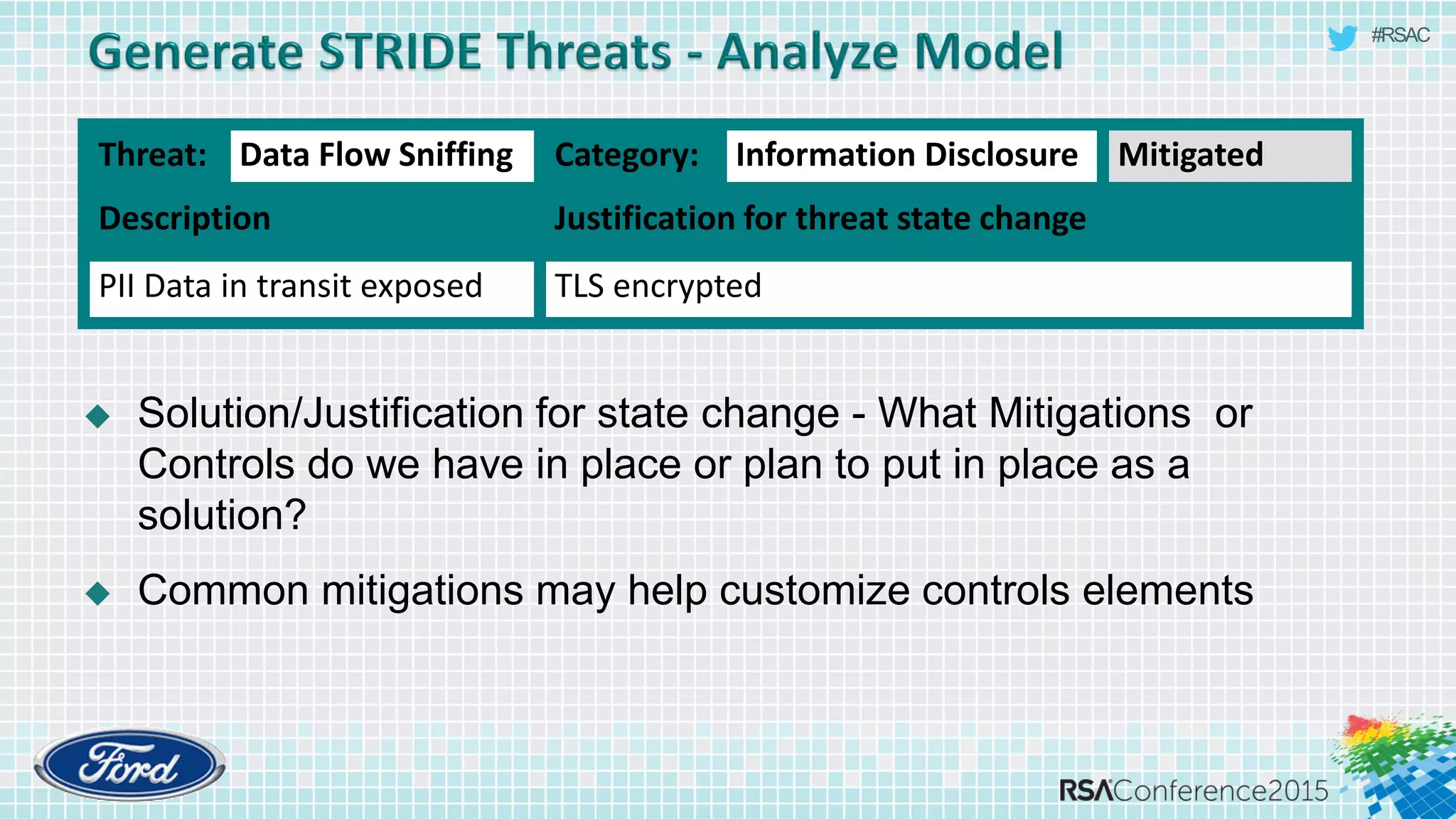
 Solution/Justification for state change - What Mitigations or
Controls do we have in place or plan to put in place as a
solution?
 Common mitigations may help customize controls elements
Threat: Data Flow Sniffing Category: Information Disclosure Mitigated
Description Justification for threat state change
PII Data in transit exposed TLS encrypted
#RSAC
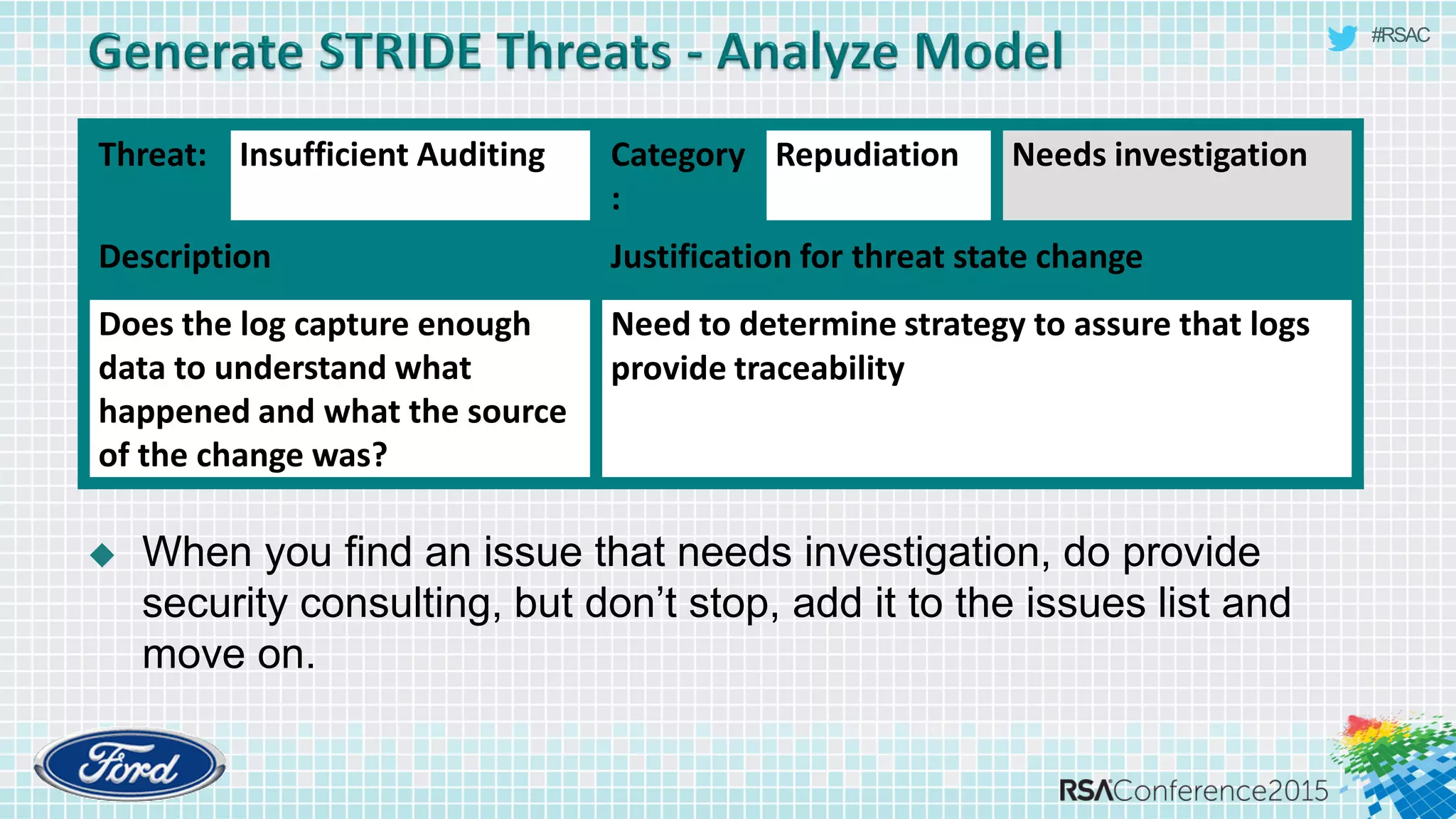
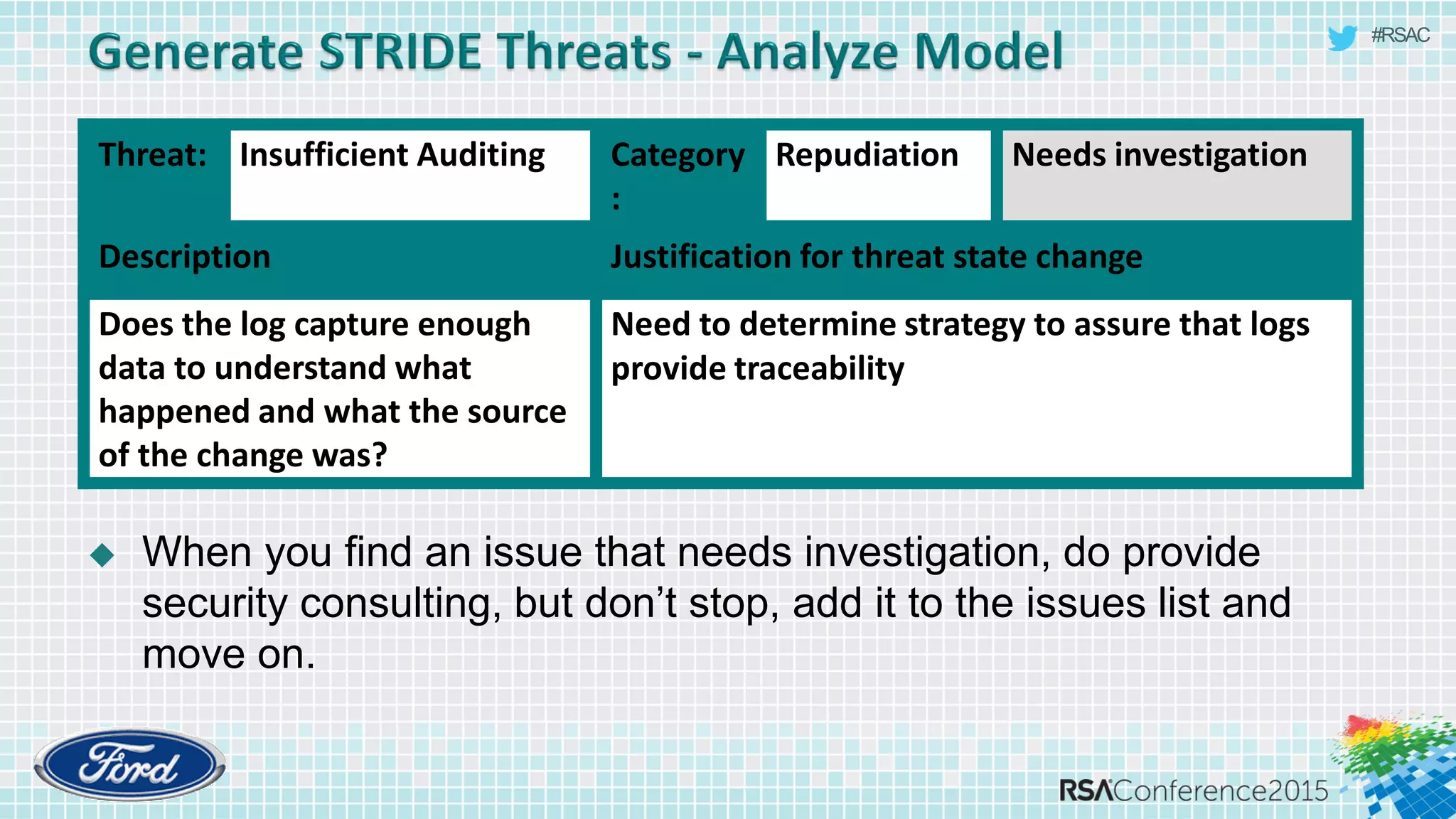
 When you find an issue that needs investigation, do provide
security consulting, but don’t stop, add it to the issues list and
move on.
Threat: Insufficient Auditing Category
:
Repudiation Needs investigation
Description Justification for threat state change
Does the log capture enough
data to understand what
happened and what the source
of the change was?
Need to determine strategy to assure that logs
provide traceability
#RSAC
 When you find an issue that needs investigation, do provide
security consulting, but don’t stop, add it to the issues list and
move on.
Threat: Insufficient Auditing Category
:
Repudiation Needs investigation
Description Justification for threat state change
Does the log capture enough
data to understand what
happened and what the source
of the change was?
Need to determine strategy to assure that logs
provide traceability
#RSAC
 When you find an issue that needs investigation, do provide
security consulting, but don’t stop, add it to the issues list and
move on.
Threat: Insufficient Auditing Category
:
Repudiation Needs investigation
Description Justification for threat state change
Does the log capture enough
data to understand what
happened and what the source
of the change was?
Need to determine strategy to assure that logs
provide traceability
#RSAC
Capture an Issues List
 Paste actions/controls gaps into a spreadsheet or immediately
enter in backlog, test tool, or project management tool
 A-ha moments: “oh, we never thought of that!”
 Critical controls that are not already documented anywhere else
 The mitigation sounds like a reason we can’t figure out how to
mitigate
 Nonstandard controls that need to be tested
#RSAC
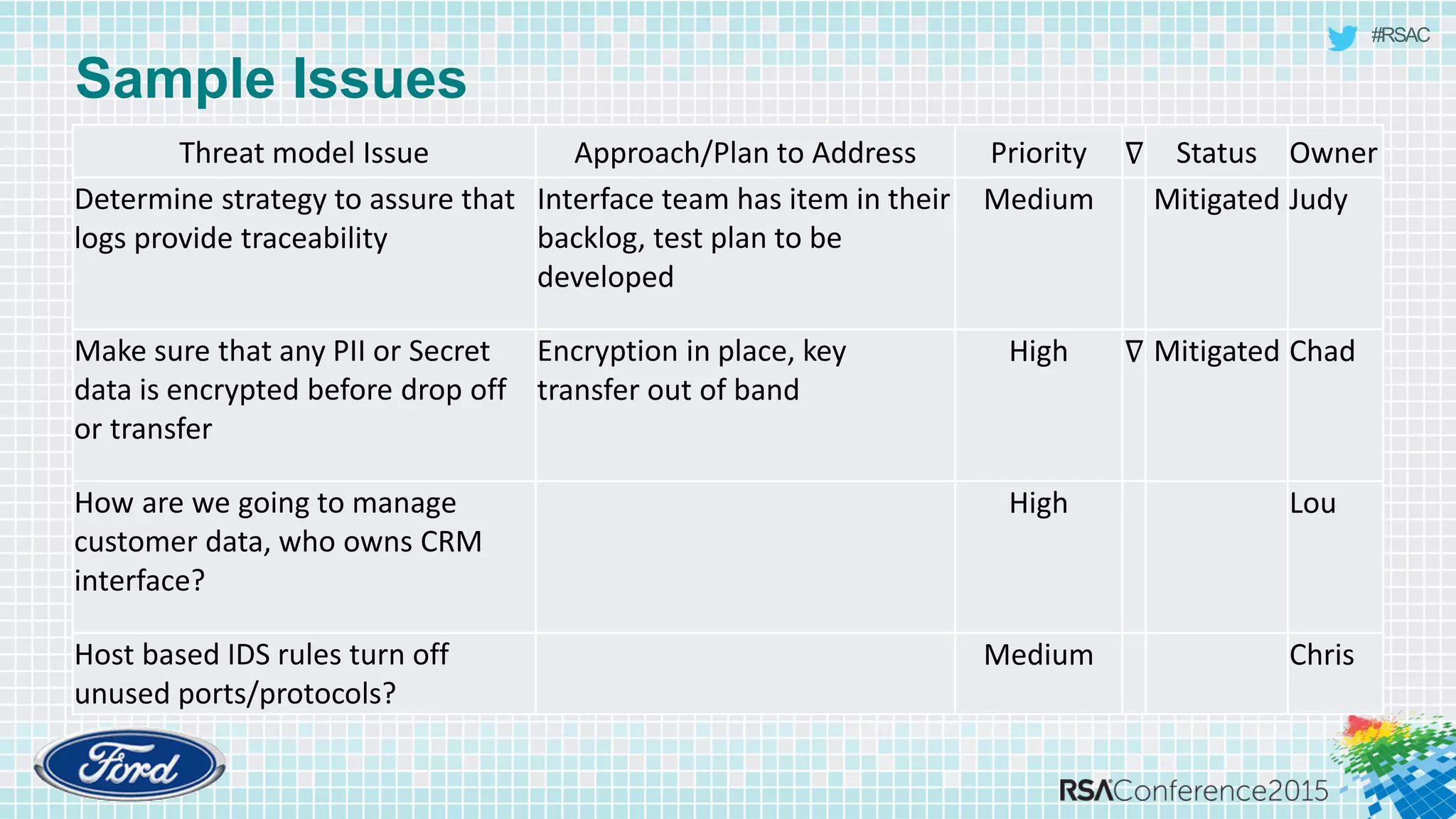
Sample Issues
Threat model Issue Approach/Plan to Address Priority ∇ Status Owner
Determine strategy to assure that
logs provide traceability
Interface team has item in their
backlog, test plan to be
developed
Medium Mitigated Judy
Make sure that any PII or Secret
data is encrypted before drop off
or transfer
Encryption in place, key
transfer out of band
High ∇ Mitigated Chad
How are we going to manage
customer data, who owns CRM
interface?
High Lou
Host based IDS rules turn off
unused ports/protocols?
Medium Chris
#RSAC
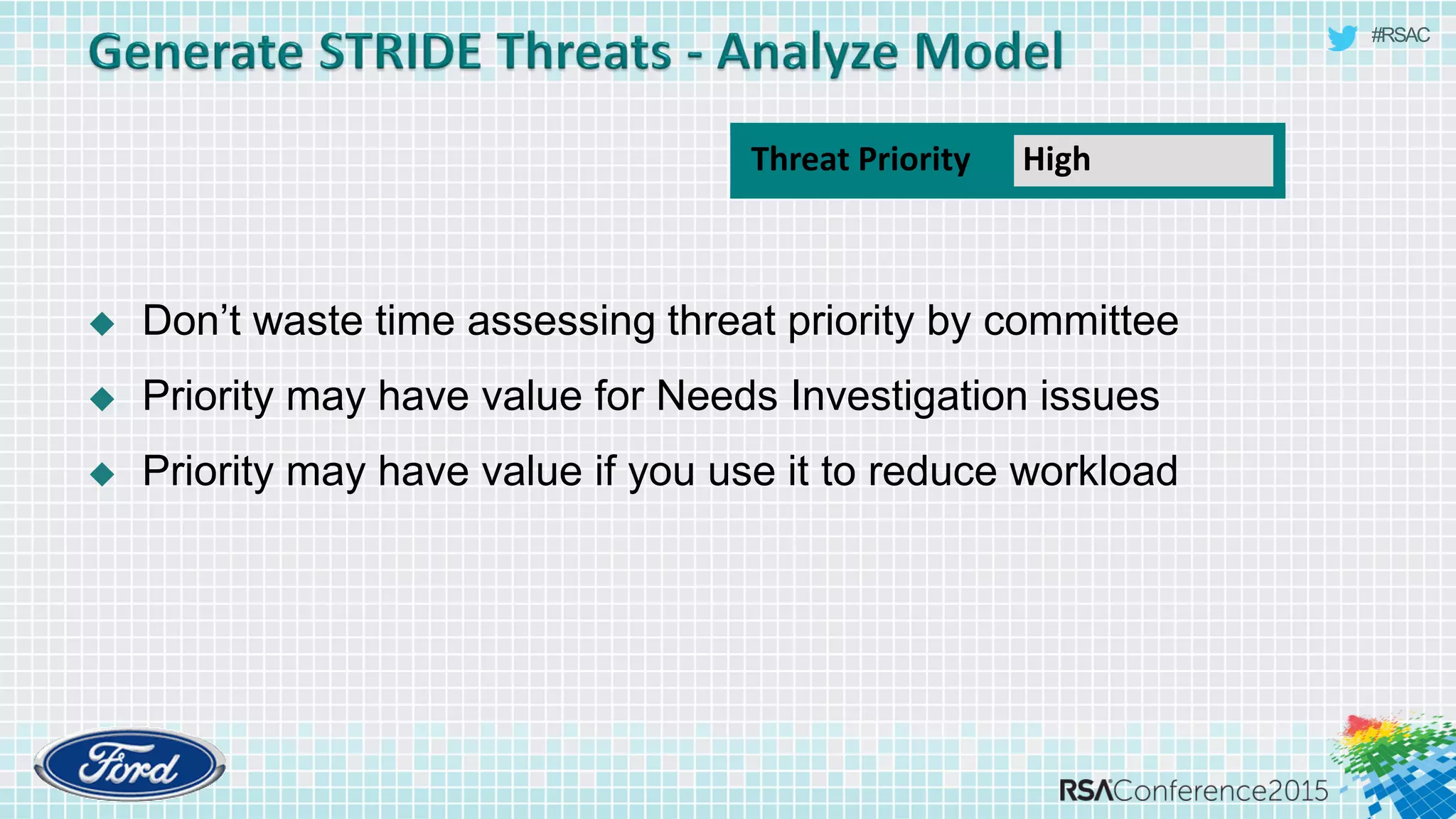
 Don’t waste time assessing threat priority by committee
 Priority may have value for Needs Investigation issues
 Priority may have value if you use it to reduce workload
Threat Priority High
#RSAC
Security unit test – regression test
 Develop from Threat Model issues list
 Example: verify that all changes from any source
are logged
 Work with QC to develop test cases for
nonfunctional requirements
 Run at each iteration before release
 Run annually to validate controls
#RSAC
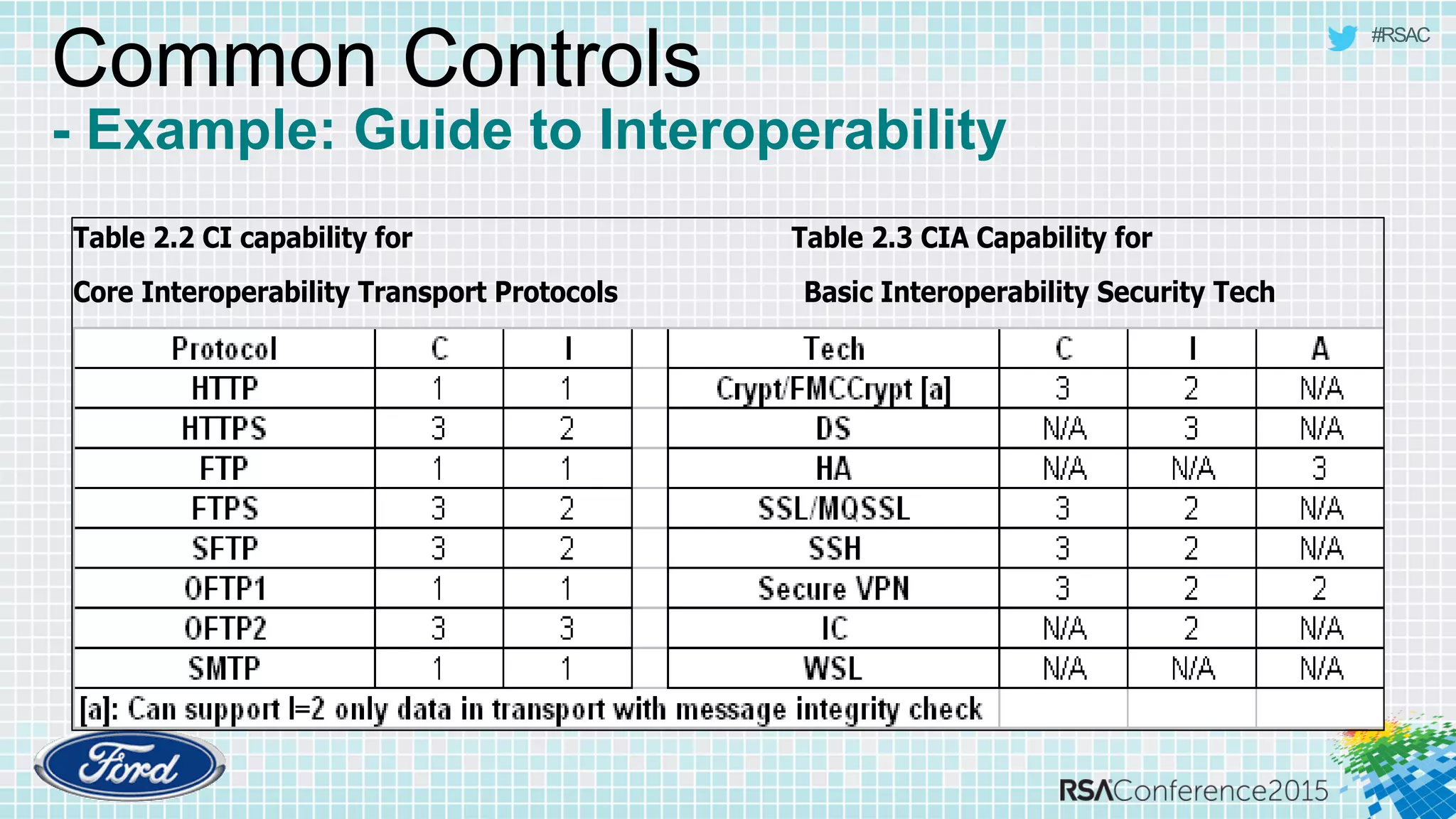
Common Controls
- Example: Guide to Interoperability
Table 2.2 CI capability for Table 2.3 CIA Capability for
Core Interoperability Transport Protocols Basic Interoperability Security Tech
#RSAC
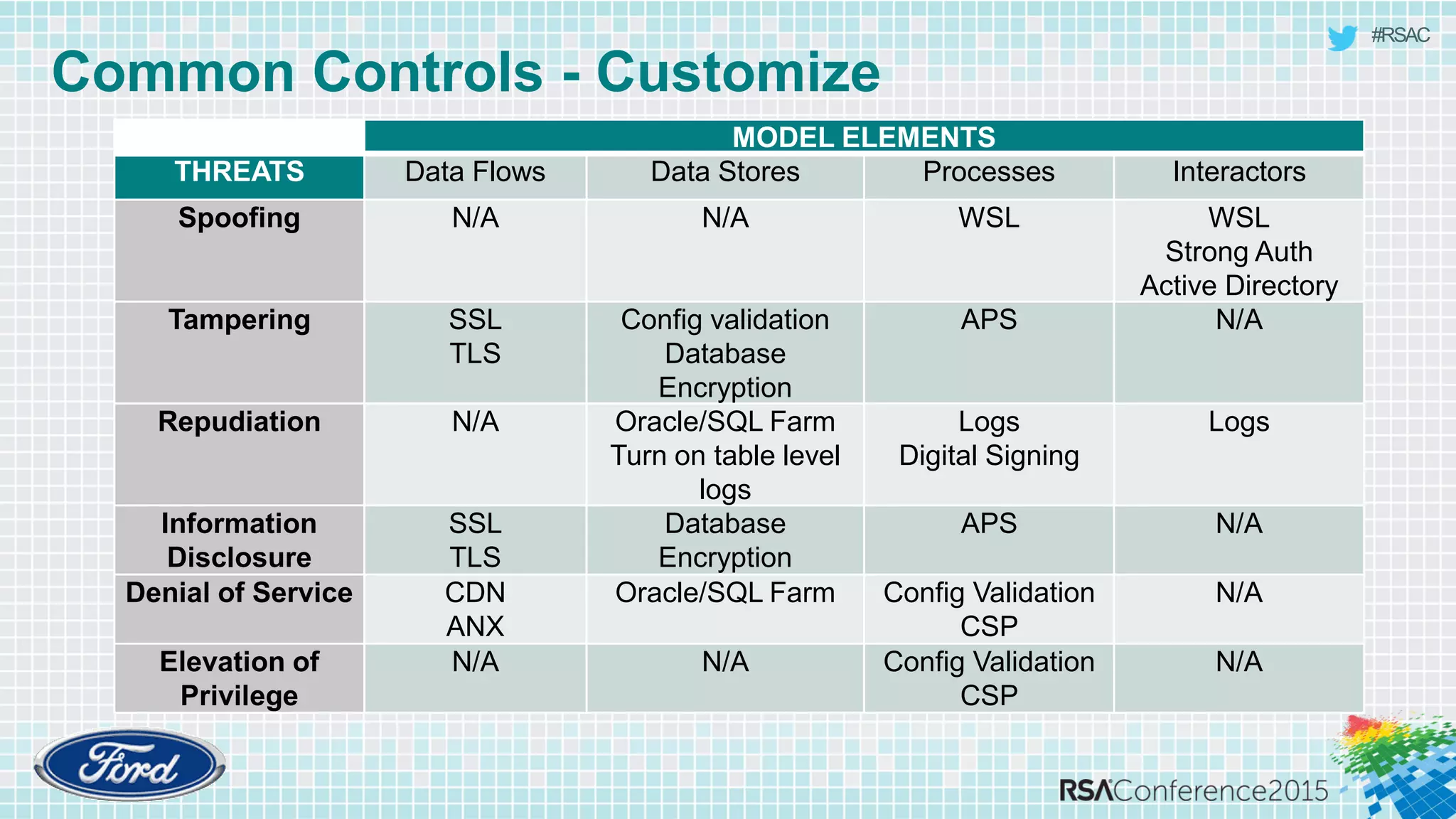
Common Controls - Customize
MODEL ELEMENTS
THREATS Data Flows Data Stores Processes Interactors
Spoofing N/A N/A WSL WSL
Strong Auth
Active Directory
Tampering SSL
TLS
Config validation
Database
Encryption
APS N/A
Repudiation N/A Oracle/SQL Farm
Turn on table level
logs
Logs
Digital Signing
Logs
Information
Disclosure
SSL
TLS
Database
Encryption
APS N/A
Denial of Service CDN
ANX
Oracle/SQL Farm Config Validation
CSP
N/A
Elevation of
Privilege
N/A N/A Config Validation
CSP
N/A
#RSAC
Common Controls - Customize
25
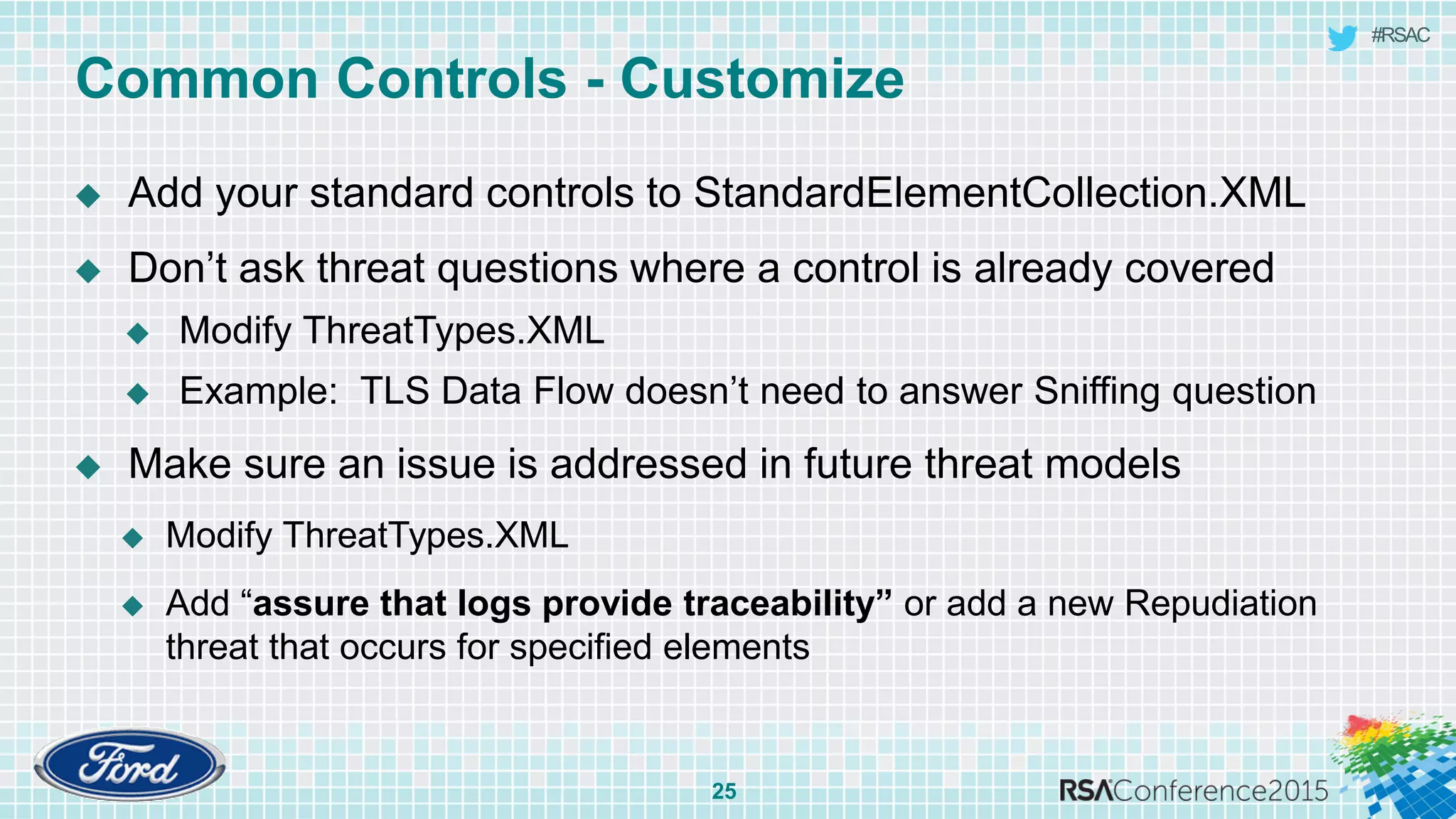
 Add your standard controls to StandardElementCollection.XML
 Don’t ask threat questions where a control is already covered
 Modify ThreatTypes.XML
 Example: TLS Data Flow doesn’t need to answer Sniffing question
 Make sure an issue is addressed in future threat models
 Modify ThreatTypes.XML
 Add “assure that logs provide traceability” or add a new Repudiation
threat that occurs for specified elements
#RSAC
Security Analysis Tools
26
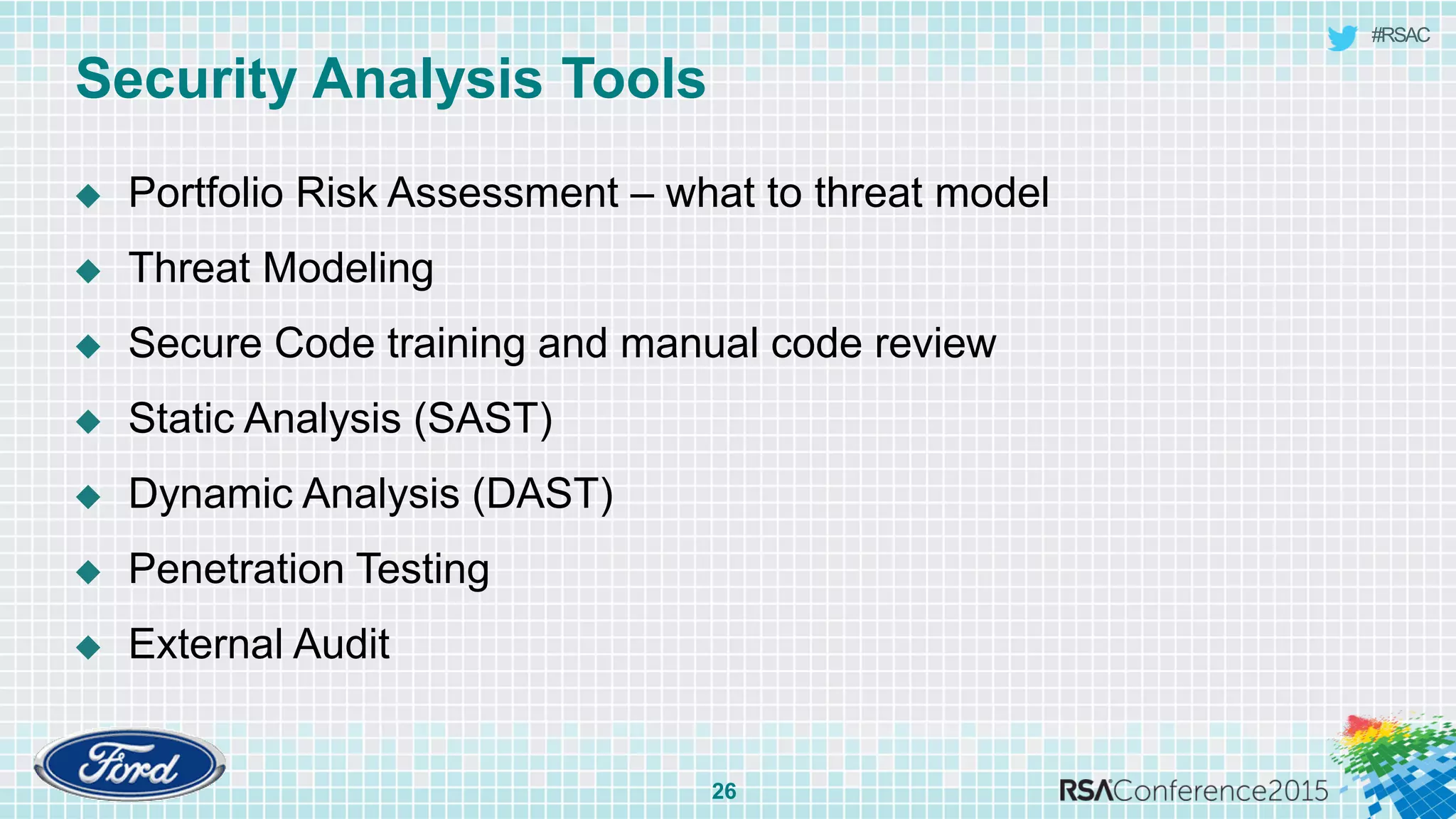
 Portfolio Risk Assessment – what to threat model
 Threat Modeling
 Secure Code training and manual code review
 Static Analysis (SAST)
 Dynamic Analysis (DAST)
 Penetration Testing
 External Audit
#RSAC
27
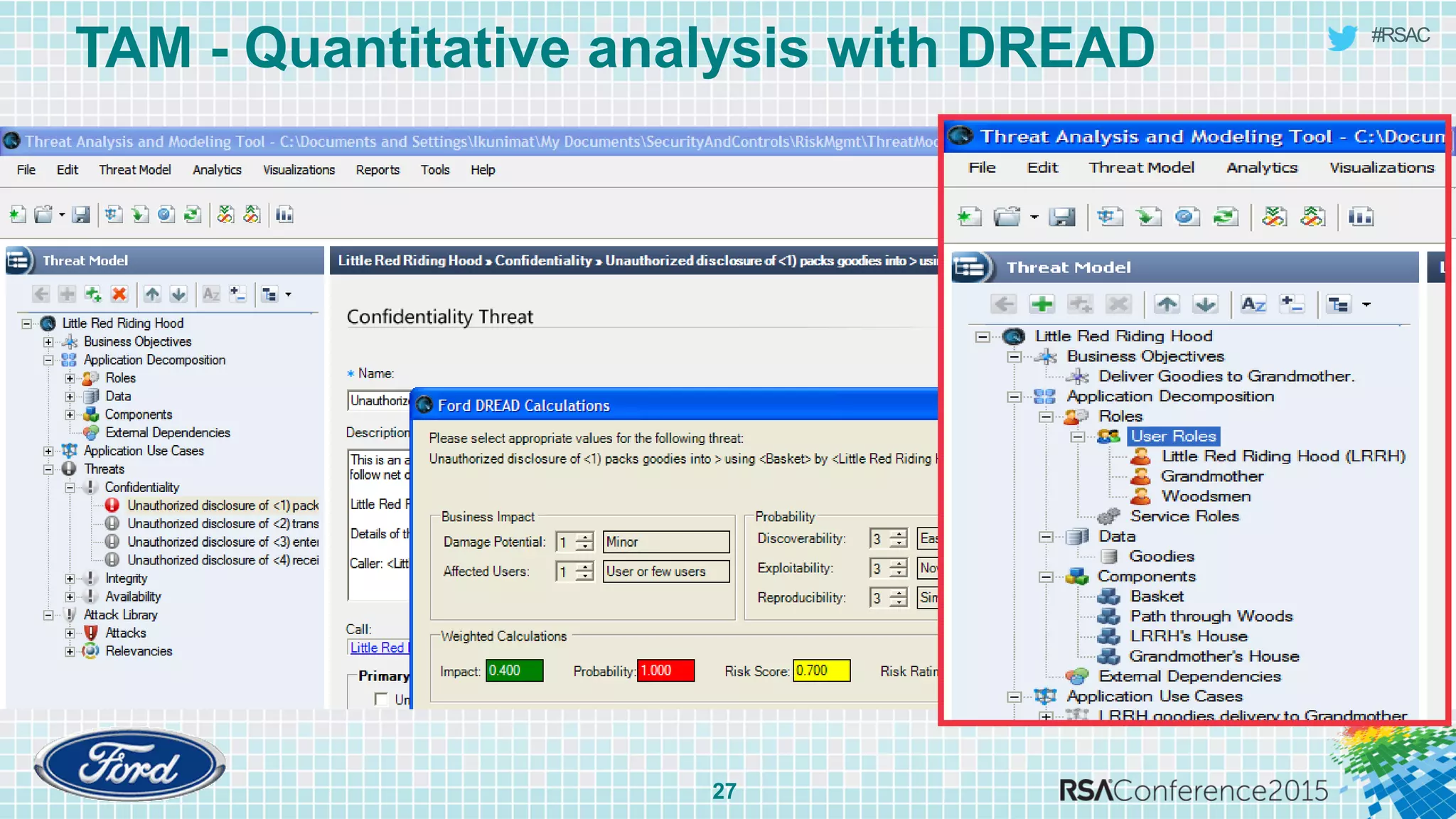
TAM - Quantitative analysis with DREAD
#RSAC
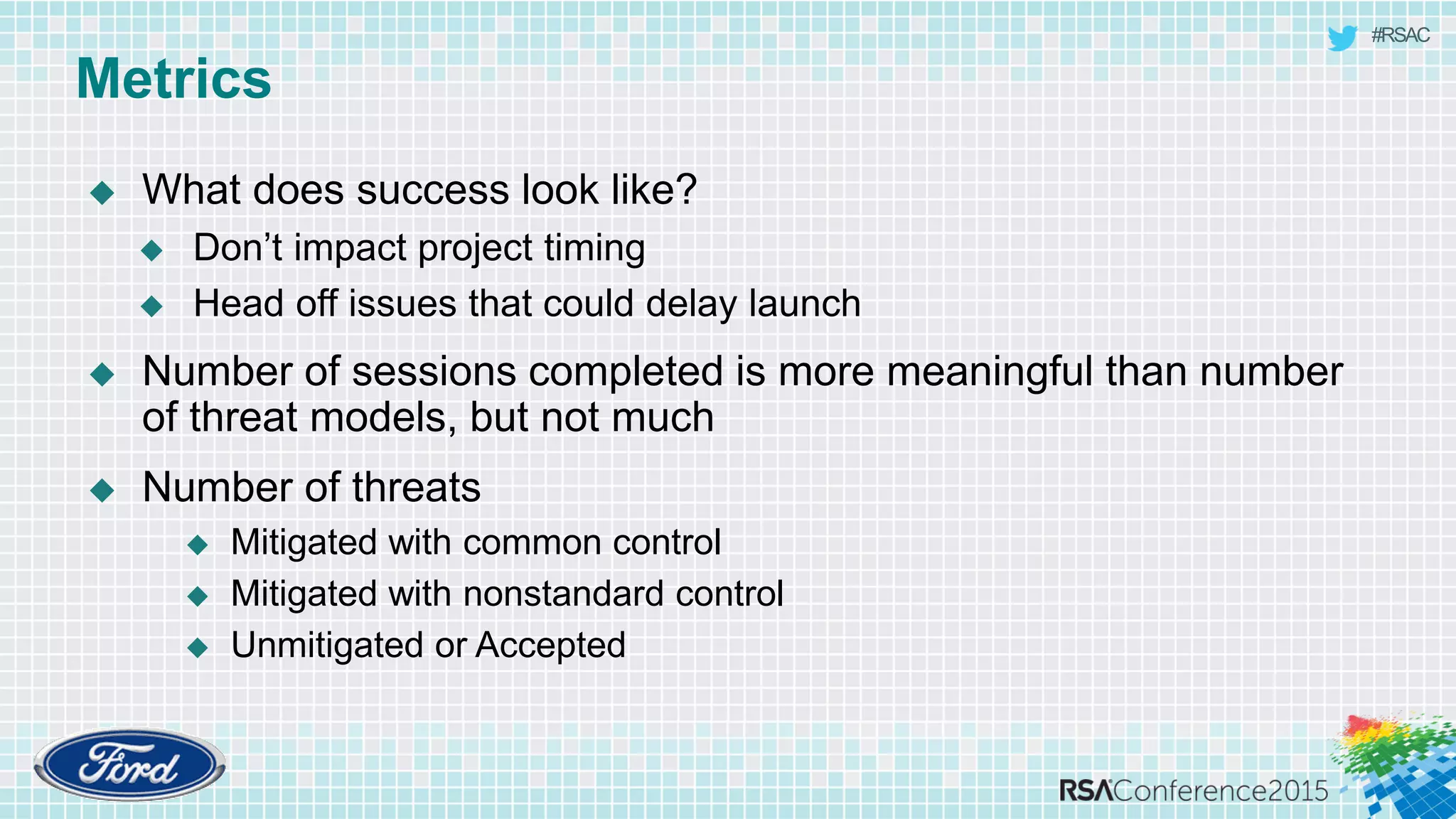
Metrics
 What does success look like?
 Don’t impact project timing
 Head off issues that could delay launch
 Number of sessions completed is more meaningful than number
of threat models, but not much
 Number of threats
 Mitigated with common control
 Mitigated with nonstandard control
 Unmitigated or Accepted
#RSAC
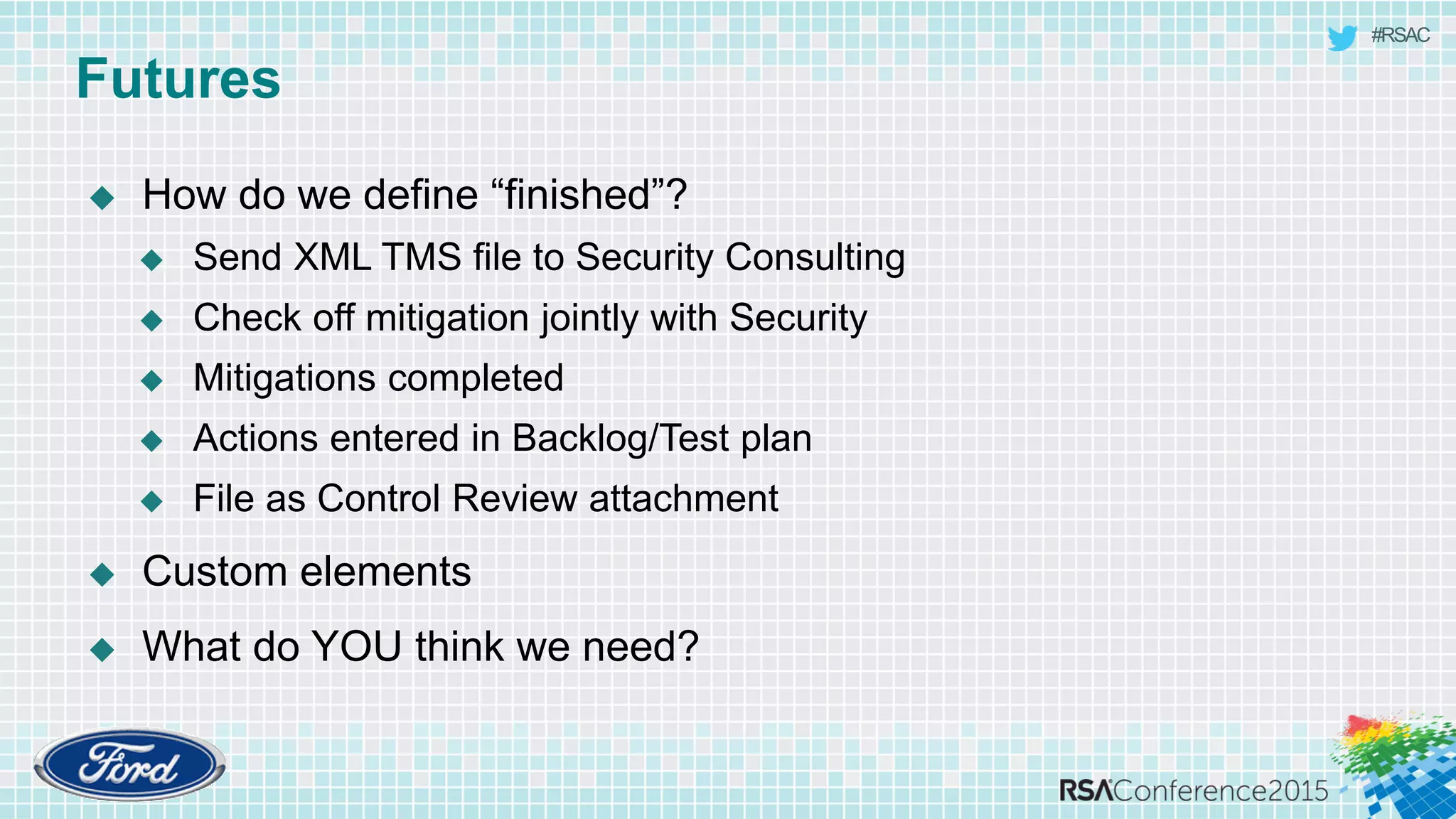
Futures
 How do we define “finished”?
 Send XML TMS file to Security Consulting
 Check off mitigation jointly with Security
 Mitigations completed
 Actions entered in Backlog/Test plan
 File as Control Review attachment
 Custom elements
 What do YOU think we need?
#RSAC
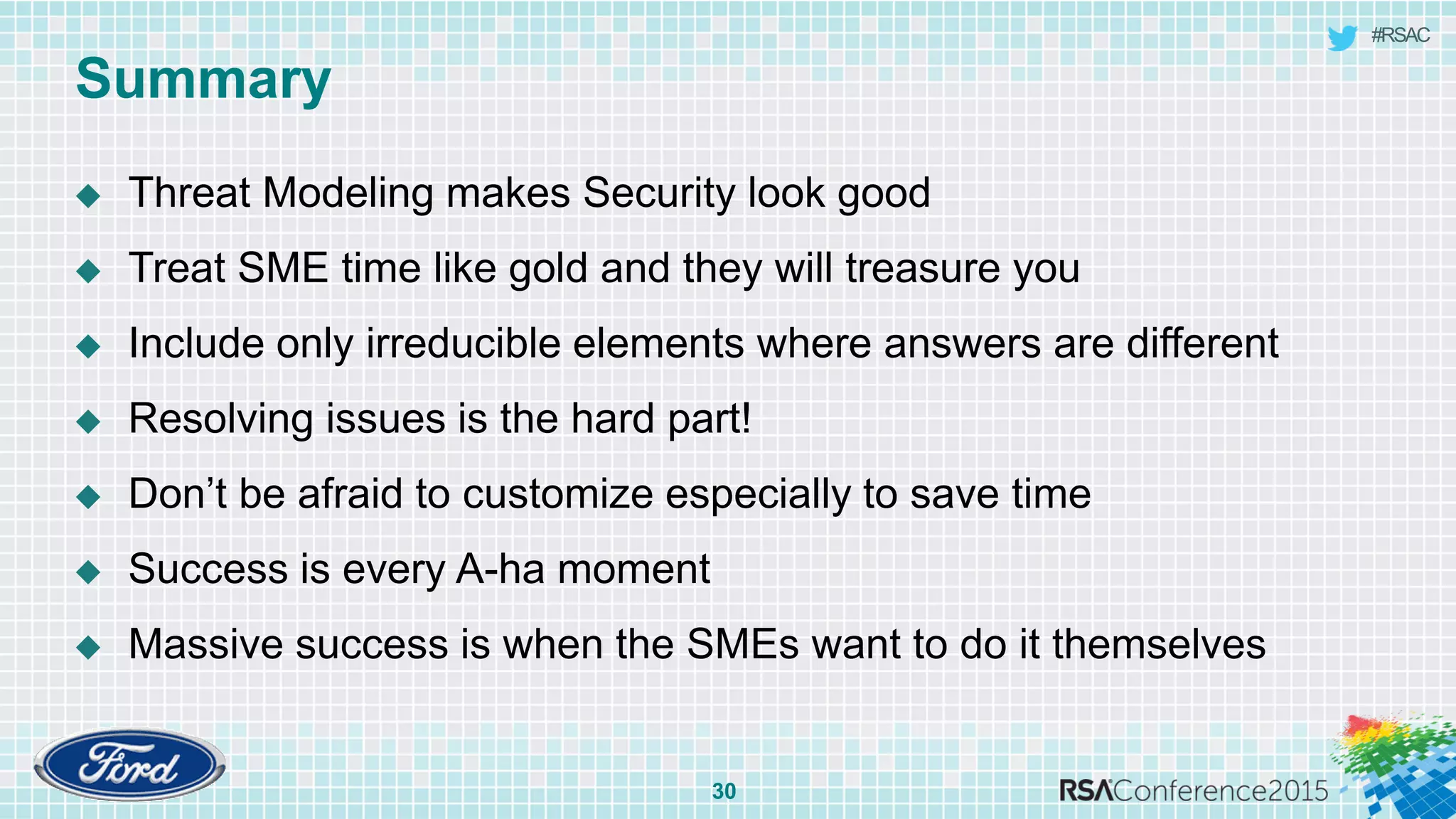
Summary
30
 Threat Modeling makes Security look good
 Treat SME time like gold and they will treasure you
 Include only irreducible elements where answers are different
 Resolving issues is the hard part!
 Don’t be afraid to customize especially to save time
 Success is every A-ha moment
 Massive success is when the SMEs want to do it themselves
#RSAC
Apply Threat Modeling in your organization
 Next week you should:
 Install the SDL Threat Modeling tool from
http://www.microsoft.com/security/sdl/adopt/threatmodeling.aspx
 In the first three months following this presentation you should:
 Think about new projects in your organization that are good
candidates for Threat Modeling and complete your first Threat Model
 Within six months you should:
 Review what you have learned in your organization and determine
who else can benefit from using Threat Modeling
31
#RSAC
Questions?
 Please use the microphones
#RSAC
Acknowledgements
 SAFECode, “Fundamental Practices for Secure Software
Development: A Guide to the Most Effective Secure Development
Practices in Use Today”
 Lou Kunimatsu, “My, What Big Teeth You Have: A Threat Analysis and
Modeling Fairy Tale”
 Michael Jones photograph “400M Hurdles” from the 2012 Olympics,
Creative Commons license CC BY-NC-SA 2.0
 Adam Shostack, “New Foundations for Threat Modeling”
 Albert Einstein, “On the Method of Theoretical Physics”

Rapid Threat Modeling Techniques

  • 1.
    SESSION ID: #RSAC Chad Childers RapidThreat Modeling Techniques ASD-R01 IT Security Ford Motor Company
  • 2.
    #RSAC Agenda 2  Threat Modelingbackground  Lessons Learned to make threat modeling faster  Techniques specifically for DFD and STRIDE effectiveness  Issues  Customizations & other security analysis tools  Success!
  • 3.
    #RSAC What is ThreatModeling? 3  Design practice from the Software Assurance Forum (SAFECode)  Attack trees  Threat library (CAPEC, OWASP Top Ten)  Use Cases  STRIDE Spoofing Tampering Repudiation Information Disclosure Denial of Service Elevation of Privilege
  • 4.
    #RSAC What is ThreatModeling? 4  Microsoft Security Development Lifecycle - Threat Modeling tool  Architectural model based on Data Flow Diagram  Each element of the diagram generates a set of STRIDE threats Process element User element Data Flow element
  • 5.
    #RSAC STRIDE by elements 5 ThreatsData Flows Data Stores Processes Interactors Spoofing X X Tampering X X X Repudiation X X X Information Disclosure X X X Denial of Service X X X Elevation of Privilege X
  • 6.
    #RSAC Why Rapid ThreatModeling? 6  Professional benefits  Security skill in demand  Architects make issues surface, clarify design issues  Developers can avoid rework, prioritize  Deliver Results  Teams can see value quickly, understand vulnerabilities  Answer “What do I do now?”
  • 7.
    #RSAC Security hurdles • Controls documentation •Paperwork exercise • Last minute gate review • Athletes have the right training • They prepare and practice • They are not surprised
  • 8.
    #RSAC Who should useThreat Modeling tools 8  Facilitated by security experts  Provide mitigation advice and consulting  Guide team  Mindset “What is the worst that can happen?”  Keep on-track and fast paced  Self-Service  Security knowledge prefilled within tool can provide guidance  Can be updated immediately if design or controls changed
  • 9.
    #RSAC Set yourself upfor success 9  Session Duration: 90 minutes ± 30  Cadence: 2 sessions a week  Web sessions save time, projector bulbs, more productive  Group size  Architect – who can answer design and controls questions  SME – who can answer business impact questions  Split up sessions per SME to save valuable time  Too many cooks…
  • 10.
    #RSAC What to ThreatModel? 10  High risk (Confidentiality/Integrity, external facing, reputational, compliance…)  Complex interactions between systems, emergent properties  Data or control transfer across a boundary  New technology/architecture to your company  Architect has trouble thinking through potential issues
  • 11.
    #RSAC What not toThreat Model? 11  A repeat implementation using all standard controls  No significant revisions to application or data  You already have a fully documented Control Review and all the questions fit well
  • 12.
    #RSAC Art of theData Flow Diagram 12 …make the irreducible basic elements as simple and as few as possible without having to surrender the adequate representation… - Einstein Threat Modeling Is Like Playing A Violin - Shostack
  • 13.
    #RSAC Data Flow Diagramelements 13 Application User Data Store External Application Application out of scope Admin
  • 14.
    #RSAC  Description/Impact -What’s the worst that can happen if this Threat is manifested? (or certify that it is not a threat)  Review common impacts to help customize default Description Threat: Data Flow Sniffing Category: Information Disclosure Mitigated Description Justification for threat state change PII Data in transit exposed. Default text appears here and can be customized so it makes sense to your users
  • 15.
    #RSAC  Solution/Justification forstate change - What Mitigations or Controls do we have in place or plan to put in place as a solution?  Common mitigations may help customize controls elements Threat: Data Flow Sniffing Category: Information Disclosure Mitigated Description Justification for threat state change PII Data in transit exposed TLS encrypted
  • 16.
    #RSAC  When youfind an issue that needs investigation, do provide security consulting, but don’t stop, add it to the issues list and move on. Threat: Insufficient Auditing Category : Repudiation Needs investigation Description Justification for threat state change Does the log capture enough data to understand what happened and what the source of the change was? Need to determine strategy to assure that logs provide traceability
  • 17.
    #RSAC  When youfind an issue that needs investigation, do provide security consulting, but don’t stop, add it to the issues list and move on. Threat: Insufficient Auditing Category : Repudiation Needs investigation Description Justification for threat state change Does the log capture enough data to understand what happened and what the source of the change was? Need to determine strategy to assure that logs provide traceability
  • 18.
    #RSAC  When youfind an issue that needs investigation, do provide security consulting, but don’t stop, add it to the issues list and move on. Threat: Insufficient Auditing Category : Repudiation Needs investigation Description Justification for threat state change Does the log capture enough data to understand what happened and what the source of the change was? Need to determine strategy to assure that logs provide traceability
  • 19.
    #RSAC Capture an IssuesList  Paste actions/controls gaps into a spreadsheet or immediately enter in backlog, test tool, or project management tool  A-ha moments: “oh, we never thought of that!”  Critical controls that are not already documented anywhere else  The mitigation sounds like a reason we can’t figure out how to mitigate  Nonstandard controls that need to be tested
  • 20.
    #RSAC Sample Issues Threat modelIssue Approach/Plan to Address Priority ∇ Status Owner Determine strategy to assure that logs provide traceability Interface team has item in their backlog, test plan to be developed Medium Mitigated Judy Make sure that any PII or Secret data is encrypted before drop off or transfer Encryption in place, key transfer out of band High ∇ Mitigated Chad How are we going to manage customer data, who owns CRM interface? High Lou Host based IDS rules turn off unused ports/protocols? Medium Chris
  • 21.
    #RSAC  Don’t wastetime assessing threat priority by committee  Priority may have value for Needs Investigation issues  Priority may have value if you use it to reduce workload Threat Priority High
  • 22.
    #RSAC Security unit test– regression test  Develop from Threat Model issues list  Example: verify that all changes from any source are logged  Work with QC to develop test cases for nonfunctional requirements  Run at each iteration before release  Run annually to validate controls
  • 23.
    #RSAC Common Controls - Example:Guide to Interoperability Table 2.2 CI capability for Table 2.3 CIA Capability for Core Interoperability Transport Protocols Basic Interoperability Security Tech
  • 24.
    #RSAC Common Controls -Customize MODEL ELEMENTS THREATS Data Flows Data Stores Processes Interactors Spoofing N/A N/A WSL WSL Strong Auth Active Directory Tampering SSL TLS Config validation Database Encryption APS N/A Repudiation N/A Oracle/SQL Farm Turn on table level logs Logs Digital Signing Logs Information Disclosure SSL TLS Database Encryption APS N/A Denial of Service CDN ANX Oracle/SQL Farm Config Validation CSP N/A Elevation of Privilege N/A N/A Config Validation CSP N/A
  • 25.
    #RSAC Common Controls -Customize 25  Add your standard controls to StandardElementCollection.XML  Don’t ask threat questions where a control is already covered  Modify ThreatTypes.XML  Example: TLS Data Flow doesn’t need to answer Sniffing question  Make sure an issue is addressed in future threat models  Modify ThreatTypes.XML  Add “assure that logs provide traceability” or add a new Repudiation threat that occurs for specified elements
  • 26.
    #RSAC Security Analysis Tools 26 Portfolio Risk Assessment – what to threat model  Threat Modeling  Secure Code training and manual code review  Static Analysis (SAST)  Dynamic Analysis (DAST)  Penetration Testing  External Audit
  • 27.
    #RSAC 27 TAM - Quantitativeanalysis with DREAD
  • 28.
    #RSAC Metrics  What doessuccess look like?  Don’t impact project timing  Head off issues that could delay launch  Number of sessions completed is more meaningful than number of threat models, but not much  Number of threats  Mitigated with common control  Mitigated with nonstandard control  Unmitigated or Accepted
  • 29.
    #RSAC Futures  How dowe define “finished”?  Send XML TMS file to Security Consulting  Check off mitigation jointly with Security  Mitigations completed  Actions entered in Backlog/Test plan  File as Control Review attachment  Custom elements  What do YOU think we need?
  • 30.
    #RSAC Summary 30  Threat Modelingmakes Security look good  Treat SME time like gold and they will treasure you  Include only irreducible elements where answers are different  Resolving issues is the hard part!  Don’t be afraid to customize especially to save time  Success is every A-ha moment  Massive success is when the SMEs want to do it themselves
  • 31.
    #RSAC Apply Threat Modelingin your organization  Next week you should:  Install the SDL Threat Modeling tool from http://www.microsoft.com/security/sdl/adopt/threatmodeling.aspx  In the first three months following this presentation you should:  Think about new projects in your organization that are good candidates for Threat Modeling and complete your first Threat Model  Within six months you should:  Review what you have learned in your organization and determine who else can benefit from using Threat Modeling 31
  • 32.
  • 33.
    #RSAC Acknowledgements  SAFECode, “FundamentalPractices for Secure Software Development: A Guide to the Most Effective Secure Development Practices in Use Today”  Lou Kunimatsu, “My, What Big Teeth You Have: A Threat Analysis and Modeling Fairy Tale”  Michael Jones photograph “400M Hurdles” from the 2012 Olympics, Creative Commons license CC BY-NC-SA 2.0  Adam Shostack, “New Foundations for Threat Modeling”  Albert Einstein, “On the Method of Theoretical Physics”