The Role of Machine Learning in IoT: A Survey
Presented by
Dr.K.S.Arikumar
Assistant Professor
School of Computer Science &
Engineering(SCOPE)
VIT-AP University
Near Vijayawada - 522 237
Andhra Pradesh.
Agenda
● Introduction
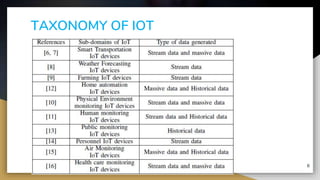
● Taxonomy of IoT
● Machine Learning techniques
● Machine Learning Techniques: Taxonomy
● Challenges and Open Issues
● Conclusion
● References
2
Introduction
● CISCO expect that the quantity of internet-connected devices can
reach a maximum of 75.44 billion by 2025
● Any devices, which are connected to the internet for enabling
wired or wireless communication with each other, are said to be
IoT devices
● Temperature sensors, pressure sensors, position sensors,
vibration sensors, humidity sensors, etc. generate diverse data
● To give better services to the end users, the IoT needs data to be
in transmission
3
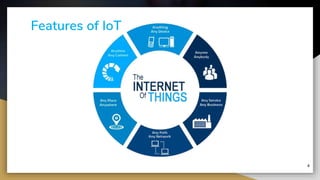
Features of IoT
4
Intelligent machine learning
● The IoT data is generated not only from a single IoT device but
from various IoT devices combined to generate various data with
their own unique features and characteristics to make a system a
smart system
● data generated by IoT devices are realtime data, which is
encompassed by scalability, and velocity features. Accordingly,
developing the appropriate data model to fit the real-time data to
generate patterns and for better analysis is the greatest issue
5
TAXONOMY OF IOT
6
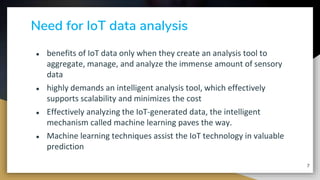
Need for IoT data analysis
● benefits of IoT data only when they create an analysis tool to
aggregate, manage, and analyze the immense amount of sensory
data
● highly demands an intelligent analysis tool, which effectively
supports scalability and minimizes the cost
● Effectively analyzing the IoT-generated data, the intelligent
mechanism called machine learning paves the way.
● Machine learning techniques assist the IoT technology in valuable
prediction
7
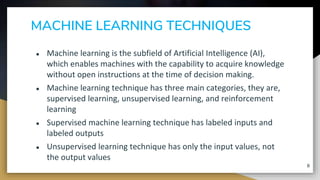
MACHINE LEARNING TECHNIQUES
● Machine learning is the subfield of Artificial Intelligence (AI),
which enables machines with the capability to acquire knowledge
without open instructions at the time of decision making.
● Machine learning technique has three main categories, they are,
supervised learning, unsupervised learning, and reinforcement
learning
● Supervised machine learning technique has labeled inputs and
labeled outputs
● Unsupervised learning technique has only the input values, not
the output values
8
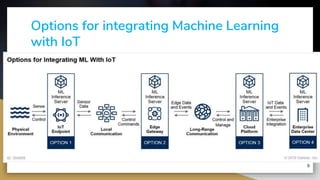
Options for integrating Machine Learning
with IoT
9
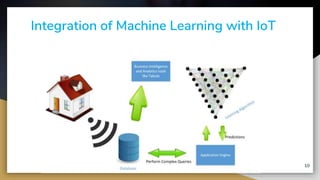
Integration of Machine Learning with IoT
10
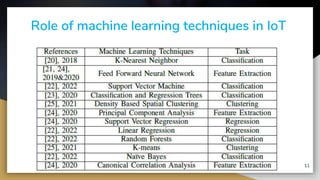
Role of machine learning techniques in IoT
11
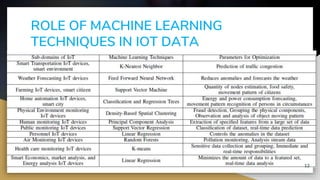
ROLE OF MACHINE LEARNING
TECHNIQUES IN IOT DATA
12
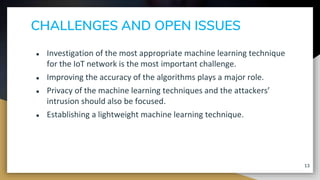
CHALLENGES AND OPEN ISSUES
● Investigation of the most appropriate machine learning technique
for the IoT network is the most important challenge.
● Improving the accuracy of the algorithms plays a major role.
● Privacy of the machine learning techniques and the attackers’
intrusion should also be focused.
● Establishing a lightweight machine learning technique.
13
CONCLUSION
● In order to optimize the applications offered by the IoT, the most
appropriate analysis and predictions have to do over the data
collected and exchanged by these IoT devices.
● Selecting an appropriate algorithm to work on the IoTs’ smart
data is an essential requirement.
● According to the survey done, the machine learning algorithms
work well for the smart data collected by the IoT devices
14
References
1. S. Misra, A. Mondal, and S. Khajjayam, ”Dynamic Big-Data Broadcast in Fat-Tree Data Center Networks With Mobile IoT Devices,” in IEEE Systems
Journal.
2. Serpanos and M. Wolf, ”Challenges and opportunities in VLSI IoT Devices and Systems,” in IEEE Design Test.
3. Prathiba, Sahaya Beni, Gunasekaran Raja, Sudha Anbalagan, K. S. Arikumar, Sugeerthi Gurumoorthy, and Kapal Dev. ”A Hybrid Deep Sensor
Anomaly Detection for Autonomous Vehicles in 6G-V2X Environment.” IEEE Transactions on Network Science and Engineering (2022).
4. Arikumar, K. S., V. Natarajan, and Suresh Chandra Satapathy. ”EELTM: An energy efficient LifeTime maximization approach for WSN by PSO and
fuzzy-based unequal clustering.” Arabian Journal for Science and Engineering 45, no. 12 (2020): 10245-10260.
5. W. Lin, R.W. Ziolkowski and J. Huang, ”Electrically Small, Low Profile, Highly Efficient, Huygens Dipole Rectennas for Wirelessly Powering Internet-
of-Things (IoT) Devices,” in IEEE Transactions on Antennas and Propagation.
6. Ahmed, Waqas, et al. ”Predicting IoT Service Adoption towards Smart Mobility in Malaysia: SEM-Neural Hybrid Pilot Study.” arXiv preprint
arXiv:2002.00152 (2020).
7. Krupitzer, Christian, et al. ”A Survey on Human Machine Interaction in Industry 4.0.” arXiv preprint arXiv:2002.01025 (2020).
8. Jain, Rashmi, and Shweta Chhajed. ”A Survey on Security Mechanism to Embedded Platform Based IOT Devices.” Our Heritage 68.30 (2020): 125-
132.
9. K. Routh and T. Pal, ”A survey on technological, business and societal aspects of Internet of Things by Q3, 2017,” 2018 3rd International Conference
On Internet of Things: Smart Innovation and Usages (IoTSIU), Bhimtal, 2018, pp. 1-4.
10. de Oliveira, Pedro Martins, et al. ”An Innovative Concept of Traceable Device for Monitoring Temperature of Temperature-Sensitive Healthcare
Products.” JOURNAL OF BIOENGINEERING AND TECHNOLOGY APPLIED TO HEALTH 2.4 (2019): 141-146.
15
Thank You
16

Machine Learning in IOT

  • 1.
    The Role ofMachine Learning in IoT: A Survey Presented by Dr.K.S.Arikumar Assistant Professor School of Computer Science & Engineering(SCOPE) VIT-AP University Near Vijayawada - 522 237 Andhra Pradesh.
  • 2.
    Agenda ● Introduction ● Taxonomyof IoT ● Machine Learning techniques ● Machine Learning Techniques: Taxonomy ● Challenges and Open Issues ● Conclusion ● References 2
  • 3.
    Introduction ● CISCO expectthat the quantity of internet-connected devices can reach a maximum of 75.44 billion by 2025 ● Any devices, which are connected to the internet for enabling wired or wireless communication with each other, are said to be IoT devices ● Temperature sensors, pressure sensors, position sensors, vibration sensors, humidity sensors, etc. generate diverse data ● To give better services to the end users, the IoT needs data to be in transmission 3
  • 4.
  • 5.
    Intelligent machine learning ●The IoT data is generated not only from a single IoT device but from various IoT devices combined to generate various data with their own unique features and characteristics to make a system a smart system ● data generated by IoT devices are realtime data, which is encompassed by scalability, and velocity features. Accordingly, developing the appropriate data model to fit the real-time data to generate patterns and for better analysis is the greatest issue 5
  • 6.
  • 7.
    Need for IoTdata analysis ● benefits of IoT data only when they create an analysis tool to aggregate, manage, and analyze the immense amount of sensory data ● highly demands an intelligent analysis tool, which effectively supports scalability and minimizes the cost ● Effectively analyzing the IoT-generated data, the intelligent mechanism called machine learning paves the way. ● Machine learning techniques assist the IoT technology in valuable prediction 7
  • 8.
    MACHINE LEARNING TECHNIQUES ●Machine learning is the subfield of Artificial Intelligence (AI), which enables machines with the capability to acquire knowledge without open instructions at the time of decision making. ● Machine learning technique has three main categories, they are, supervised learning, unsupervised learning, and reinforcement learning ● Supervised machine learning technique has labeled inputs and labeled outputs ● Unsupervised learning technique has only the input values, not the output values 8
  • 9.
    Options for integratingMachine Learning with IoT 9
  • 10.
    Integration of MachineLearning with IoT 10
  • 11.
    Role of machinelearning techniques in IoT 11
  • 12.
    ROLE OF MACHINELEARNING TECHNIQUES IN IOT DATA 12
  • 13.
    CHALLENGES AND OPENISSUES ● Investigation of the most appropriate machine learning technique for the IoT network is the most important challenge. ● Improving the accuracy of the algorithms plays a major role. ● Privacy of the machine learning techniques and the attackers’ intrusion should also be focused. ● Establishing a lightweight machine learning technique. 13
  • 14.
    CONCLUSION ● In orderto optimize the applications offered by the IoT, the most appropriate analysis and predictions have to do over the data collected and exchanged by these IoT devices. ● Selecting an appropriate algorithm to work on the IoTs’ smart data is an essential requirement. ● According to the survey done, the machine learning algorithms work well for the smart data collected by the IoT devices 14
  • 15.
    References 1. S. Misra,A. Mondal, and S. Khajjayam, ”Dynamic Big-Data Broadcast in Fat-Tree Data Center Networks With Mobile IoT Devices,” in IEEE Systems Journal. 2. Serpanos and M. Wolf, ”Challenges and opportunities in VLSI IoT Devices and Systems,” in IEEE Design Test. 3. Prathiba, Sahaya Beni, Gunasekaran Raja, Sudha Anbalagan, K. S. Arikumar, Sugeerthi Gurumoorthy, and Kapal Dev. ”A Hybrid Deep Sensor Anomaly Detection for Autonomous Vehicles in 6G-V2X Environment.” IEEE Transactions on Network Science and Engineering (2022). 4. Arikumar, K. S., V. Natarajan, and Suresh Chandra Satapathy. ”EELTM: An energy efficient LifeTime maximization approach for WSN by PSO and fuzzy-based unequal clustering.” Arabian Journal for Science and Engineering 45, no. 12 (2020): 10245-10260. 5. W. Lin, R.W. Ziolkowski and J. Huang, ”Electrically Small, Low Profile, Highly Efficient, Huygens Dipole Rectennas for Wirelessly Powering Internet- of-Things (IoT) Devices,” in IEEE Transactions on Antennas and Propagation. 6. Ahmed, Waqas, et al. ”Predicting IoT Service Adoption towards Smart Mobility in Malaysia: SEM-Neural Hybrid Pilot Study.” arXiv preprint arXiv:2002.00152 (2020). 7. Krupitzer, Christian, et al. ”A Survey on Human Machine Interaction in Industry 4.0.” arXiv preprint arXiv:2002.01025 (2020). 8. Jain, Rashmi, and Shweta Chhajed. ”A Survey on Security Mechanism to Embedded Platform Based IOT Devices.” Our Heritage 68.30 (2020): 125- 132. 9. K. Routh and T. Pal, ”A survey on technological, business and societal aspects of Internet of Things by Q3, 2017,” 2018 3rd International Conference On Internet of Things: Smart Innovation and Usages (IoTSIU), Bhimtal, 2018, pp. 1-4. 10. de Oliveira, Pedro Martins, et al. ”An Innovative Concept of Traceable Device for Monitoring Temperature of Temperature-Sensitive Healthcare Products.” JOURNAL OF BIOENGINEERING AND TECHNOLOGY APPLIED TO HEALTH 2.4 (2019): 141-146. 15
  • 16.