Presented By
Fahad Farooq
Osama Waheed
Hazma Iltaf
Supervisor: Sir Talal Bin
Afzal
CONTENTS:
Definition of AI
Early History
Types of AI
How AI works
Current status of AI
Challenges for AI
Future of AI
Benefits of AI
Global Risks Of AI
Examples of AI
Conclusion
What is AI:
The concept of what AI is
and what it can do has
changed from time to
time. But the core idea can
be explained as machines
that can think and act like
humans.
AI is a branch of computer
science dealing
with the simulation of the
intelligent
behavior in computers.
EARLY HISTORY:
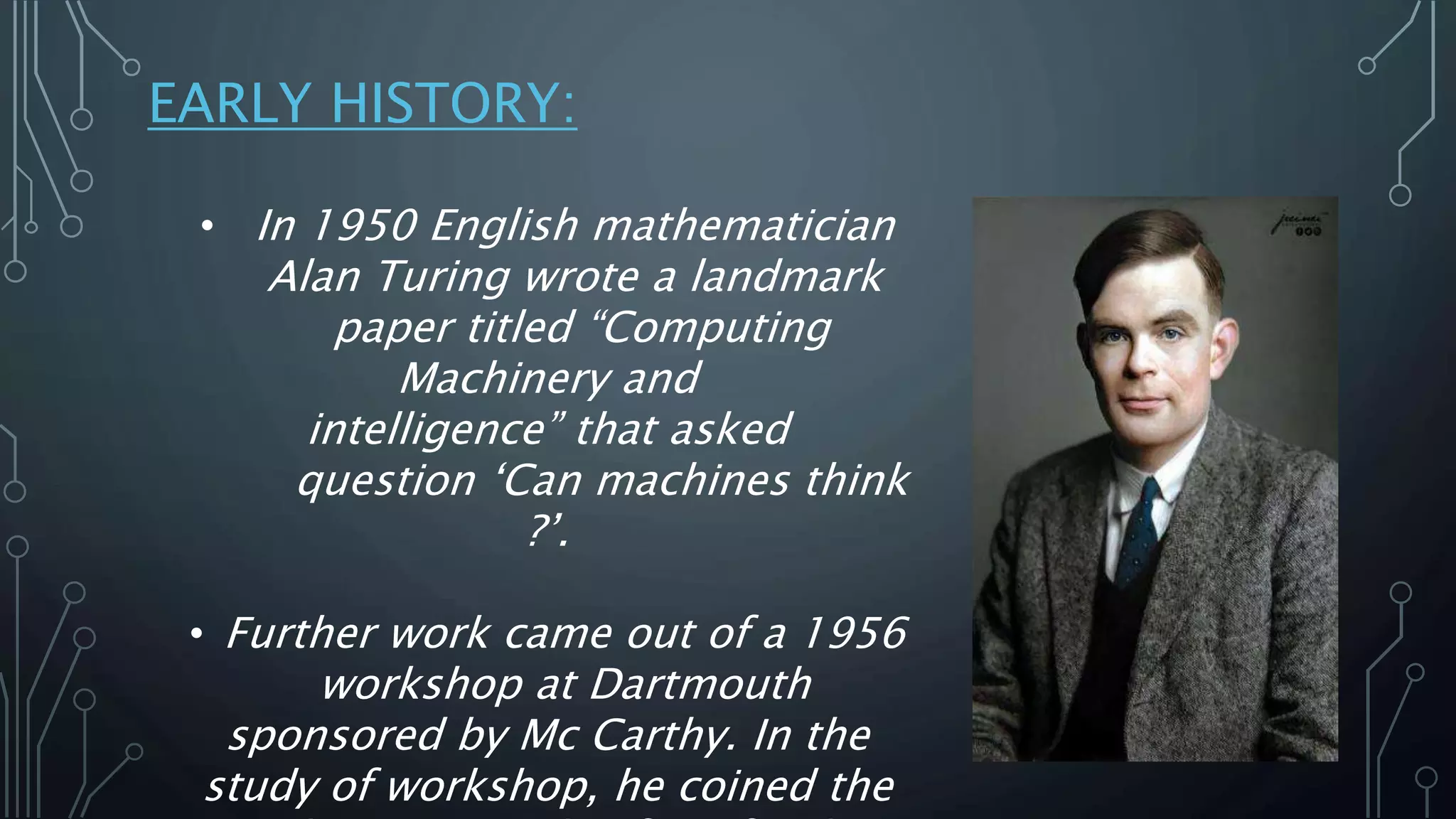
• In 1950 English mathematician
Alan Turing wrote a landmark
paper titled “Computing
Machinery and
intelligence” that asked
question ‘Can machines think
?’.
• Further work came out of a 1956
workshop at Dartmouth
sponsored by Mc Carthy. In the
study of workshop, he coined the
TYPES OF AI:
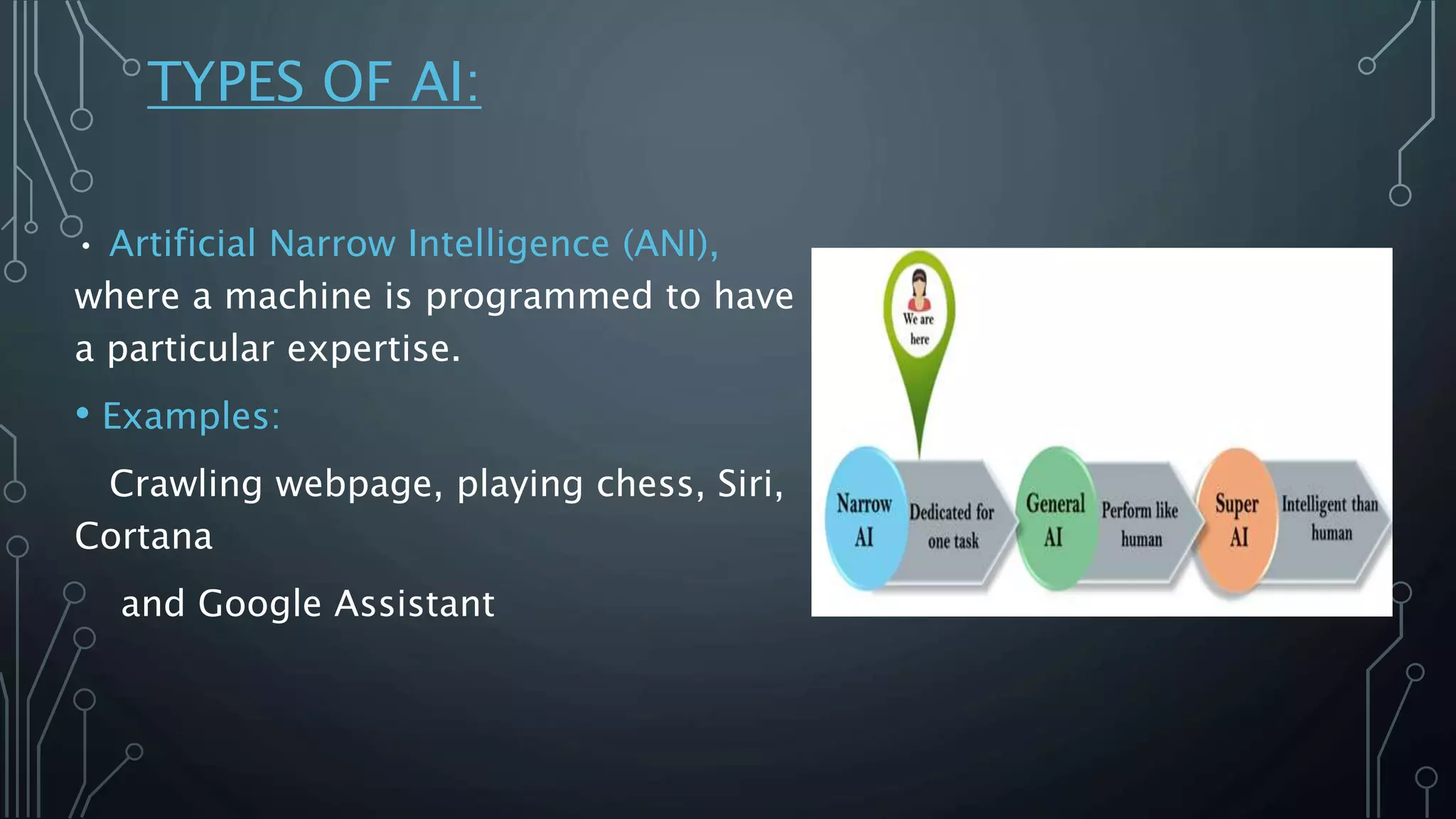
• Artificial Narrow Intelligence (ANI),
where a machine is programmed to have
a particular expertise.
• Examples:
Crawling webpage, playing chess, Siri,
Cortana
and Google Assistant
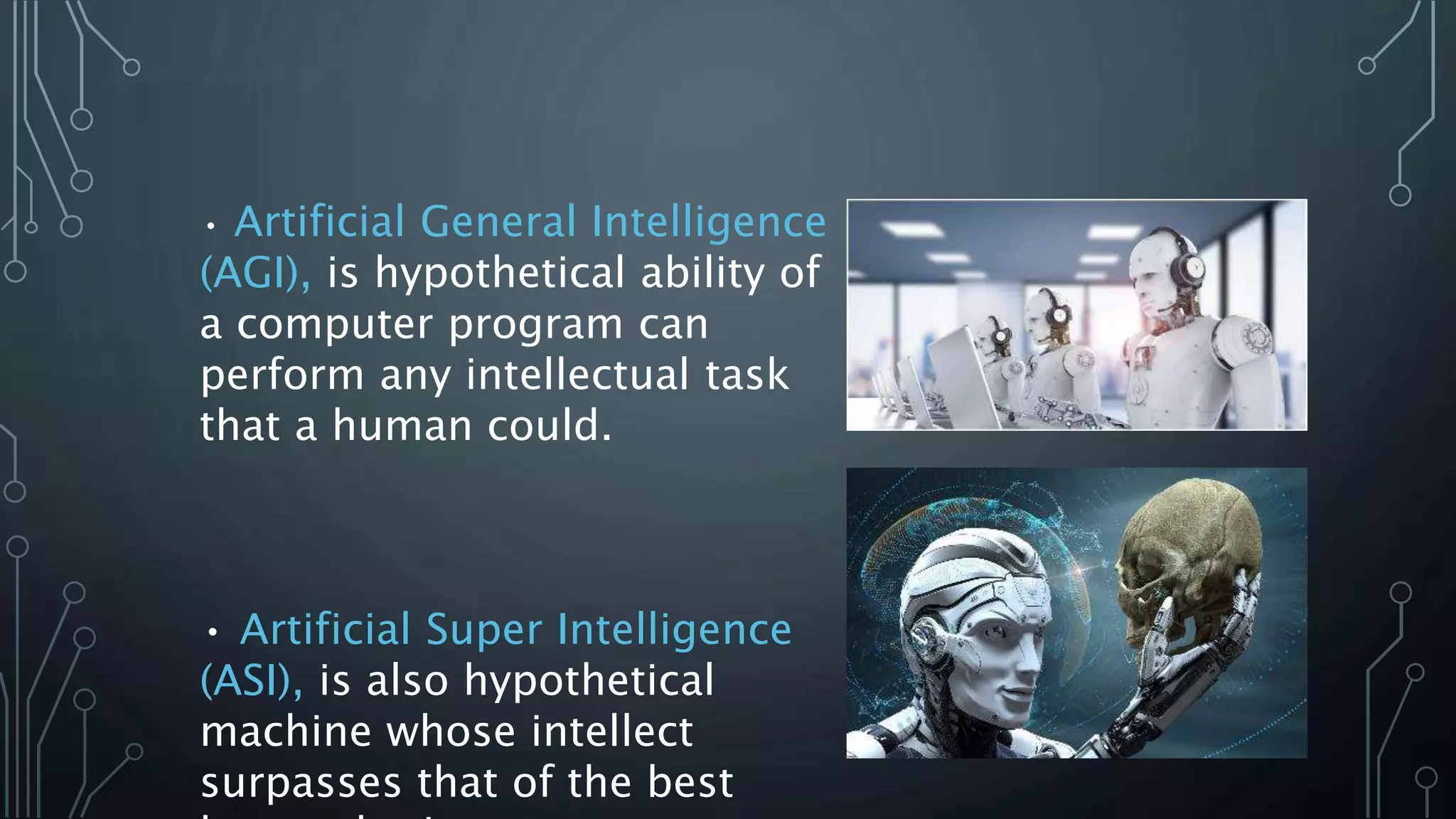
• Artificial General Intelligence
(AGI), is hypothetical ability of
a computer program can
perform any intellectual task
that a human could.
• Artificial Super Intelligence
(ASI), is also hypothetical
machine whose intellect
surpasses that of the best
HOW AI WORKS:
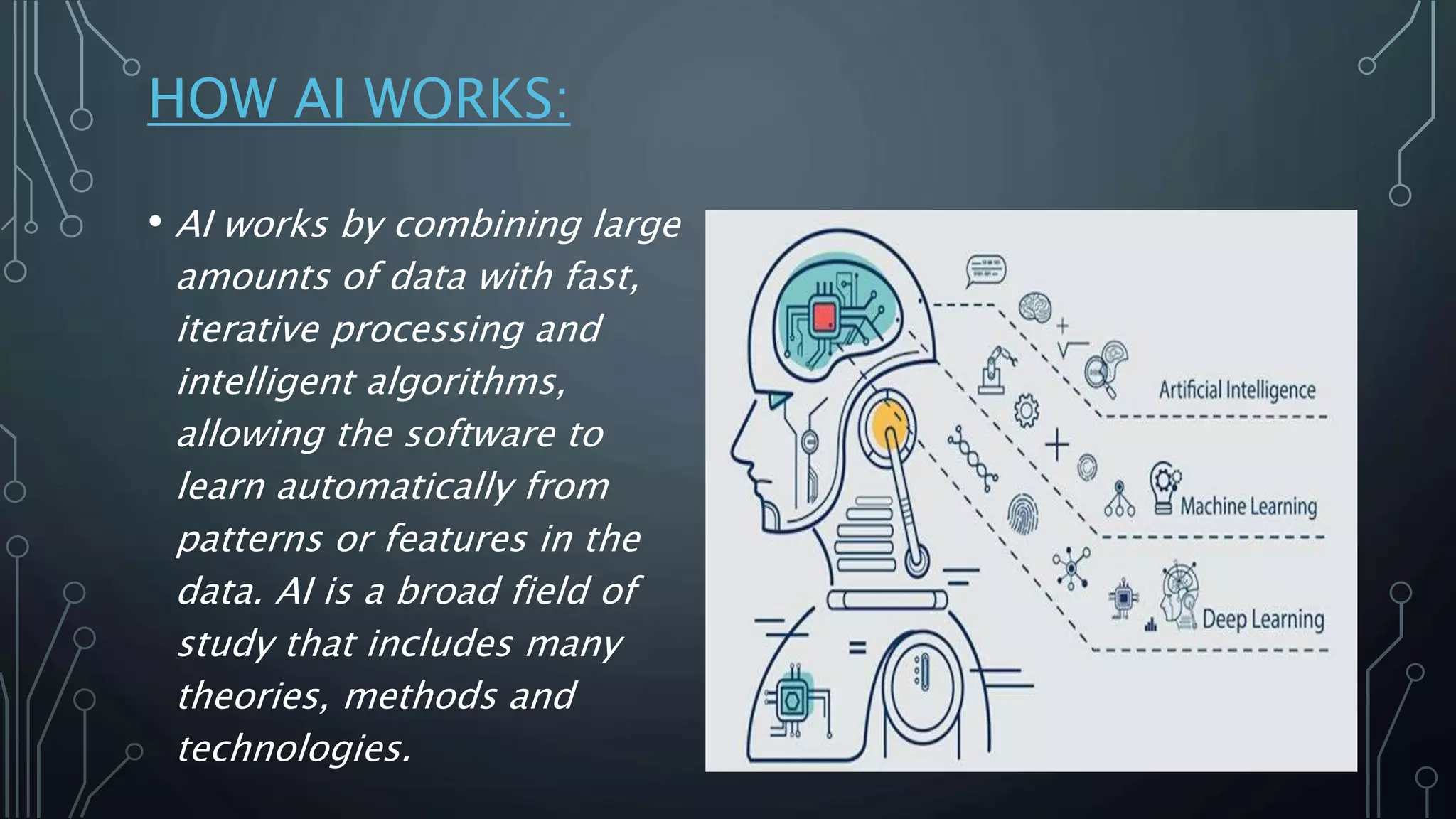
• AI works by combining large
amounts of data with fast,
iterative processing and
intelligent algorithms,
allowing the software to
learn automatically from
patterns or features in the
data. AI is a broad field of
study that includes many
theories, methods and
technologies.
CURRENT STATUS OF AI:
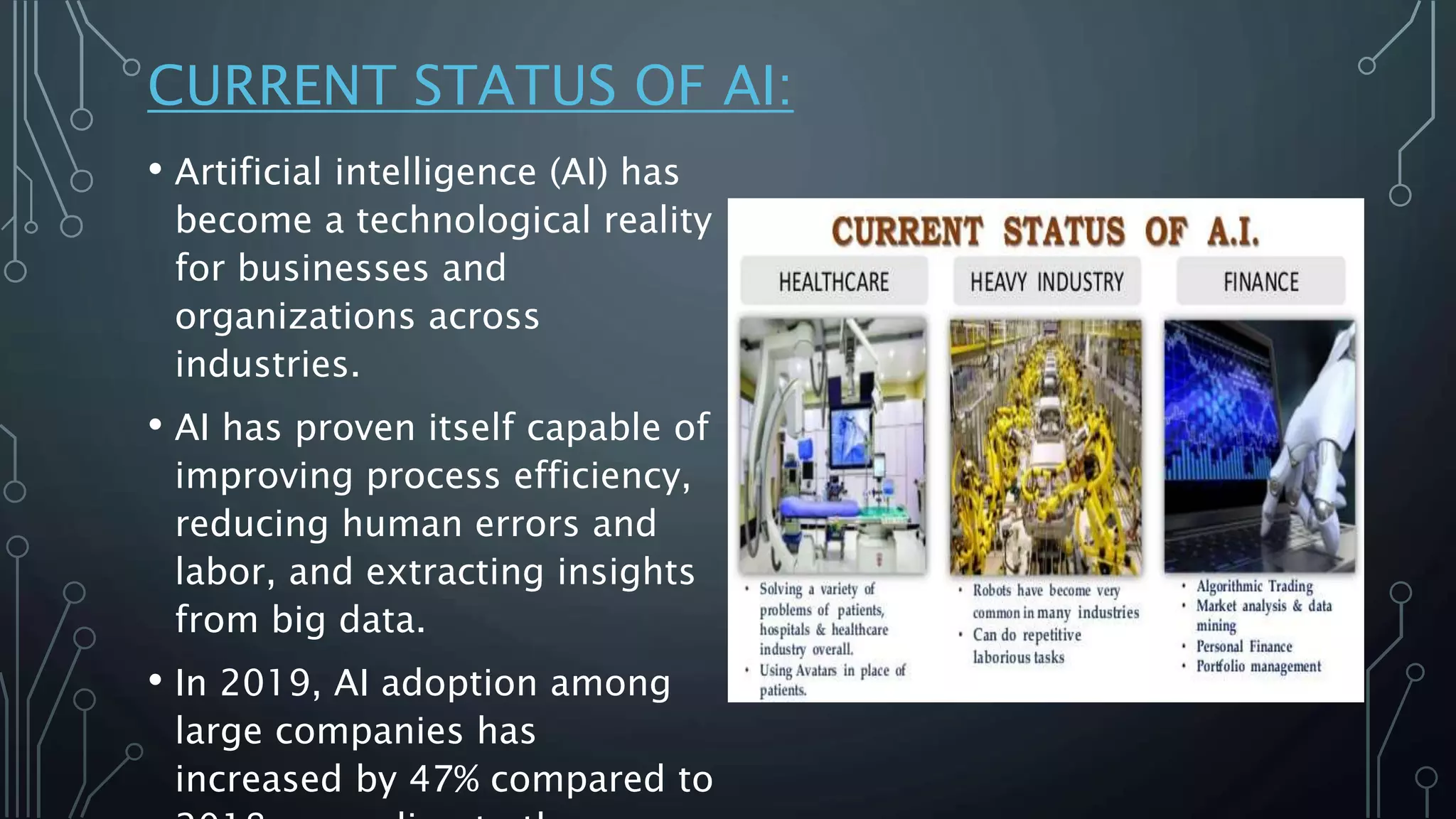
• Artificial intelligence (AI) has
become a technological reality
for businesses and
organizations across
industries.
• AI has proven itself capable of
improving process efficiency,
reducing human errors and
labor, and extracting insights
from big data.
• In 2019, AI adoption among
large companies has
increased by 47% compared to
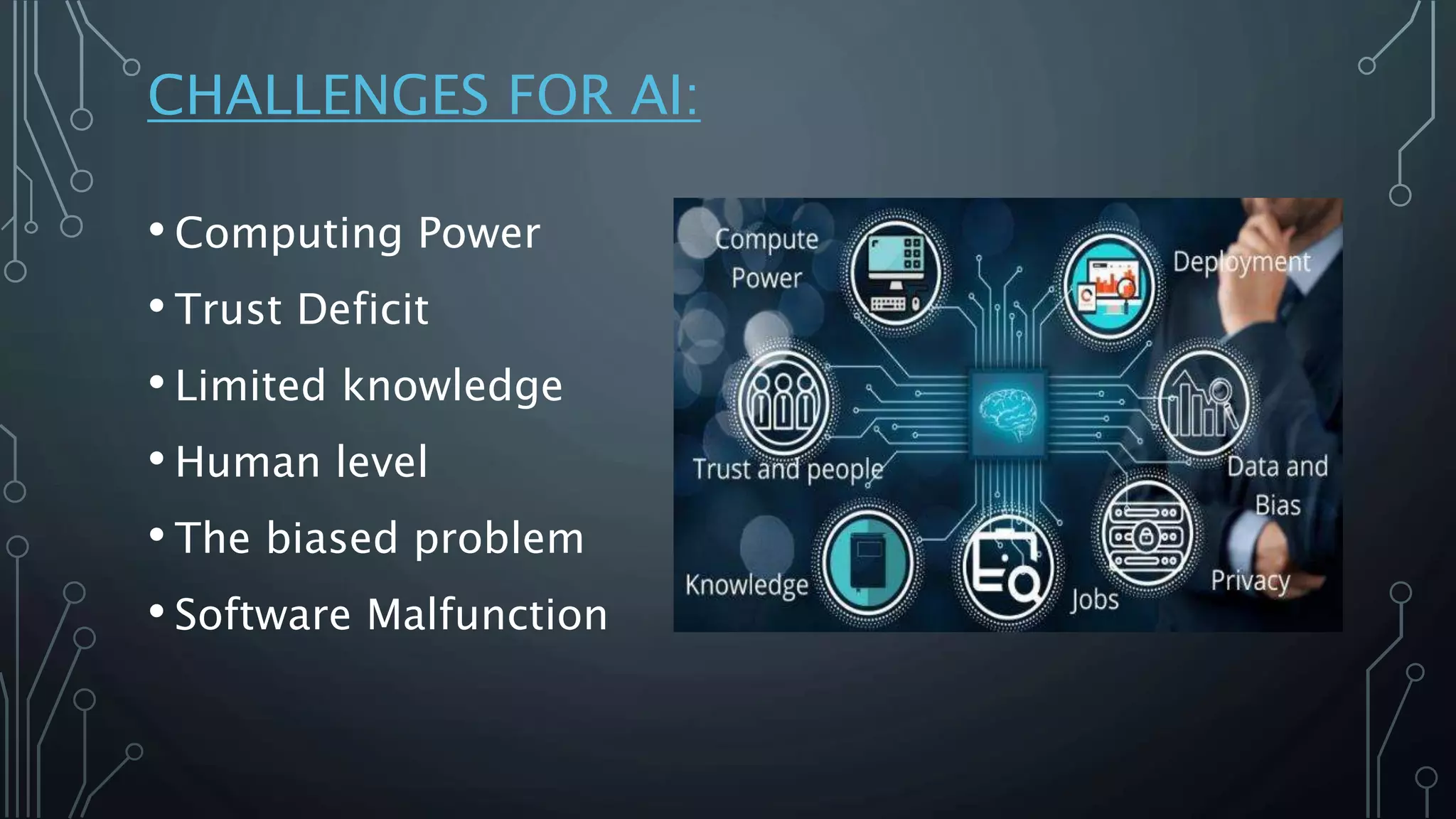
CHALLENGES FOR AI:
• Computing Power
• Trust Deficit
• Limited knowledge
• Human level
• The biased problem
• Software Malfunction
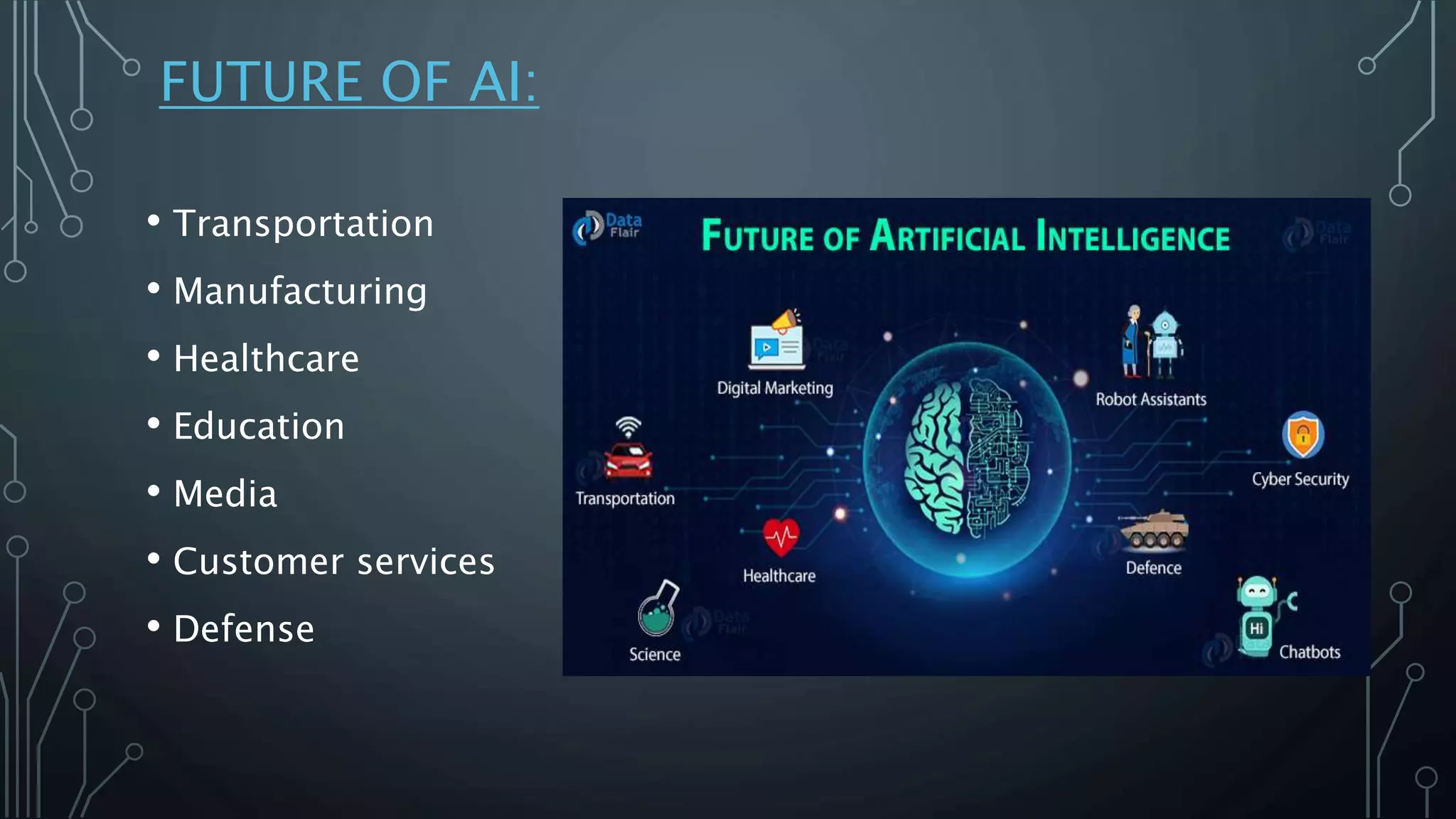
FUTURE OF AI:
• Transportation
• Manufacturing
• Healthcare
• Education
• Media
• Customer services
• Defense
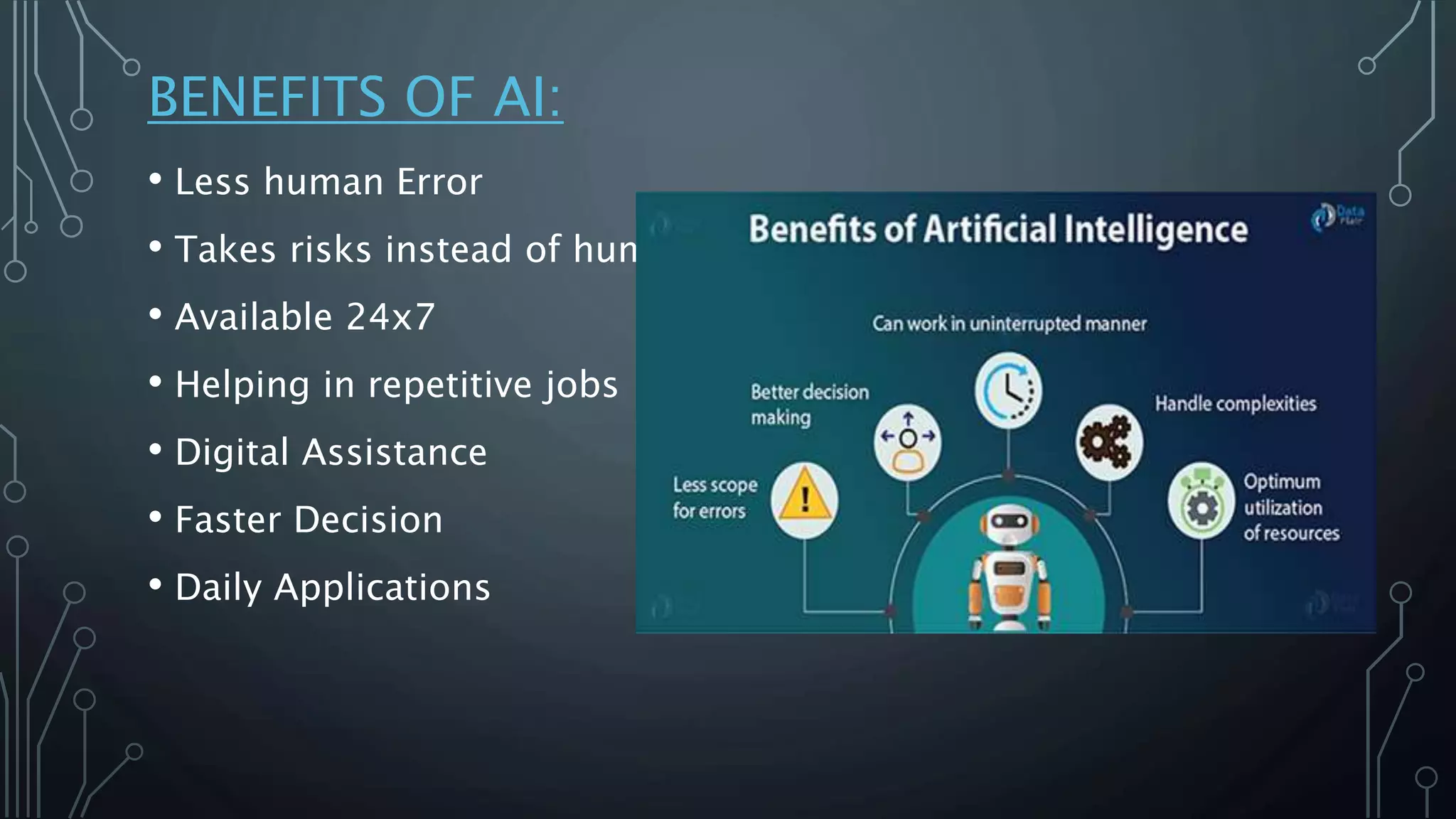
BENEFITS OF AI:
• Less human Error
• Takes risks instead of human
• Available 24x7
• Helping in repetitive jobs
• Digital Assistance
• Faster Decision
• Daily Applications
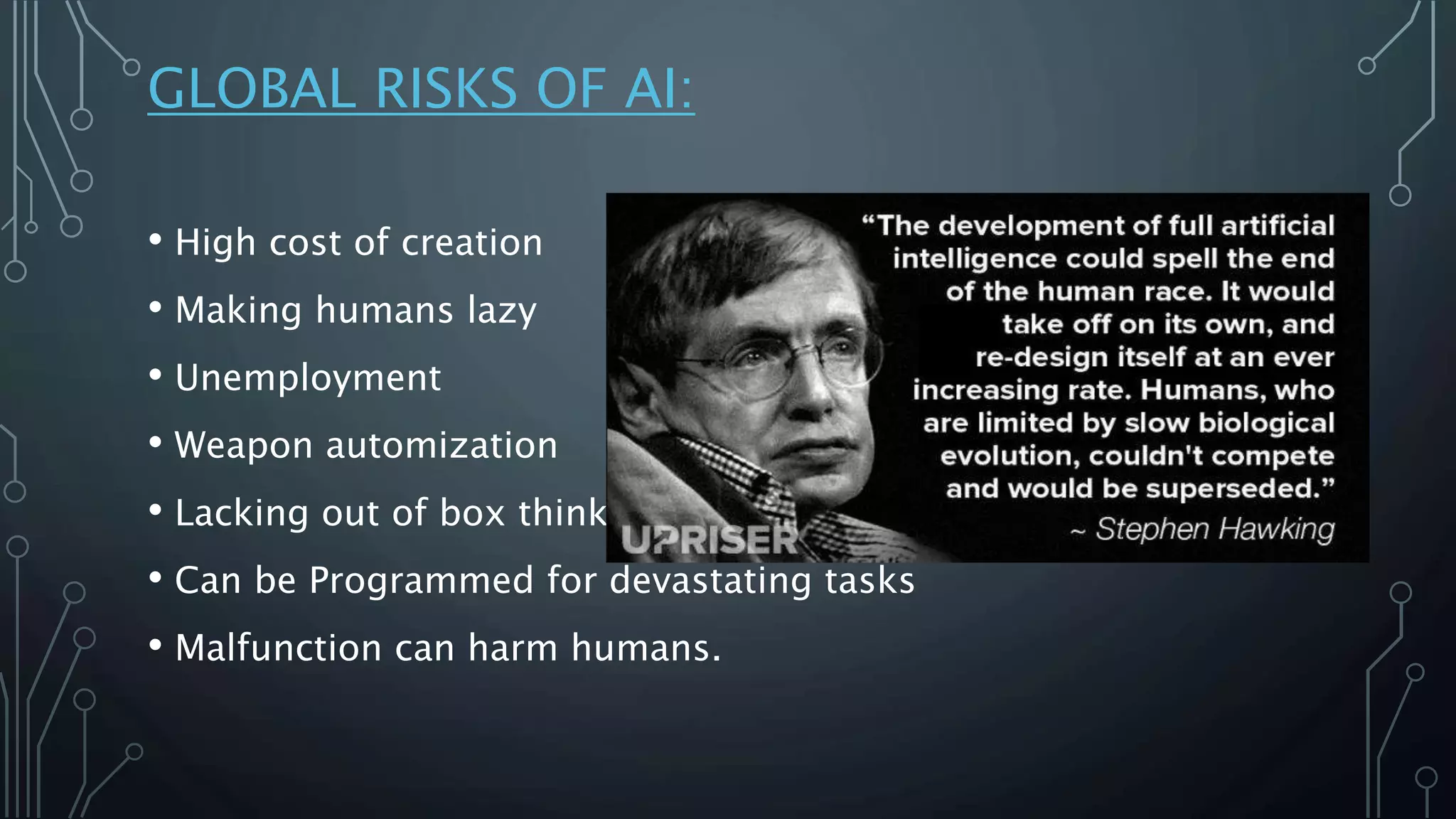
GLOBAL RISKS OF AI:
• High cost of creation
• Making humans lazy
• Unemployment
• Weapon automization
• Lacking out of box thinking
• Can be Programmed for devastating tasks
• Malfunction can harm humans.
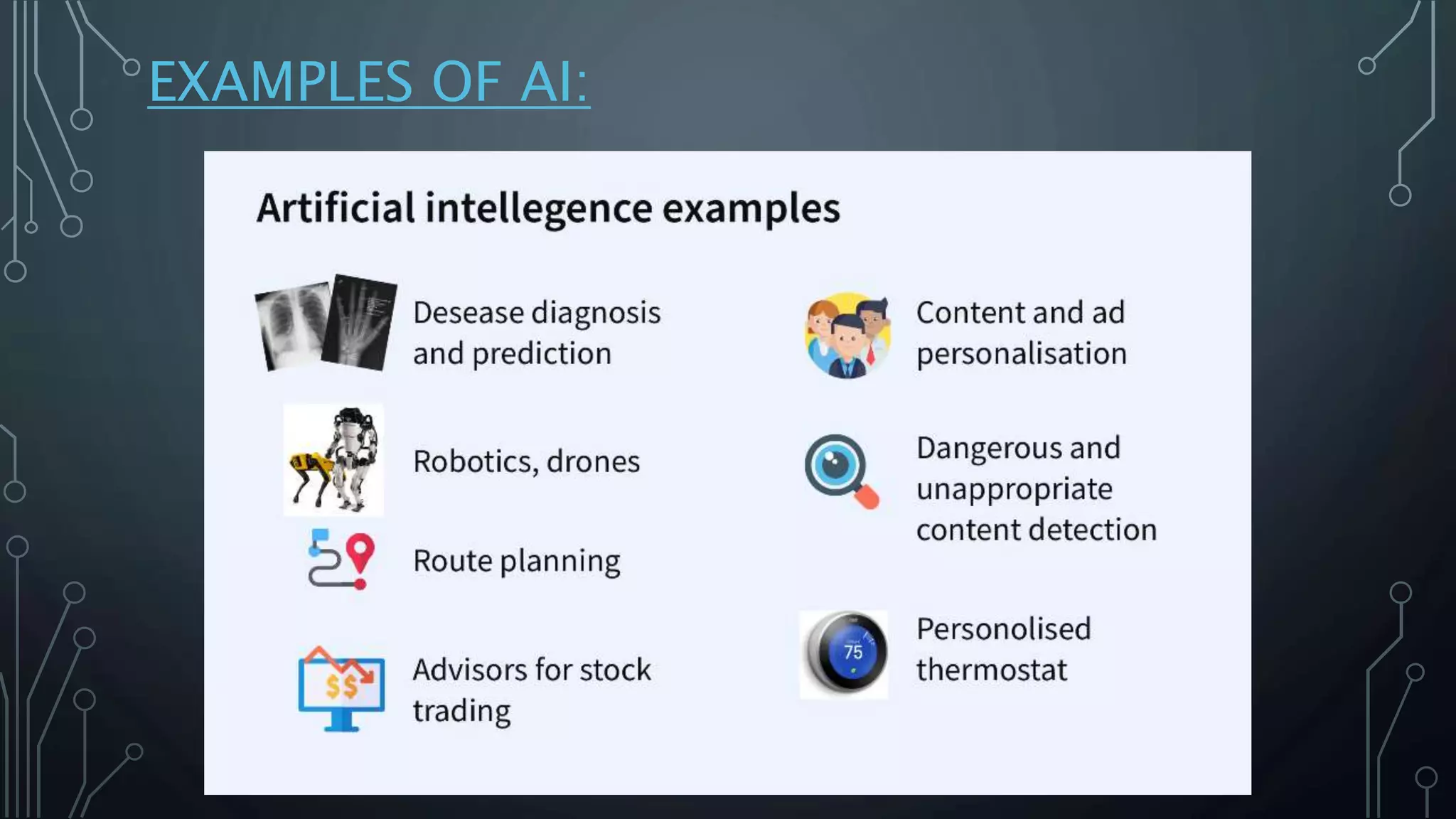
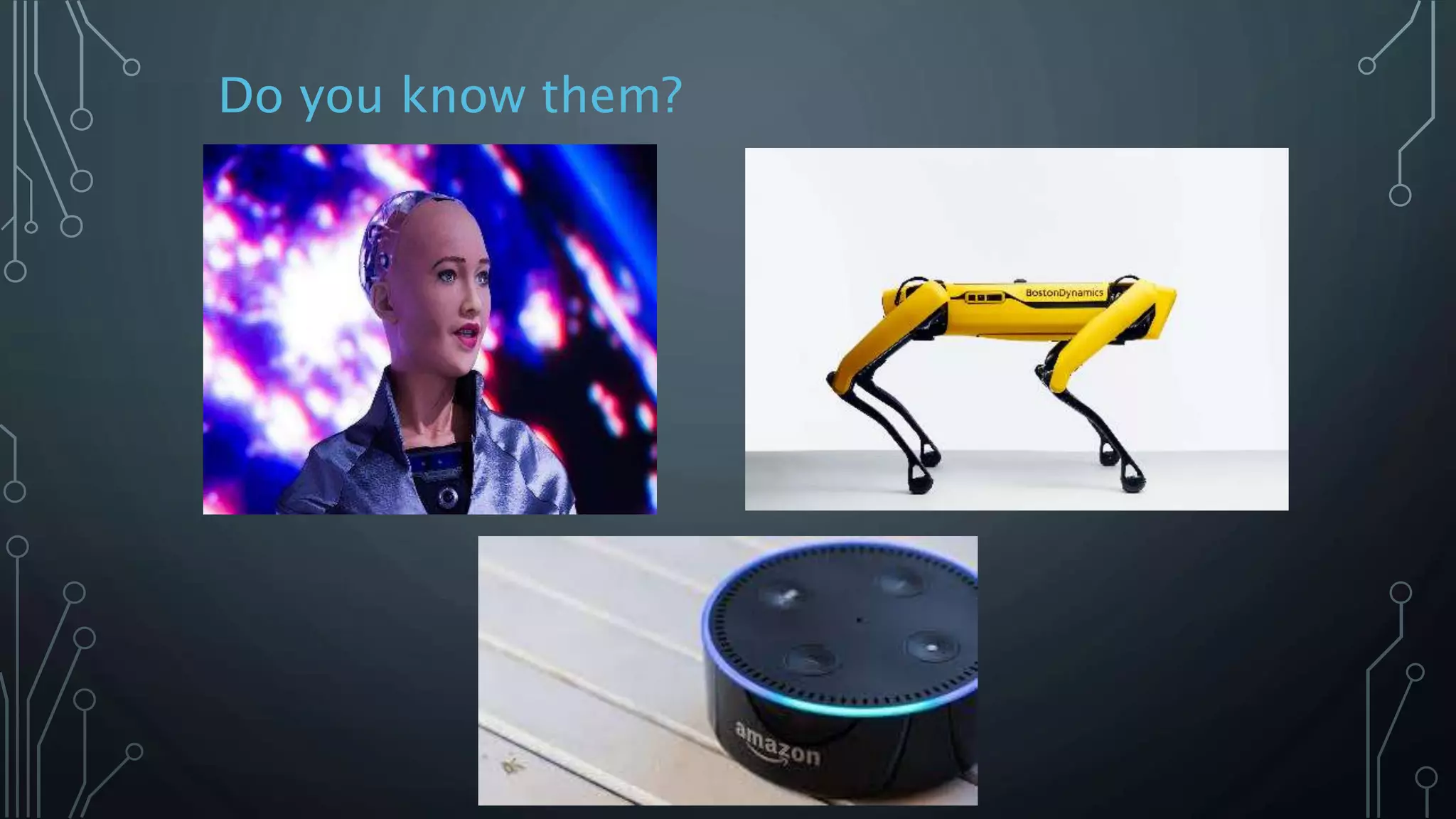
EXAMPLES OF AI:
Do you know them?
CONCLUSION:
• Finally we say that the Artificial
Intelligence is the Intelligence of
machines and the branch of
computer science that aims to
create it. AI textbooks define the
field as “Study and Designs of
Intelligent Agents” where an
intelligent agent is system that
perceives its environment and takes
actions that maximizes the chances
of its success.
• Even after the worries expressed by great
people like Bill Gates, Jeff Bezos, Elon Musk
Various scientists still believe that AI would be
helpful to mankind to a great extent.
•After all it’s a machine so the benefit & risk
depends on how humans use it.
•The way AI is programmed can determine what
effect it would generate on human lives.
Thank

Artificial intelligence (AI)

  • 1.
    Presented By Fahad Farooq OsamaWaheed Hazma Iltaf Supervisor: Sir Talal Bin Afzal
  • 2.
    CONTENTS: Definition of AI EarlyHistory Types of AI How AI works Current status of AI Challenges for AI Future of AI Benefits of AI Global Risks Of AI Examples of AI Conclusion
  • 3.
    What is AI: Theconcept of what AI is and what it can do has changed from time to time. But the core idea can be explained as machines that can think and act like humans. AI is a branch of computer science dealing with the simulation of the intelligent behavior in computers.
  • 4.
    EARLY HISTORY: • In1950 English mathematician Alan Turing wrote a landmark paper titled “Computing Machinery and intelligence” that asked question ‘Can machines think ?’. • Further work came out of a 1956 workshop at Dartmouth sponsored by Mc Carthy. In the study of workshop, he coined the
  • 5.
    TYPES OF AI: •Artificial Narrow Intelligence (ANI), where a machine is programmed to have a particular expertise. • Examples: Crawling webpage, playing chess, Siri, Cortana and Google Assistant
  • 6.
    • Artificial GeneralIntelligence (AGI), is hypothetical ability of a computer program can perform any intellectual task that a human could. • Artificial Super Intelligence (ASI), is also hypothetical machine whose intellect surpasses that of the best
  • 7.
    HOW AI WORKS: •AI works by combining large amounts of data with fast, iterative processing and intelligent algorithms, allowing the software to learn automatically from patterns or features in the data. AI is a broad field of study that includes many theories, methods and technologies.
  • 8.
    CURRENT STATUS OFAI: • Artificial intelligence (AI) has become a technological reality for businesses and organizations across industries. • AI has proven itself capable of improving process efficiency, reducing human errors and labor, and extracting insights from big data. • In 2019, AI adoption among large companies has increased by 47% compared to
  • 9.
    CHALLENGES FOR AI: •Computing Power • Trust Deficit • Limited knowledge • Human level • The biased problem • Software Malfunction
  • 10.
    FUTURE OF AI: •Transportation • Manufacturing • Healthcare • Education • Media • Customer services • Defense
  • 11.
    BENEFITS OF AI: •Less human Error • Takes risks instead of human • Available 24x7 • Helping in repetitive jobs • Digital Assistance • Faster Decision • Daily Applications
  • 12.
    GLOBAL RISKS OFAI: • High cost of creation • Making humans lazy • Unemployment • Weapon automization • Lacking out of box thinking • Can be Programmed for devastating tasks • Malfunction can harm humans.
  • 13.
  • 14.
  • 15.
    CONCLUSION: • Finally wesay that the Artificial Intelligence is the Intelligence of machines and the branch of computer science that aims to create it. AI textbooks define the field as “Study and Designs of Intelligent Agents” where an intelligent agent is system that perceives its environment and takes actions that maximizes the chances of its success.
  • 16.
    • Even afterthe worries expressed by great people like Bill Gates, Jeff Bezos, Elon Musk Various scientists still believe that AI would be helpful to mankind to a great extent. •After all it’s a machine so the benefit & risk depends on how humans use it. •The way AI is programmed can determine what effect it would generate on human lives.
  • 17.

Editor's Notes

  • #8 Deep Learning : Deep Learning ia an ML technique. It teaches a machine to process inputs through layers in order to classify, infer and predict the outcome. Neural Networks : Neural Networks work on the similar principles as of Human Neural cells. They are a series of algorithms that captures the relationship between various underying variabes and processes the data as a human brain does. Natural Language Processingc: NLP is a science of reading, understanding, interpreting a language by a machine. Once a machine understands what the user intends to communicate, it responds accordingly. Computer Vision : Computer vision algorithms tries to understand an image by breaking down an image and studying different parts of the objects. This helps the machine classify and learn from a set of images, to make a better output decision based on previous observations. Cognitive Computing : Cognitive computing algorithms try to mimic a human brain by anaysing text/speech/images/objects in a manner that a human does and tries to give the desired output