
EMBEEDED SYSTEM
Submitted by:
Varun Rawal
Eno:020512801
CONTENTS
• Company Profile.
• Introduction of Embedded Systems
• Application
• What I do??
• Hands on experience with Microcontrollers.
• Hardware Interfacing and coding.
• Software’s used.
• Proteus designs of various hardware interfacings.
• Any Questions ??
COMPANY PROFILE
 Tevatron Technologies is a Design Company focused on VLSI
Design, & Embedded Systems
 Foundation stone of TEVATRON was laid down on 8th December 2008 at
NOIDA
 ANURAG GUPTA and RAJEEV TIWARI, MD’s of our company.
Company Vision:
Tevatron Technologies Vision is to be an end-to-end provider of ESDM (
Electronics Systems Design and Manufacturing)
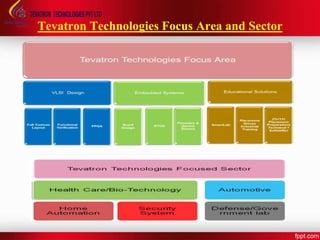
Tevatron Technologies Focus Area and Sector
DEPARTMENT OF EMBEDDED SYSTEM
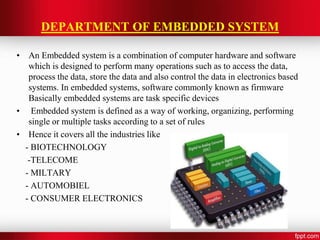
• An Embedded system is a combination of computer hardware and software
which is designed to perform many operations such as to access the data,
process the data, store the data and also control the data in electronics based
systems. In embedded systems, software commonly known as firmware
Basically embedded systems are task specific devices
• Embedded system is defined as a way of working, organizing, performing
single or multiple tasks according to a set of rules
• Hence it covers all the industries like
- BIOTECHNOLOGY
-TELECOME
- MILTARY
- AUTOMOBIEL
- CONSUMER ELECTRONICS
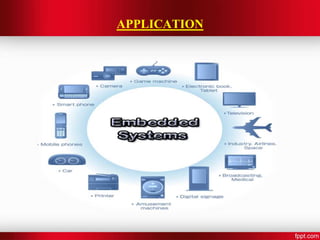
APPLICATION
WHAT I DO.??
 Presentations on Latest Technologies
 Presentations on my Project
 Study lectures by our mentors.
 Programming and hardware interfacing of different modules with atmega8
microcontrollers.
 Idea discussion
 Putting on logic on the programming
ATMEL / AVRFAMILY
 AVR stands for ADVANCED VIRTUAL RISC or Alf and
regard RISC processor.
 The AVR is a modified Harvard architecture 8-bit RISC single-
chip microcontroller, which was developed by Atmel in 1996
 The AVR was one of the first microcontroller families to use on-
chip flash memory for program storage
 AVR’s are best known for ease-of-use,
– low power consumption, and high level of integration
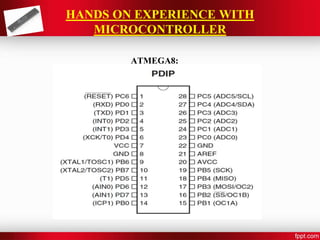
HANDS ON EXPERIENCE WITH
MICROCONTROLLER
ATMEGA8:
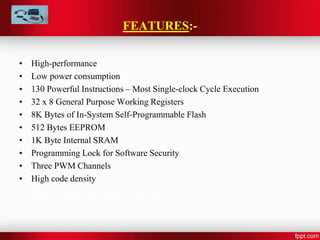
FEATURES:-
• High-performance
• Low power consumption
• 130 Powerful Instructions – Most Single-clock Cycle Execution
• 32 x 8 General Purpose Working Registers
• 8K Bytes of In-System Self-Programmable Flash
• 512 Bytes EEPROM
• 1K Byte Internal SRAM
• Programming Lock for Software Security
• Three PWM Channels
• High code density
• Master/Slave SPI Serial Interface
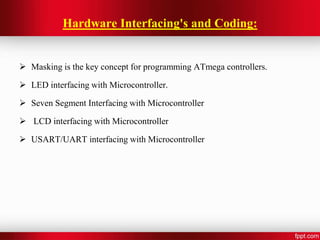
Hardware Interfacing's and Coding:
 Masking is the key concept for programming ATmega controllers.
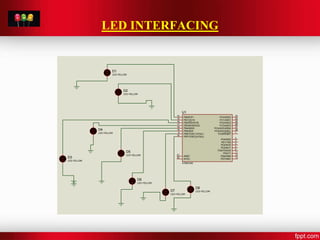
 LED interfacing with Microcontroller.
 Seven Segment Interfacing with Microcontroller
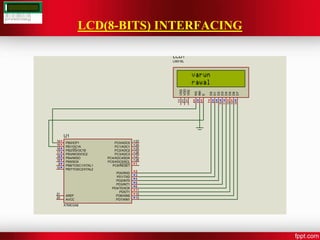
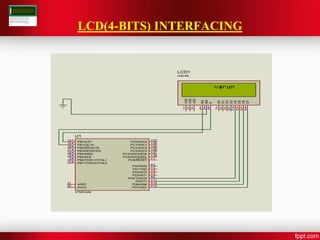
 LCD interfacing with Microcontroller
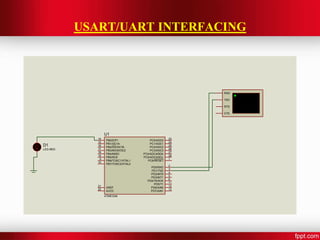
 USART/UART interfacing with Microcontroller
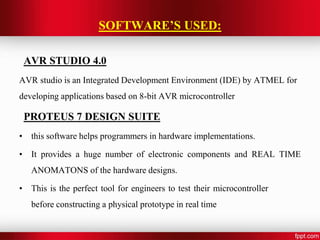
SOFTWARE’S USED:
AVR STUDIO 4.0
AVR studio is an Integrated Development Environment (IDE) by ATMEL for
developing applications based on 8-bit AVR microcontroller
PROTEUS 7 DESIGN SUITE
• this software helps programmers in hardware implementations.
• It provides a huge number of electronic components and REAL TIME
ANOMATONS of the hardware designs.
• This is the perfect tool for engineers to test their microcontrollerr designs
before constructing a physical prototype in real time
LED INTERFACING
PB0/ICP1
14
PB1/OC1A
15
PB2/SS/OC1B
16
PB3/MOSI/OC2
17
PB4/MISO
18
PB5/SCK
19
PB6/TOSC1/XTAL1
9
PB7/TOSC2/XTAL2
10
PC6/RESET
1
PD0/RXD
2
PD1/TXD
3
PD2/INT0
4
PD3/INT1
5
PD4/T0/XCK
6
PD5/T1
11
PD6/AIN0
12
PD7/AIN1
13
PC0/ADC0
23
PC1/ADC1
24
PC2/ADC2
25
PC3/ADC3
26
PC4/ADC4/SDA
27
PC5/ADC5/SCL
28
AREF
21
AVCC
20
U1
ATMEGA8
D1
LED-YELLOW
D2
LED-YELLOW
D4
LED-YELLOW
D5
LED-YELLOW
D6
LED-YELLOW
D7
LED-YELLOW
D8
LED-YELLOW
D3
LED-YELLOW
LCD(8-BITS) INTERFACING
D7
14
D6
13
D5
12
D4
11
D3
10
D2
9
D1
8
D0
7
E
6
RW
5
RS
4
VSS
1
VDD
2
VEE
3
LCD1
LM016L
PB0/ICP1
14
PB1/OC1A
15
PB2/SS/OC1B
16
PB3/MOSI/OC2
17
PB4/MISO
18
PB5/SCK
19
PB6/TOSC1/XTAL1
9
PB7/TOSC2/XTAL2
10
PC6/RESET
1
PD0/RXD
2
PD1/TXD
3
PD2/INT0
4
PD3/INT1
5
PD4/T0/XCK
6
PD5/T1
11
PD6/AIN0
12
PD7/AIN1
13
PC0/ADC0
23
PC1/ADC1
24
PC2/ADC2
25
PC3/ADC3
26
PC4/ADC4/SDA
27
PC5/ADC5/SCL
28
AREF
21
AVCC
20
U1
ATMEGA8
LCD(4-BITS) INTERFACING
PB0/ICP1
14
PB1/OC1A
15
PB2/SS/OC1B
16
PB3/MOSI/OC2
17
PB4/MISO
18
PB5/SCK
19
PB6/TOSC1/XTAL1
9
PB7/TOSC2/XTAL2
10
PC6/RESET
1
PD0/RXD
2
PD1/TXD
3
PD2/INT0
4
PD3/INT1
5
PD4/T0/XCK
6
PD5/T1
11
PD6/AIN0
12
PD7/AIN1
13
PC0/ADC0
23
PC1/ADC1
24
PC2/ADC2
25
PC3/ADC3
26
PC4/ADC4/SDA
27
PC5/ADC5/SCL
28
AREF
21
AVCC
20
U1
ATMEGA8
D7
14
D6
13
D5
12
D4
11
D3
10
D2
9
D1
8
D0
7
E
6
RW
5
RS
4
VSS
1
VDD
2
VEE
3
LCD1
LM016L
USART/UART INTERFACING
RXD
RTS
TXD
CTS
PB0/ICP1
14
PB1/OC1A
15
PB2/SS/OC1B
16
PB3/MOSI/OC2
17
PB4/MISO
18
PB5/SCK
19
PB6/TOSC1/XTAL1
9
PB7/TOSC2/XTAL2
10
PC6/RESET
1
PD0/RXD
2
PD1/TXD
3
PD2/INT0
4
PD3/INT1
5
PD4/T0/XCK
6
PD5/T1
11
PD6/AIN0
12
PD7/AIN1
13
PC0/ADC0
23
PC1/ADC1
24
PC2/ADC2
25
PC3/ADC3
26
PC4/ADC4/SDA
27
PC5/ADC5/SCL
28
AREF
21
AVCC
20
U1
ATMEGA8
D1
LED-RED
Embedded System PPT

Embedded System PPT