EMBEDDED
SYSTEMS
• Textbook:
• T. Bräunl Embedded Robotics, Springer
  2003
Plan of class
• Week 1:
  – Servo programming
  – Evolutionary algorithms
• Week 2:
  – Humanoid Robots
  – Models of robotics
    • Mapping, grammars, automata, probabilistic,
      Braitenberg Vehicles, natural language, logic
      based learning.
What in class?
1.1 Definition
• Definition for: embedded system
• A combination of hardware and software which together
  form a component of a larger machine.

• An example of an embedded system is a microprocessor
  that controls an automobile engine.

• An embedded system is designed to run on its own
  without human intervention, and may be required to
  respond to events in real time.

• Source: www.computeruser.com/resources/dictionary
Applications
  Areas
• TV                Application Areas
• stereo
• remote control
• phone / mobile phone
• refrigerator
• microwave
• washing machine
• electric tooth brush
• oven / rice or bread cooker
• watch
• alarm clock
• electronic musical instruments
• electronic toys (stuffed animals,handheld toys, pinballs, etc.)
• medical home equipment (e.g. blood
pressure, thermometer)
•…
• [PDAs?? More like standard computer system]

Consumer Products
Application Areas
• Medical Systems
   – pace maker, patient monitoring systems, injection systems,
     intensive care units, …
• Office Equipment
   – printer, copier, fax, …
• Tools
   – multimeter, oscilloscope, line tester, GPS, …
• Banking
   – ATMs, statement printers, …
• Transportation
   – (Planes/Trains/[Automobiles] and Boats)
• radar, traffic lights, signalling systems, …
Application Areas
• Automobiles
  – engine management, trip computer, cruise
    control, immobilizer, car alarm,
  – airbag, ABS, ESP, …
• Building Systems
  – elevator, heater, air conditioning, lighting, key
    card entries, locks, alarm systems, …
• Agriculture
  – feeding systems, milking systems, …
• Space
  – satellite systems, …
Application Areas

• Facts:
  – 1997: The average U.S. household has over 10
    embedded computers (source: www.it.dtu.dk/~jan)
• 1998: 90% Embedded Systems vs. 10%
  Computers
  – (source: Frautschi, www.caliberlearning.com)
• 2001: The Volvo S80 has 18 embedded
  controllers and 2 busses (source: Volvo)
Automobiles
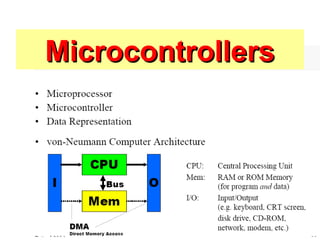
Microcontrollers
Microcontrollers

• Microprocessor
  – CPU (on single chip)
• Microcontroller
• CPU + Timers + I/O (+RAM) (+ROM)
     • Reduced chip count for board design
     • Embedded system
     • Today’s Technology:

        – Surface Mount Device (SMD)
        – Ball Grid Array (BGA)
Input and Output
• Required to communicate with outside world
• PC System:
  –   Keyboard
  –   Monitor
  –   Parallel port (printer port)
  –   Serial port + USB
• Embedded System:
  – Sensors (e.g. in automobile: acceleration sensor, seat
    sensor)
  – Actuators (e.g. in automobile: valves for airbags)
Input and Output
• Input / output device implementation can
  be:
• • Memory-mapped
• • I/O mapped (ports)
• • DMA (direct memory access)
2007.0001 week1 embeddedsystems

2007.0001 week1 embeddedsystems

  • 1.
  • 2.
    • Textbook: • T.Bräunl Embedded Robotics, Springer 2003
  • 3.
    Plan of class •Week 1: – Servo programming – Evolutionary algorithms • Week 2: – Humanoid Robots – Models of robotics • Mapping, grammars, automata, probabilistic, Braitenberg Vehicles, natural language, logic based learning.
  • 4.
  • 6.
    1.1 Definition • Definitionfor: embedded system • A combination of hardware and software which together form a component of a larger machine. • An example of an embedded system is a microprocessor that controls an automobile engine. • An embedded system is designed to run on its own without human intervention, and may be required to respond to events in real time. • Source: www.computeruser.com/resources/dictionary
  • 7.
  • 8.
    • TV Application Areas • stereo • remote control • phone / mobile phone • refrigerator • microwave • washing machine • electric tooth brush • oven / rice or bread cooker • watch • alarm clock • electronic musical instruments • electronic toys (stuffed animals,handheld toys, pinballs, etc.) • medical home equipment (e.g. blood pressure, thermometer) •… • [PDAs?? More like standard computer system] Consumer Products
  • 9.
    Application Areas • MedicalSystems – pace maker, patient monitoring systems, injection systems, intensive care units, … • Office Equipment – printer, copier, fax, … • Tools – multimeter, oscilloscope, line tester, GPS, … • Banking – ATMs, statement printers, … • Transportation – (Planes/Trains/[Automobiles] and Boats) • radar, traffic lights, signalling systems, …
  • 10.
    Application Areas • Automobiles – engine management, trip computer, cruise control, immobilizer, car alarm, – airbag, ABS, ESP, … • Building Systems – elevator, heater, air conditioning, lighting, key card entries, locks, alarm systems, … • Agriculture – feeding systems, milking systems, … • Space – satellite systems, …
  • 11.
    Application Areas • Facts: – 1997: The average U.S. household has over 10 embedded computers (source: www.it.dtu.dk/~jan) • 1998: 90% Embedded Systems vs. 10% Computers – (source: Frautschi, www.caliberlearning.com) • 2001: The Volvo S80 has 18 embedded controllers and 2 busses (source: Volvo)
  • 12.
  • 15.
  • 16.
    Microcontrollers • Microprocessor – CPU (on single chip) • Microcontroller • CPU + Timers + I/O (+RAM) (+ROM) • Reduced chip count for board design • Embedded system • Today’s Technology: – Surface Mount Device (SMD) – Ball Grid Array (BGA)
  • 26.
    Input and Output •Required to communicate with outside world • PC System: – Keyboard – Monitor – Parallel port (printer port) – Serial port + USB • Embedded System: – Sensors (e.g. in automobile: acceleration sensor, seat sensor) – Actuators (e.g. in automobile: valves for airbags)
  • 27.
    Input and Output •Input / output device implementation can be: • • Memory-mapped • • I/O mapped (ports) • • DMA (direct memory access)