http://electro8.in/
Introduction to Embedded Systems
 A combination of hardware and software which together form a

component of a larger machine.
 An embedded system is designed to run on its own without

human intervention, and may be required to respond to events

in real time.
 An embedded system is designed to perform a dedicated

function.
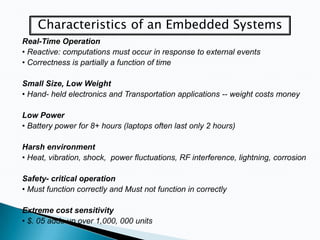
Characteristics of an Embedded Systems
Real-Time Operation
• Reactive: computations must occur in response to external events
• Correctness is partially a function of time

Small Size, Low Weight
• Hand- held electronics and Transportation applications -- weight costs money
Low Power
• Battery power for 8+ hours (laptops often last only 2 hours)
Harsh environment
• Heat, vibration, shock, power fluctuations, RF interference, lightning, corrosion
Safety- critical operation
• Must function correctly and Must not function in correctly
Extreme cost sensitivity
• $. 05 adds up over 1,000, 000 units
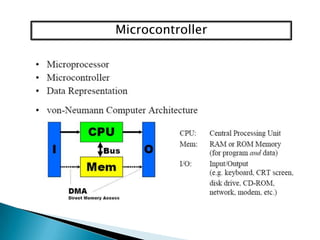
Microcontroller
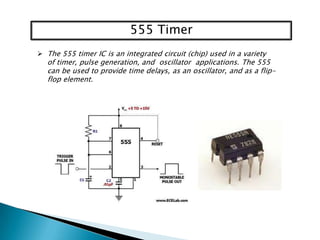
555 Timer
 The 555 timer IC is an integrated circuit (chip) used in a variety

of timer, pulse generation, and oscillator applications. The 555
can be used to provide time delays, as an oscillator, and as a flipflop element.
The wide spectrum of embedded system
devices is that there is no single

definition reflecting them all.


Automotive: Ignition System, Engine Control, Brake System



Industrial Control: Robotics and Control Systems



Networking: Routers, Hubs



Office Automation: Fax Machine, Printers, Scanners
Embedded Systems Design


When approaching embedded systems architecture design, several models

can be applied to describe the cycle of embedded system design.


The big-bang model: there is essentially no planning or processes in place
before and during the development of a system.



The code-and-fix model: product requirements are defined but no formal
processes are in place before the start of development.



The waterfall model: there is a process for developing a system in
steps, where results of one step flow into the next step.



The spiral model: there is a process for developing a system in steps, and
throughout the various steps, feedback is obtained and incorporated back
into the process.


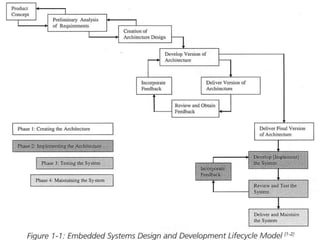
The embedded system design and development process is divided

into four phases: creating the architecture, implementing the
architecture, testing the system, and maintaining the system.



Creating Architecture is defined as being made up of six stages:
◦ having a strong technical foundation (stage 1),
◦ understanding the Architectural Business Cycle (stage 2),
◦ defining the architectural patterns and models (stage 3),

◦ defining the architectural structures (stage 4),
◦ documenting the architecture (stage 5), and
◦ analyzing and reviewing the architecture (stage 6).
The Embedded Systems Model


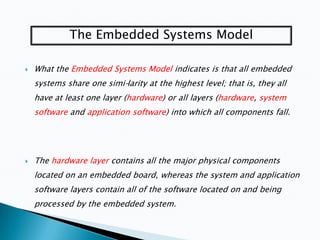
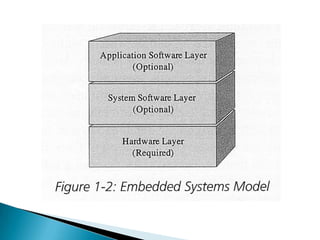
What the Embedded Systems Model indicates is that all embedded

systems share one simi-larity at the highest level; that is, they all
have at least one layer (hardware) or all layers (hardware, system
software and application software) into which all components fall.



The hardware layer contains all the major physical components
located on an embedded board, whereas the system and application

software layers contain all of the software located on and being
processed by the embedded system.
Applications
Areas
Application Areas


Medical Systems

◦ Pace maker, Patient Monitoring Systems, Injection

Systems, Intensive Care Units(ICU), …



Office Equipment



Tools



Banking



Transportation



RADAR, Traffic Lights, Signalling Systems, …

◦ Printer, Copier, Fax, …
◦ Multimeter, Oscilloscope, Line Tester, GPS, …
◦ ATMs, Statement Printers, …
◦ (Planes/Trains/[Automobiles] and Boats)
Application Areas
•
•
•
•
•
•
•
•
•
•
•
•
•
•

TV
Stereo
Remote Control
Phone / Mobile Phone
Refrigerator
Microwave
Washing Machine
Electric Tooth Brush
Oven / Rice or Bread Cooker
Watch
Alarm Clock
Electronic Musical Instruments
Electronic Toys(Stuffed Animals, Handheld Toys, Pinballs, etc.)
Medical Home Equipment (e.g. Blood Pressure, Thermometer)
 An embedded system is an applied computer system.
 “Embedded System", it constantly evolves with advances in

technology and dramatic decreases in the cost of implementing
various hardware and software components.
 Widely used in industries.








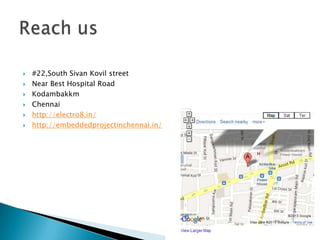
#22,South Sivan Kovil street
Near Best Hospital Road
Kodambakkm
Chennai
http://electro8.in/
http://embeddedprojectinchennai.in/
Embedded Basics

Embedded Basics

  • 1.
  • 2.
    Introduction to EmbeddedSystems  A combination of hardware and software which together form a component of a larger machine.  An embedded system is designed to run on its own without human intervention, and may be required to respond to events in real time.  An embedded system is designed to perform a dedicated function.
  • 3.
    Characteristics of anEmbedded Systems Real-Time Operation • Reactive: computations must occur in response to external events • Correctness is partially a function of time Small Size, Low Weight • Hand- held electronics and Transportation applications -- weight costs money Low Power • Battery power for 8+ hours (laptops often last only 2 hours) Harsh environment • Heat, vibration, shock, power fluctuations, RF interference, lightning, corrosion Safety- critical operation • Must function correctly and Must not function in correctly Extreme cost sensitivity • $. 05 adds up over 1,000, 000 units
  • 4.
  • 7.
    555 Timer  The555 timer IC is an integrated circuit (chip) used in a variety of timer, pulse generation, and oscillator applications. The 555 can be used to provide time delays, as an oscillator, and as a flipflop element.
  • 8.
    The wide spectrumof embedded system devices is that there is no single definition reflecting them all.  Automotive: Ignition System, Engine Control, Brake System  Industrial Control: Robotics and Control Systems  Networking: Routers, Hubs  Office Automation: Fax Machine, Printers, Scanners
  • 9.
    Embedded Systems Design  Whenapproaching embedded systems architecture design, several models can be applied to describe the cycle of embedded system design.  The big-bang model: there is essentially no planning or processes in place before and during the development of a system.  The code-and-fix model: product requirements are defined but no formal processes are in place before the start of development.  The waterfall model: there is a process for developing a system in steps, where results of one step flow into the next step.  The spiral model: there is a process for developing a system in steps, and throughout the various steps, feedback is obtained and incorporated back into the process.
  • 10.
     The embedded systemdesign and development process is divided into four phases: creating the architecture, implementing the architecture, testing the system, and maintaining the system.  Creating Architecture is defined as being made up of six stages: ◦ having a strong technical foundation (stage 1), ◦ understanding the Architectural Business Cycle (stage 2), ◦ defining the architectural patterns and models (stage 3), ◦ defining the architectural structures (stage 4), ◦ documenting the architecture (stage 5), and ◦ analyzing and reviewing the architecture (stage 6).
  • 12.
    The Embedded SystemsModel  What the Embedded Systems Model indicates is that all embedded systems share one simi-larity at the highest level; that is, they all have at least one layer (hardware) or all layers (hardware, system software and application software) into which all components fall.  The hardware layer contains all the major physical components located on an embedded board, whereas the system and application software layers contain all of the software located on and being processed by the embedded system.
  • 14.
  • 15.
    Application Areas  Medical Systems ◦Pace maker, Patient Monitoring Systems, Injection Systems, Intensive Care Units(ICU), …  Office Equipment  Tools  Banking  Transportation  RADAR, Traffic Lights, Signalling Systems, … ◦ Printer, Copier, Fax, … ◦ Multimeter, Oscilloscope, Line Tester, GPS, … ◦ ATMs, Statement Printers, … ◦ (Planes/Trains/[Automobiles] and Boats)
  • 16.
    Application Areas • • • • • • • • • • • • • • TV Stereo Remote Control Phone/ Mobile Phone Refrigerator Microwave Washing Machine Electric Tooth Brush Oven / Rice or Bread Cooker Watch Alarm Clock Electronic Musical Instruments Electronic Toys(Stuffed Animals, Handheld Toys, Pinballs, etc.) Medical Home Equipment (e.g. Blood Pressure, Thermometer)
  • 17.
     An embeddedsystem is an applied computer system.  “Embedded System", it constantly evolves with advances in technology and dramatic decreases in the cost of implementing various hardware and software components.  Widely used in industries.
  • 18.
          #22,South Sivan Kovilstreet Near Best Hospital Road Kodambakkm Chennai http://electro8.in/ http://embeddedprojectinchennai.in/