
TRANSRADIAL ACCESS FOR NON-CORONARY
INTERVENTIONS IN PATIENTS WITH MARKED
HEPATIC DYSFUNCTION
Icahn School of Medicine at Mount Sinai
Division of Interventional Radiology
New York, NY
D . M . B I E D E R M A N , R P O S H A M , V. B I S H AY, R
J . J T I TA N O , R . S . PAT E L , E . K I M , G .
S I VA N A N T H A N , F. S . N O W A K O W S K I , N . E .
TA B O R I , R . A . L O O K S T E I N & A . M . F I S C H M A N
DISCLOSURES
 DM Biederman: Nothing to disclose
 R Posham: Nothing to disclose
 V Bishay: Nothing to disclose
 JJ Titano: Nothing to disclose
 RS Patel: Consultant, Sirtex Medical Ltd Research; Consultant, Arstasis, Inc
 E Kim: Consultant, Koninklijke Philips Electronics NV; Advisory Board, Onyx
Pharmaceuticals; Speaker’s Bureau, BTG International Inc
 FS Nowakowski: Nothing to disclose
 NE Tabori: Nothing to disclose
 RA Lookstein: Consultant, Bayer AG; Consultant, Johnson & Johnson; Consultant,
Boston Scientific Corporation
 AM Fischman: Consultant, Surefire Medical, Inc; Consultant, Terumo Corporation
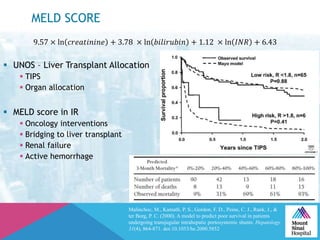
MELD SCORE
Malinchoc, M., Kamath, P. S., Gordon, F. D., Peine, C. J., Rank, J., &
ter Borg, P. C. (2000). A model to predict poor survival in patients
undergoing transjugular intrahepatic portosystemic shunts. Hepatology,
31(4), 864-871. doi:10.1053/he.2000.5852
9.57 × ln 𝑐𝑟𝑒𝑎𝑡𝑖𝑛𝑖𝑛𝑒 + 3.78 × ln 𝑏𝑖𝑙𝑖𝑟𝑢𝑏𝑖𝑛 + 1.12 × ln 𝐼𝑁𝑅 + 6.43
 UNOS – Liver Transplant Allocation
 TIPS
 Organ allocation
 MELD score in IR
 Oncology interventions
 Bridging to liver transplant
 Renal failure
 Active hemorrhage
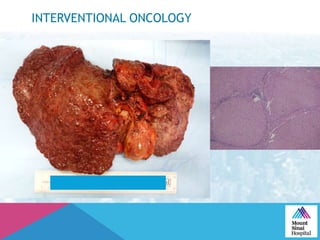
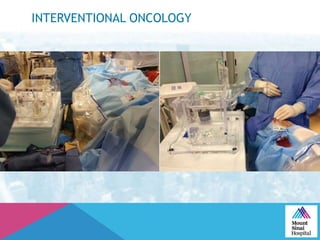
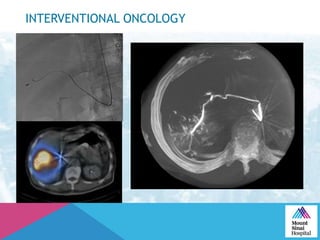
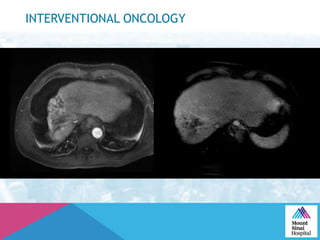
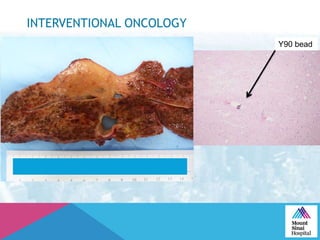
INTERVENTIONAL ONCOLOGY
Y90 bead
PURPOSE
 Review our experience performing non-coronary
interventions using TRA in patients marked hepatic
dysfunction (MELD score ≥ 20).
Technical outcomes
Safety
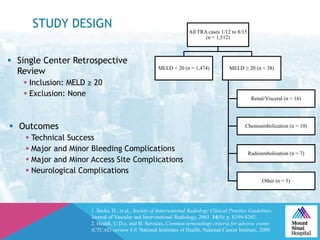
STUDY DESIGN
 Outcomes
 Technical Success
 Major and Minor Bleeding Complications
 Major and Minor Access Site Complications
 Neurological Complications
All TRA cases 1/12 to 8/15
(n = 1,512)
MELD < 20 (n = 1,474) MELD ≥ 20 (n = 38)
Renal/Visceral (n = 16)
Chemoembolization (n = 10)
Radioembolization (n = 7)
Other (n = 5)
1. Sacks, D., et al., Society of Interventional Radiology Clinical Practice Guidelines.
Journal of Vascular and Interventional Radiology, 2003. 14(9): p. S199-S202.
2. Health, U.D.o. and H. Services, Common terminology criteria for adverse events
(CTCAE) version 4.0. National Institutes of Health, National Cancer Institute, 2009.
 Single Center Retrospective
Review
 Inclusion: MELD ≥ 20
 Exclusion: None
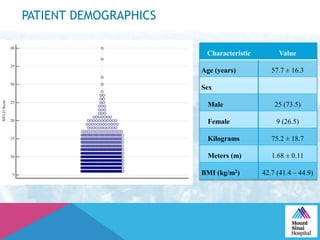
PATIENT DEMOGRAPHICS
Characteristic Value
Age (years) 57.7 ± 16.3
Sex
Male 25 (73.5)
Female 9 (26.5)
Kilograms 75.2 ± 18.7
Meters (m) 1.68 ± 0.11
BMI (kg/m2) 42.7 (41.4 – 44.9)
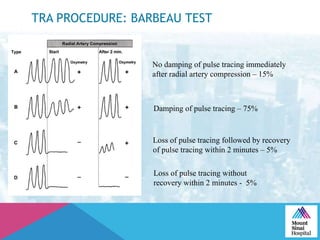
TRA PROCEDURE: BARBEAU TEST
No damping of pulse tracing immediately
after radial artery compression – 15%
Damping of pulse tracing – 75%
Loss of pulse tracing followed by recovery
of pulse tracing within 2 minutes – 5%
Loss of pulse tracing without
recovery within 2 minutes - 5%
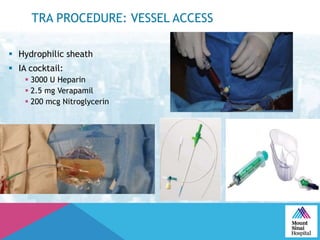
TRA PROCEDURE: VESSEL ACCESS
 Hydrophilic sheath
 IA cocktail:
 3000 U Heparin
 2.5 mg Verapamil
 200 mcg Nitroglycerin
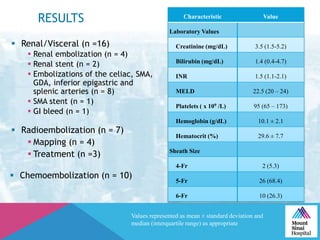
RESULTS Characteristic Value
Laboratory Values
Creatinine (mg/dL) 3.5 (1.5-5.2)
Bilirubin (mg/dL) 1.4 (0.4-4.7)
INR 1.5 (1.1-2.1)
MELD 22.5 (20 – 24)
Platelets ( x 109 /L) 95 (65 – 173)
Hemoglobin (g/dL) 10.1 ± 2.1
Hematocrit (%) 29.6 ± 7.7
Sheath Size
4-Fr 2 (5.3)
5-Fr 26 (68.4)
6-Fr 10 (26.3)
 Renal/Visceral (n =16)
 Renal embolization (n = 4)
 Renal stent (n = 2)
 Embolizations of the celiac, SMA,
GDA, inferior epigastric and
splenic arteries (n = 8)
 SMA stent (n = 1)
 GI bleed (n = 1)
 Radioembolization (n = 7)
 Mapping (n = 4)
 Treatment (n =3)
 Chemoembolization (n = 10)
Values represented as mean ± standard deviation and
median (interquartile range) as appropriate
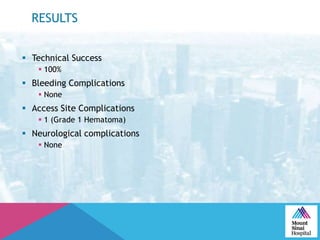
RESULTS
 Technical Success
 100%
 Bleeding Complications
 None
 Access Site Complications
 1 (Grade 1 Hematoma)
 Neurological complications
 None
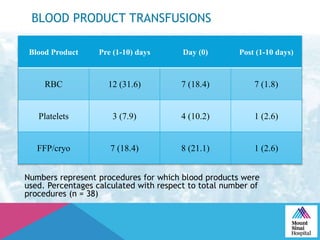
BLOOD PRODUCT TRANSFUSIONS
Blood Product Pre (1-10) days Day (0) Post (1-10 days)
RBC 12 (31.6) 7 (18.4) 7 (1.8)
Platelets 3 (7.9) 4 (10.2) 1 (2.6)
FFP/cryo 7 (18.4) 8 (21.1) 1 (2.6)
Numbers represent procedures for which blood products were
used. Percentages calculated with respect to total number of
procedures (n = 38)
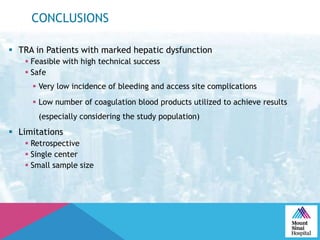
CONCLUSIONS
 TRA in Patients with marked hepatic dysfunction
 Feasible with high technical success
 Safe
 Very low incidence of bleeding and access site complications
 Low number of coagulation blood products utilized to achieve results
(especially considering the study population)
 Limitations
 Retrospective
 Single center
 Small sample size

Biederman D - AIMRADIAL 2015 - Radial access in hepatic dysfunction

  • 1.
    TRANSRADIAL ACCESS FORNON-CORONARY INTERVENTIONS IN PATIENTS WITH MARKED HEPATIC DYSFUNCTION Icahn School of Medicine at Mount Sinai Division of Interventional Radiology New York, NY D . M . B I E D E R M A N , R P O S H A M , V. B I S H AY, R J . J T I TA N O , R . S . PAT E L , E . K I M , G . S I VA N A N T H A N , F. S . N O W A K O W S K I , N . E . TA B O R I , R . A . L O O K S T E I N & A . M . F I S C H M A N
  • 2.
    DISCLOSURES  DM Biederman:Nothing to disclose  R Posham: Nothing to disclose  V Bishay: Nothing to disclose  JJ Titano: Nothing to disclose  RS Patel: Consultant, Sirtex Medical Ltd Research; Consultant, Arstasis, Inc  E Kim: Consultant, Koninklijke Philips Electronics NV; Advisory Board, Onyx Pharmaceuticals; Speaker’s Bureau, BTG International Inc  FS Nowakowski: Nothing to disclose  NE Tabori: Nothing to disclose  RA Lookstein: Consultant, Bayer AG; Consultant, Johnson & Johnson; Consultant, Boston Scientific Corporation  AM Fischman: Consultant, Surefire Medical, Inc; Consultant, Terumo Corporation
  • 3.
    MELD SCORE Malinchoc, M.,Kamath, P. S., Gordon, F. D., Peine, C. J., Rank, J., & ter Borg, P. C. (2000). A model to predict poor survival in patients undergoing transjugular intrahepatic portosystemic shunts. Hepatology, 31(4), 864-871. doi:10.1053/he.2000.5852 9.57 × ln 𝑐𝑟𝑒𝑎𝑡𝑖𝑛𝑖𝑛𝑒 + 3.78 × ln 𝑏𝑖𝑙𝑖𝑟𝑢𝑏𝑖𝑛 + 1.12 × ln 𝐼𝑁𝑅 + 6.43  UNOS – Liver Transplant Allocation  TIPS  Organ allocation  MELD score in IR  Oncology interventions  Bridging to liver transplant  Renal failure  Active hemorrhage
  • 4.
  • 5.
  • 6.
  • 7.
  • 8.
  • 9.
    PURPOSE  Review ourexperience performing non-coronary interventions using TRA in patients marked hepatic dysfunction (MELD score ≥ 20). Technical outcomes Safety
  • 10.
    STUDY DESIGN  Outcomes Technical Success  Major and Minor Bleeding Complications  Major and Minor Access Site Complications  Neurological Complications All TRA cases 1/12 to 8/15 (n = 1,512) MELD < 20 (n = 1,474) MELD ≥ 20 (n = 38) Renal/Visceral (n = 16) Chemoembolization (n = 10) Radioembolization (n = 7) Other (n = 5) 1. Sacks, D., et al., Society of Interventional Radiology Clinical Practice Guidelines. Journal of Vascular and Interventional Radiology, 2003. 14(9): p. S199-S202. 2. Health, U.D.o. and H. Services, Common terminology criteria for adverse events (CTCAE) version 4.0. National Institutes of Health, National Cancer Institute, 2009.  Single Center Retrospective Review  Inclusion: MELD ≥ 20  Exclusion: None
  • 11.
    PATIENT DEMOGRAPHICS Characteristic Value Age(years) 57.7 ± 16.3 Sex Male 25 (73.5) Female 9 (26.5) Kilograms 75.2 ± 18.7 Meters (m) 1.68 ± 0.11 BMI (kg/m2) 42.7 (41.4 – 44.9)
  • 12.
    TRA PROCEDURE: BARBEAUTEST No damping of pulse tracing immediately after radial artery compression – 15% Damping of pulse tracing – 75% Loss of pulse tracing followed by recovery of pulse tracing within 2 minutes – 5% Loss of pulse tracing without recovery within 2 minutes - 5%
  • 13.
    TRA PROCEDURE: VESSELACCESS  Hydrophilic sheath  IA cocktail:  3000 U Heparin  2.5 mg Verapamil  200 mcg Nitroglycerin
  • 14.
    RESULTS Characteristic Value LaboratoryValues Creatinine (mg/dL) 3.5 (1.5-5.2) Bilirubin (mg/dL) 1.4 (0.4-4.7) INR 1.5 (1.1-2.1) MELD 22.5 (20 – 24) Platelets ( x 109 /L) 95 (65 – 173) Hemoglobin (g/dL) 10.1 ± 2.1 Hematocrit (%) 29.6 ± 7.7 Sheath Size 4-Fr 2 (5.3) 5-Fr 26 (68.4) 6-Fr 10 (26.3)  Renal/Visceral (n =16)  Renal embolization (n = 4)  Renal stent (n = 2)  Embolizations of the celiac, SMA, GDA, inferior epigastric and splenic arteries (n = 8)  SMA stent (n = 1)  GI bleed (n = 1)  Radioembolization (n = 7)  Mapping (n = 4)  Treatment (n =3)  Chemoembolization (n = 10) Values represented as mean ± standard deviation and median (interquartile range) as appropriate
  • 15.
    RESULTS  Technical Success 100%  Bleeding Complications  None  Access Site Complications  1 (Grade 1 Hematoma)  Neurological complications  None
  • 16.
    BLOOD PRODUCT TRANSFUSIONS BloodProduct Pre (1-10) days Day (0) Post (1-10 days) RBC 12 (31.6) 7 (18.4) 7 (1.8) Platelets 3 (7.9) 4 (10.2) 1 (2.6) FFP/cryo 7 (18.4) 8 (21.1) 1 (2.6) Numbers represent procedures for which blood products were used. Percentages calculated with respect to total number of procedures (n = 38)
  • 17.
    CONCLUSIONS  TRA inPatients with marked hepatic dysfunction  Feasible with high technical success  Safe  Very low incidence of bleeding and access site complications  Low number of coagulation blood products utilized to achieve results (especially considering the study population)  Limitations  Retrospective  Single center  Small sample size

Editor's Notes

  • #5 Picture of cirrhosis, MELD 21
  • #11 MELD >= 20 *30 days most recent.
  • #16 There was one minor complication (superficial bruising) at 30 days. There were no major complications.
  • #17 There was one minor complication (superficial bruising) at 30 days. There were no major complications.