First Report of the DEFLECT I Trial
A Prospective, Single Arm Feasibility Study to
Evaluate the Safety and Performance of the
KeyStone Heart TriGuardTM Embolic Deflection
Device in Patients Undergoing Transcatheter
Aortic Valve Replacement (TAVR)
Michael Mullen, Andreas Baumbach, Stephanie Meller, Adam
Brickman, Pauliina Margolis, Jan Kovac, David Hildick Smith,
Cody Pietras, Peter Den Heier, Szilard Voros, Alexandra Lansky
I have financial relationships to disclose
Consultant for: Edwards Lifesciences, Nobles
Medical Technology
Research support from: Keystone Medical,
Edwards Lifesciences, Medtronic, Abbott
Vascular, Direct Flow Medical
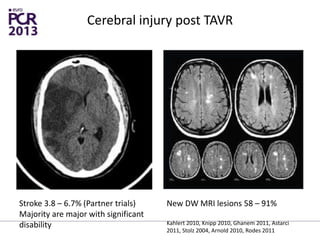
Cerebral injury post TAVR
Stroke 3.8 – 6.7% (Partner trials)
Majority are major with significant
disability
New DW MRI lesions 58 – 91%
Kahlert 2010, Knipp 2010, Ghanem 2011, Astarci
2011, Stolz 2004, Arnold 2010, Rodes 2011
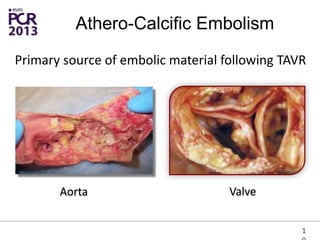
Athero-Calcific Embolism
Primary source of embolic material following TAVR
Aorta Valve
1
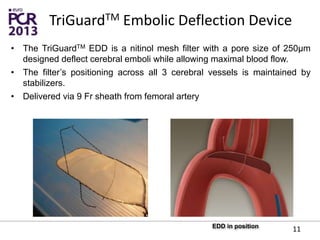
• The TriGuardTM EDD is a nitinol mesh filter with a pore size of 250μm
designed deflect cerebral emboli while allowing maximal blood flow.
• The filter’s positioning across all 3 cerebral vessels is maintained by
stabilizers.
• Delivered via 9 Fr sheath from femoral artery
EDD in position
11
TriGuardTM Embolic Deflection Device
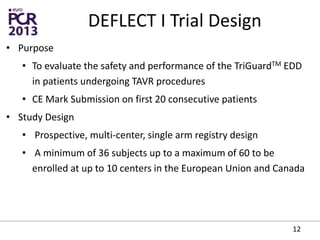
DEFLECT I Trial Design
• Purpose
• To evaluate the safety and performance of the TriGuardTM EDD
in patients undergoing TAVR procedures
• CE Mark Submission on first 20 consecutive patients
• Study Design
• Prospective, multi-center, single arm registry design
• A minimum of 36 subjects up to a maximum of 60 to be
enrolled at up to 10 centers in the European Union and Canada
12
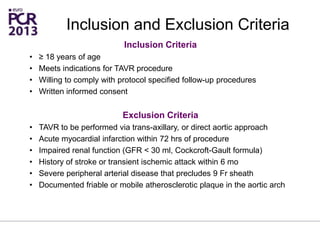
Inclusion Criteria
• ≥ 18 years of age
• Meets indications for TAVR procedure
• Willing to comply with protocol specified follow-up procedures
• Written informed consent
Exclusion Criteria
• TAVR to be performed via trans-axillary, or direct aortic approach
• Acute myocardial infarction within 72 hrs of procedure
• Impaired renal function (GFR < 30 ml, Cockcroft-Gault formula)
• History of stroke or transient ischemic attack within 6 mo
• Severe peripheral arterial disease that precludes 9 Fr sheath
• Documented friable or mobile atherosclerotic plaque in the aortic arch
Inclusion and Exclusion Criteria
14
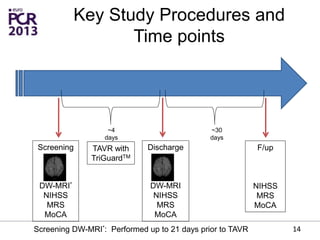
Key Study Procedures and
Time points
~4
days
TAVR with
TriGuardTM
F/up
NIHSS
MRS
MoCA
~30
days
Screening DW-MRI*: Performed up to 21 days prior to TAVR
Screening
DW-MRI*
NIHSS
MRS
MoCA
Discharge
DW-MRI
NIHSS
MRS
MoCA
DEFLECT I Trial Design
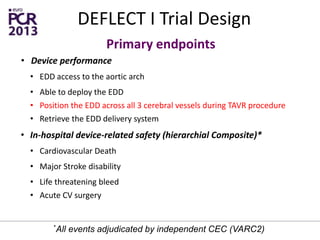
Primary endpoints
• Device performance
• EDD access to the aortic arch
• Able to deploy the EDD
• Position the EDD across all 3 cerebral vessels during TAVR procedure
• Retrieve the EDD delivery system
• In-hospital device-related safety (hierarchial Composite)*
• Cardiovascular Death
• Major Stroke disability
• Life threatening bleed
• Acute CV surgery
*All events adjudicated by independent CEC (VARC2)
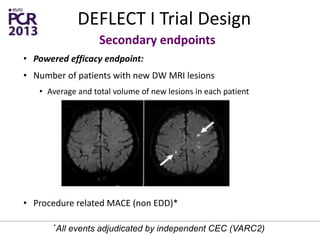
DEFLECT I Trial Design
Secondary endpoints
• Powered efficacy endpoint:
• Number of patients with new DW MRI lesions
• Average and total volume of new lesions in each patient
• Procedure related MACE (non EDD)*
*All events adjudicated by independent CEC (VARC2)
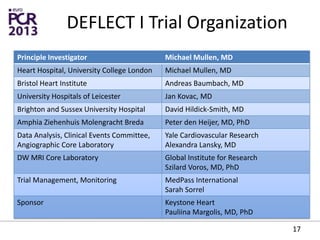
DEFLECT I Trial Organization
17
Principle Investigator Michael Mullen, MD
Heart Hospital, University College London Michael Mullen, MD
Bristol Heart Institute Andreas Baumbach, MD
University Hospitals of Leicester Jan Kovac, MD
Brighton and Sussex University Hospital David Hildick-Smith, MD
Amphia Ziehenhuis Molengracht Breda Peter den Heijer, MD, PhD
Data Analysis, Clinical Events Committee,
Angiographic Core Laboratory
Yale Cardiovascular Research
Alexandra Lansky, MD
DW MRI Core Laboratory Global Institute for Research
Szilard Voros, MD, PhD
Trial Management, Monitoring MedPass International
Sarah Sorrel
Sponsor Keystone Heart
Pauliina Margolis, MD, PhD
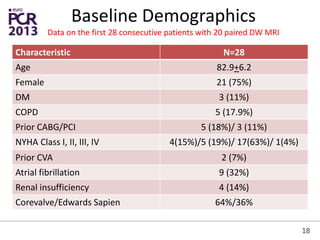
Baseline Demographics
Data on the first 28 consecutive patients with 20 paired DW MRI
Characteristic N=28
Age 82.9+6.2
Female 21 (75%)
DM 3 (11%)
COPD 5 (17.9%)
Prior CABG/PCI 5 (18%)/ 3 (11%)
NYHA Class I, II, III, IV 4(15%)/5 (19%)/ 17(63%)/ 1(4%)
Prior CVA 2 (7%)
Atrial fibrillation 9 (32%)
Renal insufficiency 4 (14%)
Corevalve/Edwards Sapien 64%/36%
18
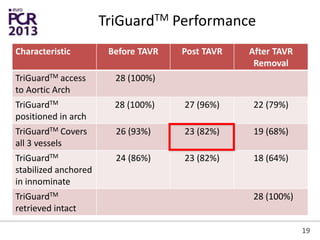
TriGuardTM Performance
Characteristic Before TAVR Post TAVR After TAVR
Removal
TriGuardTM access
to Aortic Arch
28 (100%)
TriGuardTM
positioned in arch
28 (100%) 27 (96%) 22 (79%)
TriGuardTM Covers
all 3 vessels
26 (93%) 23 (82%) 19 (68%)
TriGuardTM
stabilized anchored
in innominate
24 (86%) 23 (82%) 18 (64%)
TriGuardTM
retrieved intact
28 (100%)
19
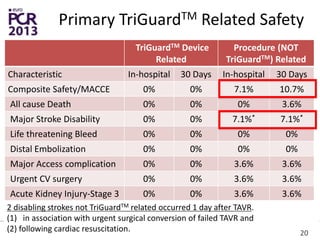
Primary TriGuardTM Related Safety
TriGuardTM Device
Related
Procedure (NOT
TriGuardTM) Related
Characteristic In-hospital 30 Days In-hospital 30 Days
Composite Safety/MACCE 0% 0% 7.1% 10.7%
All cause Death 0% 0% 0% 3.6%
Major Stroke Disability 0% 0% 7.1%* 7.1%*
Life threatening Bleed 0% 0% 0% 0%
Distal Embolization 0% 0% 0% 0%
Major Access complication 0% 0% 3.6% 3.6%
Urgent CV surgery 0% 0% 3.6% 3.6%
Acute Kidney Injury-Stage 3 0% 0% 3.6% 3.6%
2 disabling strokes not TriGuardTM related occurred 1 day after TAVR.
(1) in association with urgent surgical conversion of failed TAVR and
(2) following cardiac resuscitation. 20
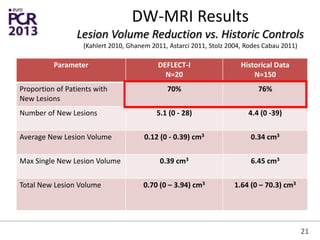
DW-MRI Results
Lesion Volume Reduction vs. Historic Controls
(Kahlert 2010, Ghanem 2011, Astarci 2011, Stolz 2004, Rodes Cabau 2011)
Parameter DEFLECT-I
N=20
Historical Data
N=150
Proportion of Patients with
New Lesions
70% 76%
Number of New Lesions 5.1 (0 - 28) 4.4 (0 -39)
Average New Lesion Volume 0.12 (0 - 0.39) cm3 0.34 cm3
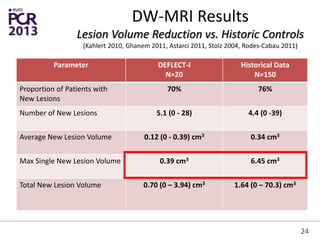
Max Single New Lesion Volume 0.39 cm3 6.45 cm3
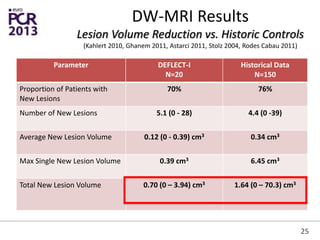
Total New Lesion Volume 0.70 (0 – 3.94) cm3 1.64 (0 – 70.3) cm3
21
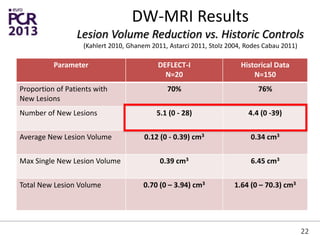
DW-MRI Results
Lesion Volume Reduction vs. Historic Controls
(Kahlert 2010, Ghanem 2011, Astarci 2011, Stolz 2004, Rodes Cabau 2011)
Parameter DEFLECT-I
N=20
Historical Data
N=150
Proportion of Patients with
New Lesions
70% 76%
Number of New Lesions 5.1 (0 - 28) 4.4 (0 -39)
Average New Lesion Volume 0.12 (0 - 0.39) cm3 0.34 cm3
Max Single New Lesion Volume 0.39 cm3 6.45 cm3
Total New Lesion Volume 0.70 (0 – 3.94) cm3 1.64 (0 – 70.3) cm3
22
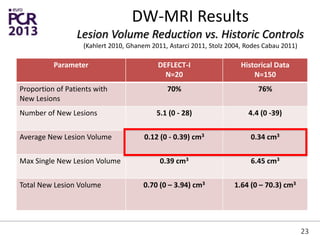
DW-MRI Results
Lesion Volume Reduction vs. Historic Controls
(Kahlert 2010, Ghanem 2011, Astarci 2011, Stolz 2004, Rodes Cabau 2011)
Parameter DEFLECT-I
N=20
Historical Data
N=150
Proportion of Patients with
New Lesions
70% 76%
Number of New Lesions 5.1 (0 - 28) 4.4 (0 -39)
Average New Lesion Volume 0.12 (0 - 0.39) cm3 0.34 cm3
Max Single New Lesion Volume 0.39 cm3 6.45 cm3
Total New Lesion Volume 0.70 (0 – 3.94) cm3 1.64 (0 – 70.3) cm3
23
DW-MRI Results
Lesion Volume Reduction vs. Historic Controls
(Kahlert 2010, Ghanem 2011, Astarci 2011, Stolz 2004, Rodes-Cabau 2011)
Parameter DEFLECT-I
N=20
Historical Data
N=150
Proportion of Patients with
New Lesions
70% 76%
Number of New Lesions 5.1 (0 - 28) 4.4 (0 -39)
Average New Lesion Volume 0.12 (0 - 0.39) cm3 0.34 cm3
Max Single New Lesion Volume 0.39 cm3 6.45 cm3
Total New Lesion Volume 0.70 (0 – 3.94) cm3 1.64 (0 – 70.3) cm3
24
DW-MRI Results
Lesion Volume Reduction vs. Historic Controls
(Kahlert 2010, Ghanem 2011, Astarci 2011, Stolz 2004, Rodes Cabau 2011)
Parameter DEFLECT-I
N=20
Historical Data
N=150
Proportion of Patients with
New Lesions
70% 76%
Number of New Lesions 5.1 (0 - 28) 4.4 (0 -39)
Average New Lesion Volume 0.12 (0 - 0.39) cm3 0.34 cm3
Max Single New Lesion Volume 0.39 cm3 6.45 cm3
Total New Lesion Volume 0.70 (0 – 3.94) cm3 1.64 (0 – 70.3) cm3
25
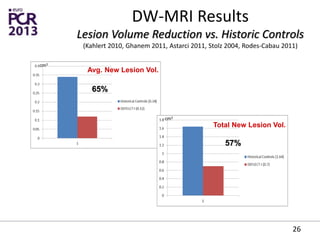
26
cm3
Avg. New Lesion Vol.
65%
Total New Lesion Vol.
57%
cm3
DW-MRI Results
Lesion Volume Reduction vs. Historic Controls
(Kahlert 2010, Ghanem 2011, Astarci 2011, Stolz 2004, Rodes-Cabau 2011)
Conclusions
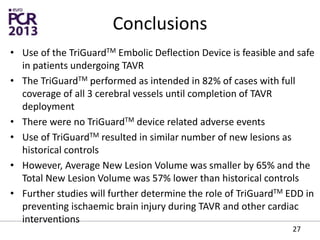
• Use of the TriGuardTM Embolic Deflection Device is feasible and safe
in patients undergoing TAVR
• The TriGuardTM performed as intended in 82% of cases with full
coverage of all 3 cerebral vessels until completion of TAVR
deployment
• There were no TriGuardTM device related adverse events
• Use of TriGuardTM resulted in similar number of new lesions as
historical controls
• However, Average New Lesion Volume was smaller by 65% and the
Total New Lesion Volume was 57% lower than historical controls
• Further studies will further determine the role of TriGuardTM EDD in
preventing ischaemic brain injury during TAVR and other cardiac
interventions
27

DEFLECT I: dispositivo de protección cerebral en TAVI

  • 1.
    First Report ofthe DEFLECT I Trial A Prospective, Single Arm Feasibility Study to Evaluate the Safety and Performance of the KeyStone Heart TriGuardTM Embolic Deflection Device in Patients Undergoing Transcatheter Aortic Valve Replacement (TAVR) Michael Mullen, Andreas Baumbach, Stephanie Meller, Adam Brickman, Pauliina Margolis, Jan Kovac, David Hildick Smith, Cody Pietras, Peter Den Heier, Szilard Voros, Alexandra Lansky
  • 2.
    I have financialrelationships to disclose Consultant for: Edwards Lifesciences, Nobles Medical Technology Research support from: Keystone Medical, Edwards Lifesciences, Medtronic, Abbott Vascular, Direct Flow Medical
  • 3.
    Cerebral injury postTAVR Stroke 3.8 – 6.7% (Partner trials) Majority are major with significant disability New DW MRI lesions 58 – 91% Kahlert 2010, Knipp 2010, Ghanem 2011, Astarci 2011, Stolz 2004, Arnold 2010, Rodes 2011
  • 4.
    Athero-Calcific Embolism Primary sourceof embolic material following TAVR Aorta Valve 1
  • 5.
    • The TriGuardTMEDD is a nitinol mesh filter with a pore size of 250μm designed deflect cerebral emboli while allowing maximal blood flow. • The filter’s positioning across all 3 cerebral vessels is maintained by stabilizers. • Delivered via 9 Fr sheath from femoral artery EDD in position 11 TriGuardTM Embolic Deflection Device
  • 6.
    DEFLECT I TrialDesign • Purpose • To evaluate the safety and performance of the TriGuardTM EDD in patients undergoing TAVR procedures • CE Mark Submission on first 20 consecutive patients • Study Design • Prospective, multi-center, single arm registry design • A minimum of 36 subjects up to a maximum of 60 to be enrolled at up to 10 centers in the European Union and Canada 12
  • 7.
    Inclusion Criteria • ≥18 years of age • Meets indications for TAVR procedure • Willing to comply with protocol specified follow-up procedures • Written informed consent Exclusion Criteria • TAVR to be performed via trans-axillary, or direct aortic approach • Acute myocardial infarction within 72 hrs of procedure • Impaired renal function (GFR < 30 ml, Cockcroft-Gault formula) • History of stroke or transient ischemic attack within 6 mo • Severe peripheral arterial disease that precludes 9 Fr sheath • Documented friable or mobile atherosclerotic plaque in the aortic arch Inclusion and Exclusion Criteria
  • 8.
    14 Key Study Proceduresand Time points ~4 days TAVR with TriGuardTM F/up NIHSS MRS MoCA ~30 days Screening DW-MRI*: Performed up to 21 days prior to TAVR Screening DW-MRI* NIHSS MRS MoCA Discharge DW-MRI NIHSS MRS MoCA
  • 9.
    DEFLECT I TrialDesign Primary endpoints • Device performance • EDD access to the aortic arch • Able to deploy the EDD • Position the EDD across all 3 cerebral vessels during TAVR procedure • Retrieve the EDD delivery system • In-hospital device-related safety (hierarchial Composite)* • Cardiovascular Death • Major Stroke disability • Life threatening bleed • Acute CV surgery *All events adjudicated by independent CEC (VARC2)
  • 10.
    DEFLECT I TrialDesign Secondary endpoints • Powered efficacy endpoint: • Number of patients with new DW MRI lesions • Average and total volume of new lesions in each patient • Procedure related MACE (non EDD)* *All events adjudicated by independent CEC (VARC2)
  • 11.
    DEFLECT I TrialOrganization 17 Principle Investigator Michael Mullen, MD Heart Hospital, University College London Michael Mullen, MD Bristol Heart Institute Andreas Baumbach, MD University Hospitals of Leicester Jan Kovac, MD Brighton and Sussex University Hospital David Hildick-Smith, MD Amphia Ziehenhuis Molengracht Breda Peter den Heijer, MD, PhD Data Analysis, Clinical Events Committee, Angiographic Core Laboratory Yale Cardiovascular Research Alexandra Lansky, MD DW MRI Core Laboratory Global Institute for Research Szilard Voros, MD, PhD Trial Management, Monitoring MedPass International Sarah Sorrel Sponsor Keystone Heart Pauliina Margolis, MD, PhD
  • 12.
    Baseline Demographics Data onthe first 28 consecutive patients with 20 paired DW MRI Characteristic N=28 Age 82.9+6.2 Female 21 (75%) DM 3 (11%) COPD 5 (17.9%) Prior CABG/PCI 5 (18%)/ 3 (11%) NYHA Class I, II, III, IV 4(15%)/5 (19%)/ 17(63%)/ 1(4%) Prior CVA 2 (7%) Atrial fibrillation 9 (32%) Renal insufficiency 4 (14%) Corevalve/Edwards Sapien 64%/36% 18
  • 13.
    TriGuardTM Performance Characteristic BeforeTAVR Post TAVR After TAVR Removal TriGuardTM access to Aortic Arch 28 (100%) TriGuardTM positioned in arch 28 (100%) 27 (96%) 22 (79%) TriGuardTM Covers all 3 vessels 26 (93%) 23 (82%) 19 (68%) TriGuardTM stabilized anchored in innominate 24 (86%) 23 (82%) 18 (64%) TriGuardTM retrieved intact 28 (100%) 19
  • 14.
    Primary TriGuardTM RelatedSafety TriGuardTM Device Related Procedure (NOT TriGuardTM) Related Characteristic In-hospital 30 Days In-hospital 30 Days Composite Safety/MACCE 0% 0% 7.1% 10.7% All cause Death 0% 0% 0% 3.6% Major Stroke Disability 0% 0% 7.1%* 7.1%* Life threatening Bleed 0% 0% 0% 0% Distal Embolization 0% 0% 0% 0% Major Access complication 0% 0% 3.6% 3.6% Urgent CV surgery 0% 0% 3.6% 3.6% Acute Kidney Injury-Stage 3 0% 0% 3.6% 3.6% 2 disabling strokes not TriGuardTM related occurred 1 day after TAVR. (1) in association with urgent surgical conversion of failed TAVR and (2) following cardiac resuscitation. 20
  • 15.
    DW-MRI Results Lesion VolumeReduction vs. Historic Controls (Kahlert 2010, Ghanem 2011, Astarci 2011, Stolz 2004, Rodes Cabau 2011) Parameter DEFLECT-I N=20 Historical Data N=150 Proportion of Patients with New Lesions 70% 76% Number of New Lesions 5.1 (0 - 28) 4.4 (0 -39) Average New Lesion Volume 0.12 (0 - 0.39) cm3 0.34 cm3 Max Single New Lesion Volume 0.39 cm3 6.45 cm3 Total New Lesion Volume 0.70 (0 – 3.94) cm3 1.64 (0 – 70.3) cm3 21
  • 16.
    DW-MRI Results Lesion VolumeReduction vs. Historic Controls (Kahlert 2010, Ghanem 2011, Astarci 2011, Stolz 2004, Rodes Cabau 2011) Parameter DEFLECT-I N=20 Historical Data N=150 Proportion of Patients with New Lesions 70% 76% Number of New Lesions 5.1 (0 - 28) 4.4 (0 -39) Average New Lesion Volume 0.12 (0 - 0.39) cm3 0.34 cm3 Max Single New Lesion Volume 0.39 cm3 6.45 cm3 Total New Lesion Volume 0.70 (0 – 3.94) cm3 1.64 (0 – 70.3) cm3 22
  • 17.
    DW-MRI Results Lesion VolumeReduction vs. Historic Controls (Kahlert 2010, Ghanem 2011, Astarci 2011, Stolz 2004, Rodes Cabau 2011) Parameter DEFLECT-I N=20 Historical Data N=150 Proportion of Patients with New Lesions 70% 76% Number of New Lesions 5.1 (0 - 28) 4.4 (0 -39) Average New Lesion Volume 0.12 (0 - 0.39) cm3 0.34 cm3 Max Single New Lesion Volume 0.39 cm3 6.45 cm3 Total New Lesion Volume 0.70 (0 – 3.94) cm3 1.64 (0 – 70.3) cm3 23
  • 18.
    DW-MRI Results Lesion VolumeReduction vs. Historic Controls (Kahlert 2010, Ghanem 2011, Astarci 2011, Stolz 2004, Rodes-Cabau 2011) Parameter DEFLECT-I N=20 Historical Data N=150 Proportion of Patients with New Lesions 70% 76% Number of New Lesions 5.1 (0 - 28) 4.4 (0 -39) Average New Lesion Volume 0.12 (0 - 0.39) cm3 0.34 cm3 Max Single New Lesion Volume 0.39 cm3 6.45 cm3 Total New Lesion Volume 0.70 (0 – 3.94) cm3 1.64 (0 – 70.3) cm3 24
  • 19.
    DW-MRI Results Lesion VolumeReduction vs. Historic Controls (Kahlert 2010, Ghanem 2011, Astarci 2011, Stolz 2004, Rodes Cabau 2011) Parameter DEFLECT-I N=20 Historical Data N=150 Proportion of Patients with New Lesions 70% 76% Number of New Lesions 5.1 (0 - 28) 4.4 (0 -39) Average New Lesion Volume 0.12 (0 - 0.39) cm3 0.34 cm3 Max Single New Lesion Volume 0.39 cm3 6.45 cm3 Total New Lesion Volume 0.70 (0 – 3.94) cm3 1.64 (0 – 70.3) cm3 25
  • 20.
    26 cm3 Avg. New LesionVol. 65% Total New Lesion Vol. 57% cm3 DW-MRI Results Lesion Volume Reduction vs. Historic Controls (Kahlert 2010, Ghanem 2011, Astarci 2011, Stolz 2004, Rodes-Cabau 2011)
  • 21.
    Conclusions • Use ofthe TriGuardTM Embolic Deflection Device is feasible and safe in patients undergoing TAVR • The TriGuardTM performed as intended in 82% of cases with full coverage of all 3 cerebral vessels until completion of TAVR deployment • There were no TriGuardTM device related adverse events • Use of TriGuardTM resulted in similar number of new lesions as historical controls • However, Average New Lesion Volume was smaller by 65% and the Total New Lesion Volume was 57% lower than historical controls • Further studies will further determine the role of TriGuardTM EDD in preventing ischaemic brain injury during TAVR and other cardiac interventions 27