Principles of Information
Systems(PIS1)
Lecturer: Rubben Nambinga
Email: rubbennambinga@gmail.com
Outlook
Lesson Objectives
At the end of this lesson you will be able to:
• Understand the basic tasks you can do in outlook
• Adding an account
• Create, reply and send email
• Attach files
• Creating a signature
Get started
Your first action is to set up your Outlook account. After that, you’ll be
ready to start receiving and sending email, use the calendar, create
contacts, and work with Outlook tasks.
Setup is automatic if you used an earlier version of Outlook on the
same computer. If you didn’t, the Auto Account Setup will start the first
time you start Outlook and walk you through the process.
Basic tasks in Outlook
Outlook organizes your emails, calendars, contacts, tasks, and to-do
lists, all in one place. That organization starts with your email account.
From there you can start working with emails, turning them into tasks
or appointments, and storing information about the people you
interact with in your contacts so that you never have to remember an
email address or a phone number. Let’s take a quick walk-through of
some basic tasks.
Basic tasks in Outlook
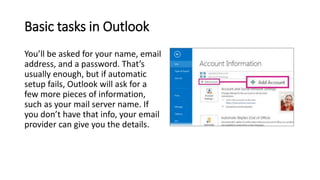
You’ll be asked for your name, email
address, and a password. That’s
usually enough, but if automatic
setup fails, Outlook will ask for a
few more pieces of information,
such as your mail server name. If
you don’t have that info, your email
provider can give you the details.
Mail
Email connects you to people inside and outside your organization. You
can add an electronic signature and attachments to your email
messages.
Create a new email message
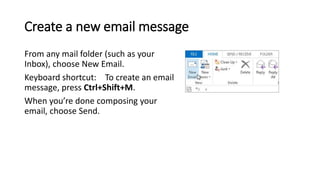
From any mail folder (such as your
Inbox), choose New Email.
Keyboard shortcut: To create an email
message, press Ctrl+Shift+M.
When you’re done composing your
email, choose Send.
Add an email signature to messages
Create personalized signatures that appear at the bottom of your
messages. Signatures can include text, images, your Electronic Business
Card, a logo, or even an image of your handwritten signature.
Add an email signature to messages
Create a signature
1. In a new message, choose Signature >Signatures.
2. On the Email Signature tab, choose New.
3. Type a name and then choose OK.
Add an email signature to messages
Create a signature
4. Under Choose default signature, do the following:
• In the E-mail account list, choose an email account to associate with the
signature.
• In the New messages list, choose the signature that you want to be added
automatically to all new email messages. If you don't want to auto sign
your email messages, you can ignore this option as (none) is the default
value.
• In the Replies/forwards list, choose the signature that you want to be
added automatically (auto sign) when you reply to or forward messages.
Otherwise, accept the default option of (none).
5. Under Edit signature, type the signature, and then choose OK.
Add an email signature to messages
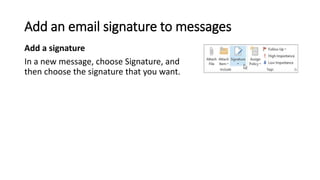
Add a signature
In a new message, choose Signature, and
then choose the signature that you want.
Forward or reply to an email message
1. On the ribbon or in the reading pane, choose Reply, Reply All, or
Forward.
2. In the To, Cc, or Bcc box, do one of the following:
• To add a recipient, click in the appropriate box and enter the
recipient's name.
• To remove a recipient, click in the appropriate box, choose the
recipient's name, and then press Delete
Add an attachment to an email message
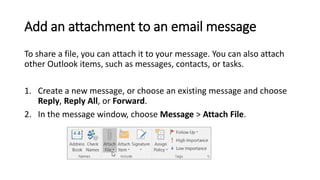
To share a file, you can attach it to your message. You can also attach
other Outlook items, such as messages, contacts, or tasks.
1. Create a new message, or choose an existing message and choose
Reply, Reply All, or Forward.
2. In the message window, choose Message > Attach File.
Open or save an email message attachment
You can open an attachment from the reading pane or from an open
message. After opening and viewing an attachment, you can save it. If a
message has more than one attachment, you can save them as a group
or one at a time.
Open an attachment
Depending on the version of Outlook you're using, there might be
multiple options available to open an attachment.
• Double-click the attachment.
Open or save an email message attachment
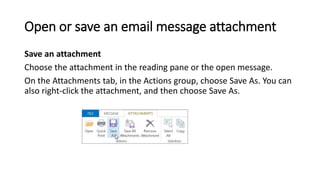
Save an attachment
Choose the attachment in the reading pane or the open message.
On the Attachments tab, in the Actions group, choose Save As. You can
also right-click the attachment, and then choose Save As.
Perfect Practice Makes Perfect
END

Outlook.pptx

  • 1.
    Principles of Information Systems(PIS1) Lecturer:Rubben Nambinga Email: rubbennambinga@gmail.com
  • 2.
    Outlook Lesson Objectives At theend of this lesson you will be able to: • Understand the basic tasks you can do in outlook • Adding an account • Create, reply and send email • Attach files • Creating a signature
  • 3.
    Get started Your firstaction is to set up your Outlook account. After that, you’ll be ready to start receiving and sending email, use the calendar, create contacts, and work with Outlook tasks. Setup is automatic if you used an earlier version of Outlook on the same computer. If you didn’t, the Auto Account Setup will start the first time you start Outlook and walk you through the process.
  • 4.
    Basic tasks inOutlook Outlook organizes your emails, calendars, contacts, tasks, and to-do lists, all in one place. That organization starts with your email account. From there you can start working with emails, turning them into tasks or appointments, and storing information about the people you interact with in your contacts so that you never have to remember an email address or a phone number. Let’s take a quick walk-through of some basic tasks.
  • 5.
    Basic tasks inOutlook You’ll be asked for your name, email address, and a password. That’s usually enough, but if automatic setup fails, Outlook will ask for a few more pieces of information, such as your mail server name. If you don’t have that info, your email provider can give you the details.
  • 6.
    Mail Email connects youto people inside and outside your organization. You can add an electronic signature and attachments to your email messages.
  • 7.
    Create a newemail message From any mail folder (such as your Inbox), choose New Email. Keyboard shortcut: To create an email message, press Ctrl+Shift+M. When you’re done composing your email, choose Send.
  • 8.
    Add an emailsignature to messages Create personalized signatures that appear at the bottom of your messages. Signatures can include text, images, your Electronic Business Card, a logo, or even an image of your handwritten signature.
  • 9.
    Add an emailsignature to messages Create a signature 1. In a new message, choose Signature >Signatures. 2. On the Email Signature tab, choose New. 3. Type a name and then choose OK.
  • 10.
    Add an emailsignature to messages Create a signature 4. Under Choose default signature, do the following: • In the E-mail account list, choose an email account to associate with the signature. • In the New messages list, choose the signature that you want to be added automatically to all new email messages. If you don't want to auto sign your email messages, you can ignore this option as (none) is the default value. • In the Replies/forwards list, choose the signature that you want to be added automatically (auto sign) when you reply to or forward messages. Otherwise, accept the default option of (none). 5. Under Edit signature, type the signature, and then choose OK.
  • 11.
    Add an emailsignature to messages Add a signature In a new message, choose Signature, and then choose the signature that you want.
  • 12.
    Forward or replyto an email message 1. On the ribbon or in the reading pane, choose Reply, Reply All, or Forward. 2. In the To, Cc, or Bcc box, do one of the following: • To add a recipient, click in the appropriate box and enter the recipient's name. • To remove a recipient, click in the appropriate box, choose the recipient's name, and then press Delete
  • 13.
    Add an attachmentto an email message To share a file, you can attach it to your message. You can also attach other Outlook items, such as messages, contacts, or tasks. 1. Create a new message, or choose an existing message and choose Reply, Reply All, or Forward. 2. In the message window, choose Message > Attach File.
  • 14.
    Open or savean email message attachment You can open an attachment from the reading pane or from an open message. After opening and viewing an attachment, you can save it. If a message has more than one attachment, you can save them as a group or one at a time. Open an attachment Depending on the version of Outlook you're using, there might be multiple options available to open an attachment. • Double-click the attachment.
  • 15.
    Open or savean email message attachment Save an attachment Choose the attachment in the reading pane or the open message. On the Attachments tab, in the Actions group, choose Save As. You can also right-click the attachment, and then choose Save As.
  • 16.