SYSTEMIC LEADERSHIP
TRANSFORMING LEADERSHIP AND
ORGANIZATIONS TOGETHER
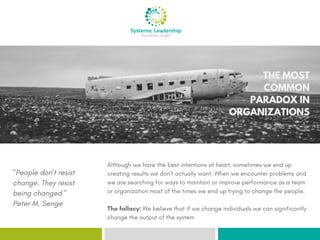
"People don't resist
change. They resist
being changed "
Peter M. Senge
Although we have the best intentions at heart, sometimes we end up
creating results we don't actually want. When we encounter problems and
we are searching for ways to maintain or improve performance as a team
or organization most of the times we end up trying to change the people.
The fallacy: We believe that if we change individuals we can significantly
change the output of the system
THE MOST
COMMON
PARADOX IN
ORGANIZATIONS
SO IF WE DON'T
CHANGE PEOPLE,
WHAT DO WE
CHANGE?
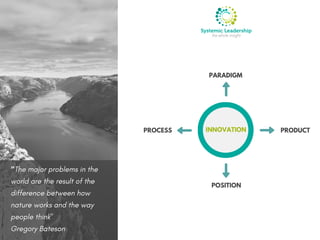
“The major problems in the
world are the result of the
difference between how
nature works and the way
people think"
Gregory Bateson
INNOVATION PRODUCTPROCESS
POSITION
PARADIGM
SYSTEMIC PROBLEMS REQUIRE
SYSTEMIC SOLUTIONS
&
SYSTEMIC SOLUTIONS
REQUIRE SYSTEMIC LEADERS
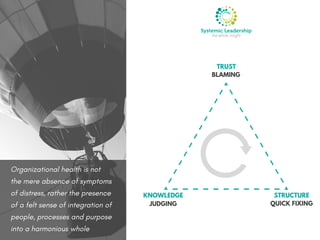
Organizational health is not
the mere absence of symptoms
of distress, rather the presence
of a felt sense of integration of
people, processes and purpose
into a harmonious whole
BLAMING
JUDGING QUICK FIXING
TRUST
KNOWLEDGE STRUCTURE
SYSTEMIC LEADERSHIP
SAFEGUARDS THE FLOW
OF HEALTH AND VITALITY
IN ORGANIZATIONS
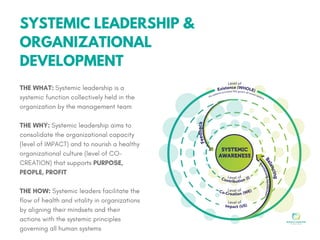
THE WHAT: Systemic leadership is a
systemic function collectively held in the
organization by the management team
THE WHY: Systemic leadership aims to
consolidate the organizational capacity
(level of IMPACT) and to nourish a healthy
organizational culture (level of CO-
CREATION) that supports PURPOSE,
PEOPLE, PROFIT
THE HOW: Systemic leaders facilitate the
flow of health and vitality in organizations
by aligning their mindsets and their
actions with the systemic principles
governing all human systems
SYSTEMIC LEADERSHIP &
ORGANIZATIONAL
DEVELOPMENT
THE SYSTEMIC
LEADERSHIP
PROGRAM
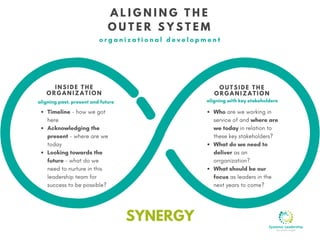
SYNERGY
aligning with key stakeholders
O U T S I D E T H E
O R G A N I Z A T I O N
aligning past, present and future
I N S I D E T H E
O R G A N I Z A T I O N
Timeline - how we got
here
Acknowledging the
present - where are we
today
Looking towards the
future - what do we
need to nurture in this
leadership team for
success to be possible?
Who are we working in
service of and where are
we today in relation to
these key stakeholders?
What do we need to
deliver as an
orrganization?
What should be our
focus as leaders in the
next years to come?
o r g a n i z a t i o n a l d e v e l o p m e n t
A L I G N I N G T H E
O U T E R S Y S T E M
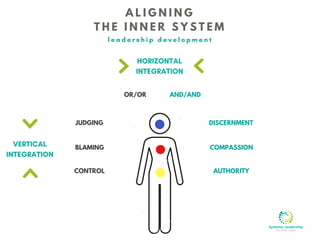
l e a d e r s h i p d e v e l o p m e n t
A L I G N I N G
T H E I N N E R S Y S T E M
JUDGING
OR/OR AND/AND
VERTICAL
INTEGRATION
HORIZONTAL
INTEGRATION
DISCERNMENT
COMPASSION
AUTHORITY
BLAMING
CONTROL
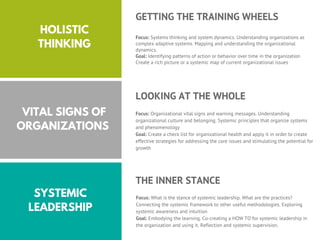
HOLISTIC
THINKING
VITAL SIGNS OF
ORGANIZATIONS
SYSTEMIC
LEADERSHIP
GETTING THE TRAINING WHEELS
Focus: Systems thinking and system dynamics. Understanding organizations as
complex adaptive systems. Mapping and understanding the organizational
dynamics.
Goal: Identifying patterns of action or behavior over time in the organization
Create a rich picture or a systemic map of current organizational issues
LOOKING AT THE WHOLE
Focus: Organizational vital signs and warning messages. Understanding
organizational culture and belonging. Systemic principles that organize systems
and phenomenology
Goal: Create a check list for organizational health and apply it in order to create
effective strategies for addressing the core issues and stimulating the potential for
growth
THE INNER STANCE
Focus: What is the stance of systemic leadership. What are the practices?
Connecting the systemic framework to other useful methodologies. Exploring
systemic awareness and intuition
Goal: Embodying the learning. Co-creating a HOW TO for systemic leadership in
the organization and using it. Reflection and systemic supervision.
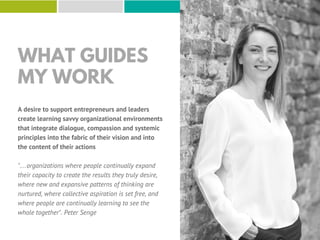
WHAT GUIDES
MY WORK
A desire to support entrepreneurs and leaders
create learning savvy organizational environments
that integrate dialogue, compassion and systemic
principles into the fabric of their vision and into
the content of their actions
"…organizations where people continually expand
their capacity to create the results they truly desire,
where new and expansive patterns of thinking are
nurtured, where collective aspiration is set free, and
where people are continually learning to see the
whole together". Peter Senge
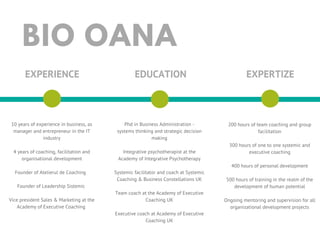
10 years of experience in business, as
manager and entrepreneur in the IT
industry
4 years of coaching, facilitation and
organisational development
Founder of Atelierul de Coaching  
Founder of Leadership Sistemic 
Vice president Sales & Marketing at the
Academy of Executive Coaching 
Phd in Business Administration -
systems thinking and strategic decision
making
Integrative psychotherapist at the
Academy of Integrative Psychotherapy
Systemic facilitator and coach at Systemic
Coaching & Business Constellations UK
Team coach at the Academy of Executive
Coaching UK
Executive coach at Academy of Executive
Coaching UK
200 hours of team coaching and group
facilitation
300 hours of one to one systemic and
executive coaching
400 hours of personal development
500 hours of training in the realm of the
development of human potential
Ongoing mentoring and supervision for all
organizational development projects
EXPERIENCE EDUCATION EXPERTIZE
BIO OANA

Systemic leadership program

  • 1.
  • 2.
    "People don't resist change.They resist being changed " Peter M. Senge Although we have the best intentions at heart, sometimes we end up creating results we don't actually want. When we encounter problems and we are searching for ways to maintain or improve performance as a team or organization most of the times we end up trying to change the people. The fallacy: We believe that if we change individuals we can significantly change the output of the system THE MOST COMMON PARADOX IN ORGANIZATIONS
  • 3.
    SO IF WEDON'T CHANGE PEOPLE, WHAT DO WE CHANGE?
  • 4.
    “The major problemsin the world are the result of the difference between how nature works and the way people think" Gregory Bateson INNOVATION PRODUCTPROCESS POSITION PARADIGM
  • 5.
    SYSTEMIC PROBLEMS REQUIRE SYSTEMICSOLUTIONS & SYSTEMIC SOLUTIONS REQUIRE SYSTEMIC LEADERS
  • 6.
    Organizational health isnot the mere absence of symptoms of distress, rather the presence of a felt sense of integration of people, processes and purpose into a harmonious whole BLAMING JUDGING QUICK FIXING TRUST KNOWLEDGE STRUCTURE
  • 7.
    SYSTEMIC LEADERSHIP SAFEGUARDS THEFLOW OF HEALTH AND VITALITY IN ORGANIZATIONS
  • 8.
    THE WHAT: Systemicleadership is a systemic function collectively held in the organization by the management team THE WHY: Systemic leadership aims to consolidate the organizational capacity (level of IMPACT) and to nourish a healthy organizational culture (level of CO- CREATION) that supports PURPOSE, PEOPLE, PROFIT THE HOW: Systemic leaders facilitate the flow of health and vitality in organizations by aligning their mindsets and their actions with the systemic principles governing all human systems SYSTEMIC LEADERSHIP & ORGANIZATIONAL DEVELOPMENT
  • 9.
  • 10.
    SYNERGY aligning with keystakeholders O U T S I D E T H E O R G A N I Z A T I O N aligning past, present and future I N S I D E T H E O R G A N I Z A T I O N Timeline - how we got here Acknowledging the present - where are we today Looking towards the future - what do we need to nurture in this leadership team for success to be possible? Who are we working in service of and where are we today in relation to these key stakeholders? What do we need to deliver as an orrganization? What should be our focus as leaders in the next years to come? o r g a n i z a t i o n a l d e v e l o p m e n t A L I G N I N G T H E O U T E R S Y S T E M
  • 11.
    l e ad e r s h i p d e v e l o p m e n t A L I G N I N G T H E I N N E R S Y S T E M JUDGING OR/OR AND/AND VERTICAL INTEGRATION HORIZONTAL INTEGRATION DISCERNMENT COMPASSION AUTHORITY BLAMING CONTROL
  • 12.
    HOLISTIC THINKING VITAL SIGNS OF ORGANIZATIONS SYSTEMIC LEADERSHIP GETTINGTHE TRAINING WHEELS Focus: Systems thinking and system dynamics. Understanding organizations as complex adaptive systems. Mapping and understanding the organizational dynamics. Goal: Identifying patterns of action or behavior over time in the organization Create a rich picture or a systemic map of current organizational issues LOOKING AT THE WHOLE Focus: Organizational vital signs and warning messages. Understanding organizational culture and belonging. Systemic principles that organize systems and phenomenology Goal: Create a check list for organizational health and apply it in order to create effective strategies for addressing the core issues and stimulating the potential for growth THE INNER STANCE Focus: What is the stance of systemic leadership. What are the practices? Connecting the systemic framework to other useful methodologies. Exploring systemic awareness and intuition Goal: Embodying the learning. Co-creating a HOW TO for systemic leadership in the organization and using it. Reflection and systemic supervision.
  • 13.
    WHAT GUIDES MY WORK Adesire to support entrepreneurs and leaders create learning savvy organizational environments that integrate dialogue, compassion and systemic principles into the fabric of their vision and into the content of their actions "…organizations where people continually expand their capacity to create the results they truly desire, where new and expansive patterns of thinking are nurtured, where collective aspiration is set free, and where people are continually learning to see the whole together". Peter Senge
  • 14.
    10 years ofexperience in business, as manager and entrepreneur in the IT industry 4 years of coaching, facilitation and organisational development Founder of Atelierul de Coaching   Founder of Leadership Sistemic  Vice president Sales & Marketing at the Academy of Executive Coaching  Phd in Business Administration - systems thinking and strategic decision making Integrative psychotherapist at the Academy of Integrative Psychotherapy Systemic facilitator and coach at Systemic Coaching & Business Constellations UK Team coach at the Academy of Executive Coaching UK Executive coach at Academy of Executive Coaching UK 200 hours of team coaching and group facilitation 300 hours of one to one systemic and executive coaching 400 hours of personal development 500 hours of training in the realm of the development of human potential Ongoing mentoring and supervision for all organizational development projects EXPERIENCE EDUCATION EXPERTIZE BIO OANA