Arianto Muditomo @2017
arianto.muditomo@2017
§ Session #1: Introduction of Knowledge Management
§ Session #2: KM & Organizational Learning
§ Session #3: Knowledge Management Strategy
§ Session #4: KM Implementation
1
Main source: Dalkir, K. (2011). Knowledge Management in Theory and Practice. The MIR Press. USA.
ISBN: 978-0262015080 – Chapter 2.t0.8
arianto.muditomo@2017
2
arianto.muditomo@2017
§ What is organizational learning?
§ What are the differences between
organizational learning and learning
organization?
§ What is the “knowledge cycle”?
§ What is “knowledge acquisition”?
§ How far is individual knowledge important to
the organization?
3
arianto.muditomo@2017
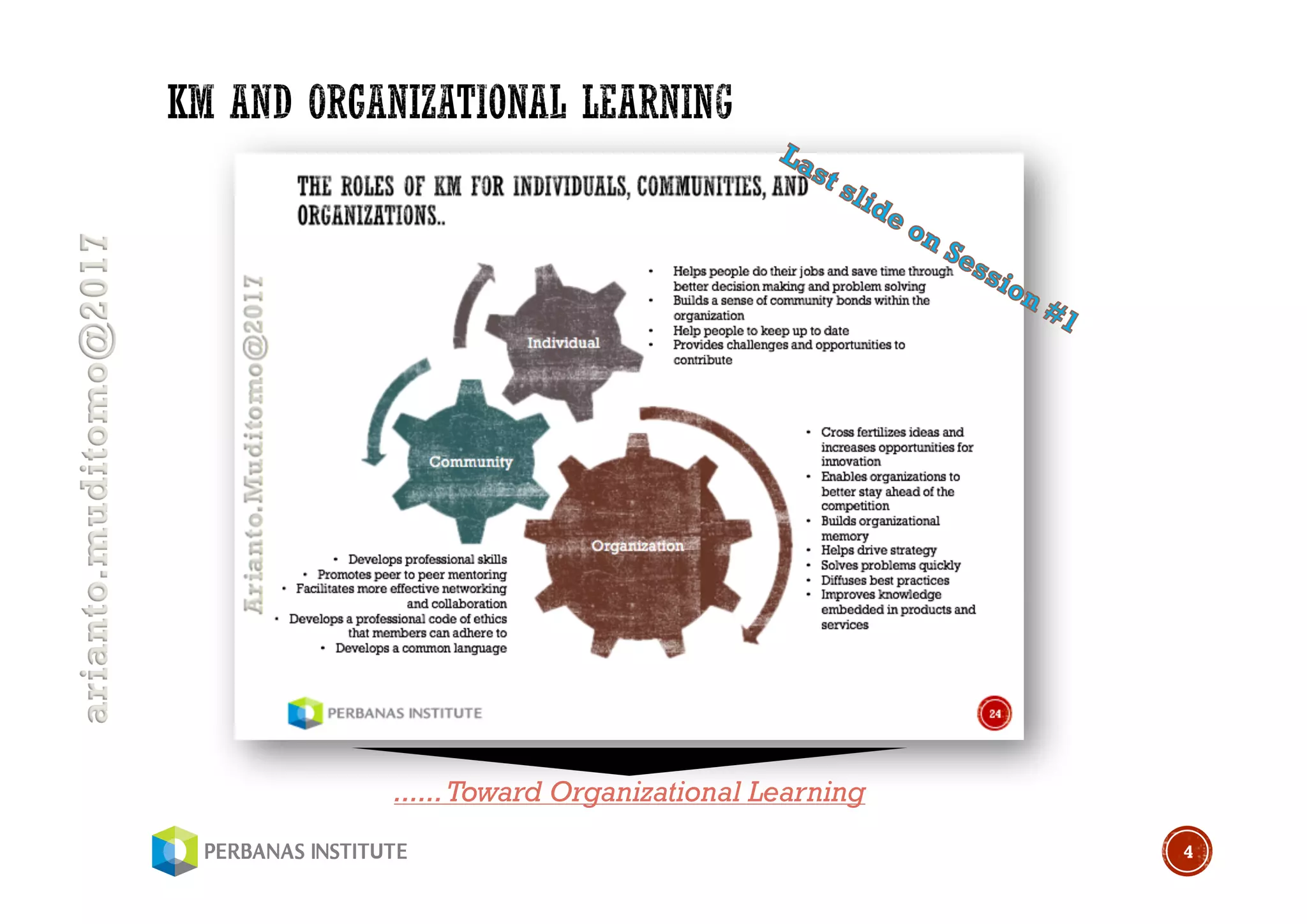
4
......Toward Organizational Learning
arianto.muditomo@2017
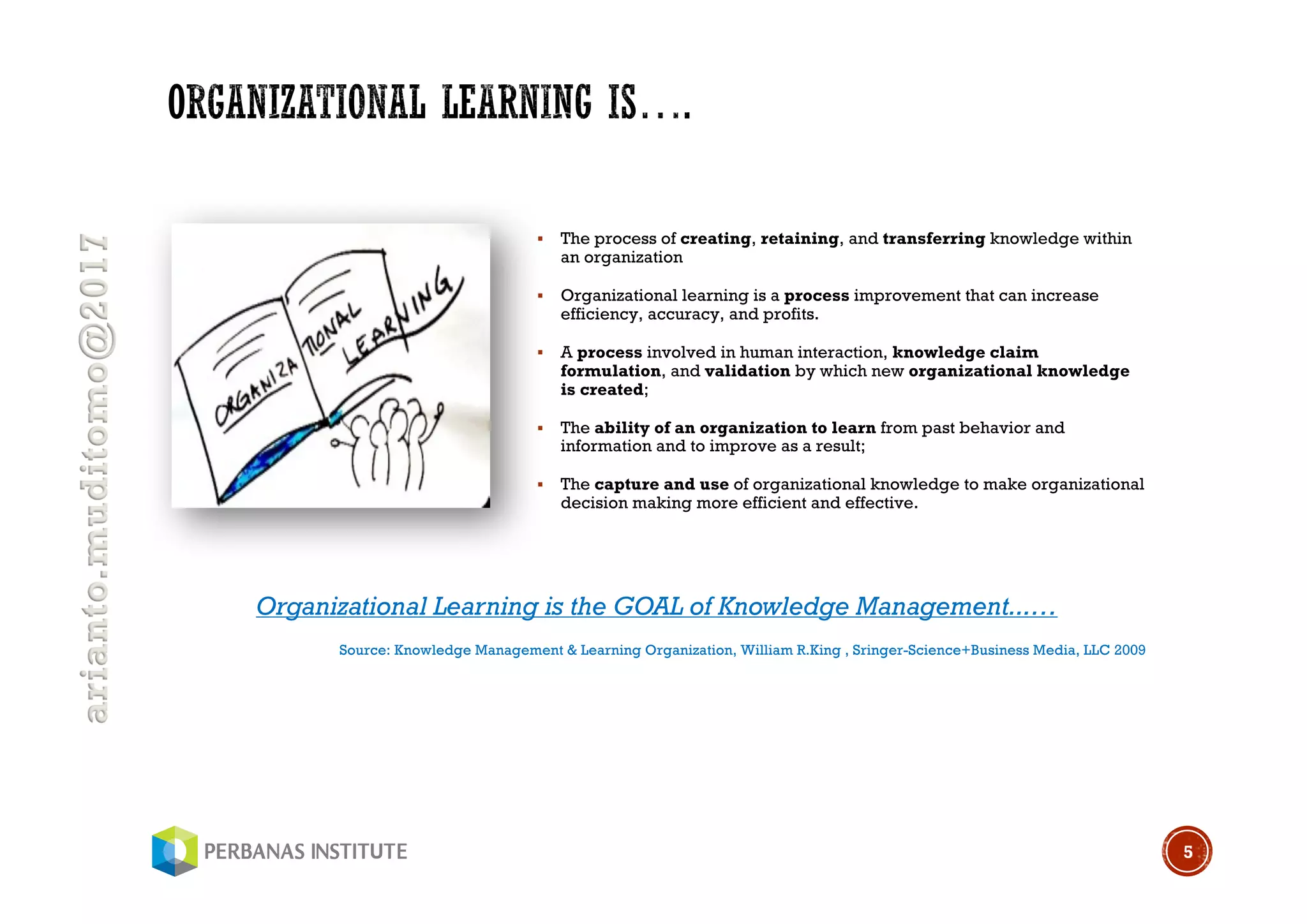
§ The process of creating, retaining, and transferring knowledge within
an organization
§ Organizational learning is a process improvement that can increase
efficiency, accuracy, and profits.
§ A process involved in human interaction, knowledge claim
formulation, and validation by which new organizational knowledge
is created;
§ The ability of an organization to learn from past behavior and
information and to improve as a result;
§ The capture and use of organizational knowledge to make organizational
decision making more efficient and effective.
5
Organizational Learning is the GOAL of Knowledge Management...…
Source: Knowledge Management & Learning Organization, William R.King , Sringer-Science+Business Media, LLC 2009
arianto.muditomo@2017
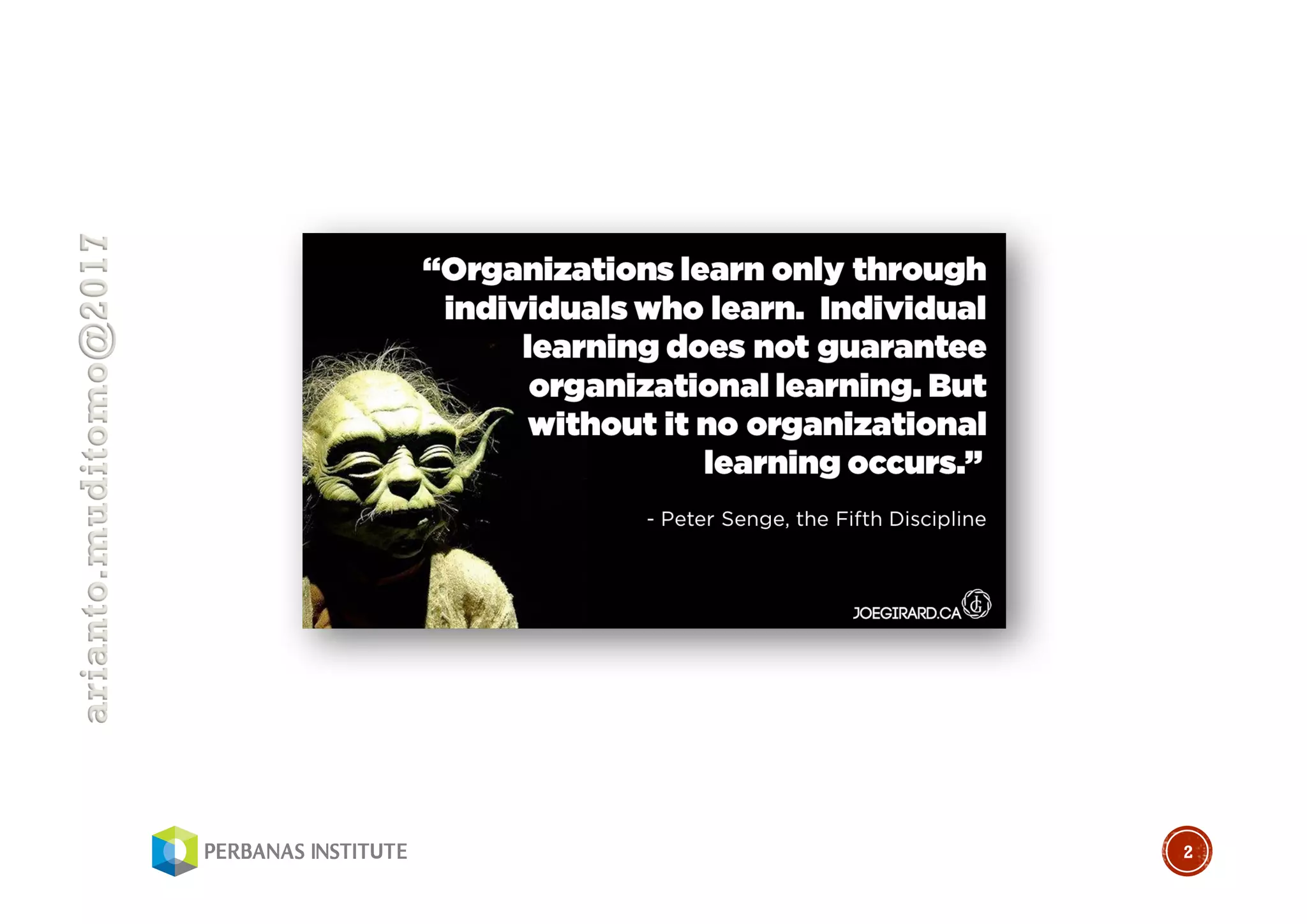
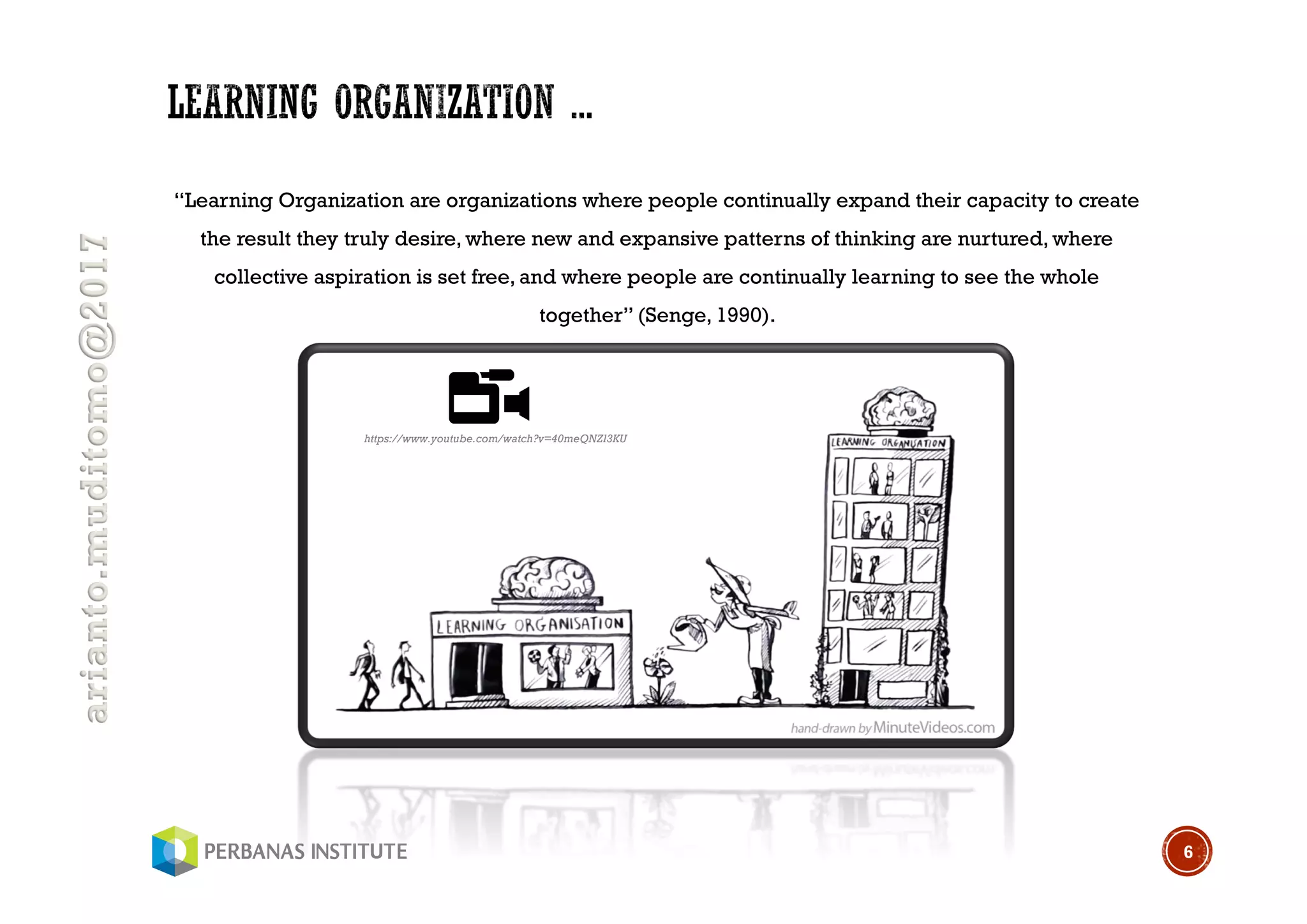
“Learning Organization are organizations where people continually expand their capacity to create
the result they truly desire, where new and expansive patterns of thinking are nurtured, where
collective aspiration is set free, and where people are continually learning to see the whole
together” (Senge, 1990).
6
https://www.youtube.com/watch?v=40meQNZl3KU
arianto.muditomo@2017
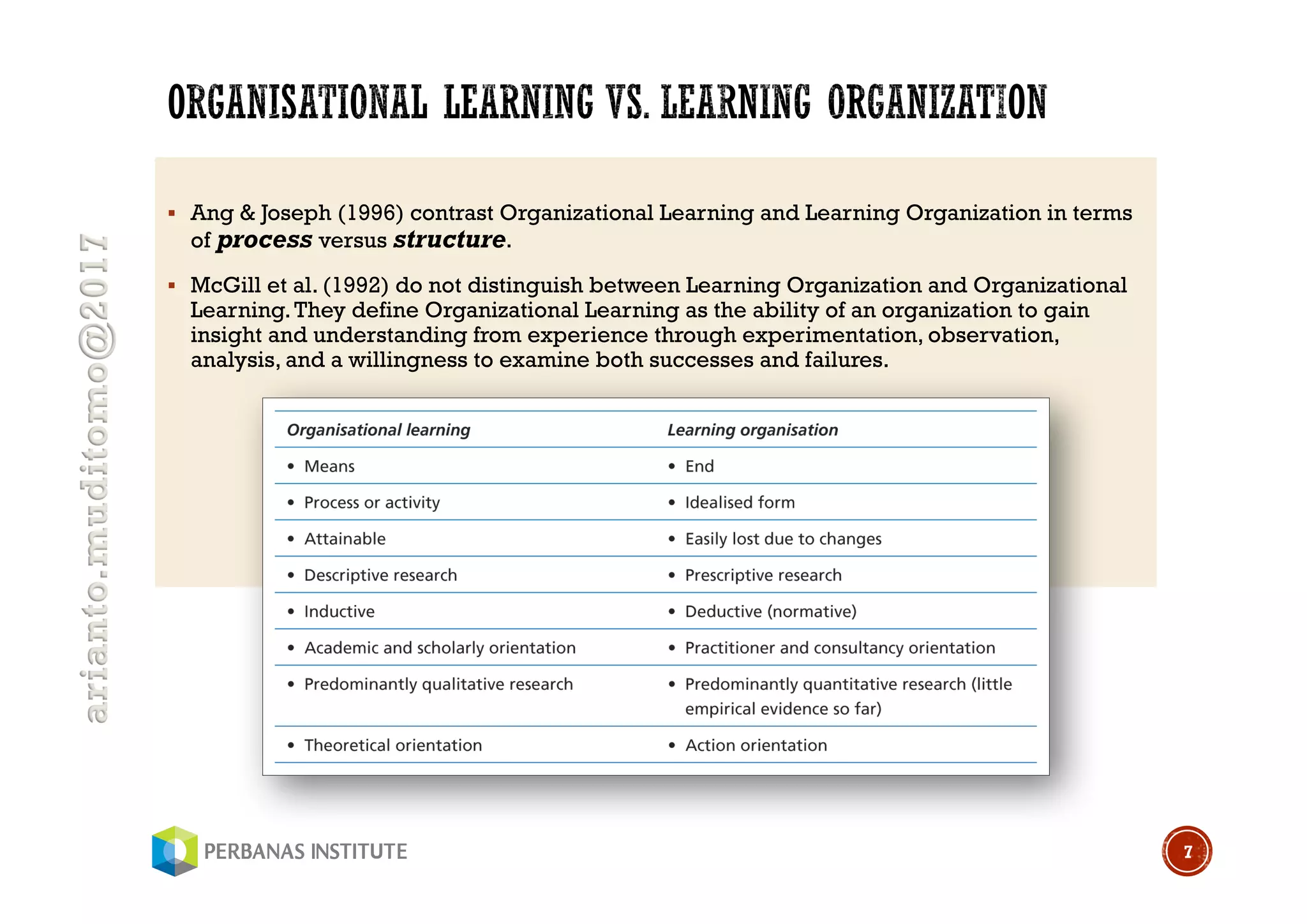
§ Ang & Joseph (1996) contrast Organizational Learning and Learning Organization in terms
of process versus structure.
§ McGill et al. (1992) do not distinguish between Learning Organization and Organizational
Learning.They define Organizational Learning as the ability of an organization to gain
insight and understanding from experience through experimentation, observation,
analysis, and a willingness to examine both successes and failures.
7
arianto.muditomo@2017
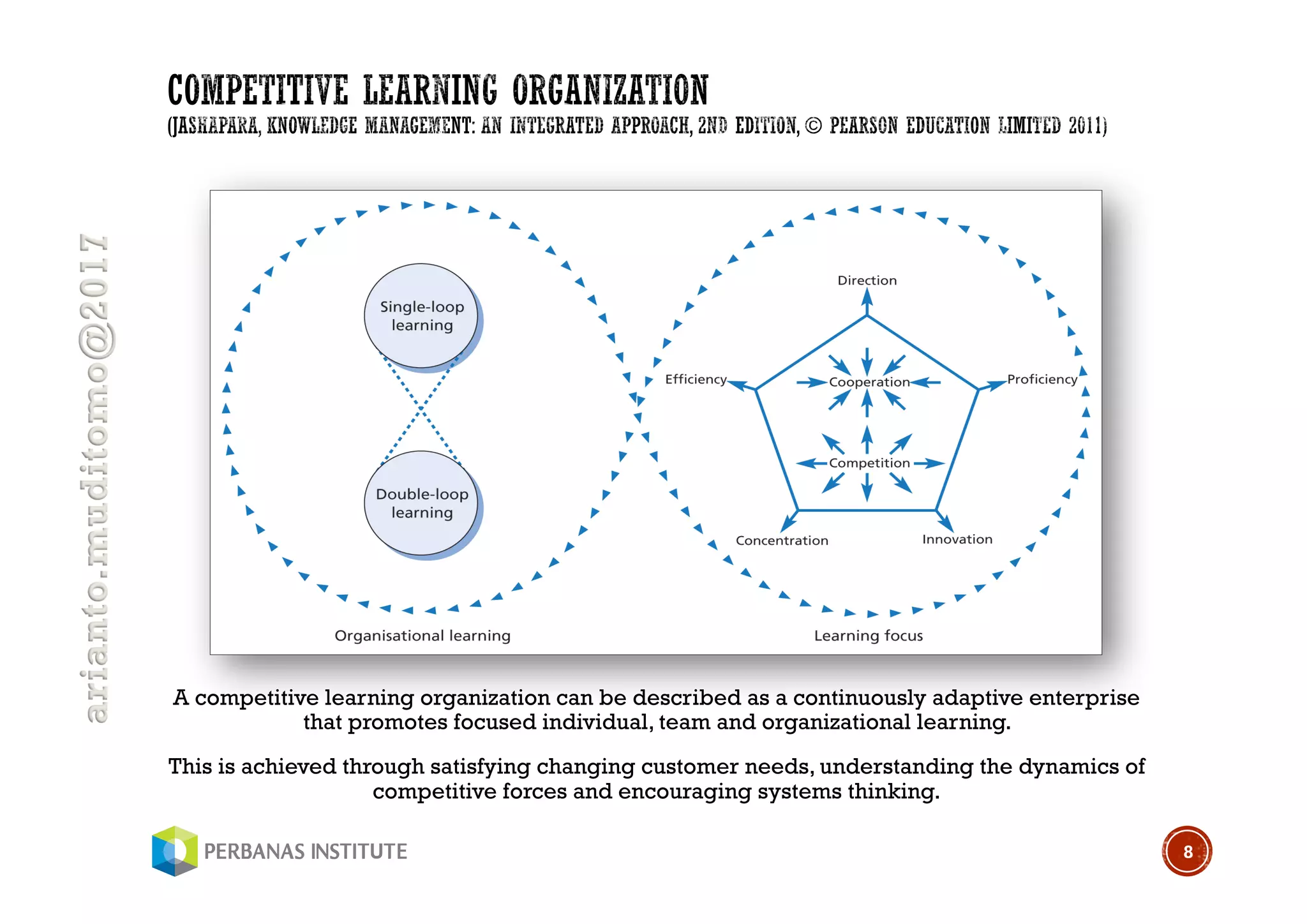
A competitive learning organization can be described as a continuously adaptive enterprise
that promotes focused individual, team and organizational learning.
This is achieved through satisfying changing customer needs, understanding the dynamics of
competitive forces and encouraging systems thinking.
8
arianto.muditomo@2017
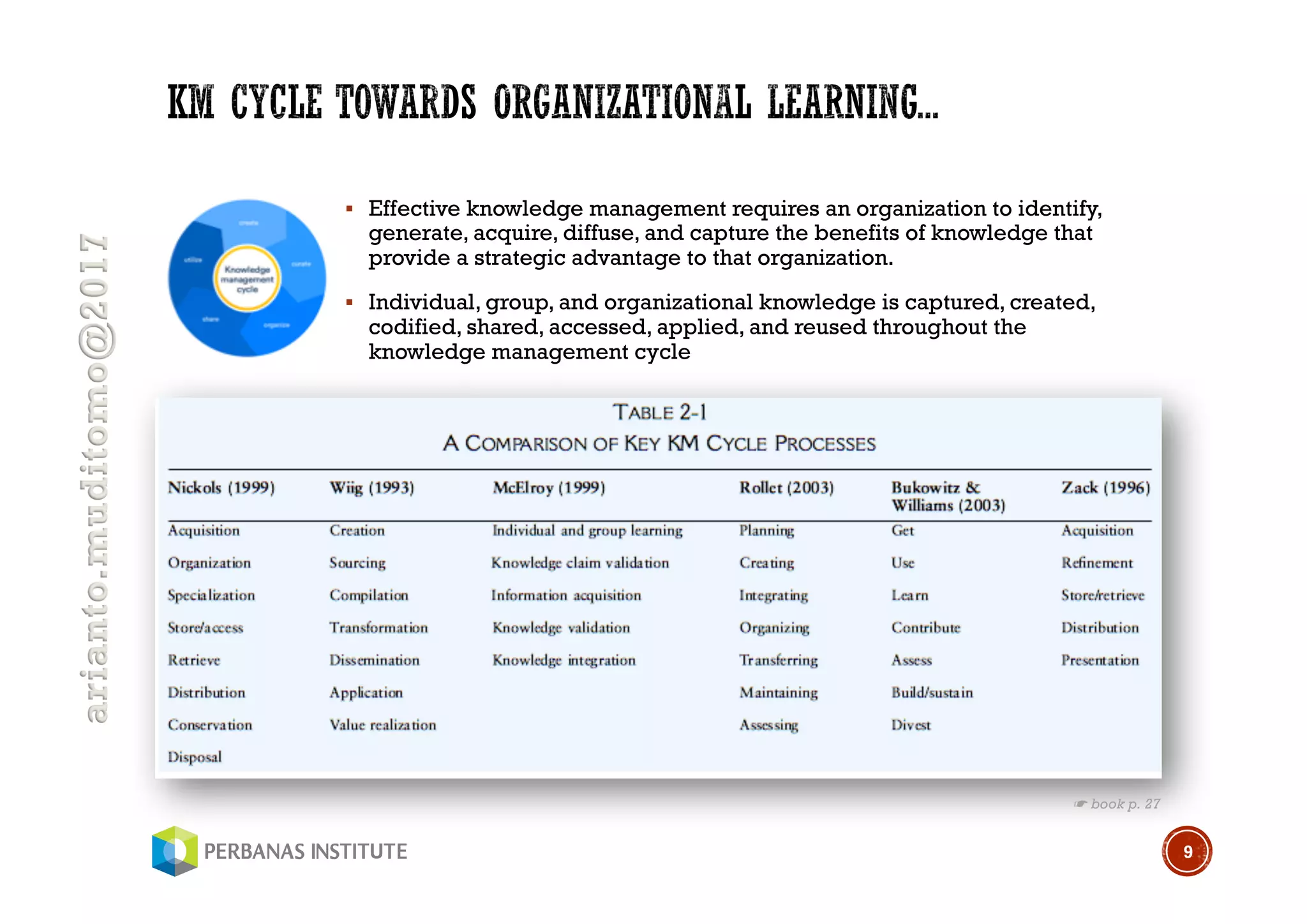
§ Effective knowledge management requires an organization to identify,
generate, acquire, diffuse, and capture the benefits of knowledge that
provide a strategic advantage to that organization.
§ Individual, group, and organizational knowledge is captured, created,
codified, shared, accessed, applied, and reused throughout the
knowledge management cycle
9
☛ book p. 27
arianto.muditomo@2017
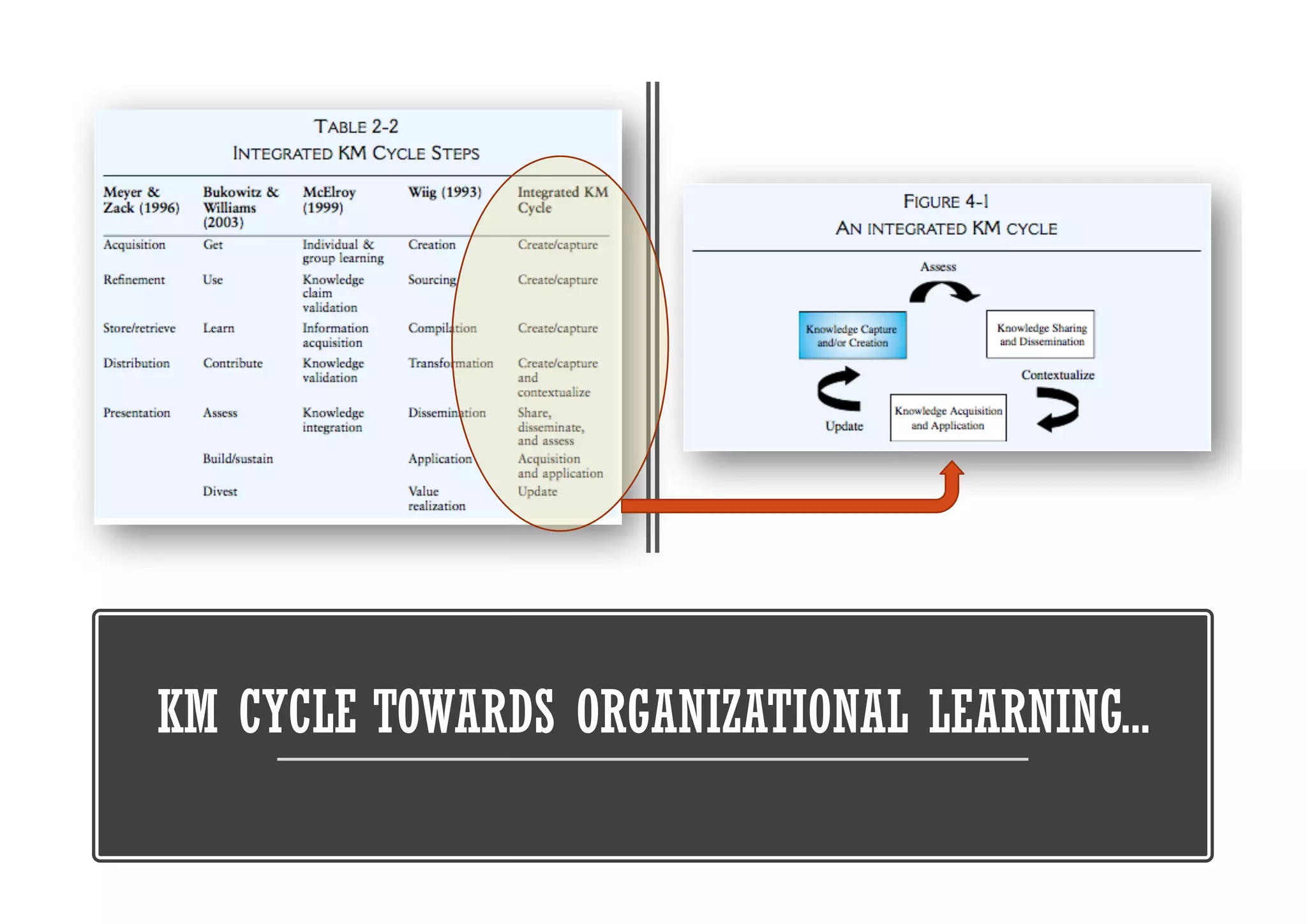
KM CYCLE TOWARDS ORGANIZATIONAL LEARNING...
arianto.muditomo@2017
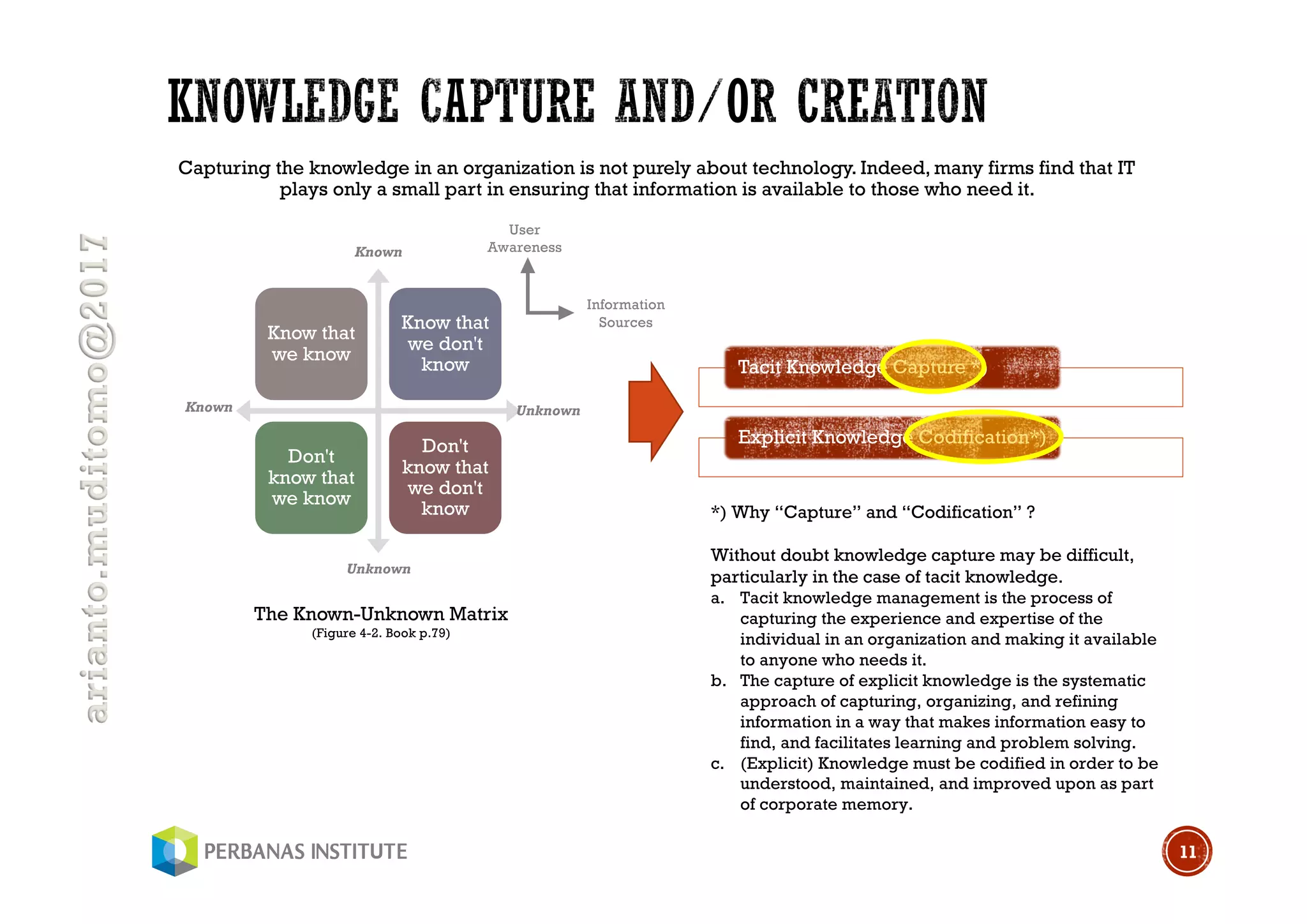
Capturing the knowledge in an organization is not purely about technology. Indeed, many firms find that IT
plays only a small part in ensuring that information is available to those who need it.
11
Know that
we know
Know that
we don't
know
Don't
know that
we know
Don't
know that
we don't
know
Known
Known
Unknown
Unknown
The Known-Unknown Matrix
(Figure 4-2. Book p.79)
User
Awareness
Information
Sources
Tacit Knowledge Capture *)
Explicit Knowledge Codification*)
*) Why “Capture” and “Codification” ?
Without doubt knowledge capture may be difficult,
particularly in the case of tacit knowledge.
a. Tacit knowledge management is the process of
capturing the experience and expertise of the
individual in an organization and making it available
to anyone who needs it.
b. The capture of explicit knowledge is the systematic
approach of capturing, organizing, and refining
information in a way that makes information easy to
find, and facilitates learning and problem solving.
c. (Explicit) Knowledge must be codified in order to be
understood, maintained, and improved upon as part
of corporate memory.
arianto.muditomo@2017
12
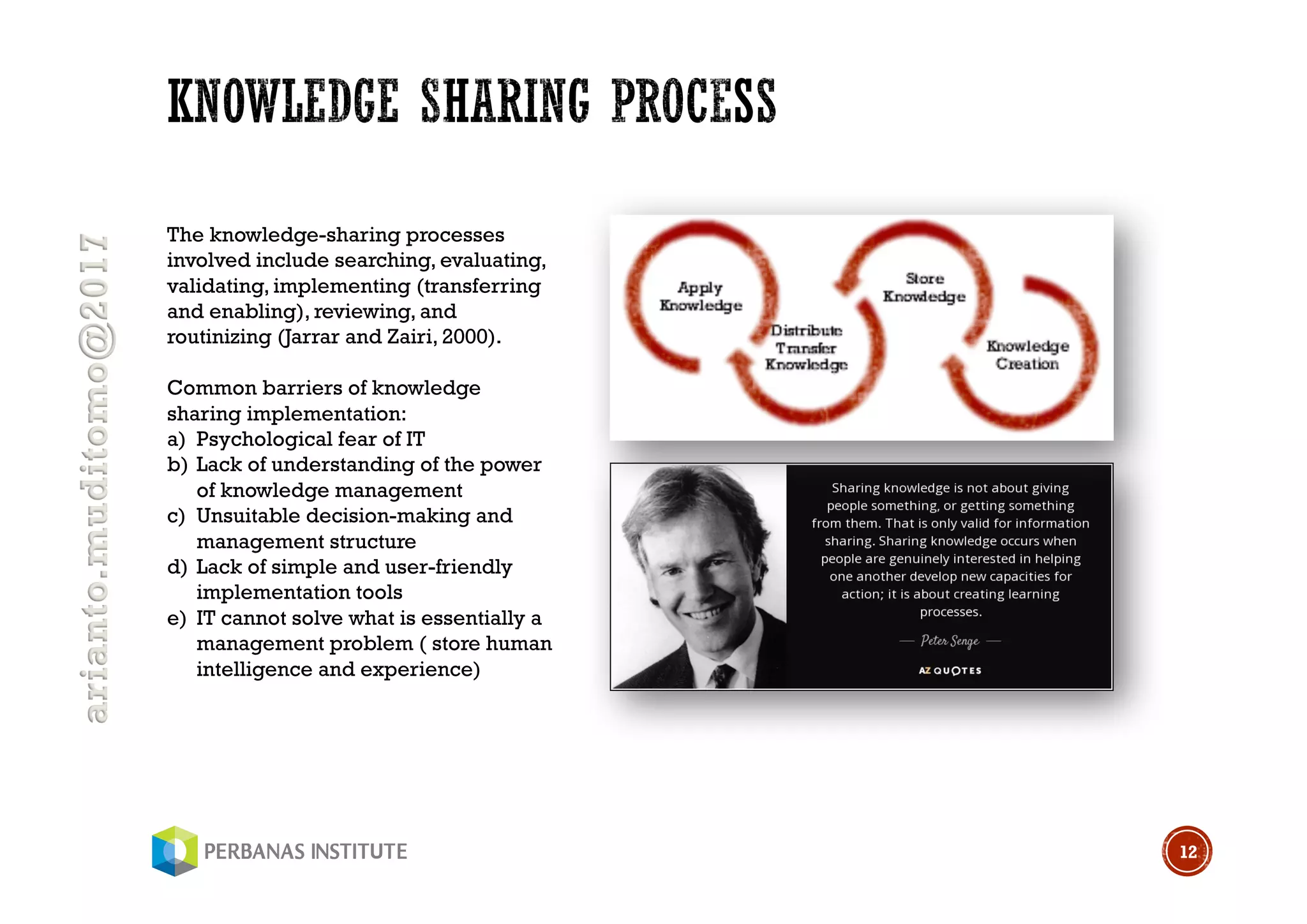
The knowledge-sharing processes
involved include searching, evaluating,
validating, implementing (transferring
and enabling), reviewing, and
routinizing (Jarrar and Zairi, 2000).
Common barriers of knowledge
sharing implementation:
a) Psychological fear of IT
b) Lack of understanding of the power
of knowledge management
c) Unsuitable decision-making and
management structure
d) Lack of simple and user-friendly
implementation tools
e) IT cannot solve what is essentially a
management problem ( store human
intelligence and experience)
arianto.muditomo@2017
Knowledge management systems (KMSs) are tools aimed at supporting knowledge management.They
evolved from information management tools that integrated many aspects of computer-supported
collaborative work (CSCW) environments with information and document management systems (Ganesan,
Edmonds, and Spector, 2001; Greif, 1988; Kling, 1991).
Key characteristics of a KMS are support for:
1. Communication among various users.
2. Coordination of users’ activities.
3. Collaboration among user groups on the creation, modification, and dissemination of artifacts and products.
4. Control processes to ensure integrity and to track the progress of projects.
13
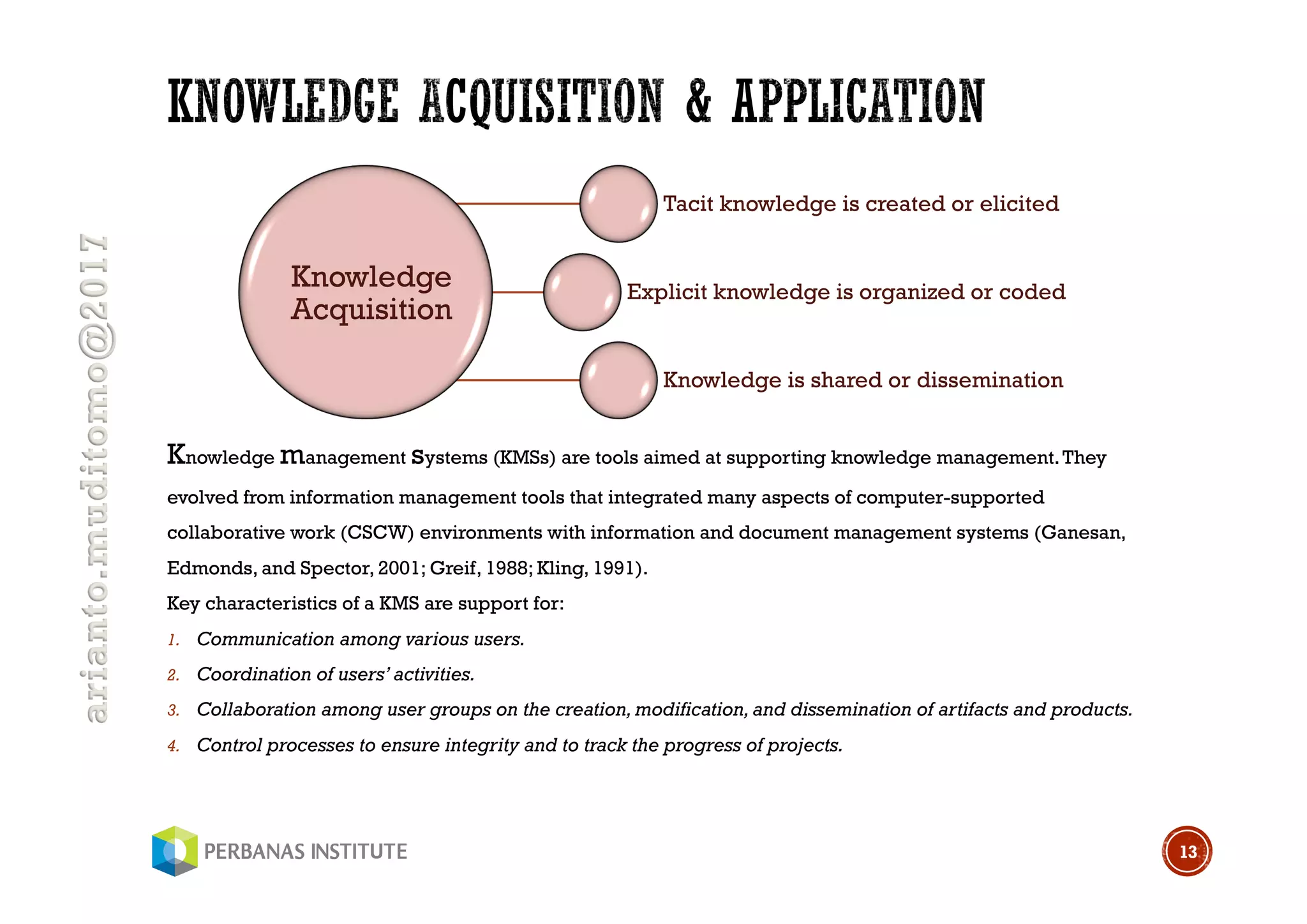
Knowledge
Acquisition
Tacit knowledge is created or elicited
Explicit knowledge is organized or coded
Knowledge is shared or dissemination
arianto.muditomo@2017
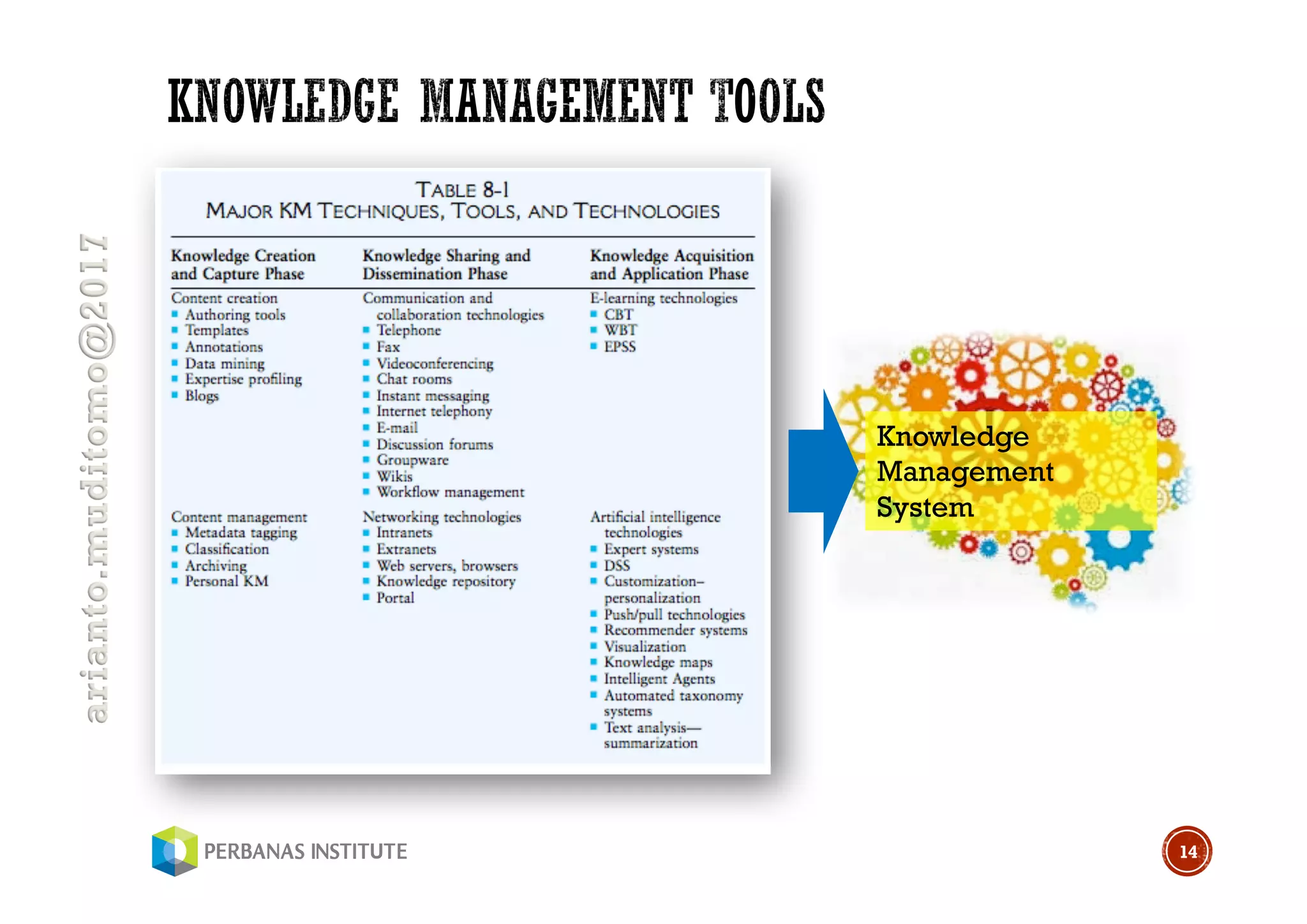
14
Knowledge
Management
System
arianto.muditomo@2017
15
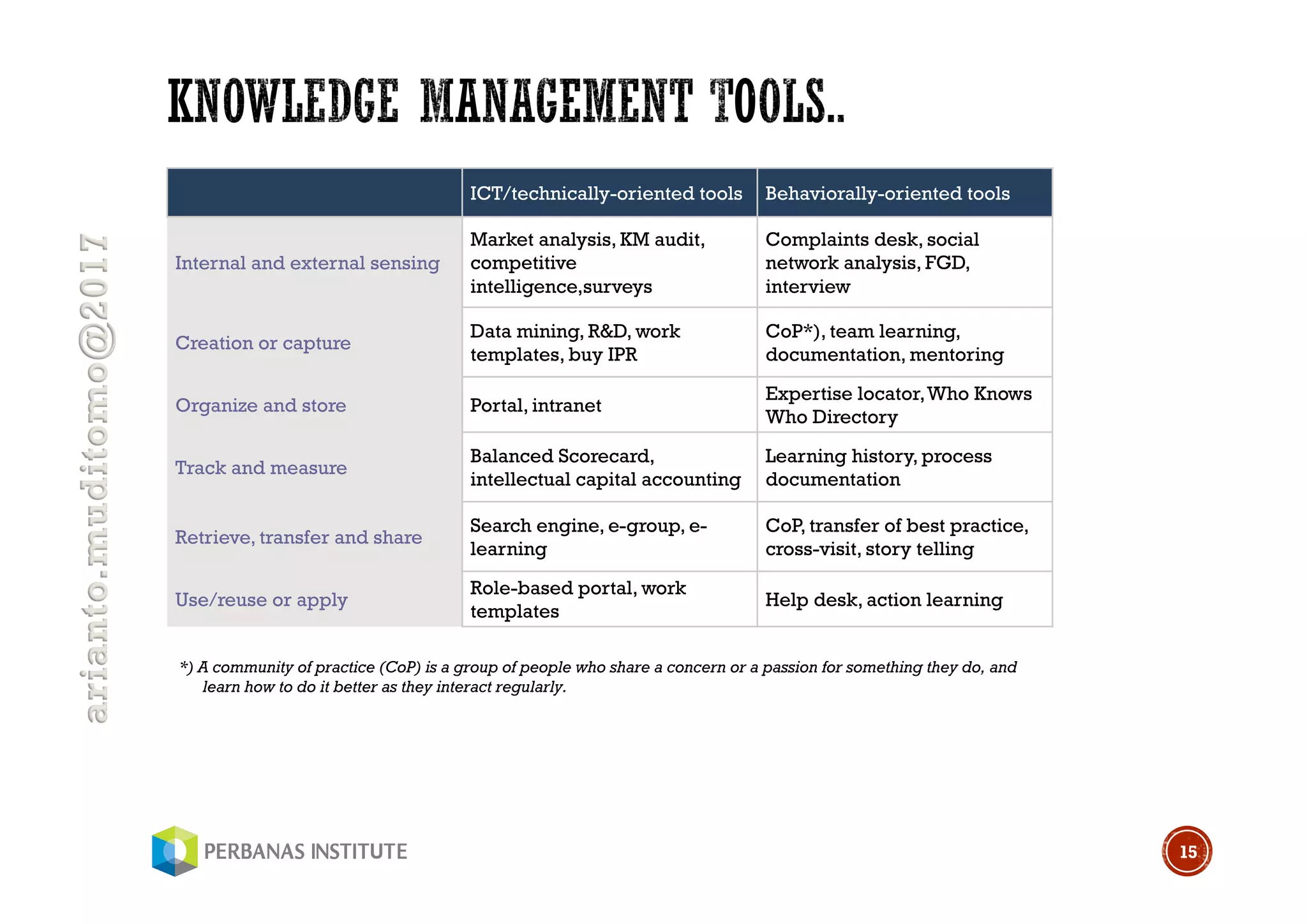
ICT/technically-oriented tools Behaviorally-oriented tools
Internal and external sensing
Market analysis, KM audit,
competitive
intelligence,surveys
Complaints desk, social
network analysis, FGD,
interview
Creation or capture
Data mining, R&D, work
templates, buy IPR
CoP*), team learning,
documentation, mentoring
Organize and store Portal, intranet
Expertise locator,Who Knows
Who Directory
Track and measure
Balanced Scorecard,
intellectual capital accounting
Learning history, process
documentation
Retrieve, transfer and share
Search engine, e-group, e-
learning
CoP, transfer of best practice,
cross-visit, story telling
Use/reuse or apply
Role-based portal, work
templates
Help desk, action learning
*) A community of practice (CoP) is a group of people who share a concern or a passion for something they do, and
learn how to do it better as they interact regularly.
arianto.muditomo@2017
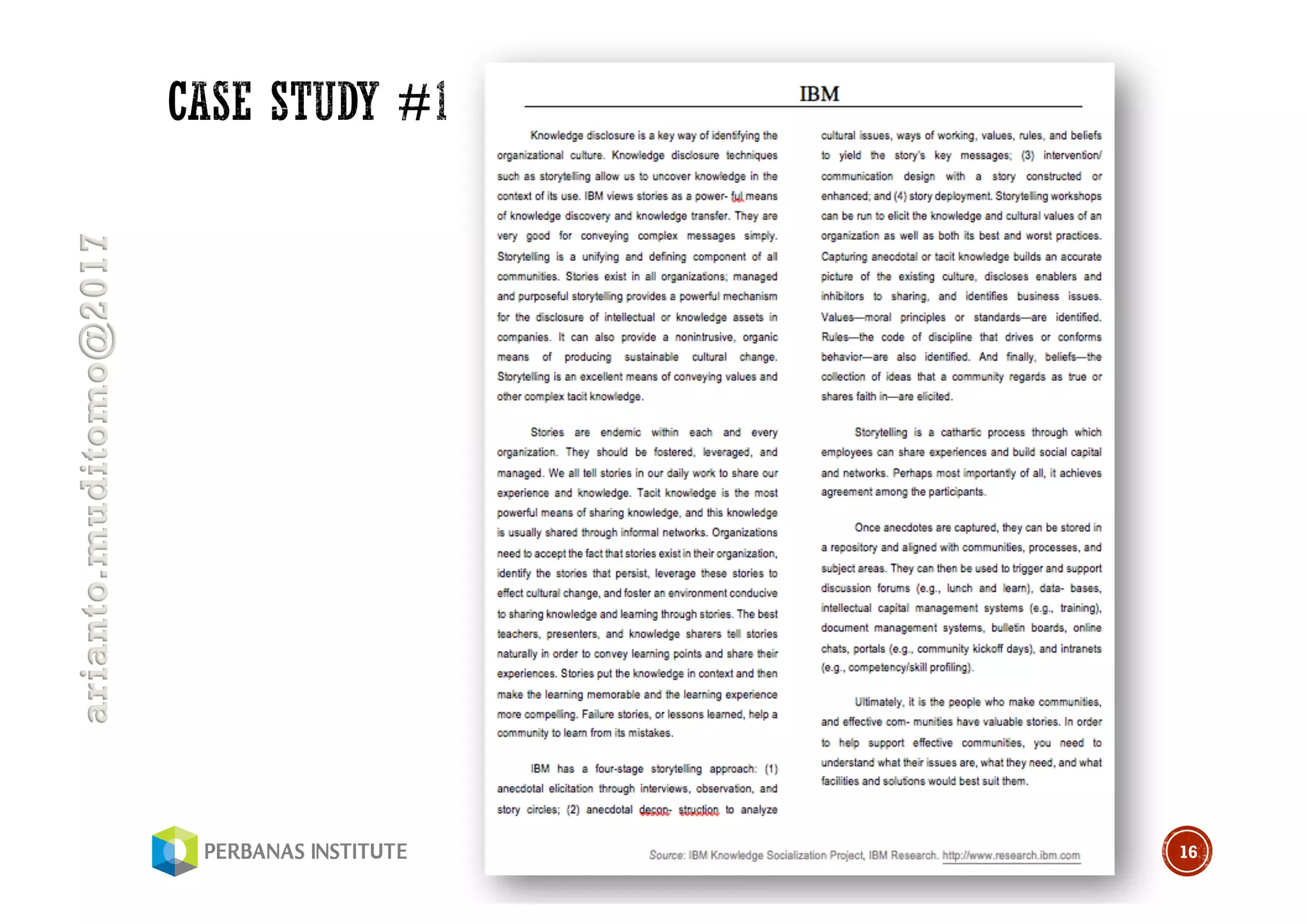
16
arianto.muditomo@2017
17
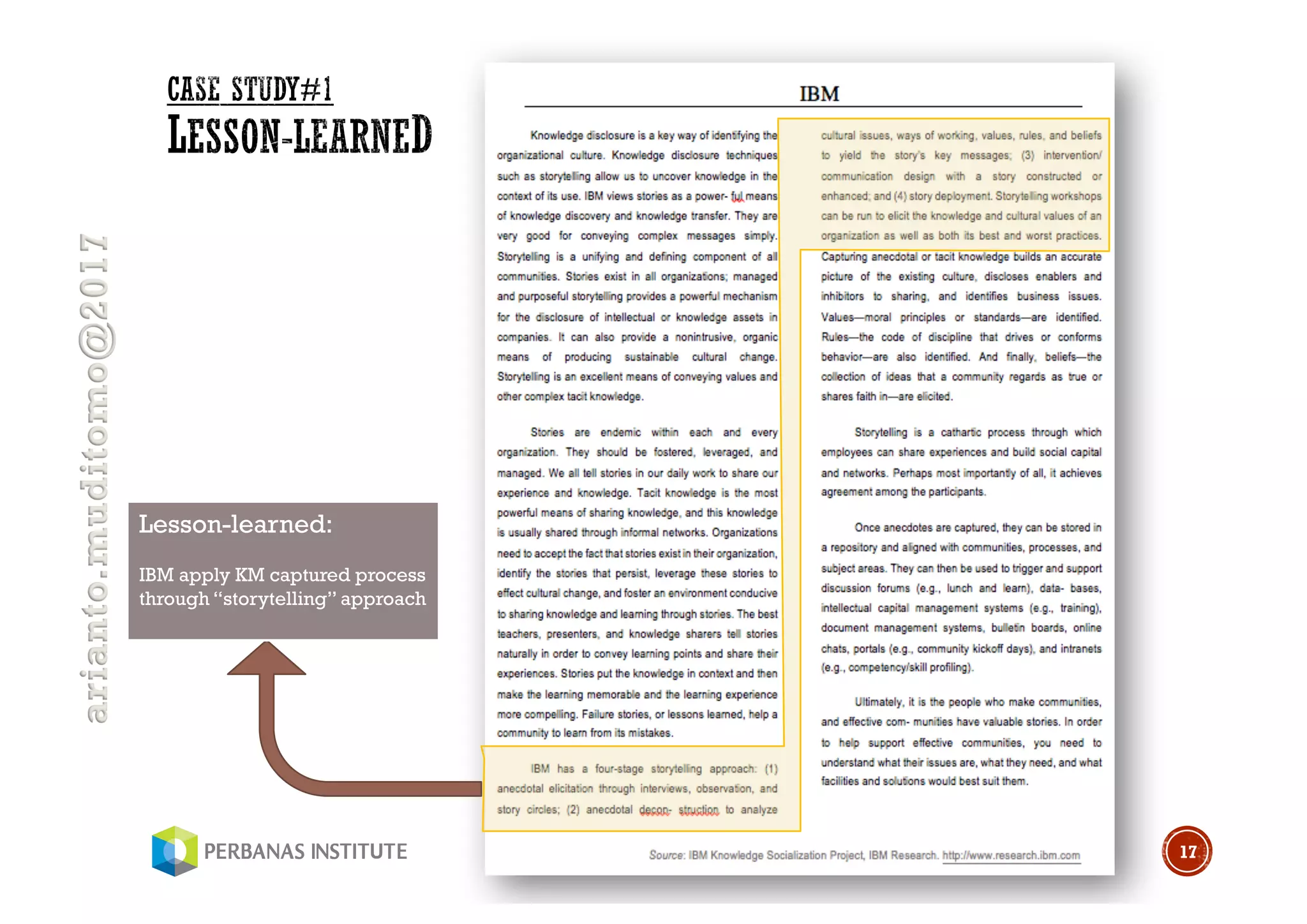
Lesson-learned:
IBM apply KM captured process
through “storytelling” approach
arianto.muditomo@2017
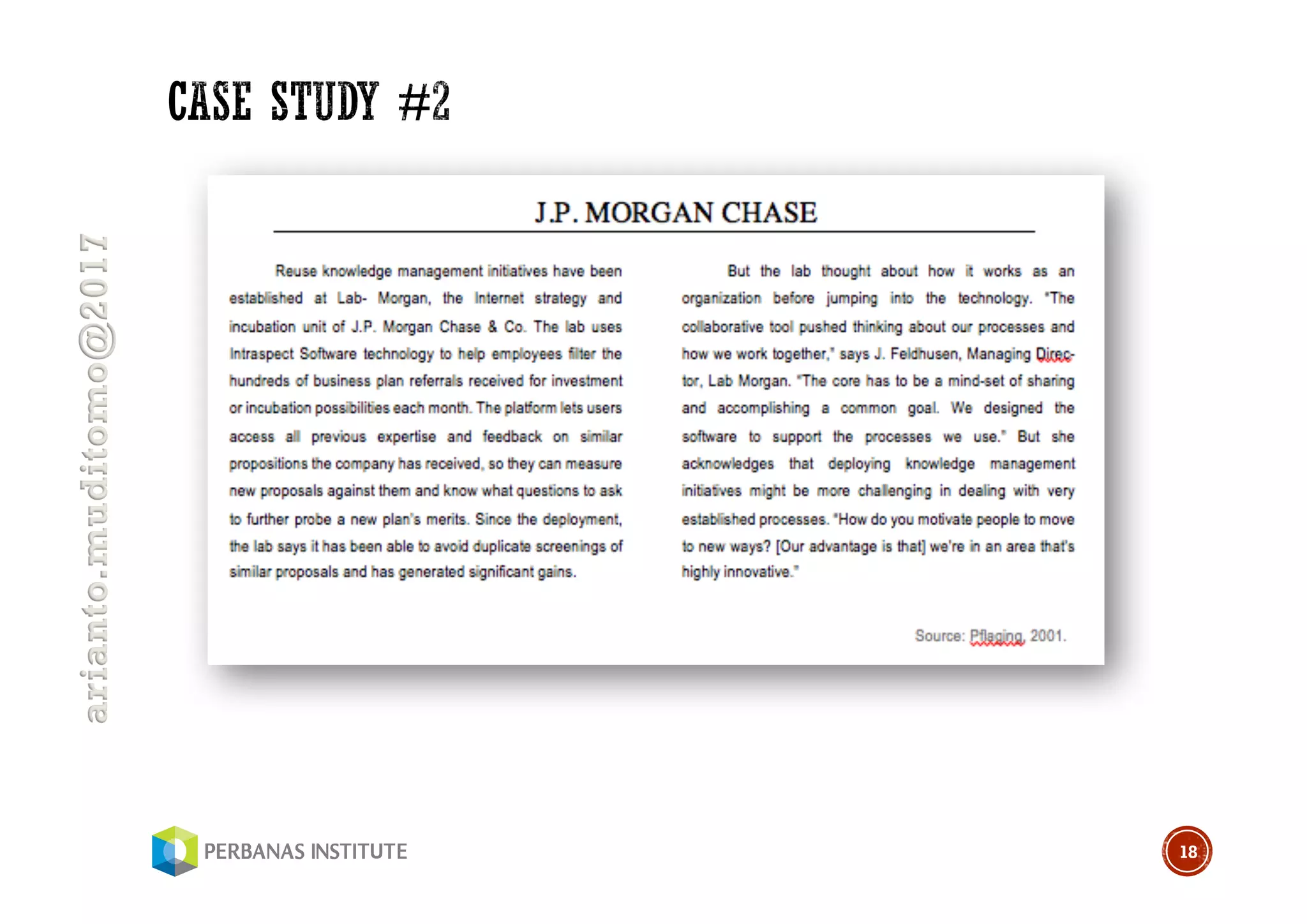
18
arianto.muditomo@2017
19
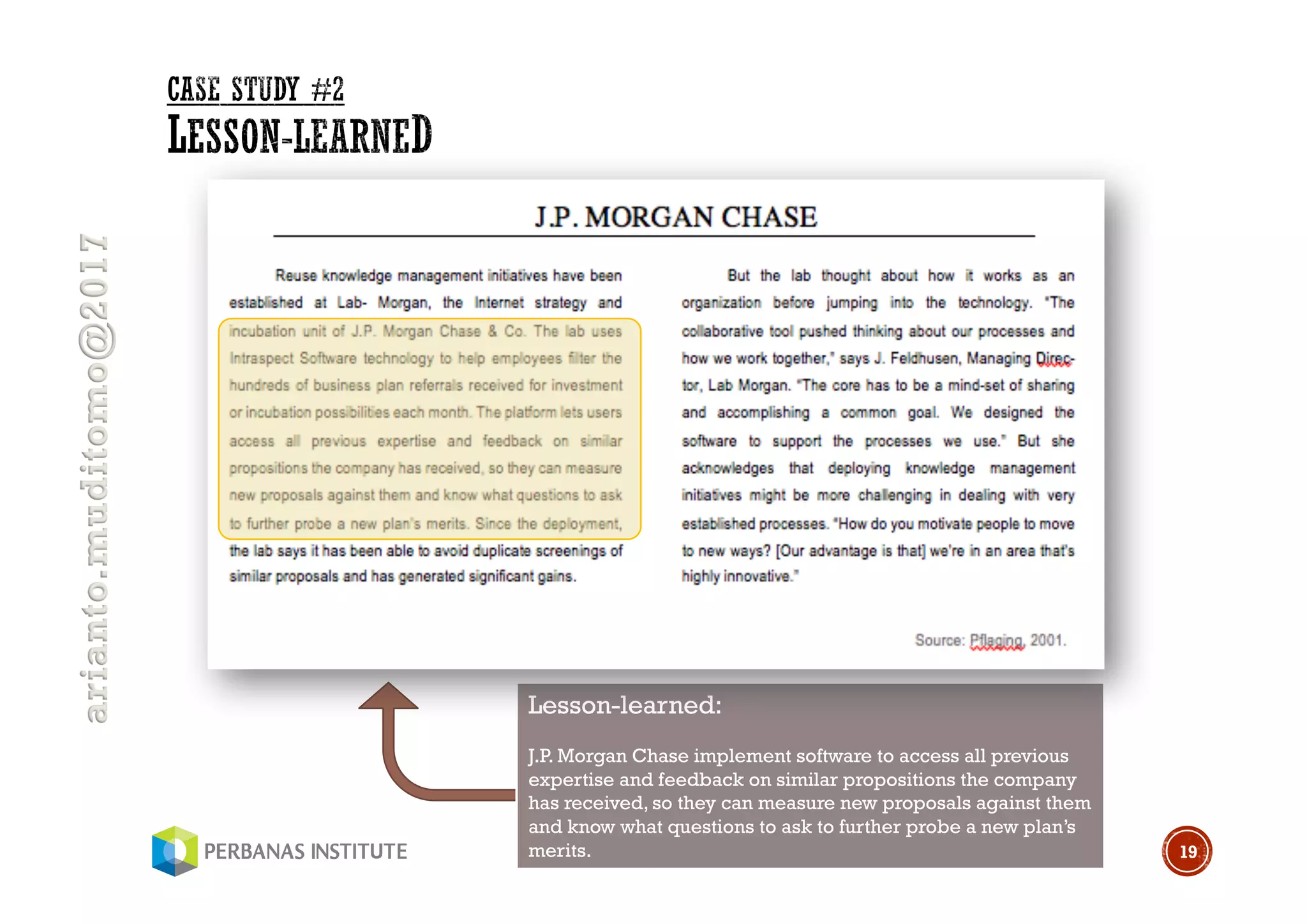
Lesson-learned:
J.P. Morgan Chase implement software to access all previous
expertise and feedback on similar propositions the company
has received, so they can measure new proposals against them
and know what questions to ask to further probe a new plan’s
merits.
arianto.muditomo@2017
§ What is organizational learning?
Organizational learning is the set of individual, team and organizational processes and skills for creating
new knowledge (e.g. work improvement, improvisation, process or product innovation) at all levels and
units in an organization and for sharing or transferring knowledge across an organization to those who
need it.
§ What are the differences between organizational learning and learning organization?
In a simple term, organizational learning is existing processes while learning organization is an ideal form
of organization.
§ What is the “knowledge cycle”?
The following steps constitute the knowledge cycle or knowledge value chain internal and external
sensing → knowledge creation (=innovation) or capture → organizing and storing knowledge → tracking
and measuring knowledge and its impacts → retrieving, transferring and sharing knowledge → and
using/reusing and applying knowledge.
§ What is “knowledge acquisition”?
Knowledge acquisition is the process of extracting, transforming, and trans- ferring expertise from a
knowledge source.
§ How far is individual knowledge important to the organization?
The whole knowledge of an organization is based on the knowledge of its members. If one member leaves
the enterprise, then often a part of the organizational knowledge gets lost as well.With help of
systematized knowledge management this problem might be reduced.
20
Arianto Muditomo @2017

002. KM & Organizational Learning

  • 1.
  • 2.
    arianto.muditomo@2017 § Session #1:Introduction of Knowledge Management § Session #2: KM & Organizational Learning § Session #3: Knowledge Management Strategy § Session #4: KM Implementation 1 Main source: Dalkir, K. (2011). Knowledge Management in Theory and Practice. The MIR Press. USA. ISBN: 978-0262015080 – Chapter 2.t0.8
  • 3.
  • 4.
    arianto.muditomo@2017 § What isorganizational learning? § What are the differences between organizational learning and learning organization? § What is the “knowledge cycle”? § What is “knowledge acquisition”? § How far is individual knowledge important to the organization? 3
  • 5.
  • 6.
    arianto.muditomo@2017 § The processof creating, retaining, and transferring knowledge within an organization § Organizational learning is a process improvement that can increase efficiency, accuracy, and profits. § A process involved in human interaction, knowledge claim formulation, and validation by which new organizational knowledge is created; § The ability of an organization to learn from past behavior and information and to improve as a result; § The capture and use of organizational knowledge to make organizational decision making more efficient and effective. 5 Organizational Learning is the GOAL of Knowledge Management...… Source: Knowledge Management & Learning Organization, William R.King , Sringer-Science+Business Media, LLC 2009
  • 7.
    arianto.muditomo@2017 “Learning Organization areorganizations where people continually expand their capacity to create the result they truly desire, where new and expansive patterns of thinking are nurtured, where collective aspiration is set free, and where people are continually learning to see the whole together” (Senge, 1990). 6 https://www.youtube.com/watch?v=40meQNZl3KU
  • 8.
    arianto.muditomo@2017 § Ang &Joseph (1996) contrast Organizational Learning and Learning Organization in terms of process versus structure. § McGill et al. (1992) do not distinguish between Learning Organization and Organizational Learning.They define Organizational Learning as the ability of an organization to gain insight and understanding from experience through experimentation, observation, analysis, and a willingness to examine both successes and failures. 7
  • 9.
    arianto.muditomo@2017 A competitive learningorganization can be described as a continuously adaptive enterprise that promotes focused individual, team and organizational learning. This is achieved through satisfying changing customer needs, understanding the dynamics of competitive forces and encouraging systems thinking. 8
  • 10.
    arianto.muditomo@2017 § Effective knowledgemanagement requires an organization to identify, generate, acquire, diffuse, and capture the benefits of knowledge that provide a strategic advantage to that organization. § Individual, group, and organizational knowledge is captured, created, codified, shared, accessed, applied, and reused throughout the knowledge management cycle 9 ☛ book p. 27
  • 11.
    arianto.muditomo@2017 KM CYCLE TOWARDSORGANIZATIONAL LEARNING...
  • 12.
    arianto.muditomo@2017 Capturing the knowledgein an organization is not purely about technology. Indeed, many firms find that IT plays only a small part in ensuring that information is available to those who need it. 11 Know that we know Know that we don't know Don't know that we know Don't know that we don't know Known Known Unknown Unknown The Known-Unknown Matrix (Figure 4-2. Book p.79) User Awareness Information Sources Tacit Knowledge Capture *) Explicit Knowledge Codification*) *) Why “Capture” and “Codification” ? Without doubt knowledge capture may be difficult, particularly in the case of tacit knowledge. a. Tacit knowledge management is the process of capturing the experience and expertise of the individual in an organization and making it available to anyone who needs it. b. The capture of explicit knowledge is the systematic approach of capturing, organizing, and refining information in a way that makes information easy to find, and facilitates learning and problem solving. c. (Explicit) Knowledge must be codified in order to be understood, maintained, and improved upon as part of corporate memory.
  • 13.
    arianto.muditomo@2017 12 The knowledge-sharing processes involvedinclude searching, evaluating, validating, implementing (transferring and enabling), reviewing, and routinizing (Jarrar and Zairi, 2000). Common barriers of knowledge sharing implementation: a) Psychological fear of IT b) Lack of understanding of the power of knowledge management c) Unsuitable decision-making and management structure d) Lack of simple and user-friendly implementation tools e) IT cannot solve what is essentially a management problem ( store human intelligence and experience)
  • 14.
    arianto.muditomo@2017 Knowledge management systems(KMSs) are tools aimed at supporting knowledge management.They evolved from information management tools that integrated many aspects of computer-supported collaborative work (CSCW) environments with information and document management systems (Ganesan, Edmonds, and Spector, 2001; Greif, 1988; Kling, 1991). Key characteristics of a KMS are support for: 1. Communication among various users. 2. Coordination of users’ activities. 3. Collaboration among user groups on the creation, modification, and dissemination of artifacts and products. 4. Control processes to ensure integrity and to track the progress of projects. 13 Knowledge Acquisition Tacit knowledge is created or elicited Explicit knowledge is organized or coded Knowledge is shared or dissemination
  • 15.
  • 16.
    arianto.muditomo@2017 15 ICT/technically-oriented tools Behaviorally-orientedtools Internal and external sensing Market analysis, KM audit, competitive intelligence,surveys Complaints desk, social network analysis, FGD, interview Creation or capture Data mining, R&D, work templates, buy IPR CoP*), team learning, documentation, mentoring Organize and store Portal, intranet Expertise locator,Who Knows Who Directory Track and measure Balanced Scorecard, intellectual capital accounting Learning history, process documentation Retrieve, transfer and share Search engine, e-group, e- learning CoP, transfer of best practice, cross-visit, story telling Use/reuse or apply Role-based portal, work templates Help desk, action learning *) A community of practice (CoP) is a group of people who share a concern or a passion for something they do, and learn how to do it better as they interact regularly.
  • 17.
  • 18.
    arianto.muditomo@2017 17 Lesson-learned: IBM apply KMcaptured process through “storytelling” approach
  • 19.
  • 20.
    arianto.muditomo@2017 19 Lesson-learned: J.P. Morgan Chaseimplement software to access all previous expertise and feedback on similar propositions the company has received, so they can measure new proposals against them and know what questions to ask to further probe a new plan’s merits.
  • 21.
    arianto.muditomo@2017 § What isorganizational learning? Organizational learning is the set of individual, team and organizational processes and skills for creating new knowledge (e.g. work improvement, improvisation, process or product innovation) at all levels and units in an organization and for sharing or transferring knowledge across an organization to those who need it. § What are the differences between organizational learning and learning organization? In a simple term, organizational learning is existing processes while learning organization is an ideal form of organization. § What is the “knowledge cycle”? The following steps constitute the knowledge cycle or knowledge value chain internal and external sensing → knowledge creation (=innovation) or capture → organizing and storing knowledge → tracking and measuring knowledge and its impacts → retrieving, transferring and sharing knowledge → and using/reusing and applying knowledge. § What is “knowledge acquisition”? Knowledge acquisition is the process of extracting, transforming, and trans- ferring expertise from a knowledge source. § How far is individual knowledge important to the organization? The whole knowledge of an organization is based on the knowledge of its members. If one member leaves the enterprise, then often a part of the organizational knowledge gets lost as well.With help of systematized knowledge management this problem might be reduced. 20
  • 22.