Knowledge and Management Jozef Hvorecký Vysoká škola manažmentu, Bratislava, Slovakia University of Liverpool Liverpool, UK
Knowledge Oxford English Dictionary: E xpertise and skills acquired by a person through experience or education What is known in a particular field or in total Theoretical or practical understanding of a subject Awareness or familiarity gained by experience of a fact or situation Facts and information
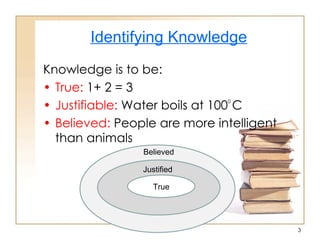
Identifying Knowledge Knowledge  is to  be: True :  1+ 2 = 3 Justifiable :  Water boils at 100 0  C Believed :  People are more intelligent than animals True Justifie d Believed
Application of Knowledge Problem Solution
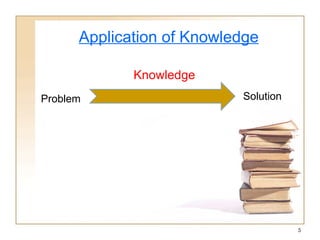
Application of Knowledge Problem Solution Knowledge
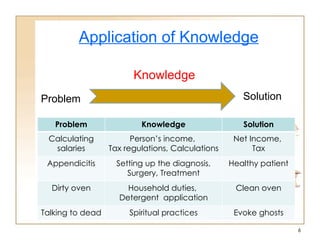
Application of Knowledge Problem Solution Knowledge Problem Knowledge Solution Calculating salaries Person’s income,  Tax regulations, Calculations Net Income,  Tax Appendicitis Setting up the diagnosis, Surgery, Treatment Healthy patient Dirty oven Household duties,  Detergent  application Clean oven Talking to dead Spiritual practices Evoke ghosts
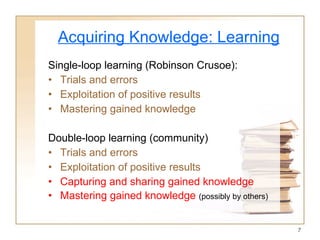
Acquiring Knowledge: Learning Single-loop learning (Robinson Crusoe): Trials and errors Exploitation of positive results Mastering gained knowledge Double-loop learning (community) Trials and errors Exploitation of positive results Capturing and sharing gained knowledge Mastering gained knowledge  (possibly by others)
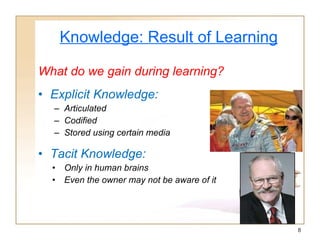
Knowledge: Result of Learning What do we gain during learning?  Explicit Knowledge: Articulated Codified Stored using certain media Tacit Knowledge: Only in human brains Even  t he owner may not be aware of it
When Do We Learn? Traditional view: At schools  ( Face  Recognition  course  :-) At training centers Working on assignments Predominantly explicit Contemporary view: Everywhere At any moment When we create connections   between pieces of knowledge Both explicit and tacit
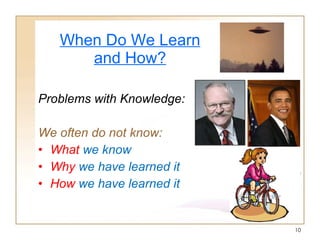
When Do We Learn and How? Problems with Knowledge: We often do not know: What  we know Why  we have learned it How  we have learned it
Learning for  a  Learning Society Learning Organization and/or Society: The society that is capable to learn in order to prosper, develop, and dominate A person or society that does not learn will suffer .  Learning must be:  Intentional Purposeful Company’s Good Strategy : Knowledge management
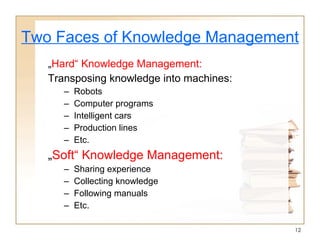
Two Faces of Knowledge Management „ Hard“ Knowledge Management: Transposing knowledge into machines: Robots Computer programs Intelligent cars Production lines Etc. „ Soft “ Knowledge Management: Sharing experience Collecting knowledge Following manuals Etc.
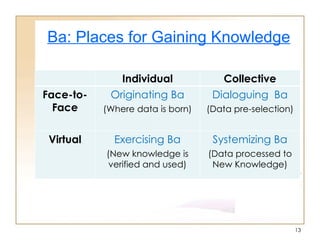
Ba: Places for Gaining Knowledge Individual Collective Face-to-Face Originating Ba (Where data is born) Dialoguing  Ba (Data pre-selection) Virtual Exercising Ba (New knowledge is verified and used) Systemizing Ba (Data processed to New Knowledge)
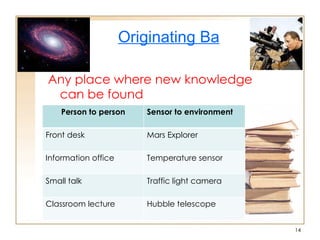
Originating Ba Any place where new knowledge can be found Person to person Sen s or to  environment Front desk Mars Explorer Information office Temperature sensor Small talk Traffic light camera Classroom lecture Hubble telescope
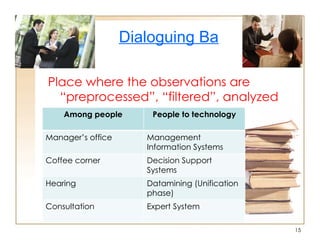
Dialoguing Ba Place where the observations are “preprocessed”, “filtered”, analyzed Among people People to technology Manager’s office Management Information Systems Coffee corner Decision Support  Systems Hearing Datamining (Unification phase) Consultation Expert System
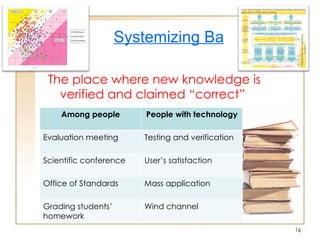
Systemizing Ba The place where new knowledge is verified and claimed “correct” Among people People with technology Evaluation meeting Testing and verification Scientific conference User’s satisfaction Office of Standards Mass application Grading students’ homework Wind channel
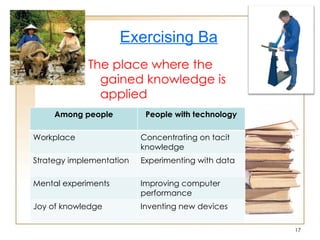
Exercising Ba The place where the gained knowledge is applied Among people People with technology Workplace Concentrating on tacit knowledge Strategy implementation Experimenting with data Mental experiments Improving computer performance Joy of knowledge Inventing new devices
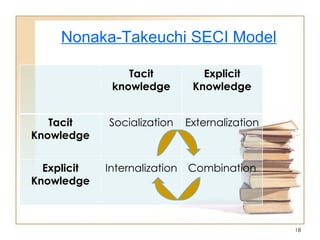
Nonaka -Takeuchi SECI Model Tacit knowledge Explicit Knowledge Tacit Knowledge Socialization Externalization Explicit Knowledge Internalization Combination
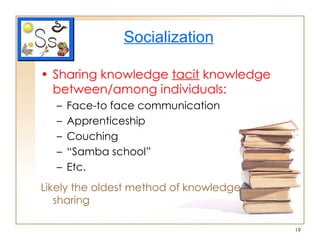
Socialization Sharing knowledge  tacit  knowledge between/among individuals: Face-to face communication Apprenticeship Couching “ Samba school” Etc. Likely the oldest method of knowledge sharing
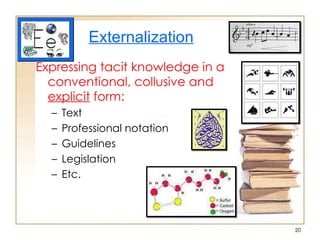
Externalization Expressing tacit knowledge in a conventional, collusive  and  explicit   form: Text Professional notation Guidelines Legislation Etc.
Combination Building new pieces of  explicit  knowledge by combining known existing knowledge (forming  explicit   facts): Evaluation Sorting Categorization Abstraction Etc.
Internalization “ Privatizing” the gained knowledge, changing it into an asset: Practicing the skills Learning by doing Memorizing Forming a new terminology or notation Etc.
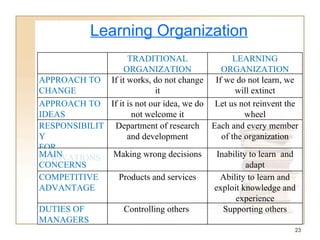
Learning Organization TRADITIONAL   ORGANIZATION LEARNING ORGANIZATION APPROACH TO CHANGE If it works, do not change it If we do not learn, we will extinct APPROACH TO  IDEAS If it is not our idea, we do not welcome it Let us not reinvent the wheel RESPONSIBILITY  FOR INNOVATIONS Department of research and development Each and every member of the organization MAIN CONCERNS Making wrong decisions Inability to learn  and adapt COMPETITIVE ADVANTAGE Products and services Ability to learn and exploit knowledge and experience DUTIES OF MANAGERS Controlling others  Supporting others
How to recognize a Learning Organization?* A learning approach to strategy :  The use of trials and errors to improve understanding and generate improvements, and to modify strategic direction as necessary. Participative policy making :  All the organization’s members are involved in strategy formation, influencing decisions and values and addressing conflict. In formative :  Information technology is used to make information available to everyone and to enable front-line staff to act on their own initiative. * Buchanan and Huczynski :  Organizational Behavior ,  p. 125
Formative accounting and control :  Accounting, budgeting and reporting systems are designed to help people to understand the operations of organizational finance. Internal exchange : Sections and departments think of themselves as customers and suppliers in an internal ‘supply chain’, learning from each other.  Reward flexibility :  A flexible and creative reward policy with financial and non-financial rewards to meet individual needs and performance. How to recognize a Learning Organization? (cont.)
Enabling structures :  Organizational charts, structures and procedures are seen as temporary, and can be changed to meet task requirements. Boundary workers as environmental scanners : Everyone who has contact with customers, suppliers, clients and business partners is treated as a valuable informative source. Inter-company learning :  The organization learns from other organizations through join ventures, alliances, and other information exchanges. How to recognize a Learning Organization? (cont.)
A learning climate : The manager’s primary task is to facilitate experimentation and learning in others, through questioning, feedback and support. Self-learning opportunities for all :  People are expected to take responsibility for their own learning, and facilities are made available, especially to ‘front-line’ staff. How to recognize a Learning Organization? (cont.)
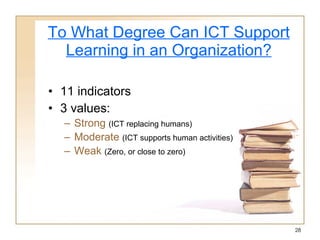
To What Degree Can ICT Support Learning in an Organization? 11 indicators 3 values: Strong   (ICT replacing humans) Moderate   (ICT supports human activities) Weak   (Zero, or close to zero)
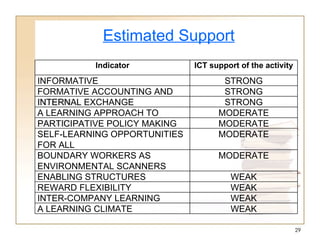
Estimated Support Indicator ICT support of the activity INFORMATIVE STRONG FORMATIVE ACCOUNTING AND CONTROL STRONG INTERNAL EXCHANGE STRONG A LEARNING APPROACH TO STRATEGY MODERATE PARTICIPATIVE POLICY MAKING MODERATE SELF-LEARNING OPPORTUNITIES FOR ALL MODERATE BOUNDARY WORKERS AS ENVIRONMENTAL SCANNERS MODERATE ENABLING STRUCTURES  WEAK REWARD FLEXIBILITY WEAK INTER-COMPANY LEARNING WEAK A LEARNING CLIMATE WEAK
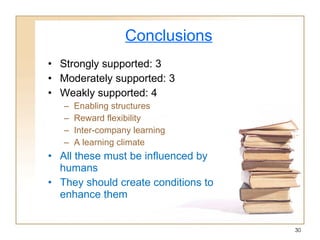
Conclusions Strongly supported: 3 Moderately supported: 3 Weakly supported: 4 Enabling structures Reward flexibility Inter-company learning A learning climate All these must be influenced by humans They should create conditions to enhance them
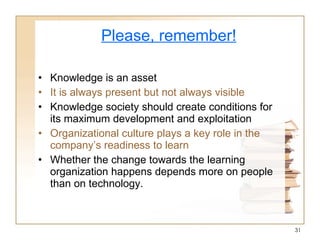
Please, remember! Knowledge is an asset It is always present but not always visible Knowledge society should create conditions for its maximum development and exploitation Organizational culture plays a key role in the company’s readiness to learn Whether the change towards the learning organization happens depends more on people than on technology.
Thank you for your attention! [email_address] http://blogy.etrend.sk/jozef-hvorecky

Knowledge and management

  • 1.
    Knowledge and ManagementJozef Hvorecký Vysoká škola manažmentu, Bratislava, Slovakia University of Liverpool Liverpool, UK
  • 2.
    Knowledge Oxford EnglishDictionary: E xpertise and skills acquired by a person through experience or education What is known in a particular field or in total Theoretical or practical understanding of a subject Awareness or familiarity gained by experience of a fact or situation Facts and information
  • 3.
    Identifying Knowledge Knowledge is to be: True : 1+ 2 = 3 Justifiable : Water boils at 100 0 C Believed : People are more intelligent than animals True Justifie d Believed
  • 4.
    Application of KnowledgeProblem Solution
  • 5.
    Application of KnowledgeProblem Solution Knowledge
  • 6.
    Application of KnowledgeProblem Solution Knowledge Problem Knowledge Solution Calculating salaries Person’s income, Tax regulations, Calculations Net Income, Tax Appendicitis Setting up the diagnosis, Surgery, Treatment Healthy patient Dirty oven Household duties, Detergent application Clean oven Talking to dead Spiritual practices Evoke ghosts
  • 7.
    Acquiring Knowledge: LearningSingle-loop learning (Robinson Crusoe): Trials and errors Exploitation of positive results Mastering gained knowledge Double-loop learning (community) Trials and errors Exploitation of positive results Capturing and sharing gained knowledge Mastering gained knowledge (possibly by others)
  • 8.
    Knowledge: Result ofLearning What do we gain during learning? Explicit Knowledge: Articulated Codified Stored using certain media Tacit Knowledge: Only in human brains Even t he owner may not be aware of it
  • 9.
    When Do WeLearn? Traditional view: At schools ( Face Recognition course :-) At training centers Working on assignments Predominantly explicit Contemporary view: Everywhere At any moment When we create connections between pieces of knowledge Both explicit and tacit
  • 10.
    When Do WeLearn and How? Problems with Knowledge: We often do not know: What we know Why we have learned it How we have learned it
  • 11.
    Learning for a Learning Society Learning Organization and/or Society: The society that is capable to learn in order to prosper, develop, and dominate A person or society that does not learn will suffer . Learning must be: Intentional Purposeful Company’s Good Strategy : Knowledge management
  • 12.
    Two Faces ofKnowledge Management „ Hard“ Knowledge Management: Transposing knowledge into machines: Robots Computer programs Intelligent cars Production lines Etc. „ Soft “ Knowledge Management: Sharing experience Collecting knowledge Following manuals Etc.
  • 13.
    Ba: Places forGaining Knowledge Individual Collective Face-to-Face Originating Ba (Where data is born) Dialoguing Ba (Data pre-selection) Virtual Exercising Ba (New knowledge is verified and used) Systemizing Ba (Data processed to New Knowledge)
  • 14.
    Originating Ba Anyplace where new knowledge can be found Person to person Sen s or to environment Front desk Mars Explorer Information office Temperature sensor Small talk Traffic light camera Classroom lecture Hubble telescope
  • 15.
    Dialoguing Ba Placewhere the observations are “preprocessed”, “filtered”, analyzed Among people People to technology Manager’s office Management Information Systems Coffee corner Decision Support Systems Hearing Datamining (Unification phase) Consultation Expert System
  • 16.
    Systemizing Ba Theplace where new knowledge is verified and claimed “correct” Among people People with technology Evaluation meeting Testing and verification Scientific conference User’s satisfaction Office of Standards Mass application Grading students’ homework Wind channel
  • 17.
    Exercising Ba Theplace where the gained knowledge is applied Among people People with technology Workplace Concentrating on tacit knowledge Strategy implementation Experimenting with data Mental experiments Improving computer performance Joy of knowledge Inventing new devices
  • 18.
    Nonaka -Takeuchi SECIModel Tacit knowledge Explicit Knowledge Tacit Knowledge Socialization Externalization Explicit Knowledge Internalization Combination
  • 19.
    Socialization Sharing knowledge tacit knowledge between/among individuals: Face-to face communication Apprenticeship Couching “ Samba school” Etc. Likely the oldest method of knowledge sharing
  • 20.
    Externalization Expressing tacitknowledge in a conventional, collusive and explicit form: Text Professional notation Guidelines Legislation Etc.
  • 21.
    Combination Building newpieces of explicit knowledge by combining known existing knowledge (forming explicit facts): Evaluation Sorting Categorization Abstraction Etc.
  • 22.
    Internalization “ Privatizing”the gained knowledge, changing it into an asset: Practicing the skills Learning by doing Memorizing Forming a new terminology or notation Etc.
  • 23.
    Learning Organization TRADITIONAL ORGANIZATION LEARNING ORGANIZATION APPROACH TO CHANGE If it works, do not change it If we do not learn, we will extinct APPROACH TO IDEAS If it is not our idea, we do not welcome it Let us not reinvent the wheel RESPONSIBILITY FOR INNOVATIONS Department of research and development Each and every member of the organization MAIN CONCERNS Making wrong decisions Inability to learn and adapt COMPETITIVE ADVANTAGE Products and services Ability to learn and exploit knowledge and experience DUTIES OF MANAGERS Controlling others Supporting others
  • 24.
    How to recognizea Learning Organization?* A learning approach to strategy : The use of trials and errors to improve understanding and generate improvements, and to modify strategic direction as necessary. Participative policy making : All the organization’s members are involved in strategy formation, influencing decisions and values and addressing conflict. In formative : Information technology is used to make information available to everyone and to enable front-line staff to act on their own initiative. * Buchanan and Huczynski : Organizational Behavior , p. 125
  • 25.
    Formative accounting andcontrol : Accounting, budgeting and reporting systems are designed to help people to understand the operations of organizational finance. Internal exchange : Sections and departments think of themselves as customers and suppliers in an internal ‘supply chain’, learning from each other. Reward flexibility : A flexible and creative reward policy with financial and non-financial rewards to meet individual needs and performance. How to recognize a Learning Organization? (cont.)
  • 26.
    Enabling structures : Organizational charts, structures and procedures are seen as temporary, and can be changed to meet task requirements. Boundary workers as environmental scanners : Everyone who has contact with customers, suppliers, clients and business partners is treated as a valuable informative source. Inter-company learning : The organization learns from other organizations through join ventures, alliances, and other information exchanges. How to recognize a Learning Organization? (cont.)
  • 27.
    A learning climate: The manager’s primary task is to facilitate experimentation and learning in others, through questioning, feedback and support. Self-learning opportunities for all : People are expected to take responsibility for their own learning, and facilities are made available, especially to ‘front-line’ staff. How to recognize a Learning Organization? (cont.)
  • 28.
    To What DegreeCan ICT Support Learning in an Organization? 11 indicators 3 values: Strong (ICT replacing humans) Moderate (ICT supports human activities) Weak (Zero, or close to zero)
  • 29.
    Estimated Support IndicatorICT support of the activity INFORMATIVE STRONG FORMATIVE ACCOUNTING AND CONTROL STRONG INTERNAL EXCHANGE STRONG A LEARNING APPROACH TO STRATEGY MODERATE PARTICIPATIVE POLICY MAKING MODERATE SELF-LEARNING OPPORTUNITIES FOR ALL MODERATE BOUNDARY WORKERS AS ENVIRONMENTAL SCANNERS MODERATE ENABLING STRUCTURES WEAK REWARD FLEXIBILITY WEAK INTER-COMPANY LEARNING WEAK A LEARNING CLIMATE WEAK
  • 30.
    Conclusions Strongly supported:3 Moderately supported: 3 Weakly supported: 4 Enabling structures Reward flexibility Inter-company learning A learning climate All these must be influenced by humans They should create conditions to enhance them
  • 31.
    Please, remember! Knowledgeis an asset It is always present but not always visible Knowledge society should create conditions for its maximum development and exploitation Organizational culture plays a key role in the company’s readiness to learn Whether the change towards the learning organization happens depends more on people than on technology.
  • 32.
    Thank you foryour attention! [email_address] http://blogy.etrend.sk/jozef-hvorecky