Sum and Difference
of Two Squares
Ms. G. Martin
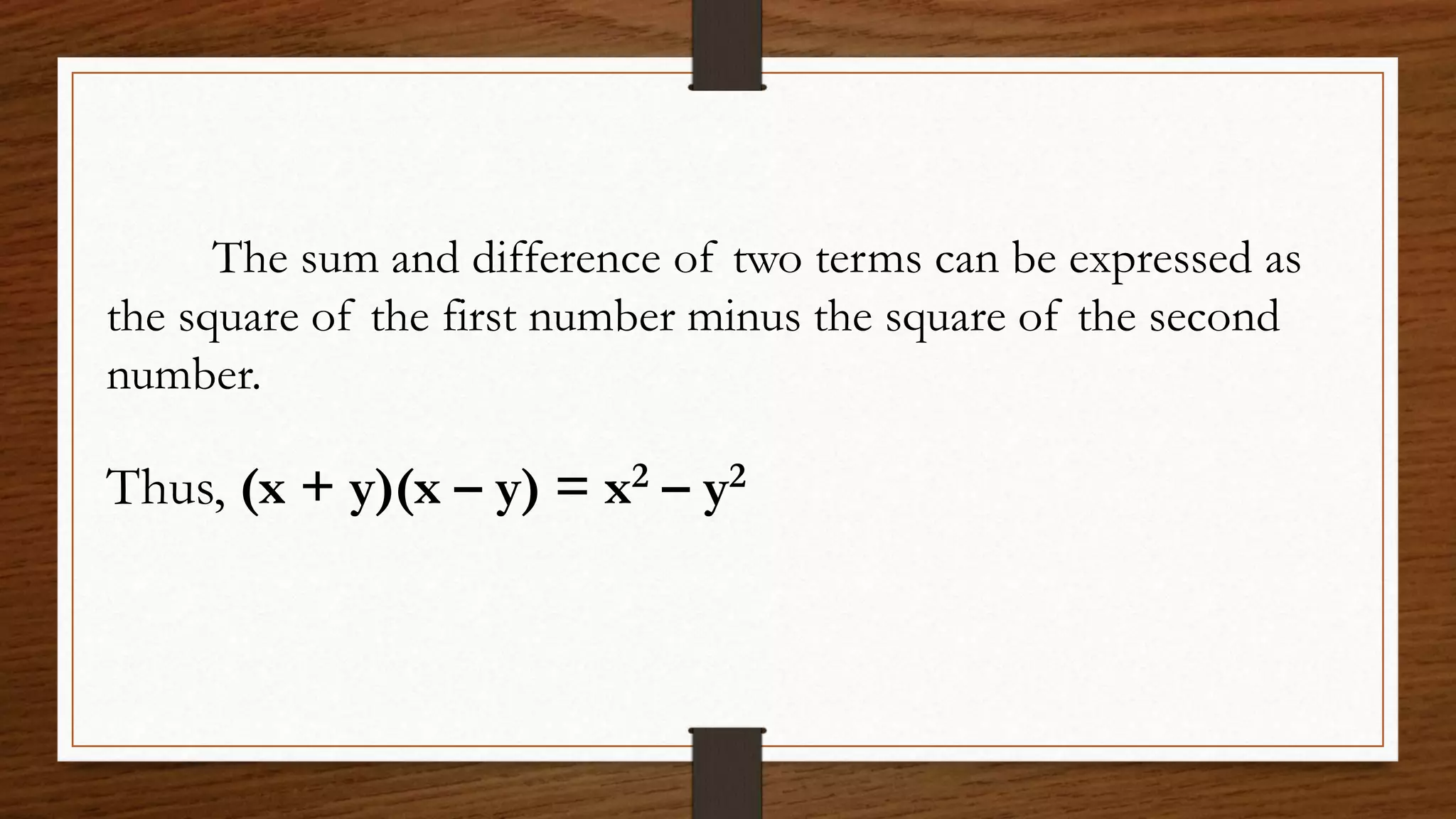
The sum and difference of two terms can be expressed as
the square of the first number minus the square of the second
number.
Thus, (x + y)(x – y) = x2 – y2
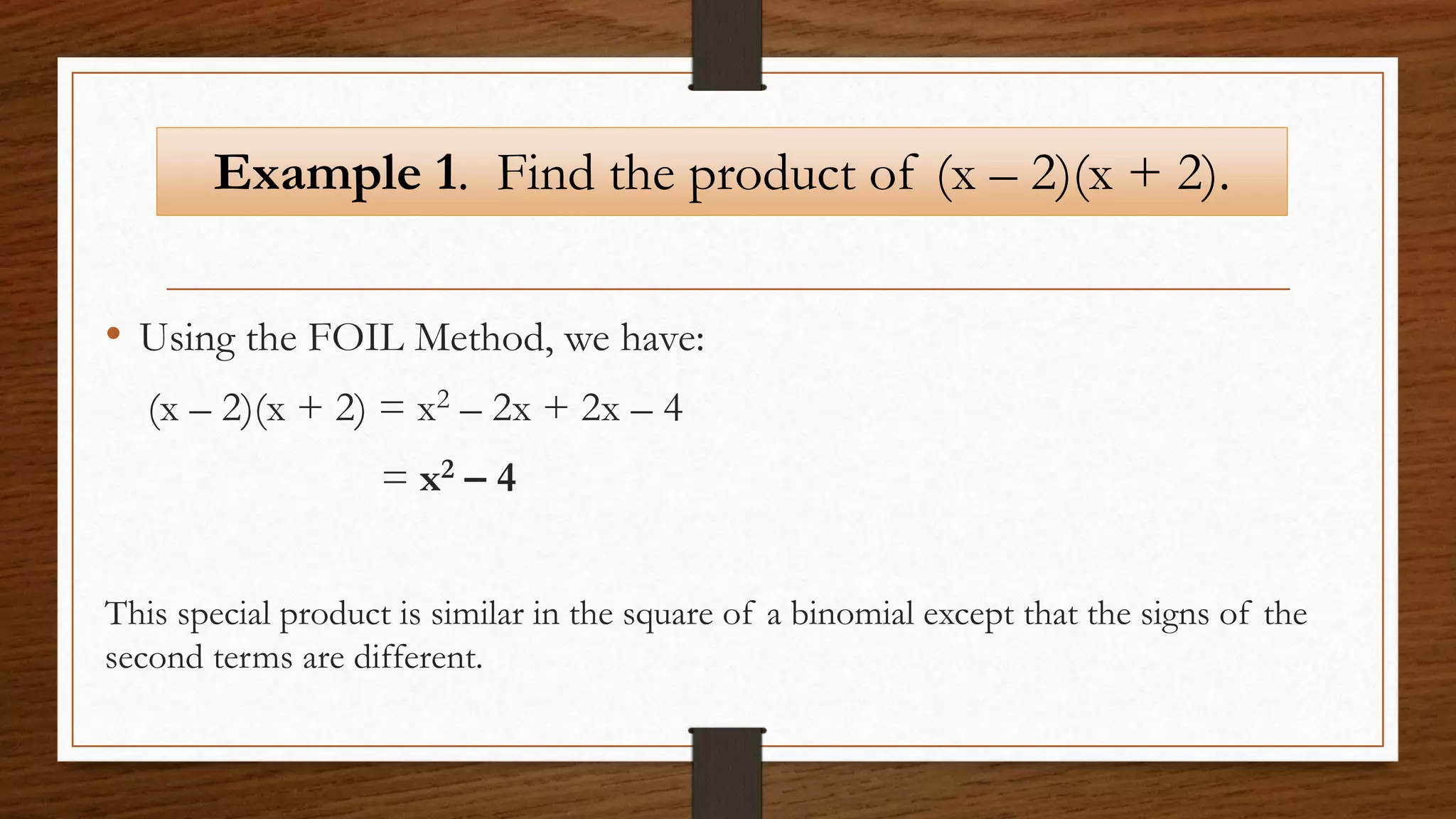
Example 1. Find the product of (x – 2)(x + 2).
• Using the FOIL Method, we have:
(x – 2)(x + 2) = x2 – 2x + 2x – 4
= x2 – 4
This special product is similar in the square of a binomial except that the signs of the
second terms are different.
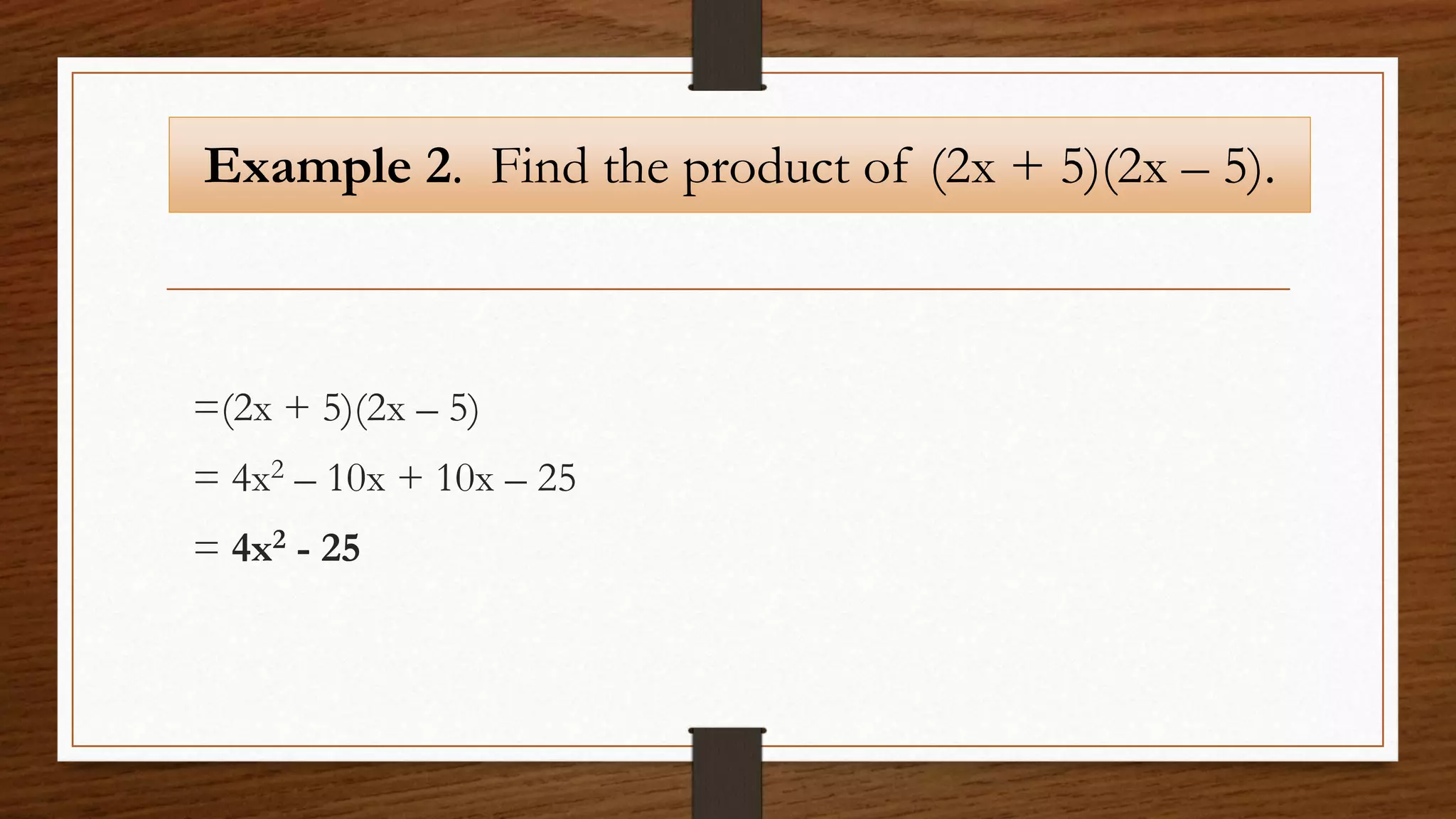
Example 2. Find the product of (2x + 5)(2x – 5).
=(2x + 5)(2x – 5)
= 4x2 – 10x + 10x – 25
= 4x2 - 25
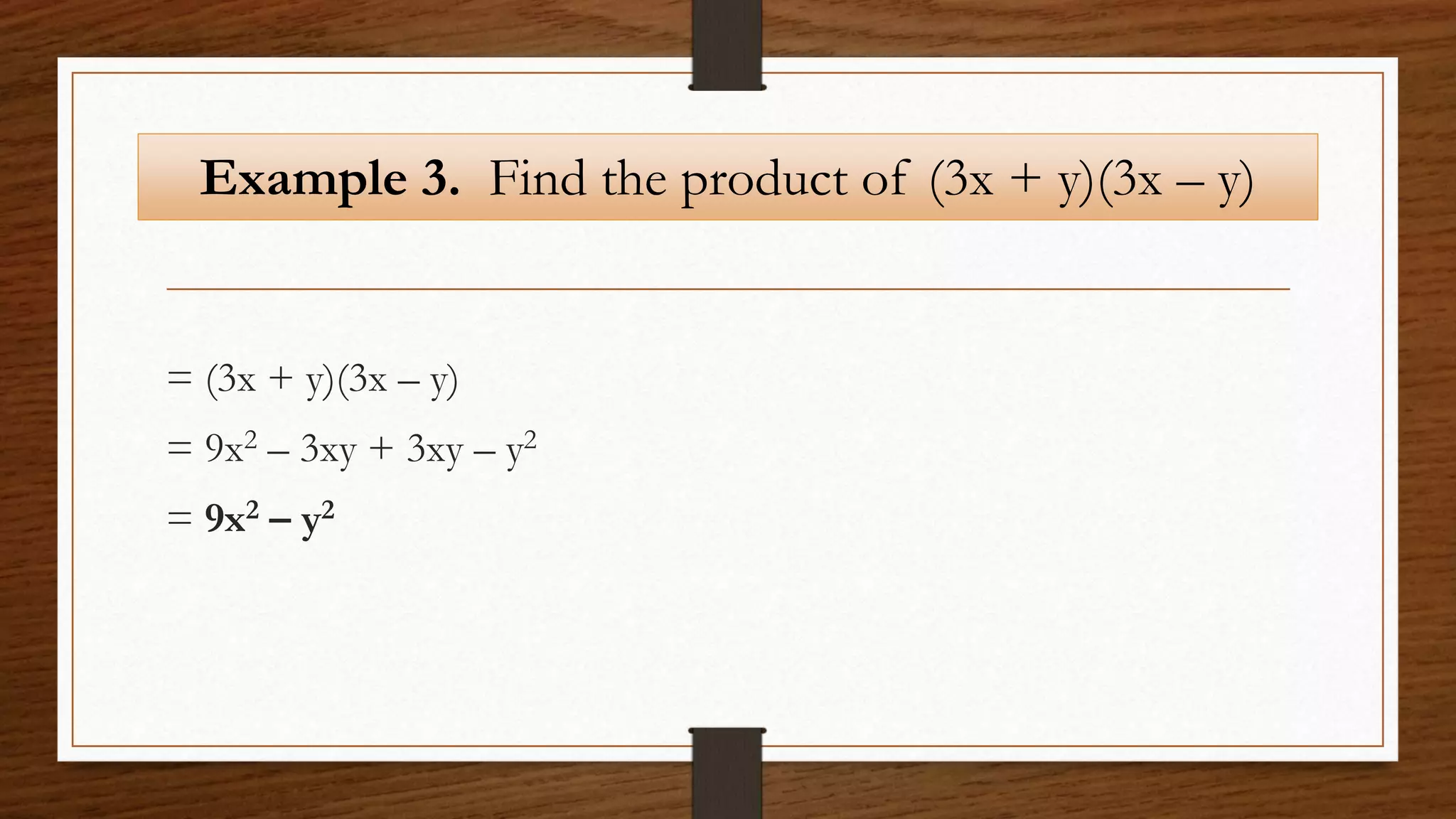
Example 3. Find the product of (3x + y)(3x – y)
= (3x + y)(3x – y)
= 9x2 – 3xy + 3xy – y2
= 9x2 – y2
Example 4. Find the product of (xy4 – 3)(xy4 + 3).
= (xy4 – 3)(xy4 + 3)
= (x2y8 – 9)
Notice that, as illustrated in these examples, multiplying the sum and
difference of two terms is equal to the difference of the squares of
the two terms.

Sum and difference of two squares

  • 1.
    Sum and Difference ofTwo Squares Ms. G. Martin
  • 2.
    The sum anddifference of two terms can be expressed as the square of the first number minus the square of the second number. Thus, (x + y)(x – y) = x2 – y2
  • 3.
    Example 1. Findthe product of (x – 2)(x + 2). • Using the FOIL Method, we have: (x – 2)(x + 2) = x2 – 2x + 2x – 4 = x2 – 4 This special product is similar in the square of a binomial except that the signs of the second terms are different.
  • 4.
    Example 2. Findthe product of (2x + 5)(2x – 5). =(2x + 5)(2x – 5) = 4x2 – 10x + 10x – 25 = 4x2 - 25
  • 5.
    Example 3. Findthe product of (3x + y)(3x – y) = (3x + y)(3x – y) = 9x2 – 3xy + 3xy – y2 = 9x2 – y2
  • 6.
    Example 4. Findthe product of (xy4 – 3)(xy4 + 3). = (xy4 – 3)(xy4 + 3) = (x2y8 – 9) Notice that, as illustrated in these examples, multiplying the sum and difference of two terms is equal to the difference of the squares of the two terms.