Chapter 7: Section 2: Solving Multi-Step Equations January 6 th , 2009
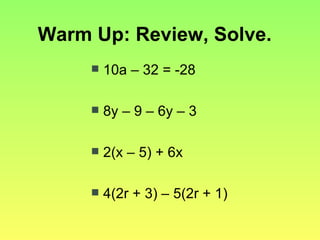
Warm Up: Review, Solve. 10a – 32 = -28 8y – 9 – 6y – 3  2(x – 5) + 6x 4(2r + 3) – 5(2r + 1)
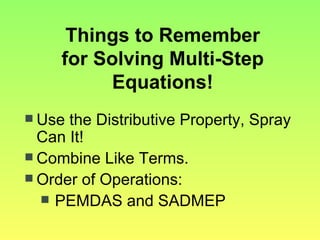
Things to Remember for Solving Multi-Step Equations! Use the Distributive Property, Spray Can It! Combine Like Terms. Order of Operations: PEMDAS and SADMEP
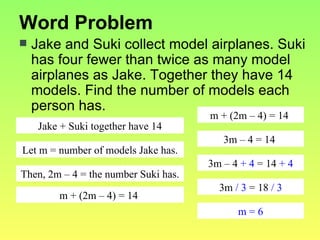
Word Problem Jake and Suki collect model airplanes. Suki has four fewer than twice as many model airplanes as Jake. Together they have 14 models. Find the number of models each person has. Jake + Suki together have 14 Let m = number of models Jake has. Then, 2m – 4 = the number Suki has. m + (2m – 4) = 14  m + (2m – 4) = 14  3m – 4 = 14  3m – 4  + 4  = 14  + 4 3m  / 3  = 18  / 3 m = 6
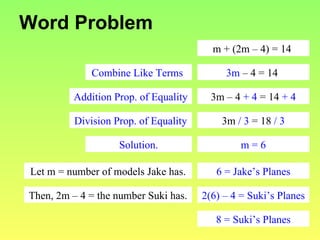
Word Problem m + (2m – 4) = 14  3m  – 4 = 14  3m – 4  + 4  = 14  + 4 3m  / 3  = 18  / 3 m = 6 Combine Like Terms   Addition Prop. of Equality Division Prop. of Equality Solution. Let m = number of models Jake has. Then, 2m – 4 = the number Suki has. 6 = Jake’s Planes 2(6) – 4 = Suki’s Planes 8 = Suki’s Planes
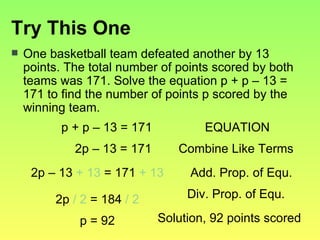
Try This One One basketball team defeated another by 13 points. The total number of points scored by both teams was 171. Solve the equation p + p – 13 = 171 to find the number of points p scored by the winning team. p + p – 13 = 171 2p – 13 = 171 EQUATION Combine Like Terms 2p – 13  + 13  = 171  + 13 Add. Prop. of Equ. p = 92 Div. Prop. of Equ. 2p  / 2  = 184  / 2 Solution, 92 points scored
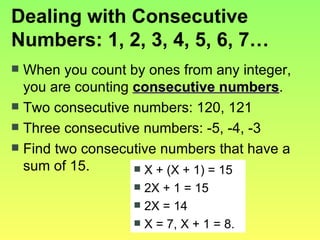
Dealing with Consecutive Numbers: 1, 2, 3, 4, 5, 6, 7… When you count by ones from any integer, you are counting  consecutive numbers . Two consecutive numbers: 120, 121 Three consecutive numbers: -5, -4, -3 Find two consecutive numbers that have a sum of 15. X + (X + 1) = 15 2X + 1 = 15 2X = 14 X = 7, X + 1 = 8.
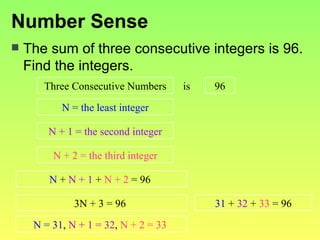
Number Sense The sum of three consecutive integers is 96. Find the integers. Three Consecutive Numbers is 96 N = the least integer N + 1 = the second integer N + 2 = the third integer N  +   N + 1  +  N + 2  = 96  3N + 3 = 96  N = 31 ,  N + 1 = 32 ,  N + 2 = 33   31  +  32  +  33  = 96
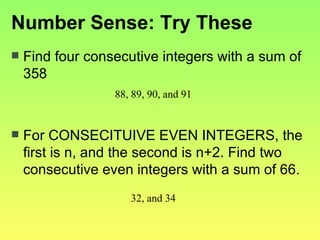
Number Sense: Try These Find four consecutive integers with a sum of 358 For CONSECITUIVE EVEN INTEGERS, the first is n, and the second is n+2. Find two consecutive even integers with a sum of 66. 88, 89, 90, and 91 32, and 34
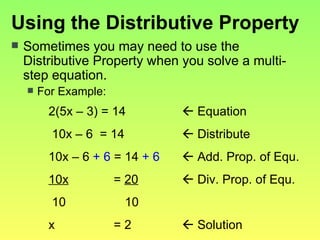
Using the Distributive Property Sometimes you may need to use the Distributive Property when you solve a multi-step equation. For Example: 2(5x – 3) = 14 10x – 6  = 14 10x – 6  + 6  = 14  + 6 10x   =  20 10  10 x  = 2    Equation    Distribute    Add. Prop. of Equ.    Div. Prop. of Equ.    Solution
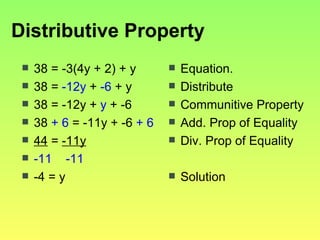
Distributive Property 38 = -3(4y + 2) + y 38 =  -12y  +  -6  + y 38 = -12y +  y  + -6 38  + 6  = -11y + -6  + 6 44  =  -11y -11  -11 -4 = y Equation. Distribute Communitive Property Add. Prop of Equality Div. Prop of Equality Solution
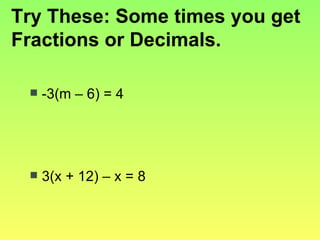
Try These: Some times you get Fractions or Decimals. -3(m – 6) = 4 3(x + 12) – x = 8
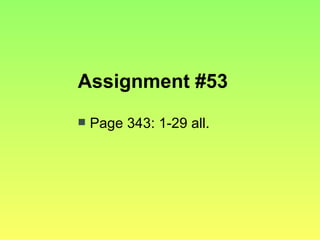
Assignment #53 Page 343: 1-29 all.

7.2 Solving Multi Step Equations

  • 1.
    Chapter 7: Section2: Solving Multi-Step Equations January 6 th , 2009
  • 2.
    Warm Up: Review,Solve. 10a – 32 = -28 8y – 9 – 6y – 3 2(x – 5) + 6x 4(2r + 3) – 5(2r + 1)
  • 3.
    Things to Rememberfor Solving Multi-Step Equations! Use the Distributive Property, Spray Can It! Combine Like Terms. Order of Operations: PEMDAS and SADMEP
  • 4.
    Word Problem Jakeand Suki collect model airplanes. Suki has four fewer than twice as many model airplanes as Jake. Together they have 14 models. Find the number of models each person has. Jake + Suki together have 14 Let m = number of models Jake has. Then, 2m – 4 = the number Suki has. m + (2m – 4) = 14 m + (2m – 4) = 14 3m – 4 = 14 3m – 4 + 4 = 14 + 4 3m / 3 = 18 / 3 m = 6
  • 5.
    Word Problem m+ (2m – 4) = 14 3m – 4 = 14 3m – 4 + 4 = 14 + 4 3m / 3 = 18 / 3 m = 6 Combine Like Terms Addition Prop. of Equality Division Prop. of Equality Solution. Let m = number of models Jake has. Then, 2m – 4 = the number Suki has. 6 = Jake’s Planes 2(6) – 4 = Suki’s Planes 8 = Suki’s Planes
  • 6.
    Try This OneOne basketball team defeated another by 13 points. The total number of points scored by both teams was 171. Solve the equation p + p – 13 = 171 to find the number of points p scored by the winning team. p + p – 13 = 171 2p – 13 = 171 EQUATION Combine Like Terms 2p – 13 + 13 = 171 + 13 Add. Prop. of Equ. p = 92 Div. Prop. of Equ. 2p / 2 = 184 / 2 Solution, 92 points scored
  • 7.
    Dealing with ConsecutiveNumbers: 1, 2, 3, 4, 5, 6, 7… When you count by ones from any integer, you are counting consecutive numbers . Two consecutive numbers: 120, 121 Three consecutive numbers: -5, -4, -3 Find two consecutive numbers that have a sum of 15. X + (X + 1) = 15 2X + 1 = 15 2X = 14 X = 7, X + 1 = 8.
  • 8.
    Number Sense Thesum of three consecutive integers is 96. Find the integers. Three Consecutive Numbers is 96 N = the least integer N + 1 = the second integer N + 2 = the third integer N + N + 1 + N + 2 = 96 3N + 3 = 96 N = 31 , N + 1 = 32 , N + 2 = 33 31 + 32 + 33 = 96
  • 9.
    Number Sense: TryThese Find four consecutive integers with a sum of 358 For CONSECITUIVE EVEN INTEGERS, the first is n, and the second is n+2. Find two consecutive even integers with a sum of 66. 88, 89, 90, and 91 32, and 34
  • 10.
    Using the DistributiveProperty Sometimes you may need to use the Distributive Property when you solve a multi-step equation. For Example: 2(5x – 3) = 14 10x – 6 = 14 10x – 6 + 6 = 14 + 6 10x = 20 10 10 x = 2  Equation  Distribute  Add. Prop. of Equ.  Div. Prop. of Equ.  Solution
  • 11.
    Distributive Property 38= -3(4y + 2) + y 38 = -12y + -6 + y 38 = -12y + y + -6 38 + 6 = -11y + -6 + 6 44 = -11y -11 -11 -4 = y Equation. Distribute Communitive Property Add. Prop of Equality Div. Prop of Equality Solution
  • 12.
    Try These: Sometimes you get Fractions or Decimals. -3(m – 6) = 4 3(x + 12) – x = 8
  • 13.
    Assignment #53 Page343: 1-29 all.