Families in the periodic table
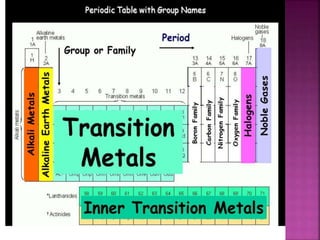
 Members of the families (vertical columns) in
the periodic table have similar properties.
The families are labeled at the top of the
columns in one of two ways:
The older method uses Roman numerals
and letters. Many chemists prefer and still
use this method.
The newer method uses the numbers 1
through 18.
 The IA family is made up of the alkali metals.
In reactions,these elements all tend to
lose a single electron.these family contains
some important elements/such as soduim
(NA)and potassium(k).
The IIA family is made up of the alkaline earth
metals.
All these elements tends to lose two
electrons.Calcium is an important member of
the IIA family.
 The VIIA family is made up of
the halogens. They all tend to gain a
single electron in reactions. Important
members in the family include chlorine
(Cl), used in making table salt and bleach,
and iodine (I).
VIIIA family is made up of tThe
he noble gases. These elements are
very unreactive. For a long time, the
noble gases were called the inert
gases, because people thought that
these elements wouldn’t react at all.
Noble Gases-make up the most
stable elements on the periodic
table.
MEMBERS:(Ar)ARGON,(He)heium),(Kr)
krypton,(Ne)neon,(Rn)radon,(Uuo)U
nunoctium,(e)xenon
Halogens are highly
reactive.because they lack
onlu 1 electron in their
outer shell to be
complete,they will readily
form compounds with
other elements.
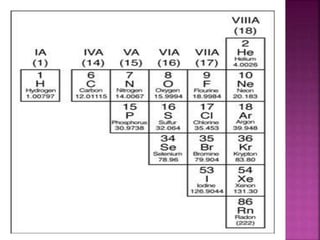
Nonmetals
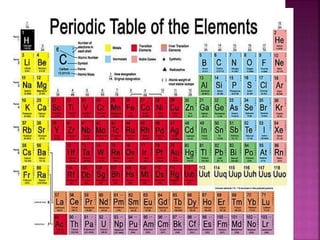
 Except for the elements that border the
stair-stepped line, the elements to the right
of the line are classified as nonmetals (along
with hydrogen). Nonmetals have properties
opposite those of the metals.
 The nonmetals are brittle, not malleable or
ductile, poor conductors of both heat and
electricity, and tend to gain electrons in
chemical reactions. Some nonmetals are
liquids. These elements are shown in the
following figure.
Metalloids
The elements that border the stair-
stepped line are classified
as metalloids. The metalloids,
or semimetals, have properties that
are somewhat of a cross between
metals and nonmetals.
Metalloids tend to be economically
important because of their unique
conductivity properties (they only
partially conduct electricity), which
make them valuable in the
semiconductor and computer chip
industry
 The thirty rare earth elements are
composed of the lanthanide and actinide
series. One element of the lanthanide
series and most of the elements in the
actinide series are called trans-uranium,
which means synthetic or man-made. All
of the rare earth metals are found in
group 3 of the periodic table, and the 6th
and 7th periods. The Rare Earth Elements
are made up of two series of elements,
the Lanthanide and Actinide Series
 The IUPAC definition[1] defines a transition
metal as "an element whose atom has a
partially filled d sub-shell, or which can give
rise to cations with an incomplete d sub-
shell“
 Many scientists describe a "transition metal"
as any element in the d-block of the periodic
table, which includes groups 3 to 12 on the
periodic table.[2][3] In actual practice, the f-
block lanthanide and actinide series are also
considered transition metals and are called
"inner transition metals".
 Cotton and Wilkinson[4] follow the IUPAC
definition (see above) which includes
scandium and yttrium on the grounds that
they at least have a partially filled d
subshell in the metallic state. However
even this does not (so far) seem to confer
catalytic properties on them which is so
characteristic of the transition metals in
general. Lanthanum and actinium are
included with the lanthanides and
actinides respectively.
elemental families and groups

elemental families and groups

  • 2.
    Families in theperiodic table  Members of the families (vertical columns) in the periodic table have similar properties. The families are labeled at the top of the columns in one of two ways: The older method uses Roman numerals and letters. Many chemists prefer and still use this method. The newer method uses the numbers 1 through 18.
  • 3.
     The IAfamily is made up of the alkali metals. In reactions,these elements all tend to lose a single electron.these family contains some important elements/such as soduim (NA)and potassium(k). The IIA family is made up of the alkaline earth metals. All these elements tends to lose two electrons.Calcium is an important member of the IIA family.
  • 4.
     The VIIAfamily is made up of the halogens. They all tend to gain a single electron in reactions. Important members in the family include chlorine (Cl), used in making table salt and bleach, and iodine (I). VIIIA family is made up of tThe he noble gases. These elements are very unreactive. For a long time, the noble gases were called the inert gases, because people thought that these elements wouldn’t react at all.
  • 5.
    Noble Gases-make upthe most stable elements on the periodic table. MEMBERS:(Ar)ARGON,(He)heium),(Kr) krypton,(Ne)neon,(Rn)radon,(Uuo)U nunoctium,(e)xenon
  • 6.
    Halogens are highly reactive.becausethey lack onlu 1 electron in their outer shell to be complete,they will readily form compounds with other elements.
  • 7.
    Nonmetals  Except forthe elements that border the stair-stepped line, the elements to the right of the line are classified as nonmetals (along with hydrogen). Nonmetals have properties opposite those of the metals.  The nonmetals are brittle, not malleable or ductile, poor conductors of both heat and electricity, and tend to gain electrons in chemical reactions. Some nonmetals are liquids. These elements are shown in the following figure.
  • 9.
    Metalloids The elements thatborder the stair- stepped line are classified as metalloids. The metalloids, or semimetals, have properties that are somewhat of a cross between metals and nonmetals. Metalloids tend to be economically important because of their unique conductivity properties (they only partially conduct electricity), which make them valuable in the semiconductor and computer chip industry
  • 10.
     The thirtyrare earth elements are composed of the lanthanide and actinide series. One element of the lanthanide series and most of the elements in the actinide series are called trans-uranium, which means synthetic or man-made. All of the rare earth metals are found in group 3 of the periodic table, and the 6th and 7th periods. The Rare Earth Elements are made up of two series of elements, the Lanthanide and Actinide Series
  • 11.
     The IUPACdefinition[1] defines a transition metal as "an element whose atom has a partially filled d sub-shell, or which can give rise to cations with an incomplete d sub- shell“  Many scientists describe a "transition metal" as any element in the d-block of the periodic table, which includes groups 3 to 12 on the periodic table.[2][3] In actual practice, the f- block lanthanide and actinide series are also considered transition metals and are called "inner transition metals".
  • 12.
     Cotton andWilkinson[4] follow the IUPAC definition (see above) which includes scandium and yttrium on the grounds that they at least have a partially filled d subshell in the metallic state. However even this does not (so far) seem to confer catalytic properties on them which is so characteristic of the transition metals in general. Lanthanum and actinium are included with the lanthanides and actinides respectively.