Green Transportation options make our lives
easier, reduce congestion, our dependence on
foreign oil, are safer & less costly, and help
save the planet.
GREEN TRANSPORTATION
Electronic Vehicles
Nayan Gupta 1
Introduction
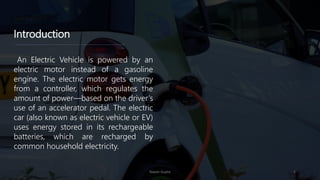
An Electric Vehicle is powered by an
electric motor instead of a gasoline
engine. The electric motor gets energy
from a controller, which regulates the
amount of power—based on the driver’s
use of an accelerator pedal. The electric
car (also known as electric vehicle or EV)
uses energy stored in its rechargeable
batteries, which are recharged by
common household electricity.
Nayan Gupta 2
Why do we need Electronic Vehicles
Gasoline Vehicles
• Causes Pollution.
• Maintenance is high.
Electronic vehicle
• Are eco friendly.
• Saves money.
Nayan Gupta 3
Problem with gasoline
• The Environment
Despite recent efforts to improve fuel efficiency
and reduce toxic emissions in cars, emissions have
continued to increase steadily in the past two
decades. When gasoline combusts it releases the
end products of carbon dioxide, carbon
monoxide, and nitrogen oxides, which may
contribute to climate change. Even the infusion of
10% ethanol into gasoline has not rectified the
emission problem.
• Health
Gasoline exposure can occur from filling your
tank, from a gas leak in your engine, or from
general spills and accidents. Gasoline can
contaminate drinking water or nearby soil if you
have a well system or soil near your driveway.
High levels of gasoline chemicals taken in from
day-to-day exposure like benzene may cause
cancer, according to the Illinois Department of
Public Health.
Nayan Gupta 4
• Fossil Fuels Dependency
It is quite widely known that the earth is running low
on fossil fuels, which gasoline is a large component
of. Even though the estimates of geologists and oil
companies predict that there is a limited amount of
oil remaining, their estimates may still be large
exaggerations according to Common Dreams. Since
gasoline may run out in the next century, it is
imperative to begin making changes in the world.
• Oil Politics
It's strange to think that something as simple as
what we put in our cars could have political
implications. Currently, the Middle East holds an
extreme degree of authority in the world due to the
world's dependency on the oil deposits found in that
region. Other world leaders have an inordinately
large amount of control as well because of oil,
including Iran's Mahmoud Ahmadinejad and
Venezuela's Hugo Chavez, according to Market
Watch.
Working of an Electronic Vehicle
• The Battery
The batteries can be charged through the use of
ordinary grid electricity at a specialized power
station. Aside from conventional lithium ion battery
technologies, there are at least four major battery
technologies now represented: Solid state,
aluminium ion, lithium sulphur, and metal-air
• The Motor Controller
The control system governs the complete operation
of the electric vehicle and the distribution of its
power at any given moment. Equipped with a
powerful microprocessor, it can limit or redirect
current – either to improve the mechanical
performance of the device or suit the operator’s
driving style. Generally, more sophisticated
controllers are capable of greater precision and thus,
higher efficiency.
Nayan Gupta 5
• Regenerative Braking
It allows for the extraction of energy from the braked
components so it can be reused rather than wasted.
When the operator applies the brake, the electric
motor goes into reverse mode, allowing the motor
itself to do most of the “braking” and thus prevent
more kinetic energy from being lost. This contrasts
conventional systems using brake pads, which
generate friction at multiple levels to achieve breaking.
• The Electric Engine
Electric engines can be structured to use either AC or
DC current. AC motors tend to be less expensive and
lighter than DC engines, reaching about 95% efficiency
at full load compared to the 85%-95% attained by AC
engines. AC engines are more common in other types
of electrical devices and, due in large part to the
reduced number of moving parts, tend to be suffer
from less mechanical wear and tear. AC technology
requires a more sophisticated controller.
Companies making Electronic Vehicles
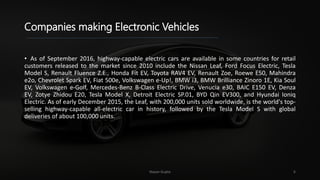
• As of September 2016, highway-capable electric cars are available in some countries for retail
customers released to the market since 2010 include the Nissan Leaf, Ford Focus Electric, Tesla
Model S, Renault Fluence Z.E., Honda Fit EV, Toyota RAV4 EV, Renault Zoe, Roewe E50, Mahindra
e2o, Chevrolet Spark EV, Fiat 500e, Volkswagen e-Up!, BMW i3, BMW Brilliance Zinoro 1E, Kia Soul
EV, Volkswagen e-Golf, Mercedes-Benz B-Class Electric Drive, Venucia e30, BAIC E150 EV, Denza
EV, Zotye Zhidou E20, Tesla Model X, Detroit Electric SP.01, BYD Qin EV300, and Hyundai Ioniq
Electric. As of early December 2015, the Leaf, with 200,000 units sold worldwide, is the world's top-
selling highway-capable all-electric car in history, followed by the Tesla Model S with global
deliveries of about 100,000 units.
Nayan Gupta 6
THANK YOU
Nayan Gupta
KIIT
Nayan Gupta 7

Electronic Vehicles (Green Transportation)

  • 1.
    Green Transportation optionsmake our lives easier, reduce congestion, our dependence on foreign oil, are safer & less costly, and help save the planet. GREEN TRANSPORTATION Electronic Vehicles Nayan Gupta 1
  • 2.
    Introduction An Electric Vehicleis powered by an electric motor instead of a gasoline engine. The electric motor gets energy from a controller, which regulates the amount of power—based on the driver’s use of an accelerator pedal. The electric car (also known as electric vehicle or EV) uses energy stored in its rechargeable batteries, which are recharged by common household electricity. Nayan Gupta 2
  • 3.
    Why do weneed Electronic Vehicles Gasoline Vehicles • Causes Pollution. • Maintenance is high. Electronic vehicle • Are eco friendly. • Saves money. Nayan Gupta 3
  • 4.
    Problem with gasoline •The Environment Despite recent efforts to improve fuel efficiency and reduce toxic emissions in cars, emissions have continued to increase steadily in the past two decades. When gasoline combusts it releases the end products of carbon dioxide, carbon monoxide, and nitrogen oxides, which may contribute to climate change. Even the infusion of 10% ethanol into gasoline has not rectified the emission problem. • Health Gasoline exposure can occur from filling your tank, from a gas leak in your engine, or from general spills and accidents. Gasoline can contaminate drinking water or nearby soil if you have a well system or soil near your driveway. High levels of gasoline chemicals taken in from day-to-day exposure like benzene may cause cancer, according to the Illinois Department of Public Health. Nayan Gupta 4 • Fossil Fuels Dependency It is quite widely known that the earth is running low on fossil fuels, which gasoline is a large component of. Even though the estimates of geologists and oil companies predict that there is a limited amount of oil remaining, their estimates may still be large exaggerations according to Common Dreams. Since gasoline may run out in the next century, it is imperative to begin making changes in the world. • Oil Politics It's strange to think that something as simple as what we put in our cars could have political implications. Currently, the Middle East holds an extreme degree of authority in the world due to the world's dependency on the oil deposits found in that region. Other world leaders have an inordinately large amount of control as well because of oil, including Iran's Mahmoud Ahmadinejad and Venezuela's Hugo Chavez, according to Market Watch.
  • 5.
    Working of anElectronic Vehicle • The Battery The batteries can be charged through the use of ordinary grid electricity at a specialized power station. Aside from conventional lithium ion battery technologies, there are at least four major battery technologies now represented: Solid state, aluminium ion, lithium sulphur, and metal-air • The Motor Controller The control system governs the complete operation of the electric vehicle and the distribution of its power at any given moment. Equipped with a powerful microprocessor, it can limit or redirect current – either to improve the mechanical performance of the device or suit the operator’s driving style. Generally, more sophisticated controllers are capable of greater precision and thus, higher efficiency. Nayan Gupta 5 • Regenerative Braking It allows for the extraction of energy from the braked components so it can be reused rather than wasted. When the operator applies the brake, the electric motor goes into reverse mode, allowing the motor itself to do most of the “braking” and thus prevent more kinetic energy from being lost. This contrasts conventional systems using brake pads, which generate friction at multiple levels to achieve breaking. • The Electric Engine Electric engines can be structured to use either AC or DC current. AC motors tend to be less expensive and lighter than DC engines, reaching about 95% efficiency at full load compared to the 85%-95% attained by AC engines. AC engines are more common in other types of electrical devices and, due in large part to the reduced number of moving parts, tend to be suffer from less mechanical wear and tear. AC technology requires a more sophisticated controller.
  • 6.
    Companies making ElectronicVehicles • As of September 2016, highway-capable electric cars are available in some countries for retail customers released to the market since 2010 include the Nissan Leaf, Ford Focus Electric, Tesla Model S, Renault Fluence Z.E., Honda Fit EV, Toyota RAV4 EV, Renault Zoe, Roewe E50, Mahindra e2o, Chevrolet Spark EV, Fiat 500e, Volkswagen e-Up!, BMW i3, BMW Brilliance Zinoro 1E, Kia Soul EV, Volkswagen e-Golf, Mercedes-Benz B-Class Electric Drive, Venucia e30, BAIC E150 EV, Denza EV, Zotye Zhidou E20, Tesla Model X, Detroit Electric SP.01, BYD Qin EV300, and Hyundai Ioniq Electric. As of early December 2015, the Leaf, with 200,000 units sold worldwide, is the world's top- selling highway-capable all-electric car in history, followed by the Tesla Model S with global deliveries of about 100,000 units. Nayan Gupta 6
  • 7.