CHAPTER-1
ENVIRONMENTAL IMPACT, HISTORYAND ELECTRIC VEHICLE TYPES
LEARNING OUTCOMES:
1. List different pollutants produced by IC engine vehicle (ICEV) and state their effect on human health.
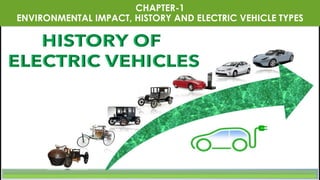
2. Briefly explain the historical journey of electric vehicle.
3. Define Electric vehicle and state the need of electric vehicle.
4. Briefly explain the problems encountered by humans with usage of Electric vehicles.
5. List the Advantages and disadvantages of electric vehicles.
6. Compare Battery Electric Vehicle (BEV) & conventional vehicles.
7. Draw the block diagram of electric vehicle and explain the major components.
8. Classification of electric vehicles according to the source of power as BEV, HEV , PHEV and FCEV.
9. Explain Battery Electric Vehicle (BEV) with a neat block diagram.
10.Explain Hybrid electric Vehicle (HEV) with a neat block diagram.
11.Explain Plug-in Hybrid Electric Vehicle (PHEV) with a neat block diagram.
12.Explain Fuel Cell Electric Vehicle (FCEV) with a neat block diagram.
4.
1.0 INTRODUCTION
• EnvironmentalImpact:
• Traditional vehicles cause pollution and climate change.
• EVs reduce air pollution and greenhouse gas emissions, helping protect
the environment.
• History:
• Transport began with walking, animal use, and wheel-based carts.
• Over time, steam engines and fuel-powered cars evolved into today’s
electric vehicles.
• Types of EVs:
• Battery Electric Vehicles (BEVs) – Fully electric, no fuel needed.
• Plug-in Hybrid Electric Vehicles (PHEVs) – Use both electricity and fuel.
• Hybrid Electric Vehicles (HEVs) – Use fuel with electric assistance, no
external charging needed.
5.
1.1 INTERNAL COMBUSTION(IC) ENGINE VEHICLES
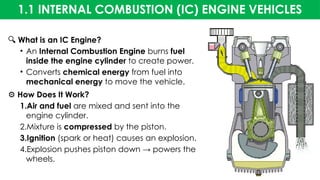
🔍 What is an IC Engine?
• An Internal Combustion Engine burns fuel
inside the engine cylinder to create power.
• Converts chemical energy from fuel into
mechanical energy to move the vehicle.
⚙️How Does It Work?
1.Air and fuel are mixed and sent into the
engine cylinder.
2.Mixture is compressed by the piston.
3.Ignition (spark or heat) causes an explosion.
4.Explosion pushes piston down → powers the
wheels.
6.
1.1 INTERNAL COMBUSTION(IC) ENGINE VEHICLES
️
🛠️Types of IC Engines
• Spark Ignition (SI) Engines
• Use petrol/gasoline
• Ignition by spark plug
• Compression Ignition (CI) Engines
• Use diesel
• Ignition by high pressure & heat
⛽ Fuels Used in IC Engines
• Petrol (Gasoline)
• Diesel
• Compressed Natural Gas (CNG)
• Liquefied Petroleum Gas (LPG)
• Biofuels (ethanol, biodiesel – in some vehicles)
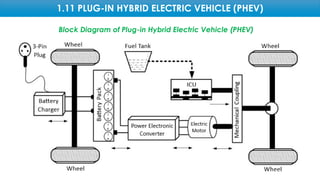
7.
1.1.1 DIFFERENT POLLUTANTSPRODUCED BY INTERNAL COMBUSTION (IC) ENGINE VEHICLES
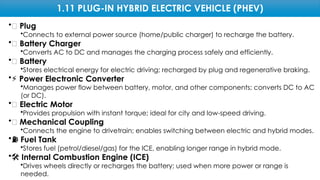
1. Carbon Monoxide (CO)
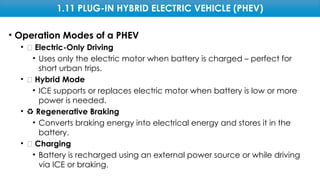
• Colorless, odorless gas from incomplete combustion
2. Carbon Dioxide (CO )
₂
• Greenhouse gas from complete fuel combustion
3. Nitrogen Oxides (NO )
ₓ
• Includes NO and NO ; formed at high combustion temps
₂
4. Unburned Hydrocarbons (HC)
• Incomplete fuel combustion
5. Particulate Matter (PM)
• Soot and fine particles from diesel engines
6. Sulfur Dioxide (SO )
₂
• From sulfur in diesel and other fuels
7. Volatile Organic Compounds (VOCs)
• Evaporate from fuel and solvents
8. Lead (Pb)
• From leaded gasoline (still used in some regions)
9. Ozone (O ) [Secondary Pollutant]
₃
• Not directly emitted—formed from NO + VOCs in sunlight
ₓ
8.
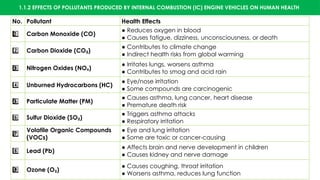
1.1.2 EFFECTS OFPOLLUTANTS PRODUCED BY INTERNAL COMBUSTION (IC) ENGINE VEHICLES ON HUMAN HEALTH
No. Pollutant Health Effects
1 ️
1️⃣ Carbon Monoxide (CO)
● Reduces oxygen in blood
● Causes fatigue, dizziness, unconsciousness, or death
2️⃣ Carbon Dioxide (CO )
₂
● Contributes to climate change
● Indirect health risks from global warming
3 ️
3️⃣ Nitrogen Oxides (NO )
ₓ
● Irritates lungs, worsens asthma
● Contributes to smog and acid rain
4️⃣ Unburned Hydrocarbons (HC)
● Eye/nose irritation
● Some compounds are carcinogenic
5 ️
5️⃣ Particulate Matter (PM)
● Causes asthma, lung cancer, heart disease
● Premature death risk
6️⃣ Sulfur Dioxide (SO )
₂
● Triggers asthma attacks
● Respiratory irritation
7 ️
7️⃣
Volatile Organic Compounds
(VOCs)
● Eye and lung irritation
● Some are toxic or cancer-causing
8️⃣ Lead (Pb)
● Affects brain and nerve development in children
● Causes kidney and nerve damage
9 ️
9️⃣ Ozone (O )
₃
● Causes coughing, throat irritation
● Worsens asthma, reduces lung function
9.
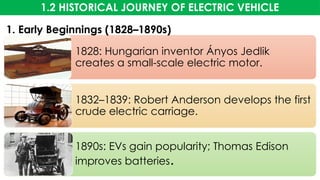
1.2 HISTORICAL JOURNEYOF ELECTRIC VEHICLE
1828: Hungarian inventor Ányos Jedlik
creates a small-scale electric motor.
1832–1839: Robert Anderson develops the first
crude electric carriage.
1890s: EVs gain popularity; Thomas Edison
improves batteries.
1. Early Beginnings (1828–1890s)
10.
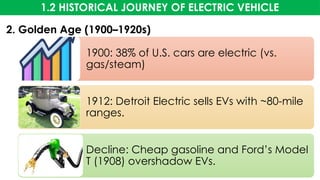
1.2 HISTORICAL JOURNEYOF ELECTRIC VEHICLE
2. Golden Age (1900–1920s)
1900: 38% of U.S. cars are electric (vs.
gas/steam)
1912: Detroit Electric sells EVs with ~80-mile
ranges.
Decline: Cheap gasoline and Ford’s Model
T (1908) overshadow EVs.
11.
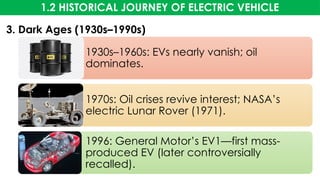
1.2 HISTORICAL JOURNEYOF ELECTRIC VEHICLE
3. Dark Ages (1930s–1990s)
1930s–1960s: EVs nearly vanish; oil
dominates.
1970s: Oil crises revive interest; NASA’s
electric Lunar Rover (1971).
1996: General Motor’s EV1—first mass-
produced EV (later controversially
recalled).
12.
1.2 HISTORICAL JOURNEYOF ELECTRIC VEHICLE
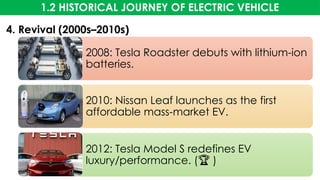
4. Revival (2000s–2010s)
2008: Tesla Roadster debuts with lithium-ion
batteries.
2010: Nissan Leaf launches as the first
affordable mass-market EV.
2012: Tesla Model S redefines EV
luxury/performance. ( )
🏆
13.
1.2 HISTORICAL JOURNEYOF ELECTRIC VEHICLE
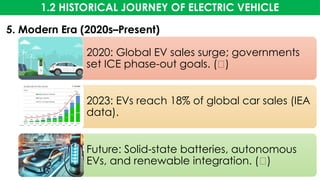
5. Modern Era (2020s–Present)
2020: Global EV sales surge; governments
set ICE phase-out goals. (🌱)
2023: EVs reach 18% of global car sales (IEA
data).
Future: Solid-state batteries, autonomous
EVs, and renewable integration. (🚀)
14.
1.3 DEFINITION OFELECTRIC VEHICLE
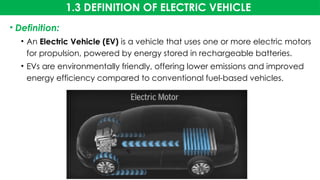
• Definition:
• An Electric Vehicle (EV) is a vehicle that uses one or more electric motors
for propulsion, powered by energy stored in rechargeable batteries.
• EVs are environmentally friendly, offering lower emissions and improved
energy efficiency compared to conventional fuel-based vehicles.
15.
1.3 DEFINITION OFELECTRIC VEHICLE
Types of Electric Vehicles
1.Battery Electric Vehicle (BEV)
1. Fully electric, powered only by batteries
2. Zero tailpipe emissions
3. Example: Tesla Model 3
2.Plug-in Hybrid Electric Vehicle (PHEV)
1. Combines an internal combustion engine with an electric motor
2. Can be recharged via external power source
3. Example: Toyota Prius Prime
3.Hybrid Electric Vehicle (HEV)
1. Uses both fuel and electric power
2. Batteries are charged through regenerative braking
3. Example: Toyota Camry Hybrid
4.Fuel Cell Electric Vehicle (FCEV)
1. Uses hydrogen gas to generate electricity
2. Emits only water vapor
3. Example: Toyota Mirai
16.
1.3.1 NEED OFELECTRIC VEHICLE
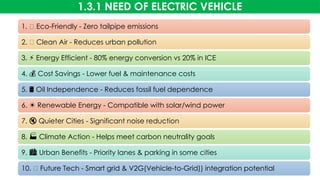
1. 🌿 Eco-Friendly - Zero tailpipe emissions
2. 💨 Clean Air - Reduces urban pollution
3. Energy Efficient - 80% energy conversion vs 20% in ICE
⚡
4. Cost Savings - Lower fuel & maintenance costs
💰
5. Oil Independence - Reduces fossil fuel dependence
️ 🛢️
6. Renewable Energy - Compatible with solar/wind power
☀️
7. Quieter Cities - Significant noise reduction
🔇
8. Climate Action - Helps meet carbon neutrality goals
🏭
9. Urban Benefits - Priority lanes & parking in some cities
️ 🏙️
10. 🔮 Future Tech - Smart grid & V2G(Vehicle-to-Grid)) integration potential
17.
1.4 PROBLEMS ENCOUNTEREDBY HUMANS WITH THE USAGE OF ELECTRIC VEHICLES
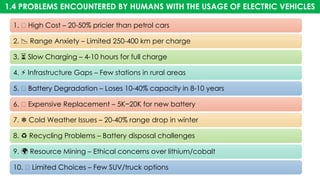
1. 🔋 High Cost – 20-50% pricier than petrol cars
2. Range Anxiety – Limited 250-400 km per charge
📉
3. Slow Charging – 4-10 hours for full charge
⏳
4. Infrastructure Gaps – Few stations in rural areas
⚡
5. 🔄 Battery Degradation – Loses 10-40% capacity in 8-10 years
6. 💸 Expensive Replacement – 5K−20K for new battery
7. Cold Weather Issues – 20-40% range drop in winter
❄️
8. Recycling Problems – Battery disposal challenges
♻️
9. Resource Mining – Ethical concerns over lithium/cobalt
🌍
10. 🚗 Limited Choices – Few SUV/truck options
18.
1.5.1 ADVANTAGES OFELECTRIC VEHICLES
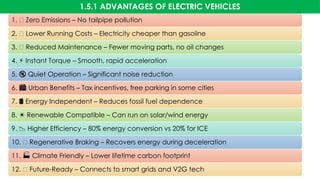
1. 🌱 Zero Emissions – No tailpipe pollution
2. 💸 Lower Running Costs – Electricity cheaper than gasoline
3. 🔧 Reduced Maintenance – Fewer moving parts, no oil changes
4. Instant Torque – Smooth, rapid acceleration
⚡
5. Quiet Operation – Significant noise reduction
🔇
6. Urban Benefits – Tax incentives, free parking in some cities
️ 🏙️
7. Energy Independent – Reduces fossil fuel dependence
️ 🛢️
8. Renewable Compatible – Can run on solar/wind energy
☀️
9. Higher Efficiency – 80% energy conversion vs 20% for ICE
📉
10. 🔄 Regenerative Braking – Recovers energy during deceleration
11. Climate Friendly – Lower lifetime carbon footprint
🏭
12. 🔮 Future-Ready – Connects to smart grids and V2G tech
19.
1.5.2 DISADVANTAGES OFELECTRIC VEHICLES
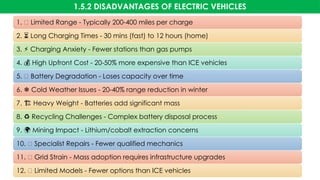
1. 🔋 Limited Range - Typically 200-400 miles per charge
2. Long Charging Times - 30 mins (fast) to 12 hours (home)
⏳
3. Charging Anxiety - Fewer stations than gas pumps
⚡
4. High Upfront Cost - 20-50% more expensive than ICE vehicles
💰
5. 🔄 Battery Degradation - Loses capacity over time
6. Cold Weather Issues - 20-40% range reduction in winter
❄️
7. Heavy Weight - Batteries add significant mass
️ 🏗️
8. Recycling Challenges - Complex battery disposal process
♻️
9. Mining Impact - Lithium/cobalt extraction concerns
🌍
10. 🔧 Specialist Repairs - Fewer qualified mechanics
11. 🔌 Grid Strain - Mass adoption requires infrastructure upgrades
12. 🚗 Limited Models - Fewer options than ICE vehicles
20.
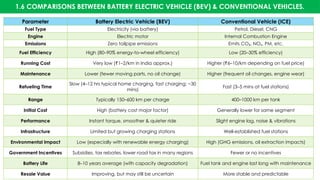
1.6 COMPARISONS BETWEENBATTERY ELECTRIC VEHICLE (BEV) & CONVENTIONAL VEHICLES.
Parameter Battery Electric Vehicle (BEV) Conventional Vehicle (ICE)
Fuel Type Electricity (via battery) Petrol, Diesel, CNG
Engine Electric motor Internal Combustion Engine
Emissions Zero tailpipe emissions Emits CO , NO , PM, etc.
₂ ₓ
Fuel Efficiency High (80–90% energy-to-wheel efficiency) Low (20–30% efficiency)
Running Cost Very low ( 1–2/km in India approx.)
₹ Higher ( 6–10/km depending on fuel price)
₹
Maintenance Lower (fewer moving parts, no oil change) Higher (frequent oil changes, engine wear)
Refueling Time
Slow (4–12 hrs typical home charging, fast charging: ~30
mins)
Fast (3–5 mins at fuel stations)
Range Typically 150–600 km per charge 400–1000 km per tank
Initial Cost High (battery cost major factor) Generally lower for same segment
Performance Instant torque, smoother & quieter ride Slight engine lag, noise & vibrations
Infrastructure Limited but growing charging stations Well-established fuel stations
Environmental Impact Low (especially with renewable energy charging) High (GHG emissions, oil extraction impacts)
Government Incentives Subsidies, tax rebates, lower road tax in many regions Fewer or no incentives
Battery Life 8–10 years average (with capacity degradation) Fuel tank and engine last long with maintenance
Resale Value Improving, but may still be uncertain More stable and predictable
21.
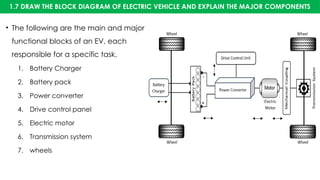
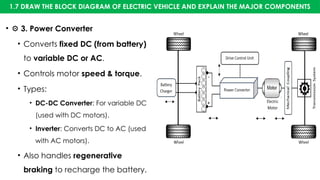
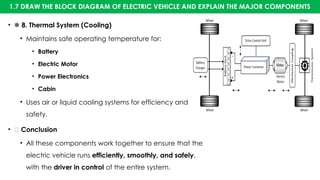
1.7 DRAW THEBLOCK DIAGRAM OF ELECTRIC VEHICLE AND EXPLAIN THE MAJOR COMPONENTS
• The following are the main and major
functional blocks of an EV, each
responsible for a specific task.
1. Battery Charger
2. Battery pack
3. Power converter
4. Drive control panel
5. Electric motor
6. Transmission system
7. wheels
22.
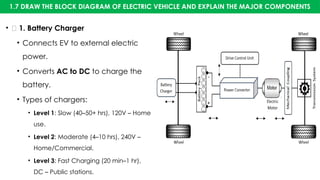
1.7 DRAW THEBLOCK DIAGRAM OF ELECTRIC VEHICLE AND EXPLAIN THE MAJOR COMPONENTS
• 🔋 1. Battery Charger
• Connects EV to external electric
power.
• Converts AC to DC to charge the
battery.
• Types of chargers:
• Level 1: Slow (40–50+ hrs), 120V – Home
use.
• Level 2: Moderate (4–10 hrs), 240V –
Home/Commercial.
• Level 3: Fast Charging (20 min–1 hr),
DC – Public stations.
23.
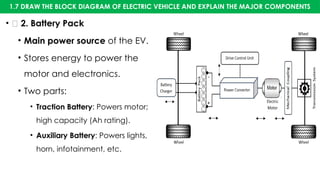
1.7 DRAW THEBLOCK DIAGRAM OF ELECTRIC VEHICLE AND EXPLAIN THE MAJOR COMPONENTS
• 🔋 2. Battery Pack
• Main power source of the EV.
• Stores energy to power the
motor and electronics.
• Two parts:
• Traction Battery: Powers motor;
high capacity (Ah rating).
• Auxiliary Battery: Powers lights,
horn, infotainment, etc.
24.
1.7 DRAW THEBLOCK DIAGRAM OF ELECTRIC VEHICLE AND EXPLAIN THE MAJOR COMPONENTS
• ⚙️3. Power Converter
• Converts fixed DC (from battery)
to variable DC or AC.
• Controls motor speed & torque.
• Types:
• DC-DC Converter: For variable DC
(used with DC motors).
• Inverter: Converts DC to AC (used
with AC motors).
• Also handles regenerative
braking to recharge the battery.
25.
1.7 DRAW THEBLOCK DIAGRAM OF ELECTRIC VEHICLE AND EXPLAIN THE MAJOR COMPONENTS
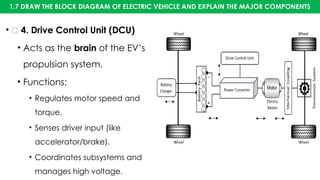
• 🧠 4. Drive Control Unit (DCU)
• Acts as the brain of the EV’s
propulsion system.
• Functions:
• Regulates motor speed and
torque.
• Senses driver input (like
accelerator/brake).
• Coordinates subsystems and
manages high voltage.
26.
1.7 DRAW THEBLOCK DIAGRAM OF ELECTRIC VEHICLE AND EXPLAIN THE MAJOR COMPONENTS
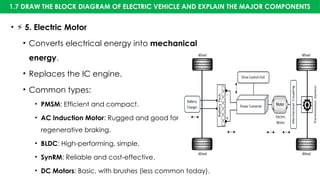
• ⚡ 5. Electric Motor
• Converts electrical energy into mechanical
energy.
• Replaces the IC engine.
• Common types:
• PMSM: Efficient and compact.
• AC Induction Motor: Rugged and good for
regenerative braking.
• BLDC: High-performing, simple.
• SynRM: Reliable and cost-effective.
• DC Motors: Basic, with brushes (less common today).
27.
1.7 DRAW THEBLOCK DIAGRAM OF ELECTRIC VEHICLE AND EXPLAIN THE MAJOR COMPONENTS
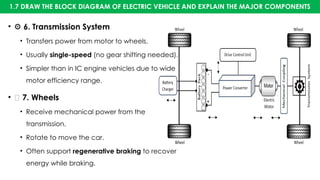
• ⚙️6. Transmission System
• Transfers power from motor to wheels.
• Usually single-speed (no gear shifting needed).
• Simpler than in IC engine vehicles due to wide
motor efficiency range.
• 🛞 7. Wheels
• Receive mechanical power from the
transmission.
• Rotate to move the car.
• Often support regenerative braking to recover
energy while braking.
28.
1.7 DRAW THEBLOCK DIAGRAM OF ELECTRIC VEHICLE AND EXPLAIN THE MAJOR COMPONENTS
• ❄️8. Thermal System (Cooling)
• Maintains safe operating temperature for:
• Battery
• Electric Motor
• Power Electronics
• Cabin
• Uses air or liquid cooling systems for efficiency and
safety.
• ✅ Conclusion
• All these components work together to ensure that the
electric vehicle runs efficiently, smoothly, and safely,
with the driver in control of the entire system.
29.
1.8 CLASSIFICATION OFELECTRIC VEHICLES ACCORDING TO THE SOURCE OF POWER
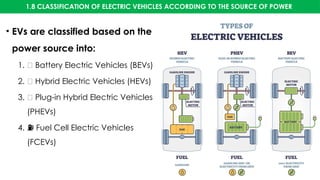
• EVs are classified based on the
power source into:
1. 🔋 Battery Electric Vehicles (BEVs)
2. 🚗 Hybrid Electric Vehicles (HEVs)
3. 🔌 Plug-in Hybrid Electric Vehicles
(PHEVs)
4. ⛽ Fuel Cell Electric Vehicles
(FCEVs)
30.
1.8 CLASSIFICATION OFELECTRIC VEHICLES ACCORDING TO THE SOURCE OF POWER
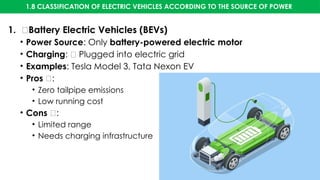
1. 🔋Battery Electric Vehicles (BEVs)
• Power Source: Only battery-powered electric motor
• Charging: 🔌 Plugged into electric grid
• Examples: Tesla Model 3, Tata Nexon EV
• Pros ✅:
• Zero tailpipe emissions
• Low running cost
• Cons ❌:
• Limited range
• Needs charging infrastructure
31.
1.8 CLASSIFICATION OFELECTRIC VEHICLES ACCORDING TO THE SOURCE OF POWER
2. Hybrid Electric Vehicles (HEVs)
⚙
• Power Source: Combines ICE + battery
• Charging: ❌ No plug-in; charged via regenerative braking and
engine
• Examples: Toyota Prius, Honda City Hybrid
• Pros ✅:
• Improved fuel economy
• Environmentally friendlier than ICE
• Cons ❌:
• Limited electric-only driving
• Still relies on fossil fuels
32.
1.8 CLASSIFICATION OFELECTRIC VEHICLES ACCORDING TO THE SOURCE OF POWER
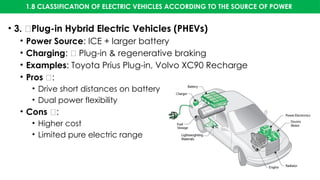
• 3. 🔌Plug-in Hybrid Electric Vehicles (PHEVs)
• Power Source: ICE + larger battery
• Charging: 🔌 Plug-in & regenerative braking
• Examples: Toyota Prius Plug-in, Volvo XC90 Recharge
• Pros ✅:
• Drive short distances on battery
• Dual power flexibility
• Cons ❌:
• Higher cost
• Limited pure electric range
33.
1.8 CLASSIFICATION OFELECTRIC VEHICLES ACCORDING TO THE SOURCE OF POWER
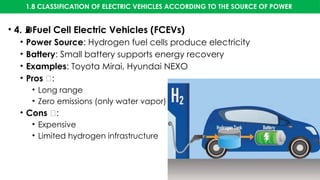
• 4. Fuel Cell Electric Vehicles (FCEVs)
⛽
• Power Source: Hydrogen fuel cells produce electricity
• Battery: Small battery supports energy recovery
• Examples: Toyota Mirai, Hyundai NEXO
• Pros ✅:
• Long range
• Zero emissions (only water vapor)
• Cons ❌:
• Expensive
• Limited hydrogen infrastructure
34.
1.9 EXPLAIN BATTERYELECTRIC VEHICLE (BEV) WITH A NEAT BLOCK DIAGRAM
• What is a BEV?
• BEVs are 100% electric vehicles – no petrol or diesel.
• They use a rechargeable battery and an electric motor to move.
• No tailpipe = No pollution from the vehicle.
• Charging is done via home outlets, public stations, or solar power
35.
1.9 EXPLAIN BATTERYELECTRIC VEHICLE (BEV) WITH A NEAT BLOCK DIAGRAM
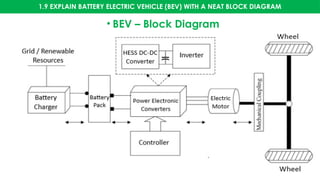
• BEV – Block Diagram
36.
1.9 EXPLAIN BATTERYELECTRIC VEHICLE (BEV) WITH A NEAT BLOCK DIAGRAM
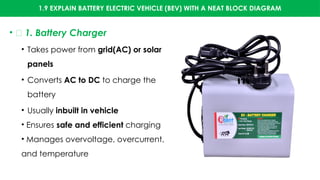
• 🔌 1. Battery Charger
• Takes power from grid(AC) or solar
panels
• Converts AC to DC to charge the
battery
• Usually inbuilt in vehicle
• Ensures safe and efficient charging
• Manages overvoltage, overcurrent,
and temperature
37.
1.9 EXPLAIN BATTERYELECTRIC VEHICLE (BEV) WITH A NEAT BLOCK DIAGRAM
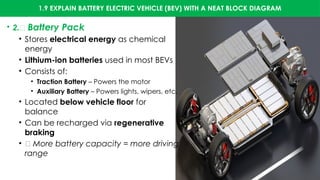
• 2.🔋 Battery Pack
• Stores electrical energy as chemical
energy
• Lithium-ion batteries used in most BEVs
• Consists of:
• Traction Battery – Powers the motor
• Auxiliary Battery – Powers lights, wipers, etc.
• Located below vehicle floor for
balance
• Can be recharged via regenerative
braking
• 📝 More battery capacity = more driving
range
38.
1.9 EXPLAIN BATTERYELECTRIC VEHICLE (BEV) WITH A NEAT BLOCK DIAGRAM
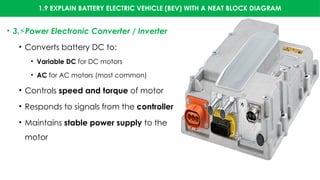
• 3. Power Electronic Converter / Inverter
⚡
• Converts battery DC to:
• Variable DC for DC motors
• AC for AC motors (most common)
• Controls speed and torque of motor
• Responds to signals from the controller
• Maintains stable power supply to the
motor
39.
1.9 EXPLAIN BATTERYELECTRIC VEHICLE (BEV) WITH A NEAT BLOCK DIAGRAM
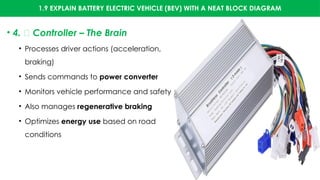
• 4. 🧠 Controller – The Brain
• Processes driver actions (acceleration,
braking)
• Sends commands to power converter
• Monitors vehicle performance and safety
• Also manages regenerative braking
• Optimizes energy use based on road
conditions
40.
1.9 EXPLAIN BATTERYELECTRIC VEHICLE (BEV) WITH A NEAT BLOCK DIAGRAM
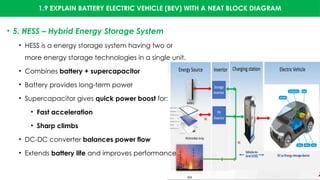
• 5. HESS – Hybrid Energy Storage System
⚡
• HESS is a energy storage system having two or
more energy storage technologies in a single unit.
• Combines battery + supercapacitor
• Battery provides long-term power
• Supercapacitor gives quick power boost for:
• Fast acceleration
• Sharp climbs
• DC-DC converter balances power flow
• Extends battery life and improves performance
41.
1.9 EXPLAIN BATTERYELECTRIC VEHICLE (BEV) WITH A NEAT BLOCK DIAGRAM
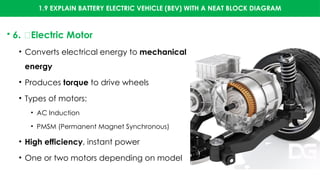
• 6. 🚗Electric Motor
• Converts electrical energy to mechanical
energy
• Produces torque to drive wheels
• Types of motors:
• AC Induction
• PMSM (Permanent Magnet Synchronous)
• High efficiency, instant power
• One or two motors depending on model
42.
1.9 EXPLAIN BATTERYELECTRIC VEHICLE (BEV) WITH A NEAT BLOCK DIAGRAM
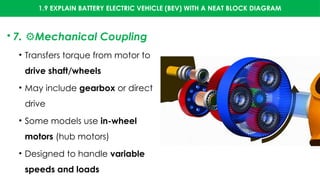
• 7. Mechanical Coupling
⚙️
• Transfers torque from motor to
drive shaft/wheels
• May include gearbox or direct
drive
• Some models use in-wheel
motors (hub motors)
• Designed to handle variable
speeds and loads
43.
1.9 EXPLAIN BATTERYELECTRIC VEHICLE (BEV) WITH A NEAT BLOCK DIAGRAM
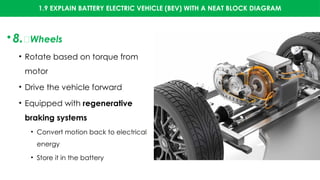
•8.🛞Wheels
• Rotate based on torque from
motor
• Drive the vehicle forward
• Equipped with regenerative
braking systems
• Convert motion back to electrical
energy
• Store it in the battery
44.
1.9 EXPLAIN BATTERYELECTRIC VEHICLE (BEV) WITH A NEAT BLOCK DIAGRAM
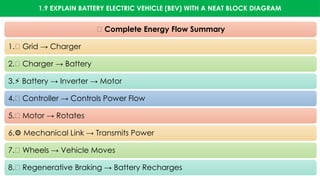
🔁 Complete Energy Flow Summary
1.🔌 Grid → Charger
2.🔋 Charger → Battery
3. Battery → Inverter → Motor
⚡
4.🧠 Controller → Controls Power Flow
5.🚗 Motor → Rotates
6. Mechanical Link → Transmits Power
⚙️
7.🛞 Wheels → Vehicle Moves
8.🔄 Regenerative Braking → Battery Recharges
45.
1.9.1 ADVANTAGES OFBATTERY ELECTRIC VEHICLE (BEV)
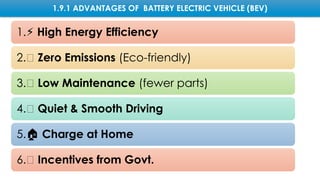
1.⚡ High Energy Efficiency
2.🌱 Zero Emissions (Eco-friendly)
3.🔧 Low Maintenance (fewer parts)
4.🤫 Quiet & Smooth Driving
5.🏠 Charge at Home
6.💸 Incentives from Govt.
46.
1.9.2 DIS ADVANTAGESOF BATTERY ELECTRIC VEHICLE (BEV)
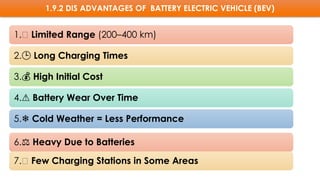
1.🔋 Limited Range (200–400 km)
2.🕒 Long Charging Times
3.💰 High Initial Cost
4.⚠️Battery Wear Over Time
5.❄️Cold Weather = Less Performance
6.⚖️Heavy Due to Batteries
7.🚫 Few Charging Stations in Some Areas
47.
1.10 HYBRID ELECTRICVEHICLE (HEV) WITH A NEAT BLOCK DIAGRAM
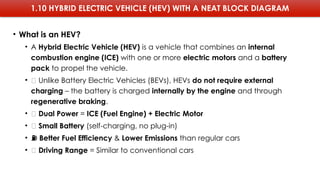
• What is an HEV?
• A Hybrid Electric Vehicle (HEV) is a vehicle that combines an internal
combustion engine (ICE) with one or more electric motors and a battery
pack to propel the vehicle.
• 💡 Unlike Battery Electric Vehicles (BEVs), HEVs do not require external
charging – the battery is charged internally by the engine and through
regenerative braking.
• 🔄 Dual Power = ICE (Fuel Engine) + Electric Motor
• 🔋 Small Battery (self-charging, no plug-in)
• ⛽ Better Fuel Efficiency & Lower Emissions than regular cars
• 🚗 Driving Range = Similar to conventional cars
48.
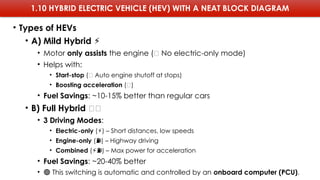
1.10 HYBRID ELECTRICVEHICLE (HEV) WITH A NEAT BLOCK DIAGRAM
• Types of HEVs
• A) Mild Hybrid ⚡
• Motor only assists the engine (❌ No electric-only mode)
• Helps with:
• Start-stop (🔄 Auto engine shutoff at stops)
• Boosting acceleration (💨)
• Fuel Savings: ~10-15% better than regular cars
• B) Full Hybrid 🚗🔋
• 3 Driving Modes:
• Electric-only ( ) – Short distances, low speeds
⚡
• Engine-only ( ) – Highway driving
⛽
• Combined ( ) – Max power for acceleration
⚡⛽
• Fuel Savings: ~20-40% better
• 🟢 This switching is automatic and controlled by an onboard computer (PCU).
49.
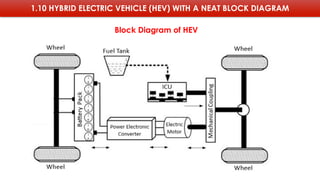
1.10 HYBRID ELECTRICVEHICLE (HEV) WITH A NEAT BLOCK DIAGRAM
Block Diagram of HEV
50.
1.10 HYBRID ELECTRICVEHICLE (HEV) WITH A NEAT BLOCK DIAGRAM
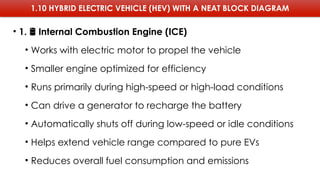
• 1. Internal Combustion Engine (ICE)
️ 🛢️
• Works with electric motor to propel the vehicle
• Smaller engine optimized for efficiency
• Runs primarily during high-speed or high-load conditions
• Can drive a generator to recharge the battery
• Automatically shuts off during low-speed or idle conditions
• Helps extend vehicle range compared to pure EVs
• Reduces overall fuel consumption and emissions
51.
1.10 HYBRID ELECTRICVEHICLE (HEV) WITH A NEAT BLOCK DIAGRAM
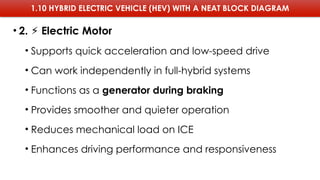
• 2. Electric Motor
⚡
• Supports quick acceleration and low-speed drive
• Can work independently in full-hybrid systems
• Functions as a generator during braking
• Provides smoother and quieter operation
• Reduces mechanical load on ICE
• Enhances driving performance and responsiveness
52.
1.10 HYBRID ELECTRICVEHICLE (HEV) WITH A NEAT BLOCK DIAGRAM
• 3. 🔋 Battery Pack
• Stores energy from regenerative braking and ICE
• Not charged from an external plug (unlike PHEVs)
• Compact but designed for high charge cycles
• Supplies clean energy to the motor
• Helps reduce dependency on fossil fuels
• Enhances low-emission operation in cities
53.
1.10 HYBRID ELECTRICVEHICLE (HEV) WITH A NEAT BLOCK DIAGRAM
• 4. Regenerative Braking System
♻️
• Captures energy lost during braking
• Converts kinetic energy to electrical energy
• Reduces brake wear and heat losses
• Improves energy efficiency and driving range
• Charges battery without fuel input
• Automatically engaged during deceleration
54.
1.10 HYBRID ELECTRICVEHICLE (HEV) WITH A NEAT BLOCK DIAGRAM
• 5. 🔄 Power Electronic Converter
• Converts DC (battery) ↔ AC (motor)
• Regulates power levels to suit load conditions
• Enables regenerative braking power conversion
• Helps control motor speed and torque
• Ensures safe and efficient power delivery
• Protects electrical system from over/under voltage
55.
1.10 HYBRID ELECTRICVEHICLE (HEV) WITH A NEAT BLOCK DIAGRAM
• 6. 🧠 Power Control Unit (PCU)
• Coordinates ICE, motor, and battery usage
• Selects best power source for different conditions
• Manages regenerative braking and energy storage
• Maintains optimal energy flow in real-time
• Embedded software ensures performance and safety
• Integrated into power converter for compact design
56.
1.10 HYBRID ELECTRICVEHICLE (HEV) WITH A NEAT BLOCK DIAGRAM
• ️
🛣️Types of HEV Architectures
• 1. 🔁 Series HEV
• Only electric motor drives wheels
• ICE powers generator → charges battery
• Ideal for city driving
• 2. 🔗 Parallel HEV
• Both motor and engine drive wheels directly
• Power split based on load and condition
• Common in many commercial hybrids
• 3. 🔀 Series-Parallel HEV
• Combines both systems
• Allows for flexible and efficient operation
• Smart control selects the best mode dynamically
57.
1.10.1✅ ADVANTAGES OFHYBRID ELECTRIC VEHICLES (HEVS)
• 🚗 1. Improved Fuel Efficiency
• Combines internal combustion engine and electric motor
• Reduces fuel usage, especially in stop-and-go traffic
• 🌱 2. Reduced Emissions
• Emits fewer greenhouse gases and pollutants
• Supports environmental sustainability
• ♻️3. Regenerative Braking
• Converts kinetic energy into electrical energy during braking
• Increases energy efficiency and battery charge
• 🔇 4. Quiet Operation
• Electric motor ensures smoother and quieter low-speed driving
• Enhances passenger comfort
• 🔌 5. No External Charging Required
• Battery is charged through regenerative braking and the ICE
• No need for plug-in charging infrastructure
58.
1.10.2⚠️DISADVANTAGES OF HYBRIDELECTRIC VEHICLES (HEVS)
• 💰 1. Higher Initial Cost
• More expensive than conventional vehicles
• Costly due to advanced hybrid technologies
• ️
🛠️2. Complex Design
• Dual systems (engine + electric motor) make design intricate
• Increases potential for system integration issues
• 🔋 3. Battery Limitations
• Smaller battery compared to BEVs
• Limited electric-only range
• ⚖️4. Weight Concerns
• Battery and motor add extra weight
• May slightly impact acceleration and efficiency
• 🧾 5. Maintenance Costs
• Dual system may require specialized repairs
• Maintenance can be costlier than conventional vehicles
59.
1.11 PLUG-IN HYBRIDELECTRIC VEHICLE (PHEV)
•🔋 What is a PHEV?
•A Plug-in Hybrid Electric Vehicle (PHEV) is a type of hybrid vehicle that uses both an internal
combustion engine (ICE) and an electric motor.
•⚡ Plug-in Capability
•Unlike conventional hybrids, PHEVs can be recharged by plugging into an external power source,
such as a wall socket or charging station.
•🔄 Dual Power Sources
•Operates using battery power for short trips and automatically switches to the engine for longer
distances.
•🌱 Eco-Friendly Alternative
•Reduces fuel consumption and emissions compared to conventional gasoline vehicles.
•🎯 Why PHEVs?
•Combines the benefits of electric driving with the extended range of Pertrol engines—ideal for both
city and highway use.
60.
1.11 PLUG-IN HYBRIDELECTRIC VEHICLE (PHEV)
Block Diagram of Plug-in Hybrid Electric Vehicle (PHEV)
61.
1.11 PLUG-IN HYBRIDELECTRIC VEHICLE (PHEV)
•🔌 Plug
•Connects to external power source (home/public charger) to recharge the battery.
•🔄 Battery Charger
•Converts AC to DC and manages the charging process safely and efficiently.
•🔋 Battery
•Stores electrical energy for electric driving; recharged by plug and regenerative braking.
•⚡ Power Electronic Converter
•Manages power flow between battery, motor, and other components; converts DC to AC
(or DC).
•🧲 Electric Motor
•Provides propulsion with instant torque; ideal for city and low-speed driving.
•🔧 Mechanical Coupling
•Connects the engine to drivetrain; enables switching between electric and hybrid modes.
•⛽ Fuel Tank
•Stores fuel (petrol/diesel/gas) for the ICE, enabling longer range in hybrid mode.
•🛠️Internal Combustion Engine (ICE)
•Drives wheels directly or recharges the battery; used when more power or range is
needed.
62.
1.11 PLUG-IN HYBRIDELECTRIC VEHICLE (PHEV)
• Operation Modes of a PHEV
• 🔋 Electric-Only Driving
• Uses only the electric motor when battery is charged – perfect for
short urban trips.
• 🔁 Hybrid Mode
• ICE supports or replaces electric motor when battery is low or more
power is needed.
• ♻️Regenerative Braking
• Converts braking energy into electrical energy and stores it in the
battery.
• 🔌 Charging
• Battery is recharged using an external power source or while driving
via ICE or braking.
63.
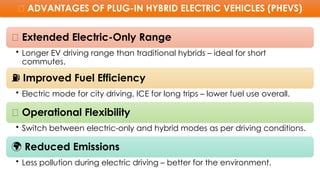
✅ ADVANTAGES OFPLUG-IN HYBRID ELECTRIC VEHICLES (PHEVS)
🚗 Extended Electric-Only Range
• Longer EV driving range than traditional hybrids – ideal for short
commutes.
⛽ Improved Fuel Efficiency
• Electric mode for city driving, ICE for long trips – lower fuel use overall.
🔄 Operational Flexibility
• Switch between electric-only and hybrid modes as per driving conditions.
🌍 Reduced Emissions
• Less pollution during electric driving – better for the environment.
64.
⚠️DISADVANTAGES OF PLUG-INHYBRID ELECTRIC VEHICLES (PHEVS)
💰 Higher Initial Cost
• Costlier due to larger battery and advanced technology.
🧱 Battery Size and Weight
• Heavier battery can affect cargo space and overall efficiency.
🔌 Charging Infrastructure Limitations
• Public/home charging access may be limited in some areas.
• 🧠 Conclusion
• PHEVs blend electric and hybrid technologies to offer efficiency, flexibility, and eco-
friendliness.
• They’re ideal for those seeking electric driving with the safety net of a combustion
engine for longer journeys.
65.
1.12 FUEL CELLELECTRIC VEHICLE (FCEV)
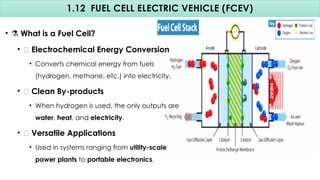
• ⚗️What is a Fuel Cell?
• 🧪 Electrochemical Energy Conversion
• Converts chemical energy from fuels
(hydrogen, methane, etc.) into electricity.
• 🌊 Clean By-products
• When hydrogen is used, the only outputs are
water, heat, and electricity.
• 🔄 Versatile Applications
• Used in systems ranging from utility-scale
power plants to portable electronics.
66.
1.12 FUEL CELLELECTRIC VEHICLE (FCEV)
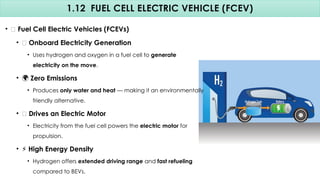
• 🚙 Fuel Cell Electric Vehicles (FCEVs)
• 🧬 Onboard Electricity Generation
• Uses hydrogen and oxygen in a fuel cell to generate
electricity on the move.
• 🌍 Zero Emissions
• Produces only water and heat — making it an environmentally
friendly alternative.
• 🔋 Drives an Electric Motor
• Electricity from the fuel cell powers the electric motor for
propulsion.
• ⚡ High Energy Density
• Hydrogen offers extended driving range and fast refueling
compared to BEVs.
67.
1.12 FUEL CELLELECTRIC VEHICLE (FCEV)
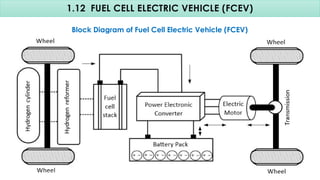
Block Diagram of Fuel Cell Electric Vehicle (FCEV)
68.
1.12 FUEL CELLELECTRIC VEHICLE (FCEV)
• Components of a Fuel Cell Electric Vehicle (FCEV)
• ️
🛢️Hydrogen Storage
• Stores hydrogen at high pressure (350–700 bar); lightweight and safe.
• 🧪 Hydrogen Reformer (optional)
• Extracts hydrogen from fuels like natural gas (used in some models only).
• ⚗️Fuel Cell Stack (FC Stack)
• Converts hydrogen and oxygen into electricity, water, and heat.
• 🔋 Battery Pack
• Stores extra energy, supports acceleration and regenerative braking.
•⚡ Power Electronic Converter
•Manages energy flow between FC stack, battery, and motor; converts DC to AC.
•🚗 Electric Motor
•Powers the wheels; provides smooth, instant torque-based propulsion.
•🔁 Transmission
•Transfers motor power to wheels; may use single-speed or CVT for efficiency.
69.
1.12 FUEL CELLELECTRIC VEHICLE (FCEV)
• Operation of an FCEV
• ️
🛢️Hydrogen Storage & Delivery
• Hydrogen is safely stored and sent to the fuel cell as needed.
• ⚗️Power Generation
• FC stack generates electricity from hydrogen and oxygen; by-
products: water + heat.
• 🚘 Electric Drive
• Motor propels the vehicle using energy from FC stack and battery
pack.
• 🔄 Regenerative Braking
• Recovers braking energy and stores it in the battery.
• 🔌 Power Management
• Power converter balances and directs electricity to match driving
demands.
70.
1.12.1✅ADVANTAGES OF FUELCELL ELECTRIC VEHICLES (FCEVS)
💧 Zero Emissions
• Only water vapor and heat are emitted — no tailpipe pollution.
️
🛣️Extended Driving Range
• Hydrogen’s high energy density enables longer distances than BEVs.
⛽ Fast Refueling
• Hydrogen refueling takes just 3–5 minutes, similar to petrol/diesel.
⚡ Efficient Operation
• Fuel cells provide continuous electricity as long as hydrogen is available.
🔇 Quiet Ride
• Electric motor ensures smooth, silent operation.
71.
1.12.2 DISADVANTAGES
⚠️ OFFUEL CELL ELECTRIC VEHICLES (FCEVS)
️
🏗️Limited Hydrogen Infrastructure
• Few refueling stations limit usability and convenience.
💰 High Cost
• Hydrogen production, storage, and FC technology are still expensive.
🔄 Lower Overall Energy Efficiency
• Hydrogen supply chain is less efficient than direct electric power use.
🧪 Storage & Transport Challenges
• Hydrogen’s low density and flammability require specialized tanks.
🚙 Limited Model Choices
• Few FCEV models are currently available in the market.
72.
1.12 FUEL CELLELECTRIC VEHICLES (FCEVS)
• 🧠 Conclusion
• FCEVs offer zero emissions, fast refueling, and long ranges, but
face challenges in infrastructure, cost, and storage.
• They’re a promising clean transport technology, especially for long-
range and heavy-duty use.
73.
MULTIPLE CHOICE QUESTIONS
•1. What does BEV stand for?
• a) Battery Electric Vehicle
• b) Bio Electric Vehicle
• c) Base Electric Vehicle
• d) Battery Environment Vehicle
• Ans: a) Battery Electric Vehicle
• 2. What is the main pollutant produced by IC Engine vehicles?
• a) Nitrogen Dioxide
• b) Carbon Monoxide
• c) Sulfur Dioxide
• d) Ozone
• Ans:b) Carbon Monoxide
• 3. Which of the following is not a type of Electric Vehicle?
• BEV
• HEV
• FCEV
• ICEV
• Ans:ICEV
74.
MULTIPLE CHOICE QUESTIONS
•Which component of an electric vehicle stores energy?
• a) Electric Motor b) Inverter
• c) Battery Pack d) Fuel Cell
• Which of these pollutants is emitted by ICEVs?
• a) Ozone b) CO2
• c) Nitrogen Oxides d) All of the above
• Which of the following is the primary advantage of BEVs?
• a) Zero emissions b) High fuel efficiency
• c) Longer driving range d) Faster refueling
75.
MULTIPLE CHOICE QUESTIONS
•What does PHEV stand for?
a) Plug-in Hybrid Electric Vehicle b) Power Hybrid Electric Vehicle
c) Petrol Hybrid Electric Vehicle d) Plug-in Hybrid Efficiency Vehicle
• Which of the following is used to charge BEVs?
a) Fuel Cells b) Gasoline c) Charging Port d) Hydrogen
• Which vehicle combines an internal combustion engine with an electric motor?
a) BEV b) PHEV c) HEV d) FCEV
76.
MULTIPLE CHOICE QUESTIONS
•What is the fuel source for Fuel Cell Electric Vehicles (FCEVs)?
a) Electricity b) Hydrogen c) Gasoline d) Coal
• Which of the following is a disadvantage of electric vehicles?
a) Zero emissions b) High initial cost
c) Low maintenance d) Lower operating costs
• Which of these components is found in all electric vehicles?
a) Internal Combustion Engine b) Electric Motor
c) Gas Tank d) Fuel Cell
77.
MULTIPLE CHOICE QUESTIONS
•What is the main disadvantage of hydrogen as a fuel source for FCEVs?
a) High emissions b) Hydrogen storage
c) Expensive d) Limited energy capacity
• Which of these is true for a Hybrid Electric Vehicle (HEV)?
a) It only uses electricity for power b) It uses both an IC engine and an
electric motor
c) It only uses hydrogen d) It has zero emissions
• Which of the following EVs requires both electric charging and hydrogen
fuelling?
a) PHEV b) BEV c) HEV d) FCEV
• d) Fuel Cell

![1.1.1 DIFFERENT POLLUTANTS PRODUCED BY INTERNAL COMBUSTION (IC) ENGINE VEHICLES
1. Carbon Monoxide (CO)
• Colorless, odorless gas from incomplete combustion
2. Carbon Dioxide (CO )
₂
• Greenhouse gas from complete fuel combustion
3. Nitrogen Oxides (NO )
ₓ
• Includes NO and NO ; formed at high combustion temps
₂
4. Unburned Hydrocarbons (HC)
• Incomplete fuel combustion
5. Particulate Matter (PM)
• Soot and fine particles from diesel engines
6. Sulfur Dioxide (SO )
₂
• From sulfur in diesel and other fuels
7. Volatile Organic Compounds (VOCs)
• Evaporate from fuel and solvents
8. Lead (Pb)
• From leaded gasoline (still used in some regions)
9. Ozone (O ) [Secondary Pollutant]
₃
• Not directly emitted—formed from NO + VOCs in sunlight
ₓ](https://image.slidesharecdn.com/ee-502evtchater-1-260102041822-650b1de5/85/EVT-1-Electrical-and-electronics-engineering-7-320.jpg)