e- VEHICLES
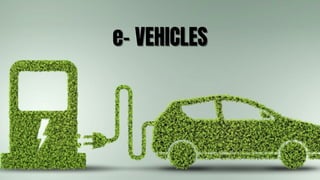
e- VEHICLES
Electric Vehicles are means of transport
that consume electrical energy as fuel
instead of traditional fuels such as petrol,
diesel, and CNG. It is either partially or fully
powered by electric power.
It can be powered with electricity from
extravehicular sources, or it can be powered
by a battery (sometimes charged by solar
panels, or by converting fuel to electricity
using fuel cells or a generator).
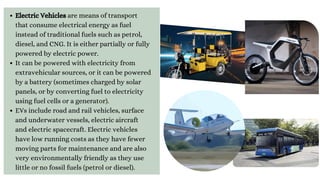
EVs include road and rail vehicles, surface
and underwater vessels, electric aircraft
and electric spacecraft. Electric vehicles
have low running costs as they have fewer
moving parts for maintenance and are also
very environmentally friendly as they use
little or no fossil fuels (petrol or diesel).
Electric motive power started in 1827, when
Hungarian priest Ányos Jedlik built the first
crude but viable electric motor and the next year
he used it to power a small car
The first mass-produced
electric vehicles appeared in
America in the early 1900s.
HISTORY
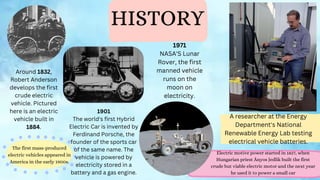
Around 1832,
Robert Anderson
develops the first
crude electric
vehicle. Pictured
here is an electric
vehicle built in
1884.
1901
The world's first Hybrid
Electric Car is invented by
Ferdinand Porsche, the
founder of the sports car
of the same name. The
vehicle is powered by
electricity stored in a
battery and a gas engine.
1971
NASA'S Lunar
Rover, the first
manned vehicle
runs on the
moon on
electricity.
A researcher at the Energy
Department's National
Renewable Energy Lab testing
electrical vehicle batteries.
The reason
why Tesla is so popular is that
it’s producing cost-effective
cars, promoting green energy,
and utilizing cutting-edge
technology.
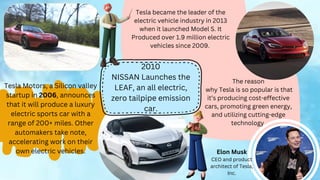
2010
NISSAN Launches the
LEAF, an all electric,
zero tailpipe emission
car.
Tesla Motors, a Silicon valley
startup in 2006, announces
that it will produce a luxury
electric sports car with a
range of 200+ miles. Other
automakers take note,
accelerating work on their
own electric vehicles.
Tesla became the leader of the
electric vehicle industry in 2013
when it launched Model S. It
Produced over 1.9 million electric
vehicles since 2009.
Elon Musk
CEO and product
architect of Tesla,
Inc.
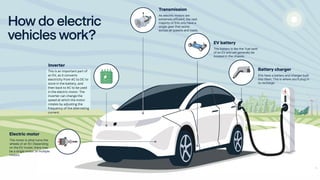
This is an important part of
an EV, as it converts
electricity from AC to DC to
store in the battery, and
then back to AC to be used
in the electric motor. The
inverter can change the
speed at which the motor
rotates by adjusting the
frequency of the alternating
current.
Need of Electric Vehicles
These are following factors which creates an urgent need for use of electric
vehicles:
1. To reduce pollution.
2. To conserve non-renewable natural resources.
3. To reduce import of petrol and diesel.
4. To promote use of renewable energy.
5. To reduce global warming
Today when the world is
thriving to use day by day new
technology everywhere,
Electric Vehicles must be the
future means of transport.
Pollution, growing demand for
fuel, Global Warming, and
promoting eco-friendly means
of transport are some of the
reasons for promoting electric
vehicles.
India unveiled ‘National Electric
Mobility Mission Plan (NEMMP) 2020’
in 2013 to overcome the issues of
National energy security, automobile
pollution, and the growth of
domestic EV manufacturers.
India has plans to make a major shift
to electric vehicles by 2030. E-
commerce companies, Indian car
manufacturers like Mahindra and
TATA Motors are working on making
electric cars more common over the
next two decades.
Benefits of Electric Vehicles use
Electric vehicles run on electricity and don't emit smoke thus it is very helpful in reducing
pollution which causes many types of life-threatening diseases.
Smoke is also one of the major causes of global warming. Thus using electric vehicles will
reduce global warming.
Petrol, Diesel, and CNG are non-renewable natural resources of energy. Over-use of these
fuels is not good for nature also. Thus the use of electric vehicles can be very helpful for the
conservation of these natural resources.
Today when the advancement of technology growing rapidly electric vehicles are new
means of transport to fulfill the larger demand of people growing day by day.
Electric vehicles are eco-friendly. The use of electric vehicles is good for the environment
as well as human life.
Electric vehicles are new technology. This sector will grow day by day which will generate a
lot of employment in this field.
The electric vehicle will reduce the dependency of a nation on petroleum export countries.
This will reduce the import cost of petrol, and diesel-like fuels and thus it will help in
growing the economy of the country.
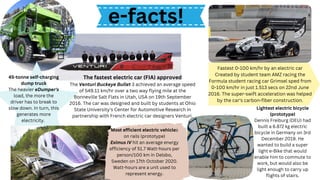
e-facts!
The fastest electric car (FIA) approved
The Venturi Buckeye Bullet 3 achieved an average speed
of 549.11 km/hr over a two way flying mile at the
Bonneville Salt Flats in Utah, USA on 19th September
2016. The car was designed and built by students at Ohio
State University's Center for Automotive Research in
partnership with French electric car designers Venturi.
Lightest electric bicycle
(prototype)
Dennis Freiburg (DEU) had
built a 6.872 kg electric
bicycle in Germany on 3rd
December 2019. He
wanted to build a super
light e-Bike that would
enable him to commute to
work, but would also be
light enough to carry up
flights of stairs.
45-tonne self-charging
dump truck
The heavier eDumper's
load, the more the
driver has to break to
slow down. In turn, this
generates more
electricity.
Most efficient electric vehicles
on rails (prototype)
Eximus IV hit an average energy
efficiency of 51.7 Watt-hours per
person/100 km in Delsbo,
Sweden on 17th October 2020.
Watt-hours are a unit used to
represent energy.
Fastest 0-100 km/hr by an electric car
Created by student team AMZ racing the
Formula student racing car Grimsel sped from
0-100 km/hr in just 1.513 secs on 22nd June
2016. The super-swift acceleration was helped
by the car's carbon-fiber construction.
Thank you
Thank you

e-Vehicles (2).pdf

  • 1.
  • 2.
    Electric Vehicles aremeans of transport that consume electrical energy as fuel instead of traditional fuels such as petrol, diesel, and CNG. It is either partially or fully powered by electric power. It can be powered with electricity from extravehicular sources, or it can be powered by a battery (sometimes charged by solar panels, or by converting fuel to electricity using fuel cells or a generator). EVs include road and rail vehicles, surface and underwater vessels, electric aircraft and electric spacecraft. Electric vehicles have low running costs as they have fewer moving parts for maintenance and are also very environmentally friendly as they use little or no fossil fuels (petrol or diesel).
  • 3.
    Electric motive powerstarted in 1827, when Hungarian priest Ányos Jedlik built the first crude but viable electric motor and the next year he used it to power a small car The first mass-produced electric vehicles appeared in America in the early 1900s. HISTORY Around 1832, Robert Anderson develops the first crude electric vehicle. Pictured here is an electric vehicle built in 1884. 1901 The world's first Hybrid Electric Car is invented by Ferdinand Porsche, the founder of the sports car of the same name. The vehicle is powered by electricity stored in a battery and a gas engine. 1971 NASA'S Lunar Rover, the first manned vehicle runs on the moon on electricity. A researcher at the Energy Department's National Renewable Energy Lab testing electrical vehicle batteries.
  • 4.
    The reason why Teslais so popular is that it’s producing cost-effective cars, promoting green energy, and utilizing cutting-edge technology. 2010 NISSAN Launches the LEAF, an all electric, zero tailpipe emission car. Tesla Motors, a Silicon valley startup in 2006, announces that it will produce a luxury electric sports car with a range of 200+ miles. Other automakers take note, accelerating work on their own electric vehicles. Tesla became the leader of the electric vehicle industry in 2013 when it launched Model S. It Produced over 1.9 million electric vehicles since 2009. Elon Musk CEO and product architect of Tesla, Inc.
  • 5.
    This is animportant part of an EV, as it converts electricity from AC to DC to store in the battery, and then back to AC to be used in the electric motor. The inverter can change the speed at which the motor rotates by adjusting the frequency of the alternating current.
  • 6.
    Need of ElectricVehicles These are following factors which creates an urgent need for use of electric vehicles: 1. To reduce pollution. 2. To conserve non-renewable natural resources. 3. To reduce import of petrol and diesel. 4. To promote use of renewable energy. 5. To reduce global warming Today when the world is thriving to use day by day new technology everywhere, Electric Vehicles must be the future means of transport. Pollution, growing demand for fuel, Global Warming, and promoting eco-friendly means of transport are some of the reasons for promoting electric vehicles. India unveiled ‘National Electric Mobility Mission Plan (NEMMP) 2020’ in 2013 to overcome the issues of National energy security, automobile pollution, and the growth of domestic EV manufacturers. India has plans to make a major shift to electric vehicles by 2030. E- commerce companies, Indian car manufacturers like Mahindra and TATA Motors are working on making electric cars more common over the next two decades.
  • 7.
    Benefits of ElectricVehicles use Electric vehicles run on electricity and don't emit smoke thus it is very helpful in reducing pollution which causes many types of life-threatening diseases. Smoke is also one of the major causes of global warming. Thus using electric vehicles will reduce global warming. Petrol, Diesel, and CNG are non-renewable natural resources of energy. Over-use of these fuels is not good for nature also. Thus the use of electric vehicles can be very helpful for the conservation of these natural resources. Today when the advancement of technology growing rapidly electric vehicles are new means of transport to fulfill the larger demand of people growing day by day.
  • 8.
    Electric vehicles areeco-friendly. The use of electric vehicles is good for the environment as well as human life. Electric vehicles are new technology. This sector will grow day by day which will generate a lot of employment in this field. The electric vehicle will reduce the dependency of a nation on petroleum export countries. This will reduce the import cost of petrol, and diesel-like fuels and thus it will help in growing the economy of the country.
  • 9.
    e-facts! The fastest electriccar (FIA) approved The Venturi Buckeye Bullet 3 achieved an average speed of 549.11 km/hr over a two way flying mile at the Bonneville Salt Flats in Utah, USA on 19th September 2016. The car was designed and built by students at Ohio State University's Center for Automotive Research in partnership with French electric car designers Venturi. Lightest electric bicycle (prototype) Dennis Freiburg (DEU) had built a 6.872 kg electric bicycle in Germany on 3rd December 2019. He wanted to build a super light e-Bike that would enable him to commute to work, but would also be light enough to carry up flights of stairs. 45-tonne self-charging dump truck The heavier eDumper's load, the more the driver has to break to slow down. In turn, this generates more electricity. Most efficient electric vehicles on rails (prototype) Eximus IV hit an average energy efficiency of 51.7 Watt-hours per person/100 km in Delsbo, Sweden on 17th October 2020. Watt-hours are a unit used to represent energy. Fastest 0-100 km/hr by an electric car Created by student team AMZ racing the Formula student racing car Grimsel sped from 0-100 km/hr in just 1.513 secs on 22nd June 2016. The super-swift acceleration was helped by the car's carbon-fiber construction.
  • 10.