ELECTRON
MICROSCOPY
PRESENTOR: DR.N.MANJULA
POST GRADUATE
DEPT OF PATHOLOGY
INTRODUCTION
• Microscope magnifies the image of the object so that we can
visualize the smallest particles.
• The word microscope is derived from the Greek word mikros
(small) and skopeo (look at).
• Light microscopy was developed from Galilean telescope – 17
th centuary.
• Dutchmen Antony van Leeuwenhook invented simple
microscope.
• Compound microscope – consisting of two lens ( objective and
eyepiece), mirror and light source.
THE MICROSCOPE
• Single convex lens was the limiting factor in it.
• The resolution power of the light microscope is limited.
• The visible light has the wavelength of 300 – 700 nm.
• Light microscope uses the visible light, and so the maximum
resolution power of the light microscope is 0.2μm.
• RESOLVING POWER is the ability of an imaging device to
see objects that are located at a small distances.
• The formula,
• λ is wavelength,
• h = 6.626 × 10⁻³⁴ (Planck’s constant),
• m = mass
• v = speed of the electron.
INCREASING VELOCITY
=
DECREASES WAVE LENGTH
=
IMPROVES RESOLVING POWER.
THE MICROSCOPE
• The improvement of the resolution capacity of the
microscope can be improved by reducing the
wavelength of the light.
• Ultraviolet ray has the wavelength of 100– 300 nm and
the resolution power is improved to 0.1 μm.
• During the first part of the 20th century, the wave like
property of the electron was demonstrated, and this has
been utilized in electron microscope.
• EM are scientific instruments that use a beam of highly
energetic electrons to examine objects on a very fine
scale.
• TYPES OF EM:-
TEM – allows study of inner structures.
SEM – visualize the surface of objects.
TRANSMISSION ELECTRON
MICROSCOPE
• It has been used by surgical pathologists over past 50 years
for diagnosis of wide range of diseases.
• It allows for visualization of subcellular morphology and
structural abnormalities.
• It is an essential part of work up of:-
 Medical renal diseases
 Peripheral nerve diseases
 Muscle diseases
 Primary cilliary dyskinesia
• It is also useful in evaluating metabolic and inherited
diseases.
• The role of EM in the diagnosis of neoplasms has
decreased since the advent of IHC and molecular
techniques.
• EM is occasionally used to demonstrate infectious agents.
• It is now considered to be a promising diagnostic
technique in oncologic surgical pathology, for the
identification and localization of targets for gene therapy.
TRANSMISSION ELECTRON
MICROSCOPE
• It has much higher resolution than light microscopy and
allows visualization of:-
 Cellular organelles.
 Intercellular junctions.
 Extracellular proteins.
• It can clarify architectural details that aid in the diagnosis of:-
 Glomerular diseases.
 Neurological diseases.
 Muscular diseases.
 Cutaneous diseases.
TEM
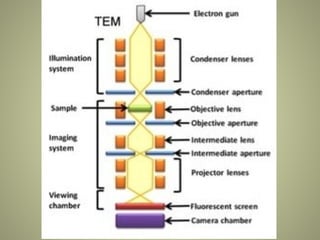
The main components of EM include:
 Electron source
 Sample illumination
 Objective lens
 Intermediate lens
 Projector lenses
 Detectors
 The electron beam as a probe has several advantages:-
 Electrons have shorter wavelength, hence higher the
resolution capacity.
 Easy to manipulate.
 Gives high brightness.
ELECTRON SOURCE
 Electron gun generates the beam of electrons.
 It consists of a:-
 Tungsten filament
 Wehnelt cylinder (cathode shield)
 Anode plate
ELECTRON SOURCE
• Tungsten filament is made of V-shaped tungsten wire.
• Both the cathode shield aperture and anode plate are
placed centrally in the same axis.
• Now a high voltage positive potential is applied to the
anode plate.
• Simultaneously the tungsten wire is heated at 2700 K
with the help of direct current.
• In this high temperature, the wire generates electrons by
the process known as thermionic emission.
• The cathode shield is negatively charged and deflects
the electron to make it a central beam.
• The central beam of electron emerges from the small
hole of the cathode shield.
CONDENSER SYSTEM
Sample Illumination :-
• Several lenses are used as condenser for focusing the
electron beam in a particular plane.
• Electromagnetic coil is used as lenses.
• By applying electrical current through the coil, the strong
magnetic field is created.
• The strength of the magnet can be changed by adjusting
the electrical current through the coils.
Reducing the current
=
Increase the focal
length.
Increase the current
=
focal length of beam
Shortened
LENSES
Objective Lens:-
• The objective lens produces magnified image of the object.
• The objective lens has small focal length.
Intermediate and Projector Lenses:-
• Used to change the magnification of the image further.
• The projector lens highly magnifies the last image and
focuses it on the screen.
THE VACUUM SYSTEM
• The beam of electron should be in the vacuum chamber.
 The vacuum is needed because of:-
 The gas molecule will scatter the electrons from their
pathway.
 Therefore to maintain the optical pathway of the electron
beam, the vacuum is mandatory.
 The vacuum chamber prevents the oxidation of the
tungsten molecule and increases the longevity of the
electron gun.
SAMPLE
• The sample is placed in the microscope column below the
condenser with the help of a holder.
• Now the electrons interact with the thin tissue and hit the
atoms of the tissue.
• Heavier atoms deflect the electrons and are known as
“electron-dense” areas [ BLACK ].
• The electron passes through the lighter atoms and
produces an “electron-lucent / transparent” area
[ WHITE ].
OBJECTIVE
• The electromagnetic lens of the objective is very
powerful.
• It creates highly magnified image that is also known as
intermediate image.
PROJECTOR LENSES
• The intermediate image is further magnified by the projector lenses.
 There are three sets of projector lenses:-
 Diffraction lens or first intermediate lens.
 It magnifies the first image created by the objective lens.
 The second intermediate lens.
 The third intermediate lens or final projector lens.
 This lens magnifies the image further and projects it on the screen of
the detector
DETECTORS
• The final image is focused on the screen of the detector.
• This is a fluorescent screen, and when the electrons are
bombarded on this screen, it emits light in the visible
range to produce visible image.
• The image can be captured permanently with the help of
a charge-coupled device camera.
ELECTRON INTERACTION IN TEM
• The beam of incident electrons of the microscope column
passes through the sample.
Thin the
specimen
=
Lighter image.
Thick the
specimen
=
Darker image.
SAMPLE PREPARATION FOR TEM
 The preparation of sample is an important prerequisite for EM.
 The major criteria of the good sample preparation include:-
 The sample should be thin and electron transparent.
 The thickness of the sample varies from 30–50 nm(3-5 micron).
The steps of sample preparation for TEM include:
1. Sample collection 2. Sample fixation
3. Dehydration 4. Clearing
5. Embedding 6. Sectioning
7. Staining
SAMPLE COLLECTION
• The sample should be cut in small pieces of 1–3 mm in
thickness of 1 square mm area.
• Try to fix the sample immediately.
• Transfer the needle biopsy sample directly into the
fixative solution.
FIXATION
DEHYDRATION
EMBEDDING
SECTIONING
STAINING
GLUTARALDEHYDE
RESIN
URANYL ACETATE
LEAD CITRATE
GLASS KNIFE
DIAMOND KNIFE
ALCOHOL
FIXATION
 The major aims of fixation are:
 To prevent any change in the tissue.
 To preserve the tissue in its living condition.
 To prepare the tissue for the further processing.
 So that the tissue does not disintegrate or tear.
 The choice of fixative depends on the type of tissue and the
particular chemical constituents to study.
 The most commonly used fixative in EM is glutaraldehyde.
 The best fixative is the combination of glutaraldehyde
followed by osmium tetroxide.
• Volume of Fixative:
• The volume of fixative should be 15 times more than the
volume of the sample.
• Duration:
• The average time of fixation is 9 h by 4% glutaraldehyde
at room temperature and 1 h for osmium tetroxide.
• The tissue should not be in fixative for more than 12 h.
Under fixation - swelling of the
mitochondria and disruption of cell
organelles.
Prolonged fixation - extract the
proteinaceous material
GLUTARALDEHYDE FIXATION
• Glutaraldehyde causes cross-linking of the protein and
denatures them.
• It stabilizes the protein without any coagulation.
• However glutaraldehyde is not a good fixative for lipids
and causes cell shrinkage.
• This effect is balanced by osmium tetroxide which is a
good fixative for lipid and causes swelling of the
cytoplasm and nucleus.
COMBINED FIXATION TECHNIQUE
• At first the tissue is kept in 2% glutaraldehyde solution
for 2 h.
• After 2 h the fixative should be poured out, and the
tissue is washed in phosphate buffer [pH = 7.2 to 7.6]
solution for 5 min three times.
• Then the tissue is fixed in 1% osmium tetroxide for 1 h
followed by two to three washing in double-distilled
water.
DEHYDRATION
• Removal of water from the sample is necessary because
most of the embedding media are not miscible with water.
• Therefore a dehydrating agent is used that remove the water.
• The water is then replaced with a different solution which is
soluble in the embedding medium.
• The dehydration is done by treating the sample in the series
of graded alcohol:-
30% ethyl alcohol: 10 min
50% ethyl alcohol: 10 min
70% ethyl alcohol: 10 min
90% ethyl alcohol: 10 min
100% ethyl alcohol: 10 min
EMBEDDING
• The embedding medium helps to provide firm base for
sectioning of the tissue.
• The ideal embedding medium should be:-
 Easy to cut the section
 Stable in electron beam and withstand higher temperature
(200 °C).
 Easy to procure the medium
 Evenly polymerized
• Presently the following media are used for EM:-
 Epoxy resin
 Acrylic media
 Polyester resin
EPOXY RESIN
 This is the M/C used embedding medium for EM.
 The advantages of epoxy resin are:
 Stable at higher temperature
 Uniform polymerization
 No damage or tissue shrinkage
 The main disadvantages of epoxy resin are:
 High viscosity that requires long infiltration time.
 Causes dermatitis and direct contact should be avoided.
ACRYLIC MEDIA
• Butyl methacrylate and methyl methacrylate are the
common acrylic media.
• They cause significant cell shrinkage.
• At the time of polymerization, bubble formation may
occur and this may damage the block.
• Moreover methacrylate may disintegrate in the presence
of high-energy electron beam.
ARALDITE:
• It is an aromatic amine.
• It is one of the epoxy resins used for EM.
• The components should be mixed properly to avoid the
formation of any air bubbles.
EPON:
• It is an alternative embedding medium for EM.
• This is an aliphatic resin and has low viscosity.
POLYESTER RESIN:
• They do not cause any cell shrinkage and polymerize uniformly.
• Vestapol W is the commonly used polyester resin.
SECTIONING
• Thin section is the crucial point of sectioning in EM.
• Ordinary histological microtomy is not suitable.
• Ultrathin microtomy is needed.
KNIVES
Glass knives:
• Glass knives are cheap and convenient.
Diamond knives:
• The diamond knives are relatively expensive.
• The section quality of diamond knives is far better than
glass knives.
• These knives are more durable than the glass knives.
SEMI-THIN SECTIONS
• It is the preliminary screening procedure to see the
adequacy of the sample.
• At first the resin-embedded blocks are trimmed to
expose the underlying tissue.
• Approximately 1 μ thick multiple sections are cut from
each block.
• The sections are picked up from the water trough placed
directly below the glass knife.
• The semi-thin sections are dried in a hot plate at 60 °C.
• The dried sections stick to the glass slide.
• The semi-thin sections are stained with 1% toluidine blue
for 1 min to see the adequacy of the sample.
• If the section contains the representative areas, then
further ultrathin sections are made from the block.
ULTRATHIN SECTION
• The trimmed blocks are cut further.
• The ultramicrotome is set in an auto mode to have optimum
thin sections.
• Sections less than 100 nm thick are cut. [optimum thickness
is 80 nm]
• The reflected light from the section gives information about
the thickness of the slide.
• The sections float either in ethanol or acetone.
• To stretch the sections, one can take the help of xylene
or chloroform.
• The stretched sections are finally picked up by small
copper grid on the dull side.
1.Grey colour: <60 nm 2.Silver colour: 60–90 nm
3.Gold colour: 90–120 nm
SECTION COLLECTION
• Ultra-thin sections are collected on specimen grids for
viewing.
• Grids measure 3 mm in diameter.
• 200 square mesh is commonly used.
• Made of conductive material - copper, nickel or gold.
• Copper grids are generally used for routine TEM.
• Nickel grids, commonly used for immunolabelling studies.
• They gain electric charge easily and can cause
astigmatism.
STAINING OF THE SECTIONS
• They are commonly stained with lead or uranyl acetate.
LEAD STAIN
• Reynold’s lead citrate solution is used for the staining.
• Lead reacts with the atmospheric CO2 and forms lead
carbonate as precipitate.
• Therefore care should be taken to prevent such
precipitation.
• The solution should always be filtered before use.
STAINING PROCEDURE
• The section is dipped in Reynold’s lead citrate solution
for 15 min.
• Wash each grid by 0.1 N NaOH solution.
• Wash by two change of distilled water.
• Dry the grid and keep it in a grid box.
URANYL SALT
• Aqueous or alcoholic solution of uranyl acetate is used
for the staining of TEM.
• Uranyl acetate combines with protein and lipids and
gives good contrast of various membranes and nucleic
acid.
 The major disadvantage of uranyl acetate:-
• Rapid precipitation in the presence of light.
• Either aqueous or alcoholic solution of uranyl acetate
can be used.
• Alcoholic solution:
• It has short staining time.
• It penetrates easily within the sample.
• It also gives better contrast.
• Aqueous solution:
• It also provides good contrast.
• However this solution is photosensitive and rapidly
precipitates.
PROCESSING TECHNIQUES
FOR SPECIAL SPECIMENS
PERCUTANEOUS RENAL BIOPSY
1-2 mm from both ends of the core biopsy is used to ensure
cortical glomeruli is present.
FINE NEEDLE ASPIRATION BIOPSY
• Aspirate is directly expressed into glutaraldehyde and
kept for fixation.
• Filtration of fixed specimen through 20 micrometer mesh
screen.
• Cells washed with buffer and processed as for solid
tissue.
BONE MARROW ASPIRATE
• Centrifugation of heparinized aspirate in haematocrit
tube.
• Gentle layering of fixative on the buffy coat and fixation.
• Disk is gently transferred and further processed.
CORE BIOPSIES OF BONE
• Challenging task as decalcification causes severe damage
to cells.
• Fixation in glutaraldehyde.
• Soft marrow is dislodged with fine needle under dissecting
microscope.
• Processed in routine fashion.
BODY FLUIDS
 NON HEMORRHAGIC FLUIDS:-
• Centrifugation
• Fixation in glutaraldehyde.
 HEMORRHAGIC FLUIDS:-
• Erythrocytes removed with hemolysis.
• Rinsing in buffer and fixation.
ADVANTAGES OF TEM
• TEM offer very powerful magnification and resolution.
• TEM have wide range of applications.
• It can be utilized in variety of different scientific,
educational and industrial fields.
• Images from TEM are high quality and detailed.
DISADVANTAGES OF TEM
• TEM are large and very expensive.
• Sample preparation is laborious.
• Operation and analysis requires special training.
• Samples are limited to those that are electron transparent.
• TEM require special housing and maintenance.
• Images formed are black and white.
KIDNEY
• EM, in conjugation with routine H and E and IF, is essential
part of work up of renal biopsies to diagnose glomerular
disease.
 Because EM makes it possible to visualize the individual
components of the GLOMERULAR CAPILLARY WALL
including:-
 Endothelium.
 Glomerular basement membrane.
 Visceral epithelial cells.
KIDNEY
 It is used for identification and localization of discrete
electron-dense deposits in glomeruli:-
 Immunoglobulins
 Amyloid
 Amyloid-like proteins.
 The glomerular basement membrane is evaluated for:-
 Abnormal thickening
 Thinning
 Presence of deposits.
 Tubular basement membranes, arterioles, and interstitium
are evaluated for:-
 Amyloid
 Light chain dense deposits
 Cryoglobulins.
KIDNEY
LOSS / EFFACEMENT OF FOOT PROCESS /
PODOCYTES
FOOT PROCESS / PODOCYTES
POST STREPTOCOCCAL
GLOMERULO NEPHRITIS
SUBEPITHELIAL
HUMP –
DEPOSITION OF
IgG & C3
LIVER
• Inherited metabolic diseases often result in hepatocellular
dysfunction.
• In the work-up of liver disease in infancy and childhood, a
portion of the liver biopsy is routinely placed in
glutaraldehyde for ultrastructural studies.
• In cases where obstruction and infection have been ruled
out, EM is performed to look for evidence of primary
metabolic disease.
• Certain metabolic diseases have pathognomonic findings:
 Type 2 and 4 glycogen storage diseases.
 Alpha-1-antitrypsin disease.
 Wilson disease.
INHERITED METABOLIC DISEASES.
• Initial studies in the work-up of inherited metabolic diseases
often include a biopsy of affected organs:-
 Liver.
 Muscle.
 Peripheral nerve.
• In most cases light microscopy and EM findings are useful in
narrowing the differential diagnosis and providing direction for
further laboratory studies.
• Definitive diagnosis typically requires enzyme studies of
fibroblast cultures and molecular studies.
PRENATAL STUDIES
• EM can be performed on amniotic cells and chorionic
villous tissue obtained for prenatal diagnosis.
• Ultrastructural studies on noncultured amniotic cells can
yield a rapid diagnosis including:-
 Type 2 glycogen storage disease.
 Lysosomal storage diseases.
 Peroxisomal disorders.
STORAGE DISORDERS
BONE MARROW:
GAUCHER CELL – LIPID LADEN
GRANULAR CYTOPLASM
EM – GAUCHER CELL- ELONGATED
DISTENDED LYSOSOMES.
GANGLION CELLS
LM – LARGE NEURON – LIPID
VACUOLATION
EM – NEURON – PROMINENT
LYSOSOME WITH WHORLED
CONFIGURATION
LYSOSOMAL STORAGE DISEASE
ZEBRA BODIES – EM –
SECONDARY LYSOSOMES
CONTAINING MEMBRANEOUS
CYTOPLASMIC BODIES
ACCUMULATION OF SPHINGOMYELIN
IN LYSOSOMES
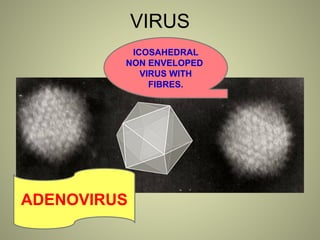
VIRUS
ICOSAHEDRAL
NON ENVELOPED
VIRUS WITH
FIBRES.
ADENOVIRUS
ISOSAHEDRAL
ENVELOPED
VIRUS.
EBV
NON-ENVELOPED
WHEEL LIKE RNA
VIRUS.
ROTAVIRUS
SPHERICAL
CAPSID.
HERPES SIMPLEX VIRUS
CRYO ELECTRON MICROSCOPY PICTURE.
LUNG
• The protocol for lung biopsy in the work-up of interstitial
lung disease in infancy includes placing a portion of the
specimen in EM fixative.
• Diseases that have characteristic ultrastructural findings
include:-
 Pulmonary interstitial glycogenosis.
 Surfactant processing abnormalities.
PRIMARY CILIARY DYSKINESIA
• At present, EM is the method of choice for the
diagnosis of primary ciliary dyskinesia using ciliary
biopsy and brushings.
 The most frequent ultrastructural abnormalities are:-
 Decreased numbers.
 Absence of outer / inner dynein arms.
PRIMARY CILIARY DYSKINESIA
CILLIA
SKELETAL MUSCLE BIOPSY
Fabry’s disease
- INCLUSION
WITHIN
MYOFIBRILS
NEOPLASM
• EM, is also useful ancillary method in cases of poorly
differentiated tumors for which immunohistochemical and
molecular studies are inconclusive.
• In general, a differential diagnosis is first developed on the
basis of light microscopic findings.
• EM is then used to look for evidence of cellular
differentiation toward the tumors in the differential
diagnosis.
• EM does not differentiate reactive, benign, neoplastic, and
malignant processes.
SQUAMOUS CELL CARCINOMA
DESMOSOMES
CYTOPLA
SMIC
TONOFIL
AMENTS
ADENOCARCINOMA
Vs
MESOTHELIOMA
ADENOCARCINOMA SMALL INTESTINE
Tight junction complex
Mucin granules
Luminal microvilli
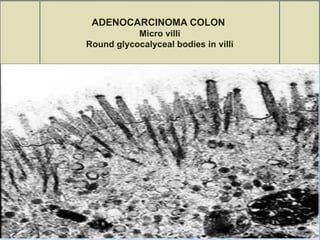
ADENOCARCINOMA COLON
Micro villi
Round glycocalyceal bodies in villi
MELANOMA
• In melanoma which do not express S 100 or HMB 45
identification of premelanosomes or melanosomes are
hallmark in diagnosis of MELANOMA.
• Melanosomes are cytoplasmic granules where melanin
is produced.
• There are four stages in the development of
melanosomes.
BURKITT’s LYMPHOMA
np
m
er
BIRBECK GRANULES – LANGERHANS CELL
HISTIOCYTOSIS
SPINDLE CELL TUMORS
FIBROSARCOMA – abundant ER
LEIOMYOSARCOMA–
poorly developed ER
SMALL ROUND CELL TUMORS
PROMINENT LAKES OF GLYCOGEN
EWING’S SARCOMA
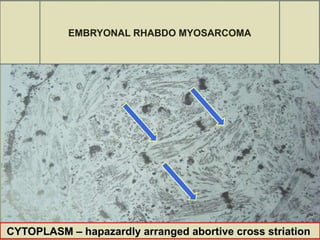
EMBRYONAL RHABDO MYOSARCOMA
CYTOPLASM – hapazardly arranged abortive cross striation
NEUROBLASTOMA
Cytoplasmic
processes
wrapping around
a neuroblastoma
cell
NEUROENDOCRINE TUMORS
• Neuro secretory
vacuoles in cytoplasm.
• Spherical to Ovoid.
• Electron dense centre
surrounded by clear
lucent halo.
NEUROPATHOLOGY SPECIMENS
• EM is critical for the evaluation of peripheral nerve
biopsies and muscle biopsies.
• Also useful in the evaluation of neuro-oncologic
specimens.
• EM examination of skin and conjunctival biopsies is used
in the diagnosis of:-
 Neuronal ceroid lipofuscinosis.
 Infantile neuroaxonal dystrophy.
 Cerebral autosomal dominant arteriopathy with
subcortical infarcts and eukoencephalopathy (CADASIL).
FILGREE PATTERN OF THE CURVING STRANDS OF ATTENUATED CELLS
EXTRACRANIAL MENINGIOMA
MENINGIOMA
Long, interdigitating
cellular processes.
Numerous cytoplasmic
filaments.
Prominent
desmosomes.
HEART
• Glycogen storage disease Type 2 (Pompe disease) can
be diagnosed on the basis of ultrastructural findings in
cardiac biopsies.
• Adriamycin toxicity involving the heart results in
characteristic cytoplasmic changes that are seen in
semithin sections.
MICROVILLUS INCLUSION DISEASE
• Microvillus inclusion disease presents as intractable
secretory diarrhea in the neonate.
 Characteristic light microscopic findings include:-
 Villous atrophy.
 Loss of the brush border.
• But EM is required for diagnosis.
 Pathognomonic ultrastructural findings include:-
 Absent or decreased numbers of stubby microvilli on the
apical cytoplasmic membrane of enterocytes.
 Cytoplasmic membrane-bound inclusions with microvillus
projections.
SCANNING ELECTRON MICROSCOPE
In SEM instead of
transmitted electrons, the
secondary electrons and
the backscattered
electrons are recorded.
• SEM provides information of the surface structures of the
object.
• The spatial resolution of the SEM is ten times better than
the light microscope.
• The image of the SEM is developed point by point from
the emitted secondary electrons like a scanner image.
 Operational Principle:
• When the electron beam hits the specimen, the
secondary electron and backscattered electrons come
back from the surface.
• These electrons emitted from the same side of the
incident beam create an image.
 Specimen preparation for SEM:
• The fixation, processing, sectioning and staining for SEM
are same as that of TEM.
ADVANTAGES OF SEM
• It gives detailed 3D and topographical imaging and the
versatile information garnered from different detectors.
• This instrument works very fast.
• Modern SEM allow for the generation of data in digital
form.
• Most SEM require minimal preparation actions.
DISADVANTAGES OF SEM
• SEM are expensive and large.
• Special training is required to operate SEM.
• Preparation of samples can result in artifacts.
• SEM are limited to solid samples.
• SEM carry small risk of radiation exposure associated with
electrons that scatter from beneath the sample surface.
TEM SEM
Incident beam of electron –
static.
Incident beam of electron –
dynamic.
Scans the object in two
perpendicular directions.
Image formed – instantly. Scanner image is formed.
Incident beam of electron
passes through the object.
Incident beam of electron hits
the object.
Secondary and backscattered
electrons forms the image.
Image formed on the
fluorescent screen.
Image formed on TV monitor.
QUALITY CONTROL
• TEM continues to play a critical role in diagnostics.
• However, due to a combination of economic and staffing
issues, diagnostic TEM is currently at a significant
crossroads.
• Diagnostic TEM are increasingly likely to be multiskilled
rather than TEM specialists.
• In such a case, attention to quality to maintain standards
is essential.
• To ensure quality, two strategies are available.
• First, it is essential to underpin good practice with clear
guidelines that define ‘‘quality standards’’ for laboratory
operations (processes and outcomes).
• Second, it is advisable to participate in an external
quality assurance program (EQAP) that audits laboratory
processes and outputs.
• Ideally the EQAP should also function as an educational
tool.
• Two EQAPs for general diagnostic TEM are currently
available.
• The Royal College of Pathologists Australasia
(RCPA), through the (RCPA QAP) Quality Assurance
Programs, successfully initiated an internationally
accredited program in 2006.
• Also, in the United Kingdom (UK) the Association of
Clinical Electron Microscopists (ACEM) has initiated
an informal quality assurance program.
CRYOGENIC ELECTRON
MICROSCOPY (CRYO-EM)
• It is a cryomicroscopy technique applied on samples
cooled to cryogenic temperatures and embedded in an
environment of vitreous water.
• In 2017, the Nobel prize was awarded to Jacques
Dubochet, Joachim Frank and Richard Henderson for
developing cryo-electron microscopy.
REFERENCES
 www.researchgate.net/publication/
282553311_Application_of_Electron_Microscopy_Method_for_Quality_
Control_of_Paint_Coating_Surface
 IMAGES FROM ONLINE SOURCE
ELECTRON MICROSCOPE                 .pptx

ELECTRON MICROSCOPE .pptx

  • 1.
  • 2.
    INTRODUCTION • Microscope magnifiesthe image of the object so that we can visualize the smallest particles. • The word microscope is derived from the Greek word mikros (small) and skopeo (look at). • Light microscopy was developed from Galilean telescope – 17 th centuary. • Dutchmen Antony van Leeuwenhook invented simple microscope. • Compound microscope – consisting of two lens ( objective and eyepiece), mirror and light source.
  • 3.
    THE MICROSCOPE • Singleconvex lens was the limiting factor in it. • The resolution power of the light microscope is limited. • The visible light has the wavelength of 300 – 700 nm. • Light microscope uses the visible light, and so the maximum resolution power of the light microscope is 0.2μm. • RESOLVING POWER is the ability of an imaging device to see objects that are located at a small distances.
  • 4.
    • The formula, •λ is wavelength, • h = 6.626 × 10⁻³⁴ (Planck’s constant), • m = mass • v = speed of the electron. INCREASING VELOCITY = DECREASES WAVE LENGTH = IMPROVES RESOLVING POWER.
  • 5.
    THE MICROSCOPE • Theimprovement of the resolution capacity of the microscope can be improved by reducing the wavelength of the light. • Ultraviolet ray has the wavelength of 100– 300 nm and the resolution power is improved to 0.1 μm. • During the first part of the 20th century, the wave like property of the electron was demonstrated, and this has been utilized in electron microscope.
  • 7.
    • EM arescientific instruments that use a beam of highly energetic electrons to examine objects on a very fine scale. • TYPES OF EM:- TEM – allows study of inner structures. SEM – visualize the surface of objects.
  • 11.
    TRANSMISSION ELECTRON MICROSCOPE • Ithas been used by surgical pathologists over past 50 years for diagnosis of wide range of diseases. • It allows for visualization of subcellular morphology and structural abnormalities. • It is an essential part of work up of:-  Medical renal diseases  Peripheral nerve diseases  Muscle diseases  Primary cilliary dyskinesia
  • 12.
    • It isalso useful in evaluating metabolic and inherited diseases. • The role of EM in the diagnosis of neoplasms has decreased since the advent of IHC and molecular techniques. • EM is occasionally used to demonstrate infectious agents. • It is now considered to be a promising diagnostic technique in oncologic surgical pathology, for the identification and localization of targets for gene therapy.
  • 13.
    TRANSMISSION ELECTRON MICROSCOPE • Ithas much higher resolution than light microscopy and allows visualization of:-  Cellular organelles.  Intercellular junctions.  Extracellular proteins. • It can clarify architectural details that aid in the diagnosis of:-  Glomerular diseases.  Neurological diseases.  Muscular diseases.  Cutaneous diseases.
  • 14.
  • 15.
    The main componentsof EM include:  Electron source  Sample illumination  Objective lens  Intermediate lens  Projector lenses  Detectors
  • 17.
     The electronbeam as a probe has several advantages:-  Electrons have shorter wavelength, hence higher the resolution capacity.  Easy to manipulate.  Gives high brightness.
  • 18.
    ELECTRON SOURCE  Electrongun generates the beam of electrons.  It consists of a:-  Tungsten filament  Wehnelt cylinder (cathode shield)  Anode plate
  • 20.
    ELECTRON SOURCE • Tungstenfilament is made of V-shaped tungsten wire. • Both the cathode shield aperture and anode plate are placed centrally in the same axis. • Now a high voltage positive potential is applied to the anode plate. • Simultaneously the tungsten wire is heated at 2700 K with the help of direct current.
  • 21.
    • In thishigh temperature, the wire generates electrons by the process known as thermionic emission. • The cathode shield is negatively charged and deflects the electron to make it a central beam. • The central beam of electron emerges from the small hole of the cathode shield.
  • 22.
    CONDENSER SYSTEM Sample Illumination:- • Several lenses are used as condenser for focusing the electron beam in a particular plane. • Electromagnetic coil is used as lenses. • By applying electrical current through the coil, the strong magnetic field is created. • The strength of the magnet can be changed by adjusting the electrical current through the coils.
  • 23.
    Reducing the current = Increasethe focal length. Increase the current = focal length of beam Shortened
  • 24.
    LENSES Objective Lens:- • Theobjective lens produces magnified image of the object. • The objective lens has small focal length. Intermediate and Projector Lenses:- • Used to change the magnification of the image further. • The projector lens highly magnifies the last image and focuses it on the screen.
  • 25.
    THE VACUUM SYSTEM •The beam of electron should be in the vacuum chamber.  The vacuum is needed because of:-  The gas molecule will scatter the electrons from their pathway.  Therefore to maintain the optical pathway of the electron beam, the vacuum is mandatory.  The vacuum chamber prevents the oxidation of the tungsten molecule and increases the longevity of the electron gun.
  • 26.
    SAMPLE • The sampleis placed in the microscope column below the condenser with the help of a holder. • Now the electrons interact with the thin tissue and hit the atoms of the tissue. • Heavier atoms deflect the electrons and are known as “electron-dense” areas [ BLACK ]. • The electron passes through the lighter atoms and produces an “electron-lucent / transparent” area [ WHITE ].
  • 27.
    OBJECTIVE • The electromagneticlens of the objective is very powerful. • It creates highly magnified image that is also known as intermediate image.
  • 28.
    PROJECTOR LENSES • Theintermediate image is further magnified by the projector lenses.  There are three sets of projector lenses:-  Diffraction lens or first intermediate lens.  It magnifies the first image created by the objective lens.  The second intermediate lens.  The third intermediate lens or final projector lens.  This lens magnifies the image further and projects it on the screen of the detector
  • 29.
    DETECTORS • The finalimage is focused on the screen of the detector. • This is a fluorescent screen, and when the electrons are bombarded on this screen, it emits light in the visible range to produce visible image. • The image can be captured permanently with the help of a charge-coupled device camera.
  • 30.
    ELECTRON INTERACTION INTEM • The beam of incident electrons of the microscope column passes through the sample. Thin the specimen = Lighter image. Thick the specimen = Darker image.
  • 31.
    SAMPLE PREPARATION FORTEM  The preparation of sample is an important prerequisite for EM.  The major criteria of the good sample preparation include:-  The sample should be thin and electron transparent.  The thickness of the sample varies from 30–50 nm(3-5 micron). The steps of sample preparation for TEM include: 1. Sample collection 2. Sample fixation 3. Dehydration 4. Clearing 5. Embedding 6. Sectioning 7. Staining
  • 32.
    SAMPLE COLLECTION • Thesample should be cut in small pieces of 1–3 mm in thickness of 1 square mm area. • Try to fix the sample immediately. • Transfer the needle biopsy sample directly into the fixative solution.
  • 33.
  • 34.
    FIXATION  The majoraims of fixation are:  To prevent any change in the tissue.  To preserve the tissue in its living condition.  To prepare the tissue for the further processing.  So that the tissue does not disintegrate or tear.  The choice of fixative depends on the type of tissue and the particular chemical constituents to study.  The most commonly used fixative in EM is glutaraldehyde.  The best fixative is the combination of glutaraldehyde followed by osmium tetroxide.
  • 35.
    • Volume ofFixative: • The volume of fixative should be 15 times more than the volume of the sample. • Duration: • The average time of fixation is 9 h by 4% glutaraldehyde at room temperature and 1 h for osmium tetroxide. • The tissue should not be in fixative for more than 12 h. Under fixation - swelling of the mitochondria and disruption of cell organelles. Prolonged fixation - extract the proteinaceous material
  • 36.
    GLUTARALDEHYDE FIXATION • Glutaraldehydecauses cross-linking of the protein and denatures them. • It stabilizes the protein without any coagulation. • However glutaraldehyde is not a good fixative for lipids and causes cell shrinkage. • This effect is balanced by osmium tetroxide which is a good fixative for lipid and causes swelling of the cytoplasm and nucleus.
  • 37.
    COMBINED FIXATION TECHNIQUE •At first the tissue is kept in 2% glutaraldehyde solution for 2 h. • After 2 h the fixative should be poured out, and the tissue is washed in phosphate buffer [pH = 7.2 to 7.6] solution for 5 min three times. • Then the tissue is fixed in 1% osmium tetroxide for 1 h followed by two to three washing in double-distilled water.
  • 38.
    DEHYDRATION • Removal ofwater from the sample is necessary because most of the embedding media are not miscible with water. • Therefore a dehydrating agent is used that remove the water. • The water is then replaced with a different solution which is soluble in the embedding medium. • The dehydration is done by treating the sample in the series of graded alcohol:- 30% ethyl alcohol: 10 min 50% ethyl alcohol: 10 min 70% ethyl alcohol: 10 min 90% ethyl alcohol: 10 min 100% ethyl alcohol: 10 min
  • 39.
    EMBEDDING • The embeddingmedium helps to provide firm base for sectioning of the tissue. • The ideal embedding medium should be:-  Easy to cut the section  Stable in electron beam and withstand higher temperature (200 °C).  Easy to procure the medium  Evenly polymerized • Presently the following media are used for EM:-  Epoxy resin  Acrylic media  Polyester resin
  • 40.
    EPOXY RESIN  Thisis the M/C used embedding medium for EM.  The advantages of epoxy resin are:  Stable at higher temperature  Uniform polymerization  No damage or tissue shrinkage  The main disadvantages of epoxy resin are:  High viscosity that requires long infiltration time.  Causes dermatitis and direct contact should be avoided.
  • 41.
    ACRYLIC MEDIA • Butylmethacrylate and methyl methacrylate are the common acrylic media. • They cause significant cell shrinkage. • At the time of polymerization, bubble formation may occur and this may damage the block. • Moreover methacrylate may disintegrate in the presence of high-energy electron beam.
  • 42.
    ARALDITE: • It isan aromatic amine. • It is one of the epoxy resins used for EM. • The components should be mixed properly to avoid the formation of any air bubbles. EPON: • It is an alternative embedding medium for EM. • This is an aliphatic resin and has low viscosity. POLYESTER RESIN: • They do not cause any cell shrinkage and polymerize uniformly. • Vestapol W is the commonly used polyester resin.
  • 43.
    SECTIONING • Thin sectionis the crucial point of sectioning in EM. • Ordinary histological microtomy is not suitable. • Ultrathin microtomy is needed. KNIVES Glass knives: • Glass knives are cheap and convenient. Diamond knives: • The diamond knives are relatively expensive. • The section quality of diamond knives is far better than glass knives. • These knives are more durable than the glass knives.
  • 45.
    SEMI-THIN SECTIONS • Itis the preliminary screening procedure to see the adequacy of the sample. • At first the resin-embedded blocks are trimmed to expose the underlying tissue. • Approximately 1 μ thick multiple sections are cut from each block. • The sections are picked up from the water trough placed directly below the glass knife.
  • 46.
    • The semi-thinsections are dried in a hot plate at 60 °C. • The dried sections stick to the glass slide. • The semi-thin sections are stained with 1% toluidine blue for 1 min to see the adequacy of the sample. • If the section contains the representative areas, then further ultrathin sections are made from the block.
  • 47.
    ULTRATHIN SECTION • Thetrimmed blocks are cut further. • The ultramicrotome is set in an auto mode to have optimum thin sections. • Sections less than 100 nm thick are cut. [optimum thickness is 80 nm] • The reflected light from the section gives information about the thickness of the slide.
  • 48.
    • The sectionsfloat either in ethanol or acetone. • To stretch the sections, one can take the help of xylene or chloroform. • The stretched sections are finally picked up by small copper grid on the dull side. 1.Grey colour: <60 nm 2.Silver colour: 60–90 nm 3.Gold colour: 90–120 nm
  • 50.
    SECTION COLLECTION • Ultra-thinsections are collected on specimen grids for viewing. • Grids measure 3 mm in diameter. • 200 square mesh is commonly used. • Made of conductive material - copper, nickel or gold. • Copper grids are generally used for routine TEM. • Nickel grids, commonly used for immunolabelling studies. • They gain electric charge easily and can cause astigmatism.
  • 52.
    STAINING OF THESECTIONS • They are commonly stained with lead or uranyl acetate. LEAD STAIN • Reynold’s lead citrate solution is used for the staining. • Lead reacts with the atmospheric CO2 and forms lead carbonate as precipitate. • Therefore care should be taken to prevent such precipitation. • The solution should always be filtered before use.
  • 53.
    STAINING PROCEDURE • Thesection is dipped in Reynold’s lead citrate solution for 15 min. • Wash each grid by 0.1 N NaOH solution. • Wash by two change of distilled water. • Dry the grid and keep it in a grid box.
  • 54.
    URANYL SALT • Aqueousor alcoholic solution of uranyl acetate is used for the staining of TEM. • Uranyl acetate combines with protein and lipids and gives good contrast of various membranes and nucleic acid.  The major disadvantage of uranyl acetate:- • Rapid precipitation in the presence of light.
  • 55.
    • Either aqueousor alcoholic solution of uranyl acetate can be used. • Alcoholic solution: • It has short staining time. • It penetrates easily within the sample. • It also gives better contrast. • Aqueous solution: • It also provides good contrast. • However this solution is photosensitive and rapidly precipitates.
  • 56.
  • 57.
    PERCUTANEOUS RENAL BIOPSY 1-2mm from both ends of the core biopsy is used to ensure cortical glomeruli is present.
  • 58.
    FINE NEEDLE ASPIRATIONBIOPSY • Aspirate is directly expressed into glutaraldehyde and kept for fixation. • Filtration of fixed specimen through 20 micrometer mesh screen. • Cells washed with buffer and processed as for solid tissue.
  • 59.
    BONE MARROW ASPIRATE •Centrifugation of heparinized aspirate in haematocrit tube. • Gentle layering of fixative on the buffy coat and fixation. • Disk is gently transferred and further processed.
  • 60.
    CORE BIOPSIES OFBONE • Challenging task as decalcification causes severe damage to cells. • Fixation in glutaraldehyde. • Soft marrow is dislodged with fine needle under dissecting microscope. • Processed in routine fashion.
  • 61.
    BODY FLUIDS  NONHEMORRHAGIC FLUIDS:- • Centrifugation • Fixation in glutaraldehyde.  HEMORRHAGIC FLUIDS:- • Erythrocytes removed with hemolysis. • Rinsing in buffer and fixation.
  • 63.
    ADVANTAGES OF TEM •TEM offer very powerful magnification and resolution. • TEM have wide range of applications. • It can be utilized in variety of different scientific, educational and industrial fields. • Images from TEM are high quality and detailed.
  • 64.
    DISADVANTAGES OF TEM •TEM are large and very expensive. • Sample preparation is laborious. • Operation and analysis requires special training. • Samples are limited to those that are electron transparent. • TEM require special housing and maintenance. • Images formed are black and white.
  • 66.
    KIDNEY • EM, inconjugation with routine H and E and IF, is essential part of work up of renal biopsies to diagnose glomerular disease.  Because EM makes it possible to visualize the individual components of the GLOMERULAR CAPILLARY WALL including:-  Endothelium.  Glomerular basement membrane.  Visceral epithelial cells.
  • 67.
    KIDNEY  It isused for identification and localization of discrete electron-dense deposits in glomeruli:-  Immunoglobulins  Amyloid  Amyloid-like proteins.  The glomerular basement membrane is evaluated for:-  Abnormal thickening  Thinning  Presence of deposits.
  • 68.
     Tubular basementmembranes, arterioles, and interstitium are evaluated for:-  Amyloid  Light chain dense deposits  Cryoglobulins. KIDNEY
  • 69.
    LOSS / EFFACEMENTOF FOOT PROCESS / PODOCYTES FOOT PROCESS / PODOCYTES
  • 70.
  • 72.
    LIVER • Inherited metabolicdiseases often result in hepatocellular dysfunction. • In the work-up of liver disease in infancy and childhood, a portion of the liver biopsy is routinely placed in glutaraldehyde for ultrastructural studies. • In cases where obstruction and infection have been ruled out, EM is performed to look for evidence of primary metabolic disease. • Certain metabolic diseases have pathognomonic findings:  Type 2 and 4 glycogen storage diseases.  Alpha-1-antitrypsin disease.  Wilson disease.
  • 73.
    INHERITED METABOLIC DISEASES. •Initial studies in the work-up of inherited metabolic diseases often include a biopsy of affected organs:-  Liver.  Muscle.  Peripheral nerve. • In most cases light microscopy and EM findings are useful in narrowing the differential diagnosis and providing direction for further laboratory studies. • Definitive diagnosis typically requires enzyme studies of fibroblast cultures and molecular studies.
  • 74.
    PRENATAL STUDIES • EMcan be performed on amniotic cells and chorionic villous tissue obtained for prenatal diagnosis. • Ultrastructural studies on noncultured amniotic cells can yield a rapid diagnosis including:-  Type 2 glycogen storage disease.  Lysosomal storage diseases.  Peroxisomal disorders.
  • 75.
    STORAGE DISORDERS BONE MARROW: GAUCHERCELL – LIPID LADEN GRANULAR CYTOPLASM EM – GAUCHER CELL- ELONGATED DISTENDED LYSOSOMES.
  • 76.
    GANGLION CELLS LM –LARGE NEURON – LIPID VACUOLATION EM – NEURON – PROMINENT LYSOSOME WITH WHORLED CONFIGURATION
  • 77.
    LYSOSOMAL STORAGE DISEASE ZEBRABODIES – EM – SECONDARY LYSOSOMES CONTAINING MEMBRANEOUS CYTOPLASMIC BODIES ACCUMULATION OF SPHINGOMYELIN IN LYSOSOMES
  • 78.
  • 79.
  • 80.
    SPHERICAL CAPSID. HERPES SIMPLEX VIRUS CRYOELECTRON MICROSCOPY PICTURE.
  • 81.
    LUNG • The protocolfor lung biopsy in the work-up of interstitial lung disease in infancy includes placing a portion of the specimen in EM fixative. • Diseases that have characteristic ultrastructural findings include:-  Pulmonary interstitial glycogenosis.  Surfactant processing abnormalities.
  • 82.
    PRIMARY CILIARY DYSKINESIA •At present, EM is the method of choice for the diagnosis of primary ciliary dyskinesia using ciliary biopsy and brushings.  The most frequent ultrastructural abnormalities are:-  Decreased numbers.  Absence of outer / inner dynein arms.
  • 83.
  • 84.
    SKELETAL MUSCLE BIOPSY Fabry’sdisease - INCLUSION WITHIN MYOFIBRILS
  • 85.
    NEOPLASM • EM, isalso useful ancillary method in cases of poorly differentiated tumors for which immunohistochemical and molecular studies are inconclusive. • In general, a differential diagnosis is first developed on the basis of light microscopic findings. • EM is then used to look for evidence of cellular differentiation toward the tumors in the differential diagnosis. • EM does not differentiate reactive, benign, neoplastic, and malignant processes.
  • 86.
  • 87.
  • 88.
    ADENOCARCINOMA SMALL INTESTINE Tightjunction complex Mucin granules Luminal microvilli
  • 89.
    ADENOCARCINOMA COLON Micro villi Roundglycocalyceal bodies in villi
  • 90.
    MELANOMA • In melanomawhich do not express S 100 or HMB 45 identification of premelanosomes or melanosomes are hallmark in diagnosis of MELANOMA. • Melanosomes are cytoplasmic granules where melanin is produced. • There are four stages in the development of melanosomes.
  • 92.
  • 95.
    BIRBECK GRANULES –LANGERHANS CELL HISTIOCYTOSIS
  • 96.
    SPINDLE CELL TUMORS FIBROSARCOMA– abundant ER LEIOMYOSARCOMA– poorly developed ER
  • 97.
    SMALL ROUND CELLTUMORS PROMINENT LAKES OF GLYCOGEN EWING’S SARCOMA
  • 98.
    EMBRYONAL RHABDO MYOSARCOMA CYTOPLASM– hapazardly arranged abortive cross striation
  • 99.
  • 100.
    NEUROENDOCRINE TUMORS • Neurosecretory vacuoles in cytoplasm. • Spherical to Ovoid. • Electron dense centre surrounded by clear lucent halo.
  • 101.
    NEUROPATHOLOGY SPECIMENS • EMis critical for the evaluation of peripheral nerve biopsies and muscle biopsies. • Also useful in the evaluation of neuro-oncologic specimens. • EM examination of skin and conjunctival biopsies is used in the diagnosis of:-  Neuronal ceroid lipofuscinosis.  Infantile neuroaxonal dystrophy.  Cerebral autosomal dominant arteriopathy with subcortical infarcts and eukoencephalopathy (CADASIL).
  • 102.
    FILGREE PATTERN OFTHE CURVING STRANDS OF ATTENUATED CELLS EXTRACRANIAL MENINGIOMA MENINGIOMA Long, interdigitating cellular processes. Numerous cytoplasmic filaments. Prominent desmosomes.
  • 103.
    HEART • Glycogen storagedisease Type 2 (Pompe disease) can be diagnosed on the basis of ultrastructural findings in cardiac biopsies. • Adriamycin toxicity involving the heart results in characteristic cytoplasmic changes that are seen in semithin sections.
  • 104.
    MICROVILLUS INCLUSION DISEASE •Microvillus inclusion disease presents as intractable secretory diarrhea in the neonate.  Characteristic light microscopic findings include:-  Villous atrophy.  Loss of the brush border. • But EM is required for diagnosis.  Pathognomonic ultrastructural findings include:-  Absent or decreased numbers of stubby microvilli on the apical cytoplasmic membrane of enterocytes.  Cytoplasmic membrane-bound inclusions with microvillus projections.
  • 105.
    SCANNING ELECTRON MICROSCOPE InSEM instead of transmitted electrons, the secondary electrons and the backscattered electrons are recorded.
  • 106.
    • SEM providesinformation of the surface structures of the object. • The spatial resolution of the SEM is ten times better than the light microscope. • The image of the SEM is developed point by point from the emitted secondary electrons like a scanner image.
  • 107.
     Operational Principle: •When the electron beam hits the specimen, the secondary electron and backscattered electrons come back from the surface. • These electrons emitted from the same side of the incident beam create an image.  Specimen preparation for SEM: • The fixation, processing, sectioning and staining for SEM are same as that of TEM.
  • 108.
    ADVANTAGES OF SEM •It gives detailed 3D and topographical imaging and the versatile information garnered from different detectors. • This instrument works very fast. • Modern SEM allow for the generation of data in digital form. • Most SEM require minimal preparation actions.
  • 109.
    DISADVANTAGES OF SEM •SEM are expensive and large. • Special training is required to operate SEM. • Preparation of samples can result in artifacts. • SEM are limited to solid samples. • SEM carry small risk of radiation exposure associated with electrons that scatter from beneath the sample surface.
  • 110.
    TEM SEM Incident beamof electron – static. Incident beam of electron – dynamic. Scans the object in two perpendicular directions. Image formed – instantly. Scanner image is formed. Incident beam of electron passes through the object. Incident beam of electron hits the object. Secondary and backscattered electrons forms the image. Image formed on the fluorescent screen. Image formed on TV monitor.
  • 111.
    QUALITY CONTROL • TEMcontinues to play a critical role in diagnostics. • However, due to a combination of economic and staffing issues, diagnostic TEM is currently at a significant crossroads. • Diagnostic TEM are increasingly likely to be multiskilled rather than TEM specialists. • In such a case, attention to quality to maintain standards is essential.
  • 112.
    • To ensurequality, two strategies are available. • First, it is essential to underpin good practice with clear guidelines that define ‘‘quality standards’’ for laboratory operations (processes and outcomes). • Second, it is advisable to participate in an external quality assurance program (EQAP) that audits laboratory processes and outputs. • Ideally the EQAP should also function as an educational tool.
  • 113.
    • Two EQAPsfor general diagnostic TEM are currently available. • The Royal College of Pathologists Australasia (RCPA), through the (RCPA QAP) Quality Assurance Programs, successfully initiated an internationally accredited program in 2006. • Also, in the United Kingdom (UK) the Association of Clinical Electron Microscopists (ACEM) has initiated an informal quality assurance program.
  • 114.
    CRYOGENIC ELECTRON MICROSCOPY (CRYO-EM) •It is a cryomicroscopy technique applied on samples cooled to cryogenic temperatures and embedded in an environment of vitreous water. • In 2017, the Nobel prize was awarded to Jacques Dubochet, Joachim Frank and Richard Henderson for developing cryo-electron microscopy.
  • 115.