VIVEKANANDHA ARTS AND SCIENCE
COLLEGE FOR WOMEN
VEERACHIPALAYAM - 6366007
SANKAGIRI, TAMIL NADU.
DEPARTMENT OF MICROBIOLOGY
SUBJECT: GENERAL MICROBIOLOGY AND MICROBIAL DIVERSITY
TOPIC: TRANSMISSION ELECTRON MICROSCOPE
SUBJECT INCHARG
Dr.V.BHARATHI,M.Sc.,M.Phil.,Ph.D.
ASSISTANT PROFESSOR
DEPARTMENT OF MICROBIOLOGY
VIAAS, SANKAGIRI
PRESENTED BY
DHIVYADHARSHINI.R
I - MICROBIOLOGY
DEPARTMENT OF MICROBIOLOGY
VIAAS, SANKAGIRI
INTRODUCTION
● The first electron microscope was later developed by Ernst Ruska and Max
Knolls in 1931
● Modified into a Transmission Electron Microscope (TEM) by Ernst Ruska
along with the Sieman’s company, in 1933.
● This TEM microscope has several advantages compared to the light
microscope with its efficiency also being very high.
DEFINITION
● This is a powerful electron microscope that uses a beam of electrons to focus
on a specimen producing a highly magnified and detailed image of the
specimen.
● The magnification power is over 2 million times better than that of the light
microscope, producing the image of the specimen.
● Which enables easy characterization of the image in its morphological
features, compositions and crystallization information is also detailed.
● TEM are the most powerful microscopes used in laboratories. It can magnify
mall particle of about 2nm, and therefore they have a resolution limit of 0.2um
PRINCIPLE
● Transmission Electron Microscope (TEM) is similar to the light microscope.
The major difference is that light microscopes use light rays to focus and
produce an image while the TEM uses a beam of electrons to focus on the
specimen, to produce an image.
● The wavelength of the electrons is about 0.005nm which is 100,000X shorter
than that of light, hence TEM has better resolution than that of the light
microscope, of about 1000times.
● when the electron illuminates the specimen, the resolution power increases
increasing the wavelength of the electron transmission.
● Electrons have a shorter wavelength in comparison to light which has a long
wavelength.
Parts of Transmission Electron Microscope
(TEM)
The major compound of Transmission electron microscope
It has three working parts which include:
1)Electron gun
2)Image producing system
3)Image recording system
1) Electron gun
● Electrons are produced by a cathode that is a tungsten filament that is
V-shaped and it is normally heated.
● It also has the condenser lens system which works to focus the electron
beam on the specimen by controlling the energy intensity and the column
hole of the electron gun.
● The TEM uses two condenser lenses to converge the beam of electrons to the
specimen. The two condenser lens each function to produce an image
● i.e the first lens which has strong magnification, produces a smaller image of
the specimen, to the second condenser lens, directing the image to the
objectives.
2)Image- Producing system
● Its made up of the objective lens, a movable stage or holding the specimen,
intermediate and projector lenses. They function by focusing the passing
electrons through the specimen forming a highly magnified image.
● The objective has a short focal length of about 1-5mm and it produces an
intermediate image from the condenser which are transmitted to the projector
lenses for magnification.
● i.e the intermediate lens which allows great magnification of the image and
the projector lens which gives a generally greater magnification over the
intermediate lens.
The projector lenses are of two types
● To produce efficient high standard images, the objectives and the projector
lenses need high power supplies with high stability for the highest standard
of resolution.
3) Image-Recording System
● Its made up of the fluorescent screen used to view and to focus on the image.
● The vacuumed system is made up of a pump, gauge, valves and a power
supply.
● The presence of colored images allows easy visualization, identification, and
characterization of the images.
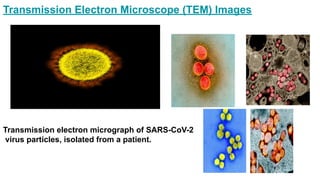
Transmission Electron Microscope (TEM) Images
Transmission electron micrograph of SARS-CoV-2
virus particles, isolated from a patient.
TEM sample preparation techniques
1.Primary fixation with aldehydes (proteins)
During this step proteins and, to a lesser extent, other cell molecules, become
crosslinked by formaldehyde and/or glutaraldehyde molecules. Small mammals
can be fixed by perfusion, whereby the fixative is introduced via the vascular
system. Other samples need to be fixed by immersion and the specimen needs to
be dissected no thicker than 1 mm in at least one direction.
2.Secondary fixation with osmium tetroxide (lipids)
This step ensures that lipids, for example the phospholipids forming membranes,
are preserved and are not extracted during dehydration. During the fixation a
black insoluble precipitate is formed on the membranes, creating membrane
contrast.
3.Tertiary fixation and contrasting with uranyl acetate
Uranyl acetate is a heavy metal salt which binds to proteins, lipids and nucleic
acids, providing additional contrast. Some authors believe it also has fixative
properties. Samples can be incubated en bloc in a solution of uranyl acetate
before dehydration but the stain can also be applied to the sectioned specimen
before lead staining.
4.Dehydration series with solvent (ethanol or acetone)
A fixed specimen is dehydrated by incubation in a series of ethanol or acetone
solutions. Solvent concentration is increased gradually so that water is removed
gently, without causing artefacts, mainly shrinkage.
5.Resin infiltration and embedding
Following dehydration, the solvent is replaced with a gradually increasing
concentration of liquid resin (typically epoxy resin for ultrastructure studies). The
specimen is placed in a mold filled with liquid resin and cured into a hard block
using heat or UV light. After this, a sample can be stored indefinitely.
6.Sectioning and mounting sections on specimen grids
A specimen embedded in hardened resin can be sectioned extremely thinly, at
less than 100 µm. This allows for the electron beam to pass from the electron gun
through the specimen to the detector. The sections are mounted on specimen
grids which fit into microscope sample holder.
7.Contrasting (poststaining)
● Biological specimens are naturally not very electron opaque as they are
composed of atoms with low atomic numbers and the beam passes through
them easily.
● To increased ample contrast, the sections can be post-stained with lead
citrate. This heavy metal salt, similarly to osmium tetroxide and uranyl
acetate, binds to cell components and scatters the incident beam electrons.
● The areas of specimen section which scatter electrons more are recorded as
darker pixels, which stand out against the brighter background.
Applications
1)To visualize and study cell structures of bacteria, viruses, and fungi
2)To view bacteria flagella and plasmids
3)To view the shapes and sizes of microbial cell organelles
4)To study and differentiate between plant and animal cells.
5)Its also used in nanotechnology to study nanoparticles such as ZnO
nanoparticles
6)It is used to detect and identify fractures, damaged microparticles which further
enable repair mechanisms of the particles.
Advantages
1)It has a very powerful magnification of about 2 million times that of the Light
microscope.
2)It can be used for a variety of applications ranging from basic Biology to
Nanotechnology, to education and industrial uses.
3)It can be used to acquire vast information on compounds and their structures.
4)It produces very efficient, high-quality images with high clarity.
5)It can produce permanent images.
6)It is easy to train and use the Transmission Electron Microscope
Disadvantages
● The disadvantage of the TEM is that they are very large and expensive setups,
which need tedious sample preparation.
● The operation and analysis require special training and the samples are
limited to small sizes and must be electron transparent.
● They require special housing and maintenance and the images obtained are
black and white.
Limitations
● They are very big to handle.
● The preparation of specimens to be viewed under the TEM is very tedious.
● The use of chemical fixations, dehydrators, and embedments can cause the
dangers of artifacts.
● They are laborious to maintain
.
● It requires a constant inflow of voltage to operate.
● It produces monochromatic images, unless they use a fluorescent screen at
the end of visualization.
References
● https://www.britannica.com/technology/transmission-electron-microscope
● https://www.ccber.ucsb.edu/collections-botanical-collections-plant-anatomy/tr
ansmission-electron-microscope
● https://www.microscopemaster.com/transmission-electron-microscope.html
• Schaechter M. and Leaderberg J. (2004). The Desk encyclopedia of Microbiology
• Ingraham, J.L. and Ingraham, C.A. (2000) Introduction to Microbiology. (2nd
Edition).
Books / ColeThomson Learning, UK.
Book source
THANK YOU
__________
__________
__________
__________
__________

TRANSMISSION ELECTRON MICROSCOPY ( TEM )

  • 1.
    VIVEKANANDHA ARTS ANDSCIENCE COLLEGE FOR WOMEN VEERACHIPALAYAM - 6366007 SANKAGIRI, TAMIL NADU. DEPARTMENT OF MICROBIOLOGY SUBJECT: GENERAL MICROBIOLOGY AND MICROBIAL DIVERSITY TOPIC: TRANSMISSION ELECTRON MICROSCOPE SUBJECT INCHARG Dr.V.BHARATHI,M.Sc.,M.Phil.,Ph.D. ASSISTANT PROFESSOR DEPARTMENT OF MICROBIOLOGY VIAAS, SANKAGIRI PRESENTED BY DHIVYADHARSHINI.R I - MICROBIOLOGY DEPARTMENT OF MICROBIOLOGY VIAAS, SANKAGIRI
  • 2.
    INTRODUCTION ● The firstelectron microscope was later developed by Ernst Ruska and Max Knolls in 1931 ● Modified into a Transmission Electron Microscope (TEM) by Ernst Ruska along with the Sieman’s company, in 1933. ● This TEM microscope has several advantages compared to the light microscope with its efficiency also being very high.
  • 3.
    DEFINITION ● This isa powerful electron microscope that uses a beam of electrons to focus on a specimen producing a highly magnified and detailed image of the specimen. ● The magnification power is over 2 million times better than that of the light microscope, producing the image of the specimen. ● Which enables easy characterization of the image in its morphological features, compositions and crystallization information is also detailed. ● TEM are the most powerful microscopes used in laboratories. It can magnify mall particle of about 2nm, and therefore they have a resolution limit of 0.2um
  • 4.
    PRINCIPLE ● Transmission ElectronMicroscope (TEM) is similar to the light microscope. The major difference is that light microscopes use light rays to focus and produce an image while the TEM uses a beam of electrons to focus on the specimen, to produce an image. ● The wavelength of the electrons is about 0.005nm which is 100,000X shorter than that of light, hence TEM has better resolution than that of the light microscope, of about 1000times. ● when the electron illuminates the specimen, the resolution power increases increasing the wavelength of the electron transmission. ● Electrons have a shorter wavelength in comparison to light which has a long wavelength.
  • 5.
    Parts of TransmissionElectron Microscope (TEM) The major compound of Transmission electron microscope It has three working parts which include: 1)Electron gun 2)Image producing system 3)Image recording system 1) Electron gun ● Electrons are produced by a cathode that is a tungsten filament that is V-shaped and it is normally heated. ● It also has the condenser lens system which works to focus the electron beam on the specimen by controlling the energy intensity and the column hole of the electron gun.
  • 6.
    ● The TEMuses two condenser lenses to converge the beam of electrons to the specimen. The two condenser lens each function to produce an image ● i.e the first lens which has strong magnification, produces a smaller image of the specimen, to the second condenser lens, directing the image to the objectives. 2)Image- Producing system ● Its made up of the objective lens, a movable stage or holding the specimen, intermediate and projector lenses. They function by focusing the passing electrons through the specimen forming a highly magnified image. ● The objective has a short focal length of about 1-5mm and it produces an intermediate image from the condenser which are transmitted to the projector lenses for magnification.
  • 7.
    ● i.e theintermediate lens which allows great magnification of the image and the projector lens which gives a generally greater magnification over the intermediate lens. The projector lenses are of two types ● To produce efficient high standard images, the objectives and the projector lenses need high power supplies with high stability for the highest standard of resolution. 3) Image-Recording System ● Its made up of the fluorescent screen used to view and to focus on the image. ● The vacuumed system is made up of a pump, gauge, valves and a power supply. ● The presence of colored images allows easy visualization, identification, and characterization of the images.
  • 9.
    Transmission Electron Microscope(TEM) Images Transmission electron micrograph of SARS-CoV-2 virus particles, isolated from a patient.
  • 10.
    TEM sample preparationtechniques 1.Primary fixation with aldehydes (proteins) During this step proteins and, to a lesser extent, other cell molecules, become crosslinked by formaldehyde and/or glutaraldehyde molecules. Small mammals can be fixed by perfusion, whereby the fixative is introduced via the vascular system. Other samples need to be fixed by immersion and the specimen needs to be dissected no thicker than 1 mm in at least one direction. 2.Secondary fixation with osmium tetroxide (lipids) This step ensures that lipids, for example the phospholipids forming membranes, are preserved and are not extracted during dehydration. During the fixation a black insoluble precipitate is formed on the membranes, creating membrane contrast.
  • 11.
    3.Tertiary fixation andcontrasting with uranyl acetate Uranyl acetate is a heavy metal salt which binds to proteins, lipids and nucleic acids, providing additional contrast. Some authors believe it also has fixative properties. Samples can be incubated en bloc in a solution of uranyl acetate before dehydration but the stain can also be applied to the sectioned specimen before lead staining. 4.Dehydration series with solvent (ethanol or acetone) A fixed specimen is dehydrated by incubation in a series of ethanol or acetone solutions. Solvent concentration is increased gradually so that water is removed gently, without causing artefacts, mainly shrinkage. 5.Resin infiltration and embedding Following dehydration, the solvent is replaced with a gradually increasing concentration of liquid resin (typically epoxy resin for ultrastructure studies). The specimen is placed in a mold filled with liquid resin and cured into a hard block using heat or UV light. After this, a sample can be stored indefinitely.
  • 12.
    6.Sectioning and mountingsections on specimen grids A specimen embedded in hardened resin can be sectioned extremely thinly, at less than 100 µm. This allows for the electron beam to pass from the electron gun through the specimen to the detector. The sections are mounted on specimen grids which fit into microscope sample holder. 7.Contrasting (poststaining) ● Biological specimens are naturally not very electron opaque as they are composed of atoms with low atomic numbers and the beam passes through them easily. ● To increased ample contrast, the sections can be post-stained with lead citrate. This heavy metal salt, similarly to osmium tetroxide and uranyl acetate, binds to cell components and scatters the incident beam electrons. ● The areas of specimen section which scatter electrons more are recorded as darker pixels, which stand out against the brighter background.
  • 13.
    Applications 1)To visualize andstudy cell structures of bacteria, viruses, and fungi 2)To view bacteria flagella and plasmids 3)To view the shapes and sizes of microbial cell organelles 4)To study and differentiate between plant and animal cells. 5)Its also used in nanotechnology to study nanoparticles such as ZnO nanoparticles 6)It is used to detect and identify fractures, damaged microparticles which further enable repair mechanisms of the particles.
  • 14.
    Advantages 1)It has avery powerful magnification of about 2 million times that of the Light microscope. 2)It can be used for a variety of applications ranging from basic Biology to Nanotechnology, to education and industrial uses. 3)It can be used to acquire vast information on compounds and their structures. 4)It produces very efficient, high-quality images with high clarity. 5)It can produce permanent images. 6)It is easy to train and use the Transmission Electron Microscope
  • 15.
    Disadvantages ● The disadvantageof the TEM is that they are very large and expensive setups, which need tedious sample preparation. ● The operation and analysis require special training and the samples are limited to small sizes and must be electron transparent. ● They require special housing and maintenance and the images obtained are black and white.
  • 16.
    Limitations ● They arevery big to handle. ● The preparation of specimens to be viewed under the TEM is very tedious. ● The use of chemical fixations, dehydrators, and embedments can cause the dangers of artifacts. ● They are laborious to maintain . ● It requires a constant inflow of voltage to operate. ● It produces monochromatic images, unless they use a fluorescent screen at the end of visualization.
  • 17.
    References ● https://www.britannica.com/technology/transmission-electron-microscope ● https://www.ccber.ucsb.edu/collections-botanical-collections-plant-anatomy/tr ansmission-electron-microscope ●https://www.microscopemaster.com/transmission-electron-microscope.html • Schaechter M. and Leaderberg J. (2004). The Desk encyclopedia of Microbiology • Ingraham, J.L. and Ingraham, C.A. (2000) Introduction to Microbiology. (2nd Edition). Books / ColeThomson Learning, UK. Book source
  • 18.