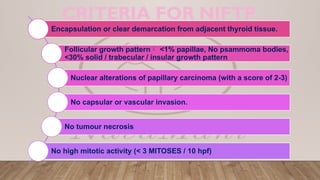
Encapsulation or clear demarcation from adjacent thyroid tissue.
Follicular growth pattern <1% papillae, No psammoma bodies,
<30% solid / trabecular / insular growth pattern
Nuclear alterations of papillary carcinoma (with a score of 2-3)
No capsular or vascular invasion.
No tumour necrosis
No high mitotic activity (< 3 MITOSES / 10 hpf)
CRITERIA FOR NIFTP
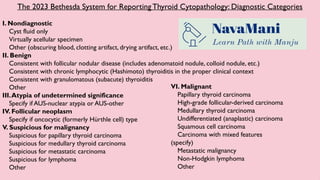
The 2023 Bethesda System for ReportingThyroid Cytopathology: Diagnostic Categories
I. Nondiagnostic
Cyst fluid only
Virtually acellular specimen
Other (obscuring blood, clotting artifact, drying artifact, etc.)
II. Benign
Consistent with follicular nodular disease (includes adenomatoid nodule, colloid nodule, etc.)
Consistent with chronic lymphocytic (Hashimoto) thyroiditis in the proper clinical context
Consistent with granulomatous (subacute) thyroiditis
Other
III.Atypia of undetermined significance
Specify if AUS-nuclear atypia or AUS-other
IV. Follicular neoplasm
Specify if oncocytic (formerly Hürthle cell) type
V. Suspicious for malignancy
Suspicious for papillary thyroid carcinoma
Suspicious for medullary thyroid carcinoma
Suspicious for metastatic carcinoma
Suspicious for lymphoma
Other
VI. Malignant
Papillary thyroid carcinoma
High-grade follicular-derived carcinoma
Medullary thyroid carcinoma
Undifferentiated (anaplastic) carcinoma
Squamous cell carcinoma
Carcinoma with mixed features
(specify)
Metastatic malignancy
Non-Hodgkin lymphoma
Other
NIFTP                                          .pptx

NIFTP .pptx

  • 1.
    Encapsulation or cleardemarcation from adjacent thyroid tissue. Follicular growth pattern <1% papillae, No psammoma bodies, <30% solid / trabecular / insular growth pattern Nuclear alterations of papillary carcinoma (with a score of 2-3) No capsular or vascular invasion. No tumour necrosis No high mitotic activity (< 3 MITOSES / 10 hpf) CRITERIA FOR NIFTP
  • 2.
    The 2023 BethesdaSystem for ReportingThyroid Cytopathology: Diagnostic Categories I. Nondiagnostic Cyst fluid only Virtually acellular specimen Other (obscuring blood, clotting artifact, drying artifact, etc.) II. Benign Consistent with follicular nodular disease (includes adenomatoid nodule, colloid nodule, etc.) Consistent with chronic lymphocytic (Hashimoto) thyroiditis in the proper clinical context Consistent with granulomatous (subacute) thyroiditis Other III.Atypia of undetermined significance Specify if AUS-nuclear atypia or AUS-other IV. Follicular neoplasm Specify if oncocytic (formerly Hürthle cell) type V. Suspicious for malignancy Suspicious for papillary thyroid carcinoma Suspicious for medullary thyroid carcinoma Suspicious for metastatic carcinoma Suspicious for lymphoma Other VI. Malignant Papillary thyroid carcinoma High-grade follicular-derived carcinoma Medullary thyroid carcinoma Undifferentiated (anaplastic) carcinoma Squamous cell carcinoma Carcinoma with mixed features (specify) Metastatic malignancy Non-Hodgkin lymphoma Other