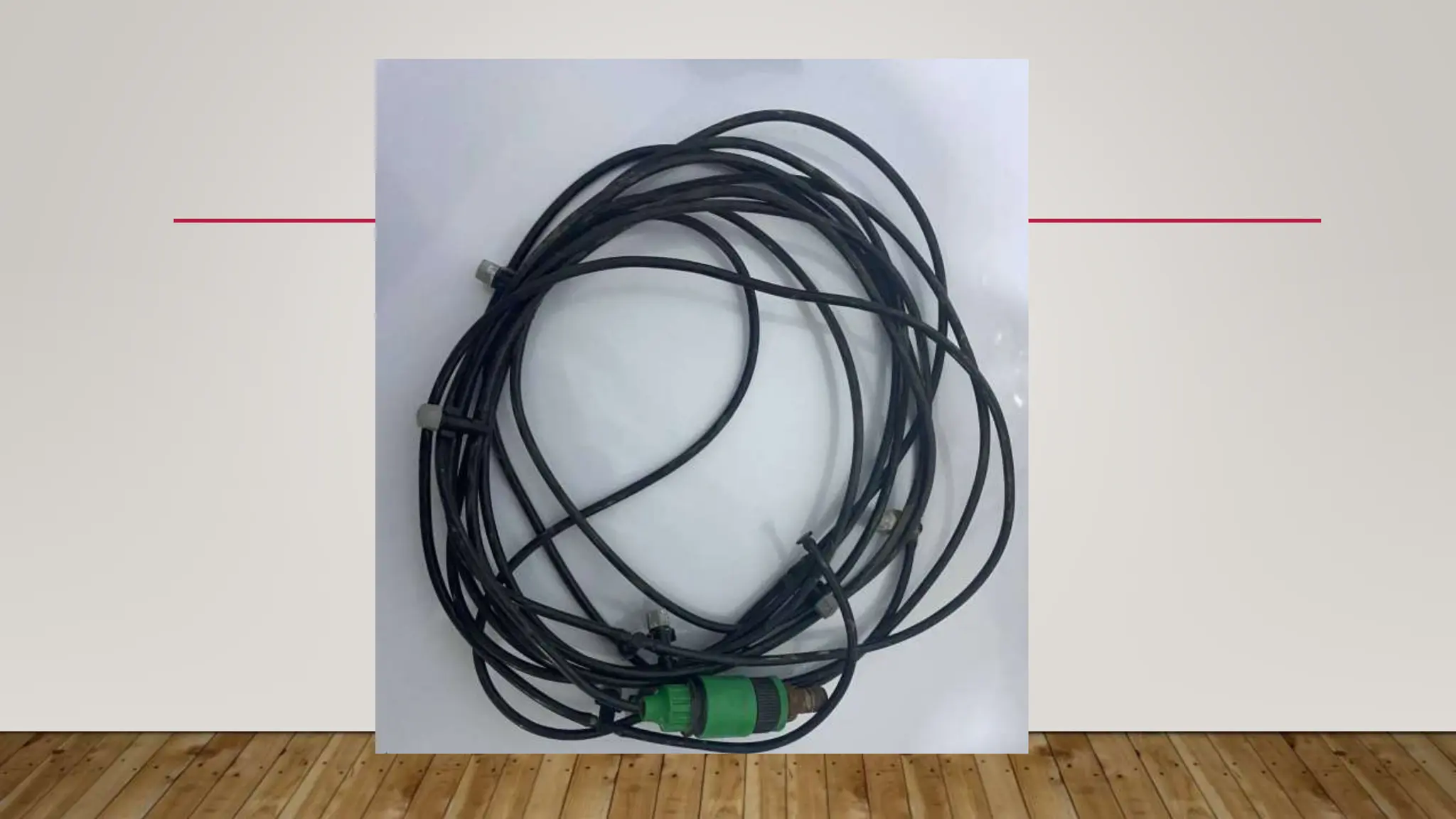
This document discusses evaporative cooling technologies for mitigating the urban heat island effect. It reviews literature showing that water features like ponds and fountains can lower air temperatures by around 2.5°C. Small-scale interventions using water spraying were found to have the highest local impact. The study aims to investigate how blue technologies interact with microclimate and urban environments under climate change. It describes a structure with nozzles and shields that reduced air temperatures by 20% through evaporative cooling. Basic HVAC processes are outlined, including sensible heating/cooling and latent humidifying/dehumidifying. Figures show the test location and aluminum support structure used.
![LITERATURE REVIEW
• Most papers look into the impacts of open water bodies which, however, are prerogative of few
conurbations in the world. A review on the temperature-mitigating effects of urban wetlands, dating
back to 2015 [20], and another systematic collection [21] on various types of urban blue features
(ponds, lakes or rivers) agree on a mean cooling effect of about 2.5 °C during the warmest months.
• Nevertheless, the meta-analysis by Gunawardena et al. [22] suggest that multiple small-scale
interventions, devised in view of dominant wind patterns and synergistic cooling tend to impact more
than a solitary larger feature.
• Indeed, in a 2017 review paper by Santamouris et al. [23], the authors compared 5 studies on pools,
ponds and open water bodies, three on evaporative wind towers, four on water sprinklers, two on
fountains, four on combinations (both monitored real scale applications and simulation studies
included).Water spraying was found to exert the highest local impact.
• In the same vein, Teleghani and Berardi [24] recently ran high-resolution simulations in ENVI-met to
check the impacts of different materials and features in a main urban square in Toronto under
summer 2015 heat wave conditions. Water ponds and water sprays emerged as especially promising
mitigation strategies (Physiological Equivalent Temperature - PET - reduced by 3.6 °C).](https://image.slidesharecdn.com/hassan-240314222519-05aba8db/75/Hassan-hassan-mechanical-fourth-stage-pptx-3-2048.jpg)
![THEORY
• To help reduce the adverse effects of UHI and climate change on the urban thermal environment, such as
heat-related mortality [8], the most common adaptation measures are to provide different types of
shade, including trees [9-11] and building structures (eg. [12-14]) to reduce the absorption of direct solar
radiation. Apart from these, spray cooling by water evaporation to reduce the air temperature could be
another efficient way of improving the OTC.
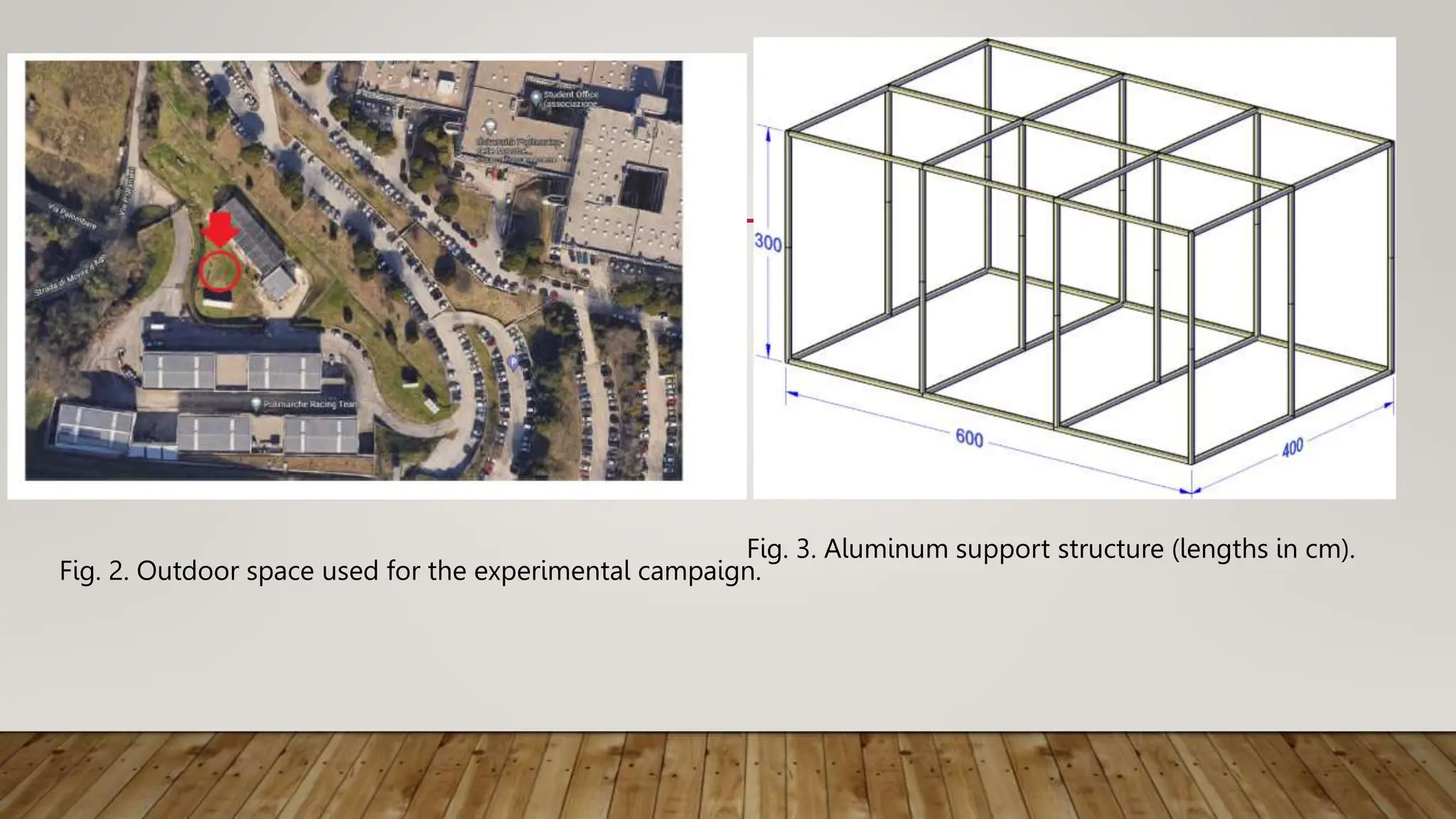
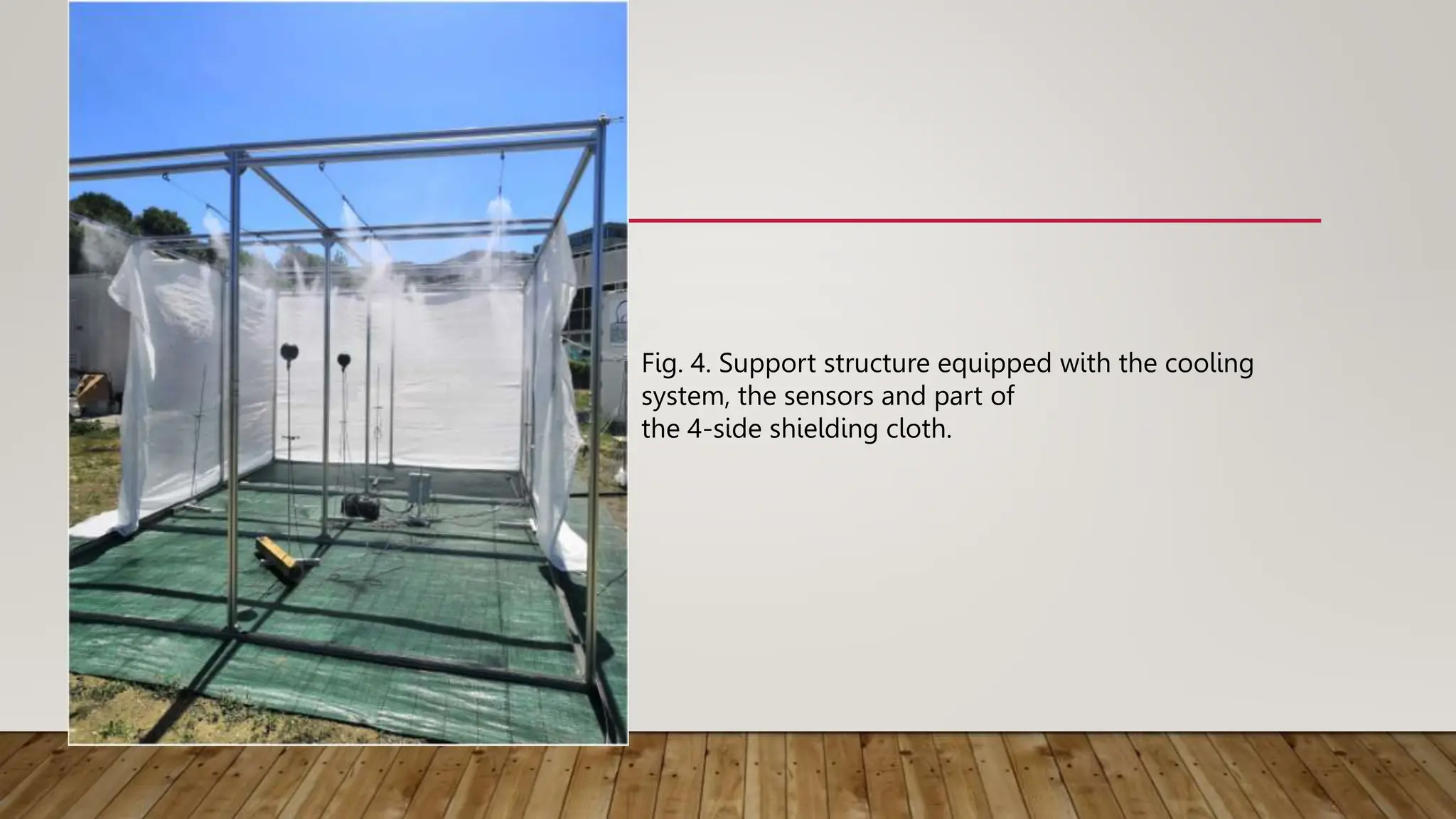
• Gianluco Coccia made a structure made of aluminum that occupies an area of about 24 square meters
and a height of 3 meters. The scientist began installing two pieces of dense fabric (an upper shield used
to mitigate the effect of solar radiation and a four-sided shield used to mitigate the effect of wind
speed). After studying, the scientist found that the height was 2.20 meters, that is, the height of the
nozzles relative to the ground, in the presence of the front shield and the side shield. The reading
indicated a decrease in the average air temperature by 20%, with a noticeable increase in humidity.](https://image.slidesharecdn.com/hassan-240314222519-05aba8db/75/Hassan-hassan-mechanical-fourth-stage-pptx-5-2048.jpg)