Ministry Of Higher Education And
Scientific Research
University Of Diyala
College Of Engineering
Department Of Communication
UAV Object detection using Al technology
Prepared by students
‫وليد‬ ‫العزيز‬ ‫عبد‬
‫ناهض‬ ‫زينب‬
Supervised by
‫جاسم‬ ‫علي‬ ‫حيدر‬ ‫دكتور‬
Introduction
 A UAV (Unmanned Aerial Vehicle), commonly known as a drone, is an aircraft that
operates without a human pilot onboard. It can be controlled remotely by an operator or
autonomously via onboard computers and sensors.
 Key Characteristics of UAVs:
 Autonomous or Semi-autonomous: Operate based on pre-programmed instructions or
real-time commands.
 Equipped with Sensors: Cameras, GPS, LiDAR, thermal sensors, etc.
 Variety of Sizes: From small hobbyist drones to large military-grade UAVs.
2
Types of UAVs
• Fixed-Wing UAVs:
• Long endurance and range (e.g., surveillance
drones).
• Rotary-Wing UAVs:
• High maneuverability (e.g., quadcopters).
• Hybrid UAVs:
• Combine fixed and rotary-wing capabilities.
importance of Object Detection for UAVs
Object detection is a critical capability for UAVs because it allows
drones to identify, classify, and track objects in their environment.
This enhances their ability to perform tasks autonomously and safely.
Object Detection is Important:
1. Navigation and Collision Avoidance:
2. Surveillance and Monitoring:
3. Search and Rescue:
4. Precision Agriculture:
5. Delivery Services:
5
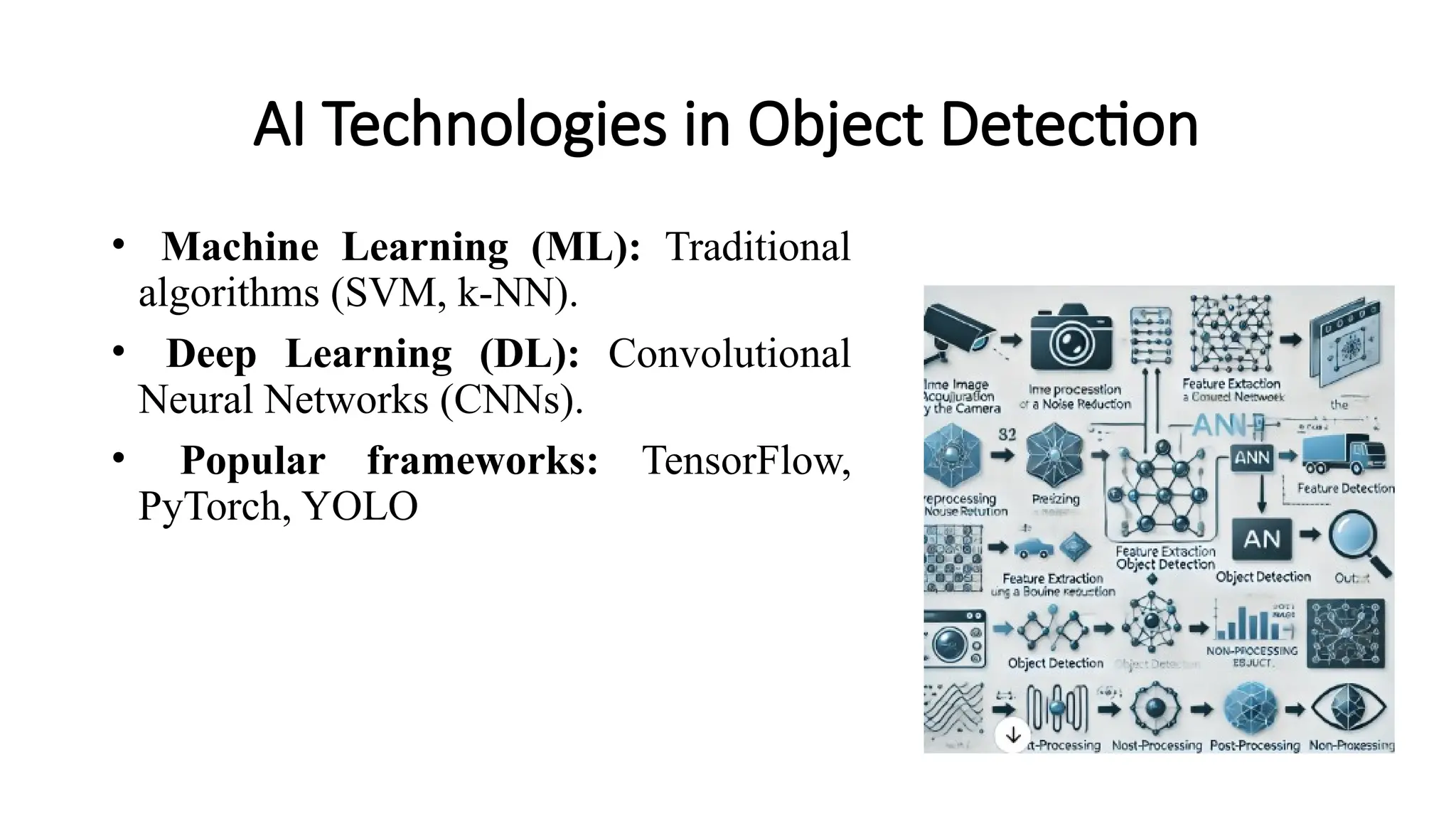
AI Technologies in Object Detection
• Machine Learning (ML): Traditional
algorithms (SVM, k-NN).
• Deep Learning (DL): Convolutional
Neural Networks (CNNs).
• Popular frameworks: TensorFlow,
PyTorch, YOLO
AI Technologies in Object Detection
Steps Involved:
1. Image Capture via onboard cameras.
2. Preprocessing: Enhancing image quality.
3. Feature Extraction using CNNs.
4. Classification and Localization.
- Real-Time Processing on UAV hardware.
Deep Learning Models for UAV Object
Detection
o Popular Models:
 YOLO: Real-time detection.
 SSD (Single Shot Multibox Detector): Faster
computation.
 Faster R-CNN: High accuracy.
• Comparison Table:
o Speed vs. Accuracy.
•
Hardware Considerations for UAVs
• Onboard Processors: NVIDIA Jetson, Intel Movidius.
• Cameras: RGB, Infrared, Thermal.
• Power Constraints: Battery efficiency for AI processing.
• Image: UAV with annotated components (camera, processor).
Challenges in UAV Object Detection
• Limited Processing Power: Edge computing challenges.
• Environmental Factors: Lighting, weather, occlusions.
• Latency: Real-time constraints.
Thank You

عبدالعزيز برزنتيشن اتصالات kkkkkkkkkk.pptx

  • 1.
    Ministry Of HigherEducation And Scientific Research University Of Diyala College Of Engineering Department Of Communication UAV Object detection using Al technology Prepared by students ‫وليد‬ ‫العزيز‬ ‫عبد‬ ‫ناهض‬ ‫زينب‬ Supervised by ‫جاسم‬ ‫علي‬ ‫حيدر‬ ‫دكتور‬
  • 2.
    Introduction  A UAV(Unmanned Aerial Vehicle), commonly known as a drone, is an aircraft that operates without a human pilot onboard. It can be controlled remotely by an operator or autonomously via onboard computers and sensors.  Key Characteristics of UAVs:  Autonomous or Semi-autonomous: Operate based on pre-programmed instructions or real-time commands.  Equipped with Sensors: Cameras, GPS, LiDAR, thermal sensors, etc.  Variety of Sizes: From small hobbyist drones to large military-grade UAVs. 2
  • 3.
    Types of UAVs •Fixed-Wing UAVs: • Long endurance and range (e.g., surveillance drones). • Rotary-Wing UAVs: • High maneuverability (e.g., quadcopters). • Hybrid UAVs: • Combine fixed and rotary-wing capabilities.
  • 5.
    importance of ObjectDetection for UAVs Object detection is a critical capability for UAVs because it allows drones to identify, classify, and track objects in their environment. This enhances their ability to perform tasks autonomously and safely. Object Detection is Important: 1. Navigation and Collision Avoidance: 2. Surveillance and Monitoring: 3. Search and Rescue: 4. Precision Agriculture: 5. Delivery Services: 5
  • 6.
    AI Technologies inObject Detection • Machine Learning (ML): Traditional algorithms (SVM, k-NN). • Deep Learning (DL): Convolutional Neural Networks (CNNs). • Popular frameworks: TensorFlow, PyTorch, YOLO
  • 7.
    AI Technologies inObject Detection Steps Involved: 1. Image Capture via onboard cameras. 2. Preprocessing: Enhancing image quality. 3. Feature Extraction using CNNs. 4. Classification and Localization. - Real-Time Processing on UAV hardware.
  • 8.
    Deep Learning Modelsfor UAV Object Detection o Popular Models:  YOLO: Real-time detection.  SSD (Single Shot Multibox Detector): Faster computation.  Faster R-CNN: High accuracy. • Comparison Table: o Speed vs. Accuracy. •
  • 9.
    Hardware Considerations forUAVs • Onboard Processors: NVIDIA Jetson, Intel Movidius. • Cameras: RGB, Infrared, Thermal. • Power Constraints: Battery efficiency for AI processing. • Image: UAV with annotated components (camera, processor).
  • 10.
    Challenges in UAVObject Detection • Limited Processing Power: Edge computing challenges. • Environmental Factors: Lighting, weather, occlusions. • Latency: Real-time constraints.
  • 14.

Editor's Notes