Muhammad Nadeem
School of Electrical Engineering &Computer Sciences
ma
F =
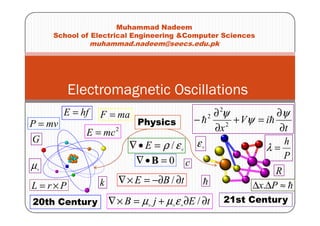
Electromagnetic Oscillations
∂
=
+
∂
−
ψ
ψ
ψ
2
2
hf
E =
Muhammad Nadeem
School of Electrical Engineering &Computer Sciences
muhammad.nadeem@seecs.edu.pk
2
mc
E =
t
B
E ∂
−∂
=
×
∇ /
ma
F =
Physics
20th Century 21st Century
t
i
V
x ∂
∂
=
+
∂
∂
−
ψ
ψ
ψ
h
h 2
2
2
hf
E =
o
ε
ρ /
=
•
∇ E
mv
P =
P
r
L ×
= h
≈
∆
∆ P
x.
0
=
•
∇ B
t
E
j
B ∂
∂
+
=
×
∇ /
o
o
o ε
µ
µ
P
h
=
λ
h
G
k
o
ε
o
µ
R
c
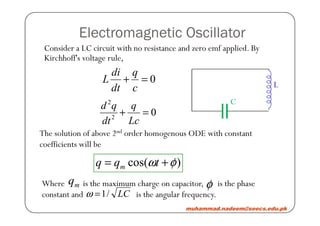
Electromagnetic Oscillator
0
=
+
c
q
dt
di
L
Consider a LC circuit with no resistance and zero emf applied. By
Kirchhoff's voltage rule,
0
2
=
+
q
q
d
L
C
0
2
=
+
Lc
dt
The solution of above 2nd order homogenous ODE with constant
coefficients will be
)
cos( φ
ω +
= t
q
q m
LC
/
1
=
ω
Where is the maximum charge on capacitor, is the phase
constant and is the angular frequency.
m
q φ
muhammad.nadeem@seecs.edu.pk
Electric energy stored in LC circuit is
)
(
cos
2
2
1 2
2
2
φ
ω +
=
= t
C
q
q
C
U m
E
1
1
2

 dq
Electric energy is stored in the
electric field inside capacitor
Magnetic energy stored in LC circuit is
)
(
sin
2
)
(
sin
2
1
2
1
2
1
2
2
2
2
2
2
2
φ
ω
φ
ω
ω
+
=
+
=






=
=
t
C
q
t
q
L
dt
dq
L
Li
U
m
m
B
m
k
=
∴ 2
ω
Magnetic energy is stored in the
magnetic field inside Inductor
muhammad.nadeem@seecs.edu.pk
Both, UE and UB, oscillates with time and have a maximum
value of
 During the motion both, UE and UB vary between zero and
maximum value.
 The total energy of the oscillator remains constant at every
time.
C
qm
2
2
time.
C
q
t
C
q
t
C
q
U
U
E
m
m
m
B
E
2
)
(
cos
2
)
(
cos
2
2
2
2
2
2
=
+
+
+
=
+
=
φ
ω
φ
ω
muhammad.nadeem@seecs.edu.pk
E
K
U
Energy versus time at ϕ=0
)
(
cos
2
2
2
t
C
q
U m
E ω
=
)
(
sin
2
2
2
t
C
q
U m
B ω
=
C
q
E m
2
2
=
muhammad.nadeem@seecs.edu.pk
Consider an oscillating LC circuit with L=12mH and C=1.7µF.
(a) what value of charge is present on the capacitor when the
energy is shared equally between electric and magnetic field?
(b) At what time t will this condition occur? Assume capacitor is
fully charged at t=0
Since
(a)
C
q
E m
2
2
=
C
q
UE
2
2
=
So
C
2 C
2
C
q
C
q
E
U m
E
2
2
1
2
2
1
2
2
=
⇒
=
2
m
q
q =
muhammad.nadeem@seecs.edu.pk
(b) If capacitor is fully charged at t=0 then
)
cos(
2
)
cos(
t
q
q
t
q
q
m
m
m
ω
ω
=
=
t
ω
1
)
cos( =
s
LC
t
t
t
µ
π
π
ω
ω
110
4
4
/
2
1
)
cos(
=
=
=
=
muhammad.nadeem@seecs.edu.pk
Damped Oscillator
A resistance R is always present in LC circuit.When we take this
resistance into account,
0
=
+
+
c
q
iR
dt
di
L
0
2
2
=
+
+
LC
q
dt
dq
R
dt
q
d
L
C
R
0
2
=
+
+
LC
dt
R
dt
The solution of above 2nd order homogenous ODE with constant
coefficients will be
)
cos(
2
/
φ
ω +
′
= −
t
e
q
q L
Rt
m
2
2
)
2
/
( L
R
−
=
′ ω
ω
Where is the maximum charge on capacitor, is the phase
constant and is the angular frequency.
m
q φ
muhammad.nadeem@seecs.edu.pk
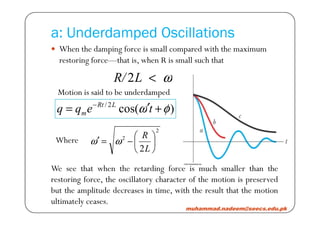
a: Underdamped Oscillations
 When the damping force is small compared with the maximum
restoring force—that is, when R is small such that
ω
L
R/ 
2
Motion is said to be underdamped
)
cos(
2
/
φ
ω +
′
= −
t
e
q
q L
Rt
m
Where
2
2
2






−
=
′
L
R
ω
ω
)
cos( φ
ω +
′
= t
e
q
q m
We see that when the retarding force is much smaller than the
restoring force, the oscillatory character of the motion is preserved
but the amplitude decreases in time, with the result that the motion
ultimately ceases.
muhammad.nadeem@seecs.edu.pk
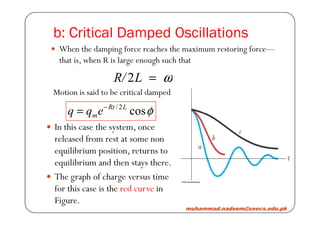
b: Critical Damped Oscillations
 When the damping force reaches the maximum restoring force—
that is, when R is large enough such that
ω
L
R/ =
2
Motion is said to be critical damped
φ
cos
2
/ L
Rt
me
q
q −
=
 In this case the system, once
released from rest at some non
equilibrium position, returns to
equilibrium and then stays there.
 The graph of charge versus time
for this case is the red curve in
Figure.
φ
cos
me
q
q =
muhammad.nadeem@seecs.edu.pk
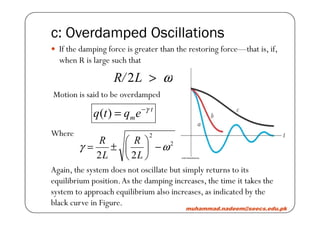
c: Overdamped Oscillations
 If the damping force is greater than the restoring force—that is, if,
when R is large such that
t
e
q
t
q )
( γ
−
=
ω
L
R/ 
2
Motion is said to be overdamped
t
me
q
t
q )
( γ
−
=
2
2
2
2
ω
γ −






±
=
L
R
L
R
Again, the system does not oscillate but simply returns to its
equilibrium position.As the damping increases, the time it takes the
system to approach equilibrium also increases, as indicated by the
black curve in Figure.
Where
muhammad.nadeem@seecs.edu.pk
Consider RLC circuit having L=12mH, C=1.6µF and R=1.5Ω.
After what time t will the amplitude of the charge oscillations
drop to one half of its initial value?
L
Rt
e L
Rt
2
ln
2
/
2
1
2
/
−
=
−
=
−
In RLC circuit, amplitude of charge oscillations will be half if
s
t
R
L
t
L
Rt
011
.
0
2
ln
2
2
ln
2
/
=
=
−
=
−
muhammad.nadeem@seecs.edu.pk
In any case in which resistance is present, whether the
system is overdamped or underdamped, the energy of
the oscillator eventually falls to zero. The lost
ELECTROMAGNETIC energy dissipates into heat.
muhammad.nadeem@seecs.edu.pk
It is possible to compensate for energy
loss in a damped system by applying an
external force that does positive work
on the system.
 At any instant, energy can be put into
the system by an applied force that
Forced Oscillator
L
C
R
~
the system by an applied force that
acts in the direction of motion of the
oscillator.
The amplitude of motion remains constant if the energy input per
cycle exactly equals the energy lost as a result of damping.Any
motion of this type is called forced oscillation.
muhammad.nadeem@seecs.edu.pk
A common example of a forced oscillator is a damped oscillator
driven by an external force that varies periodically, such as
Where is the angular frequency of the applied periodic force
)
cos(
0 t
ω
ξ
ξ ′
=
After a sufficiently long period of time, when the energy input per
ξ
=
+
+
LC
q
dt
dq
R
dt
q
d
2
2
ω′
After a sufficiently long period of time, when the energy input per
cycle equals the energy lost per cycle, a steady-state condition is
reached in which the oscillations proceed with constant amplitude.At
this time, when the system is in a steady state, the solution of above
Equation is
)
cos( φ
ω +
′
= t
q
q m
( )
2
2
2
2
/





 ′
−
−
′
=
L
R
L
qm
ω
ω
ω
ξo
muhammad.nadeem@seecs.edu.pk
Because an external force is driving it, the motion of the forced
R=0; Undamped
Small R
Large R
Because an external force is driving it, the motion of the forced
oscillator is not damped.The external agent provides the necessary
energy to overcome the losses due to the retarding force. Note that
the system oscillates at the angular frequency of the driving force.
For small damping, the amplitude becomes very large when the
frequency of the driving force is near the natural frequency of
oscillation.The dramatic increase in amplitude near the natural
frequency ω is called resonance, and for this reason ω is sometimes
called the resonance frequency of the system
ω′
muhammad.nadeem@seecs.edu.pk

Electromagnetic oscillation

  • 1.
    Muhammad Nadeem School ofElectrical Engineering &Computer Sciences ma F = Electromagnetic Oscillations ∂ = + ∂ − ψ ψ ψ 2 2 hf E = Muhammad Nadeem School of Electrical Engineering &Computer Sciences muhammad.nadeem@seecs.edu.pk 2 mc E = t B E ∂ −∂ = × ∇ / ma F = Physics 20th Century 21st Century t i V x ∂ ∂ = + ∂ ∂ − ψ ψ ψ h h 2 2 2 hf E = o ε ρ / = • ∇ E mv P = P r L × = h ≈ ∆ ∆ P x. 0 = • ∇ B t E j B ∂ ∂ + = × ∇ / o o o ε µ µ P h = λ h G k o ε o µ R c
  • 2.
    Electromagnetic Oscillator 0 = + c q dt di L Consider aLC circuit with no resistance and zero emf applied. By Kirchhoff's voltage rule, 0 2 = + q q d L C 0 2 = + Lc dt The solution of above 2nd order homogenous ODE with constant coefficients will be ) cos( φ ω + = t q q m LC / 1 = ω Where is the maximum charge on capacitor, is the phase constant and is the angular frequency. m q φ muhammad.nadeem@seecs.edu.pk
  • 3.
    Electric energy storedin LC circuit is ) ( cos 2 2 1 2 2 2 φ ω + = = t C q q C U m E 1 1 2   dq Electric energy is stored in the electric field inside capacitor Magnetic energy stored in LC circuit is ) ( sin 2 ) ( sin 2 1 2 1 2 1 2 2 2 2 2 2 2 φ ω φ ω ω + = + =       = = t C q t q L dt dq L Li U m m B m k = ∴ 2 ω Magnetic energy is stored in the magnetic field inside Inductor muhammad.nadeem@seecs.edu.pk
  • 4.
    Both, UE andUB, oscillates with time and have a maximum value of During the motion both, UE and UB vary between zero and maximum value. The total energy of the oscillator remains constant at every time. C qm 2 2 time. C q t C q t C q U U E m m m B E 2 ) ( cos 2 ) ( cos 2 2 2 2 2 2 = + + + = + = φ ω φ ω muhammad.nadeem@seecs.edu.pk
  • 5.
    E K U Energy versus timeat ϕ=0 ) ( cos 2 2 2 t C q U m E ω = ) ( sin 2 2 2 t C q U m B ω = C q E m 2 2 = muhammad.nadeem@seecs.edu.pk
  • 6.
    Consider an oscillatingLC circuit with L=12mH and C=1.7µF. (a) what value of charge is present on the capacitor when the energy is shared equally between electric and magnetic field? (b) At what time t will this condition occur? Assume capacitor is fully charged at t=0 Since (a) C q E m 2 2 = C q UE 2 2 = So C 2 C 2 C q C q E U m E 2 2 1 2 2 1 2 2 = ⇒ = 2 m q q = muhammad.nadeem@seecs.edu.pk
  • 7.
    (b) If capacitoris fully charged at t=0 then ) cos( 2 ) cos( t q q t q q m m m ω ω = = t ω 1 ) cos( = s LC t t t µ π π ω ω 110 4 4 / 2 1 ) cos( = = = = muhammad.nadeem@seecs.edu.pk
  • 8.
    Damped Oscillator A resistanceR is always present in LC circuit.When we take this resistance into account, 0 = + + c q iR dt di L 0 2 2 = + + LC q dt dq R dt q d L C R 0 2 = + + LC dt R dt The solution of above 2nd order homogenous ODE with constant coefficients will be ) cos( 2 / φ ω + ′ = − t e q q L Rt m 2 2 ) 2 / ( L R − = ′ ω ω Where is the maximum charge on capacitor, is the phase constant and is the angular frequency. m q φ muhammad.nadeem@seecs.edu.pk
  • 9.
    a: Underdamped Oscillations When the damping force is small compared with the maximum restoring force—that is, when R is small such that ω L R/ 2 Motion is said to be underdamped ) cos( 2 / φ ω + ′ = − t e q q L Rt m Where 2 2 2       − = ′ L R ω ω ) cos( φ ω + ′ = t e q q m We see that when the retarding force is much smaller than the restoring force, the oscillatory character of the motion is preserved but the amplitude decreases in time, with the result that the motion ultimately ceases. muhammad.nadeem@seecs.edu.pk
  • 10.
    b: Critical DampedOscillations When the damping force reaches the maximum restoring force— that is, when R is large enough such that ω L R/ = 2 Motion is said to be critical damped φ cos 2 / L Rt me q q − = In this case the system, once released from rest at some non equilibrium position, returns to equilibrium and then stays there. The graph of charge versus time for this case is the red curve in Figure. φ cos me q q = muhammad.nadeem@seecs.edu.pk
  • 11.
    c: Overdamped Oscillations If the damping force is greater than the restoring force—that is, if, when R is large such that t e q t q ) ( γ − = ω L R/ 2 Motion is said to be overdamped t me q t q ) ( γ − = 2 2 2 2 ω γ −       ± = L R L R Again, the system does not oscillate but simply returns to its equilibrium position.As the damping increases, the time it takes the system to approach equilibrium also increases, as indicated by the black curve in Figure. Where muhammad.nadeem@seecs.edu.pk
  • 12.
    Consider RLC circuithaving L=12mH, C=1.6µF and R=1.5Ω. After what time t will the amplitude of the charge oscillations drop to one half of its initial value? L Rt e L Rt 2 ln 2 / 2 1 2 / − = − = − In RLC circuit, amplitude of charge oscillations will be half if s t R L t L Rt 011 . 0 2 ln 2 2 ln 2 / = = − = − muhammad.nadeem@seecs.edu.pk
  • 13.
    In any casein which resistance is present, whether the system is overdamped or underdamped, the energy of the oscillator eventually falls to zero. The lost the oscillator eventually falls to zero. The lost ELECTROMAGNETIC energy dissipates into heat. muhammad.nadeem@seecs.edu.pk
  • 14.
    It is possibleto compensate for energy loss in a damped system by applying an external force that does positive work on the system. At any instant, energy can be put into the system by an applied force that Forced Oscillator L C R ~ the system by an applied force that acts in the direction of motion of the oscillator. The amplitude of motion remains constant if the energy input per cycle exactly equals the energy lost as a result of damping.Any motion of this type is called forced oscillation. muhammad.nadeem@seecs.edu.pk
  • 15.
    A common exampleof a forced oscillator is a damped oscillator driven by an external force that varies periodically, such as Where is the angular frequency of the applied periodic force ) cos( 0 t ω ξ ξ ′ = After a sufficiently long period of time, when the energy input per ξ = + + LC q dt dq R dt q d 2 2 ω′ After a sufficiently long period of time, when the energy input per cycle equals the energy lost per cycle, a steady-state condition is reached in which the oscillations proceed with constant amplitude.At this time, when the system is in a steady state, the solution of above Equation is ) cos( φ ω + ′ = t q q m ( ) 2 2 2 2 /       ′ − − ′ = L R L qm ω ω ω ξo muhammad.nadeem@seecs.edu.pk
  • 16.
    Because an externalforce is driving it, the motion of the forced R=0; Undamped Small R Large R Because an external force is driving it, the motion of the forced oscillator is not damped.The external agent provides the necessary energy to overcome the losses due to the retarding force. Note that the system oscillates at the angular frequency of the driving force. For small damping, the amplitude becomes very large when the frequency of the driving force is near the natural frequency of oscillation.The dramatic increase in amplitude near the natural frequency ω is called resonance, and for this reason ω is sometimes called the resonance frequency of the system ω′ muhammad.nadeem@seecs.edu.pk