INTENDED LEARNING OUTCOMES
Thefollowing are the learning outcomes that will be acquired
by the students after finishing the course:
1. Define and analyze the DC/AC Circuits, basic electrical and
electronic devices.
2. Apply the student’s analytical skills by determining basic
electrical measuring instruments.
3. Evaluate the properties of 3-phase systems and the
operation of transformers, D.C. machines, and induction
motors.
3.
ELECTRICITY
What is “Electricity”?
❑form of energy
❑ Greatest discoveries of man
❑ Come from the greekword “electron” which means
amber
❑ Electricity is all about electrons, which are the
fundamental cause of electricity
❑ Static Electricity - involves electrons that are moved
from one place to another, usually by rubbing or
brushing
❑ Current Electricity - involves the flow of electrons in a
conductor
4.
FAMOUS CONTRIBUTION ABOUT
ELECTRICITY
WIILIAMGILBERT
Father of electricity published his studies
The electric attraction
The electric force
BENJAMIN FRANKLIN
In 1752, Franklin proved that lightning and the spark from amber were one
and the same thing. This story is a familiar one, in which Franklin fastened an
iron spike to a silken kite, which he flew during a thunderstorm, while holding
the end of the kite string by an iron key. When lightening flashed, a tiny spark
jumped from the key to his wrist. The experiment proved Franklin's theory, but
was extremely dangerous - he could easily have been killed.
5.
FAMOUS CONTRIBUTION ABOUT
ELECTRICITY
GALVANIAND VOLTA
In 1786, Luigi Galvani, an Italian professor of medicine, found that when the
leg of a dead frog was touched by a metal knife, the leg twitched violently.
Galvani thought that the muscles of the frog must contain electricity.
By 1792, another Italian scientist, Alessandro Volta, disagreed: he realized that
the main factors in Galvani's discovery were the two different metals - the steel
knife and the tin plate - upon which the frog was lying. Volta showed that when
moisture comes between two different metals, electricity is created. This led him
to invent the first electric battery, the voltaic pile, which he made from thin sheets
of copper and zinc separated by moist pasteboard.
In this way, a new kind of electricity was discovered, electricity that flowed
steadily like a current of water instead of discharging itself in a single spark or
shock. Volta showed that electricity could be made to travel from one place to
another by wire, thereby making an important contribution to the science of
electricity. The unit of electrical potential, the Volt, is named after him.
6.
FAMOUS CONTRIBUTION ABOUT
ELECTRICITY
MICHAELFARADAY
The credit for generating electric current on a practical scale
goes to the famous English scientist, Michael Faraday. Faraday
was greatly interested in the invention of the electromagnet, but his
brilliant mind took earlier experiments still further. If electricity could
produce magnetism, why couldn't magnetism produce electricity?
In 1831, Faraday found the solution. Electricity could be produced
through magnetism by motion. He discovered that when a magnet
was moved inside a coil of copper wire, a tiny electric current flows
through the wire. Of course, by today's standards, Faraday's
electric generator was crude (and provided only a small electric
current), but he had discovered the first method of generating
electricity by means of motion in a magnetic field.
7.
FAMOUS CONTRIBUTION ABOUT
ELECTRICITY
JAMESWATT
When Edison's generator was coupled with Watt's steam engine,
large scale electricity generation became a practical proposition. James
Watt, the Scottish inventor of the steam condensing engine, was born in
1736. His improvements to steam engines were patented over a period of
15 years, starting in 1769 and his name was given to the electric unit of
power, the Watt.
ANDRE MARIE AMPERE
Andre Marie Ampere, a French mathematician who devoted himself
to the study of electricity and magnetism, was the first to explain the
electro-dynamic theory. A permanent memorial to Ampere is the use of
his name for the unit of electric current.
8.
FAMOUS CONTRIBUTION ABOUT
ELECTRICITY
GEORGEOHM
George Simon Ohm, a German mathematician and physicist,
was a college teacher in Cologne when in 1827 he published, "The
Galvanic Circuit Investigated Mathematically". His theories were
coldly received by German scientists, but his research was
recognized in Britain and he was awarded the Copley Medal in
1841. His name has been given to the unit of electrical resistance.
9.
HOW ELECTRICITY PRODUCED
❑Electricity Produced from Frictional
Energy (Static Electricity)
❑ Electricity produced from Pressure
❑ Electricity Produced from Heat
❑ Electricity Produced from Chemical
Reaction
❑ Electricity Produced from Light
❑ Electricity Produced from Magnetism
10.
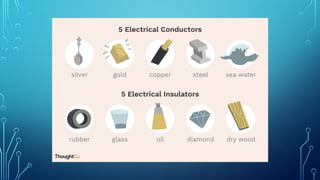
CONDUCTORS
❑ In conductors,electric charges are free to move
through the material. In insulators, they are not.
❑ In conductors:
✔ The charge carriers are called free electrons
✔ Only negative charges are free to move
✔ When isolated atoms are combined to form a
metal, outer electrons of the atoms do not remain
attached to individual atoms but become free to
move throughout the volume of the material
11.
CONDUCTORS
Other Types ofConductors
❑ Electrolytes
✔ Both negative and positive charges can move
❑ Semiconductors
✔ In-between conductors and insulators in their
ability to conduct electricity
✔ Conductivity can be greatly enhanced by adding
small amounts of other elements
✔ Requires quantum physics to truly understand how
they work
12.
INSULATORS
Insulators on theother hand are the exact opposite of
conductors. They are made of materials, generally
non-metals, that have very few or no “free electrons”
float about within their basic atom structure because the
electrons in the outer valence shell are strongly attached
by the positively charge inner nucleus. So if a potential
voltage is applied to the material no current will flow as
there are no electrons to move which gives these
materials their insulating properties.
Insulators plat an important tool within electrical and
electronics because without them electrical circuit would
14.
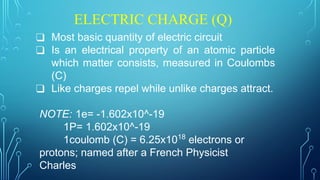
ELECTRIC CHARGE (Q)
❑Most basic quantity of electric circuit
❑ Is an electrical property of an atomic particle
which matter consists, measured in Coulombs
(C)
❑ Like charges repel while unlike charges attract.
NOTE: 1e= -1.602x10^-19
1P= 1.602x10^-19
1coulomb (C) = 6.25x10¹⁸
electrons or
protons; named after a French Physicist
Charles
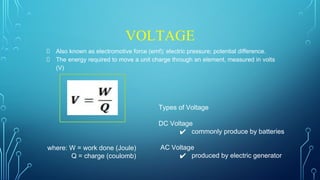
VOLTAGE
Also known aselectromotive force (emf); electric pressure; potential difference.
The energy required to move a unit charge through an element, measured in volts
(V)
where: W = work done (Joule)
Q = charge (coulomb)
Types of Voltage
DC Voltage
✔ commonly produce by batteries
AC Voltage
✔ produced by electric generator
18.
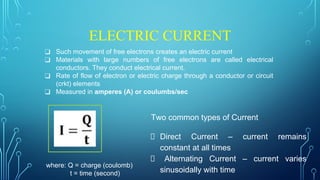
ELECTRIC CURRENT
❑ Suchmovement of free electrons creates an electric current
❑ Materials with large numbers of free electrons are called electrical
conductors. They conduct electrical current.
❑ Rate of flow of electron or electric charge through a conductor or circuit
(crkt) elements
❑ Measured in amperes (A) or coulumbs/sec
where: Q = charge (coulomb)
t = time (second)
Two common types of Current
Direct Current – current remains
constant at all times
Alternating Current – current varies
sinusoidally with time
19.
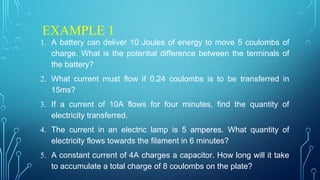
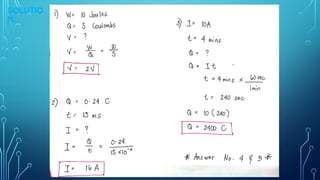
EXAMPLE 1
1. Abattery can deliver 10 Joules of energy to move 5 coulombs of
charge. What is the potential difference between the terminals of
the battery?
2. What current must flow if 0.24 coulombs is to be transferred in
15ms?
3. If a current of 10A flows for four minutes, find the quantity of
electricity transferred.
4. The current in an electric lamp is 5 amperes. What quantity of
electricity flows towards the filament in 6 minutes?
5. A constant current of 4A charges a capacitor. How long will it take
to accumulate a total charge of 8 coulombs on the plate?
RESISTANCE
❑ The electricalresistance of an electrical conductor is a measure of
the difficulty to pass an electric current through that conductor,
measured in ohms (Ω)
❑ Oppose current flow.
❑ Named after the German Physicist, George S. Ohm.
❑ Depends upon the kind of material, length of material, cross
sectional area and temperature
LAW OF RESISTANCE
❑ its varies directly as its length (l)
❑ its varies inversely as the cross-sectional (A) of the
conductor
❑ it depends on the nature of the material
❑ it depends on the temperature of the conductor
22.
RESISTANCE AND RESISTIVITY
SPECIFICRESISTANCE OR RESISTIVITY (ρ)
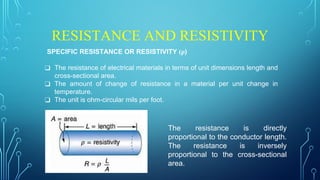
❑ The resistance of electrical materials in terms of unit dimensions length and
cross-sectional area.
❑ The amount of change of resistance in a material per unit change in
temperature.
❑ The unit is ohm-circular mils per foot.
The resistance is directly
proportional to the conductor length.
The resistance is inversely
proportional to the cross-sectional
area.
23.
RESISTANCE AND RESISTIVITY
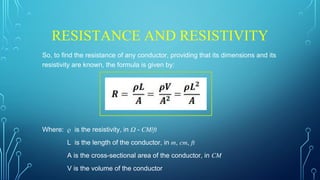
So,to find the resistance of any conductor, providing that its dimensions and its
resistivity are known, the formula is given by:
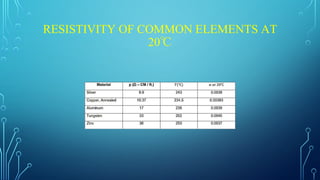
Where: 𝜌 is the resistivity, in 𝛺 - 𝐶𝑀/𝑓𝑡
L is the length of the conductor, in 𝑚, 𝑐𝑚, 𝑓𝑡
A is the cross-sectional area of the conductor, in 𝐶𝑀
V is the volume of the conductor
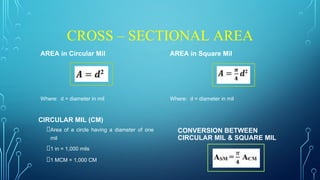
CONVERSION BETWEEN
CIRCULAR MIL& SQUARE MIL
CROSS – SECTIONAL AREA
CIRCULAR MIL (CM)
Area of a circle having a diameter of one
mil
1 in = 1,000 mils
1 MCM = 1,000 CM
AREA in Circular Mil
Where: d = diameter in mil
AREA in Square Mil
Where: d = diameter in mil
26.
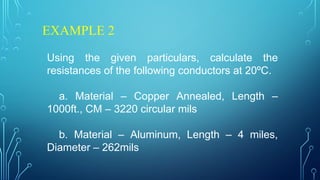
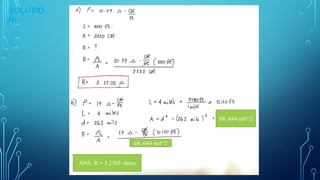
EXAMPLE 2
Using thegiven particulars, calculate the
resistances of the following conductors at 20ºC.
a. Material – Copper Annealed, Length –
1000ft., CM – 3220 circular mils
b. Material – Aluminum, Length – 4 miles,
Diameter – 262mils
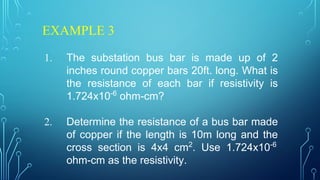
EXAMPLE 3
1. Thesubstation bus bar is made up of 2
inches round copper bars 20ft. long. What is
the resistance of each bar if resistivity is
1.724x10⁻⁶
ohm-cm?
2. Determine the resistance of a bus bar made
of copper if the length is 10m long and the
cross section is 4x4 cm2
. Use 1.724x10⁻⁶
ohm-cm as the resistivity.
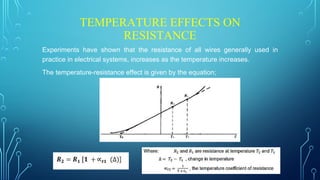
TEMPERATURE EFFECTS ON
RESISTANCE
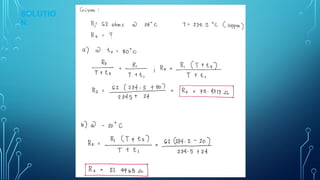
Experimentshave shown that the resistance of all wires generally used in
practice in electrical systems, increases as the temperature increases.
The temperature-resistance effect is given by the equation;
31.
EXAMPLE 4
A coilof copper wire has a resistance of 62 ohm, at
a room temperature of 24ºC. What will be its
resistance at?
a. 80ºC
b. -20ºC
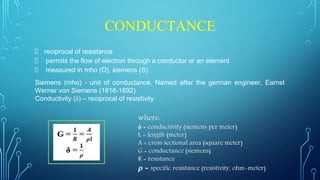
CONDUCTANCE
reciprocal of resistance
permitsthe flow of electron through a conductor or an element
measured in mho (Ʊ), siemens (S)
Siemens (mho) - unit of conductance. Named after the german engineer, Earnst
Werner von Siemens (1816-1892)
Conductivity (δ) – reciprocal of resistivity
40.
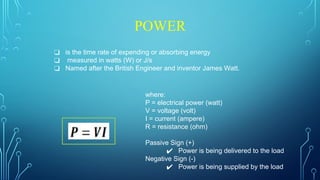
POWER
❑ is thetime rate of expending or absorbing energy
❑ measured in watts (W) or J/s
❑ Named after the British Engineer and inventor James Watt.
where:
P = electrical power (watt)
V = voltage (volt)
I = current (ampere)
R = resistance (ohm)
Passive Sign (+)
✔ Power is being delivered to the load
Negative Sign (-)
✔ Power is being supplied by the load
41.
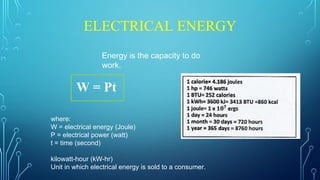
ELECTRICAL ENERGY
Energy isthe capacity to do
work.
where:
W = electrical energy (Joule)
P = electrical power (watt)
t = time (second)
kilowatt-hour (kW-hr)
Unit in which electrical energy is sold to a consumer.
W = Pt
42.
EXAMPLE 5
1. A100W electric light bulb is connected to a
250V supply. Determine:
a. the current flowing in the bulb
b. the resistance of the bulb
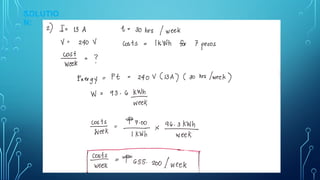
2. Electrical equipment in an office takes a
current of 13A from a 240V supply. Estimate the
cost per week of electricity if the equipment is
used for 30 hours each week and 1kWh of energy
costs 7 pesos.