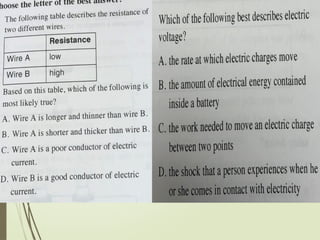
Bellringer: Pick up A Pre-Test and
powerpoint notes from the Basket
Today you need: Highlighter & Notes Folder
Go get your science notebook from the
basket.
Answer the questions on the pre-test to the
best of your ability.
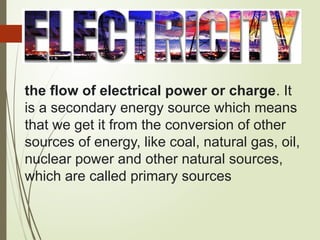
the flow of electrical power or charge. It
is a secondary energy source which means
that we get it from the conversion of other
sources of energy, like coal, natural gas, oil,
nuclear power and other natural sources,
which are called primary sources
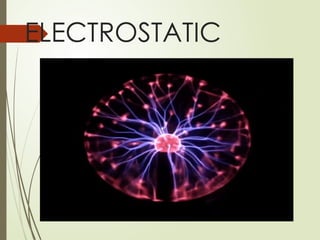
ELECTROSTATIC
Electrostatics includes the concepts of
electric charges, the forces between them,
and their behaviors in materials. What is
referred to as at rest in electrostatics is the
body that carries electrons which are the
prime movers of electricity. The negatively
charged electrons are in endless motion in
matter and affect the behavior of matter
through electric
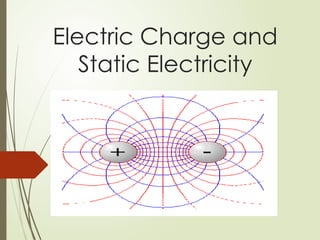
Electric Charge and
Static Electricity
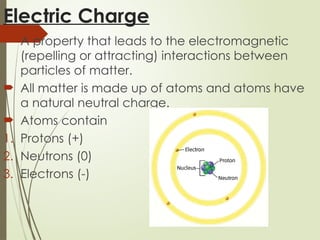
Electric Charge
 A property that leads to the electromagnetic
(repelling or attracting) interactions between
particles of matter.
 All matter is made up of atoms and atoms have
a natural neutral charge.
 Atoms contain
1. Protons (+)
2. Neutrons (0)
3. Electrons (-)
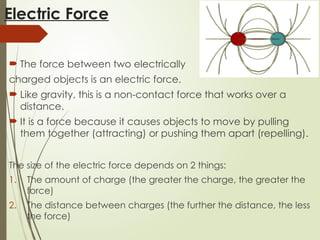
Electric Force
 The force between two electrically
charged objects is an electric force.
 Like gravity, this is a non-contact force that works over a
distance.
 It is a force because it causes objects to move by pulling
them together (attracting) or pushing them apart (repelling).
The size of the electric force depends on 2 things:
1. The amount of charge (the greater the charge, the greater the
force)
2. The distance between charges (the further the distance, the less
the force)
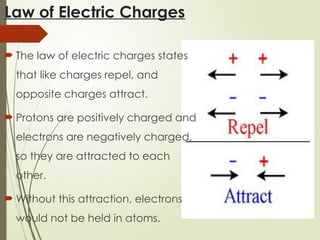
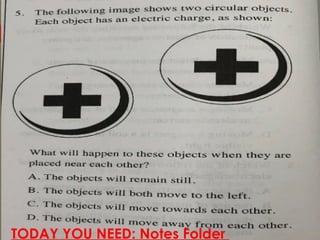
Law of Electric Charges
 The law of electric charges states
that like charges repel, and
opposite charges attract.
 Protons are positively charged and
electrons are negatively charged,
so they are attracted to each
other.
 Without this attraction, electrons
would not be held in atoms.
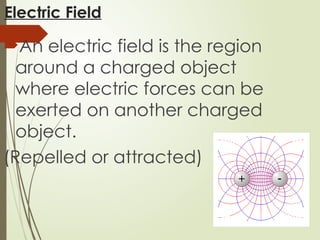
Electric Field
An electric field is the region
around a charged object
where electric forces can be
exerted on another charged
object.
(Repelled or attracted)
Charged Objects
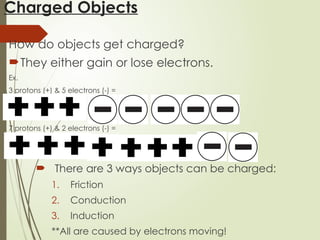
How do objects get charged?
They either gain or lose electrons.
Ex.
3 protons (+) & 5 electrons (-) =
7 protons (+) & 2 electrons (-) =
 There are 3 ways objects can be charged:
1. Friction
2. Conduction
3. Induction
**All are caused by electrons moving!
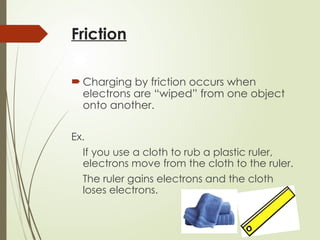
Friction
 Charging by friction occurs when
electrons are “wiped” from one object
onto another.
Ex.
If you use a cloth to rub a plastic ruler,
electrons move from the cloth to the ruler.
The ruler gains electrons and the cloth
loses electrons.
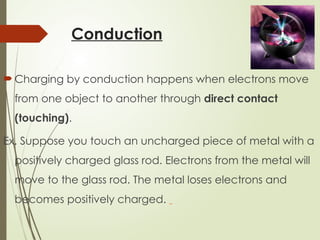
Conduction
 Charging by conduction happens when electrons move
from one object to another through direct contact
(touching).
Ex. Suppose you touch an uncharged piece of metal with a
positively charged glass rod. Electrons from the metal will
move to the glass rod. The metal loses electrons and
becomes positively charged.
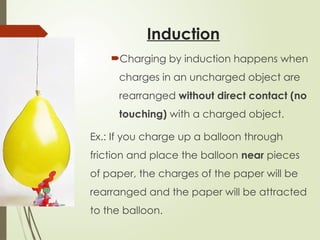
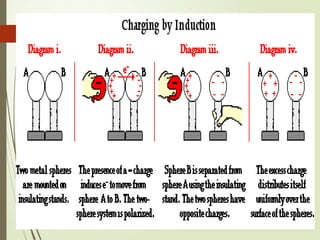
Induction
Charging by induction happens when
charges in an uncharged object are
rearranged without direct contact (no
touching) with a charged object.
Ex.: If you charge up a balloon through
friction and place the balloon near pieces
of paper, the charges of the paper will be
rearranged and the paper will be attracted
to the balloon.
This charging process induces an opposite
type of charge. This means that the charged
object does not lose its charge, instead, the
charges simply pile up --- negative charge
on one side and positive charge on the
other side.
To fully understand the process of
induction, you must also
understand the nature of
conductor as well as the process
of polarization. The following are
the important concepts about
conductors:
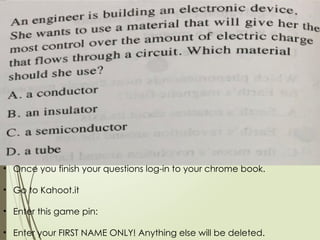
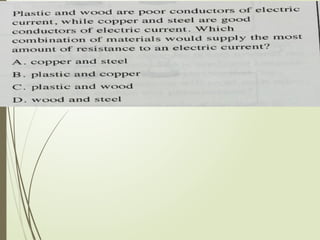
Conductors allow charges to
move freely through them.
Metals are good conductors.
They have many free electrons
that can move about the
material.
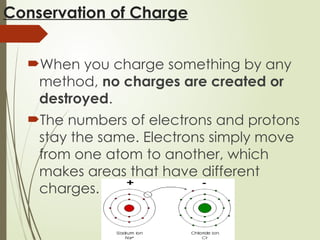
Conservation of Charge
When you charge something by any
method, no charges are created or
destroyed.
The numbers of electrons and protons
stay the same. Electrons simply move
from one atom to another, which
makes areas that have different
charges.
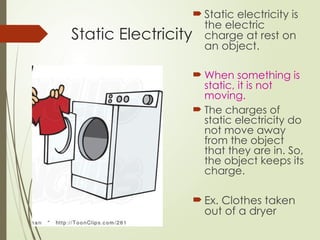
Static Electricity
 Static electricity is
the electric
charge at rest on
an object.
 When something is
static, it is not
moving.
 The charges of
static electricity do
not move away
from the object
that they are in. So,
the object keeps its
charge.
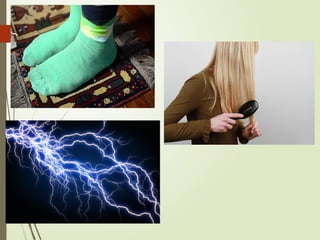
 Ex. Clothes taken
out of a dryer
Voltage and Current
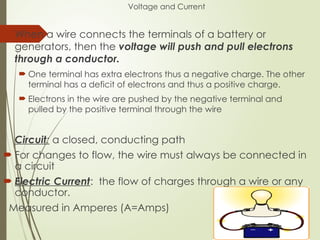
 When a wire connects the terminals of a battery or
generators, then the voltage will push and pull electrons
through a conductor.
 One terminal has extra electrons thus a negative charge. The other
terminal has a deficit of electrons and thus a positive charge.
 Electrons in the wire are pushed by the negative terminal and
pulled by the positive terminal through the wire
Circuit: a closed, conducting path
 For changes to flow, the wire must always be connected in
a circuit
 Electric Current: the flow of charges through a wire or any
conductor.
Measured in Amperes (A=Amps)
Electricity and Voltage
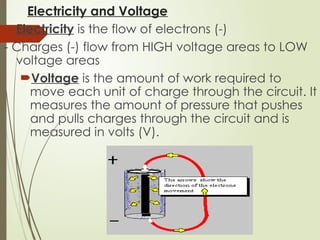
- Electricity is the flow of electrons (-)
- Charges (-) flow from HIGH voltage areas to LOW
voltage areas
Voltage is the amount of work required to
move each unit of charge through the circuit. It
measures the amount of pressure that pushes
and pulls charges through the circuit and is
measured in volts (V).
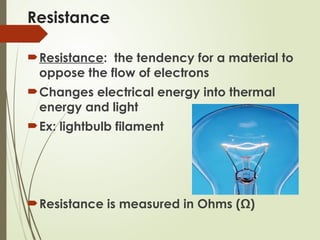
Resistance
Resistance: the tendency for a material to
oppose the flow of electrons
Changes electrical energy into thermal
energy and light
Ex: lightbulb filament
Resistance is measured in Ohms (Ω)
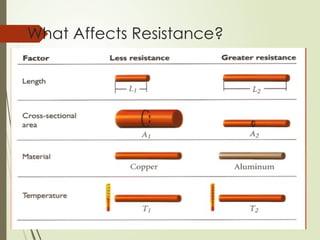
What Affects Resistance?
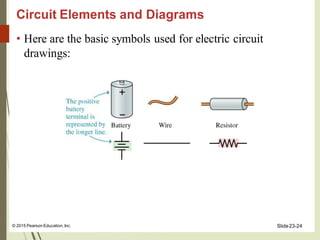
Circuit Elements and Diagrams
• Here are the basic symbols used for electric circuit
drawings:
Slide23-24
© 2015 Pearson Education, Inc.
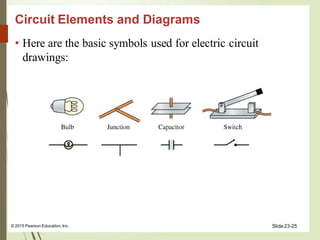
Circuit Elements and Diagrams
• Here are the basic symbols used for electric circuit
drawings:
Slide23-25
© 2015 Pearson Education,Inc.
Practice:
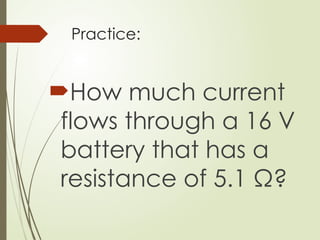
How much current
flows through a 16 V
battery that has a
resistance of 5.1 Ω?
Practice:
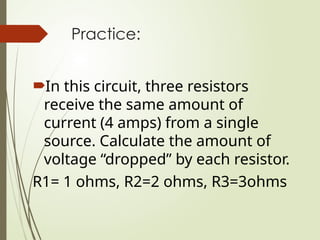
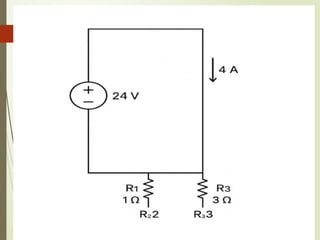
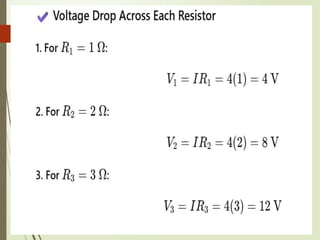
In this circuit, three resistors
receive the same amount of
current (4 amps) from a single
source. Calculate the amount of
voltage “dropped” by each resistor.
R1= 1 ohms, R2=2 ohms, R3=3ohms
SOLVE:
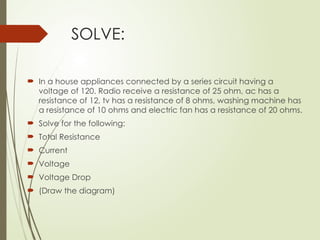
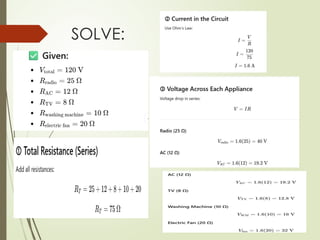
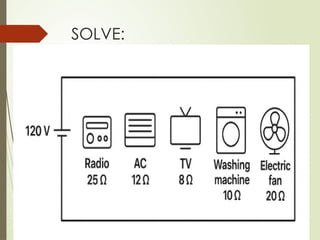
 In a house appliances connected by a series circuit having a
voltage of 120. Radio receive a resistance of 25 ohm, ac has a
resistance of 12, tv has a resistance of 8 ohms, washing machine has
a resistance of 10 ohms and electric fan has a resistance of 20 ohms.
 Solve for the following:
 Total Resistance
 Current
 Voltage
 Voltage Drop
 (Draw the diagram)
SOLVE:
SOLVE:
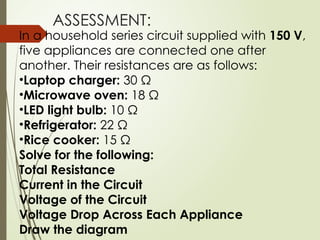
ASSESSMENT:
In a household series circuit supplied with 150 V,
five appliances are connected one after
another. Their resistances are as follows:
•Laptop charger: 30 Ω
•Microwave oven: 18 Ω
•LED light bulb: 10 Ω
•Refrigerator: 22 Ω
•Rice cooker: 15 Ω
Solve for the following:
Total Resistance
Current in the Circuit
Voltage of the Circuit
Voltage Drop Across Each Appliance
Draw the diagram
Exploratory: BRING A LIBRARY BOOK
 Walker
 Aniyah Allen
 Bradley Morrison
 Bryleigh Higginbotham
 Clay Buchanan
 Dalton Chriss
 Emily McDavid
 Leilani Coble
 Tymeisha Kelley
 Zaden Lewter
 Zykia Howard
 Laterrica Jones
 Brittany Hall
 Carter Bankston
 Chase Posey
 Jacob Connelly
 Torey Medley
 Satterfield
 Chesney Jeans
 Maddie Posey
 Cole Simms
 Brandy Dennis
 Brionna Hill
 Kade McCoy
 Cheyenne Loffler
 Heath Moffett
 Hunter Sells
 Ian Hockett
 Landin Burciaga
 Raven Hartsfield
 Ryan Blankstrom
 Ta’Laya Landers
 Zach Hernandez
 Carla Deal
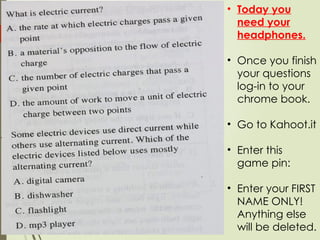
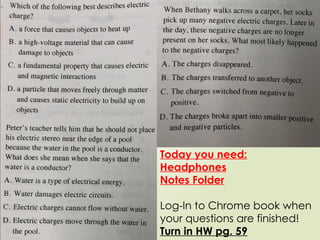
Today you need:
Headphones
Notes Folder
Log-In to Chrome book when
your questions are finished!
Turn in HW pg. 59
TODAY YOU NEED: Notes Folder
• Once you finish your questions log-in to your chrome book.
• Go to Kahoot.it
• Enter this game pin:
• Enter your FIRST NAME ONLY! Anything else will be deleted.
• Today you
need your
headphones.
• Once you finish
your questions
log-in to your
chrome book.
• Go to Kahoot.it
• Enter this
game pin:
• Enter your FIRST
NAME ONLY!
Anything else
will be deleted.

Electric_Charge_and_Static_Electricity_P

  • 1.
    Bellringer: Pick upA Pre-Test and powerpoint notes from the Basket Today you need: Highlighter & Notes Folder Go get your science notebook from the basket. Answer the questions on the pre-test to the best of your ability.
  • 2.
    the flow ofelectrical power or charge. It is a secondary energy source which means that we get it from the conversion of other sources of energy, like coal, natural gas, oil, nuclear power and other natural sources, which are called primary sources
  • 4.
  • 5.
    Electrostatics includes theconcepts of electric charges, the forces between them, and their behaviors in materials. What is referred to as at rest in electrostatics is the body that carries electrons which are the prime movers of electricity. The negatively charged electrons are in endless motion in matter and affect the behavior of matter through electric
  • 6.
  • 7.
    Electric Charge  Aproperty that leads to the electromagnetic (repelling or attracting) interactions between particles of matter.  All matter is made up of atoms and atoms have a natural neutral charge.  Atoms contain 1. Protons (+) 2. Neutrons (0) 3. Electrons (-)
  • 8.
    Electric Force  Theforce between two electrically charged objects is an electric force.  Like gravity, this is a non-contact force that works over a distance.  It is a force because it causes objects to move by pulling them together (attracting) or pushing them apart (repelling). The size of the electric force depends on 2 things: 1. The amount of charge (the greater the charge, the greater the force) 2. The distance between charges (the further the distance, the less the force)
  • 9.
    Law of ElectricCharges  The law of electric charges states that like charges repel, and opposite charges attract.  Protons are positively charged and electrons are negatively charged, so they are attracted to each other.  Without this attraction, electrons would not be held in atoms.
  • 10.
    Electric Field An electricfield is the region around a charged object where electric forces can be exerted on another charged object. (Repelled or attracted)
  • 11.
    Charged Objects How doobjects get charged? They either gain or lose electrons. Ex. 3 protons (+) & 5 electrons (-) = 7 protons (+) & 2 electrons (-) =  There are 3 ways objects can be charged: 1. Friction 2. Conduction 3. Induction **All are caused by electrons moving!
  • 12.
    Friction  Charging byfriction occurs when electrons are “wiped” from one object onto another. Ex. If you use a cloth to rub a plastic ruler, electrons move from the cloth to the ruler. The ruler gains electrons and the cloth loses electrons.
  • 13.
    Conduction  Charging byconduction happens when electrons move from one object to another through direct contact (touching). Ex. Suppose you touch an uncharged piece of metal with a positively charged glass rod. Electrons from the metal will move to the glass rod. The metal loses electrons and becomes positively charged.
  • 14.
    Induction Charging by inductionhappens when charges in an uncharged object are rearranged without direct contact (no touching) with a charged object. Ex.: If you charge up a balloon through friction and place the balloon near pieces of paper, the charges of the paper will be rearranged and the paper will be attracted to the balloon.
  • 15.
    This charging processinduces an opposite type of charge. This means that the charged object does not lose its charge, instead, the charges simply pile up --- negative charge on one side and positive charge on the other side.
  • 16.
    To fully understandthe process of induction, you must also understand the nature of conductor as well as the process of polarization. The following are the important concepts about conductors:
  • 17.
    Conductors allow chargesto move freely through them. Metals are good conductors. They have many free electrons that can move about the material.
  • 19.
    Conservation of Charge Whenyou charge something by any method, no charges are created or destroyed. The numbers of electrons and protons stay the same. Electrons simply move from one atom to another, which makes areas that have different charges.
  • 20.
    Static Electricity  Staticelectricity is the electric charge at rest on an object.  When something is static, it is not moving.  The charges of static electricity do not move away from the object that they are in. So, the object keeps its charge.  Ex. Clothes taken out of a dryer
  • 21.
    Voltage and Current When a wire connects the terminals of a battery or generators, then the voltage will push and pull electrons through a conductor.  One terminal has extra electrons thus a negative charge. The other terminal has a deficit of electrons and thus a positive charge.  Electrons in the wire are pushed by the negative terminal and pulled by the positive terminal through the wire Circuit: a closed, conducting path  For changes to flow, the wire must always be connected in a circuit  Electric Current: the flow of charges through a wire or any conductor. Measured in Amperes (A=Amps)
  • 22.
    Electricity and Voltage -Electricity is the flow of electrons (-) - Charges (-) flow from HIGH voltage areas to LOW voltage areas Voltage is the amount of work required to move each unit of charge through the circuit. It measures the amount of pressure that pushes and pulls charges through the circuit and is measured in volts (V).
  • 23.
    Resistance Resistance: the tendencyfor a material to oppose the flow of electrons Changes electrical energy into thermal energy and light Ex: lightbulb filament Resistance is measured in Ohms (Ω)
  • 24.
  • 25.
    Circuit Elements andDiagrams • Here are the basic symbols used for electric circuit drawings: Slide23-24 © 2015 Pearson Education, Inc.
  • 26.
    Circuit Elements andDiagrams • Here are the basic symbols used for electric circuit drawings: Slide23-25 © 2015 Pearson Education,Inc.
  • 29.
    Practice: How much current flowsthrough a 16 V battery that has a resistance of 5.1 Ω?
  • 30.
    Practice: In this circuit,three resistors receive the same amount of current (4 amps) from a single source. Calculate the amount of voltage “dropped” by each resistor. R1= 1 ohms, R2=2 ohms, R3=3ohms

  • 33.
    SOLVE:  In ahouse appliances connected by a series circuit having a voltage of 120. Radio receive a resistance of 25 ohm, ac has a resistance of 12, tv has a resistance of 8 ohms, washing machine has a resistance of 10 ohms and electric fan has a resistance of 20 ohms.  Solve for the following:  Total Resistance  Current  Voltage  Voltage Drop  (Draw the diagram)
  • 34.
  • 35.
  • 36.
    ASSESSMENT: In a householdseries circuit supplied with 150 V, five appliances are connected one after another. Their resistances are as follows: •Laptop charger: 30 Ω •Microwave oven: 18 Ω •LED light bulb: 10 Ω •Refrigerator: 22 Ω •Rice cooker: 15 Ω Solve for the following: Total Resistance Current in the Circuit Voltage of the Circuit Voltage Drop Across Each Appliance Draw the diagram
  • 37.
    Exploratory: BRING ALIBRARY BOOK  Walker  Aniyah Allen  Bradley Morrison  Bryleigh Higginbotham  Clay Buchanan  Dalton Chriss  Emily McDavid  Leilani Coble  Tymeisha Kelley  Zaden Lewter  Zykia Howard  Laterrica Jones  Brittany Hall  Carter Bankston  Chase Posey  Jacob Connelly  Torey Medley  Satterfield  Chesney Jeans  Maddie Posey  Cole Simms  Brandy Dennis  Brionna Hill  Kade McCoy  Cheyenne Loffler  Heath Moffett  Hunter Sells  Ian Hockett  Landin Burciaga  Raven Hartsfield  Ryan Blankstrom  Ta’Laya Landers  Zach Hernandez  Carla Deal
  • 38.
    Today you need: Headphones NotesFolder Log-In to Chrome book when your questions are finished! Turn in HW pg. 59
  • 39.
    TODAY YOU NEED:Notes Folder
  • 40.
    • Once youfinish your questions log-in to your chrome book. • Go to Kahoot.it • Enter this game pin: • Enter your FIRST NAME ONLY! Anything else will be deleted.
  • 43.
    • Today you needyour headphones. • Once you finish your questions log-in to your chrome book. • Go to Kahoot.it • Enter this game pin: • Enter your FIRST NAME ONLY! Anything else will be deleted.