Download free for 30 days
Sign in
Upload
Language (EN)
Support
Business
Mobile
Social Media
Marketing
Technology
Art & Photos
Career
Design
Education
Presentations & Public Speaking
Government & Nonprofit
Healthcare
Internet
Law
Leadership & Management
Automotive
Engineering
Software
Recruiting & HR
Retail
Sales
Services
Science
Small Business & Entrepreneurship
Food
Environment
Economy & Finance
Data & Analytics
Investor Relations
Sports
Spiritual
News & Politics
Travel
Self Improvement
Real Estate
Entertainment & Humor
Health & Medicine
Devices & Hardware
Lifestyle
Change Language
Language
English
Español
Português
Français
Deutsche
Cancel
Save
Submit search
EN
Uploaded by
cppr69mqgc
20 views
22.1 Current_and_Circuits physics elect.pdf
22.1 Current_and_Circuits
Science
◦
Read more
0
Save
Share
Embed
Embed presentation
Download
Download to read offline
1
/ 19
2
/ 19
3
/ 19
4
/ 19
5
/ 19
6
/ 19
7
/ 19
8
/ 19
9
/ 19
10
/ 19
11
/ 19
12
/ 19
13
/ 19
14
/ 19
15
/ 19
16
/ 19
17
/ 19
18
/ 19
19
/ 19
More Related Content
PPTX
Teacher PowerPoint_ Current and Circuits.pptx
by
YoussefAbaza1
PPTX
Electric current and circuits (current electricity)
by
SamehElabd3
PPT
Electric circuits
by
Leann Jester Daus
PPT
electriccircuits-120227233330-phpapp02.ppt
by
JayrNaces
PPTX
Electric current and circuit
by
mhariandithz
PPT
electriccircuits-120227233330-phpapp02.ppt
by
JayrNaces
PPT
Electrical circuits
by
Manan Patel
PPTX
Electric-circuits.pptx science and biology
by
ssuserf79681
Teacher PowerPoint_ Current and Circuits.pptx
by
YoussefAbaza1
Electric current and circuits (current electricity)
by
SamehElabd3
Electric circuits
by
Leann Jester Daus
electriccircuits-120227233330-phpapp02.ppt
by
JayrNaces
Electric current and circuit
by
mhariandithz
electriccircuits-120227233330-phpapp02.ppt
by
JayrNaces
Electrical circuits
by
Manan Patel
Electric-circuits.pptx science and biology
by
ssuserf79681
Similar to 22.1 Current_and_Circuits physics elect.pdf
PPTX
Electricity Lessons for Grade 8 Science.pptx
by
Erlison Lorenz Ognilla
PPT
circuite electrice nou clasa 8.ppt pentru elevii care vor sa invete si altfel
by
PunganIon
PPT
Introducing Electricity
by
scotfuture
PPTX
Electric current, potential difference and reietance [Autosaved] [Autosaved]....
by
mohammadatifstanikza
PPT
Electricity
by
N. SINGH
PPTX
Current
by
Raja Durai Durai
PPTX
Electricity genration, transmission, and uses
by
tausifsafi
PPT
Fundamentals of electronics electrical.p
by
AldenJrGabuya
PPT
electricity.ppt
by
Mohit Jain
PPT
electricity (1).ppt
by
Rizka696342
PPT
MODULE 1.ppt
by
honeymariyambaby
PPTX
Hshaye .pptx
by
Jonalyn34
PPTX
ELECTRICAL-CIRCUITS.pptx
by
ssuseraff95e
PPT
electricity.ppt
by
haider999
PPTX
Introducción a la Electrónica básica (UT).pptx
by
DavidAltamiranodelAn
PPT
Basic Electronic Circuits
by
KarinCicenia
PPT
Fundamentals of electrical engineering Chapter 1.ppt
by
mathewos16
PDF
electric_current_and_circuits.pdf
by
ShakirMommand
PPT
lec-voltsandcurrent (2).ppt
by
Neeraj Pandey
PPT
1_IMP_electricity.ppt
by
Yash93108
Electricity Lessons for Grade 8 Science.pptx
by
Erlison Lorenz Ognilla
circuite electrice nou clasa 8.ppt pentru elevii care vor sa invete si altfel
by
PunganIon
Introducing Electricity
by
scotfuture
Electric current, potential difference and reietance [Autosaved] [Autosaved]....
by
mohammadatifstanikza
Electricity
by
N. SINGH
Current
by
Raja Durai Durai
Electricity genration, transmission, and uses
by
tausifsafi
Fundamentals of electronics electrical.p
by
AldenJrGabuya
electricity.ppt
by
Mohit Jain
electricity (1).ppt
by
Rizka696342
MODULE 1.ppt
by
honeymariyambaby
Hshaye .pptx
by
Jonalyn34
ELECTRICAL-CIRCUITS.pptx
by
ssuseraff95e
electricity.ppt
by
haider999
Introducción a la Electrónica básica (UT).pptx
by
DavidAltamiranodelAn
Basic Electronic Circuits
by
KarinCicenia
Fundamentals of electrical engineering Chapter 1.ppt
by
mathewos16
electric_current_and_circuits.pdf
by
ShakirMommand
lec-voltsandcurrent (2).ppt
by
Neeraj Pandey
1_IMP_electricity.ppt
by
Yash93108
Recently uploaded
PPTX
ORGANIC CHEMISTRY PRESENTATION WEEK 3 and 4
by
JohnRenier1
PPTX
Rolling with Science: Perfecting the Joint and Vaporizing the Competition
by
Markus Roggen
PPTX
INTELLECTUAL PROPERTY RIGHTS FOR HORTICULTURAL CROPS PPT.pptx
by
Raghu490065
PPTX
CABG.pptx Coronary..heart surgery... Bypass grafting
by
poulomipal936
PDF
Animal Classification - Grade of Organisation, Symmetry, Coelom, Embryogeny ...
by
World of Wisdom
PPTX
Travis Hills of Minnesota Championing a Greener Future Through AI-Driven Pyro...
by
Travis Hills MN
PPTX
CAM pathway in plants (unique pathway found in Xerophytes).pptx
by
RashmiMG2
PDF
Sciences of Europe No 180 (2025)
by
Sciences of Europe
PPTX
Plant Physiology-Key words by Stuti Farmer.pptx
by
stutifarmer
PPTX
Data Collection and data types Chapter 2.pptx
by
Modern College Shivajinagar, Pune-5
PPTX
Photosynthesis (Light dependent reaction and Calvin cycle).pptx
by
RashmiMG2
PPT
Ch04uiuuuuuuuuuuuuuuuuuuuuuukkkkkkklh.ppt
by
karzanberdawood
PPTX
Cohesin And Condesin In Chromsomal Segregation.pptx
by
keesarisuchith
PDF
HND Networking and Cloud Computing (NCC).pdf
by
ssuser8dcccc
PPTX
Sedimentary basins by Team Maverick.pptx
by
olonabasit
PPTX
Ianalumab_ITP_Journal_Presentation_FULL.pptx
by
sandiponroy342
PDF
GENE THERAPY ENHANCING NEUROPLASTICITY FOR BIPOLAR DISORDER
by
PrajaktaPanda
PDF
20251030 Jonh Kemp Energy system transformations and energy security
by
ddaher1
PPTX
Preventive health care.pptx Social Pharmacy
by
potdarvrushali
PPTX
Psychopathology and mental Disorders.pptx
by
Max Annani-Akollor
ORGANIC CHEMISTRY PRESENTATION WEEK 3 and 4
by
JohnRenier1
Rolling with Science: Perfecting the Joint and Vaporizing the Competition
by
Markus Roggen
INTELLECTUAL PROPERTY RIGHTS FOR HORTICULTURAL CROPS PPT.pptx
by
Raghu490065
CABG.pptx Coronary..heart surgery... Bypass grafting
by
poulomipal936
Animal Classification - Grade of Organisation, Symmetry, Coelom, Embryogeny ...
by
World of Wisdom
Travis Hills of Minnesota Championing a Greener Future Through AI-Driven Pyro...
by
Travis Hills MN
CAM pathway in plants (unique pathway found in Xerophytes).pptx
by
RashmiMG2
Sciences of Europe No 180 (2025)
by
Sciences of Europe
Plant Physiology-Key words by Stuti Farmer.pptx
by
stutifarmer
Data Collection and data types Chapter 2.pptx
by
Modern College Shivajinagar, Pune-5
Photosynthesis (Light dependent reaction and Calvin cycle).pptx
by
RashmiMG2
Ch04uiuuuuuuuuuuuuuuuuuuuuuukkkkkkklh.ppt
by
karzanberdawood
Cohesin And Condesin In Chromsomal Segregation.pptx
by
keesarisuchith
HND Networking and Cloud Computing (NCC).pdf
by
ssuser8dcccc
Sedimentary basins by Team Maverick.pptx
by
olonabasit
Ianalumab_ITP_Journal_Presentation_FULL.pptx
by
sandiponroy342
GENE THERAPY ENHANCING NEUROPLASTICITY FOR BIPOLAR DISORDER
by
PrajaktaPanda
20251030 Jonh Kemp Energy system transformations and energy security
by
ddaher1
Preventive health care.pptx Social Pharmacy
by
potdarvrushali
Psychopathology and mental Disorders.pptx
by
Max Annani-Akollor
22.1 Current_and_Circuits physics elect.pdf
1.
Electric current is
the flow of electric charges. Section 1: Current and Circuits K What I Know W What I Want to Find Out L What I Learned
2.
Essential Questions • What
is electric current? • How does energy change in electric circuits? • What is Ohm’s law? • How are power, current, potential difference, and resistance mathematically related? Current and Circuits Copyright © McGraw-Hill Education
3.
Review • electric potential
difference New • electric current • conventional current • battery • electric circuit • ampere • resistance • resistor • parallel connection • series connection Current and Circuits Copyright © McGraw-Hill Education Vocabulary
4.
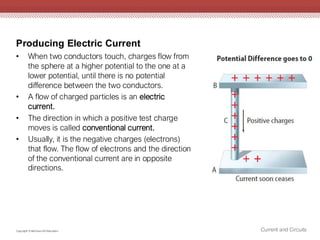
Producing Electric Current Current
and Circuits Copyright © McGraw-Hill Education • When two conductors touch, charges flow from the sphere at a higher potential to the one at a lower potential, until there is no potential difference between the two conductors. • A flow of charged particles is an electric current. • The direction in which a positive test charge moves is called conventional current. • Usually, it is the negative charges (electrons) that flow. The flow of electrons and the direction of the conventional current are in opposite directions.
5.
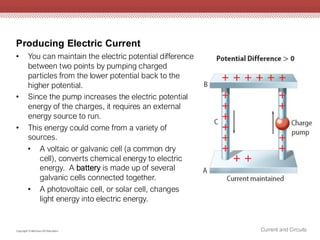
Producing Electric Current Current
and Circuits Copyright © McGraw-Hill Education • You can maintain the electric potential difference between two points by pumping charged particles from the lower potential back to the higher potential. • Since the pump increases the electric potential energy of the charges, it requires an external energy source to run. • This energy could come from a variety of sources. • A voltaic or galvanic cell (a common dry cell), converts chemical energy to electric energy. A battery is made up of several galvanic cells connected together. • A photovoltaic cell, or solar cell, changes light energy into electric energy.
6.
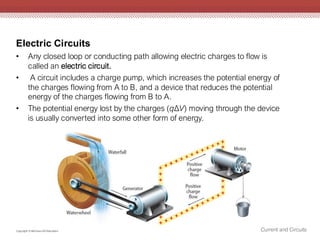
Electric Circuits Current and
Circuits Copyright © McGraw-Hill Education • Any closed loop or conducting path allowing electric charges to flow is called an electric circuit. • A circuit includes a charge pump, which increases the potential energy of the charges flowing from A to B, and a device that reduces the potential energy of the charges flowing from B to A. • The potential energy lost by the charges (qΔV) moving through the device is usually converted into some other form of energy.
7.
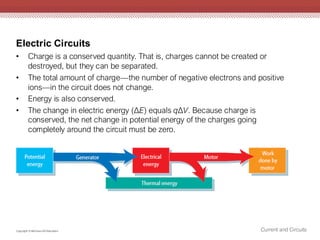
Electric Circuits Current and
Circuits Copyright © McGraw-Hill Education • Charge is a conserved quantity. That is, charges cannot be created or destroyed, but they can be separated. • The total amount of charge—the number of negative electrons and positive ions—in the circuit does not change. • Energy is also conserved. • The change in electric energy (ΔE) equals qΔV. Because charge is conserved, the net change in potential energy of the charges going completely around the circuit must be zero.
8.
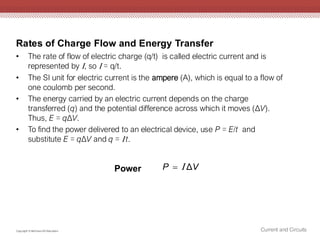
Rates of Charge
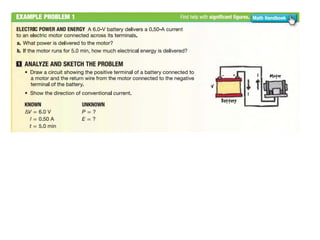
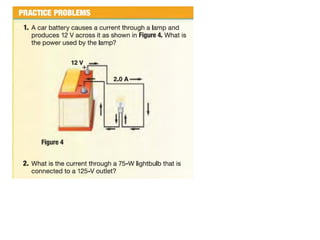
Flow and Energy Transfer Current and Circuits Copyright © McGraw-Hill Education • The rate of flow of electric charge (q/t) is called electric current and is represented by , so = q/t. • The SI unit for electric current is the ampere (A), which is equal to a flow of one coulomb per second. • The energy carried by an electric current depends on the charge transferred (q) and the potential difference across which it moves (ΔV). Thus, E = qΔV. • To find the power delivered to an electrical device, use P = E/t and substitute E = qΔV and q = t. Δ P V = Power
11.
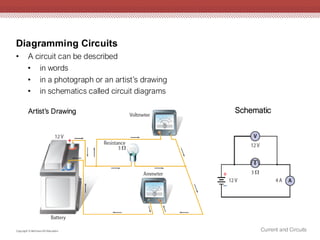
Diagramming Circuits Current and
Circuits Copyright © McGraw-Hill Education • A circuit can be described • in words • in a photograph or an artist’s drawing • in schematics called circuit diagrams Schematic Artist’s Drawing
12.
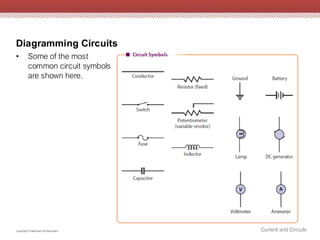
Diagramming Circuits Current and
Circuits Copyright © McGraw-Hill Education • Some of the most common circuit symbols are shown here.
13.
Resistance and Ohm’s
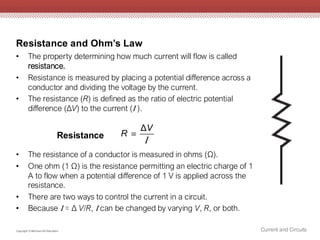
Law Current and Circuits Copyright © McGraw-Hill Education • The property determining how much current will flow is called resistance. • Resistance is measured by placing a potential difference across a conductor and dividing the voltage by the current. • The resistance (R) is defined as the ratio of electric potential difference (ΔV) to the current ( ). • The resistance of a conductor is measured in ohms (Ω). • One ohm (1 Ω) is the resistance permitting an electric charge of 1 A to flow when a potential difference of 1 V is applied across the resistance. • There are two ways to control the current in a circuit. • Because = Δ V/R, can be changed by varying V, R, or both. ΔV R Resistance
14.
Resistance and Ohm’s
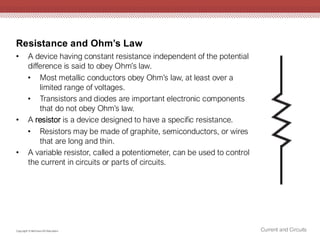
Law Current and Circuits Copyright © McGraw-Hill Education • A device having constant resistance independent of the potential difference is said to obey Ohm’s law. • Most metallic conductors obey Ohm’s law, at least over a limited range of voltages. • Transistors and diodes are important electronic components that do not obey Ohm’s law. • A resistor is a device designed to have a specific resistance. • Resistors may be made of graphite, semiconductors, or wires that are long and thin. • A variable resistor, called a potentiometer, can be used to control the current in circuits or parts of circuits.
17.
Parallel and Series
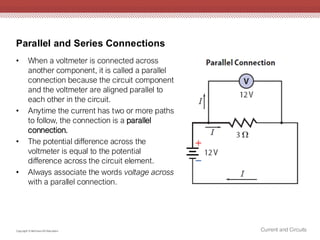
Connections Current and Circuits Copyright © McGraw-Hill Education • When a voltmeter is connected across another component, it is called a parallel connection because the circuit component and the voltmeter are aligned parallel to each other in the circuit. • Anytime the current has two or more paths to follow, the connection is a parallel connection. • The potential difference across the voltmeter is equal to the potential difference across the circuit element. • Always associate the words voltage across with a parallel connection.
18.
Parallel and Series
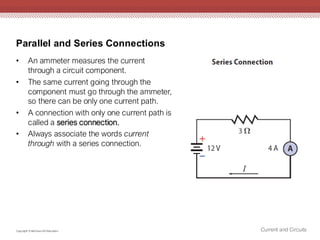
Connections Current and Circuits Copyright © McGraw-Hill Education • An ammeter measures the current through a circuit component. • The same current going through the component must go through the ammeter, so there can be only one current path. • A connection with only one current path is called a series connection. • Always associate the words current through with a series connection.
19.
Current and Circuits Copyright
© McGraw-Hill Education Review Essential Questions • What is electric current? • How does energy change in electric circuits? • What is Ohm’s law? • How are power, current, potential difference, and resistance mathematically related? Vocabulary • electric current • conventional current • battery • electric circuit • ampere • resistance • resistor • parallel connection • series connection
Download


![Electric current, potential difference and reietance [Autosaved] [Autosaved]....](https://cdn.slidesharecdn.com/ss_thumbnails/electriccurrentpotentialdifferenceandreietanceautosavedautosaved-230603173933-3538dcc3-thumbnail.jpg?width=640&height=640&fit=bounds)


