PresentationX
mob.6204191715
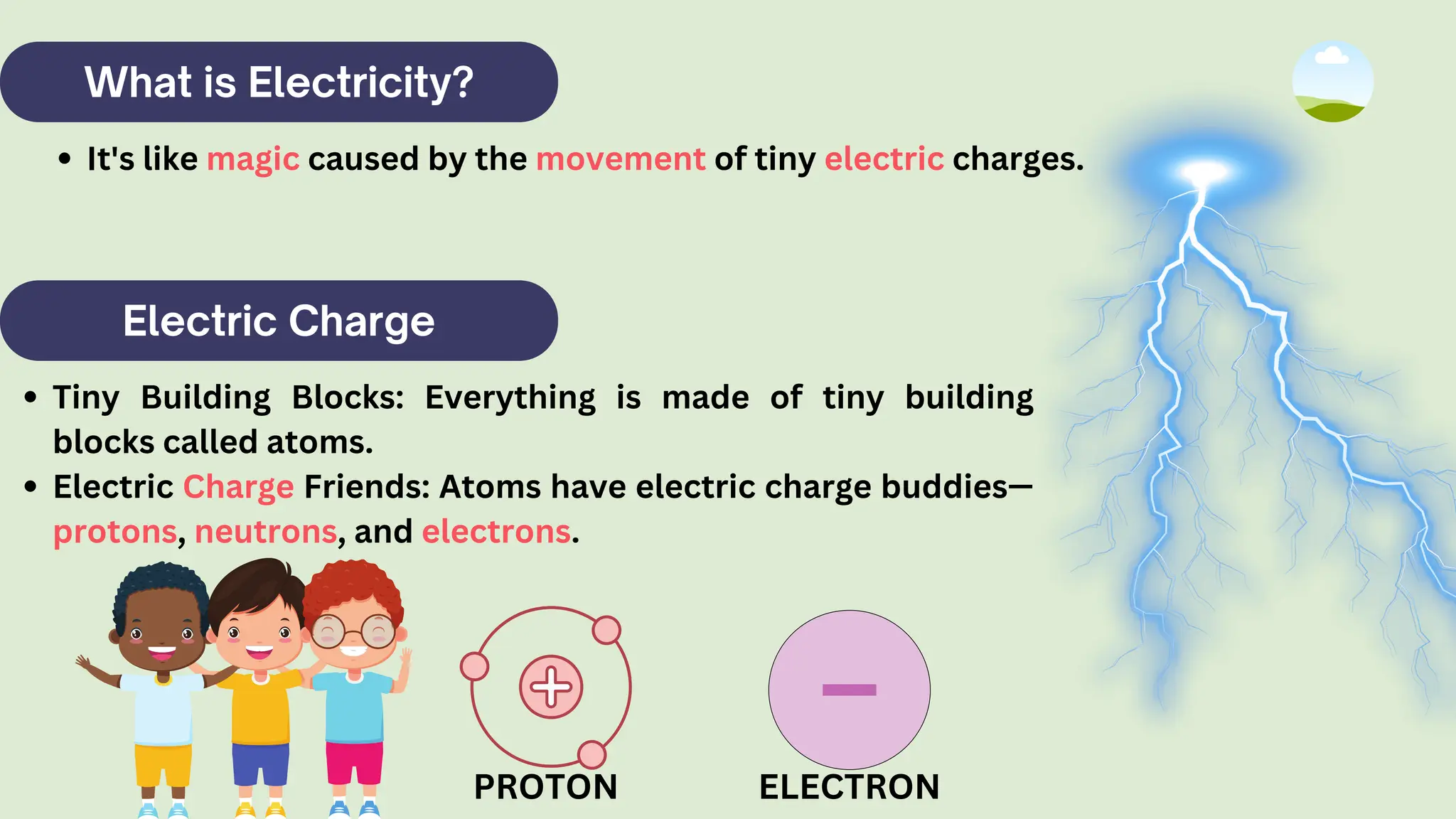
What is Electricity?
Electric Charge
It's like magic caused by the movement of tiny electric charges.
Tiny Building Blocks: Everything is made of tiny building
blocks called atoms.
Electric Charge Friends: Atoms have electric charge buddies—
protons, neutrons, and electrons.
PROTON ELECTRON
ELECTRIC CHARGE
Definition: Electric charge is a fundamental property of certain tiny particles.
Role: It determines how these particles interact with each other through
electromagnetism.
Electromagnetic Fields:
Influence: Electrically charged matter is affected by electromagnetic fields.
Production: Charged matter, in turn, generates electromagnetic fields
Properties of Electric Charge:
Conservation: Electric charge is conserved; it doesn't appear or disappear but can
transfer between particles.
Additivity: Charges add up algebraically when particles come together.
Quantization: Electric charge is quantized, meaning it comes in discrete, indivisible units.
ELECTRIC CHARGE
Unit of Electric Charge:
SI Unit: Electric charge is measured in coulombs (C).
Representation: 1 coulomb is the amount of charge passing a point in one second when
the current is 1 ampere.
Formula:
The charge (Q) of a body is given by Q = ne.
Explanation: The charge (Q) is the product of the number of electrons (n) and the charge
on a single electron (e).
Charge on an Electron:
Value: The charge on a single electron is approximately 1.6 x 10⁻¹⁹ coulombs.
Constant: This value is a fundamental constant in physics.
ELECTRIC CURRENT
Electric current is expressed by the amount of charge flowing through a particular area
in unit time
Formula: I=Q/T
Explanation :
Electric current (I) equals the amount of electric charge (Q) divided by the time (t) it
takes to flow through.
ELECTRIC CURRENT
Ampere (A):
The unit is named after Andre-Marie Ampere, a
French scientist who made significant
contributions to the understanding of electric
currents.
Lived:
Ampere lived from 1775 to 1836.
Andre-Marie Ampere
HOW DO YOU DEFINE
ONE AMPERE?
ONE AMPERE
When 1 coulomb of charge flows through any cross-section of a conductor in 1 second,
the electric charge flowing through it is said to be 1 ampere.
Smaller unit current is milliampere(mA) and microampere( UA)
1 mA = 10–3A
1 UA = 10–6A
AMMETER
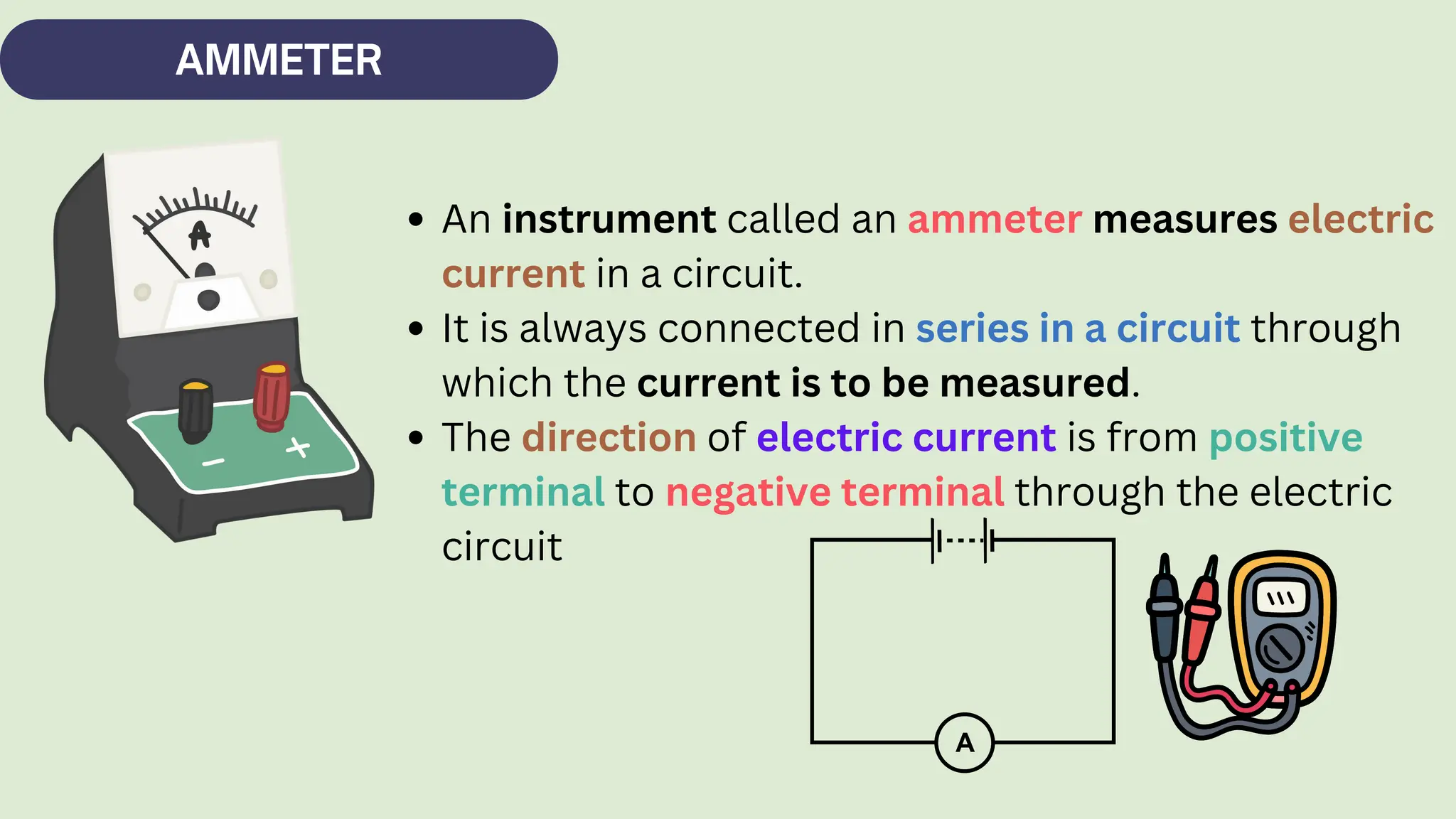
An instrument called an ammeter measures electric
current in a circuit.
It is always connected in series in a circuit through
which the current is to be measured.
The direction of electric current is from positive
terminal to negative terminal through the electric
circuit
STATIC ELECTRICITY
Example: Ever
rubbed a balloon on
your hair?
Fun Fact: Sometimes, when things rub together, they get super excited and create static
electricity!
HAIR+BALLON
What is Potential Difference?
Potential difference, say between two points A and B, is like measuring how much work is
needed to move a tiny electric charge from point B to point A.
Imagine a Slide:
Think of a slide where a tiny toy goes down. The
potential difference is like the fun or energy it gains
as it goes from the top to the bottom.
Potential Difference
Mathematical Representation:
Mathematically, potential difference (V) is expressed as the difference between the
potentials at points A and B:
Va - Vb=work done/charge move
SI Unit:
The SI unit of potential difference is the volt (V).
Alessandro volta
Electric Potential
Electric potential at a point is the work done per unit charge in bringing a charge from
infinity to that point
Formula:
V=W/Q
V: Electric potential
W: Work done
Q: Charge
Define 1 Volt
CIRCUIT DIAGRAM
Definition:
A circuit diagram is a visual representation of a circuit using symbols to represent its
components.
Purpose:
Helps simplify complex electrical connections for better understanding.
CIRCUIT DIAGRAM
CIRCUIT DIAGRAM
OHM’S LAW
Ohm's Law Statement:
"At constant temperature, the current flowing through a conductor is directly
proportional to the potential difference across its ends."
Direct Proportionality:
Current (I) is directly proportional to the potential difference (V) or vice versa.
Mathematically expressed as:
I ∝V or V ∝I at constant temperature.
Ohm's law is represented by the equation:
V = IR
Where:
V is the potential difference (voltage) across the conductor,
I is the current flowing through the conductor,
R is the constant of proportionality known as resistance.
RESISTENCE
Resistance is the opposition that a conductor offers to the flow of electric current.
Cause of Resistance:
Resistance occurs due to collisions between electrons and atoms in the conductor,
hindering the smooth flow of electron.
Mathematically:
R=V/I , where R is resistance, V is voltage, and I is current.
Factors Affecting Resistance of a Conductor
Length Effect: Longer conductors have higher resistance.
Area Effect: Wider (thicker) conductors have lower resistance.
Material Impact: The type of material affects the overall resistance.
Mathematical Expressions:
R∝l and R∝1/A
R=p (l/a)
RESISTORS IN SERIES
the current I is the same in all parts
of the circuit, and
the sum of the voltages V1, V2, and
V3 is equal to the total applied
voltage
V
R1 R1 R1
V = V1 + V2 + V3
From Ohm’s law:
V1 = IR1,
V2 = IR2,
V3 = IR3
and V = IR where R is the total circuit resistance.
Since V = V1 + V2 + V3
then IR = IR1 + IR2 + IR3
Dividing throughout by I gives
R = R1 + R2 + R3
RESISTORS IN PARALLEL
The Heating Effect of
Electric Current
This phenomenon is commonly used in devices like electric heaters and irons.
In a purely resistive circuit, resistors are connected to a battery.
When current flows through resistors, energy is dissipated as heat.
Imagine a light bulb glowing – that's the result of the heating effect of electric
current.
Practical Applications of Heating
Effect of Electric Current
Electric iron electric
heater
electric bulb
Electric fuse
Uses electric current
to produce heat for
wrinkle-free clothes
smoothing."
Breaks circuit
during excess
current, preventing
damage and
ensuring safety.
Glows when electric
current passes
through
Converts electricity
to warmth for a
comfortable
environment in cold
weather
Electric Power
Electric power is the electrical work done per unit of time.
Mathematically expressed as
P = W/t, where W is work and t is time
SI Unit of Power:
watt (W)

Current and Electricity for class 10.pdf

  • 1.
  • 2.
    What is Electricity? ElectricCharge It's like magic caused by the movement of tiny electric charges. Tiny Building Blocks: Everything is made of tiny building blocks called atoms. Electric Charge Friends: Atoms have electric charge buddies— protons, neutrons, and electrons. PROTON ELECTRON
  • 3.
    ELECTRIC CHARGE Definition: Electriccharge is a fundamental property of certain tiny particles. Role: It determines how these particles interact with each other through electromagnetism. Electromagnetic Fields: Influence: Electrically charged matter is affected by electromagnetic fields. Production: Charged matter, in turn, generates electromagnetic fields Properties of Electric Charge: Conservation: Electric charge is conserved; it doesn't appear or disappear but can transfer between particles. Additivity: Charges add up algebraically when particles come together. Quantization: Electric charge is quantized, meaning it comes in discrete, indivisible units.
  • 4.
    ELECTRIC CHARGE Unit ofElectric Charge: SI Unit: Electric charge is measured in coulombs (C). Representation: 1 coulomb is the amount of charge passing a point in one second when the current is 1 ampere. Formula: The charge (Q) of a body is given by Q = ne. Explanation: The charge (Q) is the product of the number of electrons (n) and the charge on a single electron (e). Charge on an Electron: Value: The charge on a single electron is approximately 1.6 x 10⁻¹⁹ coulombs. Constant: This value is a fundamental constant in physics.
  • 5.
    ELECTRIC CURRENT Electric currentis expressed by the amount of charge flowing through a particular area in unit time Formula: I=Q/T Explanation : Electric current (I) equals the amount of electric charge (Q) divided by the time (t) it takes to flow through.
  • 6.
    ELECTRIC CURRENT Ampere (A): Theunit is named after Andre-Marie Ampere, a French scientist who made significant contributions to the understanding of electric currents. Lived: Ampere lived from 1775 to 1836. Andre-Marie Ampere
  • 7.
    HOW DO YOUDEFINE ONE AMPERE?
  • 8.
    ONE AMPERE When 1coulomb of charge flows through any cross-section of a conductor in 1 second, the electric charge flowing through it is said to be 1 ampere. Smaller unit current is milliampere(mA) and microampere( UA) 1 mA = 10–3A 1 UA = 10–6A
  • 9.
    AMMETER An instrument calledan ammeter measures electric current in a circuit. It is always connected in series in a circuit through which the current is to be measured. The direction of electric current is from positive terminal to negative terminal through the electric circuit
  • 10.
    STATIC ELECTRICITY Example: Ever rubbeda balloon on your hair? Fun Fact: Sometimes, when things rub together, they get super excited and create static electricity! HAIR+BALLON
  • 11.
    What is PotentialDifference? Potential difference, say between two points A and B, is like measuring how much work is needed to move a tiny electric charge from point B to point A. Imagine a Slide: Think of a slide where a tiny toy goes down. The potential difference is like the fun or energy it gains as it goes from the top to the bottom.
  • 12.
    Potential Difference Mathematical Representation: Mathematically,potential difference (V) is expressed as the difference between the potentials at points A and B: Va - Vb=work done/charge move SI Unit: The SI unit of potential difference is the volt (V). Alessandro volta
  • 13.
    Electric Potential Electric potentialat a point is the work done per unit charge in bringing a charge from infinity to that point Formula: V=W/Q V: Electric potential W: Work done Q: Charge Define 1 Volt
  • 14.
    CIRCUIT DIAGRAM Definition: A circuitdiagram is a visual representation of a circuit using symbols to represent its components. Purpose: Helps simplify complex electrical connections for better understanding.
  • 15.
  • 16.
  • 17.
    OHM’S LAW Ohm's LawStatement: "At constant temperature, the current flowing through a conductor is directly proportional to the potential difference across its ends." Direct Proportionality: Current (I) is directly proportional to the potential difference (V) or vice versa. Mathematically expressed as: I ∝V or V ∝I at constant temperature. Ohm's law is represented by the equation: V = IR Where: V is the potential difference (voltage) across the conductor, I is the current flowing through the conductor, R is the constant of proportionality known as resistance.
  • 18.
    RESISTENCE Resistance is theopposition that a conductor offers to the flow of electric current. Cause of Resistance: Resistance occurs due to collisions between electrons and atoms in the conductor, hindering the smooth flow of electron. Mathematically: R=V/I , where R is resistance, V is voltage, and I is current.
  • 19.
    Factors Affecting Resistanceof a Conductor Length Effect: Longer conductors have higher resistance. Area Effect: Wider (thicker) conductors have lower resistance. Material Impact: The type of material affects the overall resistance. Mathematical Expressions: R∝l and R∝1/A R=p (l/a)
  • 20.
    RESISTORS IN SERIES thecurrent I is the same in all parts of the circuit, and the sum of the voltages V1, V2, and V3 is equal to the total applied voltage V R1 R1 R1 V = V1 + V2 + V3 From Ohm’s law: V1 = IR1, V2 = IR2, V3 = IR3 and V = IR where R is the total circuit resistance. Since V = V1 + V2 + V3 then IR = IR1 + IR2 + IR3 Dividing throughout by I gives R = R1 + R2 + R3
  • 21.
  • 22.
    The Heating Effectof Electric Current This phenomenon is commonly used in devices like electric heaters and irons. In a purely resistive circuit, resistors are connected to a battery. When current flows through resistors, energy is dissipated as heat. Imagine a light bulb glowing – that's the result of the heating effect of electric current.
  • 23.
    Practical Applications ofHeating Effect of Electric Current Electric iron electric heater electric bulb Electric fuse Uses electric current to produce heat for wrinkle-free clothes smoothing." Breaks circuit during excess current, preventing damage and ensuring safety. Glows when electric current passes through Converts electricity to warmth for a comfortable environment in cold weather
  • 24.
    Electric Power Electric poweris the electrical work done per unit of time. Mathematically expressed as P = W/t, where W is work and t is time SI Unit of Power: watt (W)