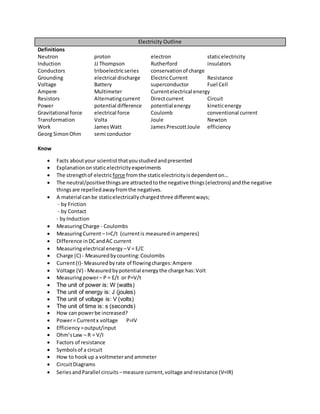
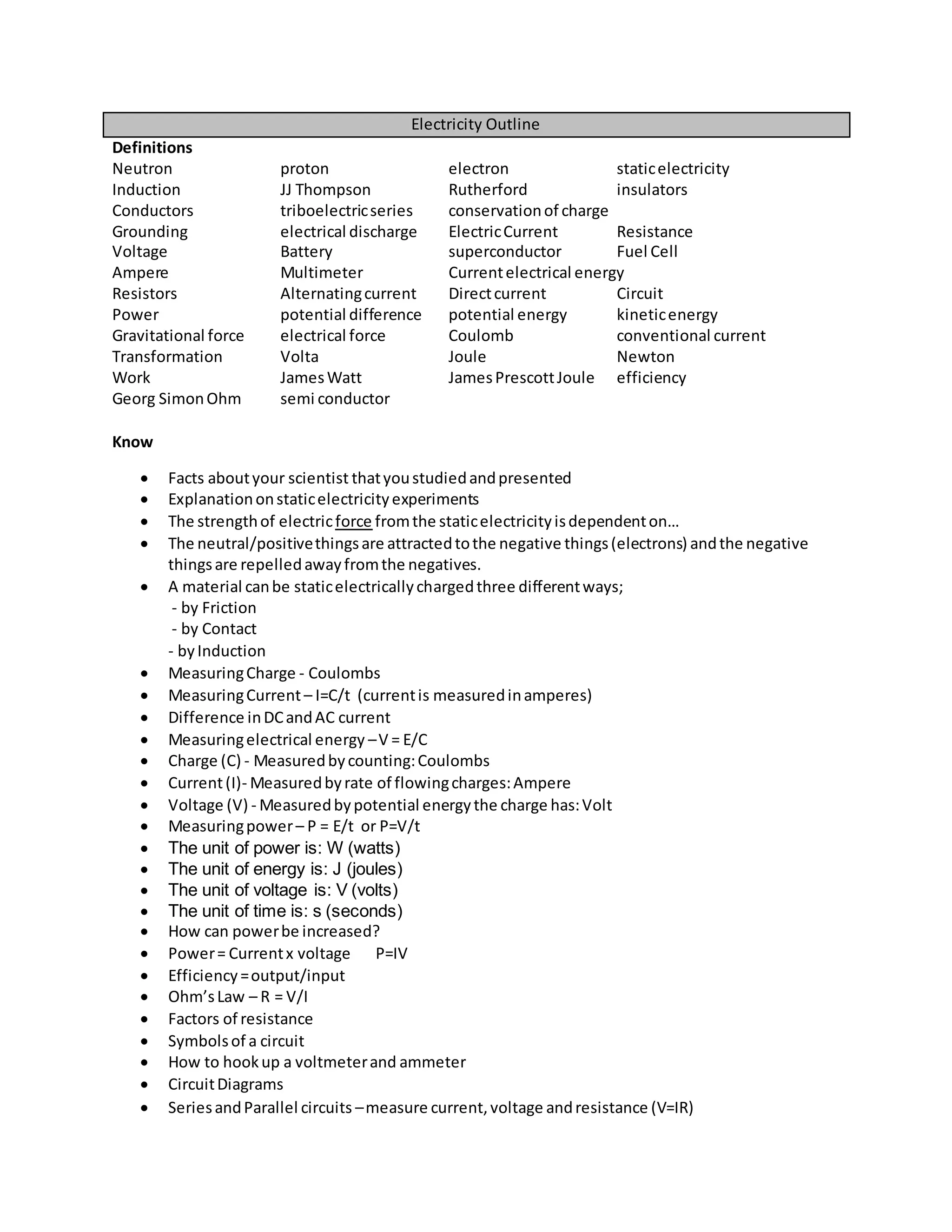
Electricity Outline
Definitions
Neutron proton electron staticelectricity
Induction JJ Thompson Rutherford insulators
Conductors triboelectricseries conservationof charge
Grounding electrical discharge ElectricCurrent Resistance
Voltage Battery superconductor Fuel Cell
Ampere Multimeter Currentelectrical energy
Resistors Alternatingcurrent Directcurrent Circuit
Power potential difference potential energy kineticenergy
Gravitational force electrical force Coulomb conventional current
Transformation Volta Joule Newton
Work JamesWatt JamesPrescottJoule efficiency
Georg SimonOhm semi conductor
Know
 Facts aboutyour scientist thatyoustudiedandpresented
 Explanationonstaticelectricityexperiments
 The strengthof electricforce fromthe staticelectricityisdependenton…
 The neutral/positivethingsare attractedtothe negative things(electrons) andthe negative
thingsare repelledawayfromthe negatives.
 A material canbe staticelectricallychargedthree differentways;
 - by Friction
 - by Contact
  - byInduction
 MeasuringCharge - Coulombs
 MeasuringCurrent – I=C/t (currentis measuredinamperes)
 Difference inDCandAC current
 Measuringelectrical energy –V = E/C
 Charge (C) - Measuredbycounting:Coulombs
 Current(I)- Measuredbyrate of flowingcharges:Ampere
 Voltage (V) - Measuredbypotential energythe charge has:Volt
 Measuringpower– P = E/t or P=V/t
 The unit of power is: W (watts)
 The unit of energy is: J (joules)
 The unit of voltage is: V (volts)
 The unit of time is: s (seconds)
 How can powerbe increased?
 Power= Currentx voltage P=IV
 Efficiency=output/input
 Ohm’sLaw – R = V/I
 Factors of resistance
 Symbolsof a circuit
 How to hookup a voltmeterand ammeter
 CircuitDiagrams
 SeriesandParallel circuits –measure current,voltage andresistance (V=IR)

Electricity outline

  • 1.
    Electricity Outline Definitions Neutron protonelectron staticelectricity Induction JJ Thompson Rutherford insulators Conductors triboelectricseries conservationof charge Grounding electrical discharge ElectricCurrent Resistance Voltage Battery superconductor Fuel Cell Ampere Multimeter Currentelectrical energy Resistors Alternatingcurrent Directcurrent Circuit Power potential difference potential energy kineticenergy Gravitational force electrical force Coulomb conventional current Transformation Volta Joule Newton Work JamesWatt JamesPrescottJoule efficiency Georg SimonOhm semi conductor Know  Facts aboutyour scientist thatyoustudiedandpresented  Explanationonstaticelectricityexperiments  The strengthof electricforce fromthe staticelectricityisdependenton…  The neutral/positivethingsare attractedtothe negative things(electrons) andthe negative thingsare repelledawayfromthe negatives.  A material canbe staticelectricallychargedthree differentways;  - by Friction  - by Contact   - byInduction  MeasuringCharge - Coulombs  MeasuringCurrent – I=C/t (currentis measuredinamperes)  Difference inDCandAC current  Measuringelectrical energy –V = E/C  Charge (C) - Measuredbycounting:Coulombs  Current(I)- Measuredbyrate of flowingcharges:Ampere  Voltage (V) - Measuredbypotential energythe charge has:Volt  Measuringpower– P = E/t or P=V/t  The unit of power is: W (watts)  The unit of energy is: J (joules)  The unit of voltage is: V (volts)  The unit of time is: s (seconds)  How can powerbe increased?  Power= Currentx voltage P=IV  Efficiency=output/input  Ohm’sLaw – R = V/I  Factors of resistance  Symbolsof a circuit  How to hookup a voltmeterand ammeter  CircuitDiagrams  SeriesandParallel circuits –measure current,voltage andresistance (V=IR)