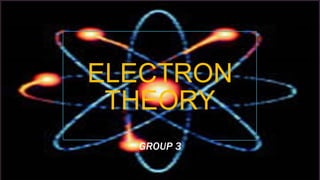
ELECTRON
THEORY
GROUP 3
2
• Understand the concept of electron theory
and its significance in the study of electricity.
• Define key terms related to electron theory
, such as atoms, electrons, protons, and
neutrons
Learning Objectives:
3
• When an atom loses electrons it becomes a
positively charged Ion. When an atom gains electrons
it becomes a negatively charged Ion. The process by
which atoms gain or lose electrons is called Ionization.
• Some materials hold their electrons very tightly.
Electrons do not move through them very well. These
things are called Insulators. Plastic, cloth, glass and
dry air are good insulators. Other materials have some
loosely held electrons, which move through them very
easily. These are called Conductors. Most metals are
good conductors. Like aluminum, gold, silver and
copper.
• The simplest form of electricity is called Static
Electricity.
• The basic unit of matter is atom
• The Atom is made up of: The Nucleus- which is
made up of protons and neutrons Electrons- which
revolve around the nucleus in paths called orbits or
shells.
• A substance that is made of atoms that are all the
same, is called an Element.
• A substance that is made up of two or more
different elements is called a Compound. A substance
that is the smallest particle of a compound and still
contains all the characteristics of that compound is
called a Molecule.
• The number of Protons plus the number of
Neutrons is the Atomic Weight.
• The number of Protons is the Atomic Number.
• Electrons in the outermost shell are called Valence
Electrons. Valence Electrons that leave the outermost
shell are called Free Electrons.
Key Terms:
WHAT IS
ELECTRON
THEORY?
 The electron theory aims to
explain the structure and
properties of solids through their
electronic structure.
 Electron Theory helps explain
electricity
 Electron theory states all matter
is comprised of molecules, which
in turn are comprised of atoms,
which are again comprised of
protons, neutrons and electrons.
5
WHO
DISCOVERED
ELECTRONS,
PROTONS ,
7
DISCOVERED ELECTRONS
8
DISCOVERED PROTONS
9
DISCOVERED NEUTRONS
10
DISCOVERED ATOM
STRUCTURE OF ATOM 11
12
Role of electron in atoms
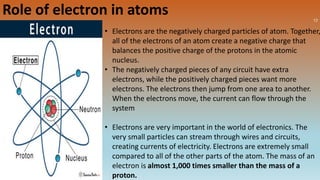
• Electrons are the negatively charged particles of atom. Together,
all of the electrons of an atom create a negative charge that
balances the positive charge of the protons in the atomic
nucleus.
• The negatively charged pieces of any circuit have extra
electrons, while the positively charged pieces want more
electrons. The electrons then jump from one area to another.
When the electrons move, the current can flow through the
system
• Electrons are very important in the world of electronics. The
very small particles can stream through wires and circuits,
creating currents of electricity. Electrons are extremely small
compared to all of the other parts of the atom. The mass of an
electron is almost 1,000 times smaller than the mass of a
proton.
13
 Electrons play a major role in all chemical
bonds. There is one type of bonding called
electrovalent bonding (ionic), where an
electron from one atom is transferred to
another atom. You wind up creating two
ions as one atom loses an electron and one
gains one. The second type of bonding is
called covalent bonding, where electrons
are actually shared between two or more
atoms in a cloud.
 Both types of bonds have specific
advantages and weaknesses.
1.Electrons are negatively charged
species.
2.The mass of electrons is lesser
than the mass of proton and
neutron. Therefore, electrons do
not contribute to the mass of the
nucleus.
3.Electrons are subatomic particles
found outside the nucleus in a fixed
energy path known as shells or
14
(Three
main
propertie
s of the
electron)
Fundamental
Properties of
electrons
15
Concept of electric charge
 The concept of electric charge
discovered by Benjamin Franklin in
America tried experiments with
charges.
 Franklin named the two kinds of
electric charges ‘positive’ and
‘negative’. He even collected
electric charges from thunderstorm
clouds through the wet string of a
kite.
16
Positive
charge &
Negative
charge
 Positive charge:
The positive charge is the positive ion
which is attracted by the negative
terminal of a circuit, positive charge
repels each other, positive and
negative charge attract each other
 Negative charge:
The negative charge is the negative
ion which is attracted by the positive
terminal of a circuit, negative charge
repels each other, positive and
negative charge attract each other.
2 Perspectives
a. BHOR
MODEL
b. Quantum
mechanical
model.
c. quantum
mechanical model.
17
Electron movement within atoms
18
• Niels Bohr proposed what is now called
the Bohr model of the atom in 1913
(Bohr 1913).
• He suggested that electrons are particles
and they undergo two kinds of motion in
atoms; they either move continuously
around the nucleus in certain stationary
orbits or discontinuously jump between
these orbits.
• This gives a visualizable picture of
motion of the electrons in atoms.
• The Bohr model was latterly replaced by
quantum mechanics, in which the
physical state of an electron is described
by a wave function.
NOTE:The movement of free electrons between atoms is called
electrical current
19
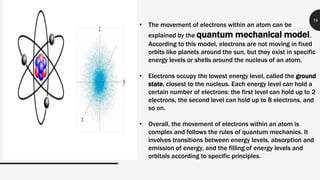
• The movement of electrons within an atom can be
explained by the quantum mechanical model.
According to this model, electrons are not moving in fixed
orbits like planets around the sun, but they exist in specific
energy levels or shells around the nucleus of an atom.
• Electrons occupy the lowest energy level, called the ground
state, closest to the nucleus. Each energy level can hold a
certain number of electrons: the first level can hold up to 2
electrons, the second level can hold up to 8 electrons, and
so on.
• Overall, the movement of electrons within an atom is
complex and follows the rules of quantum mechanics. It
involves transitions between energy levels, absorption and
emission of energy, and the filling of energy levels and
orbitals according to specific principles.
20
What is Electron Cloud and Probability ? 21
 Electron cloud is the region around an atom's nucleus where
electrons are most likely to be found. It represents the probabilistic
nature of electron location in quantum mechanics.
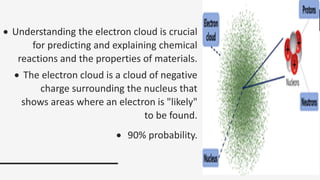
 The concept of probability in the electron cloud refers to the
likelihood of finding an electron in a specific area of space. The
electron cloud is described by the wave function solutions to the
Schrödinger equation, which is a fundamental equation in quantum
mechanics.
 Understanding the electron cloud is crucial
for predicting and explaining chemical
reactions and the properties of materials.
 The electron cloud is a cloud of negative
charge surrounding the nucleus that
shows areas where an electron is "likely"
to be found.
 90% probability.
22
QUANTUM
MECHANICS
23
24
What is Quantum mechanics?
 Quantum mechanics is a branch of physics that describes
the behavior of particles at the atomic and subatomic
levels. It provides a framework for understanding the
fundamental properties of matter and energy. Quantum
mechanics revolutionized our understanding of the
microscopic world and introduced the concept of wave-
particle duality.
 The quantum mechanical model explains how an atom's
electrons behave. Erwin Schrodinger proposed an
equation that explained an electron's behavior. His
equation accounted for the wave-particle duality and the
Heisenberg uncertainty principle.
WHAT IS CHEMICAL
BOND?
• Chemical bonds are forces that hold the
atoms together in a molecule. They are a
result of strong intramolecular interactions
among the atoms of a molecule.
• The valence (outermost) electrons of the
atoms participate in chemical bonds. When
two atoms approach each other, these outer
electrons start to interact. Although electrons
repel each other, they are attracted to the
protons within atoms. The interplay of forces
results in the formation of bonds between
the atoms. The main types of chemical bonds
are ionic bond, covalent bond, hydrogen
bond, and metallic bond.
25
CLASSIFICATION OF
MATERIALS IN TERMS
OF CONDUCTIVITY
Conductors, Insulators, and
Semiconductors
26
Insulators:- The materials whose
electrical conductivity is very very
small are called insulators. Such as
quartz, glass, dry air, wood etc.
Conductors: The materials whose electrical
conductivity is very high are called
conductors. Such as earth, human body,
aqueous solutions of salts, copper, iron,
brass, aluminium etc.
28
The materials whose
conductivity lies between
that of conductors and
insulators are called
semiconductors. Such as
germanium, silicon.
29
 Introduction: The branch of physics which deals with
the motion of charges is called current electricity.
Since the electronic current in a conductor is due to
the motion of free electrons therefore these electrons
are also known as conduction electron. The flow of
free charges in a conductor constitutes electric
current.
 Electric current:- It is defined as the charge flowing
through any section of conductor in one second.
Current
Electricity
ELECTRICITY AND ELECTRON FLOW
Basic Circuit Symbols
• Resistor: A rectangle or a zigzag line represents a
resistor, indicating a component that resists the
flow of electrical current.
• Capacitor: Two parallel lines with a gap represent a
capacitor, a component that stores electrical
energy.
• Voltage Source or Battery: A series of alternating
short and long lines represents a battery,
illustrating the power source for the circuit.
• Light Bulb: A circle with a cross inside represents a
light bulb, indicating a component that emits light
when current flows through it.
31
Diagramming the Flow of Electricity
• It’s important to realize that electrical circuits are
the foundation of modern technology.
• An electrical circuit is simply a path or a loop around
which an electrical current flows. The path may be
closed (like a loop) or open (broken), and it might
consist of various components like resistors,
transistors, capacitors, wires, and other devices.
32
Circuit Diagram
 Circuit diagrams, also known as schematic diagrams, are visual
representations of electrical circuits and the flow of electricity. They
use simplified standard symbols to represent electrical components
and lines to show the connections between those components. They
are crucial for the design, construction, and maintenance of electrical
and electronic equipment.
33
How Does Electricity Flow in
Different Types of Circuits?
There are two main types of electrical circuits:
series and parallel circuits. They each have
unique characteristics, advantages, and
disadvantages.
Characteristics of Series
Circuits:
Current: Identical through all components.
Voltage: Divided across the components.
Resistance: Total resistance is the sum of the
individual resistances.
Breaking the Circuit: If one component fails, the
circuit breaks, and current ceases to flow.
Characteristics of Parallel Circuits:
Current: Divided through the different paths, with the
total current being the sum of the currents through
each path.
Voltage: Same across all components.
Resistance: Total resistance decreases as more paths
are added.
Continuity: If one path is disrupted, current still flows
through the other paths.
34
Electron Flow Notation vz.
Conventional Flow Notation
It is the direction in which the Flow of Electric
Current Represented.
APPLICATION OF
ELECTRON THEORY
ELECTRONICS,MATERIAL SCIENCE,CHEMISTRY
35
36
ELECTRONICS Materials Science
37

ELECTRON-theory ppt industrials arts part2

  • 1.
  • 2.
    2 • Understand theconcept of electron theory and its significance in the study of electricity. • Define key terms related to electron theory , such as atoms, electrons, protons, and neutrons Learning Objectives:
  • 3.
    3 • When anatom loses electrons it becomes a positively charged Ion. When an atom gains electrons it becomes a negatively charged Ion. The process by which atoms gain or lose electrons is called Ionization. • Some materials hold their electrons very tightly. Electrons do not move through them very well. These things are called Insulators. Plastic, cloth, glass and dry air are good insulators. Other materials have some loosely held electrons, which move through them very easily. These are called Conductors. Most metals are good conductors. Like aluminum, gold, silver and copper. • The simplest form of electricity is called Static Electricity. • The basic unit of matter is atom • The Atom is made up of: The Nucleus- which is made up of protons and neutrons Electrons- which revolve around the nucleus in paths called orbits or shells. • A substance that is made of atoms that are all the same, is called an Element. • A substance that is made up of two or more different elements is called a Compound. A substance that is the smallest particle of a compound and still contains all the characteristics of that compound is called a Molecule. • The number of Protons plus the number of Neutrons is the Atomic Weight. • The number of Protons is the Atomic Number. • Electrons in the outermost shell are called Valence Electrons. Valence Electrons that leave the outermost shell are called Free Electrons. Key Terms:
  • 4.
    WHAT IS ELECTRON THEORY?  Theelectron theory aims to explain the structure and properties of solids through their electronic structure.  Electron Theory helps explain electricity  Electron theory states all matter is comprised of molecules, which in turn are comprised of atoms, which are again comprised of protons, neutrons and electrons.
  • 5.
  • 6.
  • 7.
  • 8.
  • 9.
  • 10.
  • 11.
  • 12.
    12 Role of electronin atoms • Electrons are the negatively charged particles of atom. Together, all of the electrons of an atom create a negative charge that balances the positive charge of the protons in the atomic nucleus. • The negatively charged pieces of any circuit have extra electrons, while the positively charged pieces want more electrons. The electrons then jump from one area to another. When the electrons move, the current can flow through the system • Electrons are very important in the world of electronics. The very small particles can stream through wires and circuits, creating currents of electricity. Electrons are extremely small compared to all of the other parts of the atom. The mass of an electron is almost 1,000 times smaller than the mass of a proton.
  • 13.
    13  Electrons playa major role in all chemical bonds. There is one type of bonding called electrovalent bonding (ionic), where an electron from one atom is transferred to another atom. You wind up creating two ions as one atom loses an electron and one gains one. The second type of bonding is called covalent bonding, where electrons are actually shared between two or more atoms in a cloud.  Both types of bonds have specific advantages and weaknesses.
  • 14.
    1.Electrons are negativelycharged species. 2.The mass of electrons is lesser than the mass of proton and neutron. Therefore, electrons do not contribute to the mass of the nucleus. 3.Electrons are subatomic particles found outside the nucleus in a fixed energy path known as shells or 14 (Three main propertie s of the electron) Fundamental Properties of electrons
  • 15.
    15 Concept of electriccharge  The concept of electric charge discovered by Benjamin Franklin in America tried experiments with charges.  Franklin named the two kinds of electric charges ‘positive’ and ‘negative’. He even collected electric charges from thunderstorm clouds through the wet string of a kite.
  • 16.
    16 Positive charge & Negative charge  Positivecharge: The positive charge is the positive ion which is attracted by the negative terminal of a circuit, positive charge repels each other, positive and negative charge attract each other  Negative charge: The negative charge is the negative ion which is attracted by the positive terminal of a circuit, negative charge repels each other, positive and negative charge attract each other.
  • 17.
    2 Perspectives a. BHOR MODEL b.Quantum mechanical model. c. quantum mechanical model. 17 Electron movement within atoms
  • 18.
    18 • Niels Bohrproposed what is now called the Bohr model of the atom in 1913 (Bohr 1913). • He suggested that electrons are particles and they undergo two kinds of motion in atoms; they either move continuously around the nucleus in certain stationary orbits or discontinuously jump between these orbits. • This gives a visualizable picture of motion of the electrons in atoms. • The Bohr model was latterly replaced by quantum mechanics, in which the physical state of an electron is described by a wave function. NOTE:The movement of free electrons between atoms is called electrical current
  • 19.
    19 • The movementof electrons within an atom can be explained by the quantum mechanical model. According to this model, electrons are not moving in fixed orbits like planets around the sun, but they exist in specific energy levels or shells around the nucleus of an atom. • Electrons occupy the lowest energy level, called the ground state, closest to the nucleus. Each energy level can hold a certain number of electrons: the first level can hold up to 2 electrons, the second level can hold up to 8 electrons, and so on. • Overall, the movement of electrons within an atom is complex and follows the rules of quantum mechanics. It involves transitions between energy levels, absorption and emission of energy, and the filling of energy levels and orbitals according to specific principles.
  • 20.
  • 21.
    What is ElectronCloud and Probability ? 21  Electron cloud is the region around an atom's nucleus where electrons are most likely to be found. It represents the probabilistic nature of electron location in quantum mechanics.  The concept of probability in the electron cloud refers to the likelihood of finding an electron in a specific area of space. The electron cloud is described by the wave function solutions to the Schrödinger equation, which is a fundamental equation in quantum mechanics.
  • 22.
     Understanding theelectron cloud is crucial for predicting and explaining chemical reactions and the properties of materials.  The electron cloud is a cloud of negative charge surrounding the nucleus that shows areas where an electron is "likely" to be found.  90% probability. 22
  • 23.
  • 24.
    24 What is Quantummechanics?  Quantum mechanics is a branch of physics that describes the behavior of particles at the atomic and subatomic levels. It provides a framework for understanding the fundamental properties of matter and energy. Quantum mechanics revolutionized our understanding of the microscopic world and introduced the concept of wave- particle duality.  The quantum mechanical model explains how an atom's electrons behave. Erwin Schrodinger proposed an equation that explained an electron's behavior. His equation accounted for the wave-particle duality and the Heisenberg uncertainty principle.
  • 25.
    WHAT IS CHEMICAL BOND? •Chemical bonds are forces that hold the atoms together in a molecule. They are a result of strong intramolecular interactions among the atoms of a molecule. • The valence (outermost) electrons of the atoms participate in chemical bonds. When two atoms approach each other, these outer electrons start to interact. Although electrons repel each other, they are attracted to the protons within atoms. The interplay of forces results in the formation of bonds between the atoms. The main types of chemical bonds are ionic bond, covalent bond, hydrogen bond, and metallic bond. 25
  • 26.
    CLASSIFICATION OF MATERIALS INTERMS OF CONDUCTIVITY Conductors, Insulators, and Semiconductors 26
  • 27.
    Insulators:- The materialswhose electrical conductivity is very very small are called insulators. Such as quartz, glass, dry air, wood etc. Conductors: The materials whose electrical conductivity is very high are called conductors. Such as earth, human body, aqueous solutions of salts, copper, iron, brass, aluminium etc.
  • 28.
    28 The materials whose conductivitylies between that of conductors and insulators are called semiconductors. Such as germanium, silicon.
  • 29.
    29  Introduction: Thebranch of physics which deals with the motion of charges is called current electricity. Since the electronic current in a conductor is due to the motion of free electrons therefore these electrons are also known as conduction electron. The flow of free charges in a conductor constitutes electric current.  Electric current:- It is defined as the charge flowing through any section of conductor in one second. Current Electricity ELECTRICITY AND ELECTRON FLOW
  • 30.
    Basic Circuit Symbols •Resistor: A rectangle or a zigzag line represents a resistor, indicating a component that resists the flow of electrical current. • Capacitor: Two parallel lines with a gap represent a capacitor, a component that stores electrical energy. • Voltage Source or Battery: A series of alternating short and long lines represents a battery, illustrating the power source for the circuit. • Light Bulb: A circle with a cross inside represents a light bulb, indicating a component that emits light when current flows through it.
  • 31.
    31 Diagramming the Flowof Electricity • It’s important to realize that electrical circuits are the foundation of modern technology. • An electrical circuit is simply a path or a loop around which an electrical current flows. The path may be closed (like a loop) or open (broken), and it might consist of various components like resistors, transistors, capacitors, wires, and other devices.
  • 32.
    32 Circuit Diagram  Circuitdiagrams, also known as schematic diagrams, are visual representations of electrical circuits and the flow of electricity. They use simplified standard symbols to represent electrical components and lines to show the connections between those components. They are crucial for the design, construction, and maintenance of electrical and electronic equipment.
  • 33.
    33 How Does ElectricityFlow in Different Types of Circuits? There are two main types of electrical circuits: series and parallel circuits. They each have unique characteristics, advantages, and disadvantages. Characteristics of Series Circuits: Current: Identical through all components. Voltage: Divided across the components. Resistance: Total resistance is the sum of the individual resistances. Breaking the Circuit: If one component fails, the circuit breaks, and current ceases to flow. Characteristics of Parallel Circuits: Current: Divided through the different paths, with the total current being the sum of the currents through each path. Voltage: Same across all components. Resistance: Total resistance decreases as more paths are added. Continuity: If one path is disrupted, current still flows through the other paths.
  • 34.
    34 Electron Flow Notationvz. Conventional Flow Notation It is the direction in which the Flow of Electric Current Represented.
  • 35.
  • 36.
  • 37.