

Electrical properties of the tissues
Juliana Knocikova
Electric current is the flow (movement) of electric charge.
The amount of electric current (measured in amperes) through
some surface is defined as the amount of electric charge
(measured in coulombs) flowing through that surface over time.
Electric current
Electric current
• flows to the organism
from external sources
• is generated as a
result of actions in
plasma cell membrane
(excitable tissues)
• direct current (DC)
- is the constant flow of electric
charge, the electric chagres flow
in the same direction
• alternating currnet (AC)
- is a current whose magnitude
and direction vary cyclically. A
sine wave is a usual waveform of an
Electrical properties of the tissues
• passive electric properties – tissue’s and organ’s
behaviour in electric field
• active electric properties – electricity as a result of
ogran activity
LIVE TISSUE BEHAVE AS A SPECIAL
KIND OF CONDUCTOR IN ELECTRIC
FIELD
• cell membrane conductance is lower (106 – 108 times) as
extracellulary space and cytoplasm conductance
• extracellulary space and cytoplasm – electrical current is realized as
a ions movement (electrolyt)
• membrane capacity: Cm =1μF.cm-² , membrane surface resistance:
1000 - 1500Ω.cm-²
Measurement of skin resistance
Skin is the largest organ of the integlumentary system made up of
multiple layers of epitheliar tissues that guard underlying muscles
and organs. Skin is made up of a complex mosaic of three layers,
the epidermis, dermis and subdermis and accounts for 12-16 % of
body weight. Skin reperesents a complex variable conductor when
exposed to the electric field which is characterized by large
nonhomogenity.
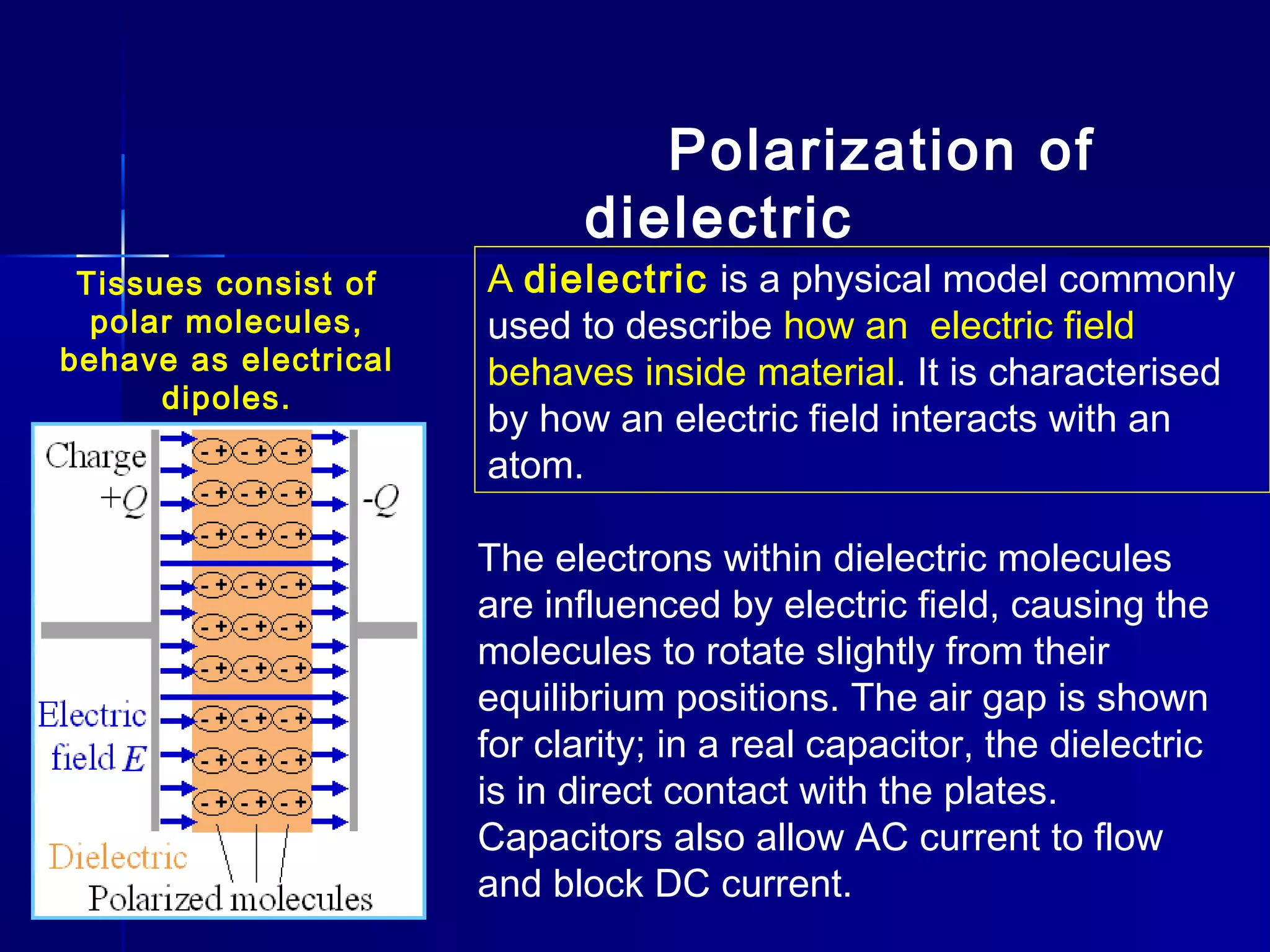
The electrons within dielectric molecules
are influenced by electric field, causing the
molecules to rotate slightly from their
equilibrium positions. The air gap is shown
for clarity; in a real capacitor, the dielectric
is in direct contact with the plates.
Capacitors also allow AC current to flow
and block DC current.
Polarization of
dielectric
A dielectric is a physical model commonly
used to describe how an electric field
behaves inside material. It is characterised
by how an electric field interacts with an
atom.
Tissues consist of
polar molecules,
behave as electrical
dipoles.
Current (I) is what flows on a wire or conductor like water flowing down a river. Current
flows from negative to positive on the surface of a conductor. Current is measured in
amperes or amps (A).
Voltage (V) is the difference in electrical potential between two points in a circuit. It's the
push or pressure behind current flow through a circuit, and is measured in volts (V) .
Resistance (R) determines how much current will flow through a component. Resistors are
used to control voltage and current levels. A very high resistance allows a small amount of
current to flow. A very low resistance allows a large amount of current to flow. Resistance
is measured in ohms (Ω).
Ohm’s low
Ohm's law states that, in an electrical circuit, the current passing
through a conductor between two points is directly proportional to
the potential difference (i.e. voltage) across the two points, and
inversely proportional to the resistance between them.
I=V/R
Resistor
Resistor is a two-terminal electrical or electronic component that resists
an electric current by producing a voltage drop between its terminals in
accordance with
Ohm's law: The electrical resistance is equal to the voltage drop
across resistor divided by the current through the resistor.
Resistors are used as part of electrical networks and electronic circuits.
Resistance
The resistance of a resistor is given by the formula
where:
•ρ is the resistivity of the material that the resistor is made from [Ωm]
•l is the length of the resistive material, between the end contacts [m]
•A is the cross sectional area of the resistive material [m²]
Capacitor
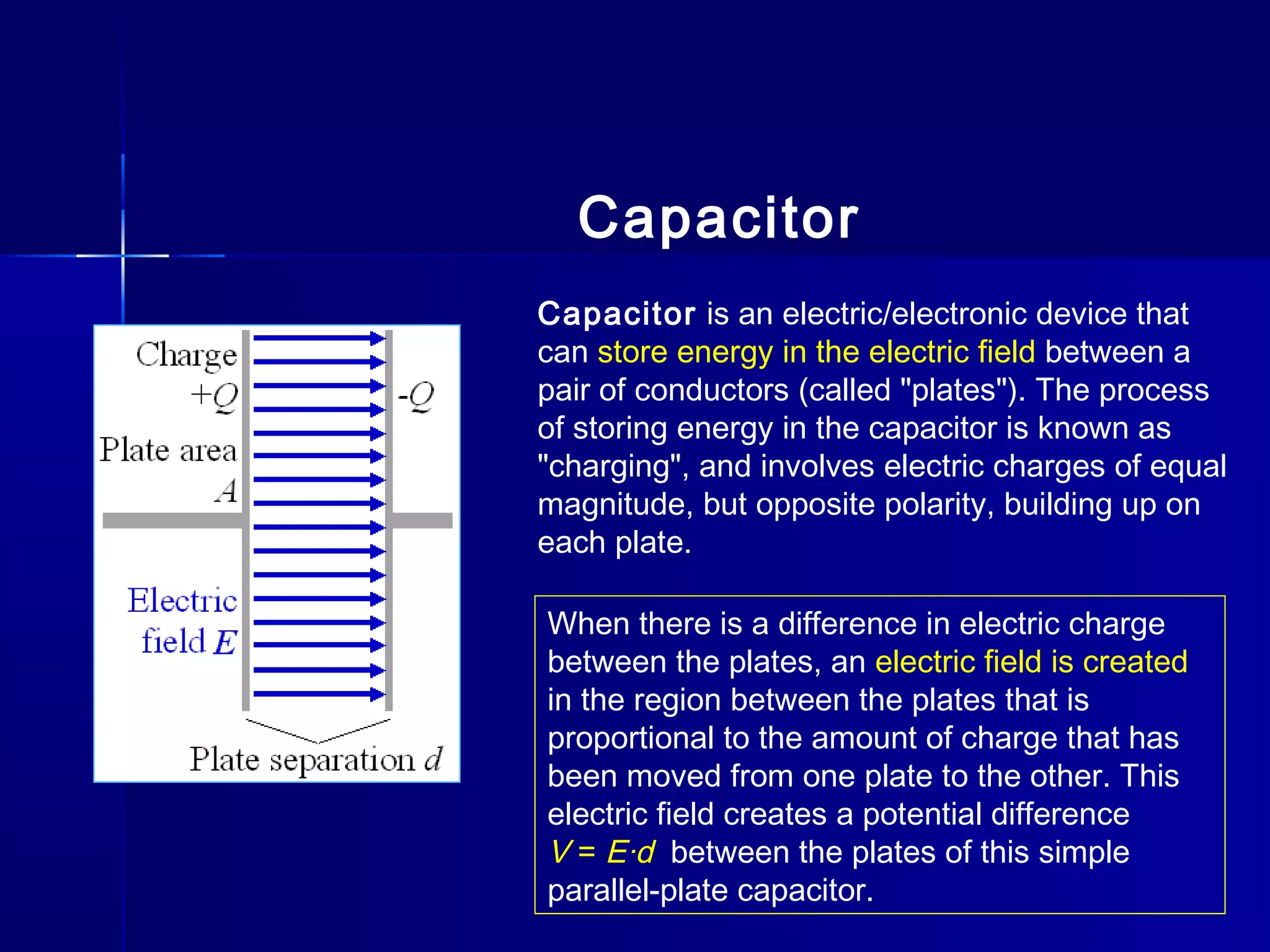
When there is a difference in electric charge
between the plates, an electric field is created
in the region between the plates that is
proportional to the amount of charge that has
been moved from one plate to the other. This
electric field creates a potential difference
V = E·d between the plates of this simple
parallel-plate capacitor.
Capacitor is an electric/electronic device that
can store energy in the electric field between a
pair of conductors (called "plates"). The process
of storing energy in the capacitor is known as
"charging", and involves electric charges of equal
magnitude, but opposite polarity, building up on
each plate.
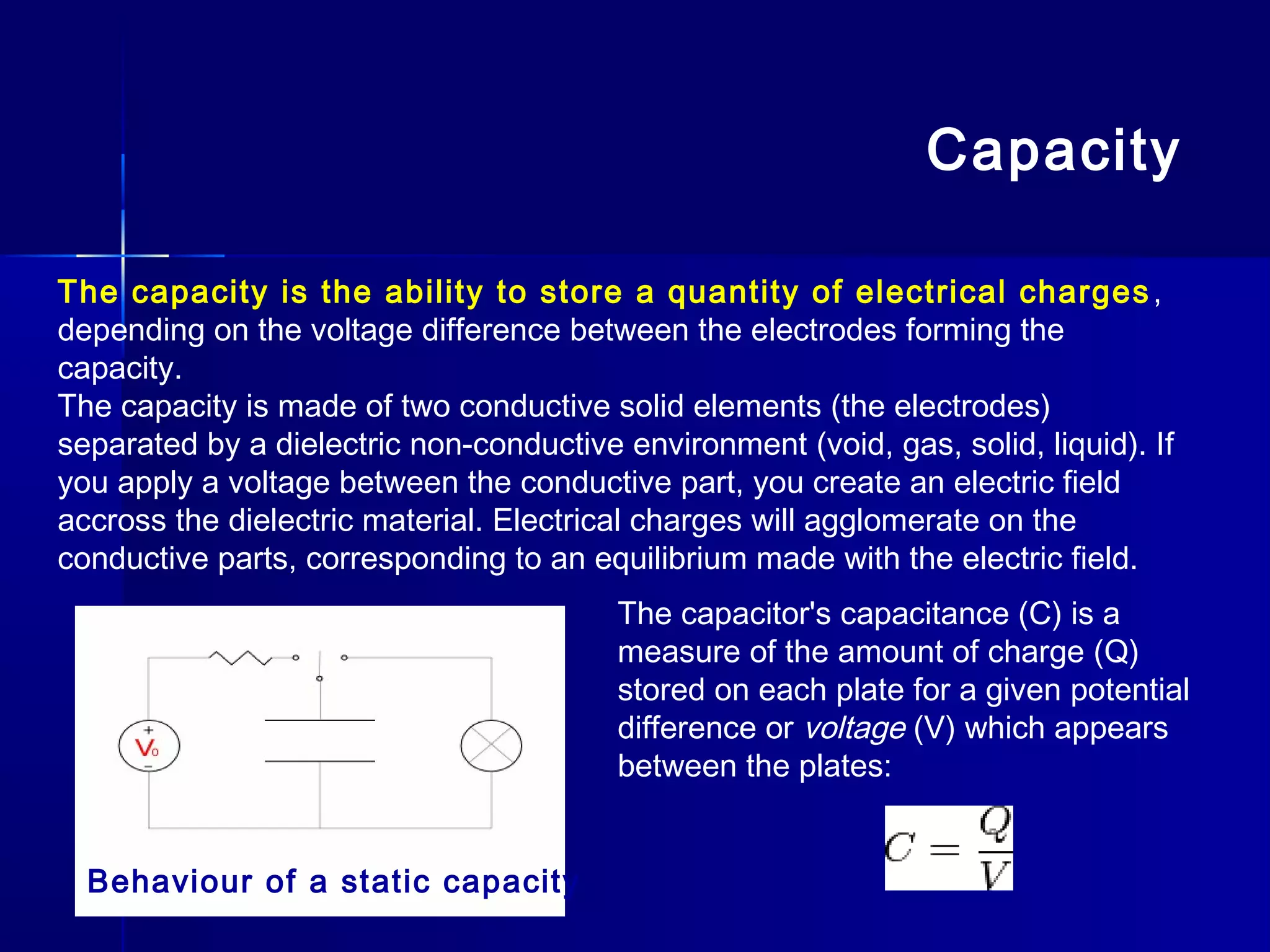
The capacity is the ability to store a quantity of electrical charges,
depending on the voltage difference between the electrodes forming the
capacity.
The capacity is made of two conductive solid elements (the electrodes)
separated by a dielectric non-conductive environment (void, gas, solid, liquid). If
you apply a voltage between the conductive part, you create an electric field
accross the dielectric material. Electrical charges will agglomerate on the
conductive parts, corresponding to an equilibrium made with the electric field.
Behaviour of a static capacity
Capacity
The capacitor's capacitance (C) is a
measure of the amount of charge (Q)
stored on each plate for a given potential
difference or voltage (V) which appears
between the plates:
Skin resistance
• Skin is a good insulator.
• It is difficult for low frequencies to pass through skin.
•Some people have very moist skin and others have very dry
skin. It takes higher voltage to penetrate dry skin than wet
skin. Moisture is the determining factor for penetration of el.
current through the skin into the body.
• Skin resistance decreases over time
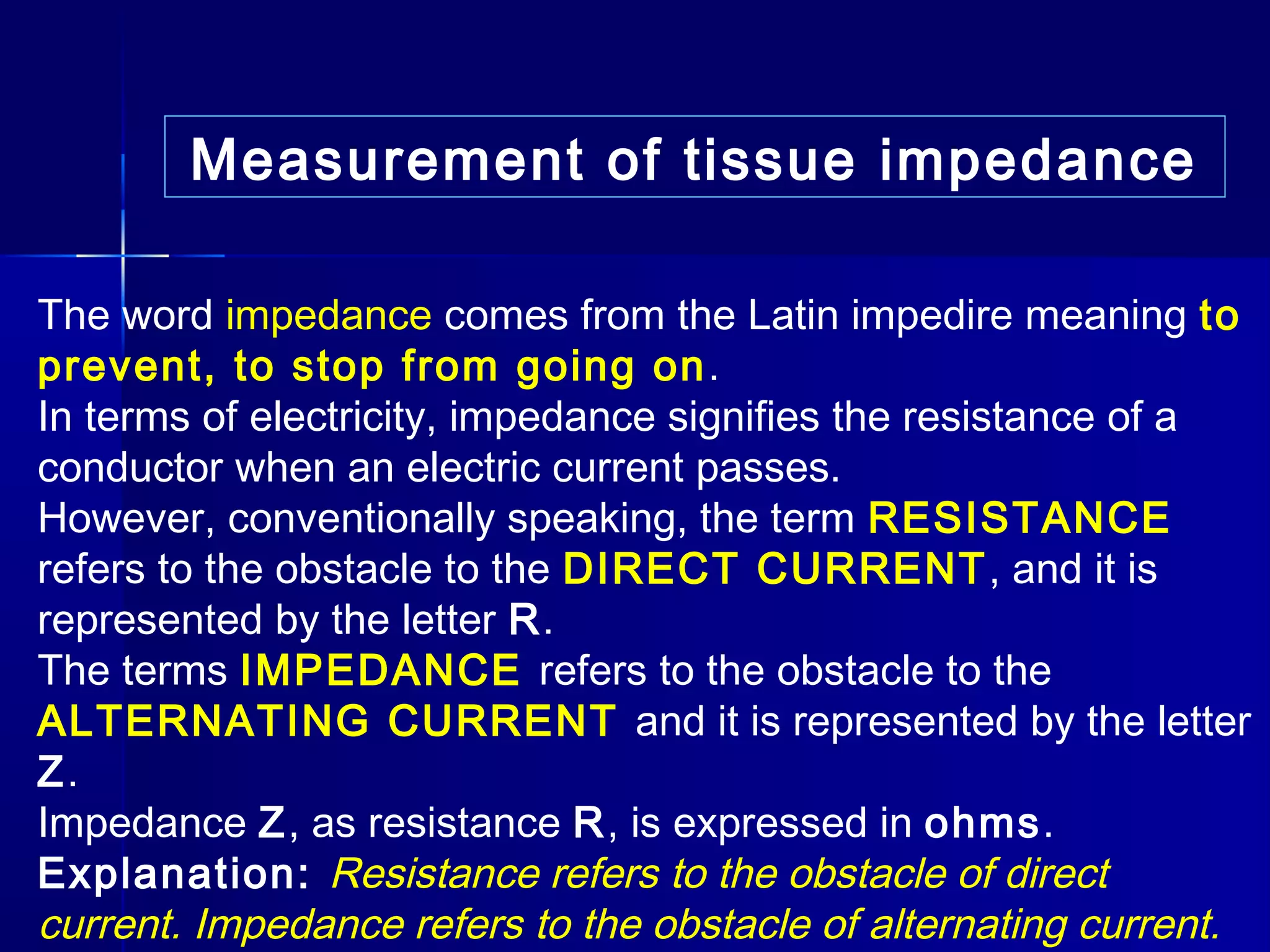
The word impedance comes from the Latin impedire meaning to
prevent, to stop from going on.
In terms of electricity, impedance signifies the resistance of a
conductor when an electric current passes.
However, conventionally speaking, the term RESISTANCE
refers to the obstacle to the DIRECT CURRENT, and it is
represented by the letter R.
The terms IMPEDANCE refers to the obstacle to the
ALTERNATING CURRENT and it is represented by the letter
Z.
Impedance Z, as resistance R, is expressed in ohms.
Explanation: Resistance refers to the obstacle of direct
current. Impedance refers to the obstacle of alternating current.
Measurement of tissue impedance
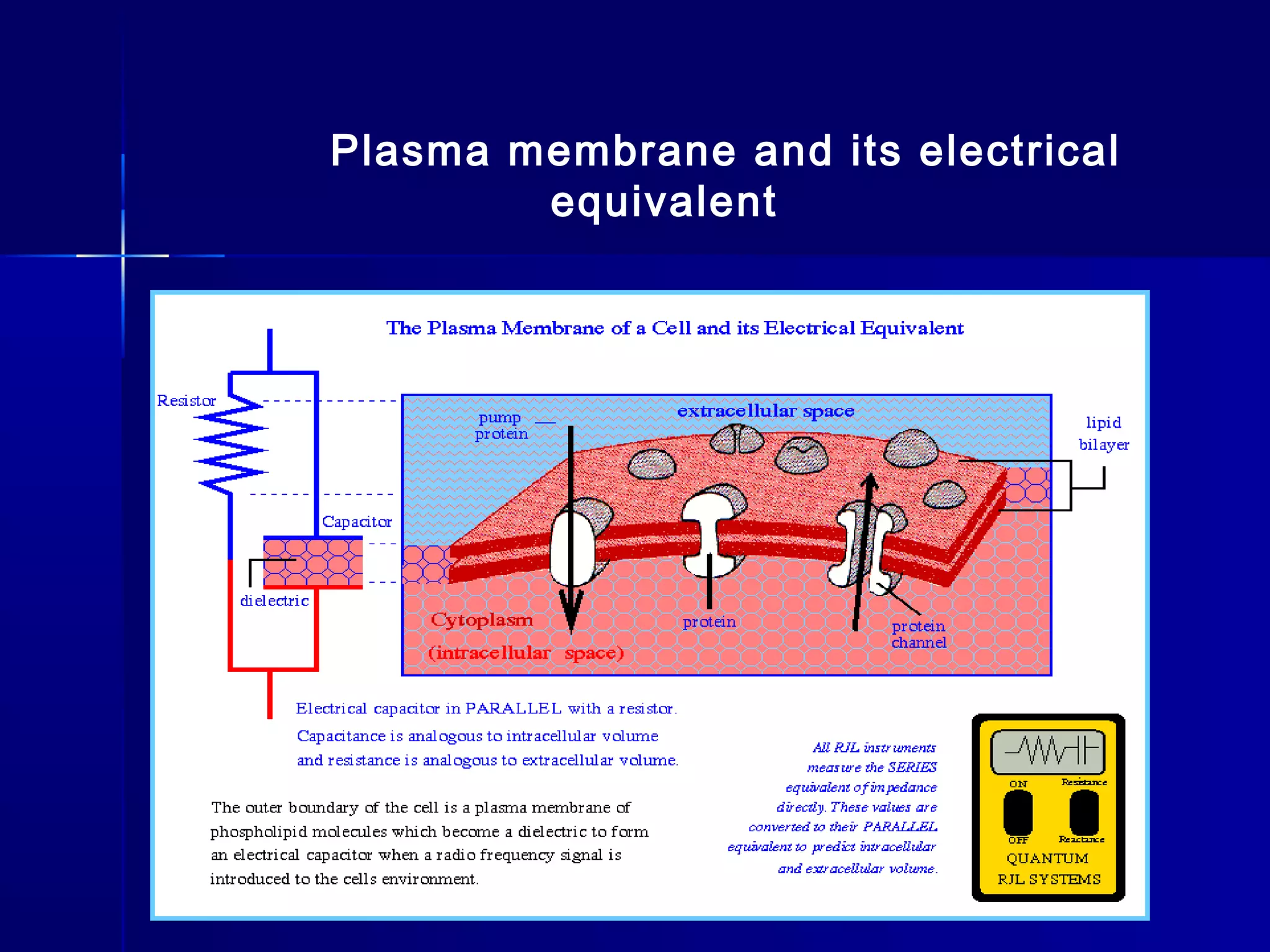
Plasma membrane and its electrical
equivalent
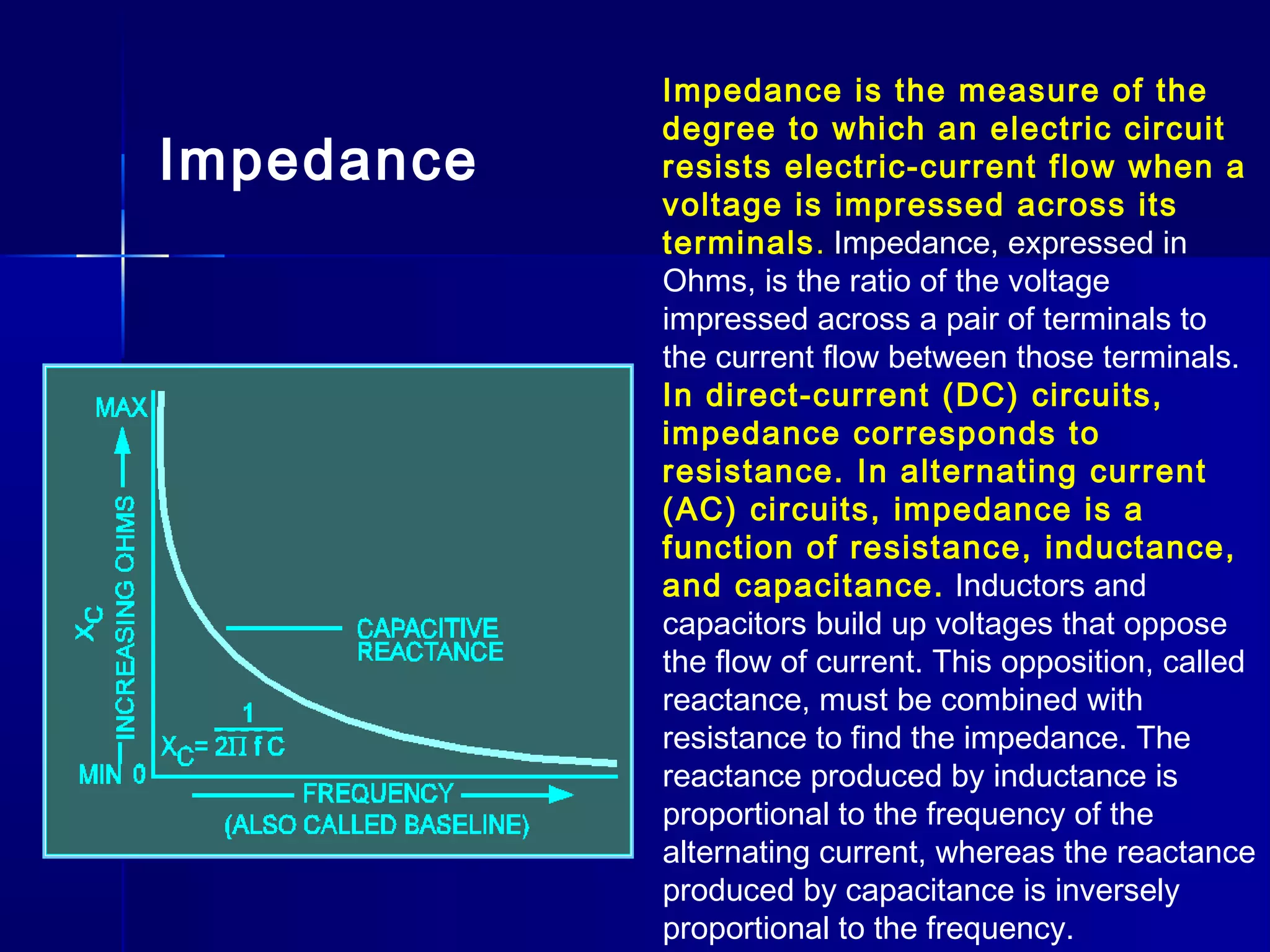
Impedance is the measure of the
degree to which an electric circuit
resists electric-current flow when a
voltage is impressed across its
terminals. Impedance, expressed in
Ohms, is the ratio of the voltage
impressed across a pair of terminals to
the current flow between those terminals.
In direct-current (DC) circuits,
impedance corresponds to
resistance. In alternating current
(AC) circuits, impedance is a
function of resistance, inductance,
and capacitance. Inductors and
capacitors build up voltages that oppose
the flow of current. This opposition, called
reactance, must be combined with
resistance to find the impedance. The
reactance produced by inductance is
proportional to the frequency of the
alternating current, whereas the reactance
produced by capacitance is inversely
proportional to the frequency.
Impedance
Impedance
Electrical Impedance (Z), is the total opposition
that a circuit presents to alternating current.
Impedance is measured in ohms and may
include resistance (R), inductive reactance
(XL), and capacitive reactance (XC).
However, the total impedance is not simply the
algebraic sum of the resistance, inductive
reactance, and capacitive reactance. Since the
inductive reactance and capacitive reactance are
90° out of phase with the resistance and,
therefore, their maximum values occur at
different times, vector addition must be used to
calculate impedance.
The resistance and the inductive
reactance lines are 90° out of phase,
so when combined to produce the
impedance line, the phase shift is
somewhere between zero and 90o.
The phase shift is always relative to
the resistance line since the
resistance line is always in-phase
with the voltage. If more resistance
than inductive reactance is present
in the circuit, the impedance line will
move toward the resistance line and
the phase shift will decrease. If more
inductive reactance is present in the
circuit, the impedance line will shift
toward the inductive reactance line
and the phase shift will increase.
Phase
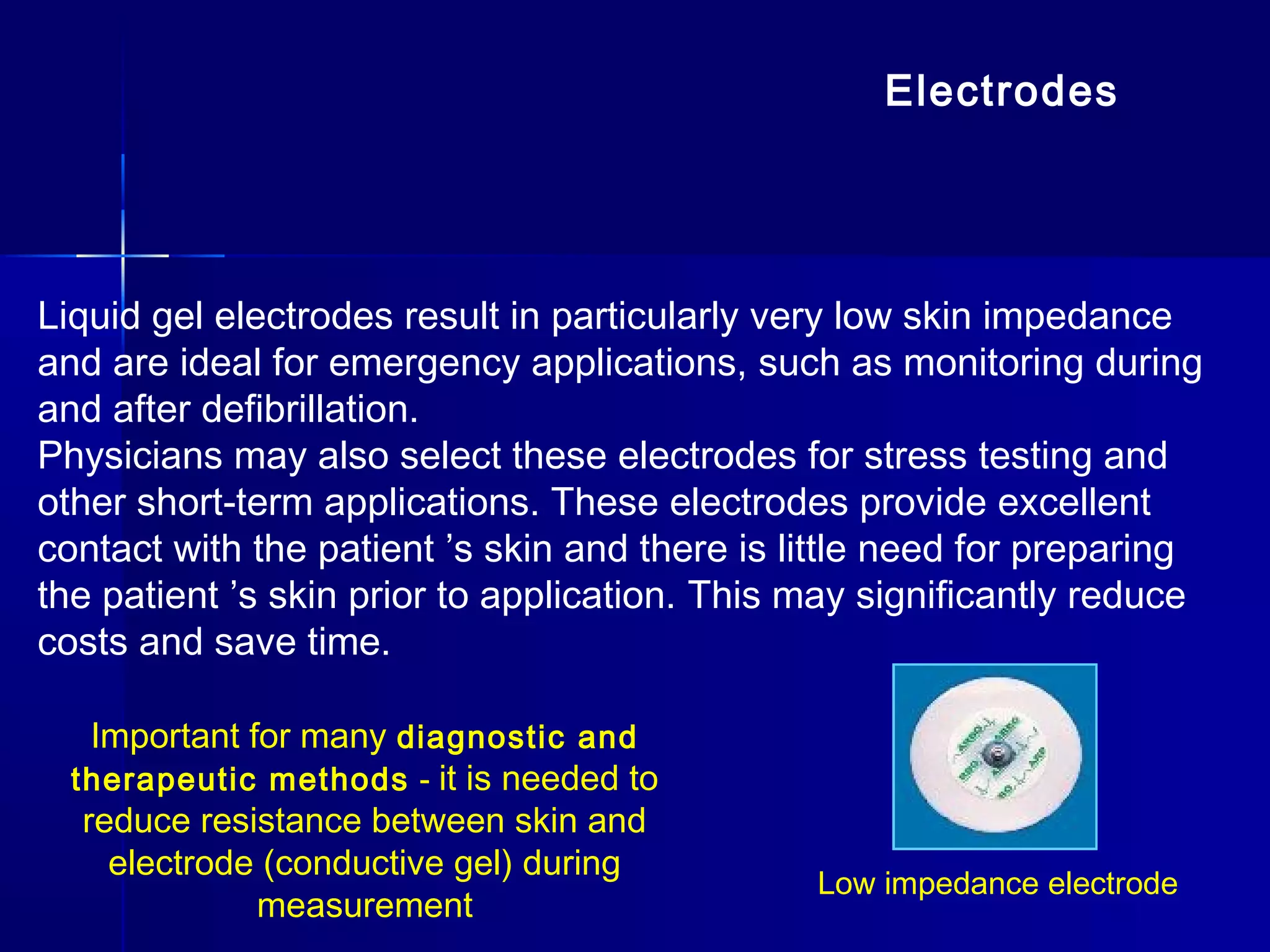
Liquid gel electrodes result in particularly very low skin impedance
and are ideal for emergency applications, such as monitoring during
and after defibrillation.
Physicians may also select these electrodes for stress testing and
other short-term applications. These electrodes provide excellent
contact with the patient ’s skin and there is little need for preparing
the patient ’s skin prior to application. This may significantly reduce
costs and save time.
Low impedance electrode
Electrodes
Important for many diagnostic and
therapeutic methods - it is needed to
reduce resistance between skin and
electrode (conductive gel) during
measurement
Electrical impedance measurement is a measurement of how electricity travels
though a given material. Every tissue has different electrical impedance determined
by its molecular composition. Some materials have high electrical impedance while
others have low electrical impedance. Breast tissue which is malignant (cancerous)
has a much lower electrical impedance – or conducts electricity much better – than
normal tissue and benign (non-cancerous) tumors.
Measurement of tissue impedance
Neoplastic (cancerous) tissue causes alterations in
intracellular and extracellular fluid compartments, cell
membrane surface area, macromolecules, ionic
permeability, and membrane associated water layers.
These histological and biochemical changes within the
cancerous tissue give rise to measurable changes in
tissue electrical impedance. When a small alternating
current is placed across the breast, the focal increase in
electrical conductance and capacitance of the cancer
tissue distorts the electric field within the breast. The
resulting impedance map shows the cancer as a focal
brightness on the gray scale image of conductivity and
capacitance measured by an array of signal sensors on
Measurement of tissue impedance
Pathological musoca mapping
Simple Lie Detector
Here's a simple lie detector that can be can be useful when you want to know if
someone is really telling you the truth. It is not as sophisticated as the ones the
professionals use, but it works. It works by measuring skin resistance,
which goes down when you lie.
It is basically a comparator circuit. It measures changes in resistance.
Supposedly if a person is lying then they start to sweat. If a person sweats then
the resitance through their skin goes way down.
1. The electrodes can be alligator clips (although they can be painful), electrode
pads (like the type they use in the hospital), or just wires and tape.
2. To use the circuit, attach the electrodes to the back of the subjects hand,
about 1 inch apart. Then, adjust the meter for a reading of 0. Ask the questions.
You know the subject is lying when the meter changes.
Bioelectrical Impedance Analysis sends minute
electric currents that a patient is unable to feel. It
measures biological impedance to measure body
composition using the latest BIA technology rather than
relying on empirical estimates.
Bioelectrical impedance analysis (BIA) is a commonly
used method for estimating body composition.
Bioelectrical impedance
analysis
Thanks for attention
© 2007 Juliana Knocikova

Electrical properies of the tissues

  • 1.
    Electrical properties ofthe tissues Juliana Knocikova
  • 2.
    Electric current isthe flow (movement) of electric charge. The amount of electric current (measured in amperes) through some surface is defined as the amount of electric charge (measured in coulombs) flowing through that surface over time. Electric current Electric current • flows to the organism from external sources • is generated as a result of actions in plasma cell membrane (excitable tissues) • direct current (DC) - is the constant flow of electric charge, the electric chagres flow in the same direction • alternating currnet (AC) - is a current whose magnitude and direction vary cyclically. A sine wave is a usual waveform of an
  • 3.
    Electrical properties ofthe tissues • passive electric properties – tissue’s and organ’s behaviour in electric field • active electric properties – electricity as a result of ogran activity LIVE TISSUE BEHAVE AS A SPECIAL KIND OF CONDUCTOR IN ELECTRIC FIELD • cell membrane conductance is lower (106 – 108 times) as extracellulary space and cytoplasm conductance • extracellulary space and cytoplasm – electrical current is realized as a ions movement (electrolyt) • membrane capacity: Cm =1μF.cm-² , membrane surface resistance: 1000 - 1500Ω.cm-²
  • 4.
    Measurement of skinresistance Skin is the largest organ of the integlumentary system made up of multiple layers of epitheliar tissues that guard underlying muscles and organs. Skin is made up of a complex mosaic of three layers, the epidermis, dermis and subdermis and accounts for 12-16 % of body weight. Skin reperesents a complex variable conductor when exposed to the electric field which is characterized by large nonhomogenity.
  • 5.
    The electrons withindielectric molecules are influenced by electric field, causing the molecules to rotate slightly from their equilibrium positions. The air gap is shown for clarity; in a real capacitor, the dielectric is in direct contact with the plates. Capacitors also allow AC current to flow and block DC current. Polarization of dielectric A dielectric is a physical model commonly used to describe how an electric field behaves inside material. It is characterised by how an electric field interacts with an atom. Tissues consist of polar molecules, behave as electrical dipoles.
  • 6.
    Current (I) iswhat flows on a wire or conductor like water flowing down a river. Current flows from negative to positive on the surface of a conductor. Current is measured in amperes or amps (A). Voltage (V) is the difference in electrical potential between two points in a circuit. It's the push or pressure behind current flow through a circuit, and is measured in volts (V) . Resistance (R) determines how much current will flow through a component. Resistors are used to control voltage and current levels. A very high resistance allows a small amount of current to flow. A very low resistance allows a large amount of current to flow. Resistance is measured in ohms (Ω). Ohm’s low Ohm's law states that, in an electrical circuit, the current passing through a conductor between two points is directly proportional to the potential difference (i.e. voltage) across the two points, and inversely proportional to the resistance between them. I=V/R
  • 7.
    Resistor Resistor is atwo-terminal electrical or electronic component that resists an electric current by producing a voltage drop between its terminals in accordance with Ohm's law: The electrical resistance is equal to the voltage drop across resistor divided by the current through the resistor. Resistors are used as part of electrical networks and electronic circuits. Resistance The resistance of a resistor is given by the formula where: •ρ is the resistivity of the material that the resistor is made from [Ωm] •l is the length of the resistive material, between the end contacts [m] •A is the cross sectional area of the resistive material [m²]
  • 8.
    Capacitor When there isa difference in electric charge between the plates, an electric field is created in the region between the plates that is proportional to the amount of charge that has been moved from one plate to the other. This electric field creates a potential difference V = E·d between the plates of this simple parallel-plate capacitor. Capacitor is an electric/electronic device that can store energy in the electric field between a pair of conductors (called "plates"). The process of storing energy in the capacitor is known as "charging", and involves electric charges of equal magnitude, but opposite polarity, building up on each plate.
  • 9.
    The capacity isthe ability to store a quantity of electrical charges, depending on the voltage difference between the electrodes forming the capacity. The capacity is made of two conductive solid elements (the electrodes) separated by a dielectric non-conductive environment (void, gas, solid, liquid). If you apply a voltage between the conductive part, you create an electric field accross the dielectric material. Electrical charges will agglomerate on the conductive parts, corresponding to an equilibrium made with the electric field. Behaviour of a static capacity Capacity The capacitor's capacitance (C) is a measure of the amount of charge (Q) stored on each plate for a given potential difference or voltage (V) which appears between the plates:
  • 10.
    Skin resistance • Skinis a good insulator. • It is difficult for low frequencies to pass through skin. •Some people have very moist skin and others have very dry skin. It takes higher voltage to penetrate dry skin than wet skin. Moisture is the determining factor for penetration of el. current through the skin into the body. • Skin resistance decreases over time
  • 11.
    The word impedancecomes from the Latin impedire meaning to prevent, to stop from going on. In terms of electricity, impedance signifies the resistance of a conductor when an electric current passes. However, conventionally speaking, the term RESISTANCE refers to the obstacle to the DIRECT CURRENT, and it is represented by the letter R. The terms IMPEDANCE refers to the obstacle to the ALTERNATING CURRENT and it is represented by the letter Z. Impedance Z, as resistance R, is expressed in ohms. Explanation: Resistance refers to the obstacle of direct current. Impedance refers to the obstacle of alternating current. Measurement of tissue impedance
  • 12.
    Plasma membrane andits electrical equivalent
  • 13.
    Impedance is themeasure of the degree to which an electric circuit resists electric-current flow when a voltage is impressed across its terminals. Impedance, expressed in Ohms, is the ratio of the voltage impressed across a pair of terminals to the current flow between those terminals. In direct-current (DC) circuits, impedance corresponds to resistance. In alternating current (AC) circuits, impedance is a function of resistance, inductance, and capacitance. Inductors and capacitors build up voltages that oppose the flow of current. This opposition, called reactance, must be combined with resistance to find the impedance. The reactance produced by inductance is proportional to the frequency of the alternating current, whereas the reactance produced by capacitance is inversely proportional to the frequency. Impedance
  • 14.
    Impedance Electrical Impedance (Z),is the total opposition that a circuit presents to alternating current. Impedance is measured in ohms and may include resistance (R), inductive reactance (XL), and capacitive reactance (XC). However, the total impedance is not simply the algebraic sum of the resistance, inductive reactance, and capacitive reactance. Since the inductive reactance and capacitive reactance are 90° out of phase with the resistance and, therefore, their maximum values occur at different times, vector addition must be used to calculate impedance.
  • 15.
    The resistance andthe inductive reactance lines are 90° out of phase, so when combined to produce the impedance line, the phase shift is somewhere between zero and 90o. The phase shift is always relative to the resistance line since the resistance line is always in-phase with the voltage. If more resistance than inductive reactance is present in the circuit, the impedance line will move toward the resistance line and the phase shift will decrease. If more inductive reactance is present in the circuit, the impedance line will shift toward the inductive reactance line and the phase shift will increase. Phase
  • 16.
    Liquid gel electrodesresult in particularly very low skin impedance and are ideal for emergency applications, such as monitoring during and after defibrillation. Physicians may also select these electrodes for stress testing and other short-term applications. These electrodes provide excellent contact with the patient ’s skin and there is little need for preparing the patient ’s skin prior to application. This may significantly reduce costs and save time. Low impedance electrode Electrodes Important for many diagnostic and therapeutic methods - it is needed to reduce resistance between skin and electrode (conductive gel) during measurement
  • 17.
    Electrical impedance measurementis a measurement of how electricity travels though a given material. Every tissue has different electrical impedance determined by its molecular composition. Some materials have high electrical impedance while others have low electrical impedance. Breast tissue which is malignant (cancerous) has a much lower electrical impedance – or conducts electricity much better – than normal tissue and benign (non-cancerous) tumors. Measurement of tissue impedance Neoplastic (cancerous) tissue causes alterations in intracellular and extracellular fluid compartments, cell membrane surface area, macromolecules, ionic permeability, and membrane associated water layers. These histological and biochemical changes within the cancerous tissue give rise to measurable changes in tissue electrical impedance. When a small alternating current is placed across the breast, the focal increase in electrical conductance and capacitance of the cancer tissue distorts the electric field within the breast. The resulting impedance map shows the cancer as a focal brightness on the gray scale image of conductivity and capacitance measured by an array of signal sensors on
  • 18.
    Measurement of tissueimpedance Pathological musoca mapping
  • 19.
    Simple Lie Detector Here'sa simple lie detector that can be can be useful when you want to know if someone is really telling you the truth. It is not as sophisticated as the ones the professionals use, but it works. It works by measuring skin resistance, which goes down when you lie. It is basically a comparator circuit. It measures changes in resistance. Supposedly if a person is lying then they start to sweat. If a person sweats then the resitance through their skin goes way down. 1. The electrodes can be alligator clips (although they can be painful), electrode pads (like the type they use in the hospital), or just wires and tape. 2. To use the circuit, attach the electrodes to the back of the subjects hand, about 1 inch apart. Then, adjust the meter for a reading of 0. Ask the questions. You know the subject is lying when the meter changes.
  • 20.
    Bioelectrical Impedance Analysissends minute electric currents that a patient is unable to feel. It measures biological impedance to measure body composition using the latest BIA technology rather than relying on empirical estimates. Bioelectrical impedance analysis (BIA) is a commonly used method for estimating body composition. Bioelectrical impedance analysis
  • 21.
    Thanks for attention ©2007 Juliana Knocikova