Introduction to Passive Circuit
Elements
Introduction
• In all electronics circuits we have to use different electronics
components such as Resistors, Capacitors, Inductors
Transformers and Semiconductor devices such as Diodes,
Transistors etc.…
• In this chapter we are going to discuss about
– various materials used to manufacture these devices
– Types
– Construction
– Properties of devices and components
Application of Electronics
• Communication and Entertainment
• Defense Application
• Industrial Applications
• Medical Science
• Instrumentation
Types of Electronics Components
1. Active Components: Diodes, Transistors,
FET
2. Passive Components: Resistors,
Capacitors, Inductors
Resistor
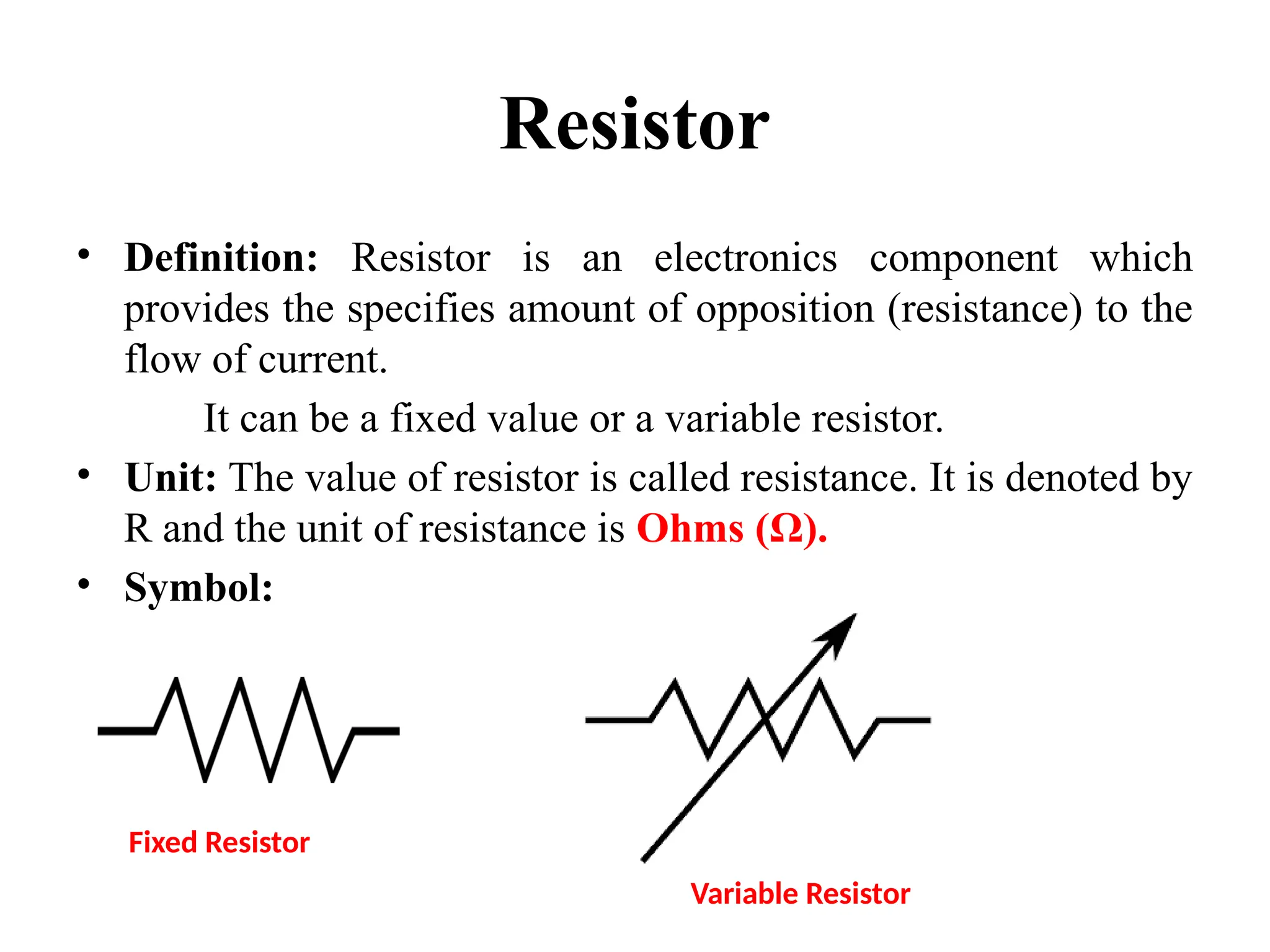
• Definition: Resistor is an electronics component which
provides the specifies amount of opposition (resistance) to the
flow of current.
It can be a fixed value or a variable resistor.
• Unit: The value of resistor is called resistance. It is denoted by
R and the unit of resistance is Ohms (Ω).
• Symbol:
Fixed Resistor
Variable Resistor
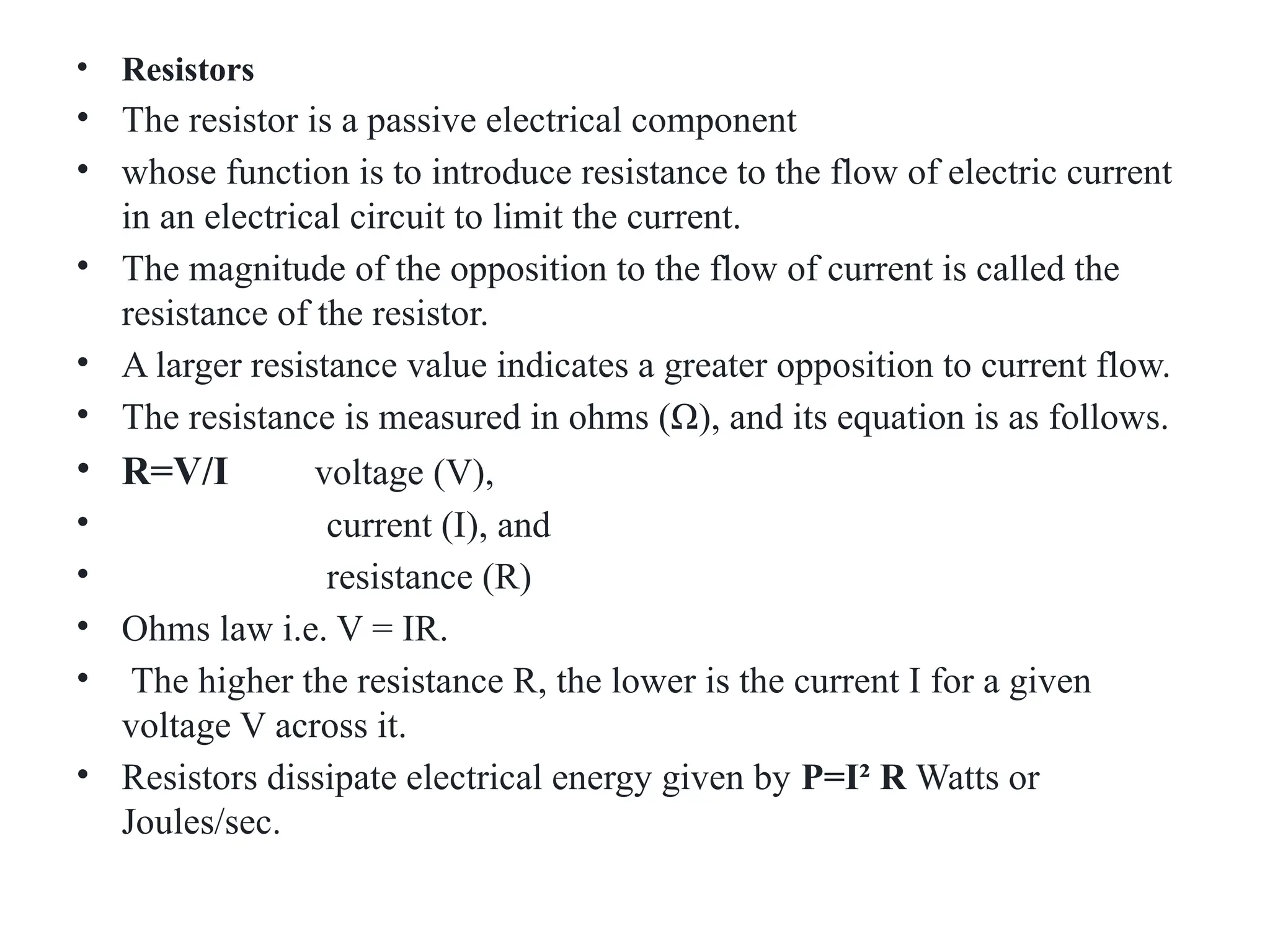
• Resistors
• The resistor is a passive electrical component
• whose function is to introduce resistance to the flow of electric current
in an electrical circuit to limit the current.
• The magnitude of the opposition to the flow of current is called the
resistance of the resistor.
• A larger resistance value indicates a greater opposition to current flow.
• The resistance is measured in ohms (Ω), and its equation is as follows.
• R=V/I voltage (V),
• current (I), and
• resistance (R)
• Ohms law i.e. V = IR.
• The higher the resistance R, the lower is the current I for a given
voltage V across it.
• Resistors dissipate electrical energy given by P=I² R Watts or
Joules/sec.
Resistance
• Resistance of material is defined as the opposition to flow of
current. It is measured in Ohms (Ω).
• Resistance of metal is small that means they are good conductors of
electric current.
• But certain material like plastic, wood glass do not allow the current
to pass through them easily, hence they are called as bad conductors
or Insulator.
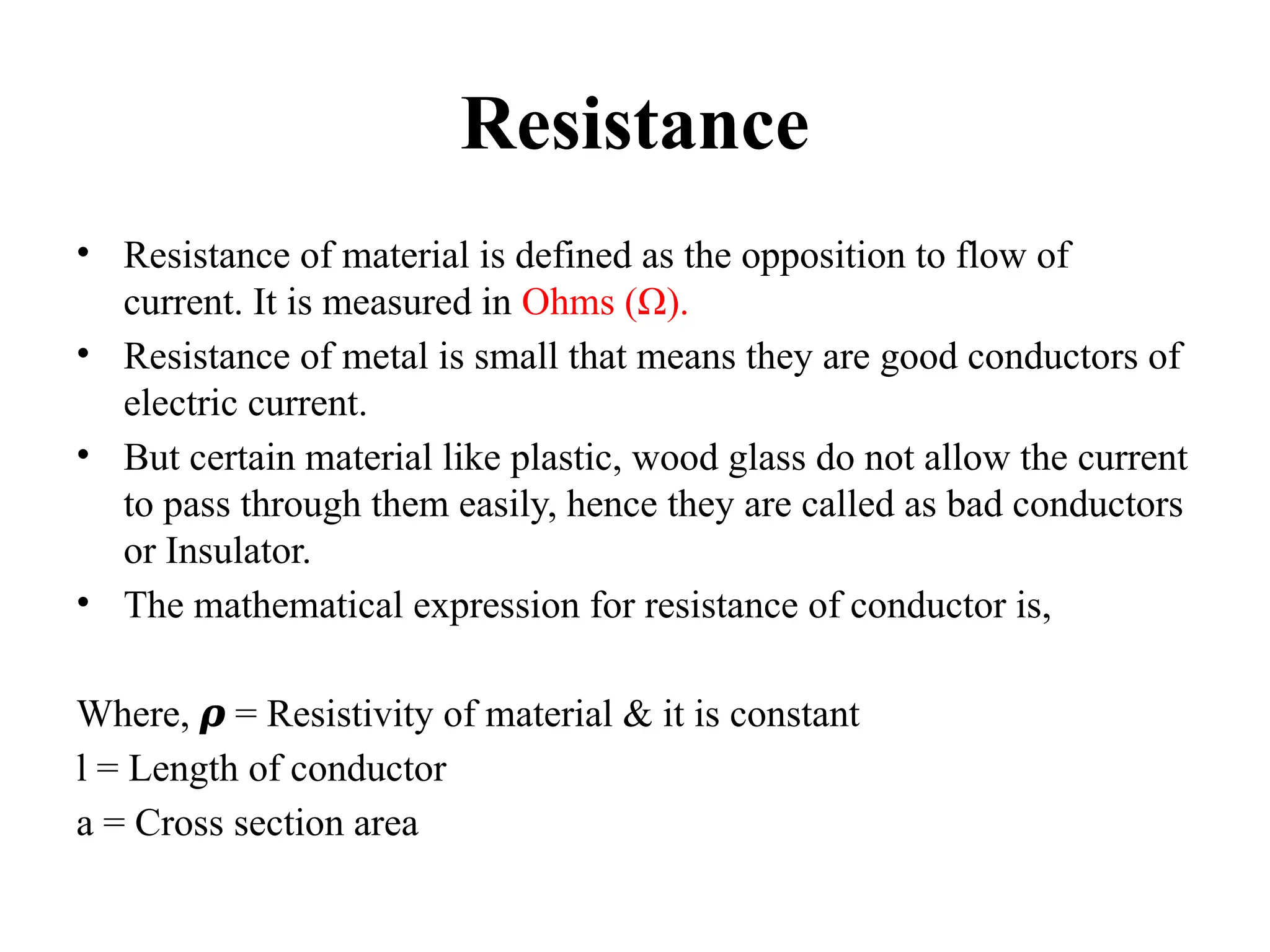
• The mathematical expression for resistance of conductor is,
Where, = Resistivity of material & it is constant
𝝆
l = Length of conductor
a = Cross section area
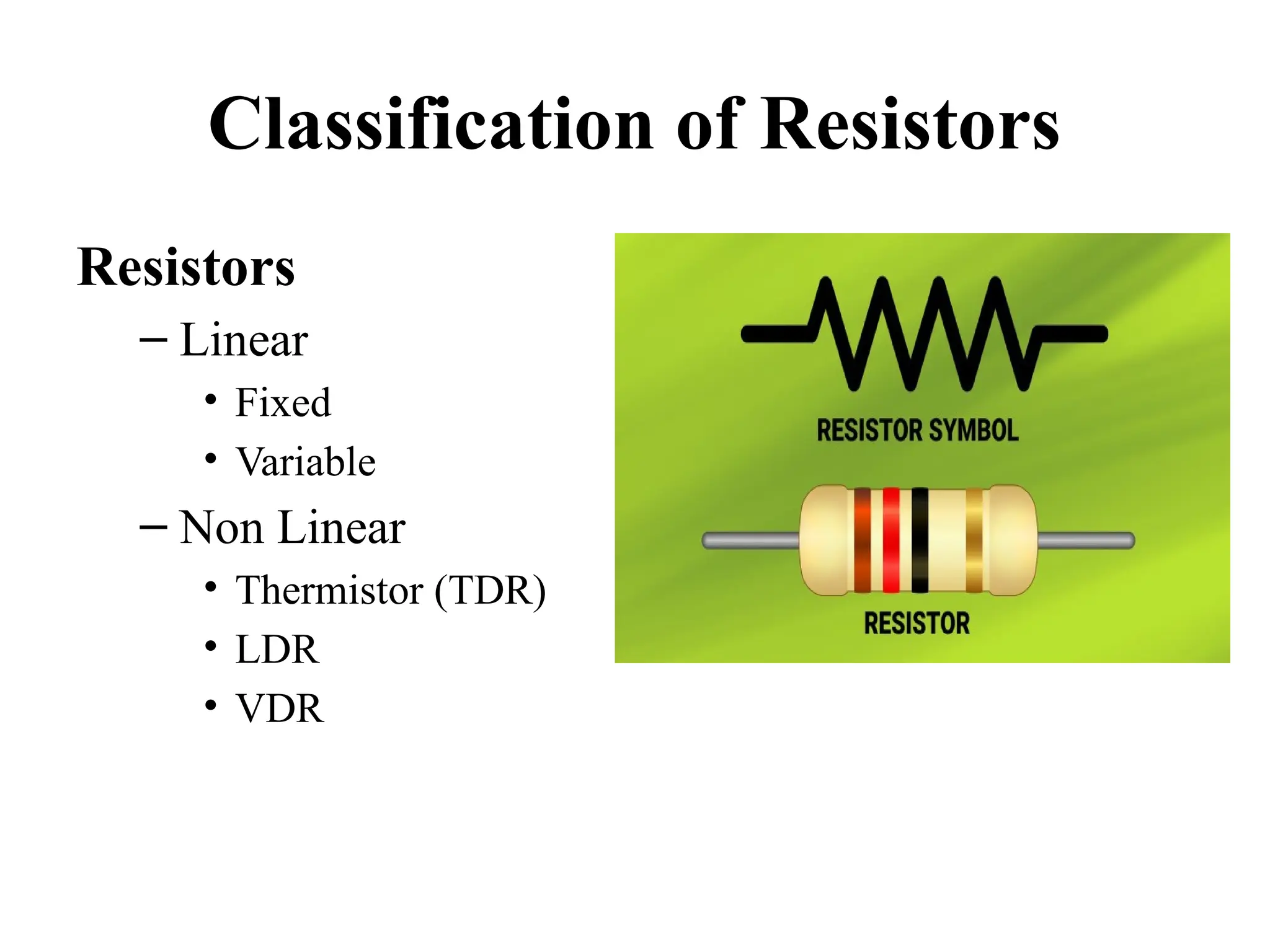
Classification of Resistors
Resistors
– Linear
• Fixed
• Variable
– Non Linear
• Thermistor (TDR)
• LDR
• VDR
• Resistors’ values vary from milliohms to mega ohms.
• the tolerance of typical resistors varies from 1% to 5%.
• precision resistor tolerance varies below 1% from 0.1% to
0.001%
• hence they are more expensive and are used in analog circuits
where precise/reference voltage is needed.
• Commonly used Resistor are available with maximum power
rating of
• 1/8(0.125W), 1/4W (0.25W), 1/2W (0.5W), 1W, 5W.
.
• Different types of resistors by size and form
• Through-hole resistors
• Surface-mount resistors SMD
• Different types of resistors by application
• Common resistor:
used in current limiter,
setting biases,
voltage dividers,
pull up, filtering,
termination resistors, load resistors, etc.
• Precision resistor: for voltage feedback circuits, voltage references.
• Current sense resistors
• Power resistors
• Resistor selection parameters
• While selecting any resistor in the circuit, the
designer needs to consider the following
parameters based on the application and real-
estate available on the printed circuit board.
• Resistance value(R),
• Power (Wattages) dissipated across it,
• Tolerance (+/- %)
• Size based on available space on PCB.
• Resistor manufacturers: AVX, Rohm, Kemet,
Vishay, Samsung, Panasoni
Capacitor
• The Capacitor is a passive electrical component.
• whose function is to store electrical energy and deliver it
to the circuit when needed.
• The capacity of a capacitor to store electrical charge is
known as the capacitance of that capacitor.
• It is denoted by (C).
• The unit of capacitance is Farad (F)
• can range from, micro Farad (µF) 1x 10⁻⁶
F, Kilo pico
Farad (KpF),
• or nano Farad (nF) 1x 10⁻⁹
F to pico Farad (pF) 1x 10-12
F.
• Typical values range from 1pF to 1000uF.
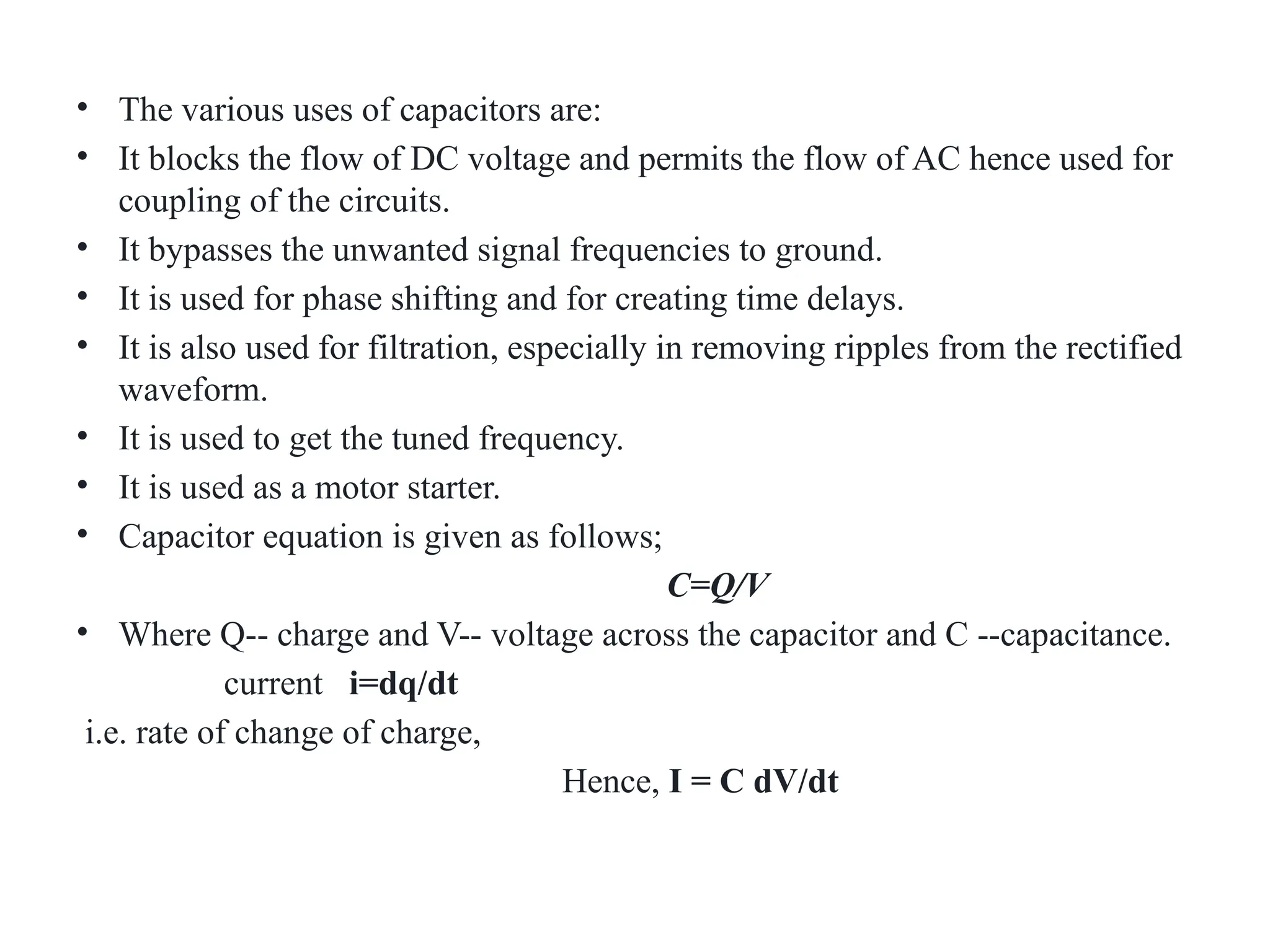
• The various uses of capacitors are:
• It blocks the flow of DC voltage and permits the flow of AC hence used for
coupling of the circuits.
• It bypasses the unwanted signal frequencies to ground.
• It is used for phase shifting and for creating time delays.
• It is also used for filtration, especially in removing ripples from the rectified
waveform.
• It is used to get the tuned frequency.
• It is used as a motor starter.
• Capacitor equation is given as follows;
C=Q/V
• Where Q-- charge and V-- voltage across the capacitor and C --capacitance.
current i=dq/dt
i.e. rate of change of charge,
Hence, I = C dV/dt
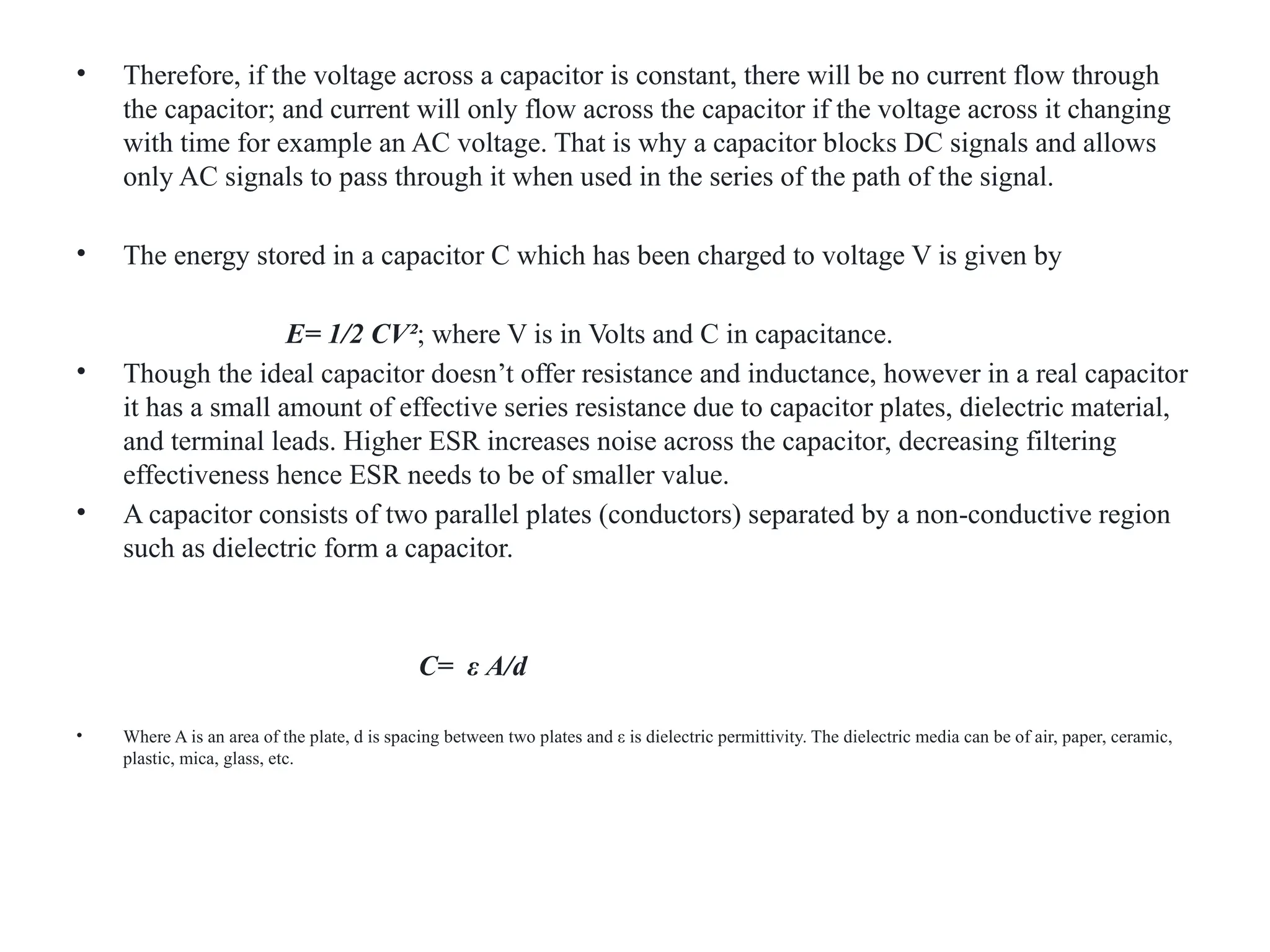
• Therefore, if the voltage across a capacitor is constant, there will be no current flow through
the capacitor; and current will only flow across the capacitor if the voltage across it changing
with time for example an AC voltage. That is why a capacitor blocks DC signals and allows
only AC signals to pass through it when used in the series of the path of the signal.
• The energy stored in a capacitor C which has been charged to voltage V is given by
E= 1/2 CV²; where V is in Volts and C in capacitance.
• Though the ideal capacitor doesn’t offer resistance and inductance, however in a real capacitor
it has a small amount of effective series resistance due to capacitor plates, dielectric material,
and terminal leads. Higher ESR increases noise across the capacitor, decreasing filtering
effectiveness hence ESR needs to be of smaller value.
• A capacitor consists of two parallel plates (conductors) separated by a non-conductive region
such as dielectric form a capacitor.
C= ε A/d
• Where A is an area of the plate, d is spacing between two plates and ε is dielectric permittivity. The dielectric media can be of air, paper, ceramic,
plastic, mica, glass, etc.
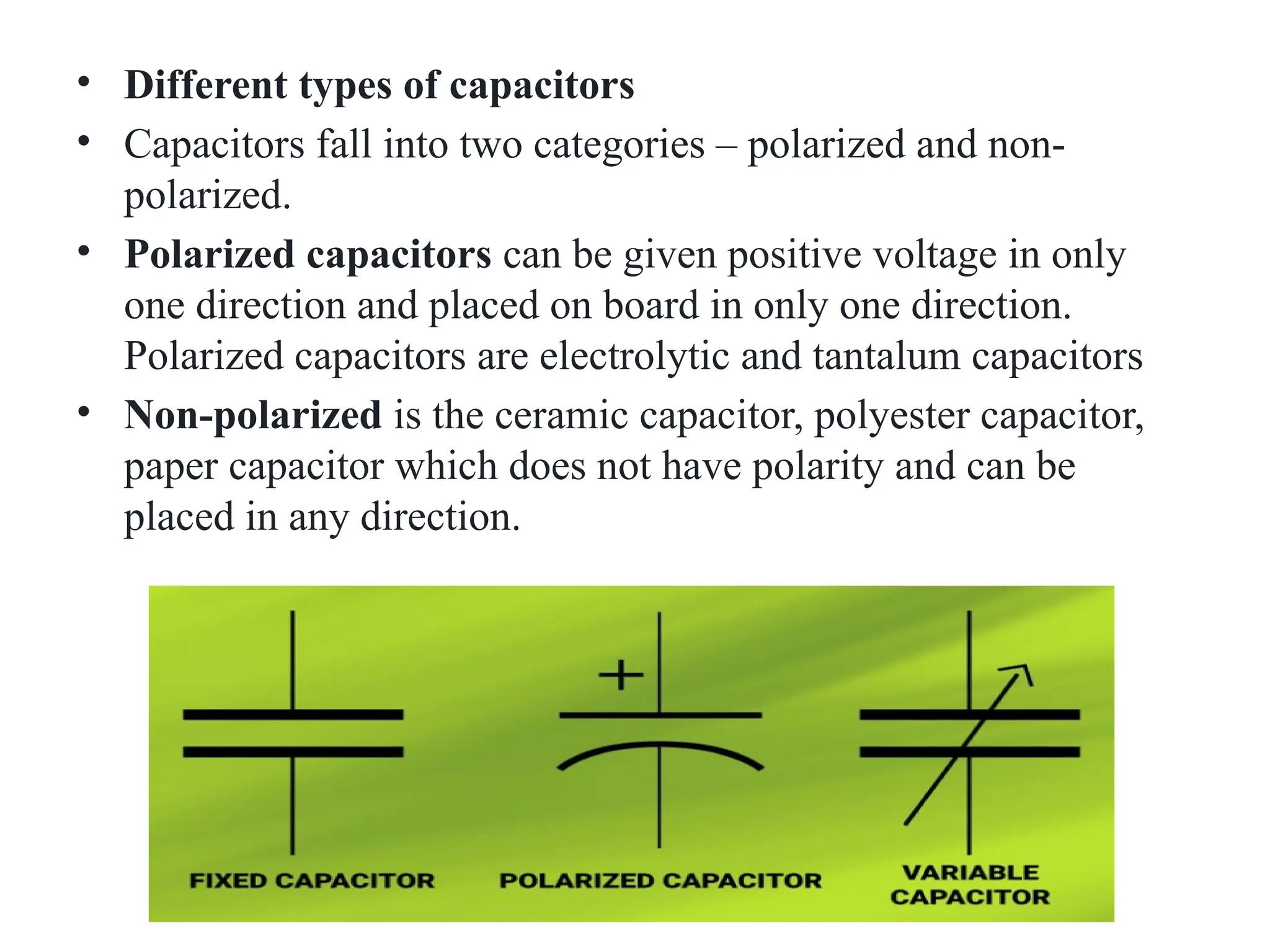
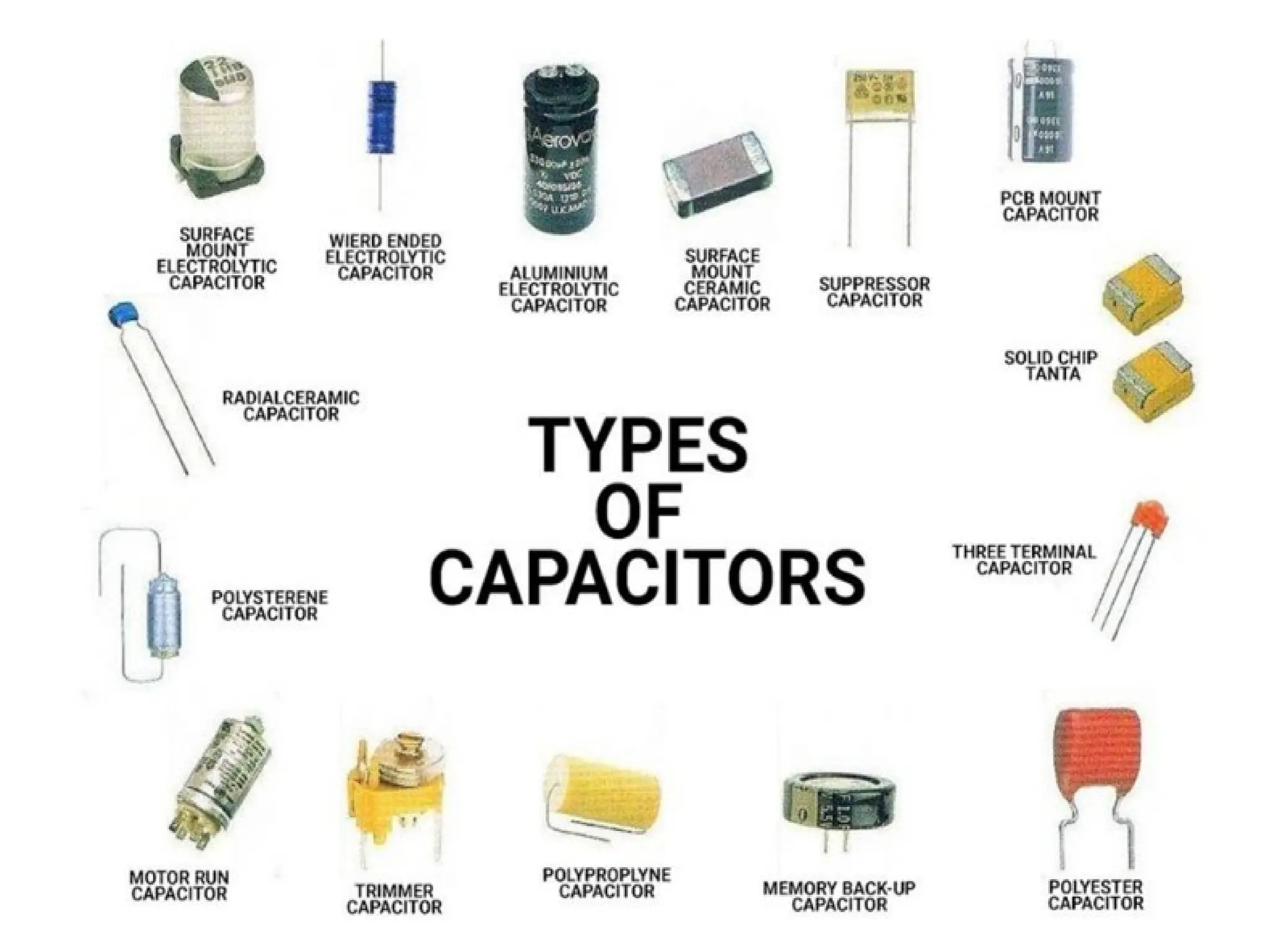
• Different types of capacitors
• Capacitors fall into two categories – polarized and non-
polarized.
• Polarized capacitors can be given positive voltage in only
one direction and placed on board in only one direction.
Polarized capacitors are electrolytic and tantalum capacitors
• Non-polarized is the ceramic capacitor, polyester capacitor,
paper capacitor which does not have polarity and can be
placed in any direction.
Capacitor selection parameters
• While selecting a capacitor in any circuit users need to take
care of the following parameters apart from the
application/usage.
1. Capacitance value
2. Maximum operating voltage of the capacitor.
3. Tolerance
4. Breakdown voltage
5. Frequency range
6. Equivalent series resistance (ESR)
7. Size
• Manufacturers: AVX, Kemet, Vishay, Samsung, Panasonic
TDK, Murata, etc.
Inductors
• The inductors (also called as a coil or choke)
• passive two-terminal electrical component.
• that stores magnetic energy when an electric current is passed
through it.
• It’s an insulated wire wound into a coil around a core of some
material
• (air, iron, powdered iron, or ferrite material) in a spiral form.
• The inductor is denoted by inductance ‘L’
• the measuring unit is Henry (H).
• Inductors have values that typically range from
1 µH to 2000 mH.
• When the time-varying current flows through an inductor, the magnetic field
is created which induces an electromotive force (e.m.f.) (voltage) in the
inductor.
Voltage V, across an inductor of inductance L, is given by:
V = L di/dt
• That is, there is a voltage across the inductor only if the current through it is
changing; DC produces no voltage through an inductor. In general, inductor
blocks the AC and passes the DC
• The energy stored in an inductor with value ‘L’ Henries is given by;
E = 1/2 Li²
energy E is in Joules, and I is in ampere.
• An ideal inductor has zero resistance and zero capacitance. However, real
inductors have a small value resistance associated with the winding of the
coil and whenever current flows through it, energy is lost in the form of
heat.
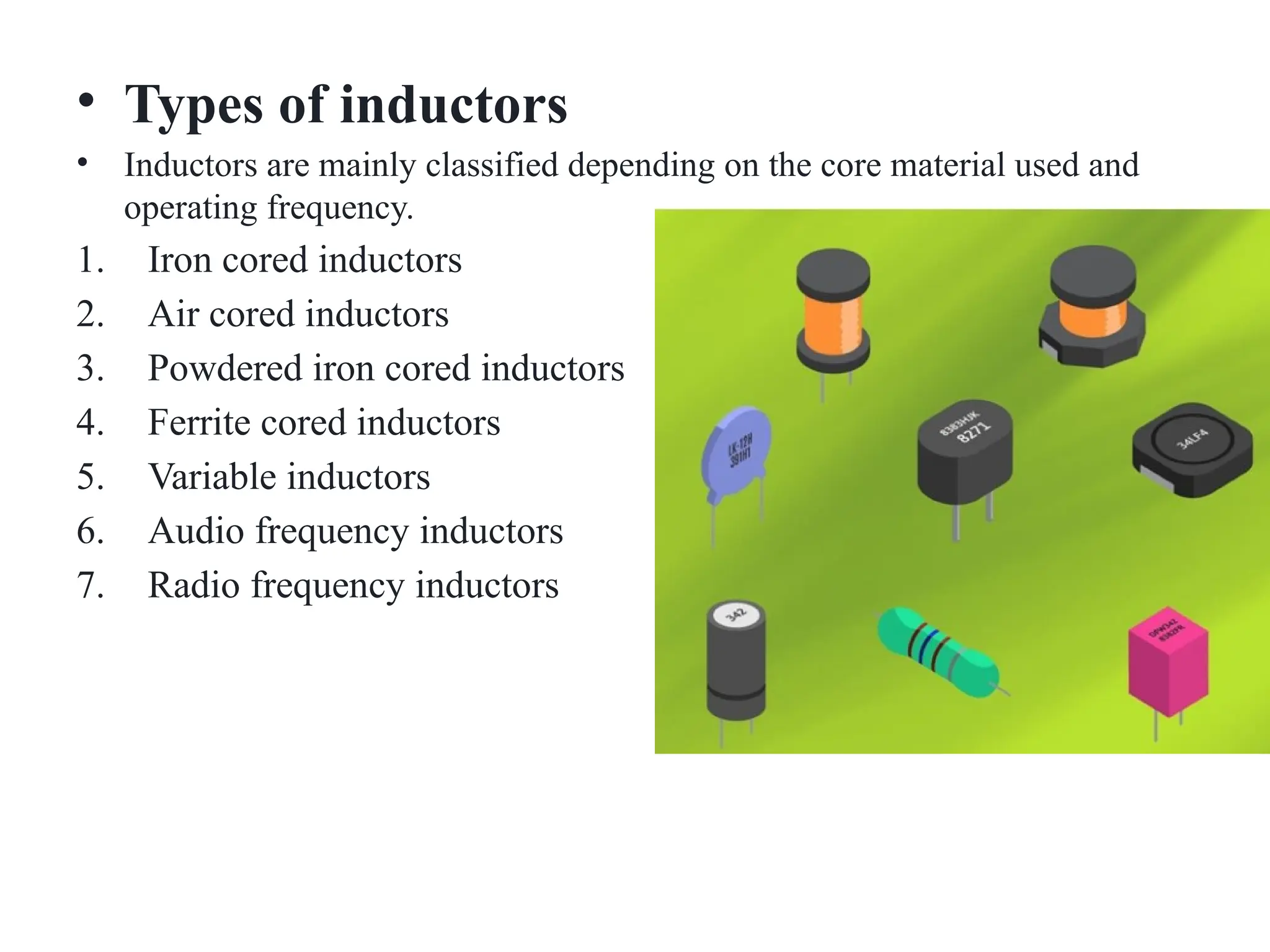
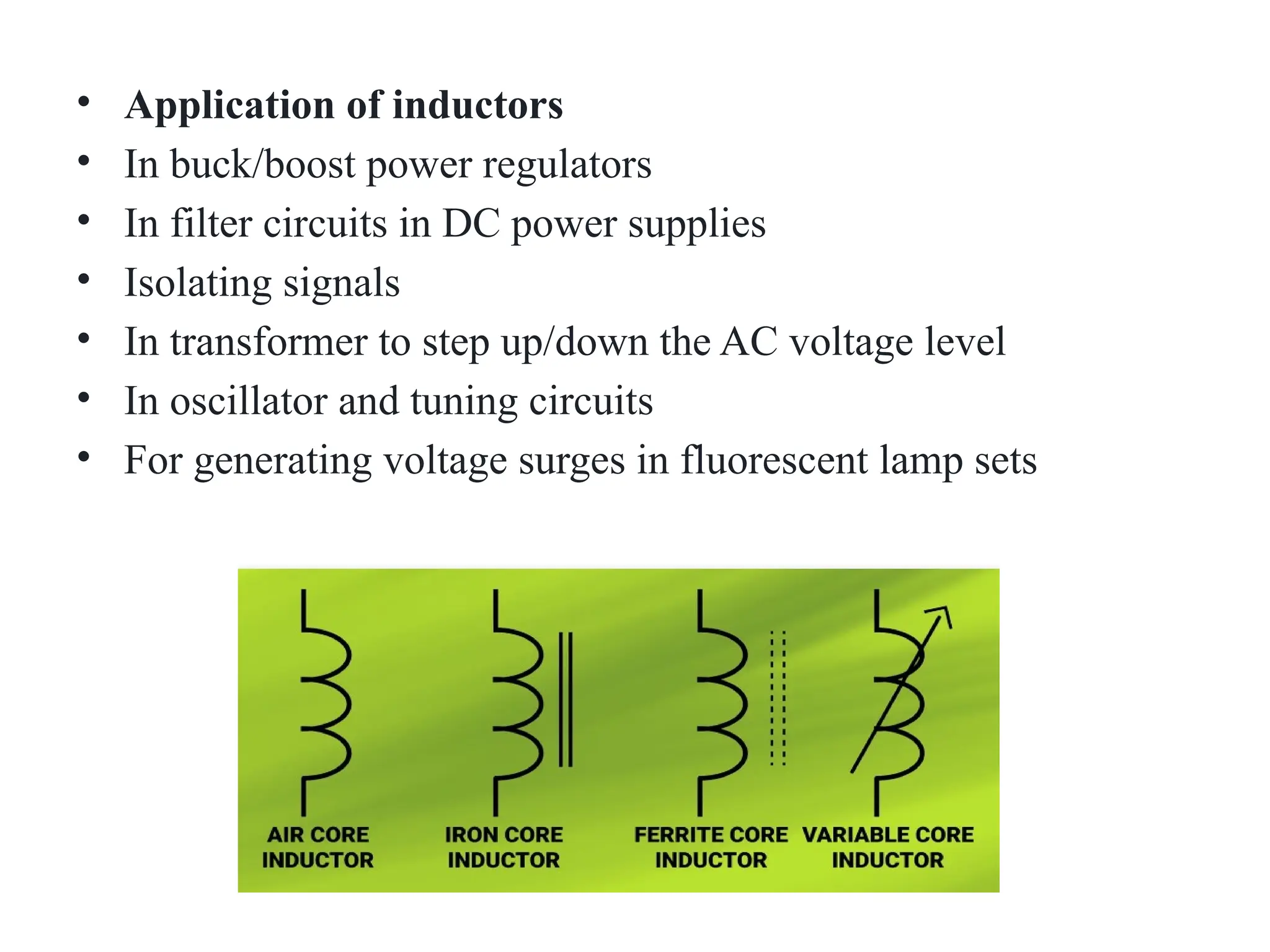
• Types of inductors
• Inductors are mainly classified depending on the core material used and
operating frequency.
1. Iron cored inductors
2. Air cored inductors
3. Powdered iron cored inductors
4. Ferrite cored inductors
5. Variable inductors
6. Audio frequency inductors
7. Radio frequency inductors
• Application of inductors
• In buck/boost power regulators
• In filter circuits in DC power supplies
• Isolating signals
• In transformer to step up/down the AC voltage level
• In oscillator and tuning circuits
• For generating voltage surges in fluorescent lamp sets
• Inductor selection parameters
• While selecting an inductor in any circuit user needs to take
care of the following parameter apart from the
application/usage.
1. Inductance value
2. Tolerance
3. Maximum current rating
4. Shielded and non-shielded
5. Size
6. Q ratings
7. Frequency range
8. The resistance of the inductor
9. Type of core used
What Are Kirchhoff’s Laws?
• In 1845, a German physicist, Gustav Kirchhoff, developed a pair of laws that
deal with the conservation of current and energy within electrical circuits.
• These two laws are commonly known as Kirchhoff’s Voltage and Current
Law.
• These laws help calculate the electrical resistance of a complex network or
impedance in the case of AC and the current flow in different network
streams.
•
Kirchhoff’s Current Law goes by several names: Kirchhoff’s First Law and
Kirchhoff’s Junction Rule. According to the Junction rule, the total of the
currents in a junction is equal to the sum of currents outside the junction in a
circuit.
• Kirchhoff’s Voltage Law goes by several names: Kirchhoff’s Second Law
and Kirchhoff’s Loop Rule. According to the loop rule, the sum of the
voltages around the closed loop is equal to null.
Kirchhoff’s First Law or Kirchhoff’s Current Law
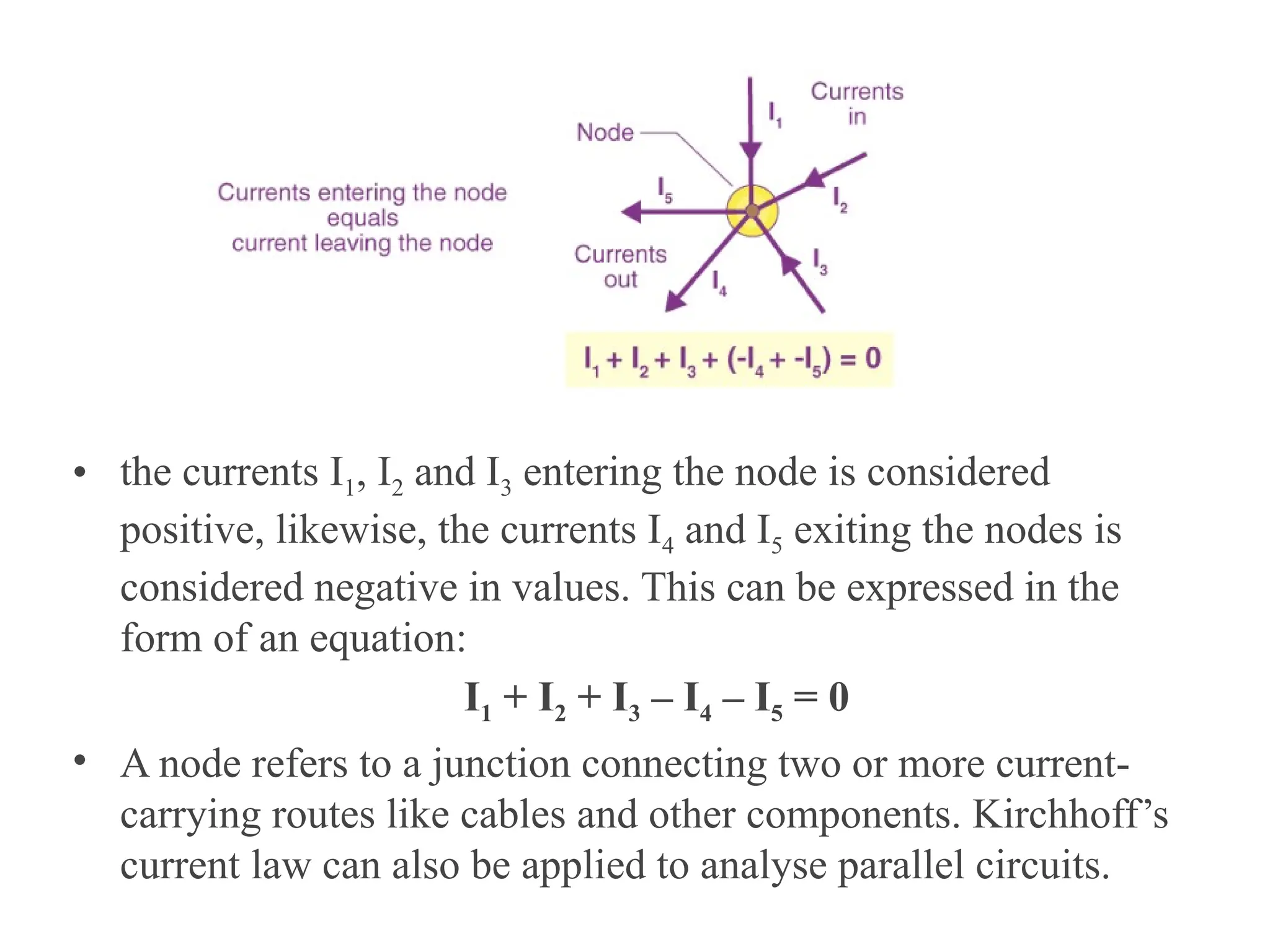
• According to Kirchhoff’s Current Law, The total current entering a
junction or a node is equal to the current leaving the node in given
circuit.
• algebraic sum of every current entering and leaving the node has to
be null.
• This property of Kirchhoff law is commonly called conservation of
charge, where in I(exit) + I(enter) = 0.
• the currents I1, I2 and I3 entering the node is considered
positive, likewise, the currents I4 and I5 exiting the nodes is
considered negative in values. This can be expressed in the
form of an equation:
I1 + I2 + I3 – I4 – I5 = 0
• A node refers to a junction connecting two or more current-
carrying routes like cables and other components. Kirchhoff’s
current law can also be applied to analyse parallel circuits.
• Kirchhoff's Laws
• Kirchhoff's laws for AC circuits are as follows:
1. The phasor sum of the currents at any point in the circuit is zero.
2. The phasor sum of the voltages around any closed loop is zero.
• The current and voltage equations are derived in the same fashion as those
for DC circuits. The algebraic manipulation of phasor quantities is no
different from that of DC quantities until numerical quantities are
introduced.
• When more than one AC voltage source is part of the circuit to be
analyzed, the relative polarities of the sources must be given.
The relative polarity, or sense, of a source is given with respect to its
phasor values. The polarity of voltage can be denoted by "+" and "-" signs
or by an arrow pointing from "+" point to "-" point (similarly as in DC
circuits).
Kirchhoff’s Second Law or Kirchhoff’s Voltage Law
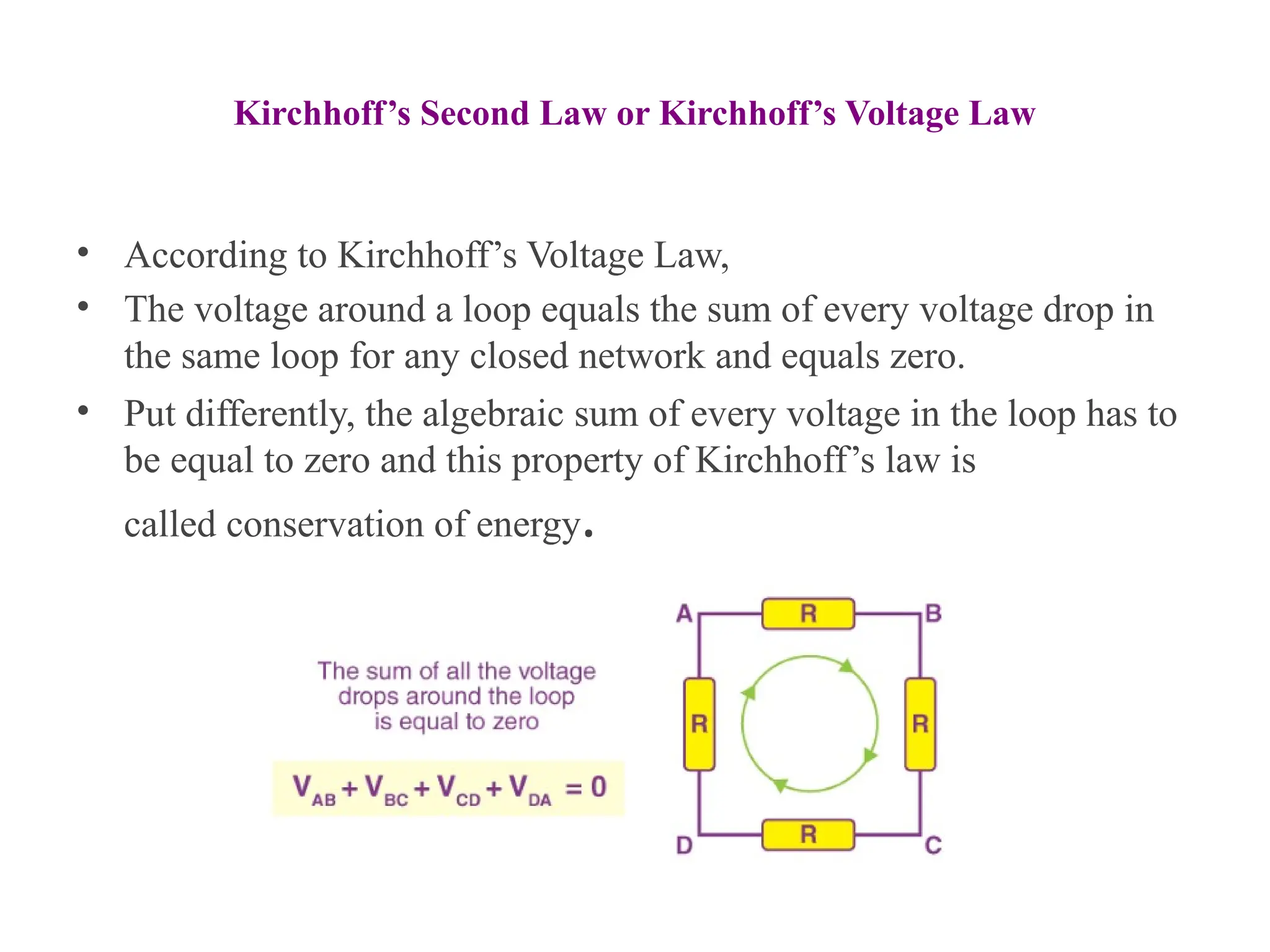
• According to Kirchhoff’s Voltage Law,
• The voltage around a loop equals the sum of every voltage drop in
the same loop for any closed network and equals zero.
• Put differently, the algebraic sum of every voltage in the loop has to
be equal to zero and this property of Kirchhoff’s law is
called conservation of energy.
Kirchhoff’s Law Solved Example
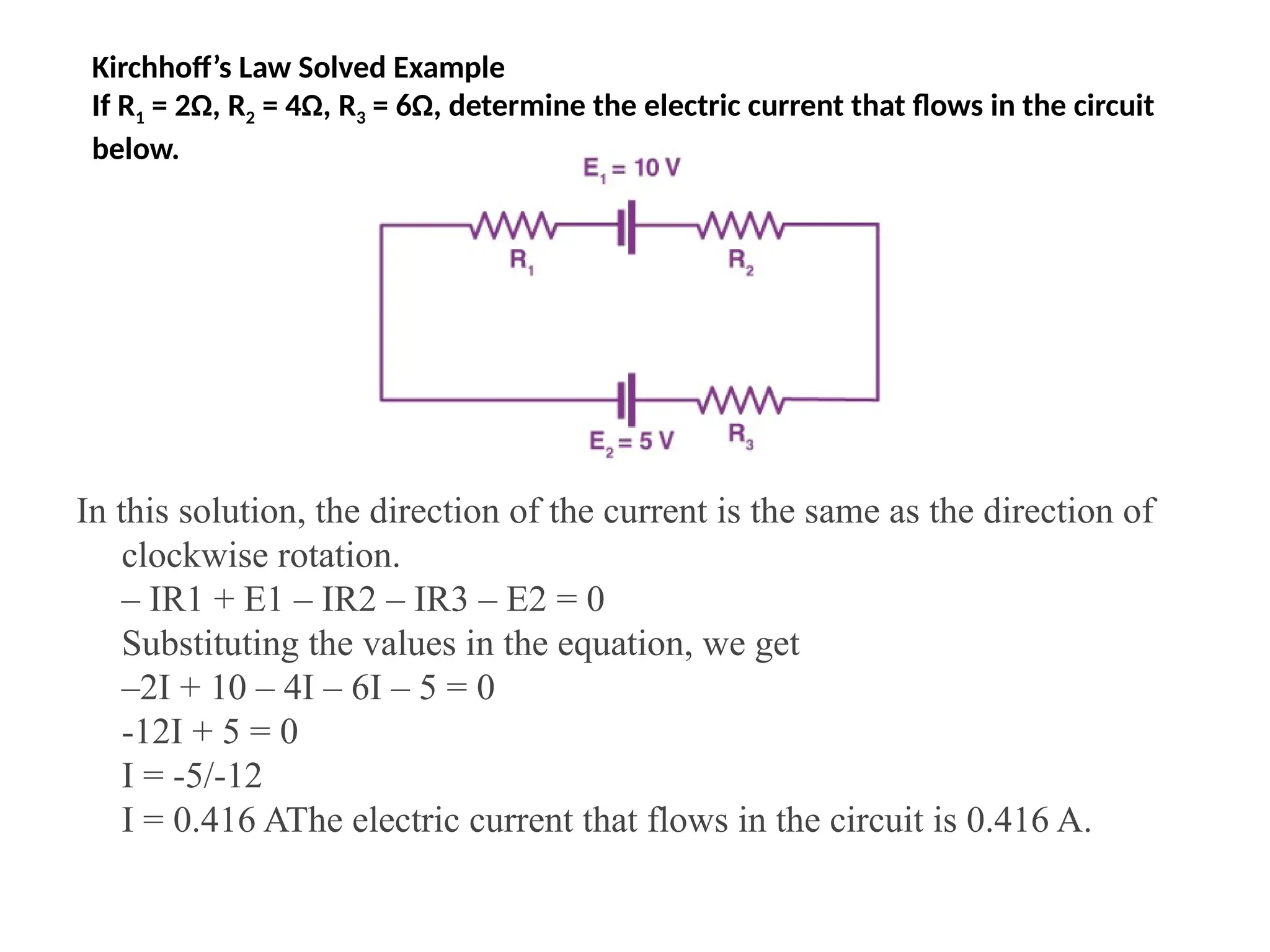
If R1 = 2Ω, R2 = 4Ω, R3 = 6Ω, determine the electric current that flows in the circuit
below.
In this solution, the direction of the current is the same as the direction of
clockwise rotation.
– IR1 + E1 – IR2 – IR3 – E2 = 0
Substituting the values in the equation, we get
–2I + 10 – 4I – 6I – 5 = 0
-12I + 5 = 0
I = -5/-12
I = 0.416 AThe electric current that flows in the circuit is 0.416 A.
Diodes
• The diode is two terminal semiconductor devices.
• That allow an electric current to pass in one direction while
blocking it in the reverse direction.
• The diode is made up of a semiconductor device with
P-type material and N-type material.
• Typical material used in a diode is silicon and germanium.
• minimum forward voltage (~ 0.7V for Silicon) is applied
across it and remain off during reverse bias condition.
• The diode symbol is represented as below and their physical
packages.
Applications of diode:
• Power conversion (AC to DC)/ rectification
• Clamping the voltage
• Zener diode as a voltage regulator
• Overvoltage protection
• ESD protection
• Demodulation of signals
Type of diodes:
• Rectifier diode
• Switching diode
• Light-emitting diode
• Zener diode
• Schottky diode
• ESD diode
• Tunnel diode
• Varicap diode
• Photodiode
• The laser diode in optical communication
• Diode selection parameters
• While selecting a diode in any circuit users need to take care of
the following parameters apart from the application/usage.
1. Forward bias voltage
2. Maximum forward current
3. Average forward current
4. Power dissipation
5. Reverse breakdown voltage/peak inverse voltage
6. Max reverse current
7. Operating junction temperature
8. Reverse recovery timeSize
• Manufacturers: Rohm Semiconductor, Diodes Incorporated
Relays
• A relay is an electromagnetic switch that opens and closes potential-free
contacts. An electromechanical relay consists of an armature, coil, spring, and
contacts. When the voltage is applied to a coil, it generates a magnetic field. This
attracts the armature and causes a change in the open/closed state of the circuit. It
is mainly used to control a high-powered circuit using a low power signal.
• There are mainly two types of relays based on constructions – electromechanical
(EMR) and solid-state (SSR) relays.
• A solid-state relay has a photodiode at its input side and a switching device such
as transistor/FET at its output side. When a specific voltage is applied at its input,
photodiode conducts and triggers the base of the transistor to cause the
switching. Due to its fast switching, miniaturized form factor, low voltage
requirement, and eliminating the mechanical arching, electrical noise, and
contact bounce, it’s widely used in applications compared to mechanical relay.
• Application
• Controlling the high power circuit with isolated low power. E.g. Controlling 230V a.c. circuits with a
+5V signal.
• Switching voltage ON/OFF
• Electrical MCB
• Driving diac/triac circuits
• Selection parameter for relay:
• Output load type – AC/DC
• Input coil voltage for a mechanical relay
• Photodiode voltage for SSR
• Output switching voltage
• Output current
• On-State resistance
• Number of clicks/switching
• Number of poles and contacts
• Type of output contacts NC/NO
• Packages
Active devices
• The basic electronic components that depend on an external power source for their
operation are called active components. They can amplify signals and/or process signals.
Some of the active components are transistor, integrated circuits ICs.
• Transistor
• The transistor is a non-linear semiconductor three-terminal device. The transistor is
considered to be one of the most important devices in the field of electronics. The
transistor has transformed many aspects of man’s life. There are two main functions of
transistors, to amplify input signals and to acts as solid-state switches. The transistor acts
as a switch when operated either in saturation or cut-off region. Whereas it amplifies
signals when used in the active region. It offers very high input resistance and very low
output resistance.
• Transistors are categorized into bipolar junction transistor and field effect transistor
based on their construction.
• Type of transistor:
• BJT: NPN and PNP,
• FET: JFET, P-MOSFET,N-MOSFET
Transistor
• The transistor is a non-linear semiconductor three-terminal device.
• The transistor is considered to be one of the most important devices in the field of
electronics.
• The transistor has transformed many aspects of man’s life.
• There are two main functions of transistors,
1. to amplify input signals and to acts as solid-state switches.
2. The transistor acts as a switch when operated either in saturation or cut-off region.
• Whereas it amplifies signals when used in the active region.
• It offers very high input resistance and very low output resistance.
• Transistors are categorized into bipolar junction transistor and field effect transistor
based on their construction.
• Type of transistor:
• BJT: NPN and PNP,
• FET: JFET, P-MOSFET,N-MOSFET
• MOSFET
• The MOSFET (metal oxide semiconductor field-effect transistor) transistor is a
semiconductor device that is different than bipolar junction transistor in terms of
construction though the applications remain the same as switching and
amplifying. It has four terminals such as drain, gate, source, and body. The body
is shorted with a source terminal. The gate is insulated from the channel near an
extremely thin layer of metal oxide. Due to which it offers very high resistance
compared to BJT.
• By controlling the gate voltage (VGS +ve/-ve) width of a channel along which
charge carriers flow (electrons or holes) from source to drain can be controlled.
The P-Channel MOSFET has a P-Channel region between the source and drain
and for N-channel MOSFET has an N-channel region.
• Advantages of MOSFET over BJT:
• Very high input resistance
• Low on-state resistance
• Low power loss
• High frequency of operations
• Application of transistors (BJT/FET)
• Amplification of analog signals
• Used as switching devices in SMPS, microcontrollers, etc.
• Oscillators
• Over/under voltage protection
• Modulation circuits & demodulation of signals
• Power control in invertors and chargers (high-current power transistors)
• Types of transistor packages
• In terms of packaging BJT and MOSFET, transistors are available in through-hole (DIP) and SMD versions. e.g. DIP: TO-92, TO- 220 and SMD:
SOT23, SOT223, TO-252, D2PAK.
• Transistor selection parameters
• While selecting a transistor in any circuit, the user needs to take care of the following parameters:
• Maximum collector current (Ic)
• Max collector voltage (Vce)
• VBE voltage
• Saturation Vce (sat) voltage
• Current gain, hfe/ß
• Input resistance
• Output resistance
• Reverse breakdown voltage
• Max reverse current
• Power dissipation
• Operating junction temperature
• Size
• Switching time/frequency
• Manufacturers: Analog Devices, Rohm Semiconductor, Diodes Incorporated, On Semi, Texas Instrument, Panasonic, Infineon, Honeywell,
etc.
• Integrated circuits
• An integrated circuit (IC) is an electronic circuit built on a semiconductor wafer,
usually made of silicon. On this wafer, there are millions of miniaturized
transistors, resistors, and capacitors, which are connected by metal traces. The
ICs are powered by an external power supply for their operations. ICs perform
specific functions such as data processing and signal processing. The entire
physical size of the IC wafer is extremely small compared to that of discrete
circuits hence it is called a microchip or simply chips. Because of their small
size, ICs have low power consumption.
• Types of ICs
• ICs are categorized as digital, analog, and mixed-signal ICs based on their
circuit functionality.
• Digital ICs
• Digital ICs can be divided into further two categories for the sake of simplicity:
• Simple ICs: Timer, counter, register, switches, digital logic gates, adder, etc.
• Complex ICs: Microprocessor, memories, switching ICs, ethernet MAC/PHY.
• A microprocessor/microcontroller is an integrated circuit, which can process the digital data.
For example, temperature sensor data can be read by a microprocessor and using its
internal logic to perform control functions such as switching an air-conditioner ON or OFF.
The ability to program a microprocessor gives it the flexibility to be used in a wide range of
applications. Some of the applications are consumer electronics (microwave, washing
machine, TV), industrial applications (motor control, process control), communication
applications (wireless communication, telephony, satellite communication).
• A microprocessor is a complex IC having an inbuilt central processing unit (CPU) consisting
of an arithmetic logic unit (ALU), registers, buffer memory, clock. The processor does not
have inbuilt memory and needs to interface RAM and ROM externally. Applications:
computers, laptops, servers, basically for high-end processing.
• A microcontroller is an integrated circuit that has CPU, inbuilt memory, general-purpose IO’s,
communication interface such as SPI, I2C, UART, ADC, DAC, PWM. Depending on the size of
memory and interface microcontrollers are targeted for specific applications. Applications:
Embedded devices such as washing machines, weighing scales, CNC machines, etc.
• Digital signal processing (DSP) controllers are a type of processor which are used in high-
computing applications such as image processing, speech processing, video compression,
etc.
• Analog ICs
Introduction to Passive Circuit Elements.pptx

Introduction to Passive Circuit Elements.pptx

  • 1.
    Introduction to PassiveCircuit Elements
  • 2.
    Introduction • In allelectronics circuits we have to use different electronics components such as Resistors, Capacitors, Inductors Transformers and Semiconductor devices such as Diodes, Transistors etc.… • In this chapter we are going to discuss about – various materials used to manufacture these devices – Types – Construction – Properties of devices and components
  • 3.
    Application of Electronics •Communication and Entertainment • Defense Application • Industrial Applications • Medical Science • Instrumentation
  • 4.
    Types of ElectronicsComponents 1. Active Components: Diodes, Transistors, FET 2. Passive Components: Resistors, Capacitors, Inductors
  • 5.
    Resistor • Definition: Resistoris an electronics component which provides the specifies amount of opposition (resistance) to the flow of current. It can be a fixed value or a variable resistor. • Unit: The value of resistor is called resistance. It is denoted by R and the unit of resistance is Ohms (Ω). • Symbol: Fixed Resistor Variable Resistor
  • 6.
    • Resistors • Theresistor is a passive electrical component • whose function is to introduce resistance to the flow of electric current in an electrical circuit to limit the current. • The magnitude of the opposition to the flow of current is called the resistance of the resistor. • A larger resistance value indicates a greater opposition to current flow. • The resistance is measured in ohms (Ω), and its equation is as follows. • R=V/I voltage (V), • current (I), and • resistance (R) • Ohms law i.e. V = IR. • The higher the resistance R, the lower is the current I for a given voltage V across it. • Resistors dissipate electrical energy given by P=I² R Watts or Joules/sec.
  • 7.
    Resistance • Resistance ofmaterial is defined as the opposition to flow of current. It is measured in Ohms (Ω). • Resistance of metal is small that means they are good conductors of electric current. • But certain material like plastic, wood glass do not allow the current to pass through them easily, hence they are called as bad conductors or Insulator. • The mathematical expression for resistance of conductor is, Where, = Resistivity of material & it is constant 𝝆 l = Length of conductor a = Cross section area
  • 8.
    Classification of Resistors Resistors –Linear • Fixed • Variable – Non Linear • Thermistor (TDR) • LDR • VDR
  • 9.
    • Resistors’ valuesvary from milliohms to mega ohms. • the tolerance of typical resistors varies from 1% to 5%. • precision resistor tolerance varies below 1% from 0.1% to 0.001% • hence they are more expensive and are used in analog circuits where precise/reference voltage is needed. • Commonly used Resistor are available with maximum power rating of • 1/8(0.125W), 1/4W (0.25W), 1/2W (0.5W), 1W, 5W. .
  • 10.
    • Different typesof resistors by size and form • Through-hole resistors • Surface-mount resistors SMD • Different types of resistors by application • Common resistor: used in current limiter, setting biases, voltage dividers, pull up, filtering, termination resistors, load resistors, etc. • Precision resistor: for voltage feedback circuits, voltage references. • Current sense resistors • Power resistors
  • 11.
    • Resistor selectionparameters • While selecting any resistor in the circuit, the designer needs to consider the following parameters based on the application and real- estate available on the printed circuit board. • Resistance value(R), • Power (Wattages) dissipated across it, • Tolerance (+/- %) • Size based on available space on PCB. • Resistor manufacturers: AVX, Rohm, Kemet, Vishay, Samsung, Panasoni
  • 12.
    Capacitor • The Capacitoris a passive electrical component. • whose function is to store electrical energy and deliver it to the circuit when needed. • The capacity of a capacitor to store electrical charge is known as the capacitance of that capacitor. • It is denoted by (C). • The unit of capacitance is Farad (F) • can range from, micro Farad (µF) 1x 10⁻⁶ F, Kilo pico Farad (KpF), • or nano Farad (nF) 1x 10⁻⁹ F to pico Farad (pF) 1x 10-12 F. • Typical values range from 1pF to 1000uF.
  • 13.
    • The varioususes of capacitors are: • It blocks the flow of DC voltage and permits the flow of AC hence used for coupling of the circuits. • It bypasses the unwanted signal frequencies to ground. • It is used for phase shifting and for creating time delays. • It is also used for filtration, especially in removing ripples from the rectified waveform. • It is used to get the tuned frequency. • It is used as a motor starter. • Capacitor equation is given as follows; C=Q/V • Where Q-- charge and V-- voltage across the capacitor and C --capacitance. current i=dq/dt i.e. rate of change of charge, Hence, I = C dV/dt
  • 14.
    • Therefore, ifthe voltage across a capacitor is constant, there will be no current flow through the capacitor; and current will only flow across the capacitor if the voltage across it changing with time for example an AC voltage. That is why a capacitor blocks DC signals and allows only AC signals to pass through it when used in the series of the path of the signal. • The energy stored in a capacitor C which has been charged to voltage V is given by E= 1/2 CV²; where V is in Volts and C in capacitance. • Though the ideal capacitor doesn’t offer resistance and inductance, however in a real capacitor it has a small amount of effective series resistance due to capacitor plates, dielectric material, and terminal leads. Higher ESR increases noise across the capacitor, decreasing filtering effectiveness hence ESR needs to be of smaller value. • A capacitor consists of two parallel plates (conductors) separated by a non-conductive region such as dielectric form a capacitor. C= ε A/d • Where A is an area of the plate, d is spacing between two plates and ε is dielectric permittivity. The dielectric media can be of air, paper, ceramic, plastic, mica, glass, etc.
  • 15.
    • Different typesof capacitors • Capacitors fall into two categories – polarized and non- polarized. • Polarized capacitors can be given positive voltage in only one direction and placed on board in only one direction. Polarized capacitors are electrolytic and tantalum capacitors • Non-polarized is the ceramic capacitor, polyester capacitor, paper capacitor which does not have polarity and can be placed in any direction.
  • 17.
    Capacitor selection parameters •While selecting a capacitor in any circuit users need to take care of the following parameters apart from the application/usage. 1. Capacitance value 2. Maximum operating voltage of the capacitor. 3. Tolerance 4. Breakdown voltage 5. Frequency range 6. Equivalent series resistance (ESR) 7. Size • Manufacturers: AVX, Kemet, Vishay, Samsung, Panasonic TDK, Murata, etc.
  • 18.
    Inductors • The inductors(also called as a coil or choke) • passive two-terminal electrical component. • that stores magnetic energy when an electric current is passed through it. • It’s an insulated wire wound into a coil around a core of some material • (air, iron, powdered iron, or ferrite material) in a spiral form. • The inductor is denoted by inductance ‘L’ • the measuring unit is Henry (H). • Inductors have values that typically range from 1 µH to 2000 mH.
  • 19.
    • When thetime-varying current flows through an inductor, the magnetic field is created which induces an electromotive force (e.m.f.) (voltage) in the inductor. Voltage V, across an inductor of inductance L, is given by: V = L di/dt • That is, there is a voltage across the inductor only if the current through it is changing; DC produces no voltage through an inductor. In general, inductor blocks the AC and passes the DC • The energy stored in an inductor with value ‘L’ Henries is given by; E = 1/2 Li² energy E is in Joules, and I is in ampere. • An ideal inductor has zero resistance and zero capacitance. However, real inductors have a small value resistance associated with the winding of the coil and whenever current flows through it, energy is lost in the form of heat.
  • 20.
    • Types ofinductors • Inductors are mainly classified depending on the core material used and operating frequency. 1. Iron cored inductors 2. Air cored inductors 3. Powdered iron cored inductors 4. Ferrite cored inductors 5. Variable inductors 6. Audio frequency inductors 7. Radio frequency inductors
  • 21.
    • Application ofinductors • In buck/boost power regulators • In filter circuits in DC power supplies • Isolating signals • In transformer to step up/down the AC voltage level • In oscillator and tuning circuits • For generating voltage surges in fluorescent lamp sets
  • 22.
    • Inductor selectionparameters • While selecting an inductor in any circuit user needs to take care of the following parameter apart from the application/usage. 1. Inductance value 2. Tolerance 3. Maximum current rating 4. Shielded and non-shielded 5. Size 6. Q ratings 7. Frequency range 8. The resistance of the inductor 9. Type of core used
  • 23.
    What Are Kirchhoff’sLaws? • In 1845, a German physicist, Gustav Kirchhoff, developed a pair of laws that deal with the conservation of current and energy within electrical circuits. • These two laws are commonly known as Kirchhoff’s Voltage and Current Law. • These laws help calculate the electrical resistance of a complex network or impedance in the case of AC and the current flow in different network streams. • Kirchhoff’s Current Law goes by several names: Kirchhoff’s First Law and Kirchhoff’s Junction Rule. According to the Junction rule, the total of the currents in a junction is equal to the sum of currents outside the junction in a circuit. • Kirchhoff’s Voltage Law goes by several names: Kirchhoff’s Second Law and Kirchhoff’s Loop Rule. According to the loop rule, the sum of the voltages around the closed loop is equal to null.
  • 24.
    Kirchhoff’s First Lawor Kirchhoff’s Current Law • According to Kirchhoff’s Current Law, The total current entering a junction or a node is equal to the current leaving the node in given circuit. • algebraic sum of every current entering and leaving the node has to be null. • This property of Kirchhoff law is commonly called conservation of charge, where in I(exit) + I(enter) = 0.
  • 25.
    • the currentsI1, I2 and I3 entering the node is considered positive, likewise, the currents I4 and I5 exiting the nodes is considered negative in values. This can be expressed in the form of an equation: I1 + I2 + I3 – I4 – I5 = 0 • A node refers to a junction connecting two or more current- carrying routes like cables and other components. Kirchhoff’s current law can also be applied to analyse parallel circuits.
  • 26.
    • Kirchhoff's Laws •Kirchhoff's laws for AC circuits are as follows: 1. The phasor sum of the currents at any point in the circuit is zero. 2. The phasor sum of the voltages around any closed loop is zero. • The current and voltage equations are derived in the same fashion as those for DC circuits. The algebraic manipulation of phasor quantities is no different from that of DC quantities until numerical quantities are introduced. • When more than one AC voltage source is part of the circuit to be analyzed, the relative polarities of the sources must be given. The relative polarity, or sense, of a source is given with respect to its phasor values. The polarity of voltage can be denoted by "+" and "-" signs or by an arrow pointing from "+" point to "-" point (similarly as in DC circuits).
  • 27.
    Kirchhoff’s Second Lawor Kirchhoff’s Voltage Law • According to Kirchhoff’s Voltage Law, • The voltage around a loop equals the sum of every voltage drop in the same loop for any closed network and equals zero. • Put differently, the algebraic sum of every voltage in the loop has to be equal to zero and this property of Kirchhoff’s law is called conservation of energy.
  • 28.
    Kirchhoff’s Law SolvedExample If R1 = 2Ω, R2 = 4Ω, R3 = 6Ω, determine the electric current that flows in the circuit below. In this solution, the direction of the current is the same as the direction of clockwise rotation. – IR1 + E1 – IR2 – IR3 – E2 = 0 Substituting the values in the equation, we get –2I + 10 – 4I – 6I – 5 = 0 -12I + 5 = 0 I = -5/-12 I = 0.416 AThe electric current that flows in the circuit is 0.416 A.
  • 29.
    Diodes • The diodeis two terminal semiconductor devices. • That allow an electric current to pass in one direction while blocking it in the reverse direction. • The diode is made up of a semiconductor device with P-type material and N-type material. • Typical material used in a diode is silicon and germanium. • minimum forward voltage (~ 0.7V for Silicon) is applied across it and remain off during reverse bias condition. • The diode symbol is represented as below and their physical packages.
  • 30.
    Applications of diode: •Power conversion (AC to DC)/ rectification • Clamping the voltage • Zener diode as a voltage regulator • Overvoltage protection • ESD protection • Demodulation of signals Type of diodes: • Rectifier diode • Switching diode • Light-emitting diode • Zener diode • Schottky diode • ESD diode • Tunnel diode • Varicap diode • Photodiode • The laser diode in optical communication
  • 31.
    • Diode selectionparameters • While selecting a diode in any circuit users need to take care of the following parameters apart from the application/usage. 1. Forward bias voltage 2. Maximum forward current 3. Average forward current 4. Power dissipation 5. Reverse breakdown voltage/peak inverse voltage 6. Max reverse current 7. Operating junction temperature 8. Reverse recovery timeSize • Manufacturers: Rohm Semiconductor, Diodes Incorporated
  • 32.
    Relays • A relayis an electromagnetic switch that opens and closes potential-free contacts. An electromechanical relay consists of an armature, coil, spring, and contacts. When the voltage is applied to a coil, it generates a magnetic field. This attracts the armature and causes a change in the open/closed state of the circuit. It is mainly used to control a high-powered circuit using a low power signal. • There are mainly two types of relays based on constructions – electromechanical (EMR) and solid-state (SSR) relays. • A solid-state relay has a photodiode at its input side and a switching device such as transistor/FET at its output side. When a specific voltage is applied at its input, photodiode conducts and triggers the base of the transistor to cause the switching. Due to its fast switching, miniaturized form factor, low voltage requirement, and eliminating the mechanical arching, electrical noise, and contact bounce, it’s widely used in applications compared to mechanical relay.
  • 33.
    • Application • Controllingthe high power circuit with isolated low power. E.g. Controlling 230V a.c. circuits with a +5V signal. • Switching voltage ON/OFF • Electrical MCB • Driving diac/triac circuits • Selection parameter for relay: • Output load type – AC/DC • Input coil voltage for a mechanical relay • Photodiode voltage for SSR • Output switching voltage • Output current • On-State resistance • Number of clicks/switching • Number of poles and contacts • Type of output contacts NC/NO • Packages
  • 34.
    Active devices • Thebasic electronic components that depend on an external power source for their operation are called active components. They can amplify signals and/or process signals. Some of the active components are transistor, integrated circuits ICs. • Transistor • The transistor is a non-linear semiconductor three-terminal device. The transistor is considered to be one of the most important devices in the field of electronics. The transistor has transformed many aspects of man’s life. There are two main functions of transistors, to amplify input signals and to acts as solid-state switches. The transistor acts as a switch when operated either in saturation or cut-off region. Whereas it amplifies signals when used in the active region. It offers very high input resistance and very low output resistance. • Transistors are categorized into bipolar junction transistor and field effect transistor based on their construction. • Type of transistor: • BJT: NPN and PNP, • FET: JFET, P-MOSFET,N-MOSFET
  • 35.
    Transistor • The transistoris a non-linear semiconductor three-terminal device. • The transistor is considered to be one of the most important devices in the field of electronics. • The transistor has transformed many aspects of man’s life. • There are two main functions of transistors, 1. to amplify input signals and to acts as solid-state switches. 2. The transistor acts as a switch when operated either in saturation or cut-off region. • Whereas it amplifies signals when used in the active region. • It offers very high input resistance and very low output resistance. • Transistors are categorized into bipolar junction transistor and field effect transistor based on their construction. • Type of transistor: • BJT: NPN and PNP, • FET: JFET, P-MOSFET,N-MOSFET
  • 36.
    • MOSFET • TheMOSFET (metal oxide semiconductor field-effect transistor) transistor is a semiconductor device that is different than bipolar junction transistor in terms of construction though the applications remain the same as switching and amplifying. It has four terminals such as drain, gate, source, and body. The body is shorted with a source terminal. The gate is insulated from the channel near an extremely thin layer of metal oxide. Due to which it offers very high resistance compared to BJT. • By controlling the gate voltage (VGS +ve/-ve) width of a channel along which charge carriers flow (electrons or holes) from source to drain can be controlled. The P-Channel MOSFET has a P-Channel region between the source and drain and for N-channel MOSFET has an N-channel region. • Advantages of MOSFET over BJT: • Very high input resistance • Low on-state resistance • Low power loss • High frequency of operations
  • 37.
    • Application oftransistors (BJT/FET) • Amplification of analog signals • Used as switching devices in SMPS, microcontrollers, etc. • Oscillators • Over/under voltage protection • Modulation circuits & demodulation of signals • Power control in invertors and chargers (high-current power transistors) • Types of transistor packages • In terms of packaging BJT and MOSFET, transistors are available in through-hole (DIP) and SMD versions. e.g. DIP: TO-92, TO- 220 and SMD: SOT23, SOT223, TO-252, D2PAK. • Transistor selection parameters • While selecting a transistor in any circuit, the user needs to take care of the following parameters: • Maximum collector current (Ic) • Max collector voltage (Vce) • VBE voltage • Saturation Vce (sat) voltage • Current gain, hfe/ß • Input resistance • Output resistance • Reverse breakdown voltage • Max reverse current • Power dissipation • Operating junction temperature • Size • Switching time/frequency • Manufacturers: Analog Devices, Rohm Semiconductor, Diodes Incorporated, On Semi, Texas Instrument, Panasonic, Infineon, Honeywell, etc.
  • 38.
    • Integrated circuits •An integrated circuit (IC) is an electronic circuit built on a semiconductor wafer, usually made of silicon. On this wafer, there are millions of miniaturized transistors, resistors, and capacitors, which are connected by metal traces. The ICs are powered by an external power supply for their operations. ICs perform specific functions such as data processing and signal processing. The entire physical size of the IC wafer is extremely small compared to that of discrete circuits hence it is called a microchip or simply chips. Because of their small size, ICs have low power consumption. • Types of ICs • ICs are categorized as digital, analog, and mixed-signal ICs based on their circuit functionality. • Digital ICs • Digital ICs can be divided into further two categories for the sake of simplicity: • Simple ICs: Timer, counter, register, switches, digital logic gates, adder, etc. • Complex ICs: Microprocessor, memories, switching ICs, ethernet MAC/PHY.
  • 39.
    • A microprocessor/microcontrolleris an integrated circuit, which can process the digital data. For example, temperature sensor data can be read by a microprocessor and using its internal logic to perform control functions such as switching an air-conditioner ON or OFF. The ability to program a microprocessor gives it the flexibility to be used in a wide range of applications. Some of the applications are consumer electronics (microwave, washing machine, TV), industrial applications (motor control, process control), communication applications (wireless communication, telephony, satellite communication). • A microprocessor is a complex IC having an inbuilt central processing unit (CPU) consisting of an arithmetic logic unit (ALU), registers, buffer memory, clock. The processor does not have inbuilt memory and needs to interface RAM and ROM externally. Applications: computers, laptops, servers, basically for high-end processing. • A microcontroller is an integrated circuit that has CPU, inbuilt memory, general-purpose IO’s, communication interface such as SPI, I2C, UART, ADC, DAC, PWM. Depending on the size of memory and interface microcontrollers are targeted for specific applications. Applications: Embedded devices such as washing machines, weighing scales, CNC machines, etc. • Digital signal processing (DSP) controllers are a type of processor which are used in high- computing applications such as image processing, speech processing, video compression, etc. • Analog ICs