12.3.2019 1
Basic therapeutic methods in medicine
Juliana Knocikova
12.3.2019 2
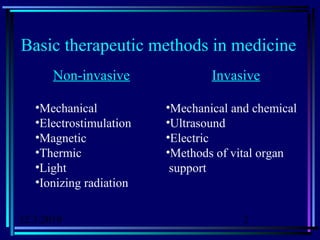
Basic therapeutic methods in medicine
Non-invasive
•Mechanical
•Electrostimulation
•Magnetic
•Thermic
•Light
•Ionizing radiation
Invasive
•Mechanical and chemical
•Ultrasound
•Electric
•Methods of vital organ
support
12.3.2019 3
-method of disintegration of cocnrements (in kidneys)
by mechanical effect of numerous shock waves (50 –4000)
with frequency 1 – 10 Hz
Efficiency of this methode : 70 – 98%
Risks: pain, bleeding
-based on photoacustic phenomen
-shock waves are generated by short light impulses
of He-Ne laser in duration of 1,5 – 3 ms and transmitted
by optical fibers to the stone
Non-invasive therapeutic methods
1. Mechanical
1. Extracorporal Shock – Wave Lithotripsy
2. Laser Lithotripsy
12.3.2019 4
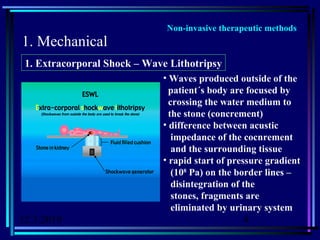
• Waves produced outside of the
patient´s body are focused by
crossing the water medium to
the stone (concrement)
• difference between acustic
impedance of the cocnrement
and the surrounding tissue
• rapid start of pressure gradient
(108
Pa) on the border lines –
disintegration of the
stones, fragments are
eliminated by urinary system
Non-invasive therapeutic methods
1. Mechanical
1. Extracorporal Shock – Wave Lithotripsy
12.3.2019 5
•Source of shock waves (electric,
electromagnetic, laser...,
form (focal or square) - mostly used is
the point electric discharge in the
water medium
•The real source of shock waves is the
condenser (as a source of voltage)
•Scintilation point (located in the
primary focus of rotary ellipsoid)
•Focusing device (acustic lenses)
Non-invasive therapeutic methods
1. Extracorporal Shock – Wave Lithotripsy
1. Mechanical
12.3.2019 6
Frequency : 0,8 – 1 MHz
Intensity: 0,2 – 0,3 W. cm-2
The surface of treatment head: 1 – 10 cm2
Indications: chronic diseases of
joints, muscles, nerves
Contraindication: therapy of
malignant tumors
Spasmolytic effect
Analgetic – removal of acid metabolic
products
Biostimulant – acceleration of healing
Parameters
Effects
Non-invasive therapeutic
methods
1. Mechanical
3. Ultrasound high frequency massage with heating of the
tissue
12.3.2019 7
1. Stimulation effect
Non-invasive therapeutic methods
2. Electrostimulation
1. Electroshocks
2. Defibrilation
•used in psychiatry – pacients with schizophrenia, oligophrenia
and other mental diseases
•cause transition blackout, strong muscles conctraction,
attenuation of CNS and „offset“ of the brain
•live saving treatment therapy
•short electric discharge applied to chest
•condenser current with voltage 5 kV, time 5 ms
12.3.2019 8
1. Stimulation effect
Non-invasive therapeutic methods
2. Electrostimulation
3. Chronaxymetry
electrostimulation of peripheral nerves and muscles using
DC current as a diagnostical test for determination of chronaxy
(the shortest time under which DC current impulse with double
intensity of Rheobase causes AP
Used for appreciation of
efficiency of the
neurosurgery treatment or
in rehabilitation
12.3.2019 9
1. Stimulation effect
Non-invasive therapeutic methods
2. Electrostimulation
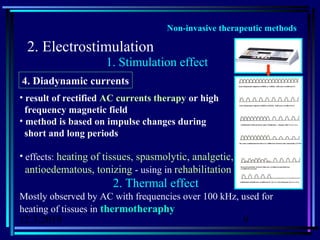
4. Diadynamic currents
• result of rectified AC currents therapy or high
frequency magnetic field
• method is based on impulse changes during
short and long periods
2. Thermal effect
Mostly observed by AC with frequencies over 100 kHz, used for
heating of tissues in thermotheraphy
• effects: heating of tissues, spasmolytic, analgetic,
antioedematous, tonizing - using in rehabilitation
12.3.2019 10
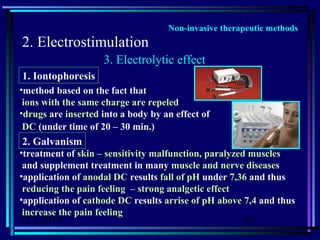
3. Electrolytic effect
•treatment of skin – sensitivity malfunction, paralyzed muscles
and supplement treatment in many muscle and nerve diseases
•application of anodal DC results fall of pH under 7,36 and thus
reducing the pain feeling – strong analgetic effect
•application of cathode DC results arrise of pH above 7,4 and thus
increase the pain feeling
Non-invasive therapeutic methods
2. Electrostimulation
2. Galvanism
1. Iontophoresis
•method based on the fact that
ions with the same charge are repeled
•drugs are inserted into a body by an effect of
DC (under time of 20 – 30 min.)
12.3.2019 11
Non-invasive therapeutic methods
3. Magnetic
• magnetotherapy as a therapeutic methode has been recognised recently
• in healthy subjects no or minimal effects, curative effect can not
be proved in all casses, conception of the „dosis“ is problematic
• application of static magnets and electromagnets on the body surface
during 10 – 45 min (5 – 80 mT)
High intensity of MF may lead to spasm of vessels, CNS disorders,
even to exitus
Therapeutic effects:
• hyperaemia
• spasmolytic
• analgetic
• antioedematous
• antiinflammatory
Indications: diseases of joints, muscles, nerves and hypertension
12.3.2019 12
Non-invasive therapeutic methods
3. Magnetic
• Magnetoelectric effects – electrical voltages induced by magnetical
fields are lower than cell membrane voltages, but they probably affect
the membrane receptors, activating biochemical reactions in cells
Magnetic induction (T)
• Magnetomechanical effects – caused only by high intensities of
magnetic fields, orientation of dia - and para - magnetic substances in
the body is so, that free energy inside MF is minimalized
• Magnetochemical effects – free radicals are created and antioxidant
systems and series of biochemical reactions are activated
Magnetic fields with low frequency – increase of CNS excitability,
decrease blood flow in the vessels with higher diameter - positive
effect of hypertension treatment
Magnetic fields with high frequency – mainly thermic effects, used in
diathermy and for treatment of inflammatory diseases
HB .µ=
12.3.2019 13
Non-invasive therapeutic methods
4. Thermic
hydrotherapy
• heat can be brought to the body – positive thermotherapy or
taken away – negative thermotherapy
• medical effects: hyperaemia, reflex vasodilatation, spasmolytic
and analgetic effect, myorelaxation
1. Thermotherapeutic methods using conduction of heat
packs, compresses (cold/warm, dry (45 -55°C)/moist, peloid,
paraffin)
2. Thermotherapeutic methods using convection of heat
1. Hydrotherapy
whole - body bath: hypothermic (10 – 34 °C)
izothermic (34 – 36 °C)
hyperthermic (37 – 42°C)
12.3.2019 14
Non-invasive therapeutic methods
4. Thermic
3. Whirling baths and underwater massage
2. Scottish torrents
4. Sauna
streams of cold and warm water – arise of immunity
hyperthermic with activation of skin receptors and hyperaemia of tissue
effect of hot (80 – 100°C) and dry air and a bath in cold water results
tonising effect
3. Thermotherapeutic methods with application of IR radiation
1. Infrared radiation – warm bath
heating effect
12.3.2019 15
4. Thermic
Non-invasive therapeutic
methods
2. Infrared lamp
local surface heating of the tissues, used in
stomatology, dermatology
4. Thermotherapeutic methods with applications of high
frequency electric currents, electromagnetic fields, micro –
waves - DIATHERMY
5. Thermotherapeutic applications of ultrasound
• diathermy and micromasage of the tissue, most of the heat is created
on the borderline between fat and muscle tissue, at least between skin
and muscle
• 1/3 of absorbed US is transformed to the heat
• short wave (27 MHz) resistive connection
• ultra short wave (434 MHz) condenser connection
• microwave (2400 MHz) inductive connection
infrared lamp
12.3.2019 16
5. Light
Non-invasive therapeutic
methods
1. Phototherapy
Heliotherapy – treatment by sun radiation
Therapy with visible light – blue part of the spectrum – therapy
of icterus – yellow coloured skin in newborn babies
2. Photodynamic Therapy
Photosensibiliser given into the body
is activated by visible light and reacts
with oxygen. It results in disorder of
metabolism of the cells, death of cells
and tissues. This therapy does not
affect the DNA.
12.3.2019 17
5. Light
Non-invasive therapeutic
methods
3. Ultraviolet light therapy
4. Laser radiation therapy
•UV-A (λ = 315 -400nm), UV-B (λ = 280 – 315nm),
UV-C ( 100 - 280nm)
•Source: mercury – discharge lamp
•biological effects: erythema (UV-B), delayed pigmentation witin (48
– 72 hours), production of vitamine D, killing efect on the germs and
bacteries - using for disinfection of surgery rooms (UV-C)
•light amplification by stimulated emission of radiation
•consists of 3 main parts: effective substance, excitation device, optic
resonator
•types: solid/liquid/gas/ semiconductor, continual/pulse, soft/hard
12.3.2019 18
5. Light
Non-invasive therapeutic
methods
Principle of laser: atom of substance is reaching the excitation due
to the removing of electrones from basic to higher energetic levels.
Laser radiation is produced by massive replacement of electrons
to their basic levels, under amplification by optic resonator
laser therapy
Low power lasers
• soft – lasers with a maximal power of 500 mW
• treatment effect: analgetic, antiinflamatory,
biostimulating
• local application – skin, the lasers with shorter
wavelengths in red part of light spectrum are used
• deep application – muscles, bones,
the lasers with longer wavelengths in IR part of
spectrum are used
12.3.2019 19
5. Light
Invasive therapeutic methods
High power lasers
Solid YAG laser – used for photocoagulation of
retinal ablation – (emits radiation in green
part of light spectrum, power supply up to 1,5 W)
Excimer laser – for therapy of myopy and
hyperopy. This laser emits ultraviolet
radiation causing photochemical reaction when connecting with eye
and thus leads to elimination of corneal tissue (1 impulse removes
about 0,25 mm of cornea) - works as a „contactless“ scalpel
YAG laser
12.3.2019 20
6. Ionizing radiation
Non-invasive therapeutic
methods
• Therapy by nuclear (α, β, γ, neutrons) and non-nuclear (X - ray)
radiation
• Principle of effect: direct effect - production of instabile electric
charged particles (cations, anions) in cells or non-direct effect –
creation of reactive radicals because water radiolysis
comparison of stochastic
(non depending on
dosis) and deterministic
(depending on dosis)
effects of ionizing
radiation
Radiation geometry: Fosusing distance (intensity of radiation
decreases with square of the length)
12.3.2019 21
6. Ionizing radiation
Non-invasive therapeutic
methods
Radioactive sources with low energy (biggest
dosis remains on surface and close under the
surface of the body
• conventional X-ray radiation (electrons with
10 MeV)
• gama radiation from radioactive source
60
CO
• streams of neutrons (deuterons with 50MeV)
Therapy with increasing energy of
radiation (dosis grows with the depth) –
reaches the tumor precisely
• stream of protons (140 MeV)
• stream of П-mesons 953 MeV)
• O2
ions (3,6 GeV)
12.3.2019 22
1. Mechanical and chemical
widely used in surgery and stomatology (scalpels, tweezers, peans)
Invasive therapeutic methods
1. Rotary and elevator instruments
2. Water scalpel
rotary and elevator instruments used in stomatology
• cutting tissues by water torrent
(isotonic solution NaCl)
• device consists of: pressure pump,
high pressure hose and water engine
• cuts are smooth
12.3.2019 23
Invasive therapeutic methods
cryo – destruction of the tumor by freezing
for deep freezing of tissues (from 25°C to -190°C) – liquid
nitrogenium is used. Water molecules changes into ice crystals and
these may harm the cells during rewarming.
Adventage: anestetic effect of cold, small destruction of
the tissue in cut´s surrounding, no bleeding
Using: opthalmology, gynecology, urology, oncolgy
3. Cryocauthery instruments
1. Mechanical and chemical
12.3.2019 24
Invasive therapeutic methods
• ultasound (US) with high intensity (50 – 1000 W/cm2)
• selective destruction of tissues
High frequency focusing US
(1 – 3 MHz)
Low frequency US (20 – 50 kHz)
Device – ultrasound is produced in
piezoelectric transformer and conducted
by special wave – conducting system,
whitch amlifies its amplitude by 10 times.
Steel scalpel oscitates in resonance with
transformator´s frequency
Widely used in otolaryngology and
neurosurgery.
2. Ultrasound
12.3.2019 25
Invasive therapeutic methods
2. Ultrasound
Facoemulsifikator
This device is utilised for extraction
of cloudy lense (cataract). Method is
based on low frequency ultrasound
application, which destructs the
cloudy lense, lense is then
emulsificated and sucked off.
3. Electric
Electrotomy and electrocoagulation
extraction of cloudy lense
• use effect of HF electric currents
• production of heat by contact different electrode with tissue
– water is evaporated and cells are destructed. This results in
proteins coagulation and vessels closing – cuts do not bleed
12.3.2019 26
4. Methods of vital organ support
Invasive therapeutic methods
1. Breathing support – artificial respiration
• is used when no spontaneous respiration is present – apnoe,
or by pulmonary insufficiency – partial presure of oxygen in
arterial blood is < 5kPa, pH<7.25
respiration devices - ventilators
•pressure controled ventilators – switch inspiration
to expiration by chosen pressure value
•volume controled ventilators – possible to set
inspiratory volume, pressure, breathing frequency –
optimal value of pulmonary ventilation
MV =VT
• f
12.3.2019 27
4. Methods of vital organ support
Invasive therapeutic methods
1. Breathing support – artificial respiration
Parameters whitch can by set on the ventilator:
• respiratory exchange ratio (1:1.5 or 1:2)
• respiratory frequency (8 – 24 /min)
• inspiratory oxygen concentration (20 – 100%)
• inspiratory pressure (maximal value is 7 kPa)
• postinspiration time (between end of inspiration and
start of expiration
-control of PaO2
(by oxymetry) and PaCO2
(by
capnogram)
Special type: CPAP (continuos possitive airway pressure)
12.3.2019 28
4. Methods of vital organ support
Invasive therapeutic methods
2. Heart function substitution – extracorporeal circulation
Blood pump – elastic tube and rotor with 2
sheaves – they rotate, compress the tube
(not totaly) and drive the blood before them
Amount and pressure of blood is regulated
by turning the pump rotation
Oxygenator – substitutes the lung function,
blood is eliminated from from CO2
and is
saturated by O2
Warmer device – modifies the temperature
of oxygenated blood which returnes to the
body to 37.5 °C
12.3.2019 29
4. Methods of vital organ support
Invasive therapeutic methods
2. Heart function substitution – extracorporeal circulation
12.3.2019 30
4. Methods of vital organ support
Invasive therapeutic methods
2. Heart function substitution
artificial
heart
• transplatantion of human´s heart
• implantation of artificial heart – driving
of pump is provided by pressure of
compressed air, suitable noniritable
material is used (imunology)
• surgery substitution of coronary arteries
(bypass) and heart valves (because of
stenosis or insufficiency)
PACEMAKING – uses DC current to
supply failure dischares in „sick sinus
syndrom“ therapy
pacemaker
12.3.2019 31
4. Methods of vital organ support
Invasive therapeutic methods
3. Artificial kidney - hemodialysis
Basic parts of this device
• Extracorporeal blood circulation - see the previous chapter
• Dialysing circulation – circle which provides flow and preparation
of dialysing solution – by mixing water and NaHCO3.
pH is changed to 7.36 and osmolarity to 5300 mOsm/l (as in blood
plasma). Integrity of dialysing membrane is controled by detection
of hemoglobine amount. Temperature of dialysing solution is kept
on the same value.
treatment of intoxications or disorder of kidney´s function –
filtration, resorbtion
12.3.2019 32
4. Methods of vital organ support
Invasive therapeutic methods
3. Artificial kidney - hemodialysis
• Dialyser – is divided into 2 parts (blood part and dialysing part) by
dialysing membrane.
Blood flows by laminary streaming (200 – 300 ml/min) on the one
side of the membrane and passes the dialysing membrane, red cells
are located centraly, plasma peripheraly.
Dialysing solution flows in opposit direction by turbulent streaming
(500ml/min) on the other side of the membrane. It results in
increasing of concentration gradient, which leads to rapid diffusion
of low weight molecules – toxic substances (urea, aceton) from
blood to dialysing solution. Velocity of ultrafiltration and amount
of redundant water can be regulated by transmembrane pressure
(middle blood pressure minus pressure of dialysing solution).
12.3.2019 33
4. Methods of vital organ support
Invasive therapeutic methods
3. Artificial kidney
Peritoneal dialysis – peritoneum works as a filter
– hemoperfusion, hemofiltration (by
intoxication treatment and liver failure)
hemodialysis and peritoneal dialysis - comparison
12.3.2019 34
4. Methods of vital organ support
Invasive therapeutic methods
4. Artificial lenses
are implanted because of injuries or the cataract
no ability of accomodation
• optic part – increases refractive power of the eye
• haptic part – for mechanical fixation in the eye ball
types:
• solid (polymetacrylate)
• soft (composite
hydrogels, termoplasts)
12.3.2019 35
4. Methods of vital organ support
Invasive therapeutic methods
5. Cochlear electrode implants
Multiple – electrode stimulating system
consist of 2 parts
External part:
• sound processor
• sensitive microphone amplifier
• transmitter
Internal part:
• receiver implanted under the skin
• electrode system inserted into central
part of cochlea – pars media near to basilar
membrane (beginning of the acustic nerve)
for deaf patients whose conduction of acoustic nerve is intact
12.3.2019 36
4. Methods of vital organ support
Invasive therapeutic methods
6. Prothesis of limbs
• Mechanical prothesis – mobile only in knee and ankle, enable
walking with assistence (lower extremities) or partial grip function
• Bioprothesis – biosignals conducted by needle electrodes into
preserved muscles. There is a lack feedback reaction between
afferent and efferent signals. Mechanism of unit can be electric,
hydraulic, etc.
• Biomanipulator – bioprothesis of new generation – more
complicated functions are possible
• Endoprothesis – artificial joints made from special steel (knee,
hip joint)
12.3.2019 37
4. Methods of vital organ support
Invasive therapeutic methods
7. Injection pumps
•enable exact timetable of drug´s application into the circulation
•ensure shift of the injection pump piston in sterile conditions
•speed of dose, quantiy of applied solution, time of application
can be seen on display
•operation of the pump is controled by microprocessor, with
ability to choose the mode
Trombolytic pumps
Drug (which dissolve the thrombus or prevents its formation) is
applied into the vessel by each pulse of compressed air
Insulin pumps
• programmable infusion dosing device
(with thin catheter ended by needle)
• automatic insulin applicator device (plus
automatic control of sugar level in blood)
12.3.2019 38
Thanks
for
attention
© 2007 Juliana Knocikova

Basic therapeutic methods in medicine

  • 1.
    12.3.2019 1 Basic therapeuticmethods in medicine Juliana Knocikova
  • 2.
    12.3.2019 2 Basic therapeuticmethods in medicine Non-invasive •Mechanical •Electrostimulation •Magnetic •Thermic •Light •Ionizing radiation Invasive •Mechanical and chemical •Ultrasound •Electric •Methods of vital organ support
  • 3.
    12.3.2019 3 -method ofdisintegration of cocnrements (in kidneys) by mechanical effect of numerous shock waves (50 –4000) with frequency 1 – 10 Hz Efficiency of this methode : 70 – 98% Risks: pain, bleeding -based on photoacustic phenomen -shock waves are generated by short light impulses of He-Ne laser in duration of 1,5 – 3 ms and transmitted by optical fibers to the stone Non-invasive therapeutic methods 1. Mechanical 1. Extracorporal Shock – Wave Lithotripsy 2. Laser Lithotripsy
  • 4.
    12.3.2019 4 • Wavesproduced outside of the patient´s body are focused by crossing the water medium to the stone (concrement) • difference between acustic impedance of the cocnrement and the surrounding tissue • rapid start of pressure gradient (108 Pa) on the border lines – disintegration of the stones, fragments are eliminated by urinary system Non-invasive therapeutic methods 1. Mechanical 1. Extracorporal Shock – Wave Lithotripsy
  • 5.
    12.3.2019 5 •Source ofshock waves (electric, electromagnetic, laser..., form (focal or square) - mostly used is the point electric discharge in the water medium •The real source of shock waves is the condenser (as a source of voltage) •Scintilation point (located in the primary focus of rotary ellipsoid) •Focusing device (acustic lenses) Non-invasive therapeutic methods 1. Extracorporal Shock – Wave Lithotripsy 1. Mechanical
  • 6.
    12.3.2019 6 Frequency :0,8 – 1 MHz Intensity: 0,2 – 0,3 W. cm-2 The surface of treatment head: 1 – 10 cm2 Indications: chronic diseases of joints, muscles, nerves Contraindication: therapy of malignant tumors Spasmolytic effect Analgetic – removal of acid metabolic products Biostimulant – acceleration of healing Parameters Effects Non-invasive therapeutic methods 1. Mechanical 3. Ultrasound high frequency massage with heating of the tissue
  • 7.
    12.3.2019 7 1. Stimulationeffect Non-invasive therapeutic methods 2. Electrostimulation 1. Electroshocks 2. Defibrilation •used in psychiatry – pacients with schizophrenia, oligophrenia and other mental diseases •cause transition blackout, strong muscles conctraction, attenuation of CNS and „offset“ of the brain •live saving treatment therapy •short electric discharge applied to chest •condenser current with voltage 5 kV, time 5 ms
  • 8.
    12.3.2019 8 1. Stimulationeffect Non-invasive therapeutic methods 2. Electrostimulation 3. Chronaxymetry electrostimulation of peripheral nerves and muscles using DC current as a diagnostical test for determination of chronaxy (the shortest time under which DC current impulse with double intensity of Rheobase causes AP Used for appreciation of efficiency of the neurosurgery treatment or in rehabilitation
  • 9.
    12.3.2019 9 1. Stimulationeffect Non-invasive therapeutic methods 2. Electrostimulation 4. Diadynamic currents • result of rectified AC currents therapy or high frequency magnetic field • method is based on impulse changes during short and long periods 2. Thermal effect Mostly observed by AC with frequencies over 100 kHz, used for heating of tissues in thermotheraphy • effects: heating of tissues, spasmolytic, analgetic, antioedematous, tonizing - using in rehabilitation
  • 10.
    12.3.2019 10 3. Electrolyticeffect •treatment of skin – sensitivity malfunction, paralyzed muscles and supplement treatment in many muscle and nerve diseases •application of anodal DC results fall of pH under 7,36 and thus reducing the pain feeling – strong analgetic effect •application of cathode DC results arrise of pH above 7,4 and thus increase the pain feeling Non-invasive therapeutic methods 2. Electrostimulation 2. Galvanism 1. Iontophoresis •method based on the fact that ions with the same charge are repeled •drugs are inserted into a body by an effect of DC (under time of 20 – 30 min.)
  • 11.
    12.3.2019 11 Non-invasive therapeuticmethods 3. Magnetic • magnetotherapy as a therapeutic methode has been recognised recently • in healthy subjects no or minimal effects, curative effect can not be proved in all casses, conception of the „dosis“ is problematic • application of static magnets and electromagnets on the body surface during 10 – 45 min (5 – 80 mT) High intensity of MF may lead to spasm of vessels, CNS disorders, even to exitus Therapeutic effects: • hyperaemia • spasmolytic • analgetic • antioedematous • antiinflammatory Indications: diseases of joints, muscles, nerves and hypertension
  • 12.
    12.3.2019 12 Non-invasive therapeuticmethods 3. Magnetic • Magnetoelectric effects – electrical voltages induced by magnetical fields are lower than cell membrane voltages, but they probably affect the membrane receptors, activating biochemical reactions in cells Magnetic induction (T) • Magnetomechanical effects – caused only by high intensities of magnetic fields, orientation of dia - and para - magnetic substances in the body is so, that free energy inside MF is minimalized • Magnetochemical effects – free radicals are created and antioxidant systems and series of biochemical reactions are activated Magnetic fields with low frequency – increase of CNS excitability, decrease blood flow in the vessels with higher diameter - positive effect of hypertension treatment Magnetic fields with high frequency – mainly thermic effects, used in diathermy and for treatment of inflammatory diseases HB .µ=
  • 13.
    12.3.2019 13 Non-invasive therapeuticmethods 4. Thermic hydrotherapy • heat can be brought to the body – positive thermotherapy or taken away – negative thermotherapy • medical effects: hyperaemia, reflex vasodilatation, spasmolytic and analgetic effect, myorelaxation 1. Thermotherapeutic methods using conduction of heat packs, compresses (cold/warm, dry (45 -55°C)/moist, peloid, paraffin) 2. Thermotherapeutic methods using convection of heat 1. Hydrotherapy whole - body bath: hypothermic (10 – 34 °C) izothermic (34 – 36 °C) hyperthermic (37 – 42°C)
  • 14.
    12.3.2019 14 Non-invasive therapeuticmethods 4. Thermic 3. Whirling baths and underwater massage 2. Scottish torrents 4. Sauna streams of cold and warm water – arise of immunity hyperthermic with activation of skin receptors and hyperaemia of tissue effect of hot (80 – 100°C) and dry air and a bath in cold water results tonising effect 3. Thermotherapeutic methods with application of IR radiation 1. Infrared radiation – warm bath heating effect
  • 15.
    12.3.2019 15 4. Thermic Non-invasivetherapeutic methods 2. Infrared lamp local surface heating of the tissues, used in stomatology, dermatology 4. Thermotherapeutic methods with applications of high frequency electric currents, electromagnetic fields, micro – waves - DIATHERMY 5. Thermotherapeutic applications of ultrasound • diathermy and micromasage of the tissue, most of the heat is created on the borderline between fat and muscle tissue, at least between skin and muscle • 1/3 of absorbed US is transformed to the heat • short wave (27 MHz) resistive connection • ultra short wave (434 MHz) condenser connection • microwave (2400 MHz) inductive connection infrared lamp
  • 16.
    12.3.2019 16 5. Light Non-invasivetherapeutic methods 1. Phototherapy Heliotherapy – treatment by sun radiation Therapy with visible light – blue part of the spectrum – therapy of icterus – yellow coloured skin in newborn babies 2. Photodynamic Therapy Photosensibiliser given into the body is activated by visible light and reacts with oxygen. It results in disorder of metabolism of the cells, death of cells and tissues. This therapy does not affect the DNA.
  • 17.
    12.3.2019 17 5. Light Non-invasivetherapeutic methods 3. Ultraviolet light therapy 4. Laser radiation therapy •UV-A (λ = 315 -400nm), UV-B (λ = 280 – 315nm), UV-C ( 100 - 280nm) •Source: mercury – discharge lamp •biological effects: erythema (UV-B), delayed pigmentation witin (48 – 72 hours), production of vitamine D, killing efect on the germs and bacteries - using for disinfection of surgery rooms (UV-C) •light amplification by stimulated emission of radiation •consists of 3 main parts: effective substance, excitation device, optic resonator •types: solid/liquid/gas/ semiconductor, continual/pulse, soft/hard
  • 18.
    12.3.2019 18 5. Light Non-invasivetherapeutic methods Principle of laser: atom of substance is reaching the excitation due to the removing of electrones from basic to higher energetic levels. Laser radiation is produced by massive replacement of electrons to their basic levels, under amplification by optic resonator laser therapy Low power lasers • soft – lasers with a maximal power of 500 mW • treatment effect: analgetic, antiinflamatory, biostimulating • local application – skin, the lasers with shorter wavelengths in red part of light spectrum are used • deep application – muscles, bones, the lasers with longer wavelengths in IR part of spectrum are used
  • 19.
    12.3.2019 19 5. Light Invasivetherapeutic methods High power lasers Solid YAG laser – used for photocoagulation of retinal ablation – (emits radiation in green part of light spectrum, power supply up to 1,5 W) Excimer laser – for therapy of myopy and hyperopy. This laser emits ultraviolet radiation causing photochemical reaction when connecting with eye and thus leads to elimination of corneal tissue (1 impulse removes about 0,25 mm of cornea) - works as a „contactless“ scalpel YAG laser
  • 20.
    12.3.2019 20 6. Ionizingradiation Non-invasive therapeutic methods • Therapy by nuclear (α, β, γ, neutrons) and non-nuclear (X - ray) radiation • Principle of effect: direct effect - production of instabile electric charged particles (cations, anions) in cells or non-direct effect – creation of reactive radicals because water radiolysis comparison of stochastic (non depending on dosis) and deterministic (depending on dosis) effects of ionizing radiation Radiation geometry: Fosusing distance (intensity of radiation decreases with square of the length)
  • 21.
    12.3.2019 21 6. Ionizingradiation Non-invasive therapeutic methods Radioactive sources with low energy (biggest dosis remains on surface and close under the surface of the body • conventional X-ray radiation (electrons with 10 MeV) • gama radiation from radioactive source 60 CO • streams of neutrons (deuterons with 50MeV) Therapy with increasing energy of radiation (dosis grows with the depth) – reaches the tumor precisely • stream of protons (140 MeV) • stream of П-mesons 953 MeV) • O2 ions (3,6 GeV)
  • 22.
    12.3.2019 22 1. Mechanicaland chemical widely used in surgery and stomatology (scalpels, tweezers, peans) Invasive therapeutic methods 1. Rotary and elevator instruments 2. Water scalpel rotary and elevator instruments used in stomatology • cutting tissues by water torrent (isotonic solution NaCl) • device consists of: pressure pump, high pressure hose and water engine • cuts are smooth
  • 23.
    12.3.2019 23 Invasive therapeuticmethods cryo – destruction of the tumor by freezing for deep freezing of tissues (from 25°C to -190°C) – liquid nitrogenium is used. Water molecules changes into ice crystals and these may harm the cells during rewarming. Adventage: anestetic effect of cold, small destruction of the tissue in cut´s surrounding, no bleeding Using: opthalmology, gynecology, urology, oncolgy 3. Cryocauthery instruments 1. Mechanical and chemical
  • 24.
    12.3.2019 24 Invasive therapeuticmethods • ultasound (US) with high intensity (50 – 1000 W/cm2) • selective destruction of tissues High frequency focusing US (1 – 3 MHz) Low frequency US (20 – 50 kHz) Device – ultrasound is produced in piezoelectric transformer and conducted by special wave – conducting system, whitch amlifies its amplitude by 10 times. Steel scalpel oscitates in resonance with transformator´s frequency Widely used in otolaryngology and neurosurgery. 2. Ultrasound
  • 25.
    12.3.2019 25 Invasive therapeuticmethods 2. Ultrasound Facoemulsifikator This device is utilised for extraction of cloudy lense (cataract). Method is based on low frequency ultrasound application, which destructs the cloudy lense, lense is then emulsificated and sucked off. 3. Electric Electrotomy and electrocoagulation extraction of cloudy lense • use effect of HF electric currents • production of heat by contact different electrode with tissue – water is evaporated and cells are destructed. This results in proteins coagulation and vessels closing – cuts do not bleed
  • 26.
    12.3.2019 26 4. Methodsof vital organ support Invasive therapeutic methods 1. Breathing support – artificial respiration • is used when no spontaneous respiration is present – apnoe, or by pulmonary insufficiency – partial presure of oxygen in arterial blood is < 5kPa, pH<7.25 respiration devices - ventilators •pressure controled ventilators – switch inspiration to expiration by chosen pressure value •volume controled ventilators – possible to set inspiratory volume, pressure, breathing frequency – optimal value of pulmonary ventilation MV =VT • f
  • 27.
    12.3.2019 27 4. Methodsof vital organ support Invasive therapeutic methods 1. Breathing support – artificial respiration Parameters whitch can by set on the ventilator: • respiratory exchange ratio (1:1.5 or 1:2) • respiratory frequency (8 – 24 /min) • inspiratory oxygen concentration (20 – 100%) • inspiratory pressure (maximal value is 7 kPa) • postinspiration time (between end of inspiration and start of expiration -control of PaO2 (by oxymetry) and PaCO2 (by capnogram) Special type: CPAP (continuos possitive airway pressure)
  • 28.
    12.3.2019 28 4. Methodsof vital organ support Invasive therapeutic methods 2. Heart function substitution – extracorporeal circulation Blood pump – elastic tube and rotor with 2 sheaves – they rotate, compress the tube (not totaly) and drive the blood before them Amount and pressure of blood is regulated by turning the pump rotation Oxygenator – substitutes the lung function, blood is eliminated from from CO2 and is saturated by O2 Warmer device – modifies the temperature of oxygenated blood which returnes to the body to 37.5 °C
  • 29.
    12.3.2019 29 4. Methodsof vital organ support Invasive therapeutic methods 2. Heart function substitution – extracorporeal circulation
  • 30.
    12.3.2019 30 4. Methodsof vital organ support Invasive therapeutic methods 2. Heart function substitution artificial heart • transplatantion of human´s heart • implantation of artificial heart – driving of pump is provided by pressure of compressed air, suitable noniritable material is used (imunology) • surgery substitution of coronary arteries (bypass) and heart valves (because of stenosis or insufficiency) PACEMAKING – uses DC current to supply failure dischares in „sick sinus syndrom“ therapy pacemaker
  • 31.
    12.3.2019 31 4. Methodsof vital organ support Invasive therapeutic methods 3. Artificial kidney - hemodialysis Basic parts of this device • Extracorporeal blood circulation - see the previous chapter • Dialysing circulation – circle which provides flow and preparation of dialysing solution – by mixing water and NaHCO3. pH is changed to 7.36 and osmolarity to 5300 mOsm/l (as in blood plasma). Integrity of dialysing membrane is controled by detection of hemoglobine amount. Temperature of dialysing solution is kept on the same value. treatment of intoxications or disorder of kidney´s function – filtration, resorbtion
  • 32.
    12.3.2019 32 4. Methodsof vital organ support Invasive therapeutic methods 3. Artificial kidney - hemodialysis • Dialyser – is divided into 2 parts (blood part and dialysing part) by dialysing membrane. Blood flows by laminary streaming (200 – 300 ml/min) on the one side of the membrane and passes the dialysing membrane, red cells are located centraly, plasma peripheraly. Dialysing solution flows in opposit direction by turbulent streaming (500ml/min) on the other side of the membrane. It results in increasing of concentration gradient, which leads to rapid diffusion of low weight molecules – toxic substances (urea, aceton) from blood to dialysing solution. Velocity of ultrafiltration and amount of redundant water can be regulated by transmembrane pressure (middle blood pressure minus pressure of dialysing solution).
  • 33.
    12.3.2019 33 4. Methodsof vital organ support Invasive therapeutic methods 3. Artificial kidney Peritoneal dialysis – peritoneum works as a filter – hemoperfusion, hemofiltration (by intoxication treatment and liver failure) hemodialysis and peritoneal dialysis - comparison
  • 34.
    12.3.2019 34 4. Methodsof vital organ support Invasive therapeutic methods 4. Artificial lenses are implanted because of injuries or the cataract no ability of accomodation • optic part – increases refractive power of the eye • haptic part – for mechanical fixation in the eye ball types: • solid (polymetacrylate) • soft (composite hydrogels, termoplasts)
  • 35.
    12.3.2019 35 4. Methodsof vital organ support Invasive therapeutic methods 5. Cochlear electrode implants Multiple – electrode stimulating system consist of 2 parts External part: • sound processor • sensitive microphone amplifier • transmitter Internal part: • receiver implanted under the skin • electrode system inserted into central part of cochlea – pars media near to basilar membrane (beginning of the acustic nerve) for deaf patients whose conduction of acoustic nerve is intact
  • 36.
    12.3.2019 36 4. Methodsof vital organ support Invasive therapeutic methods 6. Prothesis of limbs • Mechanical prothesis – mobile only in knee and ankle, enable walking with assistence (lower extremities) or partial grip function • Bioprothesis – biosignals conducted by needle electrodes into preserved muscles. There is a lack feedback reaction between afferent and efferent signals. Mechanism of unit can be electric, hydraulic, etc. • Biomanipulator – bioprothesis of new generation – more complicated functions are possible • Endoprothesis – artificial joints made from special steel (knee, hip joint)
  • 37.
    12.3.2019 37 4. Methodsof vital organ support Invasive therapeutic methods 7. Injection pumps •enable exact timetable of drug´s application into the circulation •ensure shift of the injection pump piston in sterile conditions •speed of dose, quantiy of applied solution, time of application can be seen on display •operation of the pump is controled by microprocessor, with ability to choose the mode Trombolytic pumps Drug (which dissolve the thrombus or prevents its formation) is applied into the vessel by each pulse of compressed air Insulin pumps • programmable infusion dosing device (with thin catheter ended by needle) • automatic insulin applicator device (plus automatic control of sugar level in blood)
  • 38.