
Course code: PHY-101
Course name: Physics-1
Presenter id: 181-23-52701
Presentation on
Generator
Outline
• Introduction.
• History and evolution of generators.
• Classification of generator.
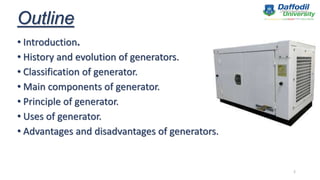
• Main components of generator.
• Principle of generator.
• Uses of generator.
• Advantages and disadvantages of generators.
2
Introduction
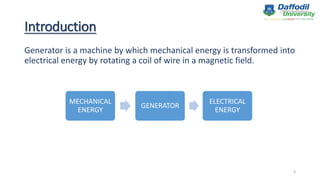
Generator is a machine by which mechanical energy is transformed into
electrical energy by rotating a coil of wire in a magnetic field.
MECHANICAL
ENERGY
GENERATOR
ELECTRICAL
ENERGY
3
History and evolution of generators
• Michel Faraday and Hippolyte Pixii were pioneers who invented early
mechanics like generator in the years of 1831–1832.
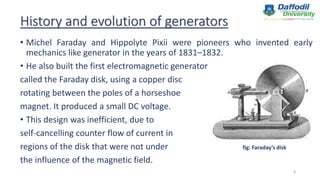
• He also built the first electromagnetic generator
called the Faraday disk, using a copper disc
rotating between the poles of a horseshoe
magnet. It produced a small DC voltage.
• This design was inefficient, due to
self-cancelling counter flow of current in
regions of the disk that were not under fig: Faraday’s disk
the influence of the magnetic field.
4
History and evolution of generator
• There are following stages of evolution of generators .
i. Electrostatic generator.
ii. Invention of Dynamos.
iii. Alternators and their evolution.
5
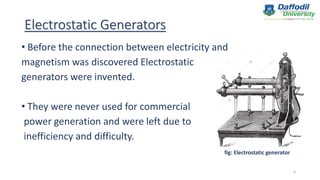
Electrostatic Generators
• Before the connection between electricity and
magnetism was discovered Electrostatic
generators were invented.
• They were never used for commercial
power generation and were left due to
inefficiency and difficulty.
fig: Electrostatic generator
6
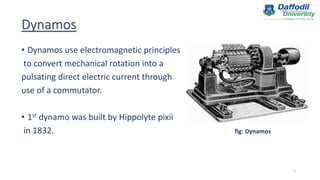
Dynamos
• Dynamos use electromagnetic principles
to convert mechanical rotation into a
pulsating direct electric current through
use of a commutator.
• 1st dynamo was built by Hippolyte pixii
in 1832. fig: Dynamos
7
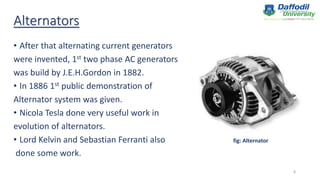
Alternators
• After that alternating current generators
were invented, 1st two phase AC generators
was build by J.E.H.Gordon in 1882.
• In 1886 1st public demonstration of
Alternator system was given.
• Nicola Tesla done very useful work in
evolution of alternators.
• Lord Kelvin and Sebastian Ferranti also fig: Alternator
done some work.
8
Classification of generator
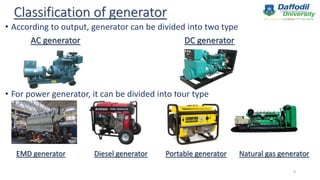
• According to output, generator can be divided into two type
AC generator DC generator
• For power generator, it can be divided into four type
EMD generator Diesel generator Portable generator Natural gas generator
9
Classification of generator
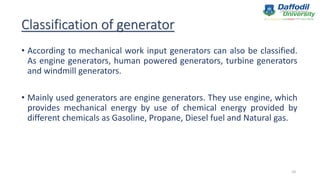
• According to mechanical work input generators can also be classified.
As engine generators, human powered generators, turbine generators
and windmill generators.
• Mainly used generators are engine generators. They use engine, which
provides mechanical energy by use of chemical energy provided by
different chemicals as Gasoline, Propane, Diesel fuel and Natural gas.
10
Main components of generator
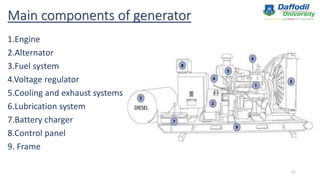
1.Engine
2.Alternator
3.Fuel system
4.Voltage regulator
5.Cooling and exhaust systems
6.Lubrication system
7.Battery charger
8.Control panel
9. Frame
11
Principle of generator
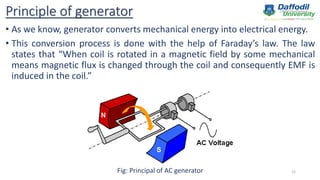
• As we know, generator converts mechanical energy into electrical energy.
• This conversion process is done with the help of Faraday’s law. The law
states that “When coil is rotated in a magnetic field by some mechanical
means magnetic flux is changed through the coil and consequently EMF is
induced in the coil.”
Fig: Principal of AC generator 12
Principle of generator
•Generator uses mechanical energy supplied to it to
force the movement of electric charges present in the
wire of its windings through an external electric circuit.
This flow of electric charges constitutes the output
electric current supplied by the generator.
•The principal of all of the generators is same, although
the detail of construction may be differ somewhat.
13
Uses of generator
• Backup power for house
• Standby power for businesses
• Temporary power on a construction site
• Permanent power :A farm
• Helping mains to supply total power required
• Pop concerts, events and exhibitions
• Caravans/Camping in remote locations
14
Advantage and disadvantage of generators
Advantage
• Power producing ability.
• Durability.
• Use of electricity.
Disadvantage
• Effect on environment.
• Power storage capacity.
• Maintenance cost.
• Automatically run.
15
Thank you
16

Generator and its all about

  • 1.
    Course code: PHY-101 Coursename: Physics-1 Presenter id: 181-23-52701 Presentation on Generator
  • 2.
    Outline • Introduction. • Historyand evolution of generators. • Classification of generator. • Main components of generator. • Principle of generator. • Uses of generator. • Advantages and disadvantages of generators. 2
  • 3.
    Introduction Generator is amachine by which mechanical energy is transformed into electrical energy by rotating a coil of wire in a magnetic field. MECHANICAL ENERGY GENERATOR ELECTRICAL ENERGY 3
  • 4.
    History and evolutionof generators • Michel Faraday and Hippolyte Pixii were pioneers who invented early mechanics like generator in the years of 1831–1832. • He also built the first electromagnetic generator called the Faraday disk, using a copper disc rotating between the poles of a horseshoe magnet. It produced a small DC voltage. • This design was inefficient, due to self-cancelling counter flow of current in regions of the disk that were not under fig: Faraday’s disk the influence of the magnetic field. 4
  • 5.
    History and evolutionof generator • There are following stages of evolution of generators . i. Electrostatic generator. ii. Invention of Dynamos. iii. Alternators and their evolution. 5
  • 6.
    Electrostatic Generators • Beforethe connection between electricity and magnetism was discovered Electrostatic generators were invented. • They were never used for commercial power generation and were left due to inefficiency and difficulty. fig: Electrostatic generator 6
  • 7.
    Dynamos • Dynamos useelectromagnetic principles to convert mechanical rotation into a pulsating direct electric current through use of a commutator. • 1st dynamo was built by Hippolyte pixii in 1832. fig: Dynamos 7
  • 8.
    Alternators • After thatalternating current generators were invented, 1st two phase AC generators was build by J.E.H.Gordon in 1882. • In 1886 1st public demonstration of Alternator system was given. • Nicola Tesla done very useful work in evolution of alternators. • Lord Kelvin and Sebastian Ferranti also fig: Alternator done some work. 8
  • 9.
    Classification of generator •According to output, generator can be divided into two type AC generator DC generator • For power generator, it can be divided into four type EMD generator Diesel generator Portable generator Natural gas generator 9
  • 10.
    Classification of generator •According to mechanical work input generators can also be classified. As engine generators, human powered generators, turbine generators and windmill generators. • Mainly used generators are engine generators. They use engine, which provides mechanical energy by use of chemical energy provided by different chemicals as Gasoline, Propane, Diesel fuel and Natural gas. 10
  • 11.
    Main components ofgenerator 1.Engine 2.Alternator 3.Fuel system 4.Voltage regulator 5.Cooling and exhaust systems 6.Lubrication system 7.Battery charger 8.Control panel 9. Frame 11
  • 12.
    Principle of generator •As we know, generator converts mechanical energy into electrical energy. • This conversion process is done with the help of Faraday’s law. The law states that “When coil is rotated in a magnetic field by some mechanical means magnetic flux is changed through the coil and consequently EMF is induced in the coil.” Fig: Principal of AC generator 12
  • 13.
    Principle of generator •Generatoruses mechanical energy supplied to it to force the movement of electric charges present in the wire of its windings through an external electric circuit. This flow of electric charges constitutes the output electric current supplied by the generator. •The principal of all of the generators is same, although the detail of construction may be differ somewhat. 13
  • 14.
    Uses of generator •Backup power for house • Standby power for businesses • Temporary power on a construction site • Permanent power :A farm • Helping mains to supply total power required • Pop concerts, events and exhibitions • Caravans/Camping in remote locations 14
  • 15.
    Advantage and disadvantageof generators Advantage • Power producing ability. • Durability. • Use of electricity. Disadvantage • Effect on environment. • Power storage capacity. • Maintenance cost. • Automatically run. 15
  • 16.