International Research Journal of Engineering and Technology (IRJET) e-ISSN: 2395-0056
Volume: 06 Issue: 09 | Sep 2019 www.irjet.net p-ISSN: 2395-0072
© 2019, IRJET | Impact Factor value: 7.34 | ISO 9001:2008 Certified Journal | Page 474
Automatic Power Factor Correction
Miss Aaiman S Shaikh1, Prof. Laxman S Patil2
1Student of Department of Electrical Engineering, Padmabhooshan Vasantraodada Patil institute technology,
Budhgaon, India
2Associate Professor of Department of Electrical Engineering, Padmabhooshan Vasantraodada Patil institute
technology, Budhgaon, India
---------------------------------------------------------------------***----------------------------------------------------------------------
Abstract - A low power factor leads to an increase in losses
and draws penalty by the utility. Modern industry
implementing the mechanized methodscansuffersfromlower
power factor due to the use of different electric equipment
which requires more reactive power. Significant savings in
utility power costs can be understood by keeping up an
average monthly power factor close to unity. The above
drawback is overcome by the PFC. Power factor correction
(PFC) is a technique of reducing the undesirable effects of
electric loads that create a power factor which are less than
one. In this paper an Automatic Power Factor Correction
(APFC) Unit is build which monitors the power factor and
automatically it corrects the power factor. Power factor
correction is a method of reducing undesirable adverseeffects
of electric loads that causes a power factor to be less than one.
In this t an Automatic Power Factor Correction Unit is build
which monitors the power factor andautomatically itcorrects
the power factor. The phase differences between voltage and
current are determined using zero crossing detectors with
some basic functions of microcontroller.
Key Words: power factor, capacitor bank, relay, micro
controller, rectifier, current transformer, potential
transformer
1. INTRODUCTION
Power quality of an A.C system is much concerned because
of the rapidly increasing numbers of electronic equipment’s,
high voltage power system and power electronics. All
commercial and industrial installation in India have a large
electrical load that are most probably inductive in nature.
This causes lagging power factor that gives high penalties to
consumers. The high penalty situation is tackled by the
Power Factor Control. Power Factor Control is a method of
reducing the disagreeable effect of loads that causes power
factor to drop down to lesser than one.
In A.C circuits, the power factor can be described as a
proportion of the actual (Real)powerthatdoesthework and
the Apparent power which is provided to the circuit. Real
power is well-characterized as the circuit’s capacity for
performing work in a specific time. Moreover, apparent
power is known as the current and voltage product of the
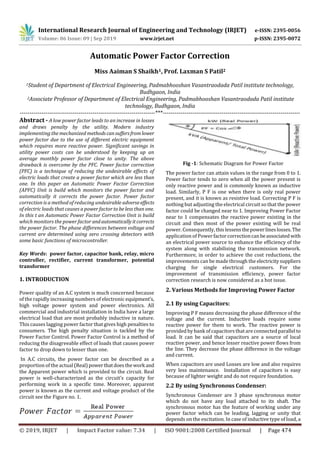
circuit see the Figure no. 1.
Fig -1: Schematic Diagram for Power Factor
The power factor can attain values in the range from 0 to 1.
Power factor tends to zero when all the power present is
only reactive power and is commonly known as inductive
load. Similarly, P F is one when there is only real power
present, and it is known as resistive load. Correcting P F is
nothing but adjusting the electrical circuit so that the power
factor could be changed near to 1. Improving Power Factor
near to 1 compensates the reactive power existing in the
circuit and then most of the power existing will be real
power. Consequently,thislessensthepowerlineslosses.The
application of Powerfactorcorrectioncanbeassociated with
an electrical power source to enhance the efficiency of the
system along with stabilising the transmission network.
Furthermore, in order to achieve the cost reductions, the
improvements can be made through the electricitysuppliers
charging for single electrical customers. For the
improvement of transmission efficiency, power factor
correction research is now considered as a hot issue.
2. Various Methods for Improving Power Factor
2.1 By using Capacitors:
Improving P F means decreasing the phase difference of the
voltage and the current. Inductive loads require some
reactive power for them to work. The reactive power is
provided by bank ofcapacitors that are connected parallelto
load. It can be said that capacitors are a source of local
reactive power, and hence lesser reactive power flows from
the line. They decrease the phase difference in the voltage
and current.
When capacitors are used Losses are low and also requires
very less maintenance. Installation of capacitors is easy
because of lighter weight and do not require foundation.
2.2 By using Synchronous Condenser:
Synchronous Condenser are 3 phase synchronous motor
which do not have any load attached to its shaft. The
synchronous motor has the feature of working under any
power factor which can be leading, lagging or unity that
depends on the excitation. In case of inductive type of load, a
International Research Journal of Engineering and Technology (IRJET) e-ISSN: 2395-0056
Volume: 06 Issue: 09 | Sep 2019 www.irjet.net p-ISSN: 2395-0072
© 2019, IRJET | Impact Factor value: 7.34 | ISO 9001:2008 Certified Journal | Page 475
synchronous condenser is connected at load side and is then
overexcited. They behave as a capacitor when they are over
excited. When suchmachineisconnectedparalleltosupply,it
takes leading current which partly neutralizes lagging
reactive component of the load thus power factor is
improved. By using synchronous condenser high Controlon
power factor and also have higher thermal stability. The
faults can be eliminated easily. Losses occur in the motor. It
has high maintenance cost.
2.3 Phase Advancer:
This is an A C exciter which is mainly used for improvement
of power Factor of the induction motor. Phase advancers are
used suitably when synchronousmotoruseisnotadmissible.
Phase advancers are uneconomical for motorsthatareunder
200HP
3. Methodology for power factor computation and
penalty and incentive sept 2018
Power Factor is computed as:
If Power Factor Level isless than 0.90thenpenaltyshallbeas
per percentage given in MERC order.
• If Power Factor is more than 0.95 and RKVAH Lag
consumption >= RKVAH Leadconsumption,thenincentiveis
as per percentage given in MERC order.
• If Power Factor is more than 0.95 and RKVAH Lag
consumption < RKVAH LeadConsumption,thenincentiveis
not applicable.
• If the RKVAH Lead reading is not available, then the old
procedure of power factor consumption will be followed.
There is Change in percentage of Power Factor penalty and
incentive as follows:
Power Factor Incentive:
Table -1: Power Factor incentives
Power Factor Old % New %
0.95 0 0
0.96 1 0.5
0.97 2 1
0.98 3 1.5
0.99 5 2.5
1 7 3.5
Table-2: Power Factor Penalty (For Lead as well as
Lag):
Power Factor Old % New %
0.90 0 0
0.89 2 1
0.88 3 1.5
0.87 4 2
0.86 5 2.5
0.85 6 3
4. PROPOSED SYSTEM
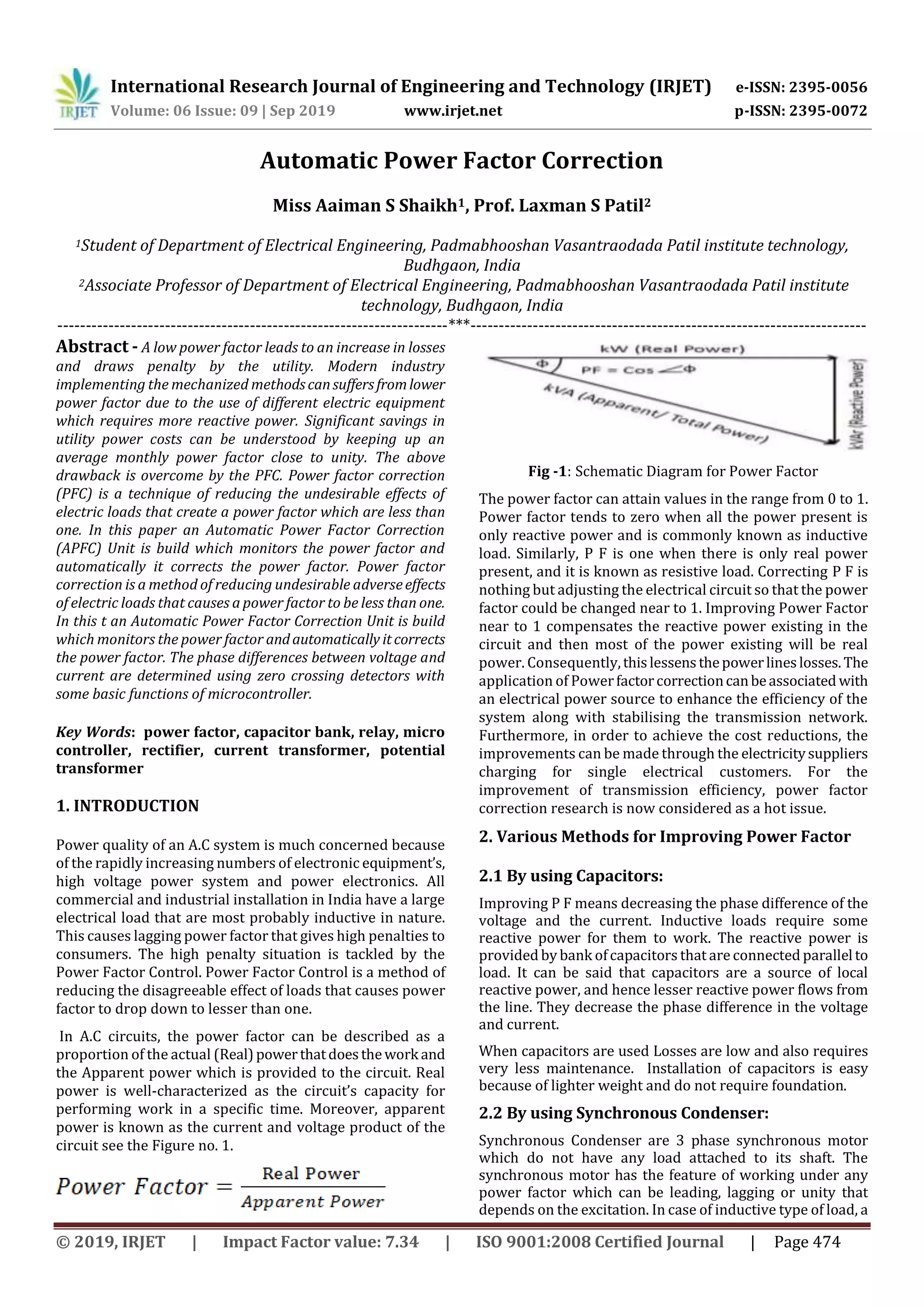
Fig -2: Block Diagram of Automatic Power Factor
Correction unit
The completeautomatic power factor correction unitconsist
of following parts
4.1 Power supply
Most of time embedded system circuit uses 12 volts. 5-volt
DC is used as its operating voltage. It’s necessary to change
the 230 Volt A C supply to the essential D C supply. Firstly 12
volts ac supply is obtained byusingstepdowntransformerby
reducing the 230 Volt supply to 12 volts. In this project the
potential transformer (PT) outputs can be used in its place
rather than going for another different step-down
transformer. By rectification process, the 12 Volts A C is
converted in to a 12 Volts pulsating DC voltage.Thepulsating
D C is then sent to a capacitive filter for smoothening and a
standard 12 Volt DC is obtained as a output.
4.2 Potential transformer
They convert A.C from one level to another voltage level
along with some loss of power. The P T utilizes a step-down
transformer to lessen hazardously higher voltage to a more
securelowervoltageinanysubstation.PotentialTransformer
used in automatic power factor correction project steps-
down the supply voltage from 230 V to 12 V as needed by
circuit to work. Potential Transformers output is usually
used for measuring and also various monitoring purposes.
4.3 Current transformer
In an electrical circuit,currents is measured by usinga C T.At
point when current is exceptionallyhightostraightforwardly
apply to measuring instruments, the C T creates a decreased
International Research Journal of Engineering and Technology (IRJET) e-ISSN: 2395-0056
Volume: 06 Issue: 09 | Sep 2019 www.irjet.net p-ISSN: 2395-0072
© 2019, IRJET | Impact Factor value: 7.34 | ISO 9001:2008 Certified Journal | Page 476
current, that can be suitably connected with measuring and
recording instruments. C T that are used in the circuit also
protects the measuring instruments from an exceptionally
higher voltage. C T are mostly used in metering devices. and
also, in protective relays
4.4 Capacitor bank
Shunt capacitor banks basically is utilized for the
improvement ofthePFinelectricalnetwork.Capacitorbanks
are also used forthe improvement ofthevoltagestabilityand
decrease network losses. Shunt capacitor banks are not
expensive. Shunt capacitors installation can be done easily
anywhere on the network. Depending on the necessity of
reactive power, capacitor bank which consist of shunt
capacitors are made ON or OFF. With the usage of relays the
switching can be done by manual way or automatically.
4.5 Microcontroller
An embedded system is not effective without logical
processing. The microcontrollers take the responsibility of
logical processing hence can be seen as a heat of an
embedded system. They do majority of the work starting
from taking the data or instructions in, processing it
according the programme written and finally provide the
output to complete the required function. It is worthy to
mention another positive characteristic of the embedded
system such as chip memory. This allows the system to store
sometemporarilyvariablesduringtheprocessingprocedures
to smoothen the process. The PIC microcontroller
PIC16f877a is one of the most well-known microcontrollers.
This microcontroller is very suitable to use. The main benefit
is that it can be write or can be erased as many times as
possible because it uses FLASH memory technology.
4.6 Relay unit
Relay unit contains a relay driver and some relays. The relay
unit controls the high-power circuit froma low powercircuit
because microcontroller’s output cannot control direct
switching of capacitors. Relay is defined as an electrically
operated switch. When there is a need to control in a circuit
by a low power signal in such cases relays are used. Current
that passes from coil of relay generates a magnetic field that
gets attracted towardslever and then the switchcontactsare
changed. Connections of relay's switch are Common,
Normally Open (NO), normally closed (NC).
Relay coil is not operated by the current provided by the
output of microcontroller as current is insufficient. Relay
driver ULN2003 is used for the operation of the relay.
ULN2003 is a mono-lithic higher voltage and higher current
Darlington transistor array.
4.7 DISPLAY UNIT
An embedded system communicates directly to a human
being by use of input and output devices. It should be noticed
that in an embedded system, the interaction is instigated by
the microcontrollers. The system uses input and output
devices those generate direct communications with human
being. LCD display can be considered as the most common
devices that is connected to the microcontroller. Specifying
the types of LCD displays, 16x2 and 20x4 are the most
common ones connectedtothemicrocontrollers.Thesedigits
indicate the numbers of the characters and the numbers of
the lines. For example, a 16x2 LCD display contains 16
characters and 2 lines made available to use. Similarly, 20x4
LCD display indicates 20 characters and 4 lines made
accessible for use. In this project a 16x2 LCD display, is
considered.
5. HARDWARE IMPLEMENTATION
The P C B was made-up as per the diagram and then all the
components were soldered. The Potential transformer,
Current Transformer,capacitorbankweresolderedproperly
at their respective places. microcontroller was programmed
by using a burner. The C T is connected in series with load
and capacitor bank. Microcontroller determines both
magnitudes and phase difference of AC voltage and current .
Based on the measured values using formula P F of load is
calculated. The liquid crystal display is used to display the
improved P.F.
Fig -3: Hardware of Automatic Power Factor Control
6. Results
Figure 3 shows the whole hardware of Automatic Power
Factor Control Unit used for improving power factor. One of
the results is discussed below. Figure 3, when inductive load
was applied i.e. Choke is used in this case the measured P.F
was found to be 0.85 Lagging (refer the figure 4) and In
Figure 5, the P F is increased to 0.99 by adding capacitor in
parallel. The result shows theworking andideaof Automatic
Power Factor Correction by using capacitors.
International Research Journal of Engineering and Technology (IRJET) e-ISSN: 2395-0056
Volume: 06 Issue: 09 | Sep 2019 www.irjet.net p-ISSN: 2395-0072
© 2019, IRJET | Impact Factor value: 7.34 | ISO 9001:2008 Certified Journal | Page 477
Fig 4 Measured power factor
Fig 5. Showing corrected power factor on LCD
7. CONCLUSION
This project is implemented to automatically correct power
factor. Microcontroller used helps to sense the PowerFactor
by monitoring the load of the system, and according to the
lagging behavior of P F because of typeofloaditwill perform
the control action by switching capacitor bank through
different relays and improves the Power Factor of the load.
By improving Power Factor electricity bill can be reduced.
REFERENCES
[1] The 8051 Microcontroller and Embedded Systems” by
Muhammad Ali Mazidi and Janice Gillispie Mazidi.
[2] Ware, John. "POWER FACTOR CORRECTION."IET
Electrical. IEE Wiring Matters, spring2006.Web.14July
2016. Available at [www.electrical.theiet.org/wiring-
matters/18/powerfactor. cfm?type=pdf] .
[3] "POWER FACTOR CORRECTION."www.nhp.com.au.NHP
Catalogue - PFCSFC, Nov. 2007. Web. 14 July 2016.
Available at[https://portal.nhp.com.au/power-quality]
[4] "Power Factor Correction: A Guide for the Plant
Engineer."www.eaton.com/. Eaton Corporation, Aug.
2014. Web. 14 July 2016. Available at
[www.eaton.com/ecm/groups/public/@pub/.../sa0260
7001e.pdf]
[5] Mehta, V. K., and Rohit Mehta. Principles of Power
System: (including Generation, Transmission,
Distribution, Switchgear and Protection). 4th ed.
Chapter 9, New Delhi: S. Chand, 2005.
[6] Kulkarni Kaumudi, Kumbhar Pooja, Patil Priyanka,Prof.
Madhuri International Namjoshi, “Automatic power
factor correctionusingPICmicrocontroller”,Engineering
Research Journal (IERJ) Volume 2 Issue 1 Page 13-16,
ISSN 2395-1621, February 2016.

IRJET- Automatic Power Factor Correction

  • 1.
    International Research Journalof Engineering and Technology (IRJET) e-ISSN: 2395-0056 Volume: 06 Issue: 09 | Sep 2019 www.irjet.net p-ISSN: 2395-0072 © 2019, IRJET | Impact Factor value: 7.34 | ISO 9001:2008 Certified Journal | Page 474 Automatic Power Factor Correction Miss Aaiman S Shaikh1, Prof. Laxman S Patil2 1Student of Department of Electrical Engineering, Padmabhooshan Vasantraodada Patil institute technology, Budhgaon, India 2Associate Professor of Department of Electrical Engineering, Padmabhooshan Vasantraodada Patil institute technology, Budhgaon, India ---------------------------------------------------------------------***---------------------------------------------------------------------- Abstract - A low power factor leads to an increase in losses and draws penalty by the utility. Modern industry implementing the mechanized methodscansuffersfromlower power factor due to the use of different electric equipment which requires more reactive power. Significant savings in utility power costs can be understood by keeping up an average monthly power factor close to unity. The above drawback is overcome by the PFC. Power factor correction (PFC) is a technique of reducing the undesirable effects of electric loads that create a power factor which are less than one. In this paper an Automatic Power Factor Correction (APFC) Unit is build which monitors the power factor and automatically it corrects the power factor. Power factor correction is a method of reducing undesirable adverseeffects of electric loads that causes a power factor to be less than one. In this t an Automatic Power Factor Correction Unit is build which monitors the power factor andautomatically itcorrects the power factor. The phase differences between voltage and current are determined using zero crossing detectors with some basic functions of microcontroller. Key Words: power factor, capacitor bank, relay, micro controller, rectifier, current transformer, potential transformer 1. INTRODUCTION Power quality of an A.C system is much concerned because of the rapidly increasing numbers of electronic equipment’s, high voltage power system and power electronics. All commercial and industrial installation in India have a large electrical load that are most probably inductive in nature. This causes lagging power factor that gives high penalties to consumers. The high penalty situation is tackled by the Power Factor Control. Power Factor Control is a method of reducing the disagreeable effect of loads that causes power factor to drop down to lesser than one. In A.C circuits, the power factor can be described as a proportion of the actual (Real)powerthatdoesthework and the Apparent power which is provided to the circuit. Real power is well-characterized as the circuit’s capacity for performing work in a specific time. Moreover, apparent power is known as the current and voltage product of the circuit see the Figure no. 1. Fig -1: Schematic Diagram for Power Factor The power factor can attain values in the range from 0 to 1. Power factor tends to zero when all the power present is only reactive power and is commonly known as inductive load. Similarly, P F is one when there is only real power present, and it is known as resistive load. Correcting P F is nothing but adjusting the electrical circuit so that the power factor could be changed near to 1. Improving Power Factor near to 1 compensates the reactive power existing in the circuit and then most of the power existing will be real power. Consequently,thislessensthepowerlineslosses.The application of Powerfactorcorrectioncanbeassociated with an electrical power source to enhance the efficiency of the system along with stabilising the transmission network. Furthermore, in order to achieve the cost reductions, the improvements can be made through the electricitysuppliers charging for single electrical customers. For the improvement of transmission efficiency, power factor correction research is now considered as a hot issue. 2. Various Methods for Improving Power Factor 2.1 By using Capacitors: Improving P F means decreasing the phase difference of the voltage and the current. Inductive loads require some reactive power for them to work. The reactive power is provided by bank ofcapacitors that are connected parallelto load. It can be said that capacitors are a source of local reactive power, and hence lesser reactive power flows from the line. They decrease the phase difference in the voltage and current. When capacitors are used Losses are low and also requires very less maintenance. Installation of capacitors is easy because of lighter weight and do not require foundation. 2.2 By using Synchronous Condenser: Synchronous Condenser are 3 phase synchronous motor which do not have any load attached to its shaft. The synchronous motor has the feature of working under any power factor which can be leading, lagging or unity that depends on the excitation. In case of inductive type of load, a
  • 2.
    International Research Journalof Engineering and Technology (IRJET) e-ISSN: 2395-0056 Volume: 06 Issue: 09 | Sep 2019 www.irjet.net p-ISSN: 2395-0072 © 2019, IRJET | Impact Factor value: 7.34 | ISO 9001:2008 Certified Journal | Page 475 synchronous condenser is connected at load side and is then overexcited. They behave as a capacitor when they are over excited. When suchmachineisconnectedparalleltosupply,it takes leading current which partly neutralizes lagging reactive component of the load thus power factor is improved. By using synchronous condenser high Controlon power factor and also have higher thermal stability. The faults can be eliminated easily. Losses occur in the motor. It has high maintenance cost. 2.3 Phase Advancer: This is an A C exciter which is mainly used for improvement of power Factor of the induction motor. Phase advancers are used suitably when synchronousmotoruseisnotadmissible. Phase advancers are uneconomical for motorsthatareunder 200HP 3. Methodology for power factor computation and penalty and incentive sept 2018 Power Factor is computed as: If Power Factor Level isless than 0.90thenpenaltyshallbeas per percentage given in MERC order. • If Power Factor is more than 0.95 and RKVAH Lag consumption >= RKVAH Leadconsumption,thenincentiveis as per percentage given in MERC order. • If Power Factor is more than 0.95 and RKVAH Lag consumption < RKVAH LeadConsumption,thenincentiveis not applicable. • If the RKVAH Lead reading is not available, then the old procedure of power factor consumption will be followed. There is Change in percentage of Power Factor penalty and incentive as follows: Power Factor Incentive: Table -1: Power Factor incentives Power Factor Old % New % 0.95 0 0 0.96 1 0.5 0.97 2 1 0.98 3 1.5 0.99 5 2.5 1 7 3.5 Table-2: Power Factor Penalty (For Lead as well as Lag): Power Factor Old % New % 0.90 0 0 0.89 2 1 0.88 3 1.5 0.87 4 2 0.86 5 2.5 0.85 6 3 4. PROPOSED SYSTEM Fig -2: Block Diagram of Automatic Power Factor Correction unit The completeautomatic power factor correction unitconsist of following parts 4.1 Power supply Most of time embedded system circuit uses 12 volts. 5-volt DC is used as its operating voltage. It’s necessary to change the 230 Volt A C supply to the essential D C supply. Firstly 12 volts ac supply is obtained byusingstepdowntransformerby reducing the 230 Volt supply to 12 volts. In this project the potential transformer (PT) outputs can be used in its place rather than going for another different step-down transformer. By rectification process, the 12 Volts A C is converted in to a 12 Volts pulsating DC voltage.Thepulsating D C is then sent to a capacitive filter for smoothening and a standard 12 Volt DC is obtained as a output. 4.2 Potential transformer They convert A.C from one level to another voltage level along with some loss of power. The P T utilizes a step-down transformer to lessen hazardously higher voltage to a more securelowervoltageinanysubstation.PotentialTransformer used in automatic power factor correction project steps- down the supply voltage from 230 V to 12 V as needed by circuit to work. Potential Transformers output is usually used for measuring and also various monitoring purposes. 4.3 Current transformer In an electrical circuit,currents is measured by usinga C T.At point when current is exceptionallyhightostraightforwardly apply to measuring instruments, the C T creates a decreased
  • 3.
    International Research Journalof Engineering and Technology (IRJET) e-ISSN: 2395-0056 Volume: 06 Issue: 09 | Sep 2019 www.irjet.net p-ISSN: 2395-0072 © 2019, IRJET | Impact Factor value: 7.34 | ISO 9001:2008 Certified Journal | Page 476 current, that can be suitably connected with measuring and recording instruments. C T that are used in the circuit also protects the measuring instruments from an exceptionally higher voltage. C T are mostly used in metering devices. and also, in protective relays 4.4 Capacitor bank Shunt capacitor banks basically is utilized for the improvement ofthePFinelectricalnetwork.Capacitorbanks are also used forthe improvement ofthevoltagestabilityand decrease network losses. Shunt capacitor banks are not expensive. Shunt capacitors installation can be done easily anywhere on the network. Depending on the necessity of reactive power, capacitor bank which consist of shunt capacitors are made ON or OFF. With the usage of relays the switching can be done by manual way or automatically. 4.5 Microcontroller An embedded system is not effective without logical processing. The microcontrollers take the responsibility of logical processing hence can be seen as a heat of an embedded system. They do majority of the work starting from taking the data or instructions in, processing it according the programme written and finally provide the output to complete the required function. It is worthy to mention another positive characteristic of the embedded system such as chip memory. This allows the system to store sometemporarilyvariablesduringtheprocessingprocedures to smoothen the process. The PIC microcontroller PIC16f877a is one of the most well-known microcontrollers. This microcontroller is very suitable to use. The main benefit is that it can be write or can be erased as many times as possible because it uses FLASH memory technology. 4.6 Relay unit Relay unit contains a relay driver and some relays. The relay unit controls the high-power circuit froma low powercircuit because microcontroller’s output cannot control direct switching of capacitors. Relay is defined as an electrically operated switch. When there is a need to control in a circuit by a low power signal in such cases relays are used. Current that passes from coil of relay generates a magnetic field that gets attracted towardslever and then the switchcontactsare changed. Connections of relay's switch are Common, Normally Open (NO), normally closed (NC). Relay coil is not operated by the current provided by the output of microcontroller as current is insufficient. Relay driver ULN2003 is used for the operation of the relay. ULN2003 is a mono-lithic higher voltage and higher current Darlington transistor array. 4.7 DISPLAY UNIT An embedded system communicates directly to a human being by use of input and output devices. It should be noticed that in an embedded system, the interaction is instigated by the microcontrollers. The system uses input and output devices those generate direct communications with human being. LCD display can be considered as the most common devices that is connected to the microcontroller. Specifying the types of LCD displays, 16x2 and 20x4 are the most common ones connectedtothemicrocontrollers.Thesedigits indicate the numbers of the characters and the numbers of the lines. For example, a 16x2 LCD display contains 16 characters and 2 lines made available to use. Similarly, 20x4 LCD display indicates 20 characters and 4 lines made accessible for use. In this project a 16x2 LCD display, is considered. 5. HARDWARE IMPLEMENTATION The P C B was made-up as per the diagram and then all the components were soldered. The Potential transformer, Current Transformer,capacitorbankweresolderedproperly at their respective places. microcontroller was programmed by using a burner. The C T is connected in series with load and capacitor bank. Microcontroller determines both magnitudes and phase difference of AC voltage and current . Based on the measured values using formula P F of load is calculated. The liquid crystal display is used to display the improved P.F. Fig -3: Hardware of Automatic Power Factor Control 6. Results Figure 3 shows the whole hardware of Automatic Power Factor Control Unit used for improving power factor. One of the results is discussed below. Figure 3, when inductive load was applied i.e. Choke is used in this case the measured P.F was found to be 0.85 Lagging (refer the figure 4) and In Figure 5, the P F is increased to 0.99 by adding capacitor in parallel. The result shows theworking andideaof Automatic Power Factor Correction by using capacitors.
  • 4.
    International Research Journalof Engineering and Technology (IRJET) e-ISSN: 2395-0056 Volume: 06 Issue: 09 | Sep 2019 www.irjet.net p-ISSN: 2395-0072 © 2019, IRJET | Impact Factor value: 7.34 | ISO 9001:2008 Certified Journal | Page 477 Fig 4 Measured power factor Fig 5. Showing corrected power factor on LCD 7. CONCLUSION This project is implemented to automatically correct power factor. Microcontroller used helps to sense the PowerFactor by monitoring the load of the system, and according to the lagging behavior of P F because of typeofloaditwill perform the control action by switching capacitor bank through different relays and improves the Power Factor of the load. By improving Power Factor electricity bill can be reduced. REFERENCES [1] The 8051 Microcontroller and Embedded Systems” by Muhammad Ali Mazidi and Janice Gillispie Mazidi. [2] Ware, John. "POWER FACTOR CORRECTION."IET Electrical. IEE Wiring Matters, spring2006.Web.14July 2016. Available at [www.electrical.theiet.org/wiring- matters/18/powerfactor. cfm?type=pdf] . [3] "POWER FACTOR CORRECTION."www.nhp.com.au.NHP Catalogue - PFCSFC, Nov. 2007. Web. 14 July 2016. Available at[https://portal.nhp.com.au/power-quality] [4] "Power Factor Correction: A Guide for the Plant Engineer."www.eaton.com/. Eaton Corporation, Aug. 2014. Web. 14 July 2016. Available at [www.eaton.com/ecm/groups/public/@pub/.../sa0260 7001e.pdf] [5] Mehta, V. K., and Rohit Mehta. Principles of Power System: (including Generation, Transmission, Distribution, Switchgear and Protection). 4th ed. Chapter 9, New Delhi: S. Chand, 2005. [6] Kulkarni Kaumudi, Kumbhar Pooja, Patil Priyanka,Prof. Madhuri International Namjoshi, “Automatic power factor correctionusingPICmicrocontroller”,Engineering Research Journal (IERJ) Volume 2 Issue 1 Page 13-16, ISSN 2395-1621, February 2016.