
1
2
EV Architecture,
Components
EV-103
This course is presented as part of Evannex
University—a free, open learning
environment that presents concise, video-
based mini-courses for those who have
interest in electric vehicles (EVs) …
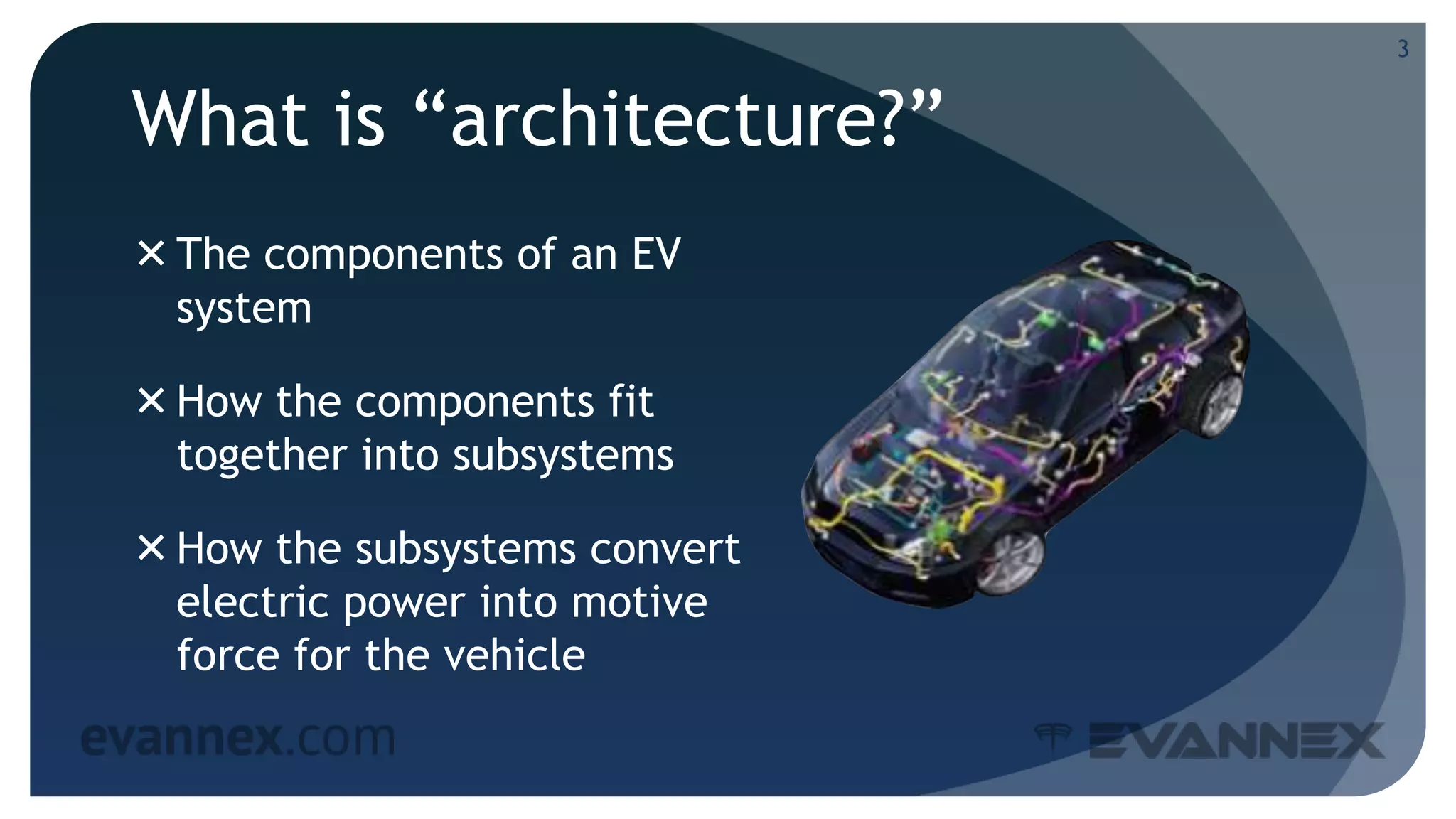
What is “architecture?”
The components of an EV
system
How the components fit
together into subsystems
How the subsystems convert
electric power into motive
force for the vehicle
3
BEV Architecture
BEV Architecture
The Battery
 The “Heart” of an EV
 The bigger and better the battery,
the better the EV
 Bigger? Not size, but storage capacity
measured in kWh
 Better? Not size, but recharge time
measured in hours and minutes
The Electric Motor
The stator
The rotor
Current creates a magnetic
field
AC causes field to vary
between N and S
The rotor “chases” the
magnetic field and rotates
7
Source: Tesla Motors
The Electric Motor
 Smaller number of moving parts,
leading to better reliability over
time
 Instant torque (power) and
variable speed—meaning no need
for a transmission
 Very efficient: 80 – 90% vs. 20 –
30% for ICE
 Zero emissions
Electric Motor—Benefits
• the electric motor can be
electronically modified
• engine performance
enhancements can often be
achieved with software and
control electronics
• an electric motor rotates around
a single axis
• we’ve been building and using
electric motors for over 100
years
9
Control Electronics
The controller performs the following
functions:
 transforms DC to AC (when required)
and regulates the energy flow from the
battery.
 reverses the motor rotation
 converts the motor into a generator
“The electric vehicle controller is the electronics
package that operates between the batteries and
the motor to control the electric vehicle's speed
and acceleration, much like a carburetor does in a
gasoline-powered vehicle.
U.S Department of Energy
Regenerative Braking
 When a car is moving, it has “kinetic
energy”
 When you brake a conventional car,
the kinetic energy is dissipated as
heat (through the brakes) and the car
slows and stops
 When you brake an EV, the kinetic
energy is transformed into electrical
energy and used to recharge the
battery
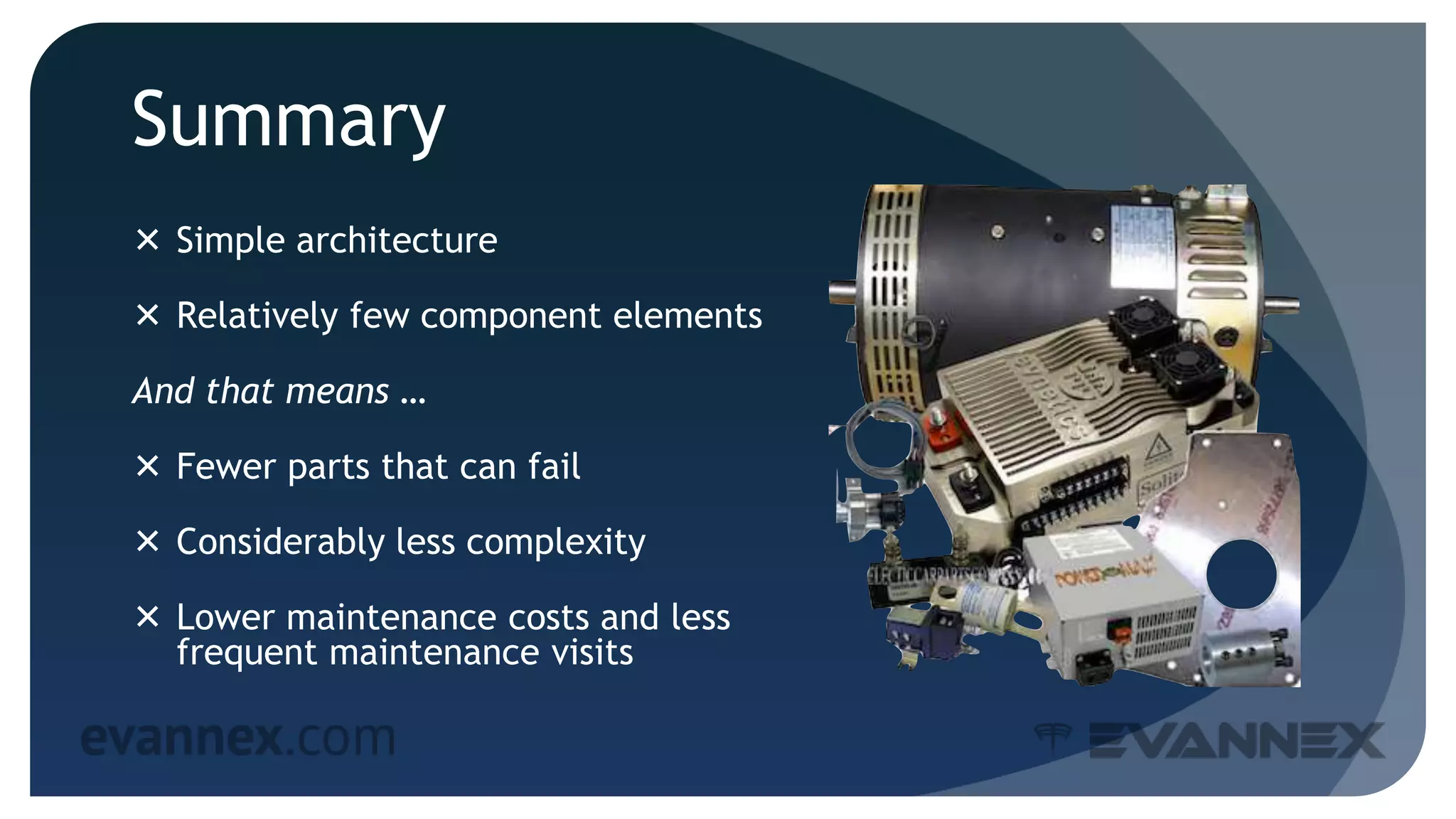
Summary
 Simple architecture
 Relatively few component elements
And that means …
 Fewer parts that can fail
 Considerably less complexity
 Lower maintenance costs and less
frequent maintenance visits
13
… a free study guide for
all EVU mini-courses is
available for download
from our website …
For a complete list of mini-
courses and the study guide,
visit: www.evannex.com

Electric Vehicle University - 103 EV ARCHITECTURE, COMPONENTS

  • 1.
  • 2.
    2 EV Architecture, Components EV-103 This courseis presented as part of Evannex University—a free, open learning environment that presents concise, video- based mini-courses for those who have interest in electric vehicles (EVs) …
  • 3.
    What is “architecture?” Thecomponents of an EV system How the components fit together into subsystems How the subsystems convert electric power into motive force for the vehicle 3
  • 4.
  • 5.
  • 6.
    The Battery  The“Heart” of an EV  The bigger and better the battery, the better the EV  Bigger? Not size, but storage capacity measured in kWh  Better? Not size, but recharge time measured in hours and minutes
  • 7.
    The Electric Motor Thestator The rotor Current creates a magnetic field AC causes field to vary between N and S The rotor “chases” the magnetic field and rotates 7 Source: Tesla Motors
  • 8.
    The Electric Motor Smaller number of moving parts, leading to better reliability over time  Instant torque (power) and variable speed—meaning no need for a transmission  Very efficient: 80 – 90% vs. 20 – 30% for ICE  Zero emissions
  • 9.
    Electric Motor—Benefits • theelectric motor can be electronically modified • engine performance enhancements can often be achieved with software and control electronics • an electric motor rotates around a single axis • we’ve been building and using electric motors for over 100 years 9
  • 10.
    Control Electronics The controllerperforms the following functions:  transforms DC to AC (when required) and regulates the energy flow from the battery.  reverses the motor rotation  converts the motor into a generator “The electric vehicle controller is the electronics package that operates between the batteries and the motor to control the electric vehicle's speed and acceleration, much like a carburetor does in a gasoline-powered vehicle. U.S Department of Energy
  • 11.
    Regenerative Braking  Whena car is moving, it has “kinetic energy”  When you brake a conventional car, the kinetic energy is dissipated as heat (through the brakes) and the car slows and stops  When you brake an EV, the kinetic energy is transformed into electrical energy and used to recharge the battery
  • 12.
    Summary  Simple architecture Relatively few component elements And that means …  Fewer parts that can fail  Considerably less complexity  Lower maintenance costs and less frequent maintenance visits
  • 13.
    13 … a freestudy guide for all EVU mini-courses is available for download from our website … For a complete list of mini- courses and the study guide, visit: www.evannex.com

Editor's Notes

  • #4 In the context of an electric vehicle the term “architecture” refers to: >> The components of an EV system >> How the components fit together into subsystems >> How the subsystems convert electric power into motive force for the vehicle In this Evannex U mini-course, we’ll take a look a the basic elements of an EV architecture, and in the next mini-course in this sequence, we’ll examine how these elements can be organized into alternative architectures.
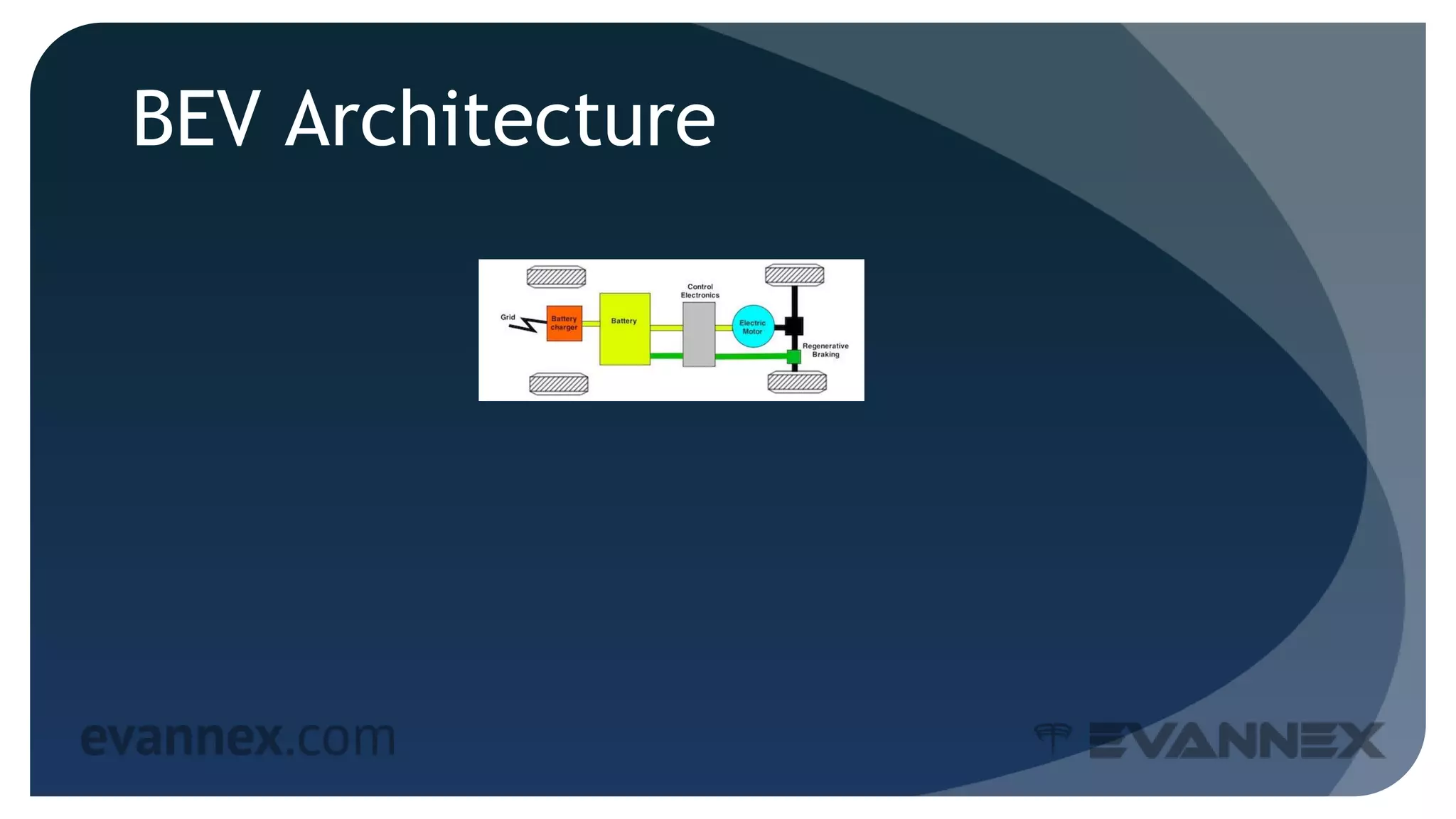
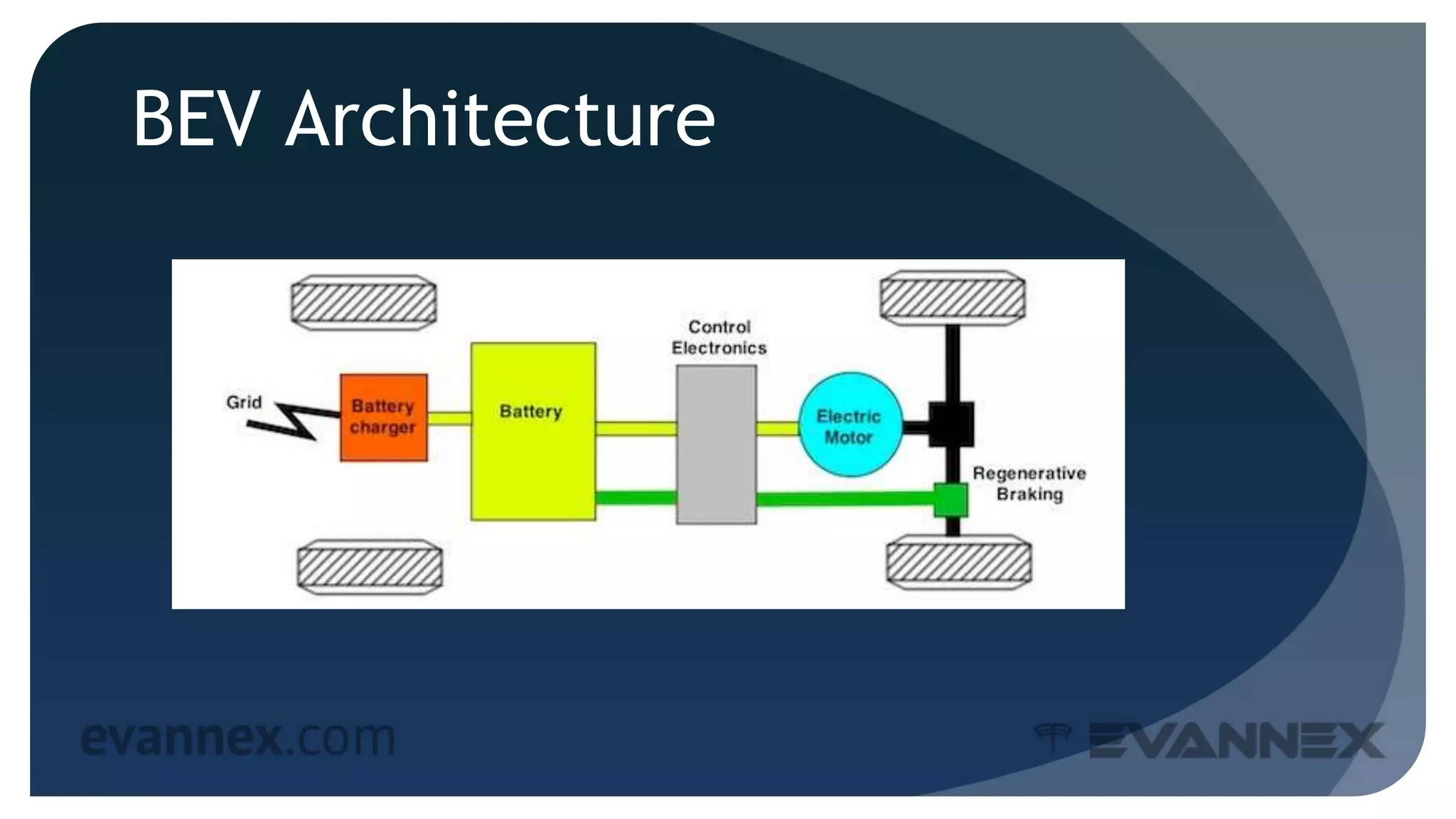
  • #5 The simplest of all EV architectures is the battery electric vehicle, the BEV. In a BEV, there is a limited set basic components associated with the propulsion of the vehicle.
  • #6 The simplest of all EV architectures is the battery electric vehicle, the BEV. In a BEV, there is a limited set of basic components associated with the propulsion of the vehicle. Looking at the diagram on your screen from left to right, - Electricity from the grid is conditioned by an charger (in orange) that may be part of the vehicle or a separate component. - The charger passes electricity to the battery (in yellow) - Energy stored in the battery is passed through control electronics (in grey) that moderate the energy flow and pass it to an electric motor - Regenerative braking (in green) translates kinetic energy of the car’s forward motion into electricity and returns energy to the battery Let’s take a look at each of these components in a bit more detail.
  • #7 In an earlier mini-course I mentioned that >> the battery is the heart of an EV. In fact, >> the bigger and better the battery, the better the EV – the higher its performance, the longer it's range, and the more utility it offers to the owner. But what do we mean by “bigger” and “better.” >> ‘Bigger’ doesn't refer to the size of the battery, but rather to its storage capacity measured in kilowatt ours. >> ‘Better’ refers to the battery’s ability to recharge quickly as measured in hours and minutes. Although battery storage capacity and recharge times have improved dramatically over the last decade, there is much to be done to improve them still further. But even today, storage capacity and recharge times are sufficient and make EVs competitive with ICE vehicles.
  • #8 The physics of an electric motor is a bit beyond the scope of this mini-course. But a few basics are important. >> Coils of copper wire run through a stack of thin steel plates and form a “stator.” >> The rotor is a steel shaft with copper bars running through it. It rotates, and ultimately, turns the wheels of the EV. But what makes the rotor rotate? >> The flow of alternating current into the copper windings of the stator creates a magnetic field. >> Alternating current causes the field to vary between N and S, appearing to move in a circular path >> The rotor “chases” the magnetic field and rotates as a consequence. Of course, there’s a bit more to it than that, but that should give you the general idea.
  • #9 The electric motor is the workhorse of modern industry, and will soon become an important motive force in the car industry. >> Electric motors are remarkably simple, have very few moving parts, and have extremely high reliability, partly due to the smaller number of moving parts. >> Electric motors have a square torque curve, meaning that you get impressive acceleration off the line And they are variable speed, meaning there is no need for a transmission, eliminating hundreds of parts that can and sometimes do fail in an ICE vehicle >> Electric motors are very efficient. ‘Efficiency’ is the degree to which a motor converts input energy to output power. For electric motors the efficiency is quite high -- in the range of 80 to 90%. The efficiency of Internal combustion engines is only in the 20 to 30% range -- a significant difference. >> Finally electric motors have zero emissions.
  • #10 There are even more benefits: >> the electric motor can be electronically modified enabling it to become a generator, allowing regenerative braking that converts the forward motion of the car (called kinetic energy) into electricity that recharges the battery >> engine performance enhancements can often be achieved with software and control electronics >> an electric motor rotates around a single axis, leading to reduced vibration and longer life. >>we’ve been building and using electric motors for over 100 years—this isn’t bleeding edge tech
  • #11 The US DoE describes the control electronic for an EV in the following manner: >> “The electric vehicle controller is the electronics package that operates between the batteries and the motor to control the electric vehicle's speed and acceleration, much like a carburetor does in an older gasoline-powered vehicle. >> The controller performs the following functions: - transforms DC current from the battery into AC (for AC motors) and regulates the energy flow from the battery. - reverses the motor rotation (so the vehicle can go in reverse) - converts the motor into a generator so that the kinetic energy can be used to recharge the battery during regenerative braking
  • #12 >> To get geeky for a moment, kinetic energy is a function of the car’s mass and its velocity squared. The mass of any car is huge, and the when a car is going fast, its velocity squared is also significant. That means there’s a lot of kinetic energy to capture. >> That’s why your brake pads become very, very hot as you brake. That’s unfortunate, because the kinetic energy of an ICE car is lost as heat, when it could be re-used. >> The transformation is really quite simple. The electric motor is electronically switched and becomes a generator that produces current that is sent back to the battery, recharging it. But be careful with your assumptions here. Not all of the kinetic energy is converted into current, because there are losses in the conversion. If there were no losses, EVs would be perpetual motion machines—and that’s impossible. But EVs do capture as much as 40 – 50 percent of the car’s kinetic energy and reuse it. And that’s pretty cool. As we’ll see in another EVU mini-course, it also makes driving an EV a bit different. Shockingly, you rarely need to hit your brakes!
  • #13 Let’s summarize …. >> The basic EV architecture is a simple architecture in automotive terms. That’s not to say that EVs don’t deliver sophisticated tech—they do! >> But the component parts of the architecture are relatively small in number. >> And that means … >> Fewer parts that can fail >> Considerably less complexity >> Lower maintenance costs and less frequent maintenance visits