ELECTRIC VEHICLES
Presentation
By Vaibhav Gautam
Roll No. 1804345
PRESENTATION TOPIC
• Parts of electric vehicle
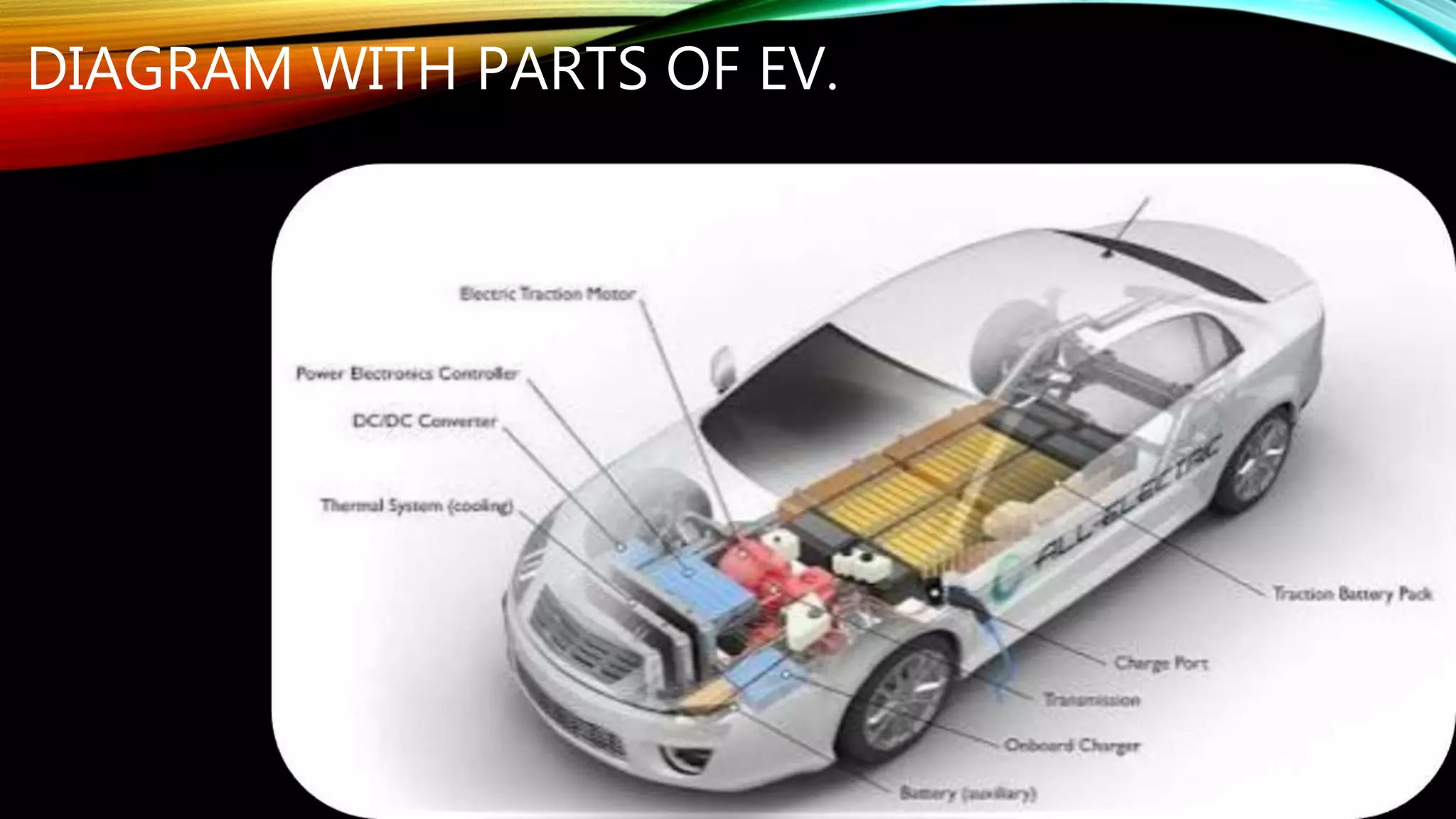
1. Electric motor(s)
2. Electric motor driver
3. Electric motor controller
4. Battery pack- 48/60/72V
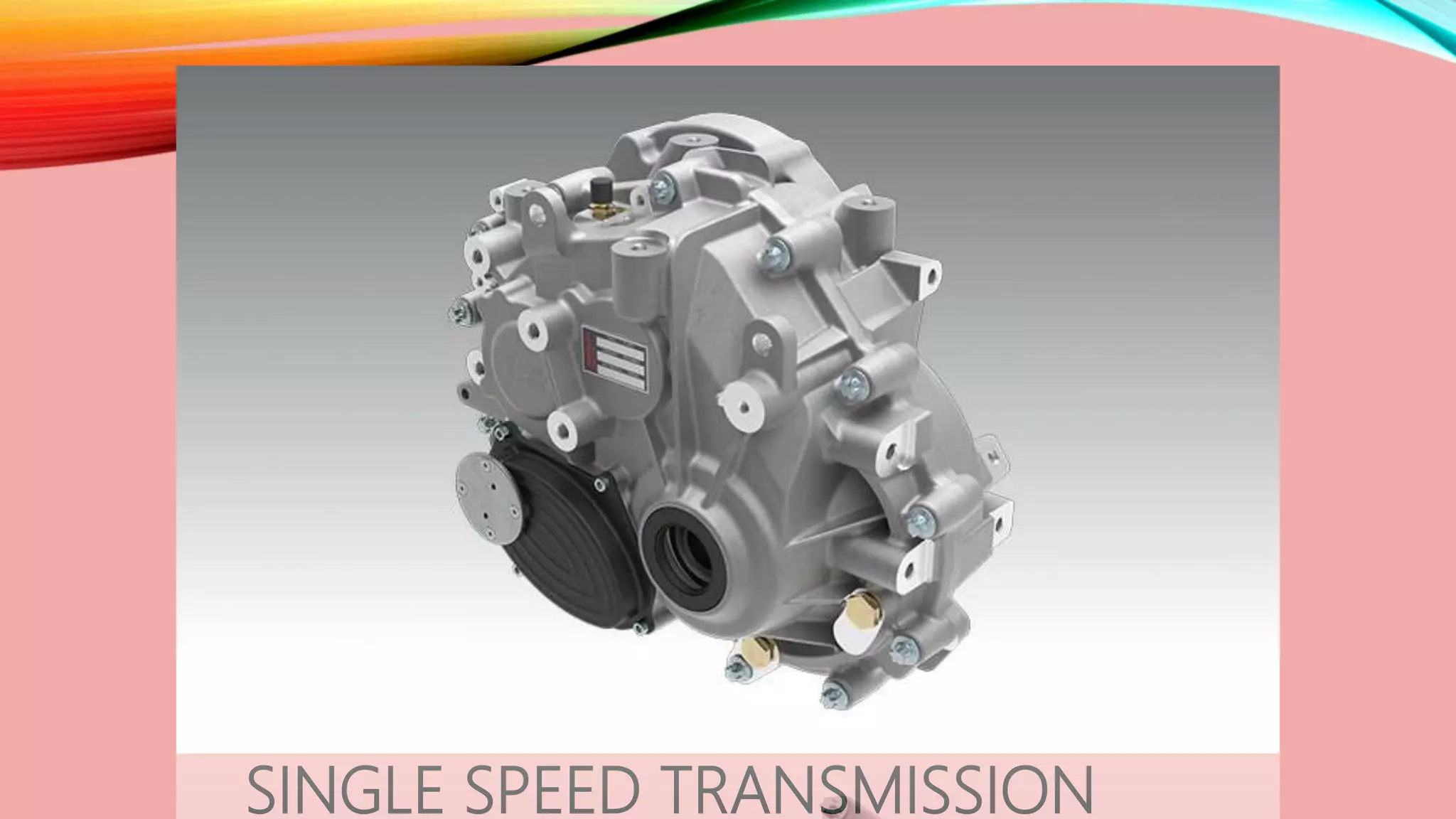
5. Single speed transmission(Optional)
6. Charging point for the batteries.
7. Brakes-hand, friction and regenerative
8. DC to DC converter */12V to run auxillaries like power window,
Smart truck , ac compressor etc
9. Joystick to choose run mode(fwd/neutral/reverse)
DIAGRAM WITH PARTS OF EV.
ELECTRIC CARS
Basic Principle
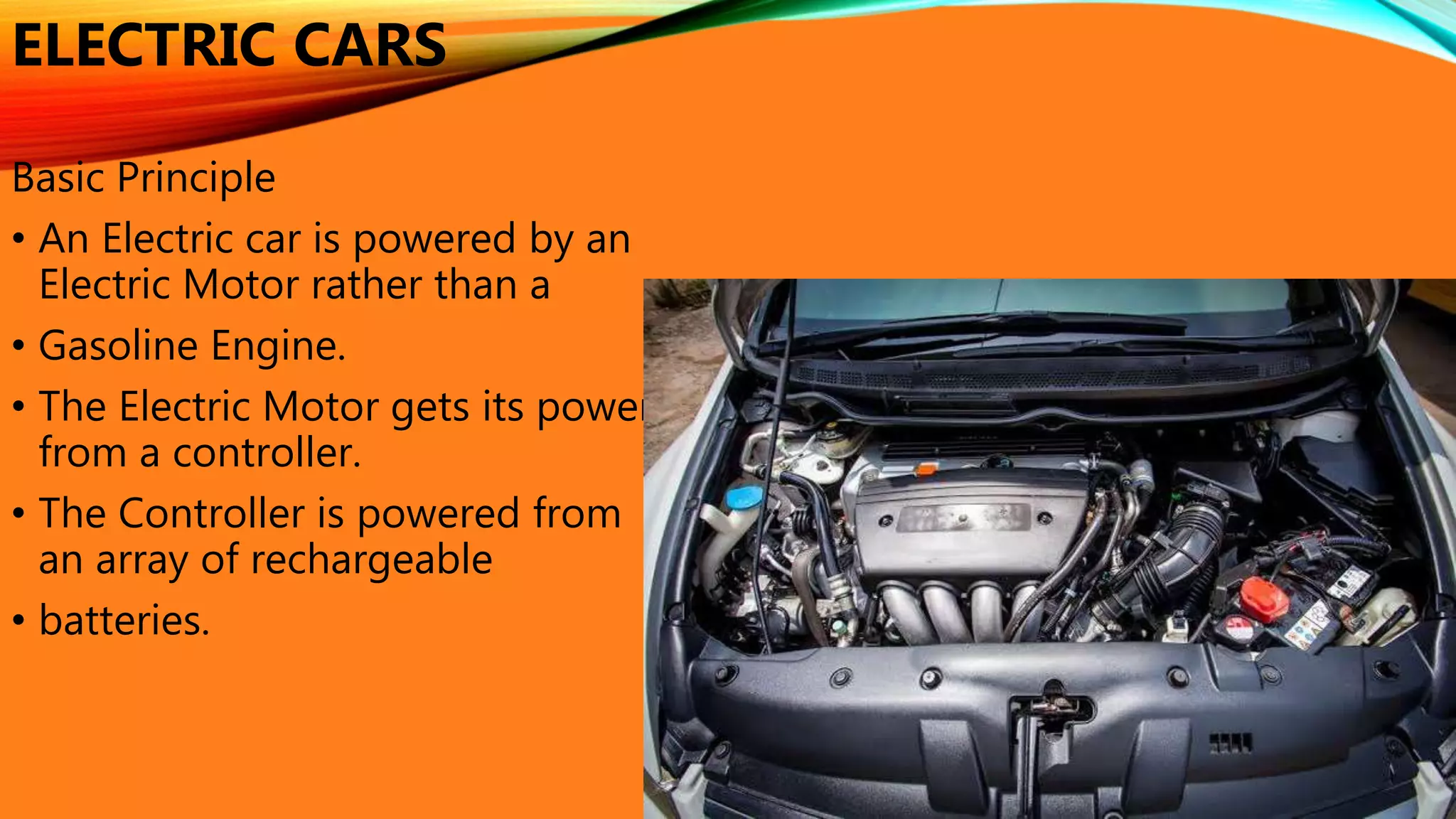
• An Electric car is powered by an
Electric Motor rather than a
• Gasoline Engine.
• The Electric Motor gets its power
from a controller.
• The Controller is powered from
an array of rechargeable
• batteries.
Charger Traction batteries DC-DC
Contactors
Speed pedal Motor controller Aux batteries
Contactors
Motors
Differential
MOTORS
• Electric cars can use AC as well as DC motors.
• DC motors run on a voltage ranging roughly between 96 to 192 volts. Most of
them come from Forklift Industry.
• DC installations are simpler.
• Another feature of DC motors is that they can be overdriven for short periods of
time (up to a factor of 10), which is good for short bursts of acceleration.
• One limitation is the heat build up. May lead to self destruction.
• Due to these limitations and other advantages provided by AC motors (like better
torque and speed output, for same weight and size DC motors are not usbrakin
• Any of the industrial 3 – phase AC motors can be used.
• They allow the use of regenerative braking.
AC MOTORS
Forklift motors
• The electric drive motor (a) reaches its
maximum torque as earlyy as the first
revolution. It does not require a start-up
phasee to reach idling speed.
• Once a specific rpm figure has been
reached, the available torquee falls as the
revs increase. This motor speed is
Approximately 14,000 rpm.
• These characteristics of an electric drive
motor mea thatt a complex transmission is
not required
ELECTRIC DRIVE
DRIVE WITH IN-WHEEL
MOTORS
•The wheels are connected
directly to the in wheel motors.
•The in-wheel concept is used
for electric scooters, electri
sbicycless and electrically
driven wheel chairs.
Features
• No drive shafts are required
• No differential transmission required
Advantages
• Four-wheel drive is technically possible
• Output axles of the in-wheel motors are directly on the wheel
• High efficiency because there are hardly any mechanical losses
Disadvantages
• Unsprung masses in the wheel are greater than wheels on a conventional
vehicle
• High mass of driven components (inertia and torque of whole vehicle
affected)
• Control is complex, both electric motors must run synchronous
CONTROLLERS
•The controller delivers a controlled
voltage to the motor, depending
upon potentiometer output.
•PWM controls the speed.
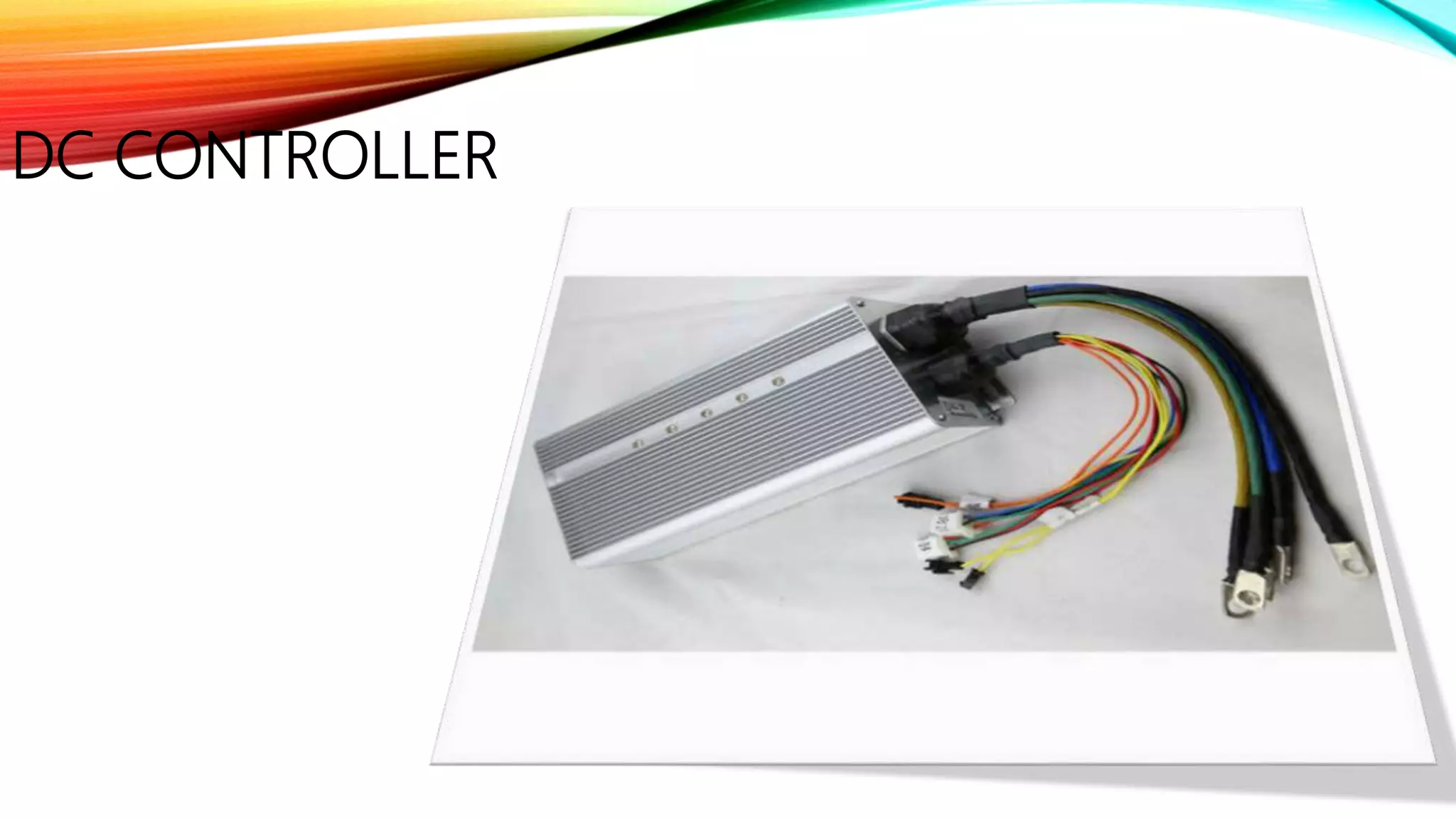
DC CONTROLLER
AC CONTROLLER
AC CONTROLLER
•An AC controller creates 3 pseudo sine waves
which are 120 degree apart (3-phase AC).
•Using six sets of power transistors, the controller
•takes in 300 volts DC and produces 240 volts AC,
•3-phase.
BATTERY PACK
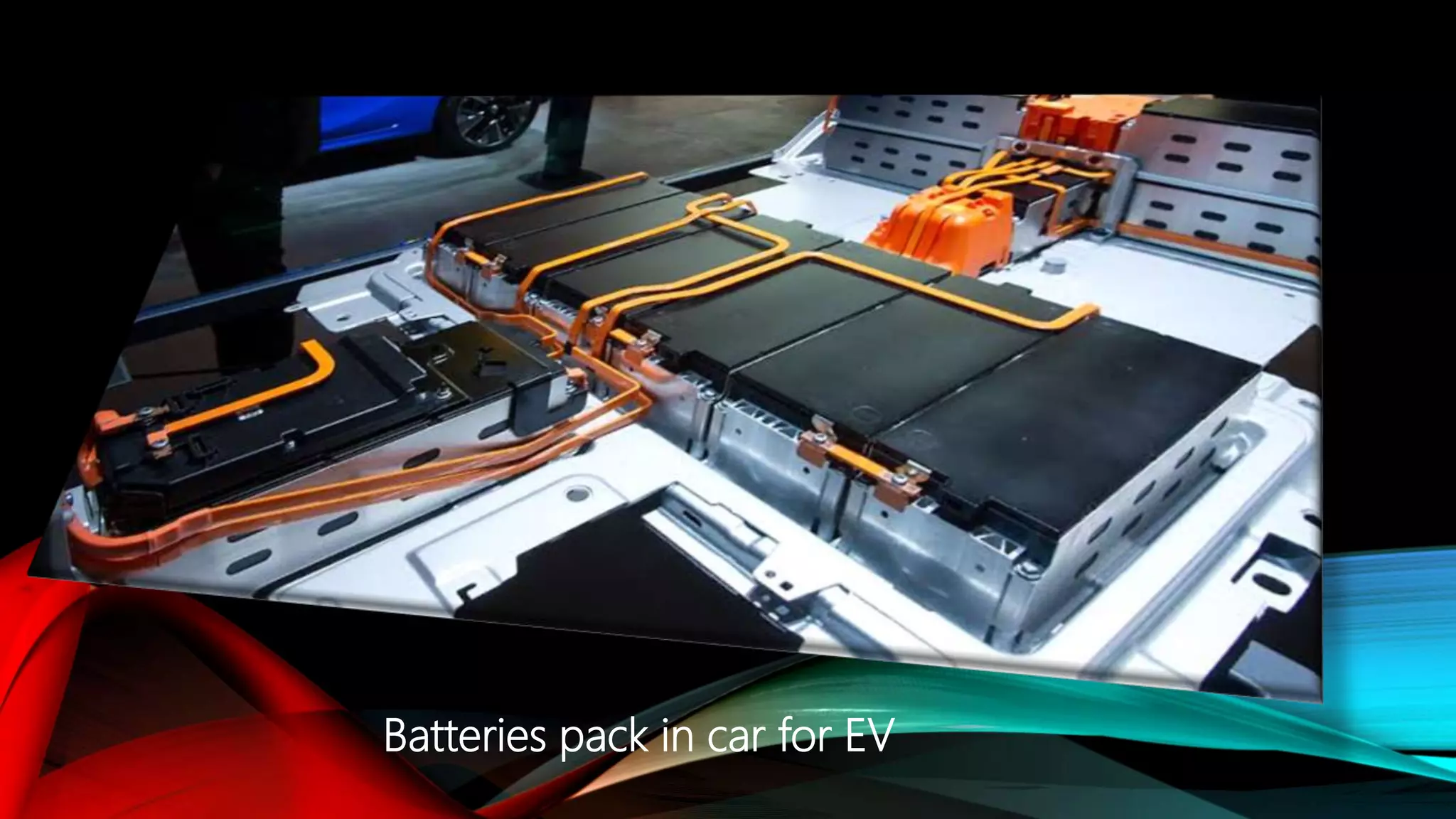
• 6831 standard 18650 Laptop Li--- ion cells.
• Supplies ~375V to motors, heating and air conditioning systems.
• Cooling system.
• Current capacity of each cell: 2100 mAh.
• Energy stored = 2100 mAh*3.7 V*6831 = 53kWh.
• Weight ~ 450 Kg.
• Energy/Weight ~ 120.
• Can be recharged easily with 110/220 V outlet.
Batteries pack in car for EV
• BATTERY PROBLEMS:
1. LONG RECHARGING TIME - REFUELING REQUIRED ONLY
MINUTES.
2. BATTERY WEIGHT - 100 POUND LEAD ACID BATTERIES = 1
POUND OF GASOLINE.
3. BATTERY COSTS.
TESLA ROADSTER: MOTOR
• Range concerns
• Price
• Consumer acceptance
• Market
1. A POWER TRANSFER SYSTEM INCLUDING A VARIABLE
SPEED ELECTRIC MOTOR AND A SINGLE SPEED TRANSMISSION IS
DISCLOSED FOR TRANSFERRING POWER FROM A SOURCE OF
POWER TO A PAIR OF DRIVEN WHEELS.
2. ELECTRIC VEHICLES INCORPORATING A HIGH SPEED ELECTRIC
MOTOR.
3. THE SINGLE SPEED TRANSMISSION INCLUDES A
HOUSING, AN INPUT SHAFT FOR RECEIVING DRIVE TORQUE
FROM THE ELECTRIC MOTOR.
4. LEAST ONE OUTPUT SHAFT AND AN INTERMEDIATE SHAFT
SUPPORTED FOR ROTATION OF THE HOUSING BETWEEN THE
INPUT SHAFT AND THE OUTPUT SHAFT.
Single speed transmission
5. THE SINGLE SPEED TRANSMISSION FURTHER
INCLUDES A PARKING SPRAG ARRANGEMENT
FOR PREVENTING ROTATION OF THE OUTPUT
SHAFT WHEN A PARK MODE IS SELECTED.
6. FIRST POSITION FOR PREVENTING RELATIVE
ROTATION BETWEEN THE INPUT SHAFT AND
THE OUTPUT SHAFT.
7. A SECOND POSITION FOR ESTABLISHING
RELATIVE ROTATION BETWEEN THE INPUT
SHAFT AND OUTPUT SHAFT.
SINGLE SPEED TRANSMISSION
CHARGING POINT FOR THE BATTERIES.
• The rate at which charging adds range to a PEV depends on the vehicle, the battery type,
and the type of EVSE. The following are typical rates for a light-duty vehicle:
• Level 1: 2 to 5 miles of range per hour of charging
• Level 2: 10 to 20 miles of range per hour of charging
• DC fast charging: 60 to 80 miles of range in 20 minutess of charging.
1. DC fast-charging EVSE (480-V AC input to the EVSE) enables rapid charging at sites such
as heavy traffic cor-ridors and public fueling stations (Figure 3, next minute A DC fast
charger can add 60 to 80 miles of range to a PEV in 20 minutes.
2. Charging Station
• There are many benefits to owning or hosting a charging station, which depend on your
site characteristics as well as your goals and values.
• Charging Station Costs
1. The costs of owning and operating a charginincentive include equipment, installation,
mainten incentive Electricity costs. You can reduce these costs by taking Advantage of
discounts and incentives.
CHANGING STATIONS
BATTERIES AND CHARGERS
•Lead acid batteries used, until recently.
•A weak link in the electric cars.
•Heavy, Bulky, limited capacity (12 – 15 kilowatt hours), slow charging rate, short life and
expensive.
• NiMH batteries give double the range and last 10 years, but expensive.
•Lithium ion and NiMH batteries likely to be used if their prices can be made
competitive with lead acid batteries.
•Charging done from power grid (household/ charging station).
•A good charger monitors battery voltage, current flow and battery temperature to
minimize charging time.
•120/240 Volts.
•Part of the controller/separate box.
•Magna – charge inductive charging system.
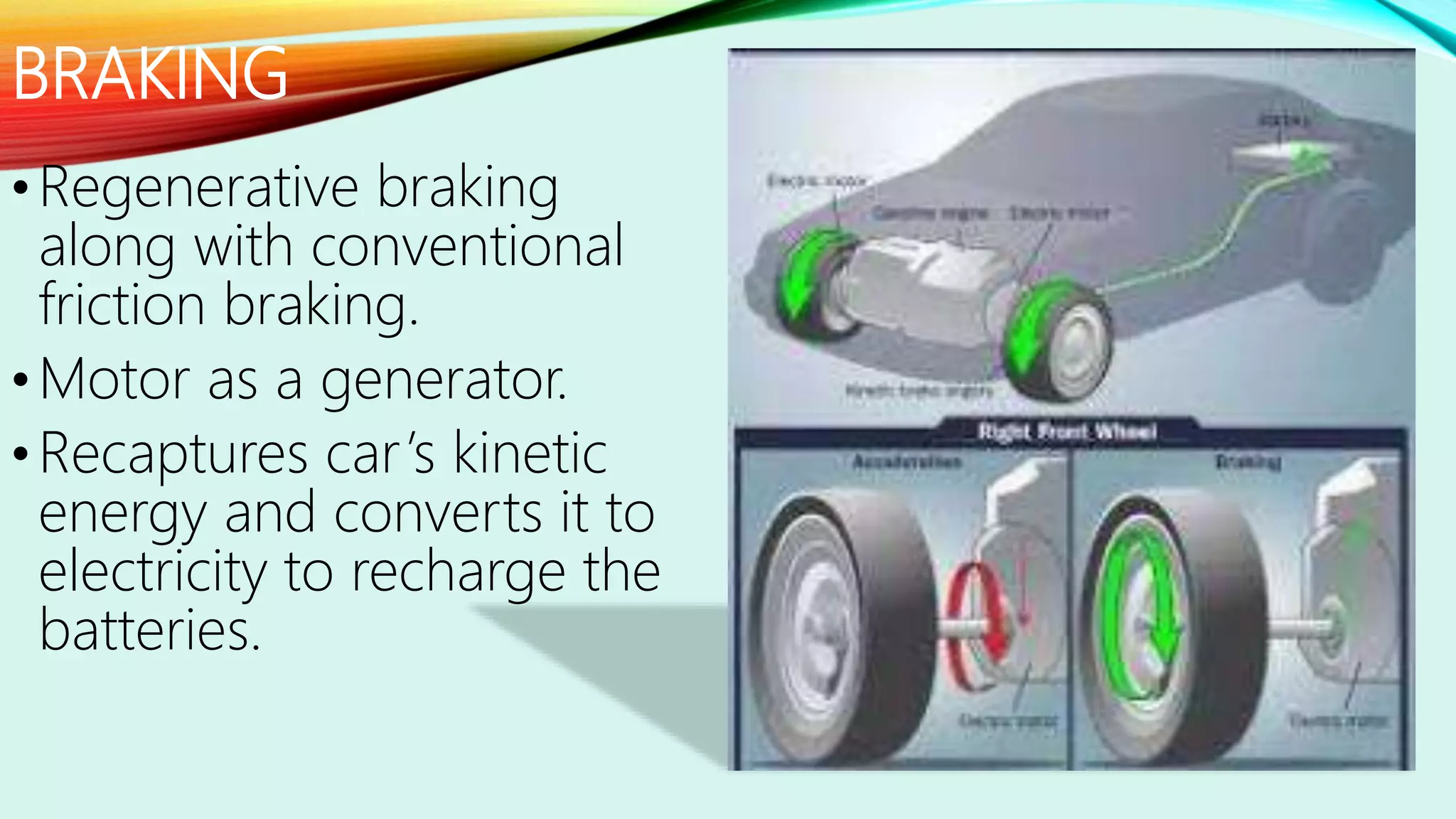
BRAKING
•Regenerative braking
along with conventional
friction braking.
•Motor as a generator.
•Recaptures car’s kinetic
energy and converts it to
electricity to recharge the
batteries.
DC-DC CONVERTERS
• A 14 volt battery which provides power
for accessories, like headlights, radios,
fans, computers, airbags, wipers,
power windows etc. .
• Runs motor controller logic and power
electronics.
• To charge the Aux. Battery a DC – to –
DC converter converts the voltage
from main battery array (say 300 volts)
to 14 volts.
CAR IN ARCHITECTURE
THANK
YOU
SIR
SUMITED BY
VAIBHAV GAUTAM

Vaibhav gautam (electric vehicle file )

  • 1.
  • 2.
    PRESENTATION TOPIC • Partsof electric vehicle 1. Electric motor(s) 2. Electric motor driver 3. Electric motor controller 4. Battery pack- 48/60/72V 5. Single speed transmission(Optional) 6. Charging point for the batteries. 7. Brakes-hand, friction and regenerative 8. DC to DC converter */12V to run auxillaries like power window, Smart truck , ac compressor etc 9. Joystick to choose run mode(fwd/neutral/reverse)
  • 3.
  • 4.
    ELECTRIC CARS Basic Principle •An Electric car is powered by an Electric Motor rather than a • Gasoline Engine. • The Electric Motor gets its power from a controller. • The Controller is powered from an array of rechargeable • batteries.
  • 5.
    Charger Traction batteriesDC-DC Contactors Speed pedal Motor controller Aux batteries Contactors Motors Differential
  • 6.
    MOTORS • Electric carscan use AC as well as DC motors. • DC motors run on a voltage ranging roughly between 96 to 192 volts. Most of them come from Forklift Industry. • DC installations are simpler. • Another feature of DC motors is that they can be overdriven for short periods of time (up to a factor of 10), which is good for short bursts of acceleration. • One limitation is the heat build up. May lead to self destruction. • Due to these limitations and other advantages provided by AC motors (like better torque and speed output, for same weight and size DC motors are not usbrakin • Any of the industrial 3 – phase AC motors can be used. • They allow the use of regenerative braking.
  • 7.
  • 8.
    • The electricdrive motor (a) reaches its maximum torque as earlyy as the first revolution. It does not require a start-up phasee to reach idling speed. • Once a specific rpm figure has been reached, the available torquee falls as the revs increase. This motor speed is Approximately 14,000 rpm. • These characteristics of an electric drive motor mea thatt a complex transmission is not required ELECTRIC DRIVE
  • 9.
    DRIVE WITH IN-WHEEL MOTORS •Thewheels are connected directly to the in wheel motors. •The in-wheel concept is used for electric scooters, electri sbicycless and electrically driven wheel chairs.
  • 10.
    Features • No driveshafts are required • No differential transmission required Advantages • Four-wheel drive is technically possible • Output axles of the in-wheel motors are directly on the wheel • High efficiency because there are hardly any mechanical losses Disadvantages • Unsprung masses in the wheel are greater than wheels on a conventional vehicle • High mass of driven components (inertia and torque of whole vehicle affected) • Control is complex, both electric motors must run synchronous
  • 11.
    CONTROLLERS •The controller deliversa controlled voltage to the motor, depending upon potentiometer output. •PWM controls the speed.
  • 12.
  • 13.
  • 14.
    AC CONTROLLER •An ACcontroller creates 3 pseudo sine waves which are 120 degree apart (3-phase AC). •Using six sets of power transistors, the controller •takes in 300 volts DC and produces 240 volts AC, •3-phase.
  • 15.
    BATTERY PACK • 6831standard 18650 Laptop Li--- ion cells. • Supplies ~375V to motors, heating and air conditioning systems. • Cooling system. • Current capacity of each cell: 2100 mAh. • Energy stored = 2100 mAh*3.7 V*6831 = 53kWh. • Weight ~ 450 Kg. • Energy/Weight ~ 120. • Can be recharged easily with 110/220 V outlet.
  • 16.
  • 17.
    • BATTERY PROBLEMS: 1.LONG RECHARGING TIME - REFUELING REQUIRED ONLY MINUTES. 2. BATTERY WEIGHT - 100 POUND LEAD ACID BATTERIES = 1 POUND OF GASOLINE. 3. BATTERY COSTS. TESLA ROADSTER: MOTOR • Range concerns • Price • Consumer acceptance • Market
  • 18.
    1. A POWERTRANSFER SYSTEM INCLUDING A VARIABLE SPEED ELECTRIC MOTOR AND A SINGLE SPEED TRANSMISSION IS DISCLOSED FOR TRANSFERRING POWER FROM A SOURCE OF POWER TO A PAIR OF DRIVEN WHEELS. 2. ELECTRIC VEHICLES INCORPORATING A HIGH SPEED ELECTRIC MOTOR. 3. THE SINGLE SPEED TRANSMISSION INCLUDES A HOUSING, AN INPUT SHAFT FOR RECEIVING DRIVE TORQUE FROM THE ELECTRIC MOTOR. 4. LEAST ONE OUTPUT SHAFT AND AN INTERMEDIATE SHAFT SUPPORTED FOR ROTATION OF THE HOUSING BETWEEN THE INPUT SHAFT AND THE OUTPUT SHAFT. Single speed transmission
  • 19.
    5. THE SINGLESPEED TRANSMISSION FURTHER INCLUDES A PARKING SPRAG ARRANGEMENT FOR PREVENTING ROTATION OF THE OUTPUT SHAFT WHEN A PARK MODE IS SELECTED. 6. FIRST POSITION FOR PREVENTING RELATIVE ROTATION BETWEEN THE INPUT SHAFT AND THE OUTPUT SHAFT. 7. A SECOND POSITION FOR ESTABLISHING RELATIVE ROTATION BETWEEN THE INPUT SHAFT AND OUTPUT SHAFT.
  • 20.
  • 21.
    CHARGING POINT FORTHE BATTERIES. • The rate at which charging adds range to a PEV depends on the vehicle, the battery type, and the type of EVSE. The following are typical rates for a light-duty vehicle: • Level 1: 2 to 5 miles of range per hour of charging • Level 2: 10 to 20 miles of range per hour of charging • DC fast charging: 60 to 80 miles of range in 20 minutess of charging. 1. DC fast-charging EVSE (480-V AC input to the EVSE) enables rapid charging at sites such as heavy traffic cor-ridors and public fueling stations (Figure 3, next minute A DC fast charger can add 60 to 80 miles of range to a PEV in 20 minutes. 2. Charging Station • There are many benefits to owning or hosting a charging station, which depend on your site characteristics as well as your goals and values. • Charging Station Costs 1. The costs of owning and operating a charginincentive include equipment, installation, mainten incentive Electricity costs. You can reduce these costs by taking Advantage of discounts and incentives.
  • 22.
  • 23.
    BATTERIES AND CHARGERS •Leadacid batteries used, until recently. •A weak link in the electric cars. •Heavy, Bulky, limited capacity (12 – 15 kilowatt hours), slow charging rate, short life and expensive. • NiMH batteries give double the range and last 10 years, but expensive. •Lithium ion and NiMH batteries likely to be used if their prices can be made competitive with lead acid batteries. •Charging done from power grid (household/ charging station). •A good charger monitors battery voltage, current flow and battery temperature to minimize charging time. •120/240 Volts. •Part of the controller/separate box. •Magna – charge inductive charging system.
  • 24.
    BRAKING •Regenerative braking along withconventional friction braking. •Motor as a generator. •Recaptures car’s kinetic energy and converts it to electricity to recharge the batteries.
  • 26.
    DC-DC CONVERTERS • A14 volt battery which provides power for accessories, like headlights, radios, fans, computers, airbags, wipers, power windows etc. . • Runs motor controller logic and power electronics. • To charge the Aux. Battery a DC – to – DC converter converts the voltage from main battery array (say 300 volts) to 14 volts.
  • 27.
  • 28.