ELECTRIC VEHICLE overview and categorizations .pptx
2.
• INTRODUCTION
• Inrecent some years, Greenhouse gas problem increases day by day and also the gasoline fuel
rate increases. In daily life routine, public transportation is very important but the fuel rate, some
people avoid using bikes or cars. So, many automobile manufacturer and new companies put
their effort to convert the conventional vehicle into electric vehicle that provide reliable solution.
A vehicle is propelled with electric motors and draw power from onboard electric source is an
electric vehicle. It is more durable and mechanically simpler than gasoline vehicle. It gives more
fuel efficiency than gasoline because it does not produce emission like Internal combustion
engine. However, automobile industry is not completely moving towards pure electric cars
because there is inherent problem of existing batteries technology. For storing the electric energy,
most common storage device used in Electric vehicle is battery. It can store large amount of
energy in a small volume and weight. The recent report shows that there were more vehicle
running on a gasoline product in past few years but now the report has been changed with
increasing the usage of Hybrid and Electric vehicle. Presently people are more inclined towards
the Hybrid vehicle but the future will be totally based on electrification.
SIGNIFICANCE
• Lower runningcosts
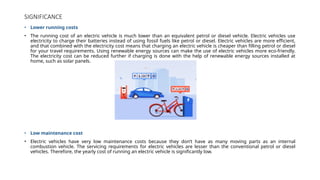
• The running cost of an electric vehicle is much lower than an equivalent petrol or diesel vehicle. Electric vehicles use
electricity to charge their batteries instead of using fossil fuels like petrol or diesel. Electric vehicles are more efficient,
and that combined with the electricity cost means that charging an electric vehicle is cheaper than filling petrol or diesel
for your travel requirements. Using renewable energy sources can make the use of electric vehicles more eco-friendly.
The electricity cost can be reduced further if charging is done with the help of renewable energy sources installed at
home, such as solar panels.
• Low maintenance cost
• Electric vehicles have very low maintenance costs because they don’t have as many moving parts as an internal
combustion vehicle. The servicing requirements for electric vehicles are lesser than the conventional petrol or diesel
vehicles. Therefore, the yearly cost of running an electric vehicle is significantly low.
5.
• Zero TailpipeEmissions
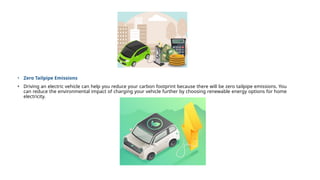
• Driving an electric vehicle can help you reduce your carbon footprint because there will be zero tailpipe emissions. You
can reduce the environmental impact of charging your vehicle further by choosing renewable energy options for home
electricity.
6.
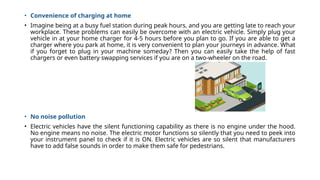
• Convenience ofcharging at home
• Imagine being at a busy fuel station during peak hours, and you are getting late to reach your
workplace. These problems can easily be overcome with an electric vehicle. Simply plug your
vehicle in at your home charger for 4-5 hours before you plan to go. If you are able to get a
charger where you park at home, it is very convenient to plan your journeys in advance. What
if you forget to plug in your machine someday? Then you can easily take the help of fast
chargers or even battery swapping services if you are on a two-wheeler on the road.
• No noise pollution
• Electric vehicles have the silent functioning capability as there is no engine under the hood.
No engine means no noise. The electric motor functions so silently that you need to peek into
your instrument panel to check if it is ON. Electric vehicles are so silent that manufacturers
have to add false sounds in order to make them safe for pedestrians.
7.
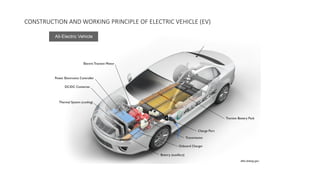
• The presentworking mechanism of an electrical vehicle can be explained as follows.
• EVs have forward and reverse modes. When the vehicle is placed in gear and the accelerator is pressed, the following
happen:
• (i) Power is converted from dc(battery) to ac(electric motor).
• (ii)The accelerator pedal sends a signal to the controller which adjusts the vehicle speed by changing the frequency of ac
power from the invertor to the motor.
• (iii)The motor connects and turns the wheels through a cog.
• (iv)When the brakes are pressed and the car is decelerating the motor becomes an alternator and produces power which is
sent back to the battery.
• The key components of a battery based electric vehicle are:
• 1. Electric motor:
• The currently used electric motors are brushless dc motors and ac induction motors.
• Advantages of brushless dc motors:
• (i) Less mechanical losses.
• Disadvantages of brushless dc motors:
8.
• (i)We cannothave gear ratio of high power motor due to size limitations.
• ac induction motors are being used in modern day evs like Tesla.
• Advantages of ac induction motors:
• (i)They do not have permanent magnets with them,hence low cost.
• (ii)Since there are no magnets,it has a good life.
• 2. Invertor
• This device is used to convert dc to ac power in an ev motor.It can change the speed at Erich the motor rotates
by adjusting the frequency of ac and can also increase or decrease the power or torque of motor by adjusting
the amplitude of signal.
• 3. Battery
• An ev uses a battery to store electrical energy that is ready to use.A battery pack is made of a number of cells
grouped to modules.Currently lithium ion batteries are being used owing to their advantages above previously
used lead acid batteries.
• 4.Controller
9.
• The controlleris like the brain of a vehicle,managing all its parameters.It controls rate of charge
using information from the battery.It also translates the process on the accelerator pedal to adjust
speed in the motor invertor.
5.Auxilary battery:
• An auxilary battery is provided to power the vehicle's accessories and other equipment.It is
recharged via dc-dc convertor which converts high voltage current from battery pack to low voltage
current.
10.
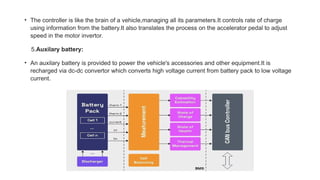
• 6.Battery managementsystem
• The circuit for monitoring cells during charging and discharging processes.It measures 3 vital
parameters of the battery:
• (i)Voltage
• (ii)Current
• (iii)Temperature
• It even measures state of charge(tells how far you can ride before recharging) and state of
health(tells when it is the time for recharge).
11.
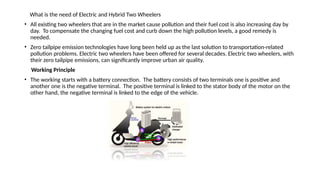
What is theneed of Electric and Hybrid Two Wheelers
• All existing two wheelers that are in the market cause pollution and their fuel cost is also increasing day by
day. To compensate the changing fuel cost and curb down the high pollution levels, a good remedy is
needed.
• Zero tailpipe emission technologies have long been held up as the last solution to transportation-related
pollution problems. Electric two wheelers have been offered for several decades. Electric two wheelers, with
their zero tailpipe emissions, can significantly improve urban air quality.
Working Principle
• The working starts with a battery connection. The battery consists of two terminals one is positive and
another one is the negative terminal. The positive terminal is linked to the stator body of the motor on the
other hand, the negative terminal is linked to the edge of the vehicle.
12.
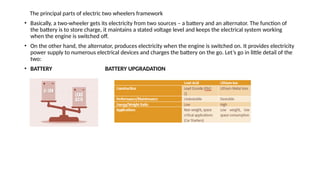
The principal partsof electric two wheelers framework
• Basically, a two-wheeler gets its electricity from two sources – a battery and an alternator. The function of
the battery is to store charge, it maintains a stated voltage level and keeps the electrical system working
when the engine is switched off.
• On the other hand, the alternator, produces electricity when the engine is switched on. It provides electricity
power supply to numerous electrical devices and charges the battery on the go. Let’s go in little detail of the
two:
• BATTERY BATTERY UPGRADATION
13.
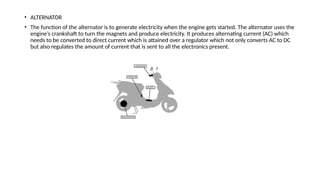
• ALTERNATOR
• Thefunction of the alternator is to generate electricity when the engine gets started. The alternator uses the
engine’s crankshaft to turn the magnets and produce electricity. It produces alternating current (AC) which
needs to be converted to direct current which is attained over a regulator which not only converts AC to DC
but also regulates the amount of current that is sent to all the electronics present.
14.
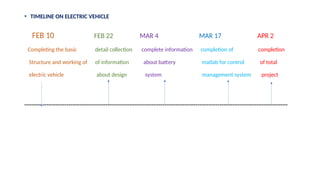
• TIMELINE ONELECTRIC VEHICLE
-----------------------------------------------------------------------------------------------------------------------------------------------
FEB 10 FEB 22 MAR 4 MAR 17 APR 2
Completing the basic detail collection complete information completion of completion
Structure and working of of information about battery matlab for control of total
electric vehicle about design system management system project
15.
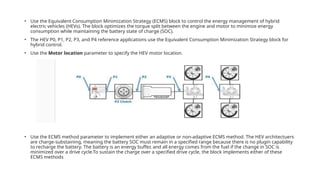
• Use theEquivalent Consumption Minimization Strategy (ECMS) block to control the energy management of hybrid
electric vehicles (HEVs). The block optimizes the torque split between the engine and motor to minimize energy
consumption while maintaining the battery state of charge (SOC).
• The HEV P0, P1, P2, P3, and P4 reference applications use the Equivalent Consumption Minimization Strategy block for
hybrid control.
• Use the Motor location parameter to specify the HEV motor location.
• Use the ECMS method parameter to implement either an adaptive or non-adaptive ECMS method. The HEV architectuers
are charge-substaining, meaning the battery SOC must remain in a specified range because there is no plugin capability
to recharge the battery. The battery is an energy buffer, and all energy comes from the fuel if the change in SOC is
minimized over a drive cycle.To sustain the charge over a specified drive cycle, the block implements either of these
ECMS methods
16.
ADAVANTAGES OF THEPRESENT PROPOSED METHOD
• Electric vehicles have other advantages over those powered by combustion engines:
• No fuel required so you save money on gas
Paying $0.10 per kW is the equivalent of driving on gasoline that costs less than $1
per gallon. On average, drivers save about $700 in fuel costs per year while driving
electric cars.
• Environmental friendly as they do not emit pollutants
Drivers of electric vehicles have reduced CO2 emissions by more than 177,758,804
kg
• Lower maintenance due to an efficient electric motor
Electric motors have less parts that lead to less damage than a traditional non
electric vehicle which means you save on operating cost!
• Better Performance
Electric cars are not only lighter but have faster acceleration




![6576787798564646464546_EV PPT (1)[1].pptx](https://cdn.slidesharecdn.com/ss_thumbnails/21985a0230evppt11-240502180247-603799cf-thumbnail.jpg?width=640&height=640&fit=bounds)


