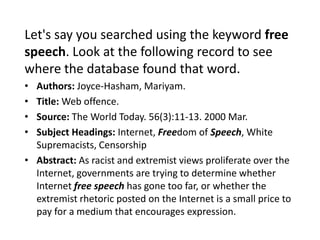
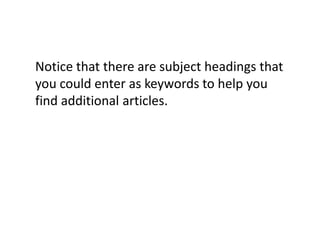
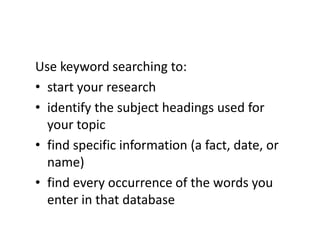
DatabasesA Database is an organized collection of information, usually pertaining to a particular subject.Think of databases as huge electronic filing systems. They must be highly organized for people to easily find the information they need.
There are many kinds of databases. The most common type you will encounter in the library is an online periodical index, which points you to articles published in magazines, journals, and newspapers.
Each year millions of articles are published in periodicals, most of which are indexed in periodical indexes.Evans Library will own many - but not all - of the periodicals included in those indexes.
What's in a Database?Periodical indexes allow you to search for citations to articles in popular magazines and scholarly journals. Sometimes these indexes have the complete or "full text" of articles as well.
Indexes cover all sorts of subjects. Multi-disciplinary indexes contain articles about new trends, opinions, and information for the non-specialist. You may be familiar with one of the multi-disciplinary periodical indexes, such as Academic Search Complete, ProQuest, or WilsonWeb.
Periodical indexes are one of the best places to find information when writing a research paper, seeking data, or looking for answers to questions, because:you can access most of them through the Webthey index information which often has gone through an editorial review processthey cover a variety of subjectsthey are structured for finding information more preciselythey offer citations to the popular magazines and scholarly journals that have articles on your topic
Which database?Choosing an appropriate database or periodical index is an essential part of research. How are you going to choose among those available from Evans Library?
Library databases organize particular types of materials. Some index citations for government documents, conference proceedings, book reviews, or magazine and journal articles.Others, like the library catalog, focus on a particular collection. Knowing what type of information you are looking for will make your selection easier.
Many library databases specialize in a particular subject. There are databases for education, business, anthropology, engineering, and architecture - virtually every academic discipline! Other databases are more general or multi-disciplinary, indexing popular and scholarly periodicals from a wide variety of topics.
If you have completed E-LEARN's process of "Defining a Research Topic," you will be better prepared to select appropriate databases.
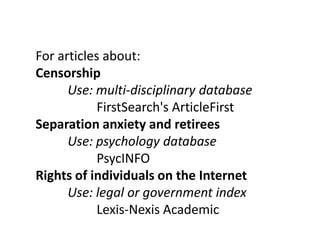
For articles about:CensorshipUse: multi-disciplinary database FirstSearch'sArticleFirstSeparation anxiety and retireesUse: psychology databasePsycINFORights of individuals on the InternetUse: legal or government index	         Lexis-Nexis Academic
Databases available to you are listed on the Library website under Databases/Indexes.And the List Goes on…
You may also want to ask one of the reference librarians to recommend the best databases for your topic. To contact a reference librarian, call: 321-674-8021You may also use our Ask a Librarian service.
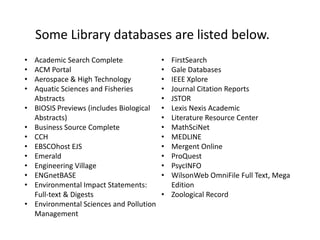
Some Library databases are listed below.Academic Search Complete
ACM Portal
Aerospace & High Technology
Aquatic Sciences and Fisheries Abstracts
BIOSIS Previews (includes Biological Abstracts)
Business Source Complete
CCH
EBSCOhost EJS
Emerald
Engineering Village
ENGnetBASE

E-LEARN: Databases

  • 1.
    DatabasesA Database isan organized collection of information, usually pertaining to a particular subject.Think of databases as huge electronic filing systems. They must be highly organized for people to easily find the information they need.
  • 2.
    There are manykinds of databases. The most common type you will encounter in the library is an online periodical index, which points you to articles published in magazines, journals, and newspapers.
  • 3.
    Each year millionsof articles are published in periodicals, most of which are indexed in periodical indexes.Evans Library will own many - but not all - of the periodicals included in those indexes.
  • 4.
    What's in aDatabase?Periodical indexes allow you to search for citations to articles in popular magazines and scholarly journals. Sometimes these indexes have the complete or "full text" of articles as well.
  • 5.
    Indexes cover allsorts of subjects. Multi-disciplinary indexes contain articles about new trends, opinions, and information for the non-specialist. You may be familiar with one of the multi-disciplinary periodical indexes, such as Academic Search Complete, ProQuest, or WilsonWeb.
  • 6.
    Periodical indexes areone of the best places to find information when writing a research paper, seeking data, or looking for answers to questions, because:you can access most of them through the Webthey index information which often has gone through an editorial review processthey cover a variety of subjectsthey are structured for finding information more preciselythey offer citations to the popular magazines and scholarly journals that have articles on your topic
  • 7.
    Which database?Choosing anappropriate database or periodical index is an essential part of research. How are you going to choose among those available from Evans Library?
  • 8.
    Library databases organizeparticular types of materials. Some index citations for government documents, conference proceedings, book reviews, or magazine and journal articles.Others, like the library catalog, focus on a particular collection. Knowing what type of information you are looking for will make your selection easier.
  • 9.
    Many library databasesspecialize in a particular subject. There are databases for education, business, anthropology, engineering, and architecture - virtually every academic discipline! Other databases are more general or multi-disciplinary, indexing popular and scholarly periodicals from a wide variety of topics.
  • 10.
    If you havecompleted E-LEARN's process of "Defining a Research Topic," you will be better prepared to select appropriate databases.
  • 11.
    For articles about:CensorshipUse:multi-disciplinary database FirstSearch'sArticleFirstSeparation anxiety and retireesUse: psychology databasePsycINFORights of individuals on the InternetUse: legal or government index Lexis-Nexis Academic
  • 12.
    Databases available toyou are listed on the Library website under Databases/Indexes.And the List Goes on…
  • 13.
    You may alsowant to ask one of the reference librarians to recommend the best databases for your topic. To contact a reference librarian, call: 321-674-8021You may also use our Ask a Librarian service.
  • 14.
    Some Library databasesare listed below.Academic Search Complete
  • 15.
  • 16.
  • 17.
    Aquatic Sciences andFisheries Abstracts
  • 18.
    BIOSIS Previews (includesBiological Abstracts)
  • 19.
  • 20.
  • 21.
  • 22.
  • 23.
  • 24.