
User-Centered Public Services: User
experience and Academic Libraries. Presented by
Rose Petralia at Colorado Mesa University,
Tomlinson Library, January 20, 2016.
We all know that, even in academia, libraries are no longer the first place that people access to solve a
problem – the internet does a great job of answering most questions without the help of a reference
librarian.
That is reality at this moment – in ten years it might be something else. BUT there is something that has
always been at the core of a library, and that is service. We help users to discover what they want; we curate
the tools to expand knowledge in sometimes surprising ways; and we provide the space to come together to
experience knowledge and to create new understanding of the world and our place in it together.
And a truly brilliant library will keep its core while evolving with the world.
Which is why library professionals have to continually evaluate the moment we are in, and keep our users’ experience
as our guiding motivation for improving public service.
And already the library is not just a building where the books are – it’s an experience.
Are our users delighted? Are we delighted?
Poncho is an information service that has found a way to make
weather delightful by connecting cultural silliness – like this clip from
American Psycho that pokes fun at Huey Lewis – with useful
information. “I don’t know the lyrics to this weather, but it sure is
catchy.”
Poncho
This interaction brought me delight – at the end of the confirmation
email from my first transaction with Eat24, a food ordering service, I’m
told that every time I tell a friend about Eat24, a unicorn high fives a t-
rex in outer space.
A FAQ is included with the email, and I’m told that yes, my order
is on its way, and definitely not lost in cyberspace.
Now, assuming that everything is right with my order, I already
really like these people. I want to do business with them. I am
delighted.
Eat24
It is our challenge to provide our users with a seamless user experience. And
libraries have an incredible opportunity to renew their focus on the user by
following some principles of UX design.
There are lots of definitions and applications for user experience design, but these five from Brave UX represent
to me the essence, and I think they work well in the context of designing library experiences.
Do we understand our users?
Unless we’ve shared our user’s experience, it’s difficult to truly
empathize. Can we forget what we know and put ourselves in our
user’s place?
Are our assessments valid, accurate, and useful? Are we assessing the right things?
Federal agencies, including the TSA, are now collecting feedback from
customers by asking one simple question, “Were you satisfied?” Up to
two additional questions may be asked to understand the reasons
behind users’ answers.
These feedback stations are super fast, and placed within the service
area – they require extremely minimal effort from the user and
provide rapid assessment.
Are we making our users learn new ways to do tasks, or are we providing experiences that are
consistent with previous experiences?
Overdrive lets users check out library books from their devices and
read them wherever they usually read books. Now the experience of
checking out public library books is consistent with the experiences of
purchasing and reading Kindle books, or downloading PDFs from
websites.
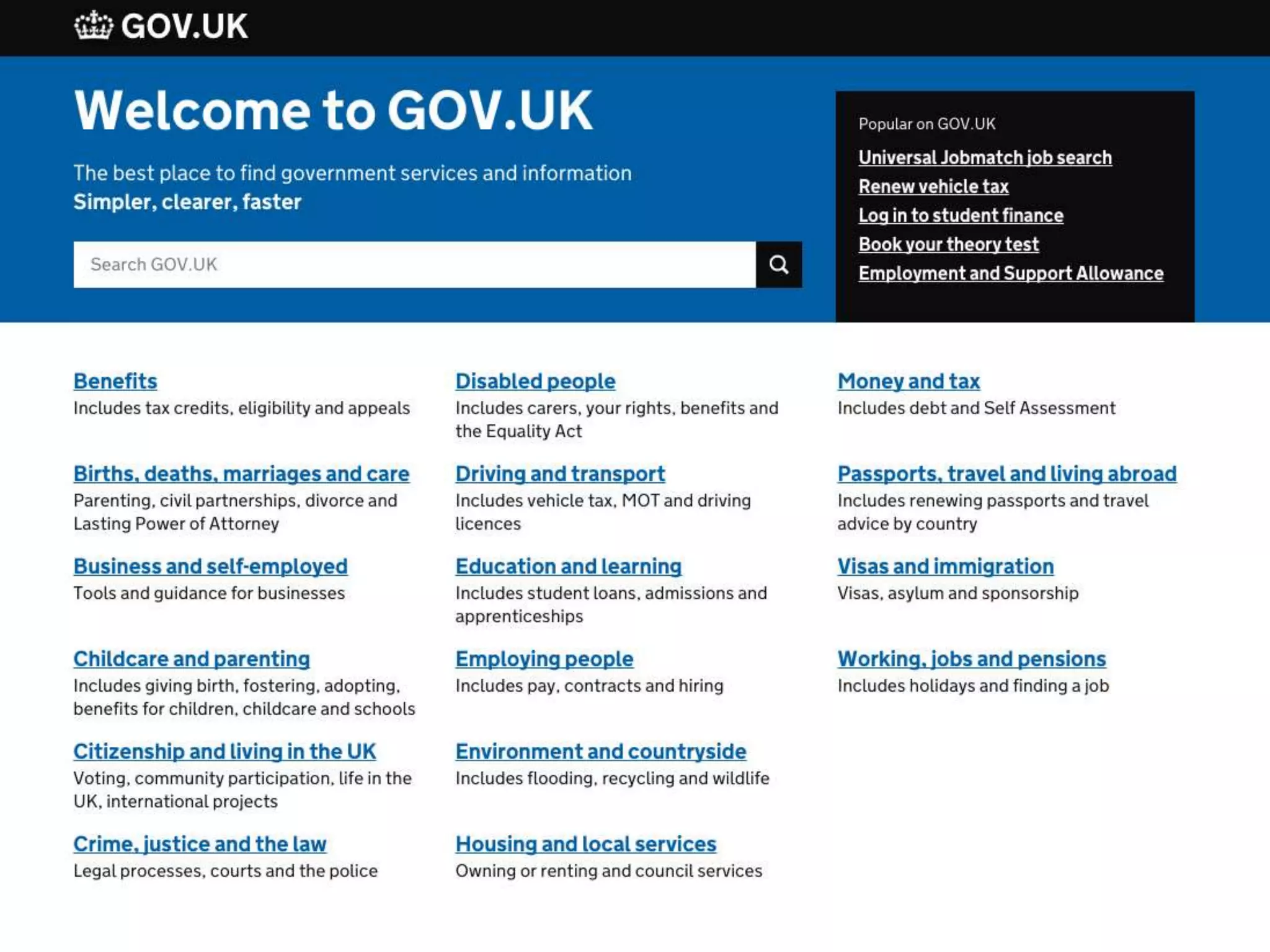
How do we prioritize our user’s needs?
Gov.uk won the Design Museum Design award of 2013 for “making the
user experience simpler, clearer, and faster.” Rather than stick as much
content as possible on the website, the user is directed to the most
important collections of information, with the option to search for
more.
Are our services ultimately providing the best experience for our users?
The Allegheny Ukulele Kollective’s Lending Library Program is an
excellent example of UNITY in UX, because since libraries that
participate in the program are required to send at least one librarian
for training in how to play the instrument, library users who check out
a ukulele are in immediate contact with an “expert” who can show
them how to get started.
How do we make sure that we are making the right kinds of changes – that we are evolving while retaining our core
dedication to service?
Lean UX is one way. Lean is a way of thinking that changes an organization’s focus from separate units or products
to the holistic process of providing perfect value to the customer with zero waste. (The Colorado Department of
Regulatory Agencies uses lean UX.)
Really at the core of lean thinking are three questions: What is our purpose, what is our process, and who are
our people?
Before we can improve experiences, we first need to know what problems exist.
Do our internal processes flow toward a valuable end? Are we taking the most direct route
to our goals? Are we making our users jump through hoops when they don’t need to?
Are staff in the right roles? Does everyone have ownership of PROJECTS instead of tasks? Is
everyone engaged and working toward a unified goal?
Are projects supported and assessed? Are rewards and consequences matched to the work? Is the working
environment open and accessible?
Ultimately, do we add value to our users’ lives? Perfect user experience doesn’t happen
overnight. We have to make the right changes after assessing what is or isn’t possible with
the right people in the right roles.
And the library can become more than just highly functional, or a place that’s open
late at night. It can be a place of delight – for our students, faculty, and staff – and for
us.
This is why we’re here in the first place.
Without an amazing staff, there is no amazing UX.
Find me in the usual places – I’m happy to have a conversation.
https://boagworld.com/usability/empathy | http://fight-for-
ux.myshopify.com | http://publiclibrariesonline.org |
http://uxmag.com | http://eat24.com |
http://eventsgloucester.com.au |
https://www.gov.uk/government/news |
http://www.lean.org/WhatsLean | http://sr.ithaka.org |
http://poncho.is | http://www.ukulelemag.com |
http://csreports.aspeninstitute.org |
https://feedback.usa.gov | Walton, G. (2015). What user
experience (UX) means for academic libraries. New Review
of Academic Librarianship.
User-Centered Public Services: UX and Academic Libraries

User-Centered Public Services: UX and Academic Libraries

  • 1.
    User-Centered Public Services:User experience and Academic Libraries. Presented by Rose Petralia at Colorado Mesa University, Tomlinson Library, January 20, 2016.
  • 2.
    We all knowthat, even in academia, libraries are no longer the first place that people access to solve a problem – the internet does a great job of answering most questions without the help of a reference librarian. That is reality at this moment – in ten years it might be something else. BUT there is something that has always been at the core of a library, and that is service. We help users to discover what they want; we curate the tools to expand knowledge in sometimes surprising ways; and we provide the space to come together to experience knowledge and to create new understanding of the world and our place in it together. And a truly brilliant library will keep its core while evolving with the world.
  • 3.
    Which is whylibrary professionals have to continually evaluate the moment we are in, and keep our users’ experience as our guiding motivation for improving public service.
  • 4.
    And already thelibrary is not just a building where the books are – it’s an experience. Are our users delighted? Are we delighted?
  • 5.
    Poncho is aninformation service that has found a way to make weather delightful by connecting cultural silliness – like this clip from American Psycho that pokes fun at Huey Lewis – with useful information. “I don’t know the lyrics to this weather, but it sure is catchy.” Poncho
  • 6.
    This interaction broughtme delight – at the end of the confirmation email from my first transaction with Eat24, a food ordering service, I’m told that every time I tell a friend about Eat24, a unicorn high fives a t- rex in outer space. A FAQ is included with the email, and I’m told that yes, my order is on its way, and definitely not lost in cyberspace. Now, assuming that everything is right with my order, I already really like these people. I want to do business with them. I am delighted. Eat24
  • 7.
    It is ourchallenge to provide our users with a seamless user experience. And libraries have an incredible opportunity to renew their focus on the user by following some principles of UX design.
  • 8.
    There are lotsof definitions and applications for user experience design, but these five from Brave UX represent to me the essence, and I think they work well in the context of designing library experiences.
  • 9.
    Do we understandour users?
  • 10.
    Unless we’ve sharedour user’s experience, it’s difficult to truly empathize. Can we forget what we know and put ourselves in our user’s place?
  • 11.
    Are our assessmentsvalid, accurate, and useful? Are we assessing the right things?
  • 12.
    Federal agencies, includingthe TSA, are now collecting feedback from customers by asking one simple question, “Were you satisfied?” Up to two additional questions may be asked to understand the reasons behind users’ answers. These feedback stations are super fast, and placed within the service area – they require extremely minimal effort from the user and provide rapid assessment.
  • 13.
    Are we makingour users learn new ways to do tasks, or are we providing experiences that are consistent with previous experiences?
  • 14.
    Overdrive lets userscheck out library books from their devices and read them wherever they usually read books. Now the experience of checking out public library books is consistent with the experiences of purchasing and reading Kindle books, or downloading PDFs from websites.
  • 15.
    How do weprioritize our user’s needs?
  • 16.
    Gov.uk won theDesign Museum Design award of 2013 for “making the user experience simpler, clearer, and faster.” Rather than stick as much content as possible on the website, the user is directed to the most important collections of information, with the option to search for more.
  • 17.
    Are our servicesultimately providing the best experience for our users?
  • 18.
    The Allegheny UkuleleKollective’s Lending Library Program is an excellent example of UNITY in UX, because since libraries that participate in the program are required to send at least one librarian for training in how to play the instrument, library users who check out a ukulele are in immediate contact with an “expert” who can show them how to get started.
  • 19.
    How do wemake sure that we are making the right kinds of changes – that we are evolving while retaining our core dedication to service?
  • 20.
    Lean UX isone way. Lean is a way of thinking that changes an organization’s focus from separate units or products to the holistic process of providing perfect value to the customer with zero waste. (The Colorado Department of Regulatory Agencies uses lean UX.)
  • 21.
    Really at thecore of lean thinking are three questions: What is our purpose, what is our process, and who are our people?
  • 22.
    Before we canimprove experiences, we first need to know what problems exist.
  • 23.
    Do our internalprocesses flow toward a valuable end? Are we taking the most direct route to our goals? Are we making our users jump through hoops when they don’t need to?
  • 24.
    Are staff inthe right roles? Does everyone have ownership of PROJECTS instead of tasks? Is everyone engaged and working toward a unified goal? Are projects supported and assessed? Are rewards and consequences matched to the work? Is the working environment open and accessible?
  • 25.
    Ultimately, do weadd value to our users’ lives? Perfect user experience doesn’t happen overnight. We have to make the right changes after assessing what is or isn’t possible with the right people in the right roles. And the library can become more than just highly functional, or a place that’s open late at night. It can be a place of delight – for our students, faculty, and staff – and for us.
  • 26.
    This is whywe’re here in the first place.
  • 27.
    Without an amazingstaff, there is no amazing UX.
  • 28.
    Find me inthe usual places – I’m happy to have a conversation.
  • 29.
    https://boagworld.com/usability/empathy | http://fight-for- ux.myshopify.com| http://publiclibrariesonline.org | http://uxmag.com | http://eat24.com | http://eventsgloucester.com.au | https://www.gov.uk/government/news | http://www.lean.org/WhatsLean | http://sr.ithaka.org | http://poncho.is | http://www.ukulelemag.com | http://csreports.aspeninstitute.org | https://feedback.usa.gov | Walton, G. (2015). What user experience (UX) means for academic libraries. New Review of Academic Librarianship.

Editor's Notes

  • #2  -
  • #3  - We all know that, even in academia, libraries are no longer the first place that people access to solve a problem – the internet does a great job of answering most questions without the help of a reference librarian. That is reality at this moment – in ten years it might be something else. BUT there is something that has always been at the core of a library, and that is service. We help users to discover what they want; we curate the tools to expand knowledge in sometimes surprising ways; and we provide the space to come together to experience knowledge and to create new understanding of the world and our place in it together. And a truly brilliant library will keep its core while evolving with the world.
  • #4  - Which is why library professionals have to continually evaluate the moment we are in, and keep our users’ experience as our guiding motivation for improving public service.
  • #5  - And already the library is not just a building where the books are – it’s an experience. Are our users delighted? Are we delighted?
  • #6  - Poncho is an information service that has found a way to make weather delightful by connecting cultural silliness – like this clip from American Psycho that pokes fun at Huey Lewis – with useful information. “I don’t know the lyrics to this weather, but it sure is catchy.”
  • #7  - This interaction brought me delight – at the end of the confirmation email from my first transaction with Eat24, a food ordering service, I’m told that every time I tell a friend about Eat24, a unicorn high fives a t-rex in outer space. A FAQ is included with the email, and I’m told that yes, my order is on its way, and definitely not lost in cyberspace. Now, assuming that everything is right with my order, I already really like these people. I want to do business with them. I am delighted.
  • #8  - It is our challenge to provide our users with a seamless user experience. And libraries have an incredible opportunity to renew their focus on the user by following some principles of UX design.
  • #9  - There are lots of definitions and applications for user experience design, but these five from Brave UX represent to me the essence, and I think they work well in the context of designing library experiences.
  • #10  - Do we understand our users?
  • #11  - Unless we’ve shared our user’s experience, it’s difficult to truly empathize. Can we forget what we know and put ourselves in our user’s place?
  • #12  - Are our assessments valid, accurate, and useful? Are we assessing the right things?
  • #13  - Federal agencies, including the TSA, are now collecting feedback from customers by asking one simple question, “Were you satisfied?” Up to two additional questions may be asked to understand the reasons behind users’ answers. These feedback stations are super fast, and placed within the service area – they require extremely minimal effort from the user and provide rapid assessment.
  • #14  - Are we making our users learn new ways to do tasks, or are we providing experiences that are consistent with previous experiences?
  • #15  - Overdrive lets users check out library books from their devices and read them wherever they usually read books. Now the experience of checking out public library books is consistent with the experiences of purchasing and reading Kindle books, or downloading PDFs from websites.
  • #16  - How do we prioritize our user’s needs?
  • #17  - Gov.uk won the Design Museum Design award of 2013 for “making the user experience simpler, clearer, and faster.” Rather than stick as much content as possible on the website, the user is directed to the most important collections of information, with the option to search for more.
  • #18  - Are our services ultimately providing the best experience for our users?
  • #19  - The Allegheny Ukulele Kollective’s Lending Library Program is an excellent example of UNITY in UX, because since libraries that participate in the program are required to send at least one librarian for training in how to play the instrument, library users who check out a ukulele are in immediate contact with an “expert” who can show them how to get started.
  • #20  - How do we make sure that we are making the right kinds of changes – that we are evolving while retaining our core dedication to service?
  • #21  - Lean UX is one way. Lean is a way of thinking that changes an organization’s focus from separate units or products to the holistic process of providing perfect value to the customer with zero waste. (The Colorado Department of Regulatory Agencies uses lean UX.)
  • #22  - Really at the core of lean thinking are three questions: What is our purpose, what is our process, and who are our people?
  • #23  - Before we can improve experiences, we first need to know what problems exist.
  • #24  - Do our internal processes flow toward a valuable end? Are we taking the most direct route to our goals? Are we making our users jump through hoops when they don’t need to?
  • #25  - Are staff in the right roles? Does everyone have ownership of PROJECTS instead of tasks? Is everyone engaged and working toward a unified goal? Are projects supported and assessed? Are rewards and consequences matched to the work? Is the working environment open and accessible?
  • #26  - Ultimately, do we add value to our users’ lives? Perfect user experience doesn’t happen overnight. We have to make the right changes after assessing what is or isn’t possible with the right people in the right roles. And the library can become more than just highly functional, or a place that’s open late at night. It can be a place of delight – for our students, faculty, and staff – and for us.
  • #27  - This is why we’re here in the first place.
  • #28  - Without an amazing staff, there is no amazing UX.
  • #29  - Find me in the usual places – I’m happy to have a conversation.
  • #30  -
  • #31  -