Presentedby
Ambreen Zulfiqar
Mahnoor
Sikandar abbas
Karan
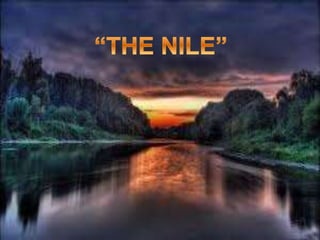
 “THE NILE”
 It's Been The Nile All The While
 The geography of Egypt can be quite
confusing because it's very much
related to the Nile. In fact, ancient
Egypt's other name is "The Nile
Valley."
 Oh and what about the ancient Egyptian
name for the Nile Valley you say?
 It's called "Kemet", which means the
black land.
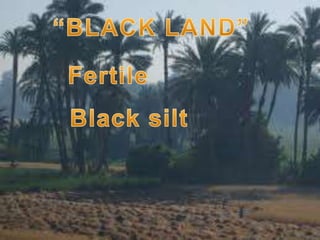
 Why is it called the black land? That’s
related to...
 yes,
 the Nile. It's always about the Egyptian
Nile.
THE ANCIENT EGYPTIANS THOUGHT OF
EGYPT AS BEING DIVIDED INTO TWO
TYPES OF LAND
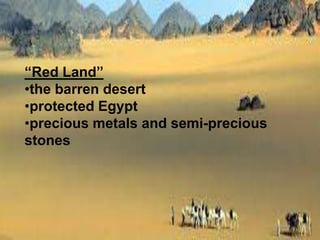
“Red Land”
•the barren desert
•protected Egypt
•precious metals and semi-precious
stones
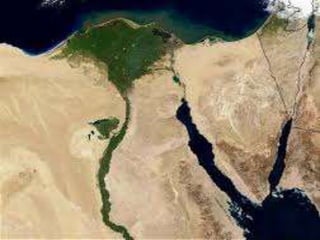
 The Nile River runs vertically through
the middle and splits the land in two
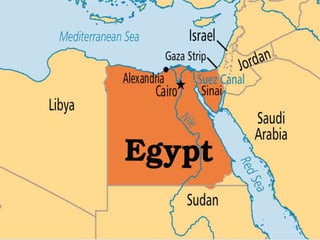
 Egypt is located in northern Africa along
the Mediterranean and Red Seas and
shares borders with Gaza Strip, Israel,
Libya and Sudan. Egypt's boundaries also
include the Sinai Peninsula
 The geography of ancient Egypt is divided
into 4 main parts, although there are
many other subdivisions..
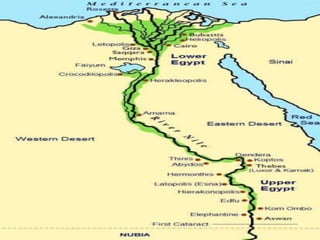
 First there is the north and south. Lower
Egypt is the northern part of the land and
Upper Egypt is the southern part.
 The Nile runs from the source (which is in
the south) up to the north and flows into
the Mediterranean Sea. So the beginning
part (upper part) of the Nile is in the
south, and vice versa...
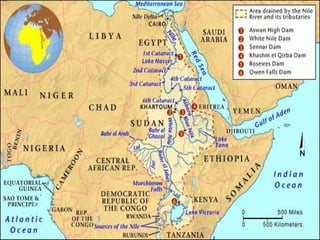
 It originates in Burunndi, south of the
equator, and flows northward through
northeastern Africa, eventually flowing
through Egypt and finally draining into
the Mediterranean Sea
 ...And as you now know, Egypt is all
about the Nile.
 The other division of the geography of
Egypt is (I hate to say it) also related to
the Nile. We've got the east and west
banks of the Nile River.
 The ancient Egyptians thought of the east
bank as "the land of the living“
 They thought of the west bank as "the
land of the dead“
 Other than these 4 main divisions, there
were 42 nomes, or provinces. 22 of them
were in Upper Egypt, 20 in Lower Egypt.
The ancient Egyptians called these nomes
"sepat".
 Each nome had a mayor, a local temple, a
capital, a deity and religious beliefs and
rituals.
 There were no flags to represent all the
different nomes however, but there were
staffs with the local deity's statue for each.
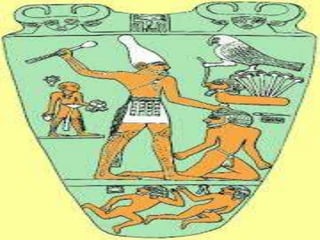
 As for Upper Egypt, it was represented by
the white crown, the sedge and the Goddess
Nekhbet.
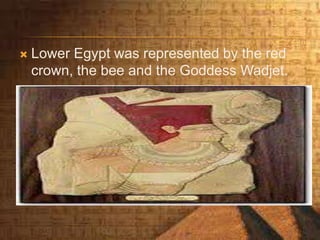
 Lower Egypt was represented by the red
crown, the bee and the Goddess Wadjet.
Economic system of
Ancient Egypt
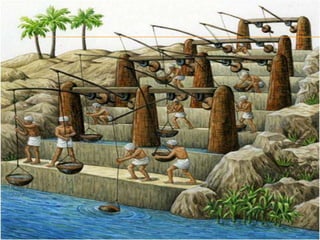
 Agriculture was main economic activity
for Egyptian.
 They built dykes, tanks and canals for
storing water and irrigating land.
•The main crops of ancient egypt
were wheat and Barley, lettuce,
beans, onions figs, dates, grapes
melon and cucumber.
•They used to grow flax.
 There was no typical money system
in egypt.
 Trade around Mediterranean sea and
red sea
 Cairo is financial center of egypt.
Social system of Egypt
•Egyptian religion was based on
polytheism.
•Akhnaton introduced the concept
of monotheism among them.
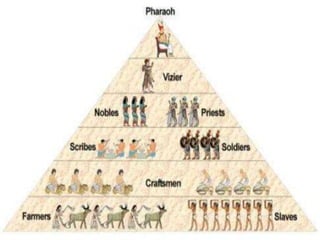
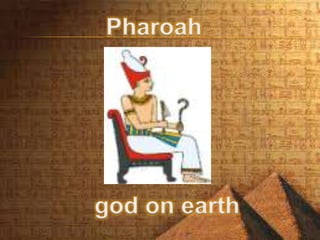
god on earth
Pharoah
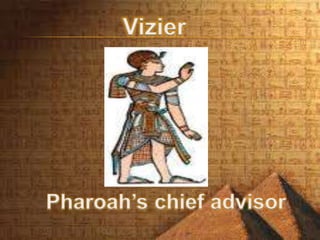
Pharoah’s chief advisor
Vizier
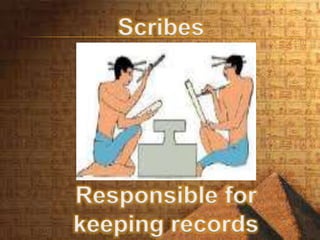
Scribes
Responsible for
keeping records
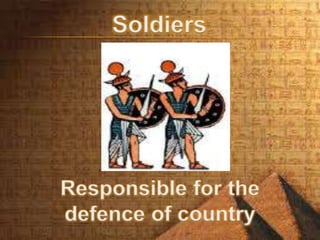
Soldiers
Responsible for the
defence of country
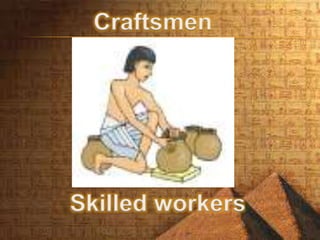
Craftsmen
Skilled workers
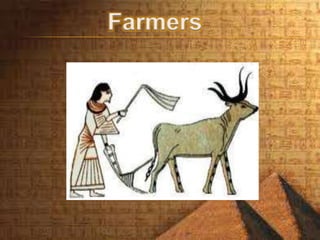
Farmers
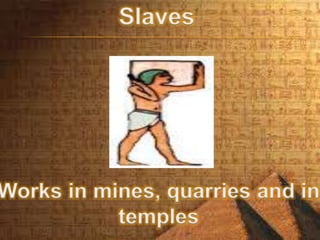
Slaves
Works in mines, quarries and in
temples
Heiroglyphs
Greek word
Heiro = sacred
Glypho = inscription
•Writing in Egypt have been dated
to 3400 BC
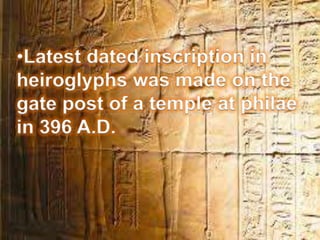
•Latest dated inscription in
heiroglyphs was made on the
gate post of a temple at philae
in 396 A.D.
RIVER NILE
 The longest river in the world.
 Nile River, Arabic Baḥr Al-Nīl or Nahr Al-
Nīl, river, the father of African rivers.
 It rises south of the Equator and flows
northward through northeastern Africa to
drain into the Mediterranean Sea.
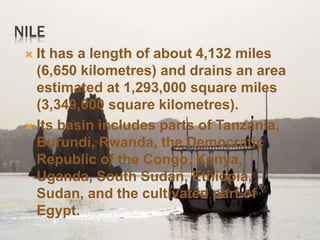
NILE
 It has a length of about 4,132 miles
(6,650 kilometres) and drains an area
estimated at 1,293,000 square miles
(3,349,000 square kilometres).
 Its basin includes parts of Tanzania,
Burundi, Rwanda, the Democratic
Republic of the Congo, Kenya,
Uganda, South Sudan, Ethiopia,
Sudan, and the cultivated part of
Egypt.
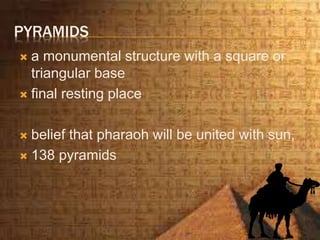
PYRAMIDS
 a monumental structure with a square or
triangular base
 final resting place
 belief that pharaoh will be united with sun,
 138 pyramids
PYRAMIDS
 Sneferu’s Pyramids
 Khufu – 2575-2566 BC
 Khafre 2558–2532 BC
 Menkaura 2532-2503 BC
SNEFERU’S PYRAMIDS
 The fourth-dynasty king, Sneferu 2686 –
2667 BC,
 was the first to create the pyramid shape
 built three pyramids
 first two were glorious failures.
SNEFERU
 first, the pyramid at Medium,
 step pyramid
 it was unstable and the limestone blocks
began to slip.
SNEFERU
 King Sneferu then moved to Dahshur
 built a second pyramid,
 which we now know as the “Bent Pyramid”
 because its upper part rises at a shallower
angle of incline than the lower part.
 angle of incline was decreased from 54º 31’
13’’ to 43º 21’.
 But the bent pyramid was never used.
SNEFERU
 Sneferu began a third pyramid about a mile
way.
 This one is called the red pyramid
 because of the red limestone blocks used in
its construction.
 It became the world’s first successful true
pyramid.
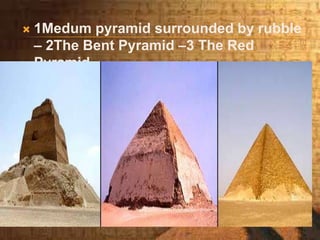
 1Medum pyramid surrounded by rubble
– 2The Bent Pyramid –3 The Red
Pyramid.
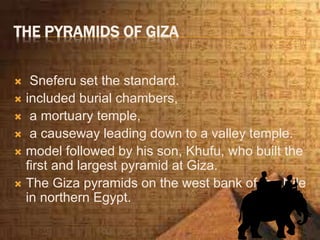
THE PYRAMIDS OF GIZA
 Sneferu set the standard.
 included burial chambers,
 a mortuary temple,
 a causeway leading down to a valley temple.
 model followed by his son, Khufu, who built the
first and largest pyramid at Giza.
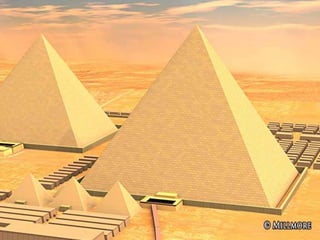
 The Giza pyramids on the west bank of the Nile
in northern Egypt.
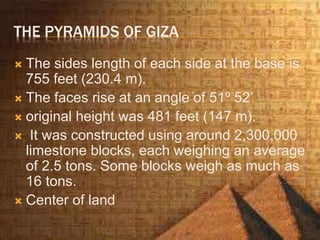
THE PYRAMIDS OF GIZA
 The sides length of each side at the base is
755 feet (230.4 m).
 The faces rise at an angle of 51º 52’
 original height was 481 feet (147 m).
 It was constructed using around 2,300,000
limestone blocks, each weighing an average
of 2.5 tons. Some blocks weigh as much as
16 tons.
 Center of land
KHAFRE
 Khufu’s son, Khafre (also known as
Chephren).
 His pyramid, on a nearby site at Giza,
appears taller than his father’s, but this is an
illusion;
 it is built on higher ground and was in fact,
originally at 447 .5 feet (136.4 m),
 33.5 feet (10.2 m) shorter than the Great
Pyramid.
 It represents Ra-Harakhte, the sun god,
 as he rises in the east at dawn
 but the face of the Sphinx is a portrait of
Khafre himself,
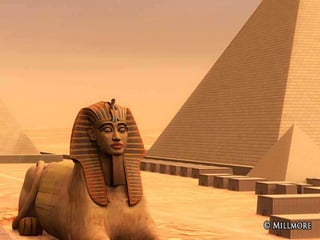
THE GREAT SPHINX
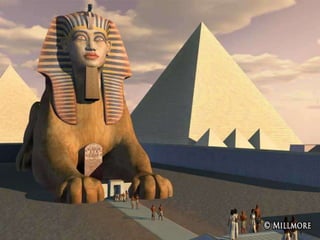
 The Great Sphinx has the body of a lion and the face of a man.
 It is a giant limestone sculpture in the Giza Plateau near modern Cairo,
Egypt,
 measuring 73.5 m. in length by 20 m. in height.
 The Great Sphinx is the earliest known monumental sculpture.
 The statue has been missing its nose since at least Napoleonic times.
 Probably helping to preserve it, the sphinx was nearly buried in sand.
 The sphinx stands in the Egyptian necropolis at Giza that contains the 3
monumental pyramids:
 the Great Pyramid of Khufu (Cheops),
 the Pyramid of Khufu's son Khafra (Chephren),
 the pyramid of Khufu's grandson Menkaure (Mycerinus).
 It is believed the Great Sphinx's head was modeled on Pharaoh Khafra.
MENKAURA 2532-2503 BC
 Khafre’s son, Menkaura built the third
pyramid at the Giza necropolis .
 With an original height of 228 feet (70 m),
 it is less than half the height of the pyramid
built by his grandfather, Khufu.
 The lower layers consist of red building
material from Aswan and the upper courses
were originally made of polished white
marble.
VALLEY OF KINGS
 Valley of the Kings, Arabic Wādī Al-Mulūk,
long, narrow defile just west of the Nile River in
Upper Egypt.
 part of the ancient city of Thebes
 was the burial site of almost all the kings
(pharaohs) of the 18th, 19th, and 20th dynasties
(1539–1075 bce), from Thutmose I to Ramses
X.
 Located in the hills behind Dayr al-Baḥrī,
 the 62 known tombs exhibit variety both in plan
and in decoration.
 At the end of the corridor is a burial chamber
with a stone coffin in which the royal mummy
was laid
 store chambers around which furniture and
equipment were stacked
 The walls covered with sculptured and
 painted scenes depicting the dead king in the
presence of divinity, the kings use in the next
world.
 Some were present but few were robbed by new
kingdom.
 In the 1st century bce, Greek travelors visited 40 of
the tombs.
 The wonderful treasures that were exhumed from
Tutankhamen’s tomb in 1922 and that now reside in
the Egyptian Museum in Cairo vividly indicate how
rich the burial of a great pharaoh of the empire’s
heyday must have been.
VALLEY OF QUEENS
 Valley of the Queens, Wādī al-Harīm,
 in the hills along the western bank of the Nile
River in Upper Egypt.
 It was part of ancient Thebes and served as
the burial site of the queens and some royal
children of the 19th and 20th dynasties
(1292–1075 bc).
 more than 90 known tombs,
 The earliest may be that of Sitre, wife of
Ramses I.
 The most notable are those of Nefertari, the
favourite queen of Ramses II;
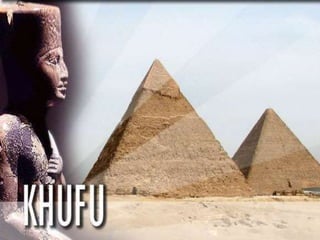
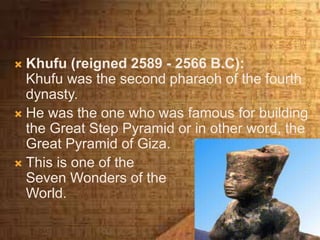
 Khufu (reigned 2589 - 2566 B.C):
Khufu was the second pharaoh of the fourth
dynasty.
 He was the one who was famous for building
the Great Step Pyramid or in other word, the
Great Pyramid of Giza.
 This is one of the
Seven Wonders of the
World.
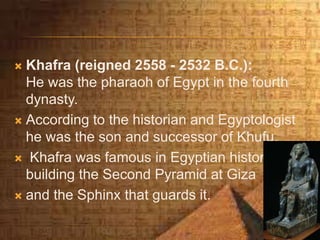
 Khafra (reigned 2558 - 2532 B.C.):
He was the pharaoh of Egypt in the fourth
dynasty.
 According to the historian and Egyptologist
he was the son and successor of Khufu.
 Khafra was famous in Egyptian history for
building the Second Pyramid at Giza
 and the Sphinx that guards it.
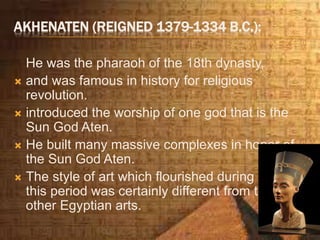
AKHENATEN (REIGNED 1379-1334 B.C.):
He was the pharaoh of the 18th dynasty,
 and was famous in history for religious
revolution.
 introduced the worship of one god that is the
Sun God Aten.
 He built many massive complexes in honor of
the Sun God Aten.
 The style of art which flourished during
this period was certainly different from the
other Egyptian arts.
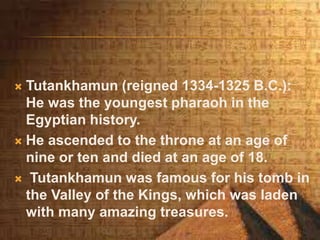
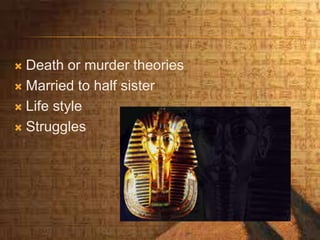
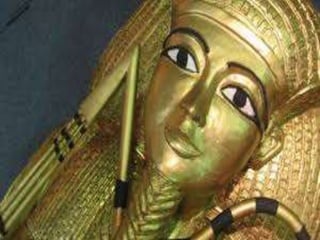
 Tutankhamun (reigned 1334-1325 B.C.):
He was the youngest pharaoh in the
Egyptian history.
 He ascended to the throne at an age of
nine or ten and died at an age of 18.
 Tutankhamun was famous for his tomb in
the Valley of the Kings, which was laden
with many amazing treasures.
 Death or murder theories
 Married to half sister
 Life style
 Struggles
 Hatshepsut (reigned 1498-1483 B.C.):
She was the fifth pharaoh of the 18th dynasty.
 she was one of the most successful pharaohs.
 She reigned longer than any other women of the
Egyptian dynasty.
 she was very ambitious and had crowned herself as
the pharaoh of the Egypt.
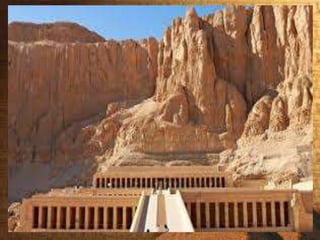
 The walls of her temple at Deir el-Bahri, show the
exotic tips of her famous trading expeditions in the
land of Punt.
CAIRO
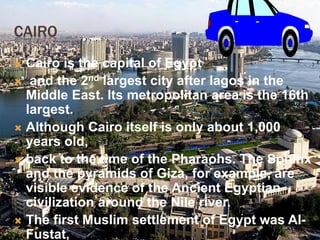
 Cairo is the capital of Egypt
 and the 2nd largest city after lagos in the
Middle East. Its metropolitan area is the 16th
largest.
 Although Cairo itself is only about 1,000
years old,
 back to the time of the Pharaohs. The Sphinx
and the pyramids of Giza, for example, are
visible evidence of the Ancient Egyptian
civilization around the Nile river.
 The first Muslim settlement of Egypt was Al-
Fustat,
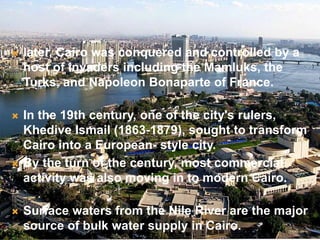
 later, Cairo was conquered and controlled by a
host of invaders including the Mamluks, the
Turks, and Napoleon Bonaparte of France.
 In the 19th century, one of the city's rulers,
Khedive Ismail (1863-1879), sought to transform
Cairo into a European- style city.
 By the turn of the century, most commercial
activity was also moving in to modern Cairo.
 Surface waters from the Nile River are the major
source of bulk water supply in Cairo.
ALEXANDRIA
 One of the largest cities of Egypt
 about 32 km (20 mi) along the coast of the
Mediterranean Sea in the north central part
of the country.
 It is also the largest city lying directly on the
Mediterranean coast.
 Alexandria is Egypt's largest seaport,
serving approximately 80% of Egypt's
imports and exports.
an important tourist resort.
Alexandria was founded in 331 BC by
Alexander the Great.
best known for the Lighthouse of Alexandria
one of the Seven Wonders of the Ancient
World; its Great Library is there
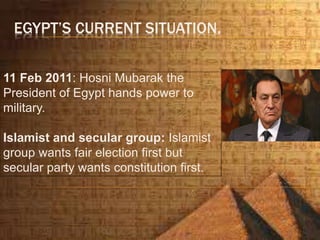
EGYPT’S CURRENT SITUATION.
11 Feb 2011: Hosni Mubarak the
President of Egypt hands power to
military.
Islamist and secular group: Islamist
group wants fair election first but
secular party wants constitution first.
 28 Nov 2011: Muslim Brotherhood
sweeps the election.
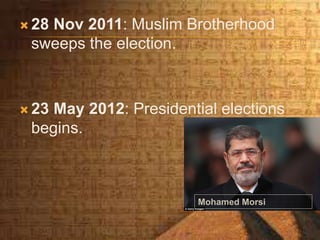
 23 May 2012: Presidential elections
begins.
Mohamed Morsi
 Nov 29 2012: Islamist finish first draft
constitution.
“Women, Christians, intellectuals, all these were sidelined in the
new constitution. They would say, ‘You can have liberty of
expression, freedom, etc. — if it is in conformity with Sharia.’”
4 Dec 2012: Egyptian march to
presidential palace.
- The next day islamists group attack on anti Mosri sit in,
sparking street battles which leaves at least 10 dead.
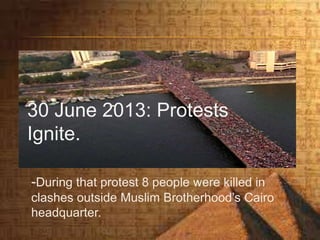
-During that protest 8 people were killed in
clashes outside Muslim Brotherhood’s Cairo
headquarter.
30 June 2013: Protests
Ignite.
 July 1 2013: Military give ultimatum.
-Sisi appears on national television ordering
Morsi to come up with a political solution
within 48 hours.
“I will not allow anyone to dispute my
legitimacy. This is unacceptable.
Unacceptable! Unacceptable!”
-President Mohamed
Mors
 July 3 2013: Military removes Morsi
from office.
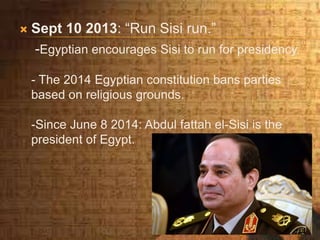
 Sept 10 2013: “Run Sisi run.”
-Egyptian encourages Sisi to run for presidency.
- The 2014 Egyptian constitution bans parties
based on religious grounds.
-Since June 8 2014: Abdul fattah el-Sisi is the
president of Egypt.
Thankyou

Egypt ppt sec b copy

  • 1.
  • 2.
  • 3.
     It's BeenThe Nile All The While  The geography of Egypt can be quite confusing because it's very much related to the Nile. In fact, ancient Egypt's other name is "The Nile Valley."
  • 4.
     Oh andwhat about the ancient Egyptian name for the Nile Valley you say?  It's called "Kemet", which means the black land.
  • 5.
     Why isit called the black land? That’s related to...  yes,  the Nile. It's always about the Egyptian Nile.
  • 6.
    THE ANCIENT EGYPTIANSTHOUGHT OF EGYPT AS BEING DIVIDED INTO TWO TYPES OF LAND
  • 8.
    “Red Land” •the barrendesert •protected Egypt •precious metals and semi-precious stones
  • 9.
     The NileRiver runs vertically through the middle and splits the land in two
  • 11.
     Egypt islocated in northern Africa along the Mediterranean and Red Seas and shares borders with Gaza Strip, Israel, Libya and Sudan. Egypt's boundaries also include the Sinai Peninsula
  • 13.
     The geographyof ancient Egypt is divided into 4 main parts, although there are many other subdivisions..
  • 14.
     First thereis the north and south. Lower Egypt is the northern part of the land and Upper Egypt is the southern part.
  • 16.
     The Nileruns from the source (which is in the south) up to the north and flows into the Mediterranean Sea. So the beginning part (upper part) of the Nile is in the south, and vice versa...
  • 17.
     It originatesin Burunndi, south of the equator, and flows northward through northeastern Africa, eventually flowing through Egypt and finally draining into the Mediterranean Sea  ...And as you now know, Egypt is all about the Nile.
  • 19.
     The otherdivision of the geography of Egypt is (I hate to say it) also related to the Nile. We've got the east and west banks of the Nile River.
  • 20.
     The ancientEgyptians thought of the east bank as "the land of the living“  They thought of the west bank as "the land of the dead“
  • 21.
     Other thanthese 4 main divisions, there were 42 nomes, or provinces. 22 of them were in Upper Egypt, 20 in Lower Egypt. The ancient Egyptians called these nomes "sepat".  Each nome had a mayor, a local temple, a capital, a deity and religious beliefs and rituals.
  • 22.
     There wereno flags to represent all the different nomes however, but there were staffs with the local deity's statue for each.  As for Upper Egypt, it was represented by the white crown, the sedge and the Goddess Nekhbet.
  • 24.
     Lower Egyptwas represented by the red crown, the bee and the Goddess Wadjet.
  • 25.
  • 26.
     Agriculture wasmain economic activity for Egyptian.  They built dykes, tanks and canals for storing water and irrigating land.
  • 28.
    •The main cropsof ancient egypt were wheat and Barley, lettuce, beans, onions figs, dates, grapes melon and cucumber. •They used to grow flax.
  • 29.
     There wasno typical money system in egypt.  Trade around Mediterranean sea and red sea  Cairo is financial center of egypt.
  • 30.
  • 32.
    •Egyptian religion wasbased on polytheism. •Akhnaton introduced the concept of monotheism among them.
  • 33.
  • 34.
  • 35.
  • 36.
  • 37.
  • 38.
  • 39.
    Slaves Works in mines,quarries and in temples
  • 41.
    Heiroglyphs Greek word Heiro =sacred Glypho = inscription •Writing in Egypt have been dated to 3400 BC
  • 42.
    •Latest dated inscriptionin heiroglyphs was made on the gate post of a temple at philae in 396 A.D.
  • 44.
    RIVER NILE  Thelongest river in the world.  Nile River, Arabic Baḥr Al-Nīl or Nahr Al- Nīl, river, the father of African rivers.  It rises south of the Equator and flows northward through northeastern Africa to drain into the Mediterranean Sea.
  • 45.
    NILE  It hasa length of about 4,132 miles (6,650 kilometres) and drains an area estimated at 1,293,000 square miles (3,349,000 square kilometres).  Its basin includes parts of Tanzania, Burundi, Rwanda, the Democratic Republic of the Congo, Kenya, Uganda, South Sudan, Ethiopia, Sudan, and the cultivated part of Egypt.
  • 46.
    PYRAMIDS  a monumentalstructure with a square or triangular base  final resting place  belief that pharaoh will be united with sun,  138 pyramids
  • 47.
    PYRAMIDS  Sneferu’s Pyramids Khufu – 2575-2566 BC  Khafre 2558–2532 BC  Menkaura 2532-2503 BC
  • 48.
    SNEFERU’S PYRAMIDS  Thefourth-dynasty king, Sneferu 2686 – 2667 BC,  was the first to create the pyramid shape  built three pyramids  first two were glorious failures.
  • 49.
    SNEFERU  first, thepyramid at Medium,  step pyramid  it was unstable and the limestone blocks began to slip.
  • 50.
    SNEFERU  King Sneferuthen moved to Dahshur  built a second pyramid,  which we now know as the “Bent Pyramid”  because its upper part rises at a shallower angle of incline than the lower part.  angle of incline was decreased from 54º 31’ 13’’ to 43º 21’.  But the bent pyramid was never used.
  • 51.
    SNEFERU  Sneferu begana third pyramid about a mile way.  This one is called the red pyramid  because of the red limestone blocks used in its construction.  It became the world’s first successful true pyramid.
  • 52.
     1Medum pyramidsurrounded by rubble – 2The Bent Pyramid –3 The Red Pyramid.
  • 53.
    THE PYRAMIDS OFGIZA  Sneferu set the standard.  included burial chambers,  a mortuary temple,  a causeway leading down to a valley temple.  model followed by his son, Khufu, who built the first and largest pyramid at Giza.  The Giza pyramids on the west bank of the Nile in northern Egypt.
  • 54.
    THE PYRAMIDS OFGIZA  The sides length of each side at the base is 755 feet (230.4 m).  The faces rise at an angle of 51º 52’  original height was 481 feet (147 m).  It was constructed using around 2,300,000 limestone blocks, each weighing an average of 2.5 tons. Some blocks weigh as much as 16 tons.  Center of land
  • 56.
    KHAFRE  Khufu’s son,Khafre (also known as Chephren).  His pyramid, on a nearby site at Giza, appears taller than his father’s, but this is an illusion;  it is built on higher ground and was in fact, originally at 447 .5 feet (136.4 m),  33.5 feet (10.2 m) shorter than the Great Pyramid.
  • 57.
     It representsRa-Harakhte, the sun god,  as he rises in the east at dawn  but the face of the Sphinx is a portrait of Khafre himself,
  • 59.
    THE GREAT SPHINX The Great Sphinx has the body of a lion and the face of a man.  It is a giant limestone sculpture in the Giza Plateau near modern Cairo, Egypt,  measuring 73.5 m. in length by 20 m. in height.  The Great Sphinx is the earliest known monumental sculpture.  The statue has been missing its nose since at least Napoleonic times.  Probably helping to preserve it, the sphinx was nearly buried in sand.  The sphinx stands in the Egyptian necropolis at Giza that contains the 3 monumental pyramids:  the Great Pyramid of Khufu (Cheops),  the Pyramid of Khufu's son Khafra (Chephren),  the pyramid of Khufu's grandson Menkaure (Mycerinus).  It is believed the Great Sphinx's head was modeled on Pharaoh Khafra.
  • 61.
    MENKAURA 2532-2503 BC Khafre’s son, Menkaura built the third pyramid at the Giza necropolis .  With an original height of 228 feet (70 m),  it is less than half the height of the pyramid built by his grandfather, Khufu.  The lower layers consist of red building material from Aswan and the upper courses were originally made of polished white marble.
  • 63.
    VALLEY OF KINGS Valley of the Kings, Arabic Wādī Al-Mulūk, long, narrow defile just west of the Nile River in Upper Egypt.  part of the ancient city of Thebes  was the burial site of almost all the kings (pharaohs) of the 18th, 19th, and 20th dynasties (1539–1075 bce), from Thutmose I to Ramses X.  Located in the hills behind Dayr al-Baḥrī,  the 62 known tombs exhibit variety both in plan and in decoration.
  • 65.
     At theend of the corridor is a burial chamber with a stone coffin in which the royal mummy was laid  store chambers around which furniture and equipment were stacked  The walls covered with sculptured and  painted scenes depicting the dead king in the presence of divinity, the kings use in the next world.
  • 66.
     Some werepresent but few were robbed by new kingdom.  In the 1st century bce, Greek travelors visited 40 of the tombs.  The wonderful treasures that were exhumed from Tutankhamen’s tomb in 1922 and that now reside in the Egyptian Museum in Cairo vividly indicate how rich the burial of a great pharaoh of the empire’s heyday must have been.
  • 67.
    VALLEY OF QUEENS Valley of the Queens, Wādī al-Harīm,  in the hills along the western bank of the Nile River in Upper Egypt.  It was part of ancient Thebes and served as the burial site of the queens and some royal children of the 19th and 20th dynasties (1292–1075 bc).
  • 68.
     more than90 known tombs,  The earliest may be that of Sitre, wife of Ramses I.  The most notable are those of Nefertari, the favourite queen of Ramses II;
  • 70.
     Khufu (reigned2589 - 2566 B.C): Khufu was the second pharaoh of the fourth dynasty.  He was the one who was famous for building the Great Step Pyramid or in other word, the Great Pyramid of Giza.  This is one of the Seven Wonders of the World.
  • 71.
     Khafra (reigned2558 - 2532 B.C.): He was the pharaoh of Egypt in the fourth dynasty.  According to the historian and Egyptologist he was the son and successor of Khufu.  Khafra was famous in Egyptian history for building the Second Pyramid at Giza  and the Sphinx that guards it.
  • 72.
    AKHENATEN (REIGNED 1379-1334B.C.): He was the pharaoh of the 18th dynasty,  and was famous in history for religious revolution.  introduced the worship of one god that is the Sun God Aten.  He built many massive complexes in honor of the Sun God Aten.  The style of art which flourished during this period was certainly different from the other Egyptian arts.
  • 73.
     Tutankhamun (reigned1334-1325 B.C.): He was the youngest pharaoh in the Egyptian history.  He ascended to the throne at an age of nine or ten and died at an age of 18.  Tutankhamun was famous for his tomb in the Valley of the Kings, which was laden with many amazing treasures.
  • 74.
     Death ormurder theories  Married to half sister  Life style  Struggles
  • 75.
     Hatshepsut (reigned1498-1483 B.C.): She was the fifth pharaoh of the 18th dynasty.  she was one of the most successful pharaohs.  She reigned longer than any other women of the Egyptian dynasty.  she was very ambitious and had crowned herself as the pharaoh of the Egypt.  The walls of her temple at Deir el-Bahri, show the exotic tips of her famous trading expeditions in the land of Punt.
  • 76.
    CAIRO  Cairo isthe capital of Egypt  and the 2nd largest city after lagos in the Middle East. Its metropolitan area is the 16th largest.  Although Cairo itself is only about 1,000 years old,  back to the time of the Pharaohs. The Sphinx and the pyramids of Giza, for example, are visible evidence of the Ancient Egyptian civilization around the Nile river.  The first Muslim settlement of Egypt was Al- Fustat,
  • 77.
     later, Cairowas conquered and controlled by a host of invaders including the Mamluks, the Turks, and Napoleon Bonaparte of France.  In the 19th century, one of the city's rulers, Khedive Ismail (1863-1879), sought to transform Cairo into a European- style city.  By the turn of the century, most commercial activity was also moving in to modern Cairo.  Surface waters from the Nile River are the major source of bulk water supply in Cairo.
  • 78.
    ALEXANDRIA  One ofthe largest cities of Egypt  about 32 km (20 mi) along the coast of the Mediterranean Sea in the north central part of the country.  It is also the largest city lying directly on the Mediterranean coast.  Alexandria is Egypt's largest seaport, serving approximately 80% of Egypt's imports and exports.
  • 79.
    an important touristresort. Alexandria was founded in 331 BC by Alexander the Great. best known for the Lighthouse of Alexandria one of the Seven Wonders of the Ancient World; its Great Library is there
  • 80.
    EGYPT’S CURRENT SITUATION. 11Feb 2011: Hosni Mubarak the President of Egypt hands power to military. Islamist and secular group: Islamist group wants fair election first but secular party wants constitution first.
  • 81.
     28 Nov2011: Muslim Brotherhood sweeps the election.  23 May 2012: Presidential elections begins. Mohamed Morsi
  • 82.
     Nov 292012: Islamist finish first draft constitution. “Women, Christians, intellectuals, all these were sidelined in the new constitution. They would say, ‘You can have liberty of expression, freedom, etc. — if it is in conformity with Sharia.’” 4 Dec 2012: Egyptian march to presidential palace. - The next day islamists group attack on anti Mosri sit in, sparking street battles which leaves at least 10 dead.
  • 83.
    -During that protest8 people were killed in clashes outside Muslim Brotherhood’s Cairo headquarter. 30 June 2013: Protests Ignite.
  • 84.
     July 12013: Military give ultimatum. -Sisi appears on national television ordering Morsi to come up with a political solution within 48 hours. “I will not allow anyone to dispute my legitimacy. This is unacceptable. Unacceptable! Unacceptable!” -President Mohamed Mors  July 3 2013: Military removes Morsi from office.
  • 85.
     Sept 102013: “Run Sisi run.” -Egyptian encourages Sisi to run for presidency. - The 2014 Egyptian constitution bans parties based on religious grounds. -Since June 8 2014: Abdul fattah el-Sisi is the president of Egypt.
  • 86.